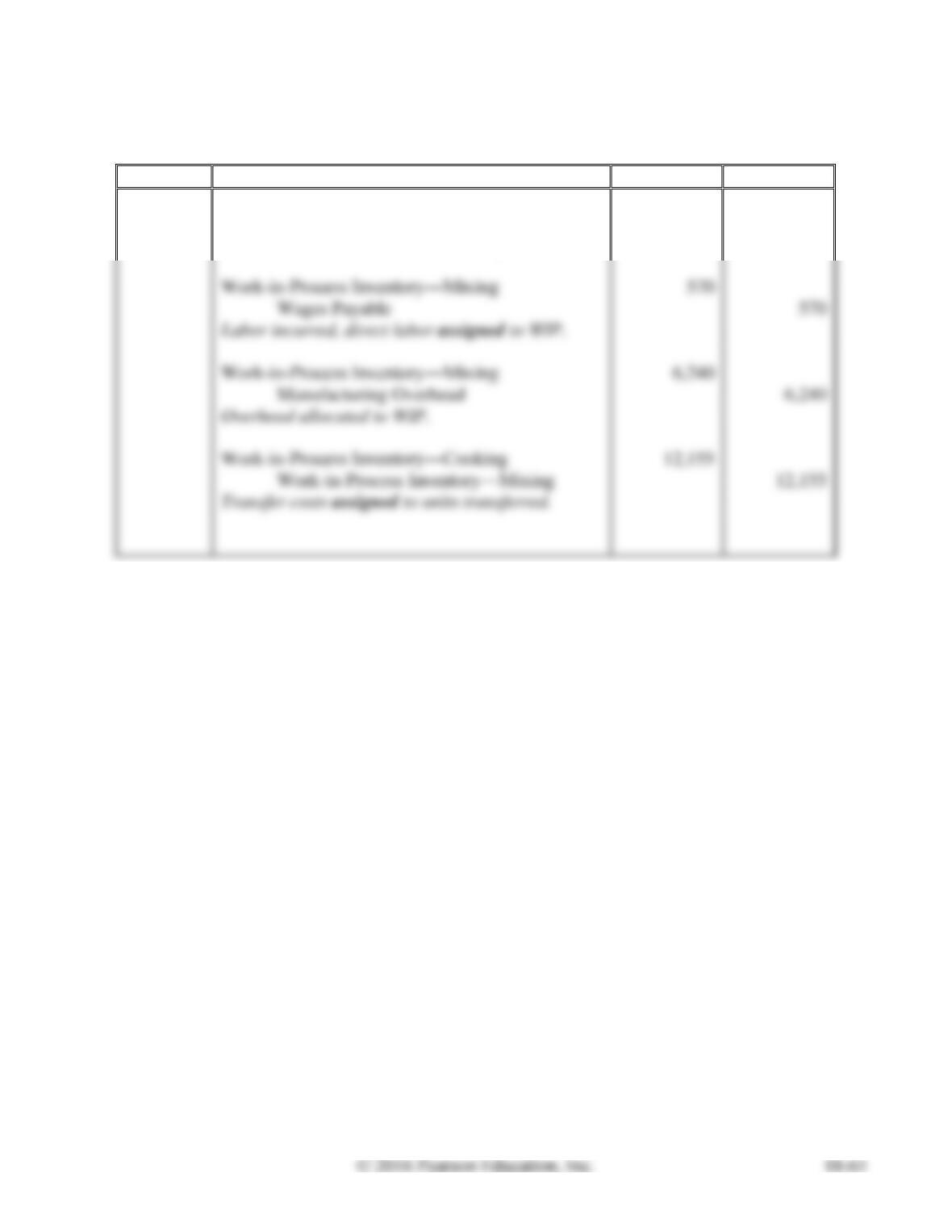
P18-37B, cont.
Requirement 2
Date
Accounts and Explanation
Debit
Credit
Sep. 30
Work-in–Process Inventory―Mixing
5,675
Raw Materials Inventory
5,675
Materials used, direct materials assigned to WIP.
Work-in–Process Inventory―Mixing
Wages Payable
Work-in–Process Inventory―Mixing
6,240
Manufacturing Overhead
6,240
Work-in–Process Inventory―Cooking
P18-38B Preparing a production cost report, two materials added at different points, no beginning
WIP or costs transferred in; journal entries
Learning Objectives 2, 3, 4
1. Total cost per EUP $2.26
3. WIP Balance $1,836
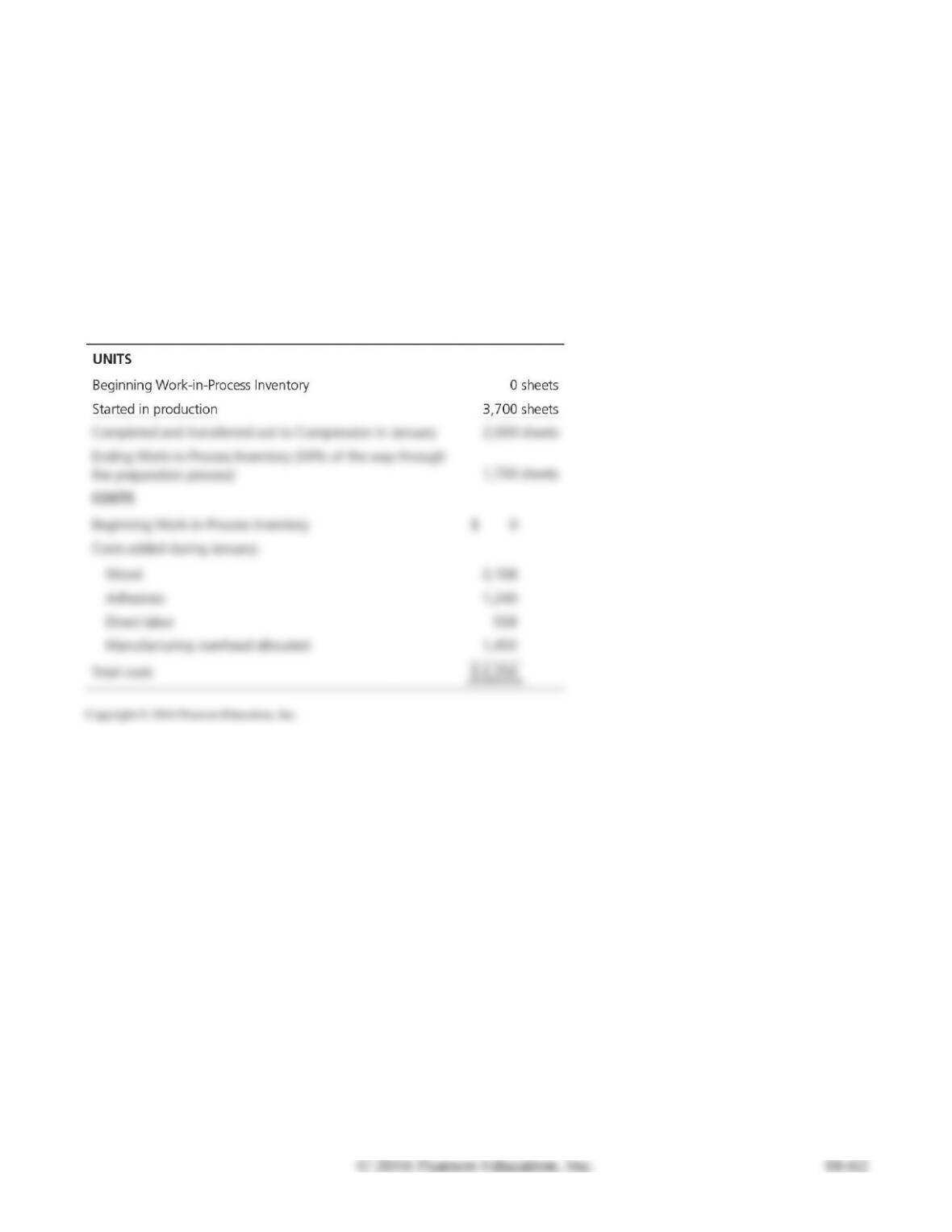
John’s Exteriors produces exterior siding for homes. The Preparation Department begins with wood,
which is chopped into small bits. At the end of the process, an adhesive is added. Then the
wood/adhesive mixture goes on to the Compression Department, where the wood is compressed into
sheets. Conversion costs are added evenly throughout the preparation process. January data for the
Preparation Department are as follows:
Requirements
1. Prepare a production cost report for the Preparation Department for January. (Hint: Each direct
material added at a different point in the production process requires its own equivalent unit of
production computation.)
2. Prepare the journal entry to record the cost of the sheets completed and transferred out to the
Compression Department.
3. Post the journal entries to the Work-in-Process Inventory—Preparation T-account. What is the
ending balance?
SOLUTION
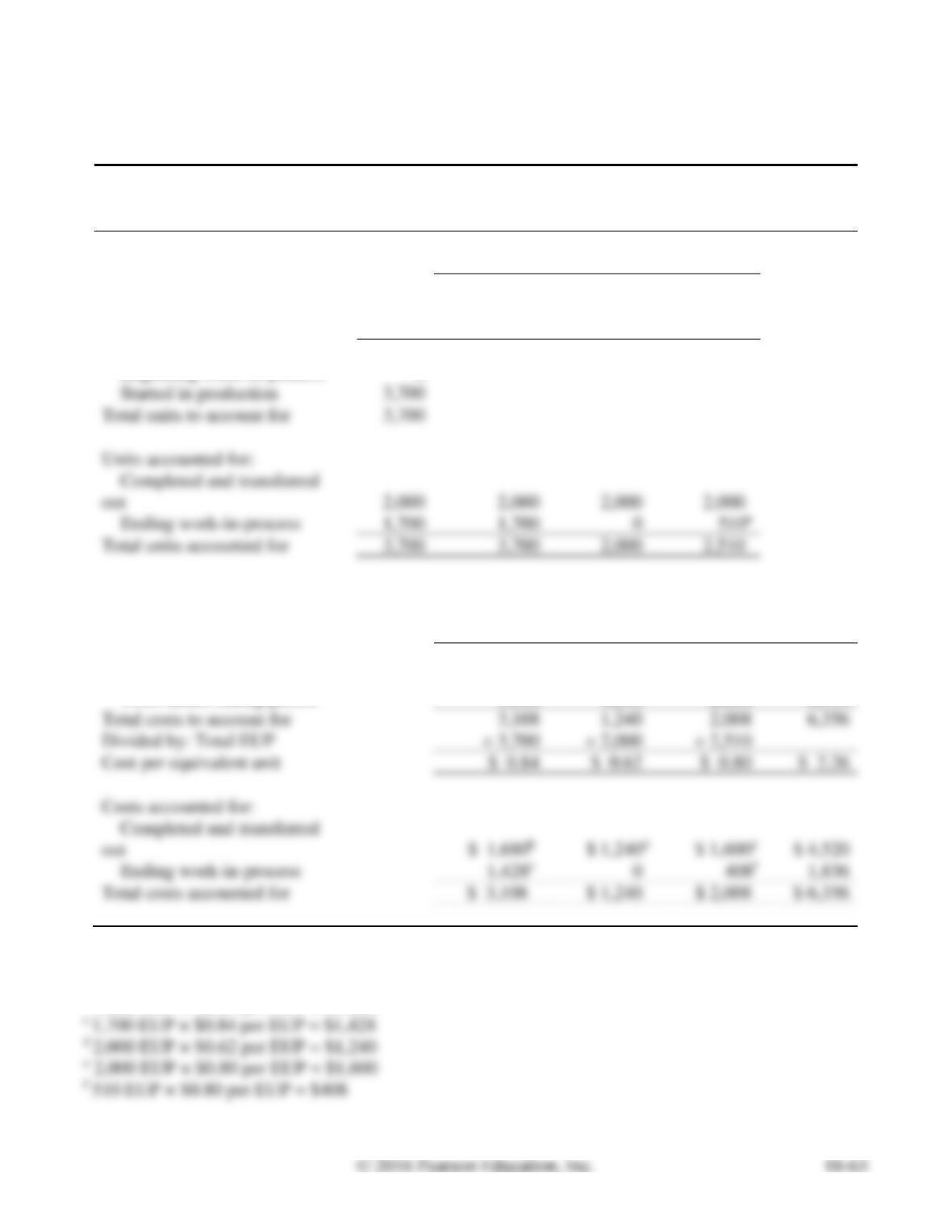
Requirement 1
JOHN’S EXTERIORS
Production Cost Report―PREPARATION DEPARTMENT
Month Ended January 31, 20XX
Equivalent Units
UNITS
Whole
Units
Direct
Materials–
Wood
Direct
Materials–
Adhesive
Conversion
Costs
Units to account for:
Beginning work-in-process
0
Started in production
Total units to account for
Units accounted for:
out
2,000
2,000
Ending work-in-process
1,700
Total units accounted for
3,700
2,000
COSTS
Direct
Materials–
Wood
Direct
Materials–
Adhesive
Conversion
Costs
Total
Costs
Costs to account for:
Beginning work-in-process
$ 0
$ 0
$ 0
$ 0
Costs added during period
3,108
1,240
2,008
6,356
Total costs to account for
3,108
1,240
Divided by: Total EUP
Cost per equivalent unit
Costs accounted for:
out
$ 4,520
Ending work-in-process
1,836
Total costs accounted for
$ 2,008
$ 6,356
a 1,700 × 30% = 510
b 2,000 EUP × $0.84 per EUP = $1,680
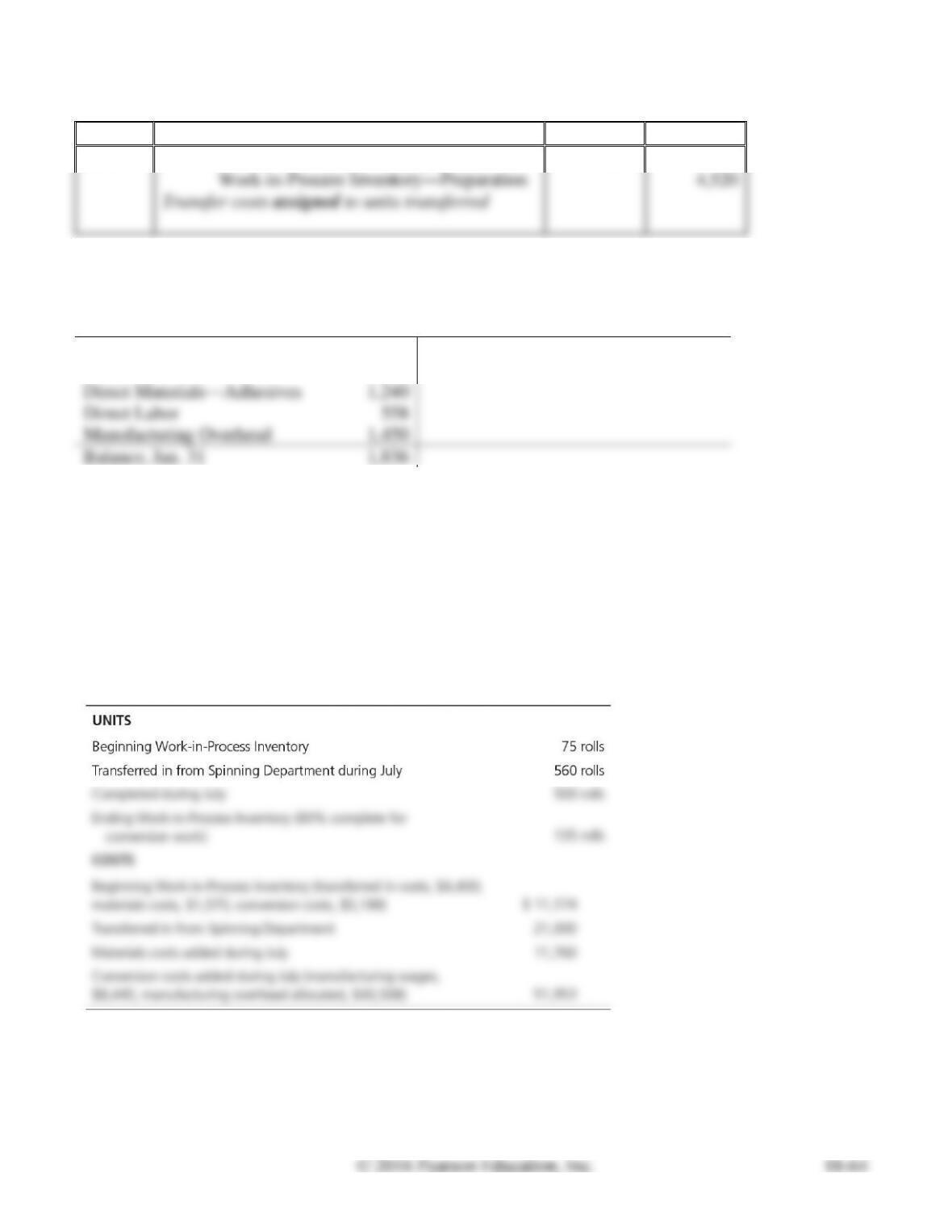
Requirement 2
Date
Accounts and Explanation
Debit
Credit
Jan. 31
Work-in–Process Inventory―Compression
4,520
4,520
Requirement 3
Work-in-Process―Preparation
Balance, Jan. 1
0
4,520
Transferred to Compression
Direct Materials––Wood
3,108
Direct Materials––Adhesives
1,240
Direct Labor
Manufacturing Overhead
1,450
Balance, Jan. 31
1,836
P18-39B Preparing a production cost report, second department with beginning WIP; journal
entries
Learning Objectives 2, 3, 4
1. Cost per EUP DM $21.00
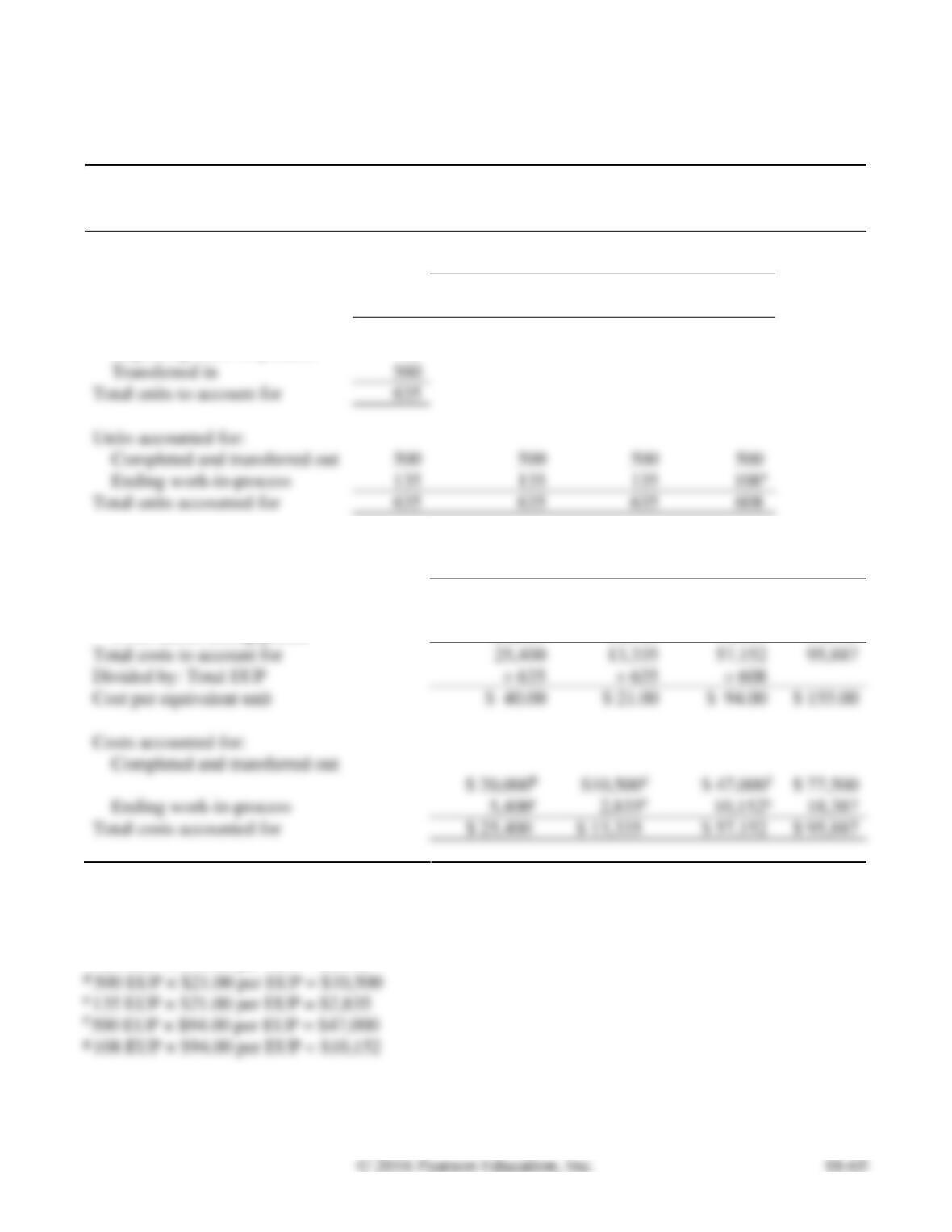
Carrie Carpet manufactures broadloom carpet in seven processes: spinning, dyeing, plying, spooling,
tufting, latexing, and shearing. In the Dyeing Department, direct materials (dye) are added at the
beginning of the process. Conversion costs are incurred evenly throughout the process. Information for
July 2016 follows:
Requirements
1. Prepare a production cost report for Carrie’s Dyeing Department for July.
2. Journalize all transactions affecting Carrie’s Dyeing Department during July, including the entries
that have already been posted.
SOLUTION
Requirement 1
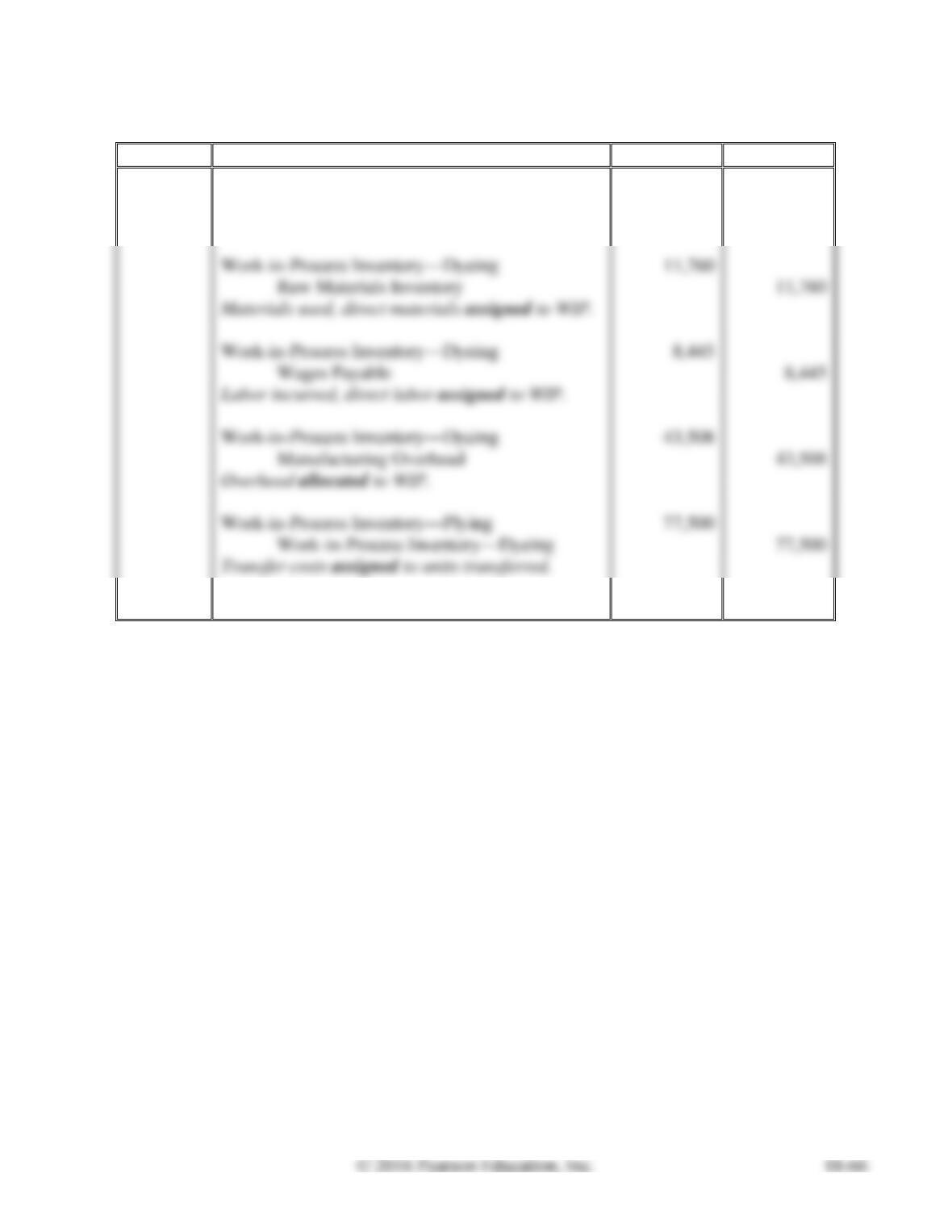
CARRIE CARPET
Production Cost Report―DYEING DEPARTMENT
Month Ended July 31, 2016
Equivalent Units
UNITS
Whole
Units
Transferred
In
Direct
Materials
Conversion
Costs
Units to account for:
Beginning work-in-process
75
Transferred in
Total units to account for
Units accounted for:
Completed and transferred out
Ending work-in-process
Total units accounted for
COSTS
Transferred
In
Direct
Materials
Conversion
Costs
Total
Costs
Costs to account for:
Beginning work-in-process
$ 4,400
$ 1,575
$ 5,199
$ 11,174
Costs added during period
21,000
11,760
51,953
84,713
Total costs to account for
25,400
13,335
57,152
Divided by: Total EUP
Cost per equivalent unit
$ 40.00
$ 21.00
$ 94.00
$ 155.00
Costs accounted for:
$ 77,500
Ending work-in-process
18,387
Total costs accounted for
$ 25,400
$ 13,335
$ 95,887
a 135 × 80% = 108
b 500 EUP × $40.00 per EUP = $20,000
c 135 EUP × $40.00 per EUP = $5,400
e 135 EUP × $21.00 per EUP = $2,835
g 108 EUP × $94.00 per EUP = $10,152
P18-39B, cont.
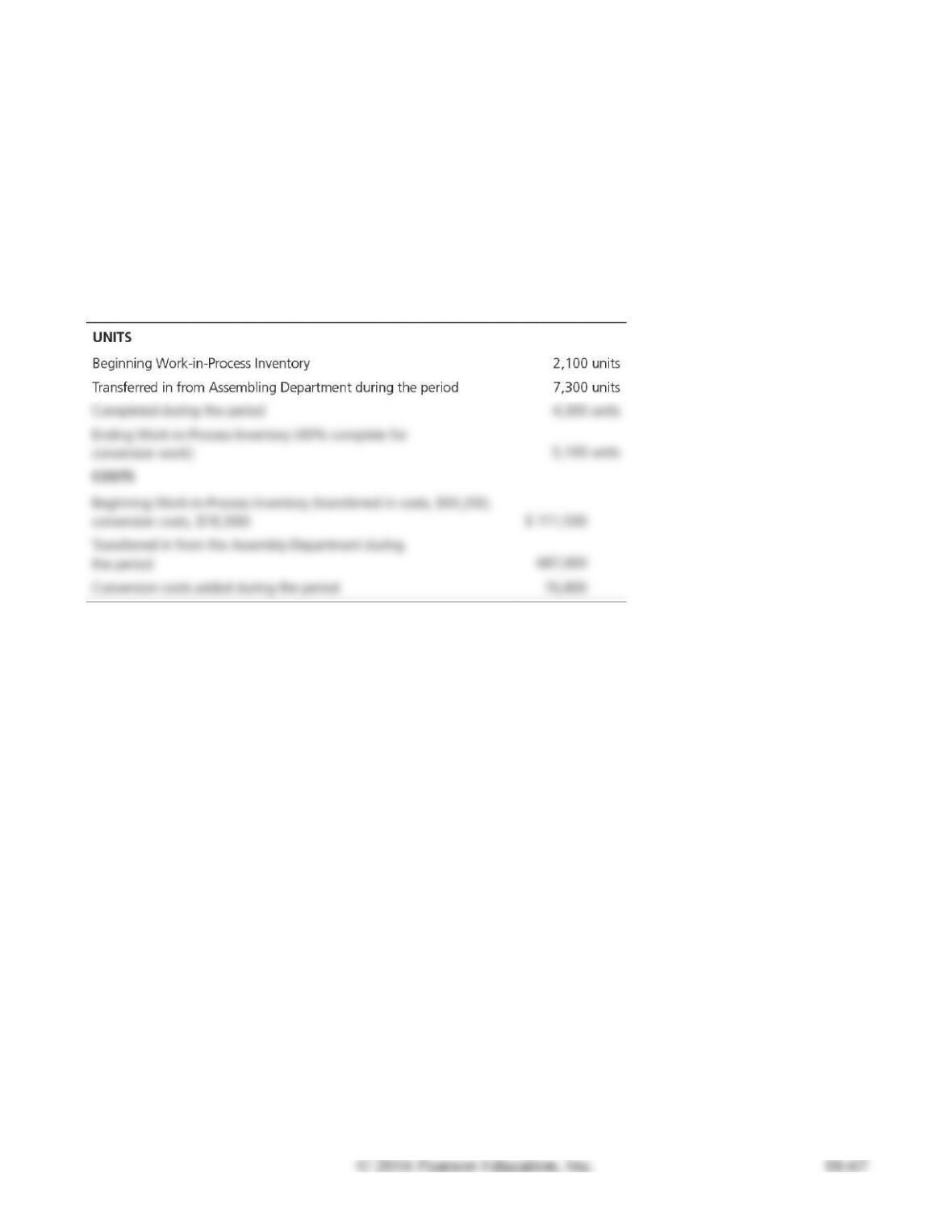
Requirement 2
Date
Accounts and Explanation
Debit
Credit
Jul. 31
Work-in–Process Inventory―Dyeing
21,000
Work-in–Process―Spinning
21,000
Transfer costs assigned to units transferred.
Work-in–Process Inventory―Dyeing
11,760
Raw Materials Inventory
11,760
Work-in–Process Inventory―Dyeing
Wages Payable
Labor incurred, direct labor assigned to WIP.
Work-in–Process Inventory―Dyeing
43,508
Manufacturing Overhead
43,508
Work-in–Process Inventory―Plying
77,500
Work-in–Process Inventory―Dyeing
77,500
Transfer costs assigned to units transferred.
P18-40B Preparing a production cost report, second department with beginning WIP; decision
making
Learning Objectives 2, 3, 5
1. Cost per EUP CC $15.00
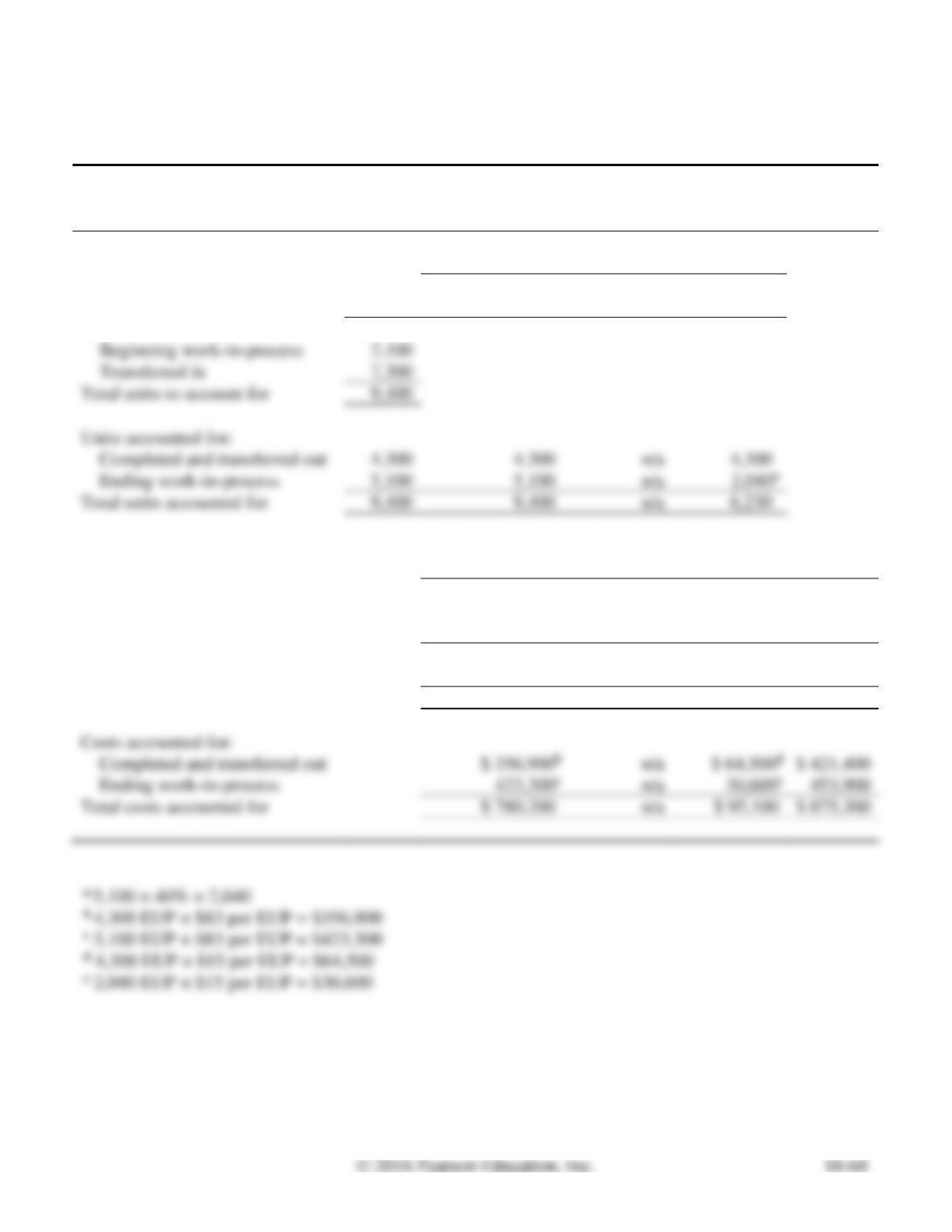
Lake Bound uses three processes to manufacture lifts for personal watercrafts: forming a lift’s parts
from galvanized steel, assembling the lift, and testing the completed lift. The lifts are transferred to
finished goods before shipment to marinas across the country.
Lake Bound’s Testing Department requires no direct materials. Conversion costs are incurred evenly
throughout the testing process. Other information follows for October 2016:
The cost transferred into Finished Goods Inventory is the cost of the lifts transferred out of the Testing
Department. Lake Bound uses weighted-average process costing.
Requirements
1. Prepare a production cost report for the Testing Department.
2. What is the cost per unit for lifts completed and transferred out to Finished Goods Inventory? Why
would management be interested in this cost?
SOLUTION
Requirement 1
LAKE BOUND
Production Cost Report―TESTING DEPARTMENT
Month Ended October 31, 2016
Equivalent Units
UNITS
Whole
Units
Transferred
In
Direct
Materials
Conversion
Costs
Units to account for:
Beginning work-in-process
Transferred in
Total units to account for
Units accounted for:
Completed and transferred out
n/a
Ending work-in-process
n/a
Total units accounted for
n/a
COSTS
Transferred
In
Direct
Materials
Conversion
Costs
Total
Costs
Costs to account for:
Beginning work-in-process
$ 93,200
n/a
$ 18,300
$ 111,500
Costs added during period
687,000
n/a
76,800
763,800
Total costs to account for
780,200
n/a
95,100
875,300
Divided by: Total EUP
÷ 9,400
n/a
÷ 6,340
Cost per equivalent unit
$ 83.00
n/a
$ 15.00
$ 98.00
Costs accounted for:
Completed and transferred out
n/a
$ 421,400
Ending work-in-process
n/a
453,900
Total costs accounted for
n/a
$ 95,100
$ 875,300
P18-40B, cont.
Requirement 2
Costs per lift
=
Total Costs
/
Units Completed and Transferred Out
=
$421,400
/
4,300 lifts
=
$98.00 average cost per lift
P18A-41B Preparing a production cost report, second department, with beginning WIP and
transferred in costs, FIFO method
Learning Objective 6
Appendix 18A
1. Cost per EUP CC $19.0000
Vuma, Inc. manufactures tire tubes in a two-stage process that includes assembly and sealing. The
Sealing Department tests the tubes and adds a puncture-resistant coating to each tube to prevent air
leaks.
The direct materials (coating) are added at the end of the sealing process.
Conversion costs are incurred evenly throughout the process. Work in process of the Sealing
Department on March 31, 2016, consisted of 400 tubes that were 30% of the way through the production
Requirements
1. Prepare a production cost report for the Sealing Department for April.
2. Journalize all transactions affecting the Sealing Department during April, including the entries that
have already been posted.
SOLUTION
Requirement 1
VUMA, INC.
Production Cost Report―SEALING DEPARTMENT
Month Ended April 30, 2016
Equivalent Units
UNITS
Whole
Units
Transferred
In
Direct
Materials
Conversion
Costs
Units to account for:
Beginning WIP
400
Started in production
3,000
Total units to account for
3,400
Units accounted for:
Beginning WIP
400
Started and completed
2,400
2,400
2,400
2,400
Transferred to FG
2,800
2,400
2,800
2,680
Ending WIP
600
Total units accounted for
3,400
3,000
2,800
3,160
COSTS
Transferred
In
Direct
Materials
Conversion
Costs
Total
Costs
Cost
per Unit
Costs to account for:
Beginning work-in-process
$ 10,500
$ 0
$ 17,300
$ 27,800
Costs added during period
48,000
22,400
60,040
130,440
Total costs to account for
58,500
22,400
77,340
158,240
Cost added during period
48,000
22,400
60,040
Divided by: Total EUP
÷ 3,160
Cost per equivalent unit
$ 16.0000
$ 8.0000
Costs accounted for:
Beginning WIP
$ 10,500
$ 0
Costs to complete beg. WIP
8,520
Total costs for beg. WIP
10,500
3,200
22,620
36,320
Started and completed
103,200
Transferred to FG
48,900
22,400
68,220
139,520
Ending WIP
18,720
Total costs accounted for
$ 58,500
$ 22,400
P18A-41B, cont.
Requirement 1, cont.
a 400 × 70% = 280
b 600 × 80% = 480
c 2,400 EUP × $16.0000 per EUP = $38,400
g 280 EUP × $19.0000 per EUP = $5,320
h 2,400 EUP × $19.0000 per EUP = $45,600
k $103,200 / 2,400 units = $43.0000 per unit
Requirement 2
Date
Accounts and Explanation
Debit
Credit
Apr. 30
Work-in–Process Inventory―Sealing
48,000
Work-in–Process―Assembly
48,000
Transfer costs assigned to units transferred.
Work-in–Process Inventory―Sealing
22,400
22,400
Work-in–Process Inventory―Sealing
19,850
19,850
Labor incurred, direct labor assigned to WIP.
Work-in–Process Inventory―Sealing
40,190
40,190
Finished Goods Inventory
Work-in–Process Inventory―Sealing
Transfer costs assigned to units transferred.

P18A-42B Preparing a production cost report, second department with beginning WIP; journal
entries
Learning Objective 6
Appendix 18A
1. Cost per EUP DM $21.0000
Work Problem P18-39B using the FIFO method. The Dyeing Department beginning work in process of
75 units is 80% complete as to conversion costs. Round equivalent unit costs to four decimal places.
SOLUTION
Requirement 1
CARRIE CARPET
Production Cost Report―DYEING DEPARTMENT
Month Ended July 31, 2016
Equivalent Units
UNITS
Whole
Units
Transferred
In
Direct
Materials
Conversion
Costs
Units to account for:
Beginning WIP
75
Started in production
Total units to account for
Units accounted for:
Beginning WIP
75
Started and completed
425
Transferred to Plying
440
Ending WIP
Total units accounted for
548
COSTS
Transferred
In
Direct
Materials
Conversion
Costs
Total
Costs
Cost
per Unit
Costs to account for:
Beginning work-in-process
$ 4,400
$ 1,575
$ 5,199
$ 11,174
Costs added during period
21,000
11,760
51,953
84,713
Total costs to account for
25,400
13,335
57,152
95,887
Cost added during period
21,000
11,760
51,953
84,713
Divided by: Total EUP
÷ 560
÷ 548
Cost per equivalent unit
$ 21.0000
Costs accounted for:
Beginning WIP
$ 11,174
Costs to complete beg. WIP
Total costs for beg. WIP
12,596
Started and completed
Transferred to Plying
20,338
10,500
46,913
77,751
Total costs accounted for
$ 25,401
P18A-42B, cont.
Requirement 1, cont.
a 75 × 20% = 15
b 135 × 80% = 108
c 425 EUP × $37.5000 per EUP = $15,938
d 135 EUP × $37.5000 per EUP = $5,063
e 425 EUP × $21.0000 per EUP = $8,925
g 15 EUP × $94.8047 per EUP = $1,422
h 425 EUP × $94.8047 per EUP = $40,292
k $65,155 / 425 units = $153.3059 per unit
Requirement 2
Date
Accounts and Explanation
Debit
Credit
Jul. 31
Work-in–Process Inventory―Dyeing
21,000
Work-in–Process―Spinning
21,000
Transfer costs assigned to units transferred.
Work-in–Process Inventory―Dyeing
11,760
11,760
Work-in–Process Inventory―Dyeing
Labor incurred, direct labor assigned to WIP.
Work-in-Process Inventory―Dyeing
43,508
43,508
Work-in–Process Inventory―Plying
77,751
Work-in–Process Inventory―Dyeing
77,751
Transfer costs assigned to units transferred.
CRITICAL THINKING
Decision Case 18-1
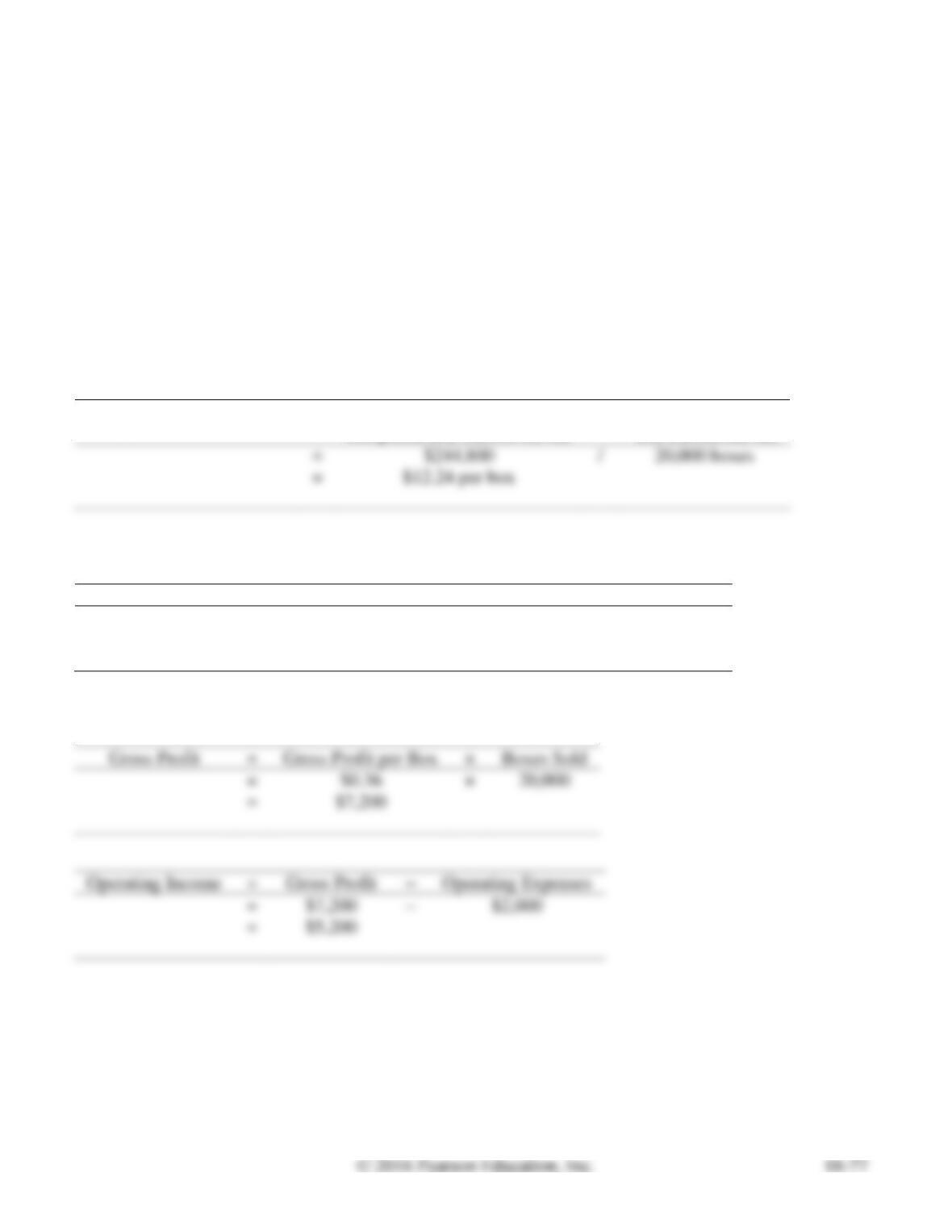
Billy Davidson operates Billy’s Worm Farm in Mississippi. Davidson raises worms for fishing. He sells
a box of 20 worms for $12.60. Davidson has invested $400,000 in the worm farm. He had hoped to earn
a 24% annual rate of return (net income divided by total assets), which works out to a 2% monthly
Requirements
Billy Davidson has the following questions about the farm’s performance during June.
1. What is the cost per box of worms sold? (Hint: This is the unit cost of the boxes completed and
shipped out of brooding.)
2. What is the gross profit per box?
3. How much operating income did Billy’s Worm Farm make in June?
4. What is the return on Davidson’s investment of $400,000 for the month of June? (Compute this as
June’s operating income divided by Davidson’s $400,000 investment, expressed as a percentage.)
5. What monthly operating income would provide a 2% monthly rate of return? What price per box
would Billy’s Worm Farm have had to charge in June to achieve a 2% monthly rate of return?
SOLUTION
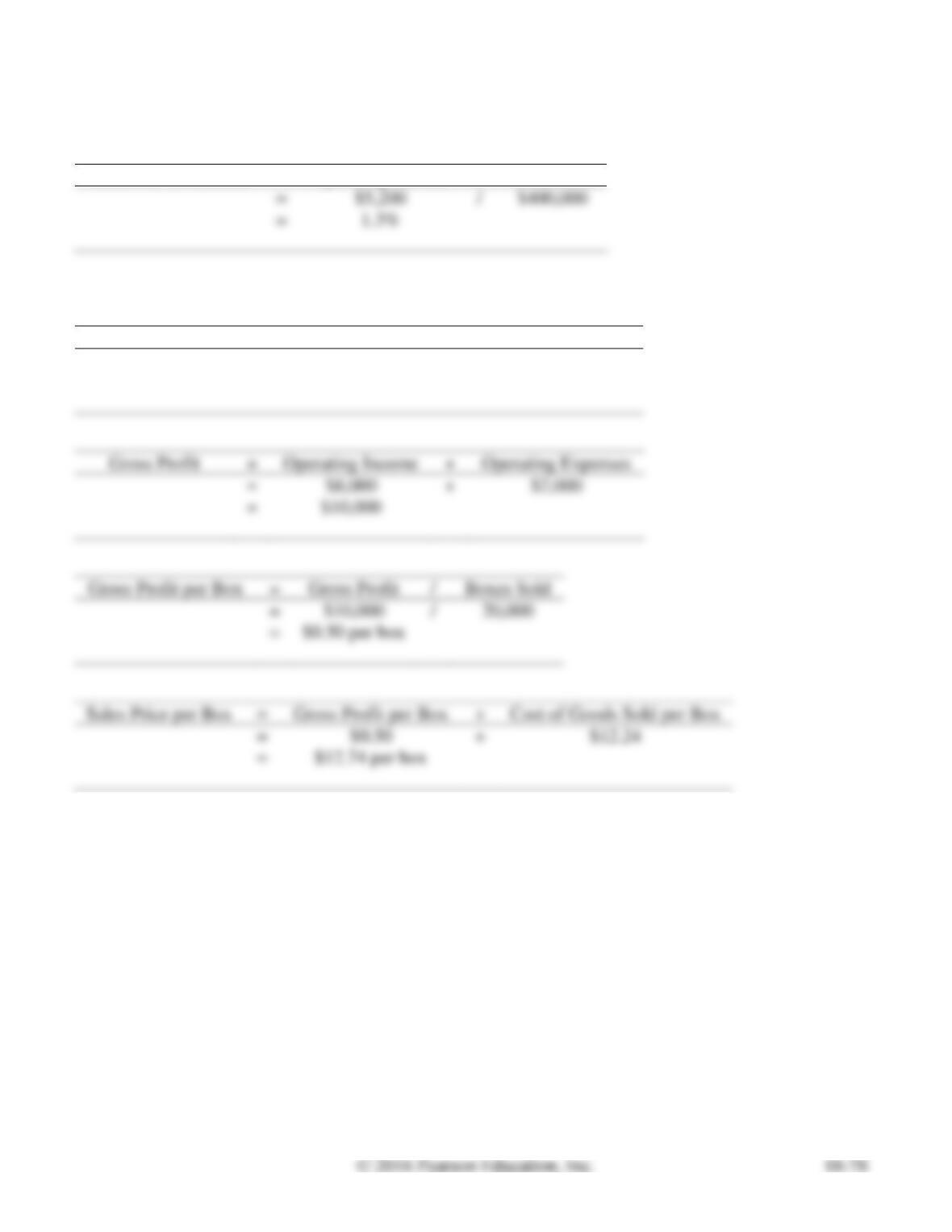
Requirement 1
Cost per box of worms sold
=
Total costs of boxes of worms
completed and transferred out
/
Units completed
and transferred out
=
=
Requirement 2
Gross Profit per Box
=
Sales Price per Box
–
Cost of Goods Sold per Box
=
$12.60
–
$12.24
=
$0.36
Requirement 3
=
Gross Profit per Box
Boxes Sold
=
=
Operating Income
=
–
Operating Expenses
=
–
=
Decision Case 18-1, cont.
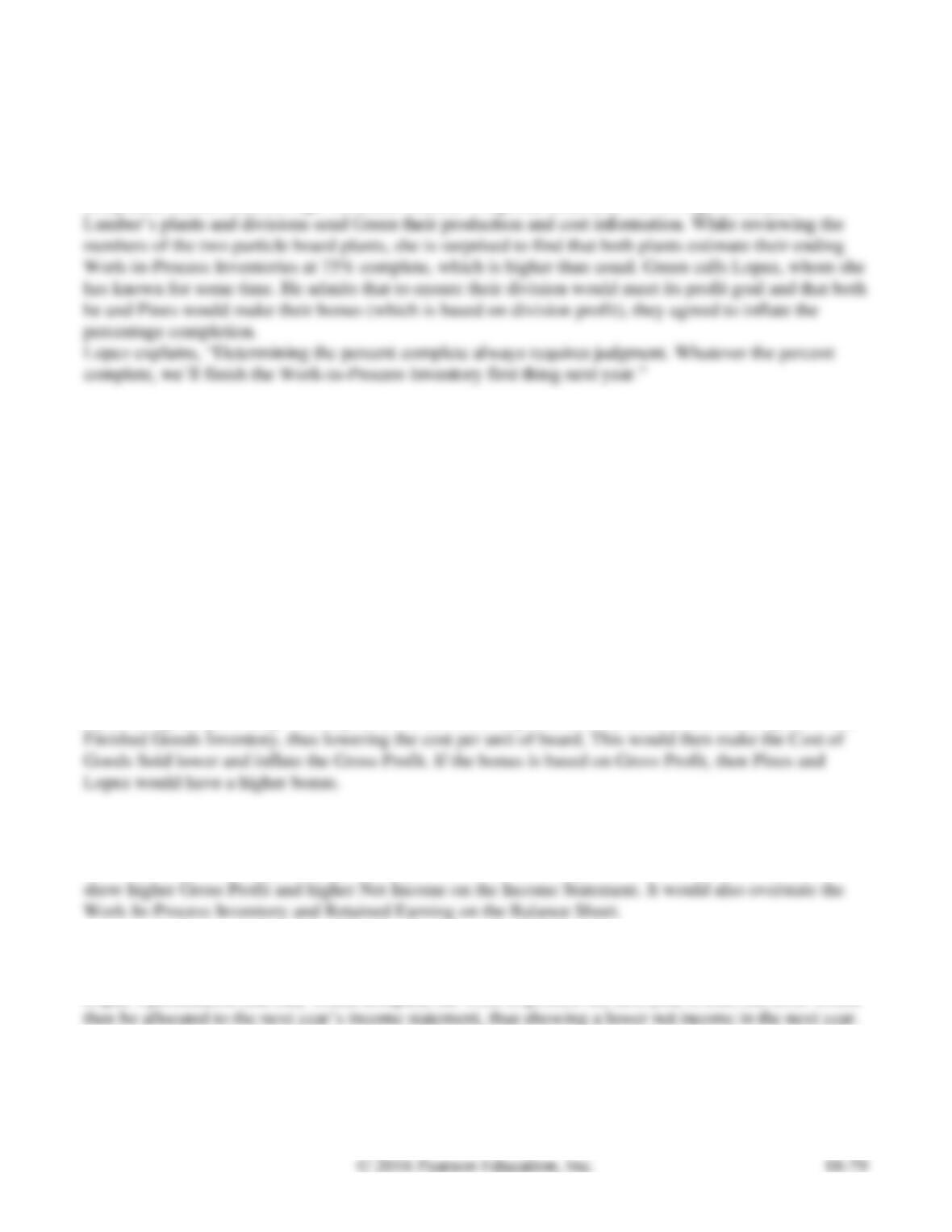
Requirement 4
Return on Investment
=
Operating Income
/
Investment
=
/
$400,000
=
Requirement 5
Operating Income
=
Investment
×
Return on Investment
=
$400,000
×
2.0%
=
$8,000
=
Operating Income
+
Operating Expenses
=
+
=
Gross Profit per Box
=
Boxes Sold
=
=
=
Gross Profit per Box
+
Cost of Goods Sold per Box
=
+
=
Ethical Issue 18-1
Rick Pines and Joe Lopez are the plant managers for High Mountain Lumber’s particle board division.
High Mountain Lumber has adopted a just-in-time management philosophy. Each plant combines wood
chips with chemical adhesives to produce particle board to order, and all product is sold as soon as it is
completed. Laura Green is High Mountain Lumber’s regional controller. All of High Mountain
Requirements
1. How would inflating the percentage completion of ending Work-in-Process Inventory help Pines and
Lopez get their bonus?
2. The particle board division is the largest of High Mountain Lumber’s divisions. If Green does not
correct the percentage completion of this year’s ending Work– in-Process Inventory, how will the
misstatement affect High Mountain Lumber’s financial statements?
3. Evaluate Lopez’s justification, including the effect, if any, on next year’s financial statements.
4. Address the following: What is the ethical issue? What are the options? What are the potential
consequences? What should Green do?
SOLUTION
Requirement 1
By inflating the percentage of completion for the work in process, fewer costs would be assigned to the
Requirement 2
The misstatement of the percentage of completion for the work in process will cause the company to
Requirement 3
Lopez’s justification that they would complete the work in process the next year is true, but costs would
Requirement 4
The ethical issue is the willingness to misstate information in order to earn a bonus. If Lopez and Pines