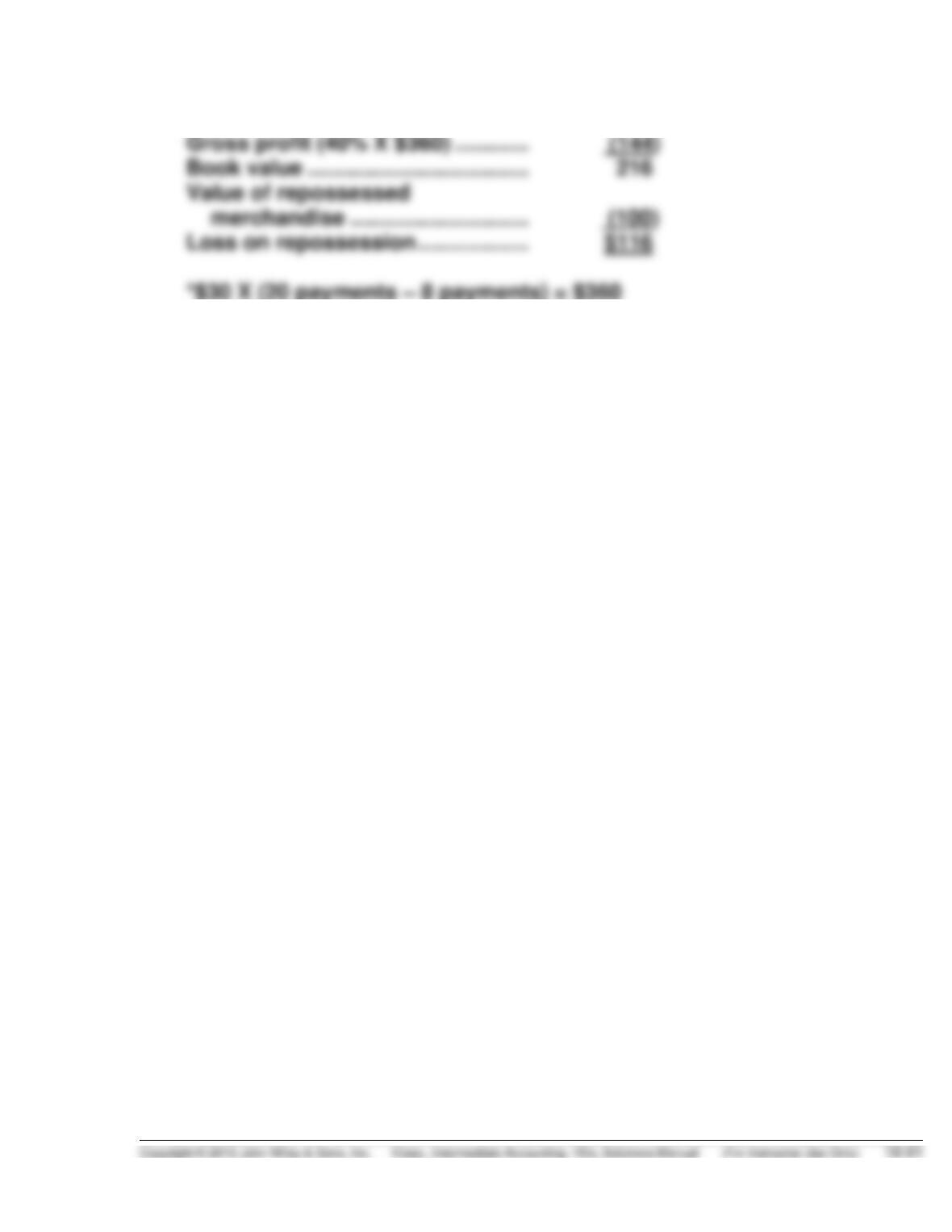
PROBLEM 18-13 (Continued)
Balance at repossession ………….. $360*
PROBLEM 18-14
(a) 1. SAPRANO COMPANY
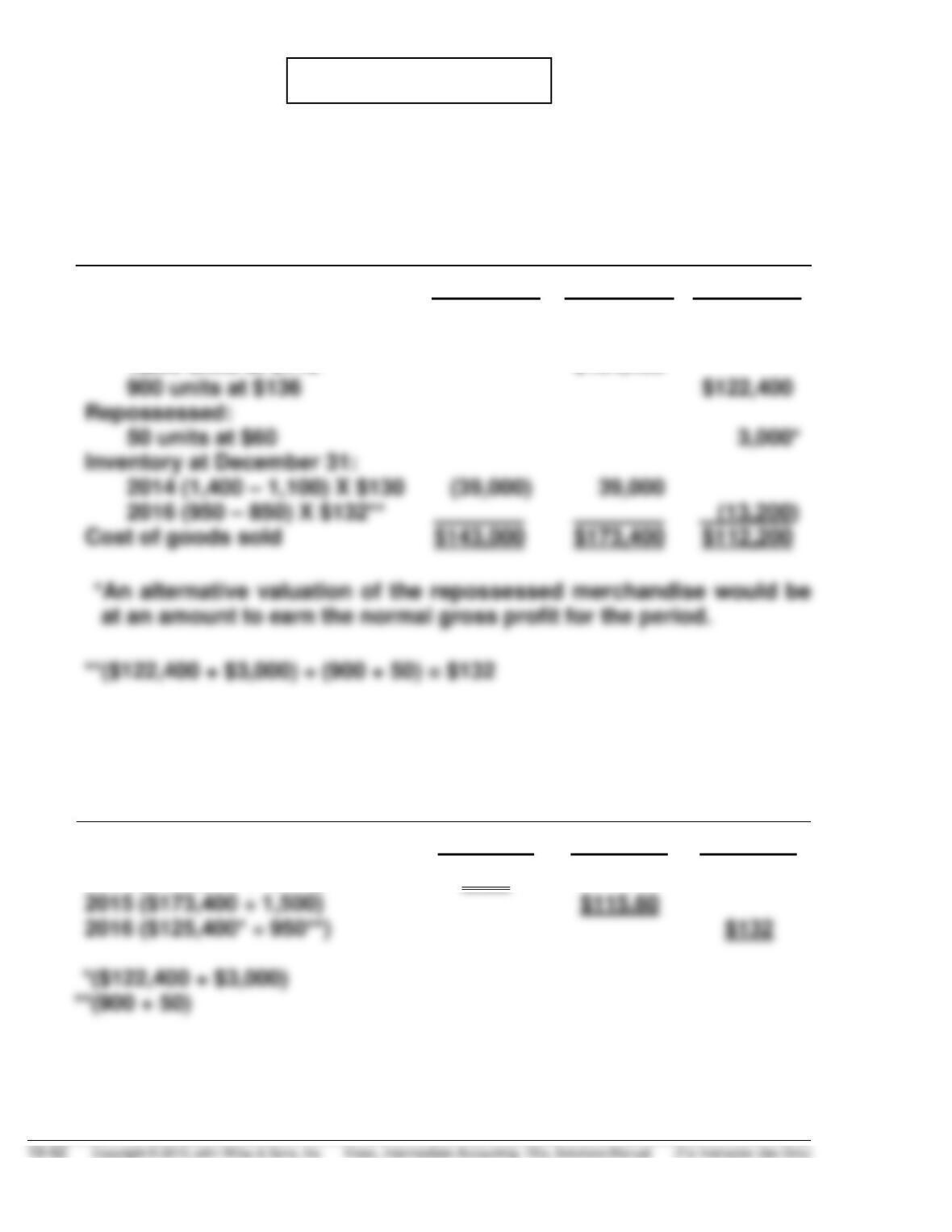
Schedule to Compute Cost
of Goods Sold on Installments
For 2014, 2015, and 2016
2014
2015
2016
Purchases:
1,400 units at $130
($182,000
1,200 units at $112
$134,400
900 units at $136
Repossessed:
50 units at $60
Inventory at December 31:
Cost of goods sold
2. SAPRANO COMPANY
Schedule to Compute Average Unit Cost
of Goods Sold on Installments
For 2014, 2015, and 2016
2014
2015
2016
2014 ($182,000 ÷ 1,400)
$130
2016 ($125,400* ÷ 950**)
PROBLEM 18-14 (Continued)
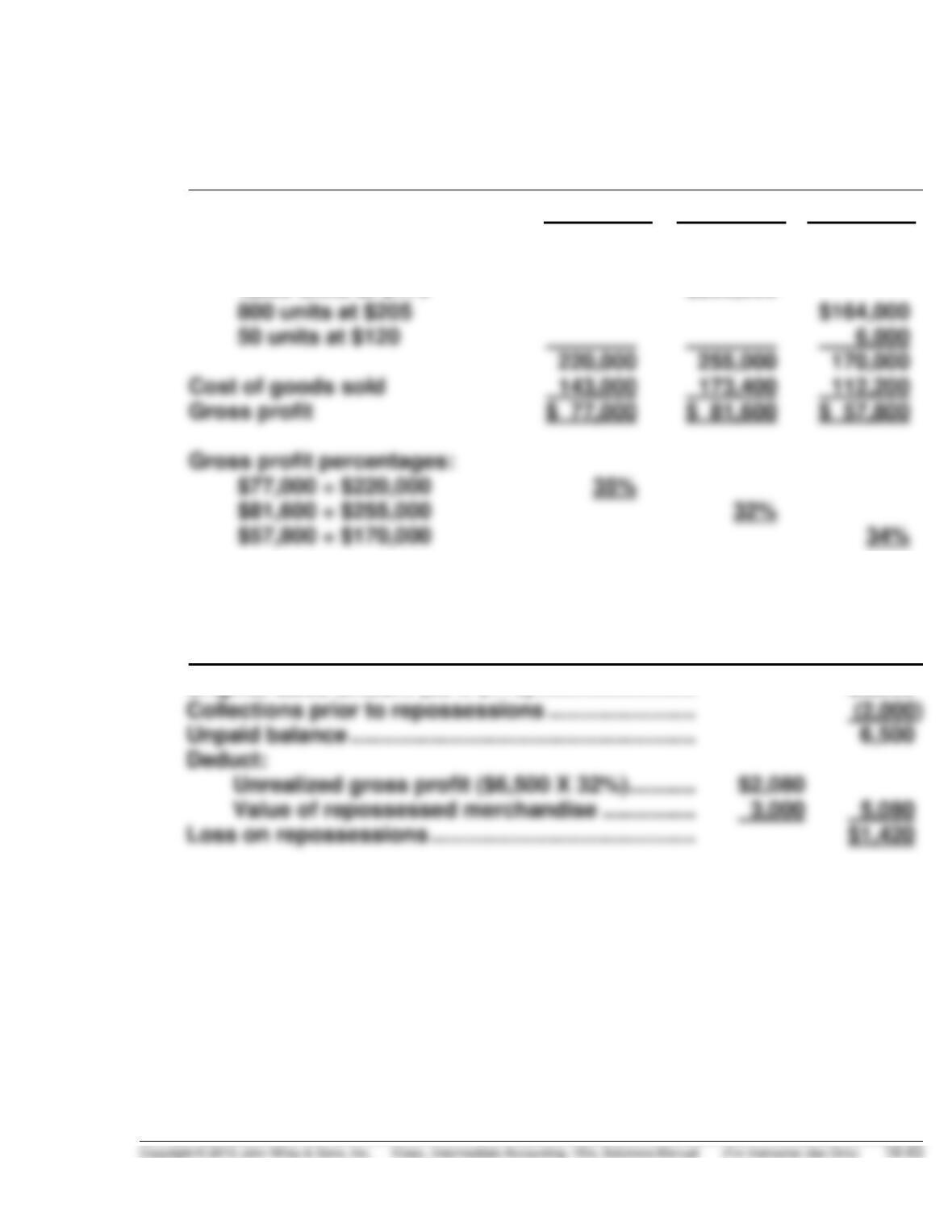
(b) SAPRANO COMPANY
Schedule to Compute Gross Profit Percentages
For 2014, 2015, and 2016
2014
2015
2016
Sales:
1,100 units at $200
$220,000
1,500 units at $170
$255,000
800 units at $205
50 units at $120
6,000
Cost of goods sold
Gross profit
$ 77,000
$ 81,600
$ 57,800
Gross profit percentages:
$77,000 ÷ $220,000
$81,600 ÷ $255,000
$57,800 ÷ $170,000
(c) SAPRANO COMPANY
Schedule to Compute Loss on Repossessions
For 2016
Original sales amount (50 X $170) …………………….. $8,500
PROBLEM 18-14 (Continued)
(d) SAPRANO COMPANY
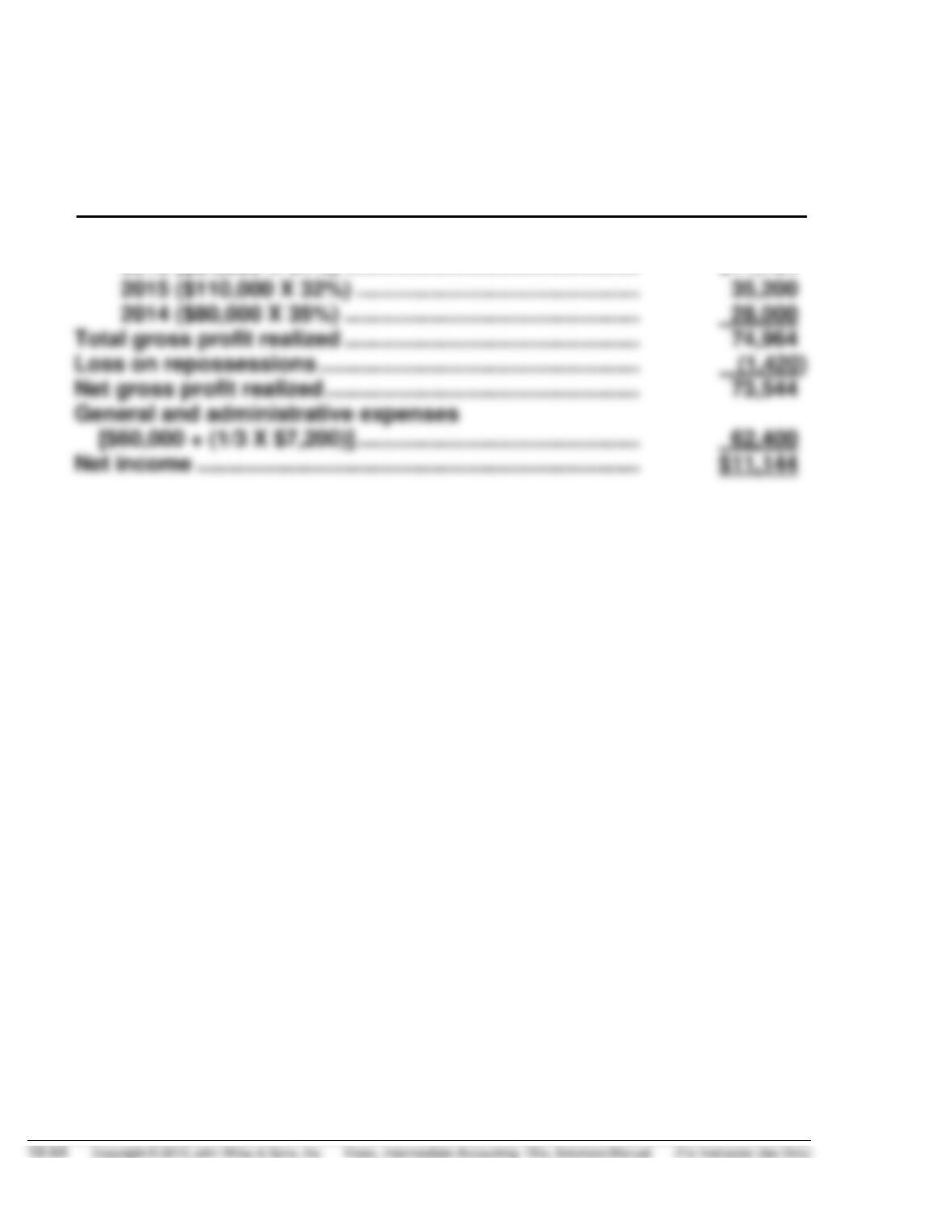
Schedule to Compute Net Income
From Installment Sales
For 2016
Gross profit realized on installment sales:
2016 ($34,600 X 34%) ………………………………………… $11,764
PROBLEM 18-15
(a) MONAT CONSTRUCTION COMPANY, INC.
Computation of Billings on Uncompleted Contract
In Excess of Related Costs
December 31, 2014
Partial billings on contract during 2014 …………………… $1,400,000
MONAT CONSTRUCTION COMPANY, INC.
Computation of Cost of Uncompleted Contract
In Excess of Related Billings
December 31, 2015
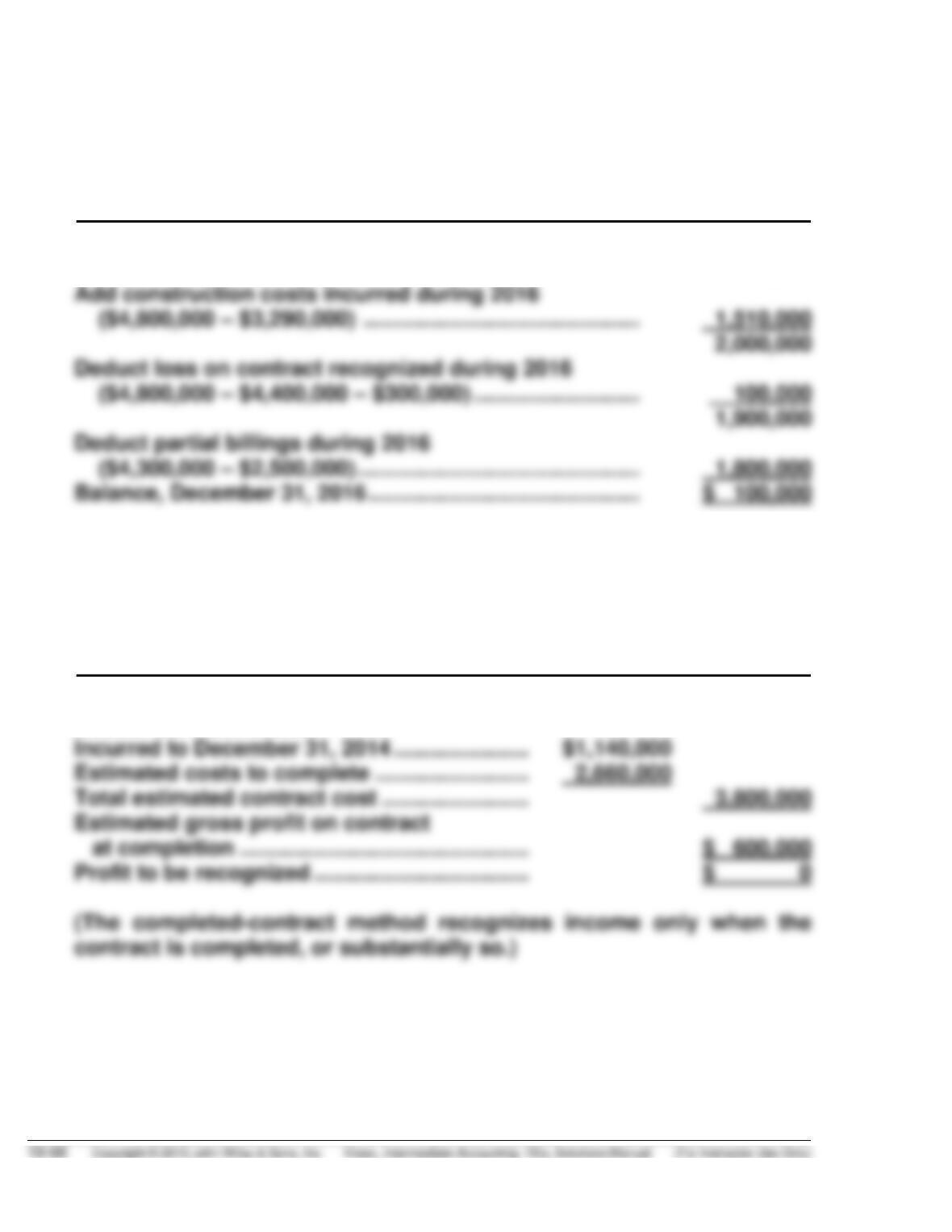
Balance, December 31, 2014—excess of
billings over costs ……………………………………………… $ (260,000)
PROBLEM 18-15 (Continued)
MONAT CONSTRUCTION COMPANY, INC.
Computation of Costs Relating to Substantially
Completed Contract in Excess of Billings
December 31, 2016
Balance, December 31, 2015—excess of costs
over billings …………………………………………………………. $ 490,000
(b) MONAT CONSTRUCTION COMPANY, INC.
Computation of Profit or Loss to be Recognized
On Uncompleted Contract
Year Ended December 31, 2014
Contract price …………………………………………. $4,400,000
Deduct contract costs:
PROBLEM 18-15 (Continued)
MONAT CONSTRUCTION COMPANY, INC.
Computation of Loss to be Recognized
On Uncompleted Contract
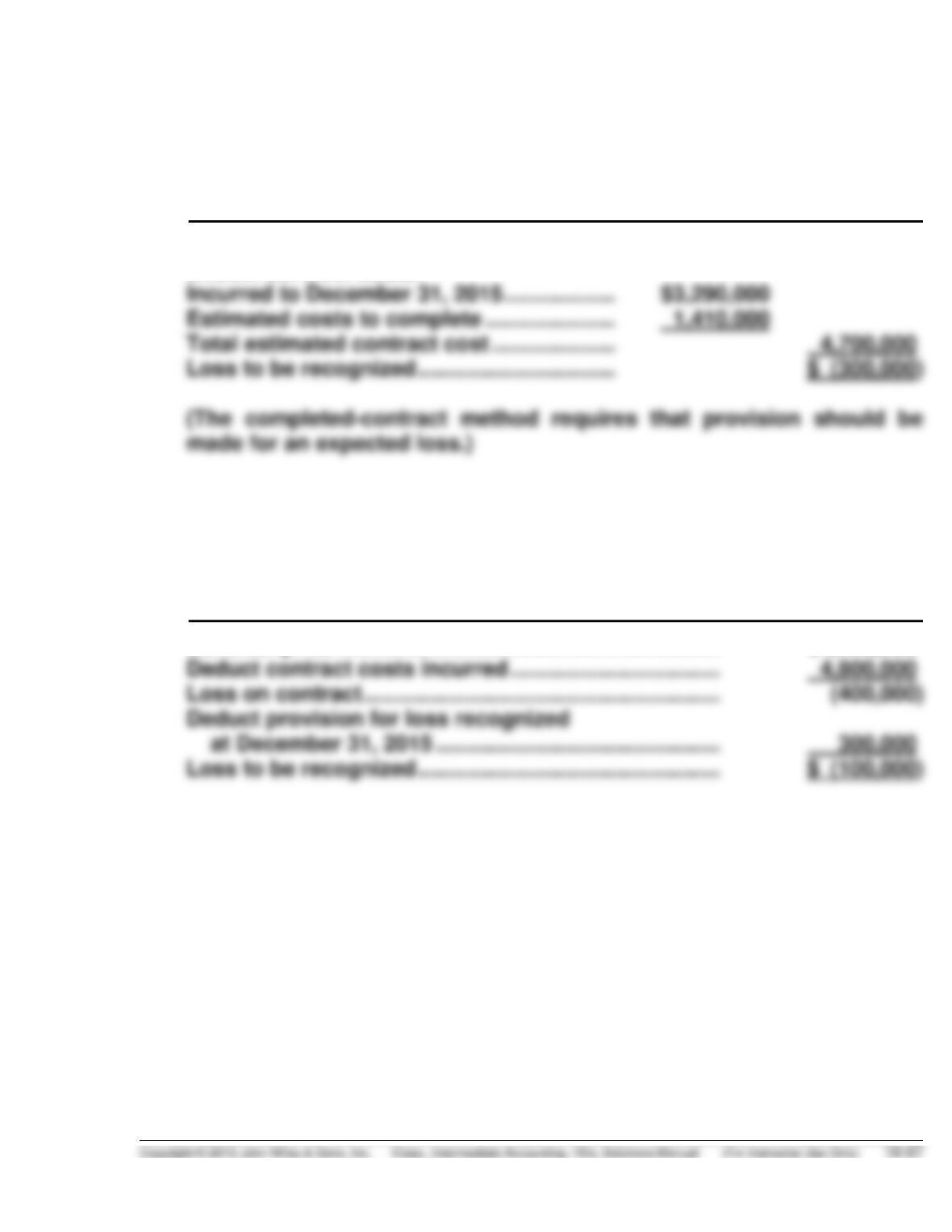
Year Ended December 31, 2015
Contract price ……………………………………… $4,400,000
Deduct contract costs:
MONAT CONSTRUCTION COMPANY, INC.
Computation of Loss to Be Recognized
On Substantially Completed Contract
Year Ended December 31, 2016
Contract price …………………………………………………….. $4,400,000
PROBLEM 18-16
Dear Sue:
This letter regards the revenue recognition matter which we discussed earlier.
By using a recognition method called percentage-of-completion, you will
show a profit in every year of the construction project, assuming, of course,
that no unexpected losses occur.
The completed-contract method which you use presumes that revenue
The most frequently used measure of this degree of completion is the cost–
to–cost method, which determines the percentage of a project’s completion
as the ratio of costs that have already been incurred to the total estimated
costs required in order to finish the project. This percentage is then applied
to the total contract price or gross profit to arrive at the amount of revenue
or gross profit recognized for the period.
PROBLEM 18-16 (Continued)
2014 and 2015 actually allow you to show a profit before the project has been
finished. In addition, where applicable, generally accepted accounting princi–
ples require the use of the percentage-of-completion method in preference
PROBLEM 18-16 (Continued)
Percentage-of–Completion Method
Three-Year Schedule of Gross Profit Recognition
Gross profit recognized in 2014:
Contract price ……………………………………… $1,100,000
Costs:
Gross profit recognized in 2015:
Contract price ……………………………………… $1,100,000
Costs:
Gross profit recognized in 2016:
Contract price ……………………………………… $1,100,000
Costs:
Less: Costs to date ………………………………. $790,000
PROBLEM 18-17
(a) Schedule to Compute Gross Profit for 2014
A
B
C
D
E
Estimated profit (loss):
A: ($300,000 – $320,000)
$(20,000)
B: ($350,000 – $339,000)
D: ($200,000 – $205,000)
A: (not applicable)
—
B: ($67,800 ÷ $339,000)
20%
D: (not applicable)
Gross profit (loss) recognized
$(20,000)
Schedule to Compute Unbilled Contract Costs
and Recognized Profit and Billings
in Excess of Costs and Recognized Profit
Costs and
Estimated Profits
or Losses
Related
Billings
Costs and
Estimated Profits
in Excess of Billings
Billings in Excess
of Costs and Estimated
Profits
A
$228,000a
$200,000
$ 28,000
D
PROBLEM 18-17 (Continued)
(b) Partial Income Statement
Revenue from long-term contracts …………………………………. $925,622*
Costs of construction
($252,500 + $67,800 + $186,000 + $120,122 + $190,000) …. 816,422
Gross profit …………………………………………………………………… $109,200
*A: $300,000 X ($248,000 ÷ $320,000) = $232,500
Partial Balance Sheet
Current assets:
Accounts receivable
($830,000 – $765,000) ………………………….. $ 65,000
Project
Costs
Profit/(loss)
Construction
in Process
Billings
A
$248,000
$(20,000)
$228,000
$200,000
E
38,000)
PROBLEM 18-17 (Continued)
(c) Schedule to Compute Gross Profit for 2014
A
B
C
D
E
A: ($300,000 – $320,000)
$(20,000)
B: Not completed
Schedule to Compute Unbilled Contract Costs
and Billings in Excess of Costs
Costs and
Recognized Profits
or Losses
Related
Billings
Costs and
Recognized Losses
in Excess of Billings
Billings in Excess
of Costs
A
a$228,000a
$200,000
$ 28,000
(d) The principal advantage of the completed-contract method is that it
reports revenue based on the final results and not on estimates made
throughout the construction period. However, the disadvantage of
using this method is that for contracts which extend more than one
PROBLEM 18-17 (Continued)
On the other hand, the percentage-of-completion method does recog-
nize revenue and gross profit before the completion of a project. If Buhl
can determine reliable estimates of its progress and meets the other
conditions for this method, Buhl can recognize revenues as the work
TIME AND PURPOSE OF CONCEPTS FOR ANALYSIS
CA 18-1 (Time 20–30 minutes)
Purpose—to provide a situation that requires an examination and application of the earning and
realization elements of three revenue recognition methods. The three business situations require the
computation of revenue to be recognized.
CA 18-2 (Time 35–45 minutes)
Purpose—to provide the student with an understanding of the conceptual merits of recognizing revenue
CA 18-3 (Time 25–30 minutes)
Purpose—to provide the student with an understanding of the conceptual factors underlying the
CA 18-4 (Time 30–35 minutes)
Purpose—to provide the student with an understanding of the criteria and applications utilized in the
CA 18-5 (Time 35–45 minutes)
Purpose—to provide the student an opportunity to explain how a magazine publisher should recognize
subscription revenue. The case is complicated by a 25% return rate and a premium offered to
subscribers. The effect on the current ratio must be discussed.
CA 18-6 (Time 20–25 minutes)
Purpose—to provide the student an opportunity to discuss the theoretical justification for use of the
CA 18-7 (Time 20–25 minutes)
Purpose—to provide the student an ethical situation related to the recognition of revenue from
membership fees.
*CA 18-8 (Time 35–45 minutes)
Purpose—to provide the student with an understanding of the accounting treatment accorded franchis–
SOLUTIONS TO CONCEPTS FOR ANALYSIS
CA 18-1
(a) Definitions and descriptions of each of the three noted revenue recognition methods, and an
indication as to whether they are in accordance with generally accepted accounting principles
(GAAP), are presented below.
1. The completion-of-production method allows revenue to be recognized when production
is complete even though a sale has not yet been made. The circumstances that justify
revenue recognition at this point are:
2. The percentage-of-completion method is used on long-term projects and the following
conditions must exist for its use:
• A firm contract price with a high probability of collection.
3. The installment-sales method allows revenue to be recognized when cash is collected
rather than at the point of sale. Due, in part, to improved credit procedures that increase the
(b) The revenue to be recognized in the fiscal year ended November 30, 2014, for each of the three
companies is as calculated and presented below:
1. Farber Mining would recognize as revenue the market value of metals mined during the
year.
CA 18-1 (Continued)
2. Enyart Paperbacks would recognize revenue of $5,600,000, calculated as follows.
Sales in fiscal 2014 ………………………………. $7,000,000
Less: Estimated sales returns
3. Glesen Protection Devices would recognize revenue of $5,000,000. Revenue to be recog-
CA 18-2
(a) The point of sale is the most widely used basis for the timing of revenue recognition because in
most cases it provides the degree of objective evidence accountants consider necessary to reliably
measure periodic business income. In other words, sales transactions with outsiders represent
(b) 1. Though it is recognized that revenue is earned throughout the entire production process,
generally it is not feasible to measure revenue on the basis of operating activity. It is not
feasible because of the absence of suitable criteria for consistently and objectively arriving
at a periodic determination of the amount of revenue to recognize.
2. To criticize the sales basis as not being sufficiently conservative because accounts receiv–
able do not represent disposable funds, it is necessary to assume that the collection of
CA 18-2 (Continued)
factor in the earnings process and substitutes for it the administrative function of managing
and collecting receivables. In other words, the investment of funds in receivables should be
regarded as a policy designed to increase total revenues, properly recognized at the point
of sale, and the cost of managing receivables (e.g., bad debts and collection costs) should
(c) 1. During production. This basis of recognizing revenue is frequently used by firms whose
major source of revenue is long-term construction projects. For these firms the point of sale
is far less significant to the earnings process than is production activity because the sale is
assured under the contract (except of course where performance is not substantially in
accordance with the contract terms).
To defer revenue recognition until the completion of long-term construction projects could
2. When cash is received. The most common application of this basis for the timing of
revenue recognition is in connection with installment-sales contracts. Its use is justified on
the grounds that, due to the length of the collection period, increased risks of default, and
CA 18-3
(a) Most merchandising concerns deal in finished products and would recognize revenue at the point
of sale. This is often identified as the moment when the title legally passes from seller to purchaser.
At the point of sale, there is an arm’s-length transaction to objectively measure the amount of
revenue to be recognized. With accounting theory based heavily on objective measurement, it is
logical that point-of-sale transaction revenue recognition would be used by many firms, especially
merchandising concerns.
Other advantages of point-of-sale timing for revenue recognition include the following:
1. It is a discernible event (as contrasted to the accretion concept).
(b) For service-type transactions, revenue is generally recognized on the basis of the seller’s perform-
ance of the transaction with performance being the execution of a defined act or acts or the passage
of time. Service-type firms may select from recommended methods to recognize revenue:
(1) specific performance method, (2) completed performance method, (3) proportional performance
method, and (4) collection method.
(c) Revenue is sometimes recognized at completion of the production activity, or after the point of
sale. The recognition of revenue at completion of production is justified only if certain conditions
are present. The necessary conditions are that there must be a relatively stable market for the
product, marketing costs must be nominal, and the units must be homogeneous. These three
necessary conditions are not often present except in the case of certain precious metals and
agricultural products. In these situations it has been considered appropriate to recognize revenue
at the completion of production.
CA 18-4
(a) Income results from economic activity in which one entity furnishes goods or services to another.
To warrant revenue recognition, the earnings process must be substantially complete and there
must be a change in net assets that is capable of being objectively measured. Normally, this
involves an arm’s-length exchange transaction with a party external to the entity. The existence
and terms of the transaction may be defined by operation of law, by established trade practice, or
may be stipulated in a contract.
(b) Griseta & Dubel Inc., in effect, is a merchandising firm which collects cash (for merchandise
credits) far in advance of furnishing the goods. In addition, since the data indicate that about
5 percent of the credits sold will never be redeemed, it also has revenue from this source unless
these credits are redeemed. Griseta & Dubel’s revenues from these two sources could be recog–
nized on one of three major bases. First, all revenue could be recognized when the credits are
be to recognize the revenue from the never–to–be–redeemed credits on a passage-of-time basis.
The principal expense, merchandise premium costs, should be matched with the revenue. If all
revenue is recognized when credits are sold, an accrual of the cost of the future premium
redemptions would be necessary. In such a case, when credit redemptions and related premium
issuances occurred, the costs of the premiums would be charged to the accrued liability account.
On the other hand, if credit sales were treated as an advance, the deferred revenue would be
recognized and the matching cost of the premiums issued would be recognized with the revenue
at the time of redemption.