CHAPTER 17
Investments
ASSIGNMENT CLASSIFICATION TABLE (BY TOPIC)
Topics
Questions
Brief
Exercises
Exercises
Problems
Concepts
for Analysis
1. Debt securities.
1, 2, 3, 13
1
6
(a) Held-to-maturity.
4, 5, 7, 8,
10, 13, 21
1, 3
2, 3, 5
1, 7
(c) Available-for-sale.
4, 7, 8, 9,
10, 11, 21
2, 10
4
1, 2, 3, 4, 7
1
2. Bond amortization.
8, 9
1, 2, 3
3, 4, 5
1, 2, 3
3. Equity securities.
1, 12, 16
1
6
15, 21
12, 16,
19, 20
10, 11, 12
(b) Trading.
6, 7, 8, 10,
14, 15, 21
6
6, 7, 14, 15,
19, 20
6, 8
1, 3
(c) Equity method.
16, 17, 18,
19, 20
7
12, 13,
16, 17
8
4, 5
4. Comprehensive income.
22
9
10
9, 10, 12
5. Disclosures of investments.
18
10
5, 8, 9, 10,
11, 12
6. Fair value option.
25, 26, 27
19, 20, 21
7. Impairments.
24
10
18
3
28, 29, 30, 31,
32, 33, 34, 35
22, 23, 24,
25, 26, 27
13, 14, 15,
16, 17, 18
36, 37
ASSIGNMENT CLASSIFICATION TABLE (BY LEARNING OBJECTIVE)
Learning Objectives
Questions
Brief
Exercises
Exercises
Problems
Concepts
for
Analysis
accounting and
reporting treatment
for each category.
on bond investments.
1. Identify the three
categories of debt
securities and
describe the
1, 2, 3, 4, 5,
6, 7
1
CA17-1
3. Identify the
categories of equity
securities and
describe the
accounting and
reporting treatment
for each category.
12, 13, 14,
15
5, 6, 8
1, 6, 7, 8, 9,
11, 12, 14,
15, 16, 19,
20, 21
3, 5, 6, 8,
9, 10, 11,
12
CA17-1,
CA17-3,
CA17-5
value
option and the
accounting for
impairments
of debt and equity
investments.
6. Describe the
reporting of
reclassification
adjustments and the
accounting for
transfers between
categories.
22, 23
9
10
and accounting for
derivatives.
account for a fair

value hedge.
*9. Explain how to
account for a cash
flow hedge.
33, 34
24, 27
derivatives.
ASSIGNMENT CHARACTERISTICS TABLE
Item
Description
Level of
Difficulty
Time
(minutes)
E17-1
Investment classifications.
Simple
5–10
E17-2
Entries for held-to-maturity securities.
Simple
10–15
E17-3
Entries for held-to-maturity securities.
Simple
15–20
E17-4
Entries for available-for-sale securities.
Simple
10–15
E17-5
Effective-interest versus straight-line bond amortization.
Simple
20–30
E17-6
Entries for available-for-sale and trading securities.
Simple
10–15
E17-7
Trading securities entries.
Simple
10–15
E17-8
Available-for-sale securities entries and reporting.
Simple
presentation.
E17-10
Comprehensive income disclosure.
Moderate
20–25
E17-11
Equity securities entries.
Simple
20–25
E17-12
Journal entries for fair value and equity methods.
Simple
15–20
E17-13
Equity method.
Moderate
10–15
E17-14
Equity investment—trading.
Moderate
10–15
E17-15
Equity investments—trading.
Moderate
15–20
E17-16
Fair value and equity method compared.
Simple
15–20
E17-17
Equity method.
Simple
10–15
E17-18
Impairment of debt securities.
Moderate
15–20
E17-19
Fair value measurement.
Moderate
15–20
E17-20
Fair value measurement issues.
Moderate
15–20
Derivative transaction.
Moderate
15–20
Fair value hedge.
Moderate
20–25
Cash flow hedge.
Moderate
20–25
Fair value hedge.
Moderate
15–20
Call option.
Moderate
20–25
Cash flow hedge.
Moderate
25–30
P17-1
Debt securities.
Moderate
20–30
P17-2
Available-for-sale debt investments.
Moderate
30–40
P17-3
Available-for-sale investments.
Moderate
25–30
P17-4
Available-for-sale debt securities.
Moderate
25–35
P17-5
Equity securities entries and disclosures.
Moderate
25–35
P17-6
Trading and available-for-sale securities entries.
Simple
25–35
P17-7
Available-for-sale and held-to-maturity debt securities entries.
Moderate
25–35
P17-8
Fair value and equity methods.
Moderate
20–30
investments.
ASSIGNMENT CHARACTERISTICS TABLE (Continued)
Item
Description
Level of
Difficulty
Time
(minutes)
P17-10
Gain on sale of securities and comprehensive income.
Moderate
20–30
P17-11
Equity investments—available-for-sale.
Complex
30–40
P17-12
Available-for-sale securities—statement presentation.
Moderate
20–30
*P17-13
Derivative financial instrument.
Moderate
20–25
*P17-14
Derivative financial instrument.
Moderate
20–25
*P17-15
Free-standing derivative.
Moderate
20–25
*P17-16
Fair value hedge interest rate swap.
Moderate
30–40
*P17-17
Cash flow hedge.
Moderate
25–35
*P17-18
Fair value hedge.
Moderate
25–35
CA17-1
Issues raised about investment securities.
Moderate
25–30
CA17-2
Equity securities.
Moderate
25–30
CA17-3
Financial statement effect of equity securities.
Simple
20–30
CA17-4
Equity securities.
Moderate
15–25
CA17-5
Investment accounted for under the equity method.
Simple
15–25
CA17-6
Equity investment.
Moderate
25–35
CA17-7
Fair value.
Moderate
25–35
SOLUTIONS TO CODIFICATION EXERCISES
CE17-1
Master Glossary
(a) Trading securities are securities that are bought and held principally for the purpose of selling
them in the near term and therefore held for only a short period of time. Trading generally reflects
active and frequent buying and selling, and trading securities are generally used with the
objective of generating profits on short-term differences in price.
CE17-2
According to FASB ASC 235-10-S99-1 (Notes to Financial Statements—SEC Materials):
(n) Accounting policies for certain derivative instruments. Disclosures regarding accounting policies
shall include descriptions of the accounting policies used for derivative financial instruments and
(1) A discussion of each method used to account for derivative financial instruments and
derivative commodity instruments;
(2) The types of derivative financial instruments and derivative commodity instruments accounted
for under each method;
CE17-2 (Continued)
(6) The method used to account for derivatives when the designated item matures, is sold, is
(7) Where and when derivative financial instruments and derivative commodity instruments, and
Instructions to paragraph 4-08(n).
1. For purposes of this paragraph (n), derivative financial instruments and derivative
commodity instruments (collectively referred to as “derivatives”) are defined as follows:
(i) Derivative financial instruments have the same meaning as defined by generally
accepted accounting principles (see Financial Accounting Standards Board
(“FASB”), Statement of Financial Accounting Standards No. 119, “Disclosure about
Derivative Financial Instruments and Fair Value of Financial Instruments,” (“FAS 119”)
paragraphs 5–7, (October 1994)), and include futures, forwards, swaps, options,
and other financial instruments with similar characteristics.
2. For purposes of paragraphs (n)(2), (n)(3), (n)(4), and (n)(7), the required disclosures
should address separately derivatives entered into for trading purposes and derivatives
entered into for purposes other than trading.
3. For purposes of paragraph (n)(6), anticipated transactions means transactions (other
than transactions involving existing assets or liabilities or transactions necessitated by
4. Registrants should provide disclosures required under paragraph (n) in filings with the
Commission that include financial statements of fiscal periods ending after June 15, 1997.
[45 FR 63669, Sept. 25, 1980, as amended at 46 FR 56179, Nov. 16, 1981; 50
CE17-3
According to FASB ASC 323-10–35-20 (Investments—Equity Method and Joint Ventures—Subsequent
Measurement):
The investor ordinarily shall discontinue applying the equity method if the investment (and net
CE17-4
According to FASB ASC 815-10–45-4 (Derivatives and Hedging—Other Presentation Matters—Balance
Sheet Netting);
Unless the conditions in paragraph 210–20–45-1 are met, the fair value of derivative instruments in a
ANSWERS TO QUESTIONS
1. A debt security is an instrument representing a creditor relationship with an entity. Debt securities
include U.S. government securities, municipal securities, corporate bonds, convertible debt, and
commercial paper. Trade accounts receivable and loans receivable are not debt securities
because they do not meet the definition of a security.
securities.
2. The variety in bond features along with the variability in interest rates permits investors to shop
for exactly the investment that satisfies their risk, yield, and marketability desires, and permits
issuers to create a debt instrument best suited to their needs.
3. Cost includes the total consideration to acquire the investment, including brokerage fees and
other costs incidental to the purchase.
4. The three types of classifications are:
5. A debt investment should be classified as held-to-maturity only if the company has both: (1) the
positive intent and (2) the ability to hold those securities to maturity.
8. $3,500,000 X 10% = $350,000; $350,000 ÷ 2 = $175,000. Wheeler would make the following entry:
10. Unrealized holding gains and losses for trading securities should be included in net income for
the current period. Unrealized holding gains and losses for available-for-sale securities should be
reported as other comprehensive income and as a separate component of stockholders’ equity.
Unrealized holding gains and losses are not recognized for held-to-maturity securities.
Questions Chapter 17 (Continued)
11. (a) Unrealized Holding Gain or Loss—Equity ………………………………. 60,000
12. Investments in equity securities can be classified as follows:
(a) Holdings of less than 20% (fair value method)—investor has passive interest.
13. Investments in stock do not have a maturity date and therefore cannot be classified as held–to–
maturity securities.
14. Selling price of 10,000 shares at $27.50 ……………………………………….. $275,000
Less: Brokerage commissions ……………………………………………………. (1,770)
15. Both trading and available-for-sale equity securities are reported at fair value. However, any
16. Significant influence over an investee may result from representation on the board of directors,
participation in policy-making processes, material intercompany transactions, interchange of
managerial personnel, or technological dependency. An investment (direct or indirect) of 20% or
more of the voting stock of an investee constitutes significant influence unless there exists
evidence to the contrary.
17. Under the equity method, the investment is originally recorded at cost, but is adjusted for
18. The 20% rule is that an investment (direct or indirect) of 20 percent or more of the voting stock of
an investee leads to the presumption that an investor has the ability to exercise significant
influence over an investee and the equity method should be used. However, there are other
Questions Chapter 17 (Continued)
Factors that could lead to a conclusion of no significant ownership, when ownership in above
19. Dividends subsequent to acquisition should be accounted for as a reduction in the Equity
Investment received account.
20. Ordinarily, Raleigh Corp. should discontinue applying the equity method and not provide for
additional losses beyond the carrying value of $170,000. However, if Raleigh Corp.’s loss is not
21. Trading securities should be reported at aggregate fair value as current assets. Individual held-to–
maturity and available-for-sale securities are classified as current or noncurrent depending upon the
22. Reclassification adjustments are necessary to insure that double counting does not result when
realized gains or losses are reported as part of net income but also are shown as part of other
comprehensive income in the current period or in previous periods.
23. When a security is transferred from one category to another, the transfer should be recorded at
24. A debt security is impaired when “it is probable that the investor will be unable to collect all
25. Fair value is defined as “the price that would be received to sell an asset or paid to transfer a
liability in an orderly transaction between market participants at the measurement date.” Fair
value is therefore a market-based measure.
26. The fair value option gives companies the option to report most financial instruments at fair value
with all gains and losses related to changes in fair value reported in the income statement. This
27. No. The fair value option is generally available only at the time a company first purchases the
Questions Chapter 17 (Continued)
*28. An underlying is a special interest rate, security price, commodity price, index of prices or rates,
or other market-related variable. Changes in the underlying determine changes in the value of
*29. See illustration below:
Feature
Traditional Financial Instrument
(e.g., Trading Security)
Derivative Financial Instrument
(e.g., Call Option)
Payment Provision
Stock price times the number
of shares.
Change in stock price (underlying)
times number of shares (notional
amount).
Initial Investment
For a traditional financial instrument, an investor generally must pay the full cost, while derivatives
require little initial investment. In addition, the holder of a traditional security is exposed to all risks
*30. The purpose of a fair value hedge is to offset the exposure to changes in the fair value of a
recognized asset or liability or of an unrecognized firm commitment.
*31. The unrealized holding gain or loss on available-for-sale securities should be reported as income
*32. This is likely a setting where the company is hedging the fair value of a fixed-rate debt obligation.
The fixed payments received on the swap will offset fixed payments on the debt obligation. As a
*33. A cash flow hedge is used to hedge exposures to cash flow risk, which is exposure to the
*34. Derivatives used in cash flow hedges are accounted for at fair value on the balance sheet but
gains or losses are recorded in equity as part of other comprehensive income.
*35. A hybrid security is a security that has characteristics of both debt and equity and often is a
Questions Chapter 17 (Continued)
*36. The voting-interest model is when a company owns more than 50% of another company. The
*37. A variable-interest entity (VIE) is an entity that has one of the following characteristics:
(a) Insufficient equity investment at risk. Stockholders are assumed to have sufficient capital
investment to support the entity’s operations. If thinly capitalized, the entity is considered
a VIE and is subject to the risk-and-reward model.
(b) Stockholders lack decision-making rights. In some cases, stockholders do not have the
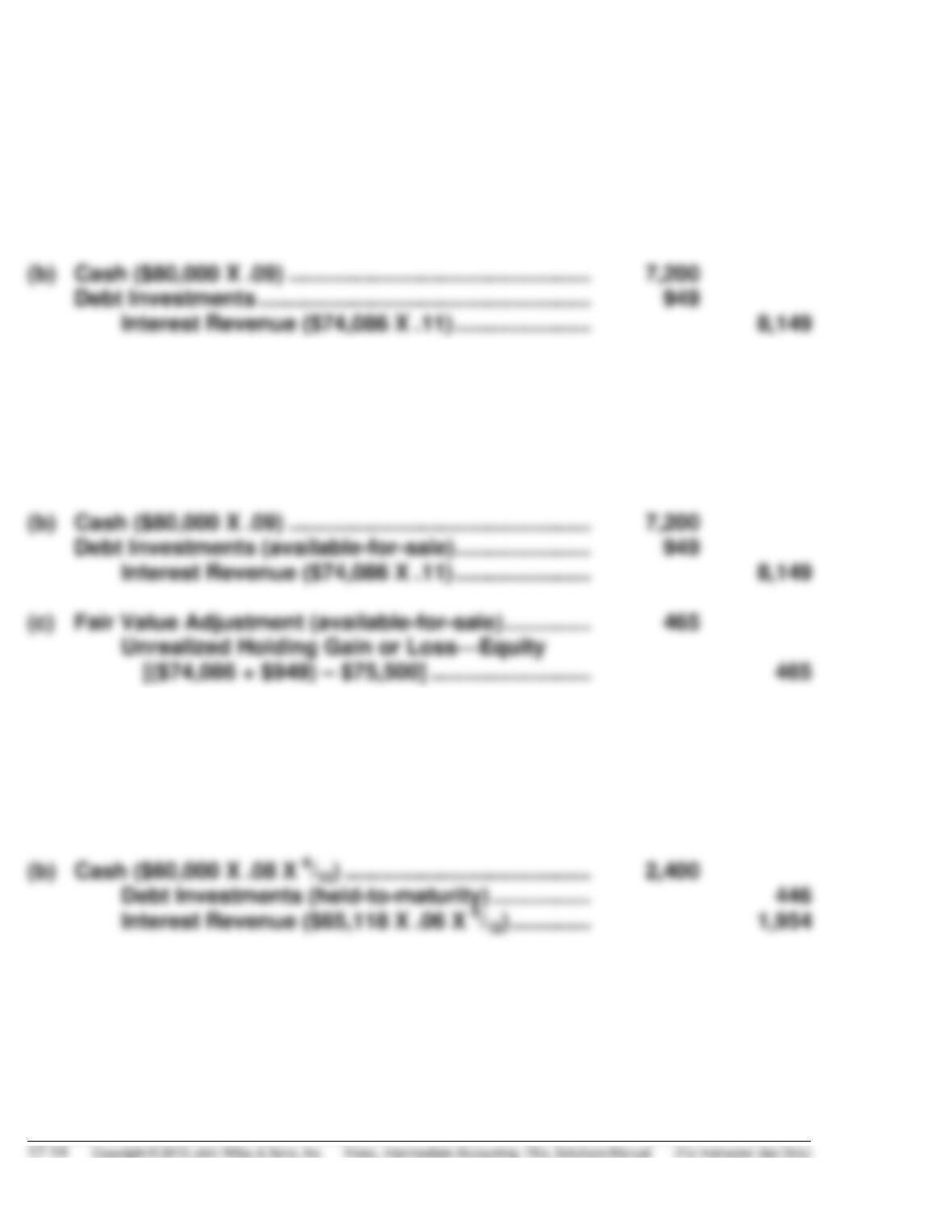
SOLUTIONS TO BRIEF EXERCISES
BRIEF EXERCISE 17-1
(a) Debt Investments ……………………………………………… 74,086
Cash …………………………………………………………. 74,086
BRIEF EXERCISE 17-2
(a) Debt Investments (available-for-sale) …………………. 74,086
Cash …………………………………………………………. 74,086
BRIEF EXERCISE 17-3
(a) Debt Investments ……………………………………………… 65,118
Cash …………………………………………………………. 65,118
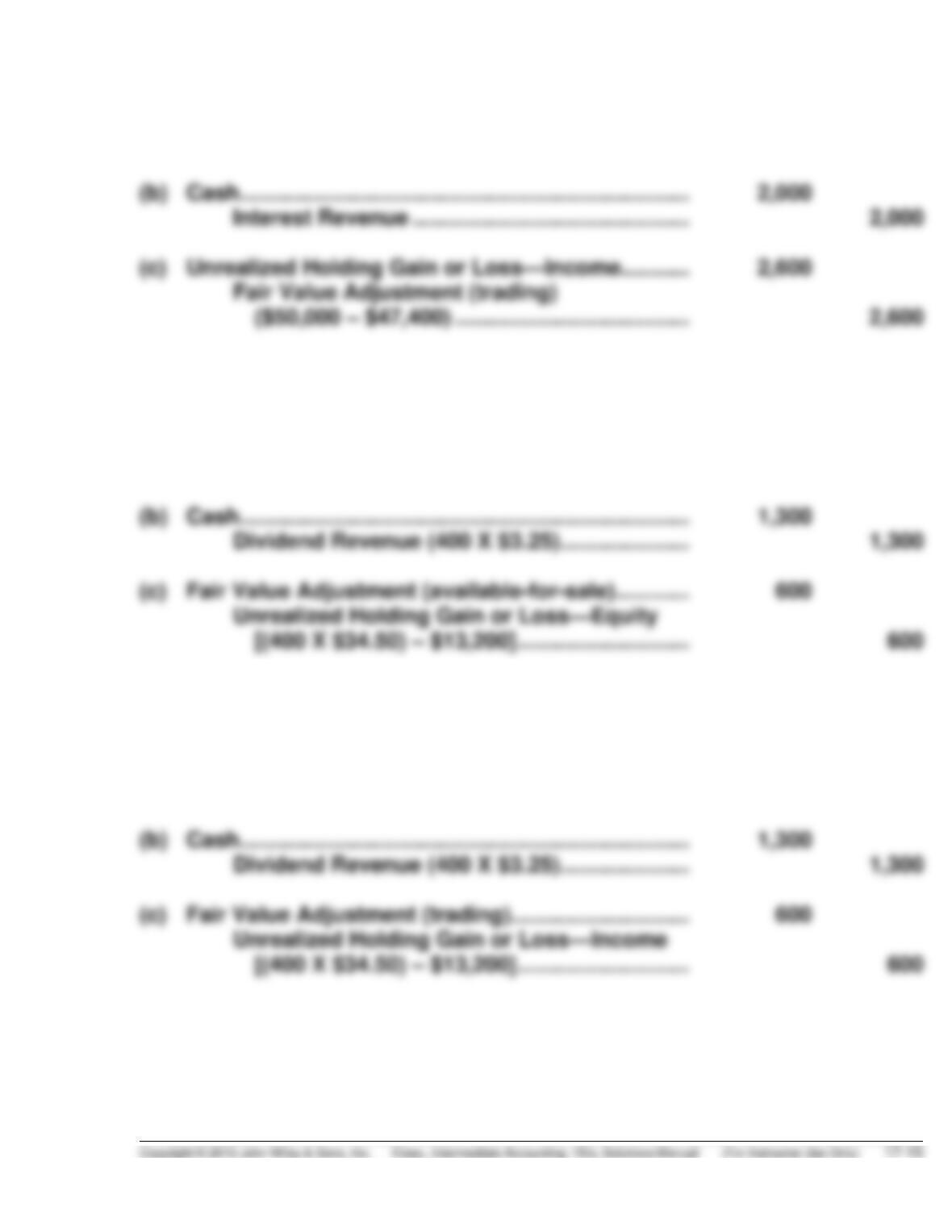
BRIEF EXERCISE 17-4
(a) Debt Investments (trading) ……………………………… 50,000
Cash ……………………………………………………….. 50,000
BRIEF EXERCISE 17-5
(a) Equity Investments (available-for-sale) …………….. 13,200
Cash ……………………………………………………….. 13,200
BRIEF EXERCISE 17-6
(a) Equity Investments (trading) …………………………... 13,200
Cash ……………………………………………………….. 13,200
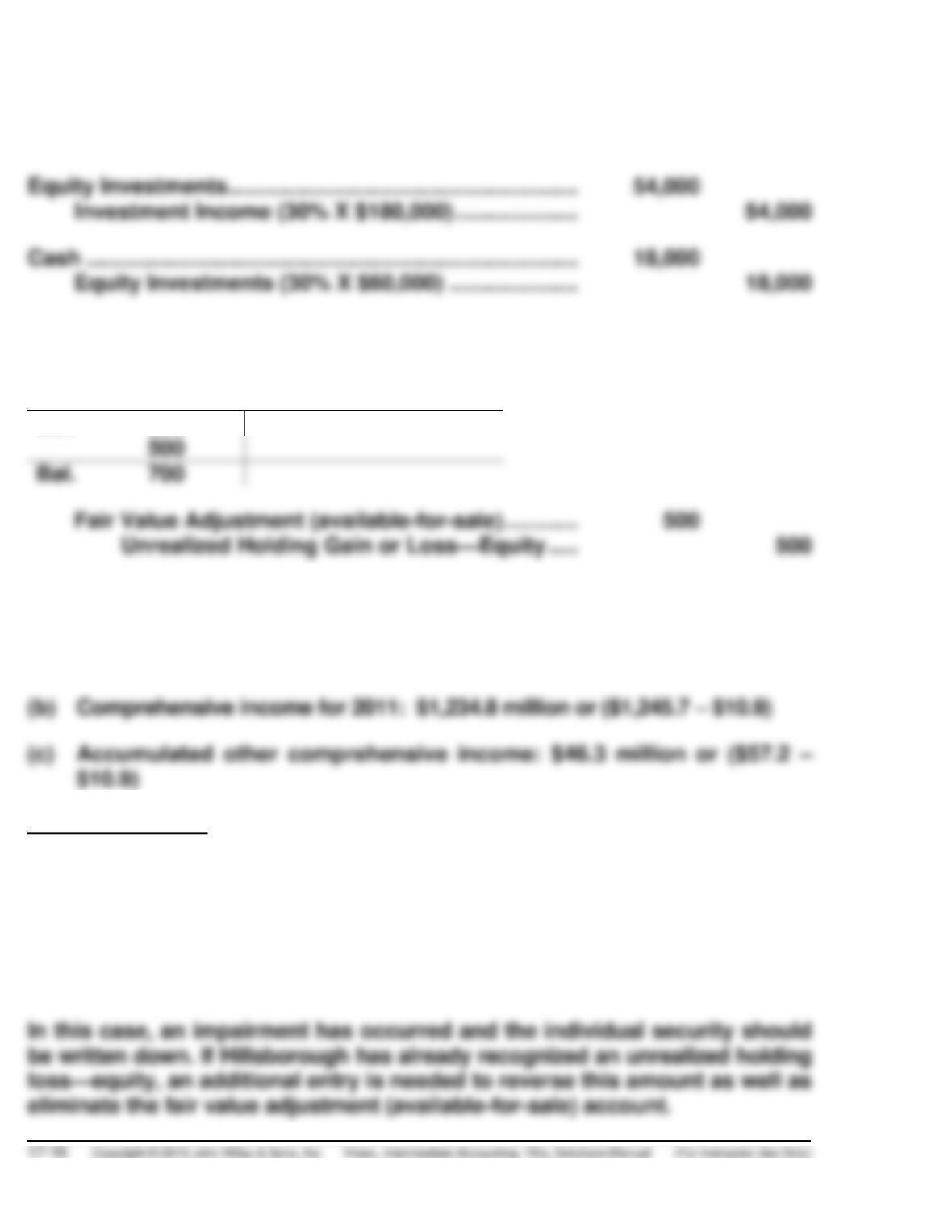
BRIEF EXERCISE 17-7
Equity Investments ………………………………………………… 300,000
Cash ………………………………………………………………. 300,000
BRIEF EXERCISE 17-8
Fair Value Adjustment (available-for-sale)
Bal. 200
Bal. 700
BRIEF EXERCISE 17-9
(a) Other comprehensive income (loss) for 2011: ($10.9) million
Note to instructor: In 2011, Starbucks also reported foreign currency trans–
lation adjustments, which affected accumulated other comprehensive income.
BRIEF EXERCISE 17-10
Loss on Impairment …………………………..…………………….. 10,000
Debt Investments (available-for-sale) …………………. 10,000
SOLUTIONS TO EXERCISES
EXERCISE 17-1 (5–10 minutes)
(a) 1. (b) 2. (c) 1. (d) 2. (e) 2. (f) 3.
EXERCISE 17-2 (10–15 minutes)
(a) January 1, 2013
Debt Investments ………………………………………. 300,000
Cash ………………………………………………….. 300,000
(b) December 31, 2013
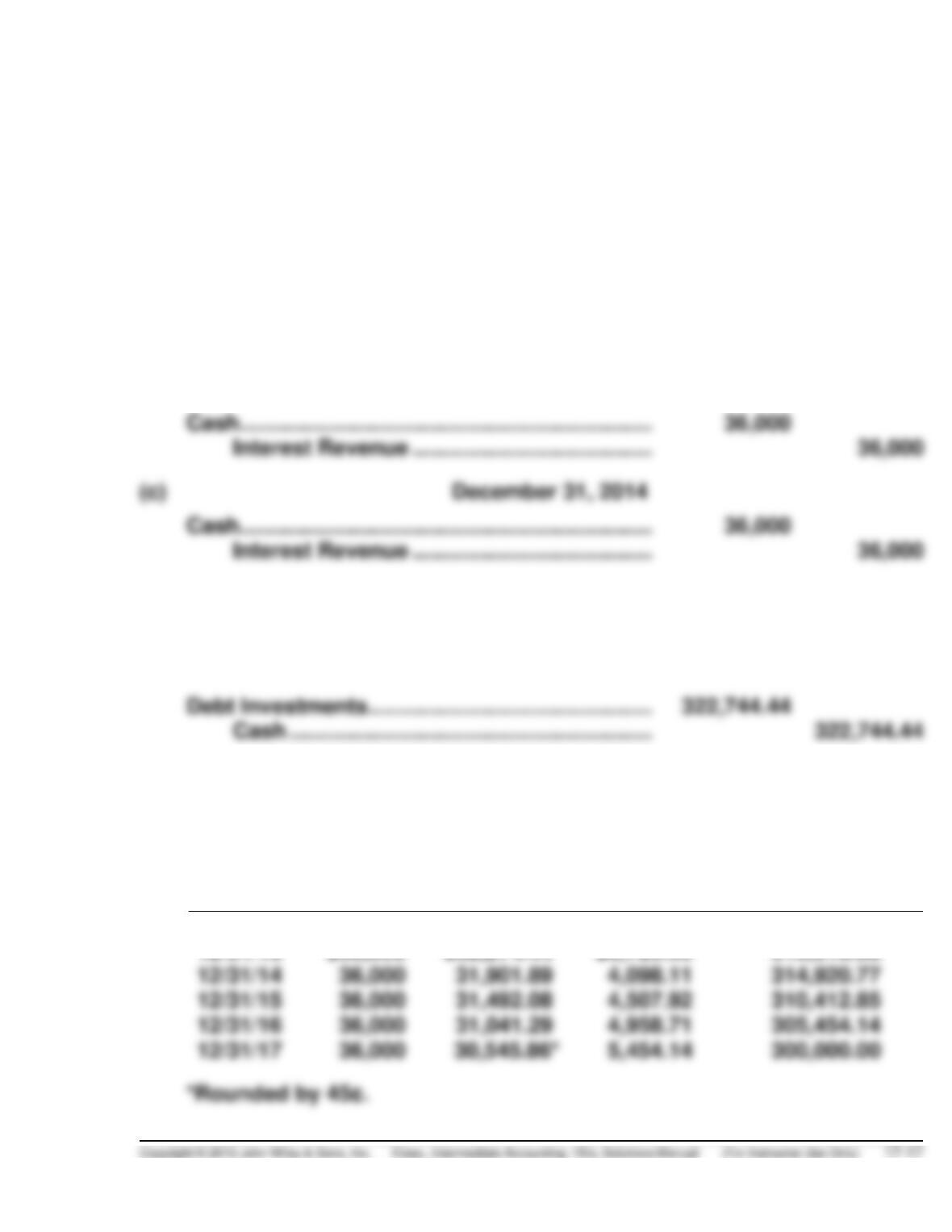
EXERCISE 17-3 (15–20 minutes)
(a) January 1, 2013
(b) Schedule of Interest Revenue and Bond Premium Amortization
Effective-Interest Method
12% Bonds Sold to Yield 10%
Date
Cash
Received
Interest
Revenue
Premium
Amortized
Carrying Amount
of Bonds
1/1/13
—
—
—
$322,744.44
12/31/13
12/31/14
12/31/15
12/31/16
12/31/17
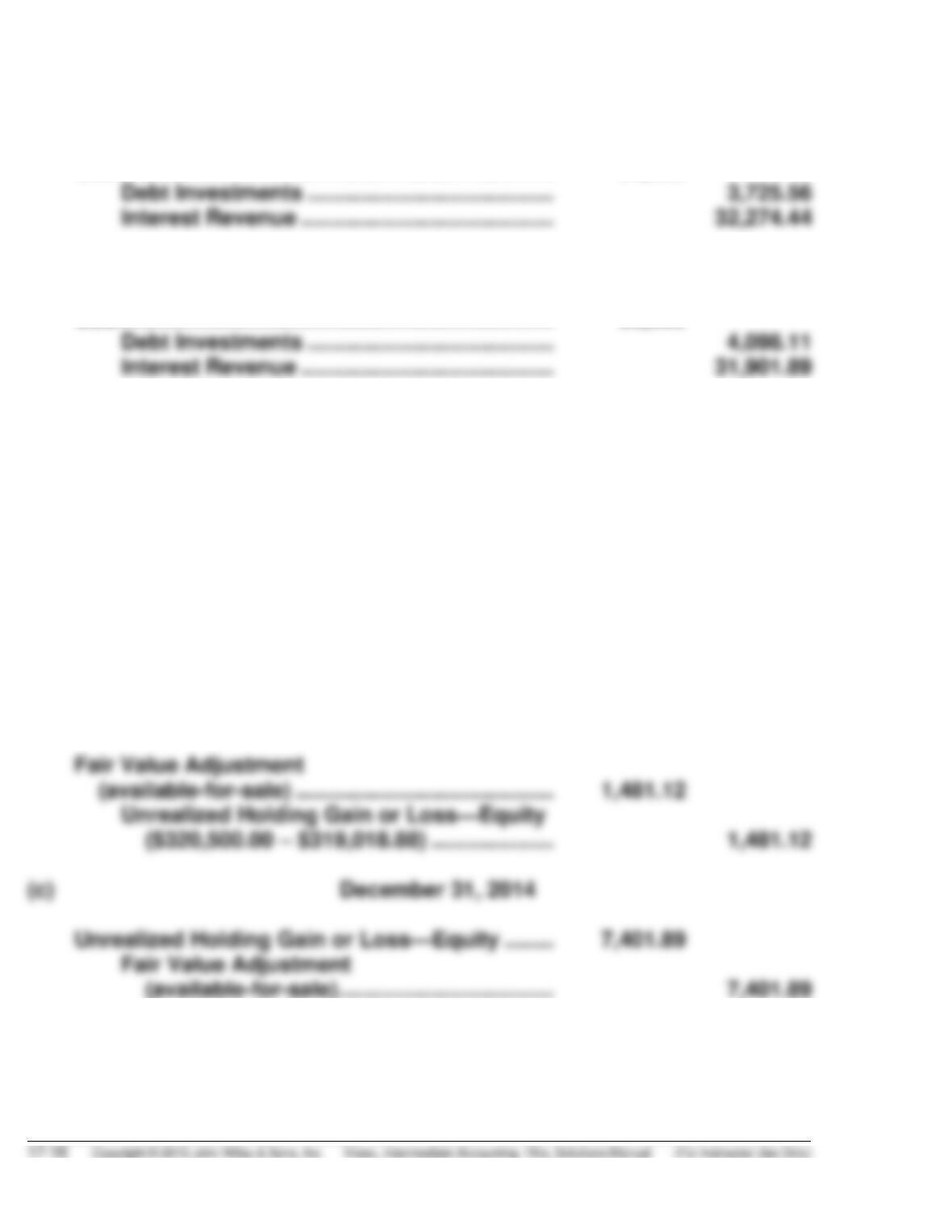
EXERCISE 17-3 (Continued)
(c) December 31, 2013
Cash …………………………………………………………… 36,000
(d) December 31, 2014
Cash …………………………………………………………… 36,000
EXERCISE 17-4 (10–15 minutes)
(a) January 1, 2013
Debt Investments (available-for-sale) ……………. 322,744.44
Cash ……………………………………………………. 322,744.44
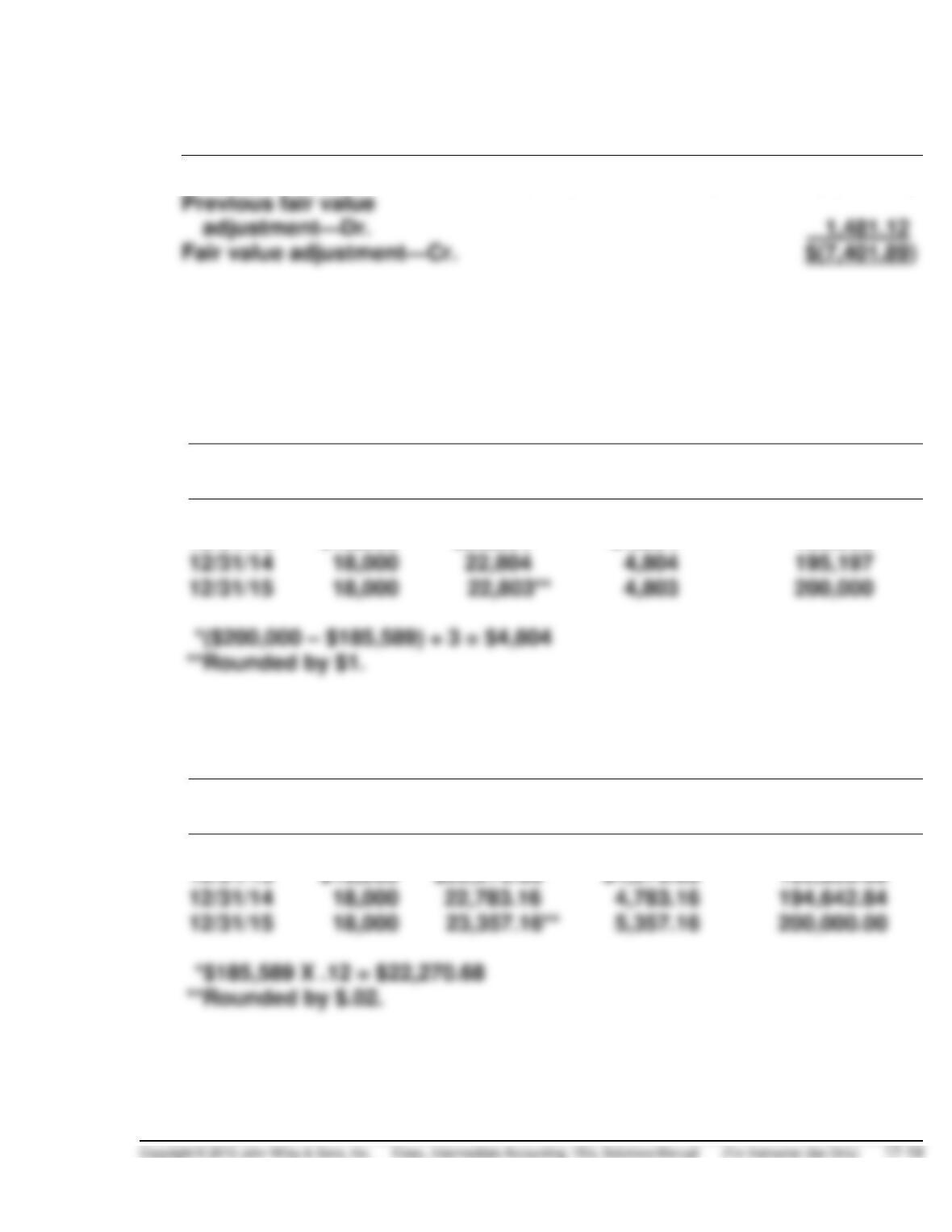
(b) December 31, 2013
Cash …………………………………………………………… 36,000
Debt Investments (available-for-sale) …….. 3,725.56
Interest Revenue ($322,744.44 X .10) ……… 32,274.44
EXERCISE 17-4 (Continued)
Amortized
Cost
Fair Value
Unrealized
Gain (Loss)
Available-for-sale bonds
$314,920.77
$309,000.00
$(5,920.77)
EXERCISE 17-5 (20–30 minutes)
(a) Schedule of Interest Revenue and Bond Discount Amortization
Straight-line Method
9% Bond Purchased to Yield 12%
Date
Cash
Received
Interest
Revenue
Bond Discount
Amortization
Carrying Amount
of Bonds
1/1/13
—
—
—
$185,589
12/31/13
$18,000
$22,804
*$4,804*
190,393
12/31/14
195,197
(b) Schedule of Interest Revenue and Bond Discount Amortization
Effective-Interest Method
9% Bond Purchased to Yield 12%
Date
Cash
Received
Interest
Revenue
Bond Discount
Amortization
Carrying Amount
of Bonds
1/1/13
—
—
—
$185,589.00
12/31/13
$18,000
$22,270.68*
12/31/14
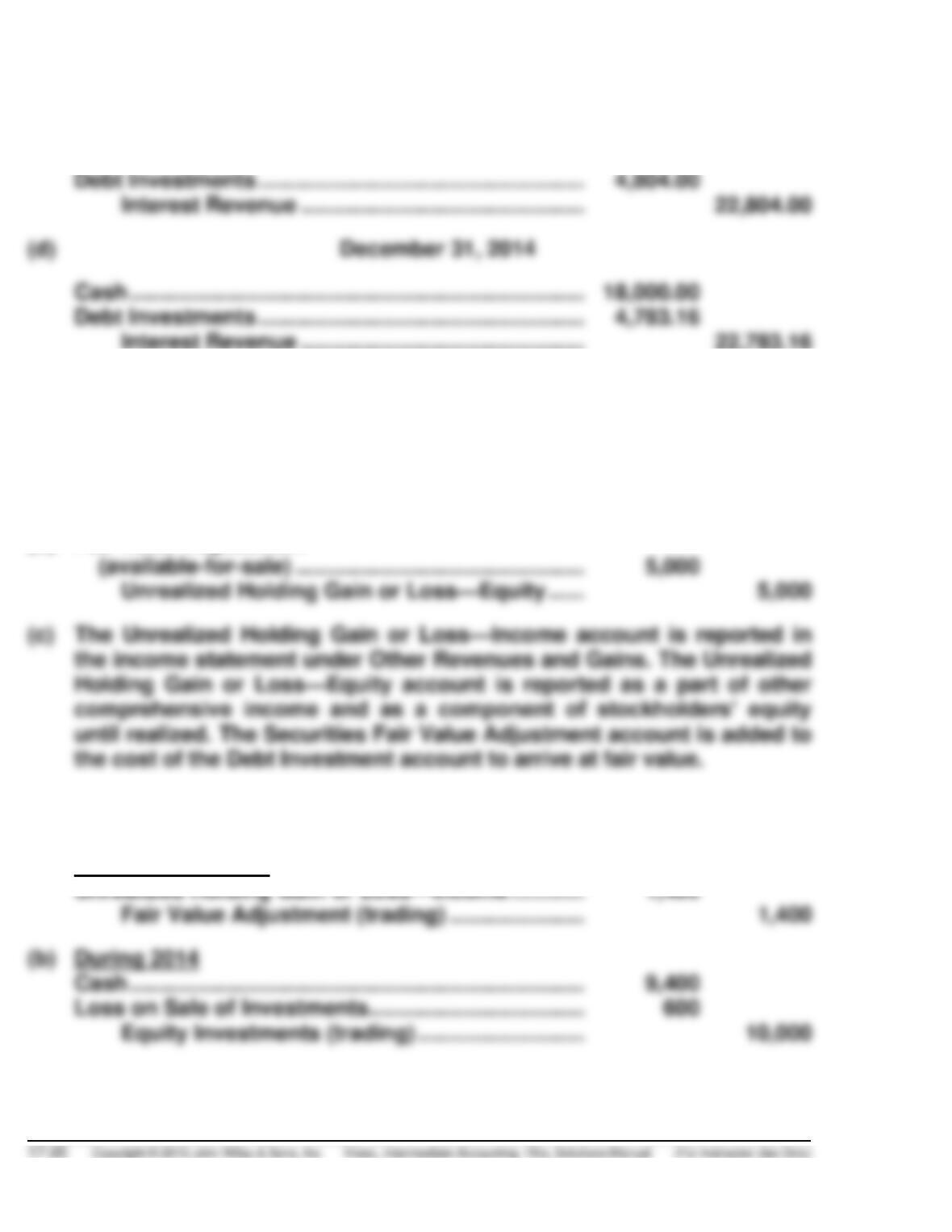
EXERCISE 17-5 (Continued)
(c) December 31, 2014
Cash ……………………………………………………………….. 18,000.00
EXERCISE 17-6 (10–15 minutes)
(a) Fair Value Adjustment
(trading) ………………………………………………………. 5,000
Unrealized Holding Gain or Loss—Income …. 5,000
(b) Fair Value Adjustment
EXERCISE 17-7 (10–15 minutes)
(a) December 31, 2013