CHAPTER 17
Lateral Earth Pressures
QUESTIONS AND PRACTICE PROBLEMS
Section 17.1 Lateral Earth Pressures and Wall Movement
17.1 A massive gravity wall is to be built on a hard bedrock, then backfilled with a very loose
uncompacted cohesionless soil. Which should be used for the design earth pressure
acting on the back of this wall, the at-rest pressure, the active pressure, or the passive
pressure? Why?
Solution
Because the backfill soils are loose, the wall would need to move about 0.04H to develop
17.2 Explain the difference between the active, at-rest, and the passive earth pressure
conditions.
Solution
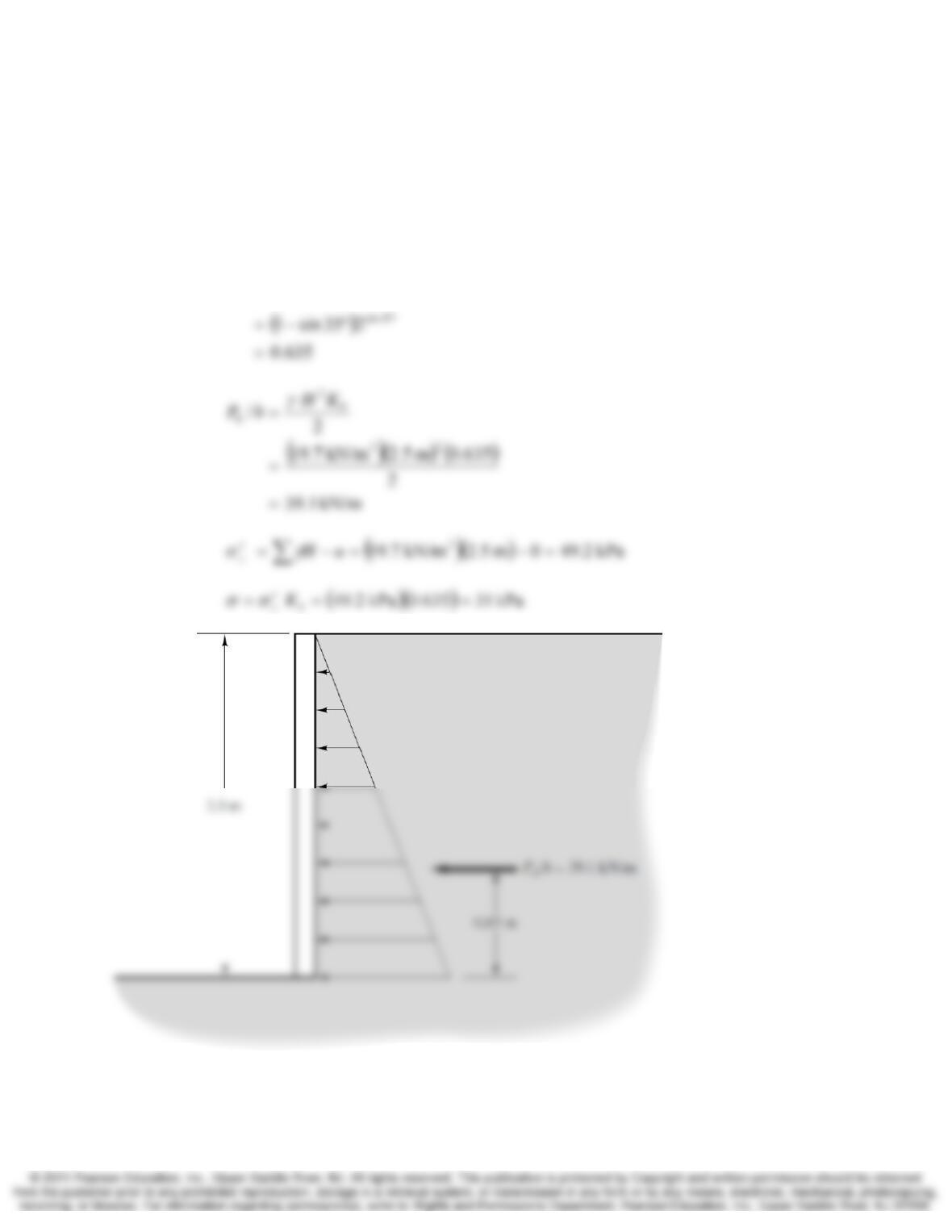
The at-rest pressure is that which acts on a wall that has not experienced any lateral
17.3 Which of the three earth pressure conditions should be used to design a rigid basement
wall? Why?
Solution
A rigid basement wall should be designed using at-rest pressure because it has not moved
17-2 Lateral Earth Pressures Chap. 17
17.4 A basement is to be built using 2.5-m tall masonry walls. These walls will be backfilled
with a silty sand that has c
′
= 0,
φ′
= 35°, and γ = 19.7 kN/m3. Assuming the at-rest
condition will exist and using an overconsolidation ratio of 2, compute the normal force
per meter acting on the back of this wall. Also, draw a pressure diagram and indicate the
lateral earth pressure acting at the bottom of the wall.
Solution
()
‘sin1
‘sin
0
−=
φ
φ
OCRK
Chap. 17 Lateral Earth Pressures 17-3
17.5 A 4-m-tall cantilever wall is to be backfilled with a dense silty sand. How far must this
wall move to attain the active condition in the soil behind it? Is it appropriate to use the
active pressure for design? Explain.
Solution
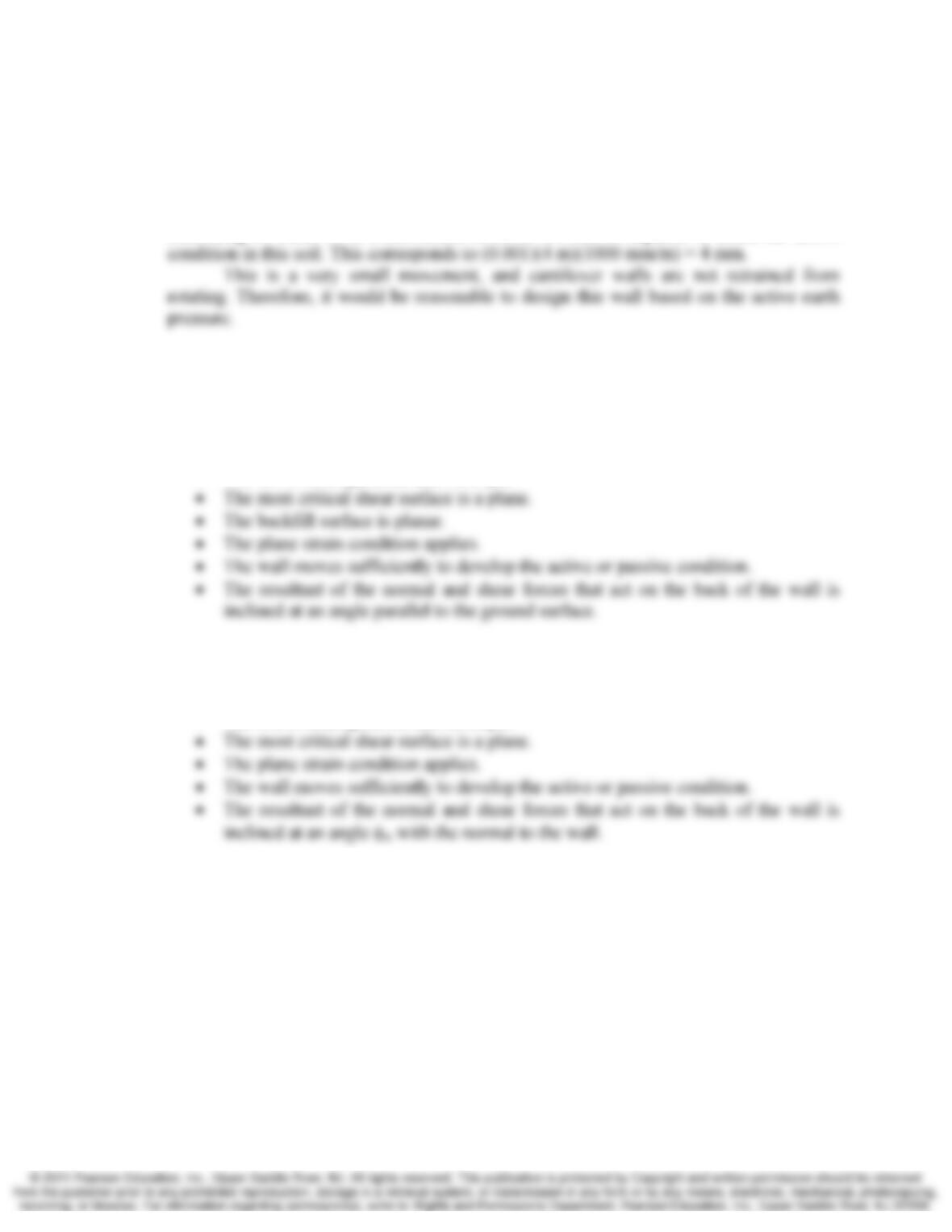
According to Table 17.1, a movement of about 0.001H is required to attain the active
Section 17.2 Classical Lateral Earth Pressure Theories
17.6 State the assumptions in the Rankine’s method of calculating lateral earth pressures.
Solution
• The soil is homogeneous and isotropic.
17.7 State the assumptions in the Coulomb’s method of calculating lateral earth pressures.
Solution
• The soil is homogeneous and isotropic.
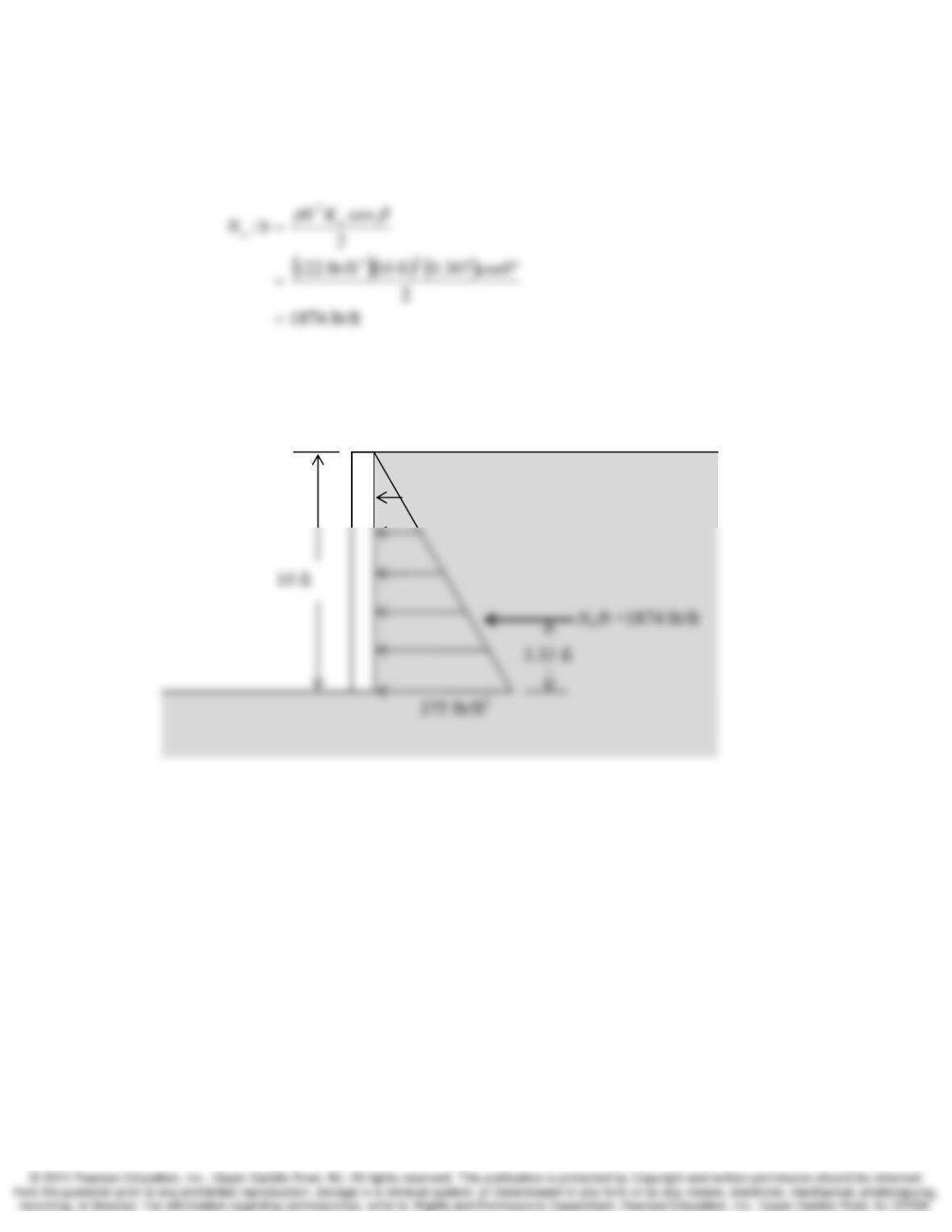
17.8 A 10-ft-tall concrete wall with a vertical back is to be backfilled with a silty sand that has
a unit weight of 122 lb/ft3, an effective cohesion of 0, and an effective friction angle of
32°. The ground behind the wall will be level. Using Rankine’s method, compute the
normal force per foot acting on the back of the wall. Assume the wall moves sufficiently
to develop the active condition in the soil. Also, draw a pressure diagram and indicate
the lateral earth pressure acting at the bottom of the wall.
17-4 Lateral Earth Pressures Chap. 17
Solution
()
(
)
307.02/3245tan2/45tan 22 =°−°=−°=
φ
a
K
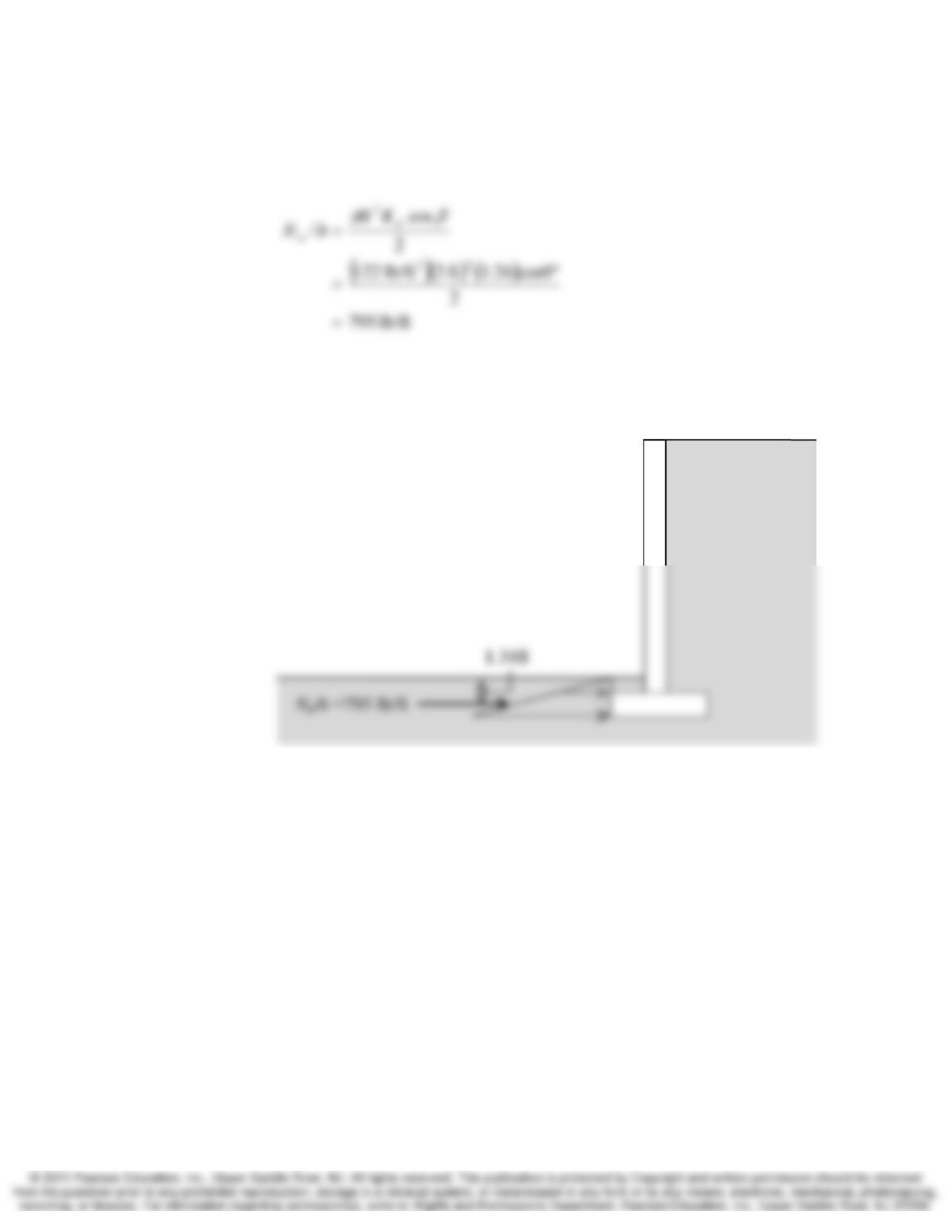
17.9 The wall described in Problem 17.8 has a foundation that extends from the ground
surface to a depth of 2 ft. As the wall moves slightly away from the backfill soils to
create the active condition, the footing moves into the soils below the wall, creating the
passive condition as shown in Figure 17.4. Using Rankine’s method, compute the normal
force per foot acting on the front of the foundation. Draw the distribution of passive
pressure on the front of the foundation. Determine the magnitude of the resultant passive
force and its theoretical point of application.
Chap. 17 Lateral Earth Pressures 17-5
Solution
()
(
)
26.32/3245tan2/45tan 22 =°+°=+°=
φ
p
K
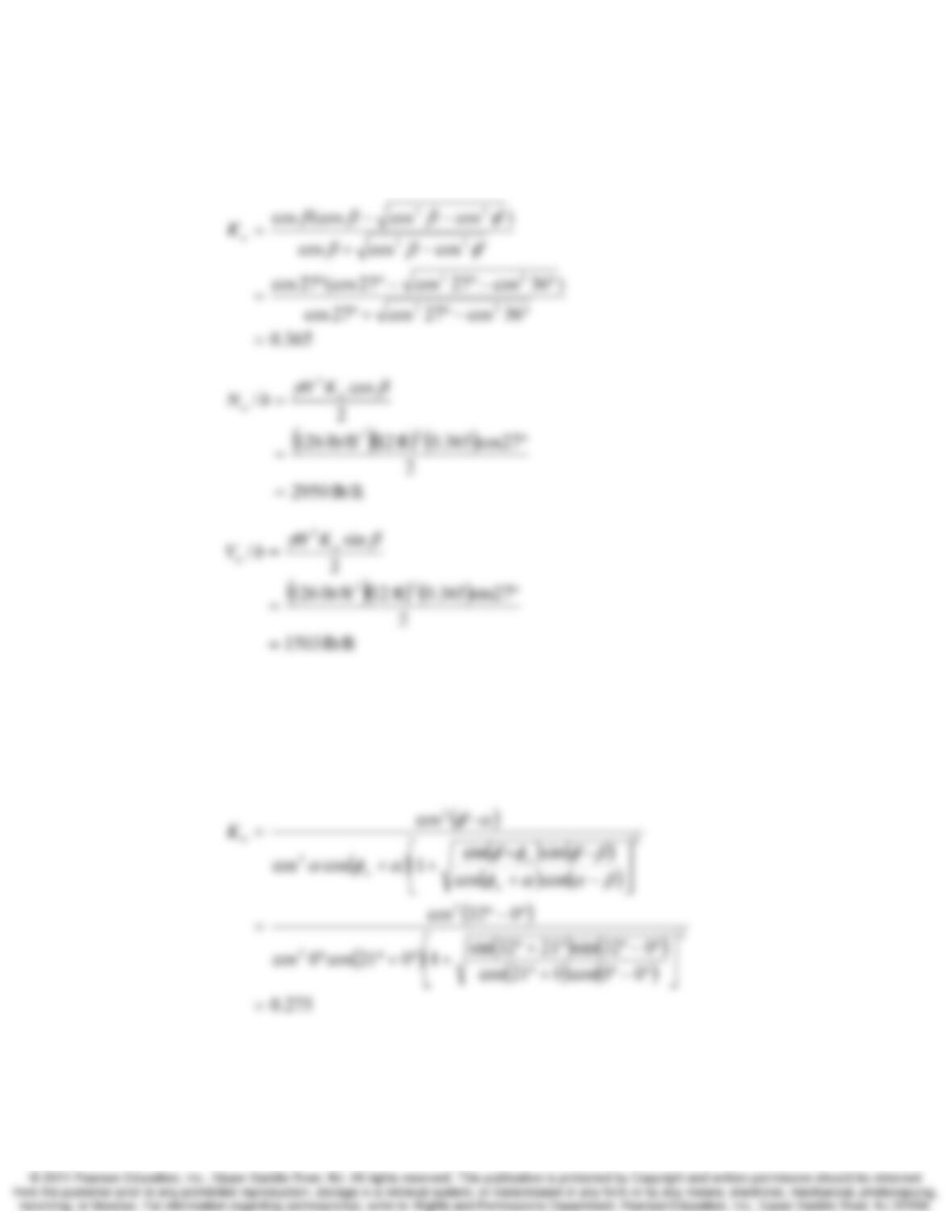
17.10 A 12-ft-tall concrete wall with a vertical back is to be backfilled with a clean sand that
has a unit weight of 126 lb/ft3, an effective cohesion of 0, and an effective friction angle
of 36°. The ground behind the wall will be inclined at a slope of 2 horizontal to 1 vertical.
Using Rankine’s method, compute the normal and shear forces per foot acting on the back
of the wall. Assume the wall moves sufficiently to develop the active condition in the
soil.
17-6 Lateral Earth Pressures Chap. 17
Solution
()
°== −272/1tan 1
β
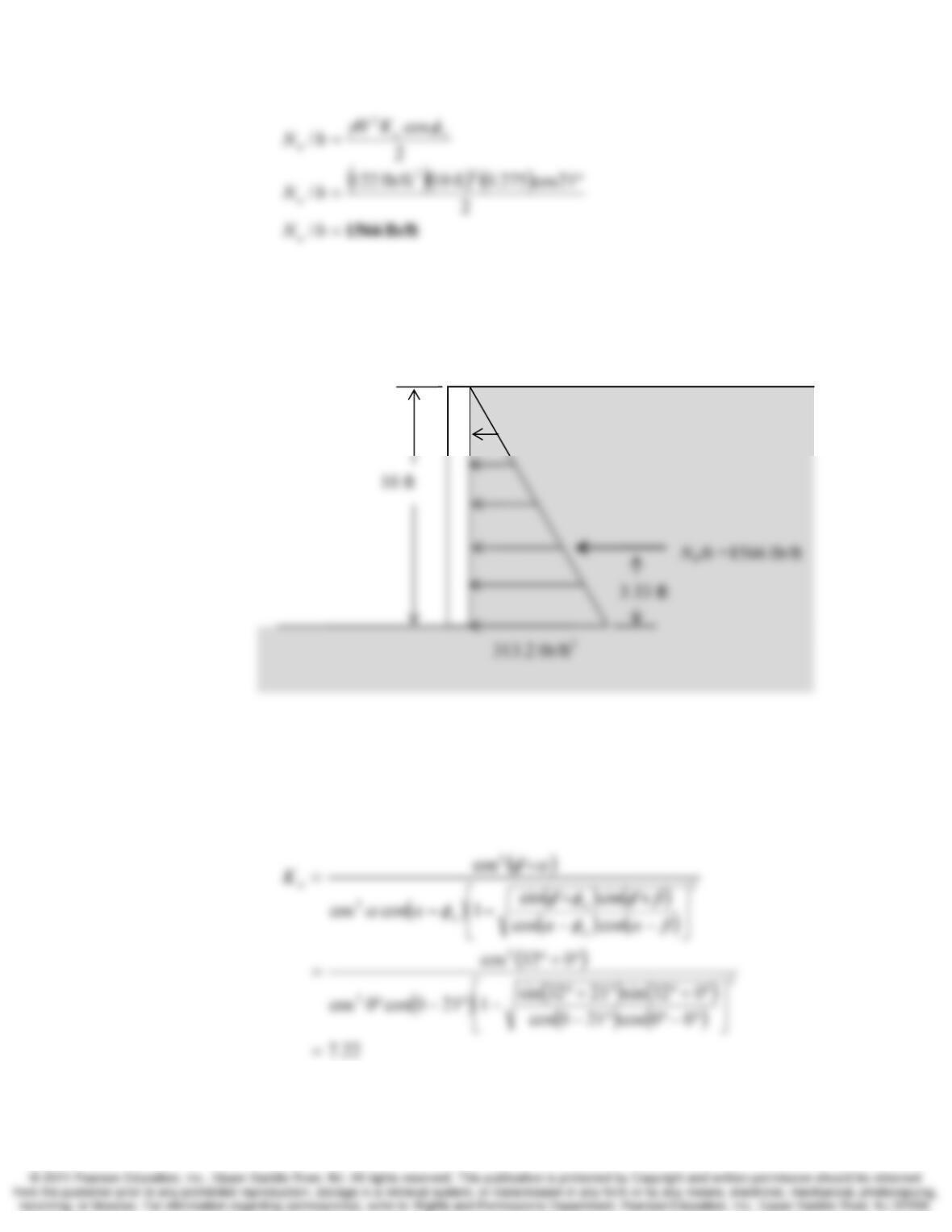
17.11 Repeat Problem 17.8 using Coulomb’s method.
Solution
()
°
=
°== 213267.0‘67.0
φ
φ
w
Chap. 17 Lateral Earth Pressures 17-7
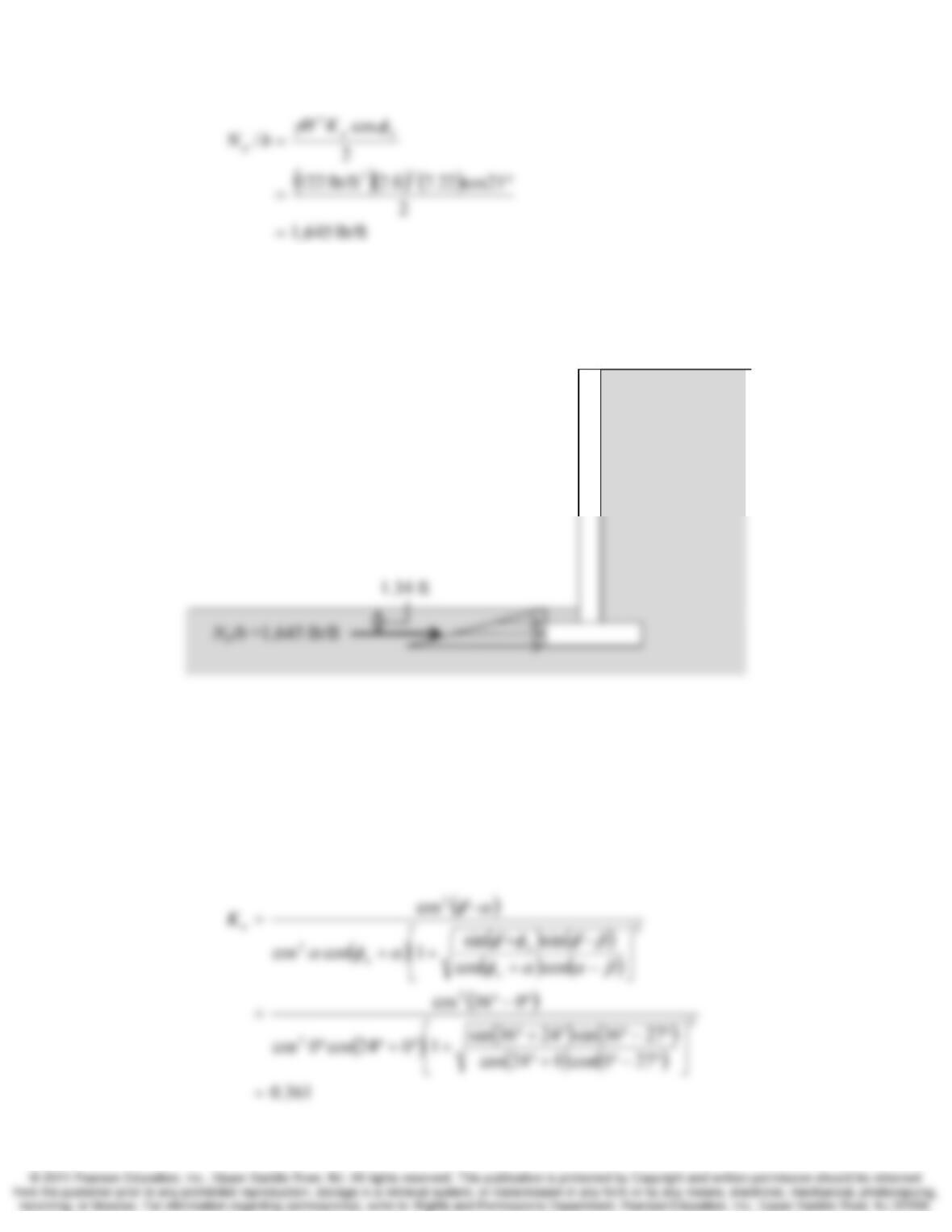
17.12 Repeat Problem 17.9 using Coulomb’s method.
(
)
°
=
°== 213267.0‘67.0
φ
φ
w
17-8 Lateral Earth Pressures Chap. 17
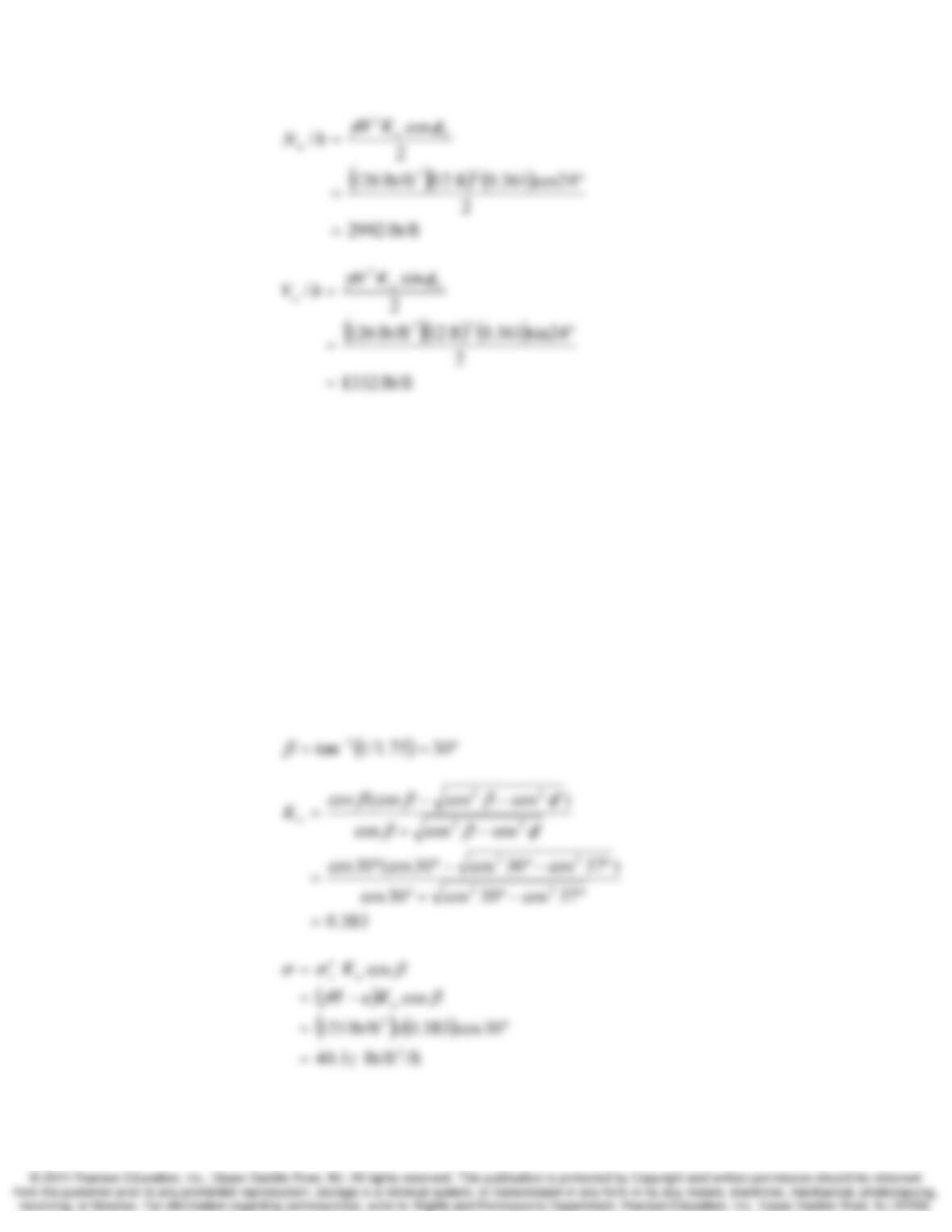
17.13 Repeat Problem 17.10 using Coulomb’s method.
Solution
()
°
=
°== 243667.0‘67.0
φ
φ
w
Chap. 17 Lateral Earth Pressures 17-9
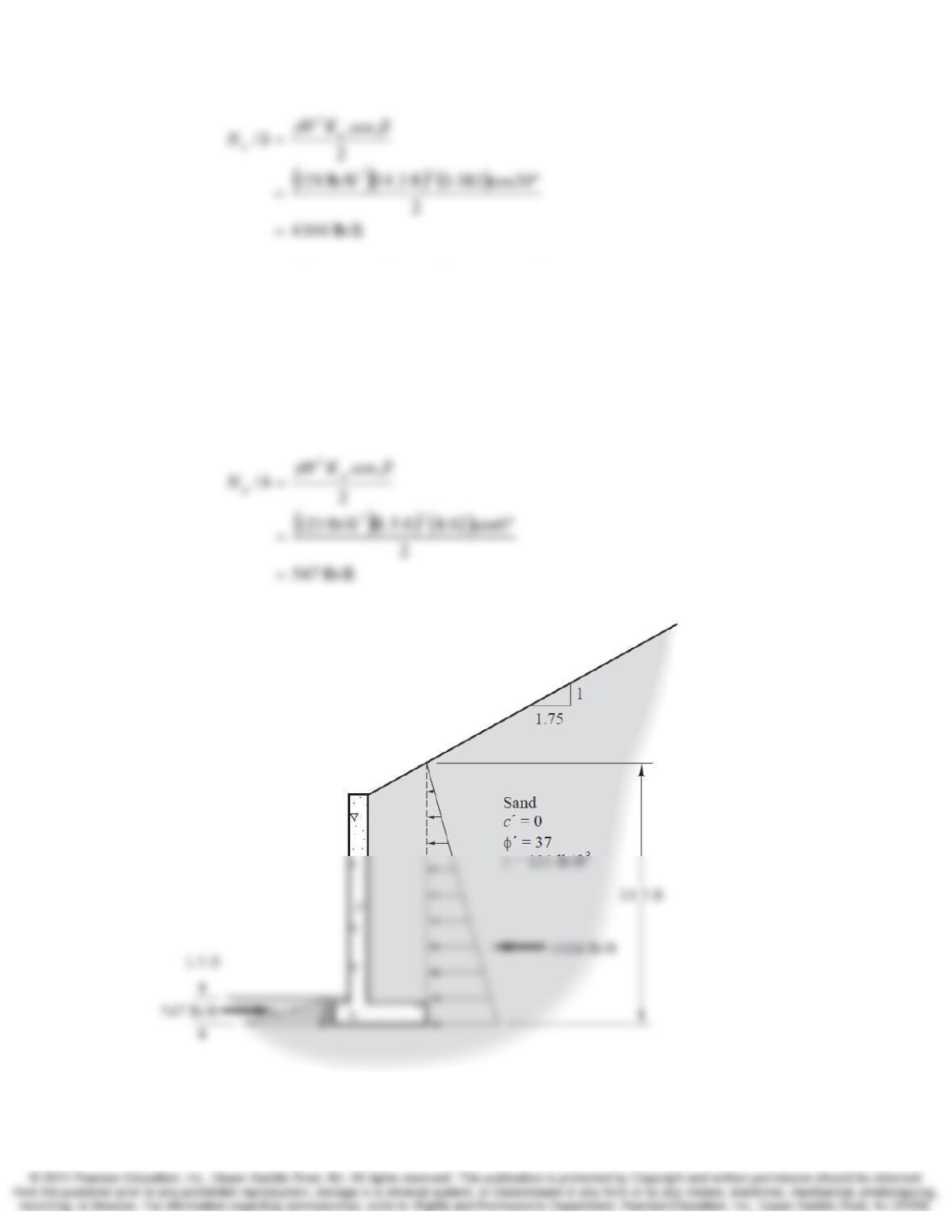
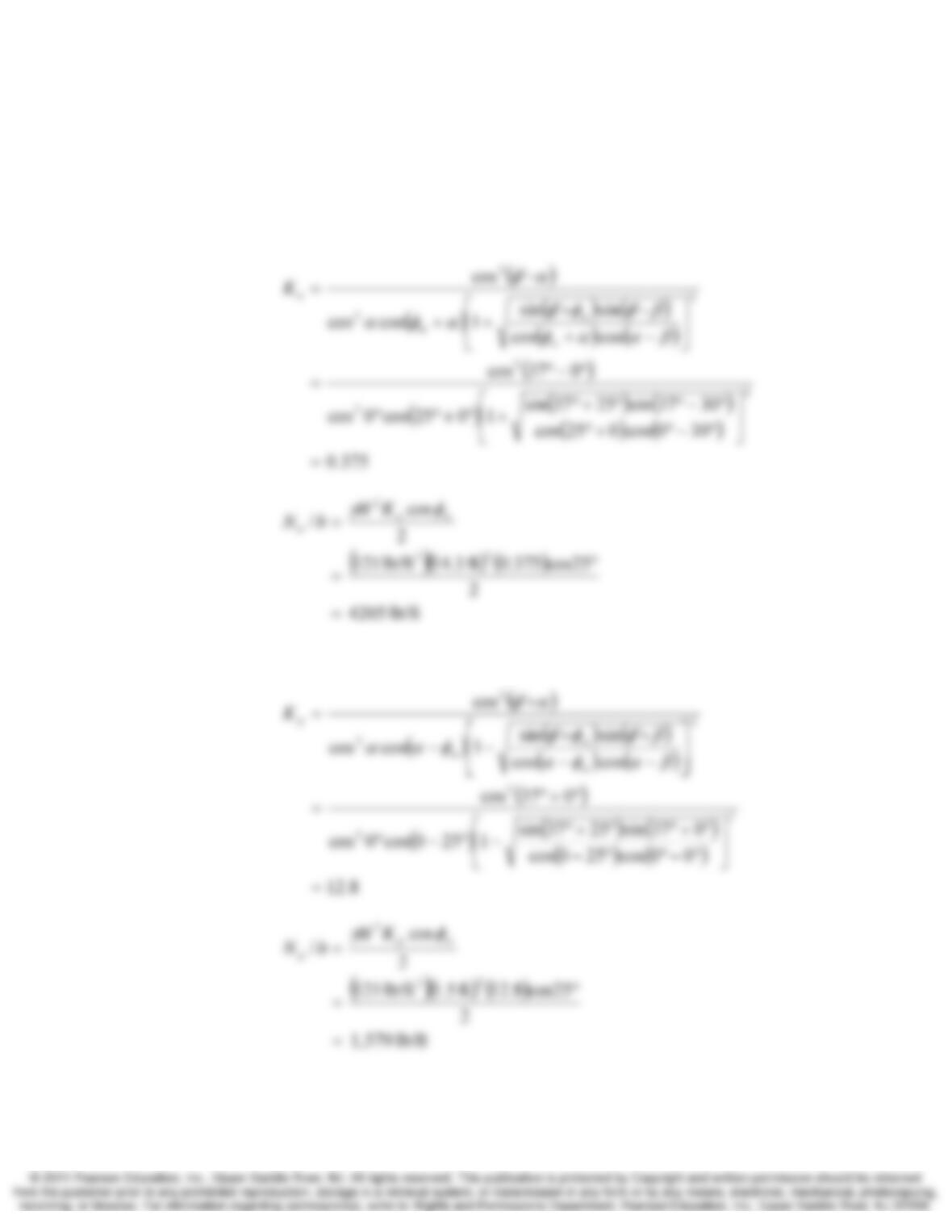
17.14 A proposed concrete retaining wall is to be built as shown in Figure 17.17. Using
Rankine’s method, compute the horizontal component of the active earth pressure acting
on the 14.3-ft-tall dashed line and the passive earth pressure acting on the front of the
footing. Present your results as pressure diagrams. Then compute the resultant of the
active earth pressure and the resultant of the passive earth pressure and show them as
horizontal point loads.
Note: Another important force has not been considered in this analysis: The
sliding friction force along the bottom of the footing. In a properly designed wall, the
combination of this force and the resultant of the passive pressure is greater than the
resultant active pressure with an appropriate factor of safety.
Solution
Let z = depth below ground surface
17-10 Lateral Earth Pressures Chap. 17
()
(
)
02.42/3745tan2/45tan 22 =°+°=+°=
φ
p
K
()
()
()
/ftlb/ft 486
0cos02.4lb/ft 121
cos
cos
2
3
z
z
KuH
K
p
pz
=
°=
−=
′
=
βγ
βσσ
Chap. 17 Lateral Earth Pressures 17-11
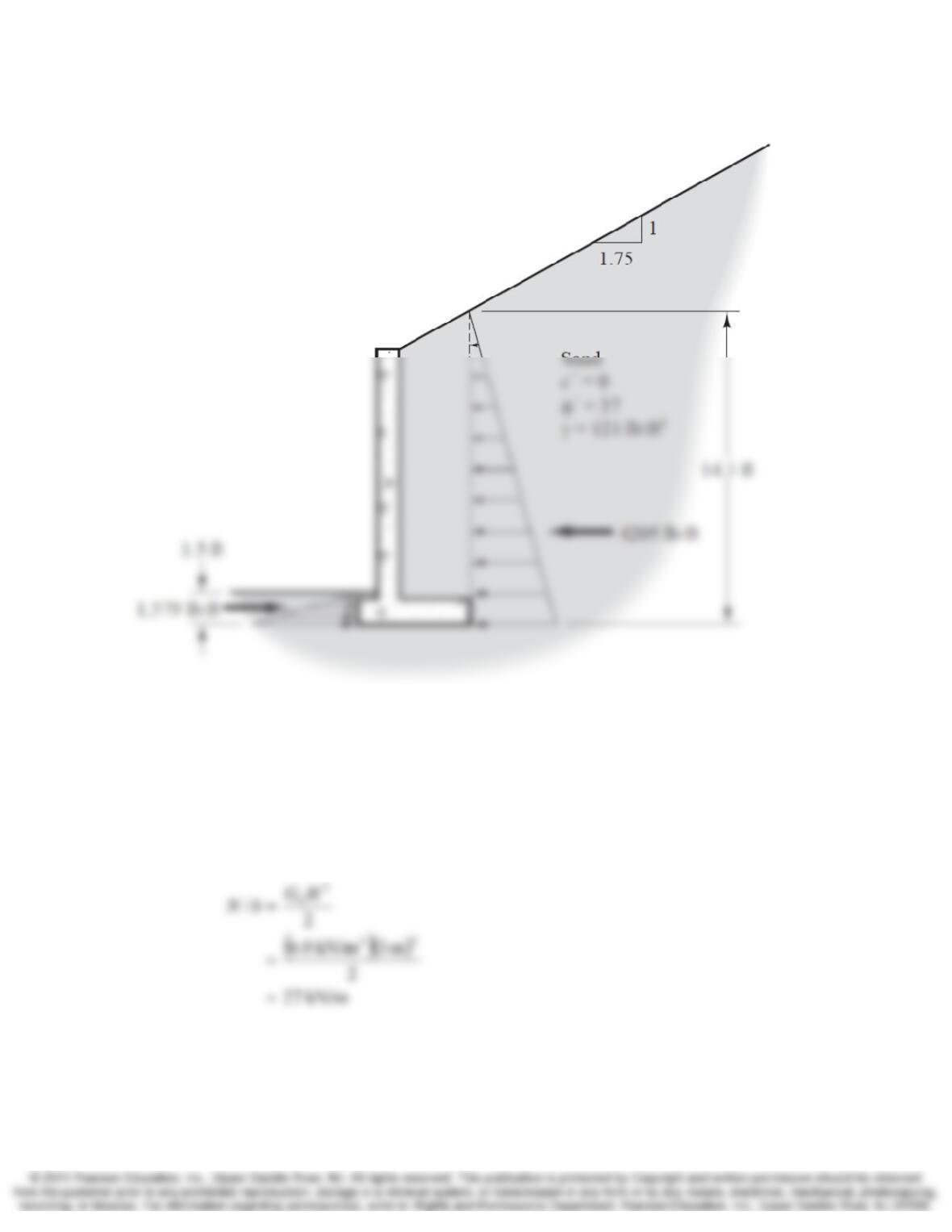
17.15 Repeat Problem 17.14 using Coulomb’s method. Compare your answers with the ones
obtained in Problem 17.14.
Solution
(
)
°
=
°== 253767.0‘67.0
φ
φ
w
The Coulomb Na value is 2.5 percent larger than the Rankine value.
17-12 Lateral Earth Pressures Chap. 17
The Coulomb Np value is 2.9 times the Rankine value.
Section 17.3 Equivalent Fluid Pressure
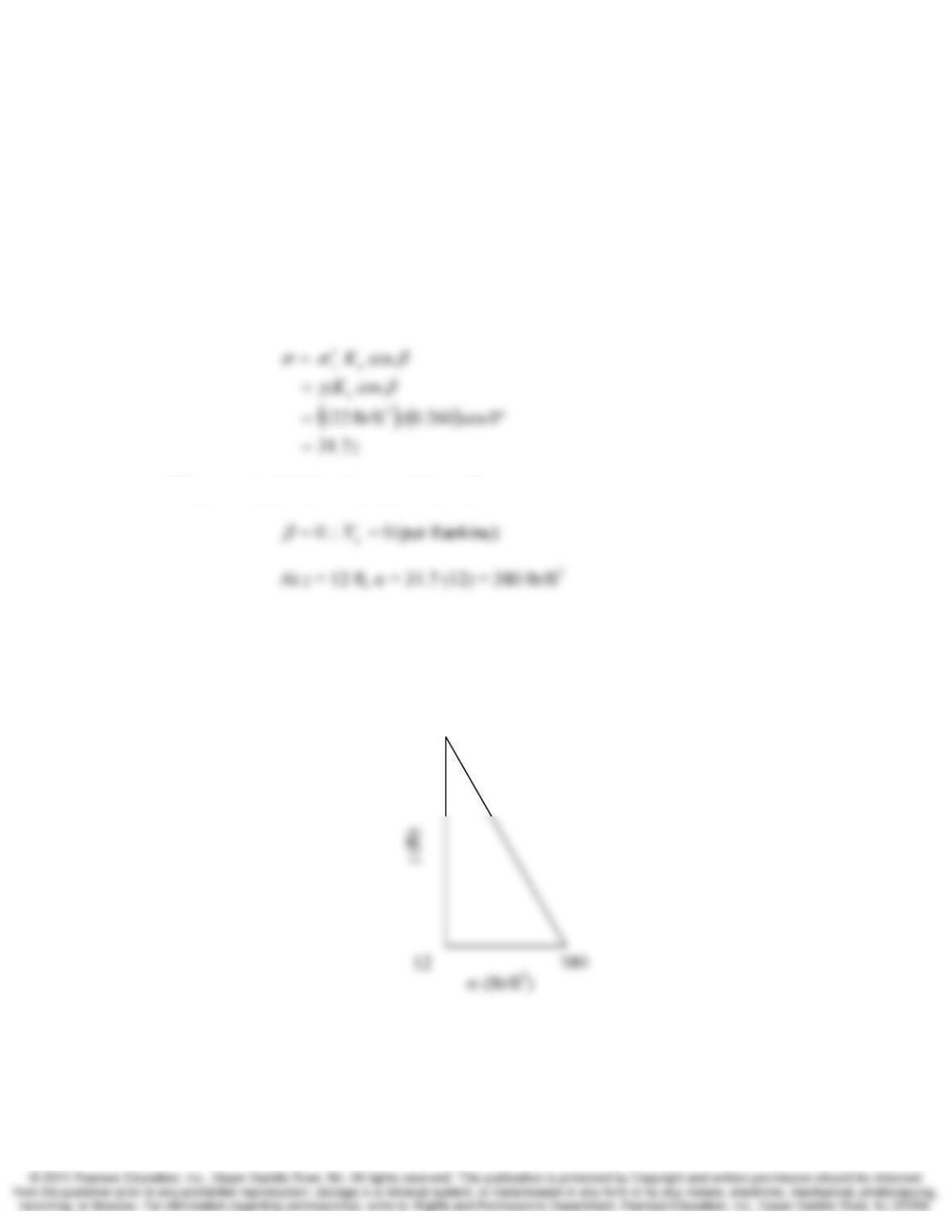
17.16 A 3-m-tall cantilever retaining wall with a vertical back is to be backfilled with a soil that
has an equivalent fluid density of 6.0 kN/m3. Compute the lateral force per meter acting
on the back of this wall.
Solution
Chap. 17 Lateral Earth Pressures 17-13
Section 17.4 Groundwater Effects
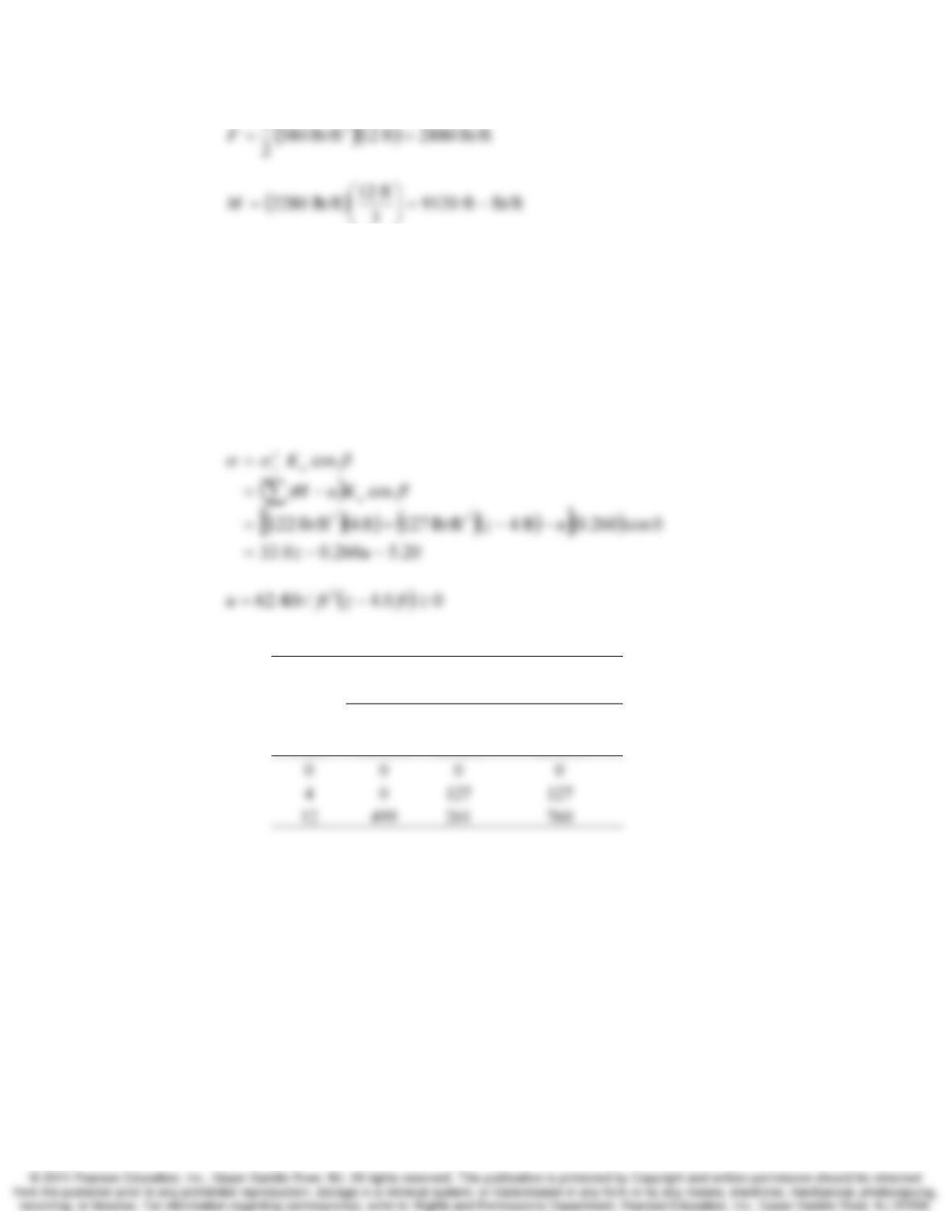
17.17 Using a groundwater table at Level A and Rankine’s method, compute the lateral earth
pressure acting on the back of the concrete wall in Figure 17.18. Present your results in
the form of a pressure diagram, and then compute the total force acting on the wall and
the bending moment at the bottom of the stem.
Solution
()
(
)
260.02/3645tan2/‘45tan 22 =°−°=−°=
φ
a
K
Where z = depth below the top of the wall
0
17-14 Lateral Earth Pressures Chap. 17
⎠
⎝
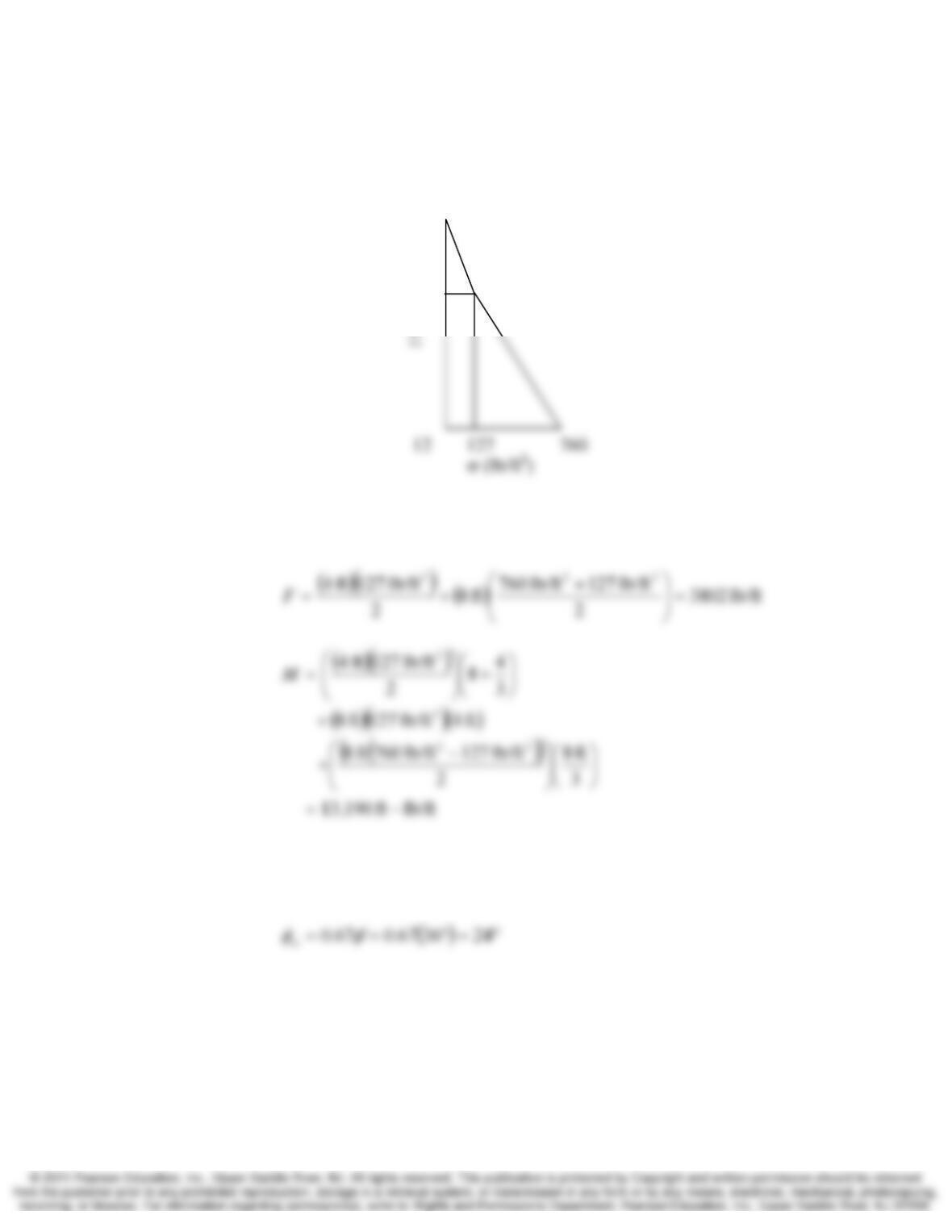
17.18 Using the information from Problem 17.17 and a groundwater table at Level B,
recompute the lateral earth pressures and compute the hydrostatic pressures acting on the
back of the wall. Present your results in the form of a pressure diagram, and then
compute the total force acting on the wall and the bending moment at the bottom of the
stem. Compare the results with those obtained in Problem 17.17.
Solution
4ft,zFor ≥
Total horizontal pressure on the wall = σ + u
z (ft)
Groundwater at b
u
(lb/ft2)
σ
(lb/ft2)
Total Pressure
(lb/ft2)
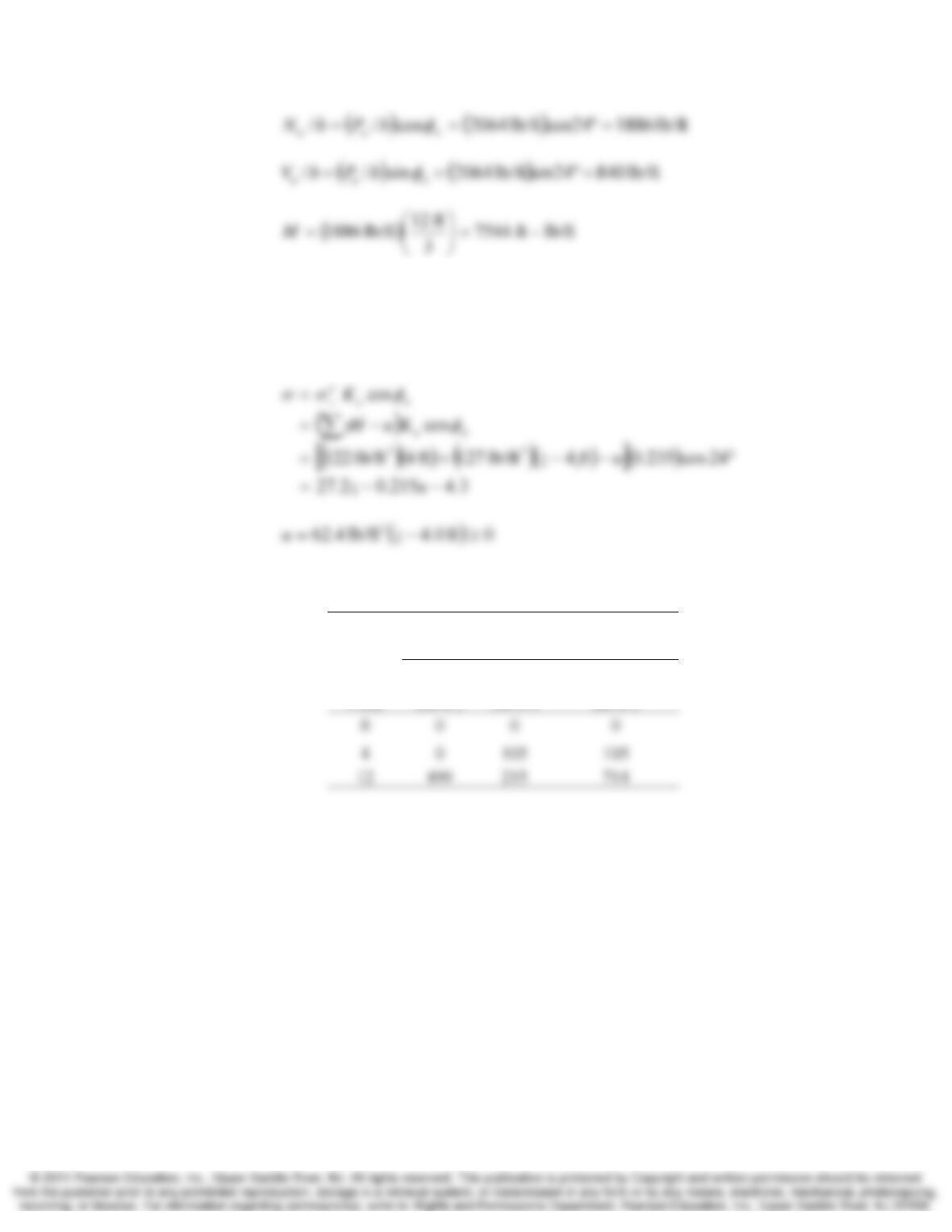
Chap. 17 Lateral Earth Pressures 17-15
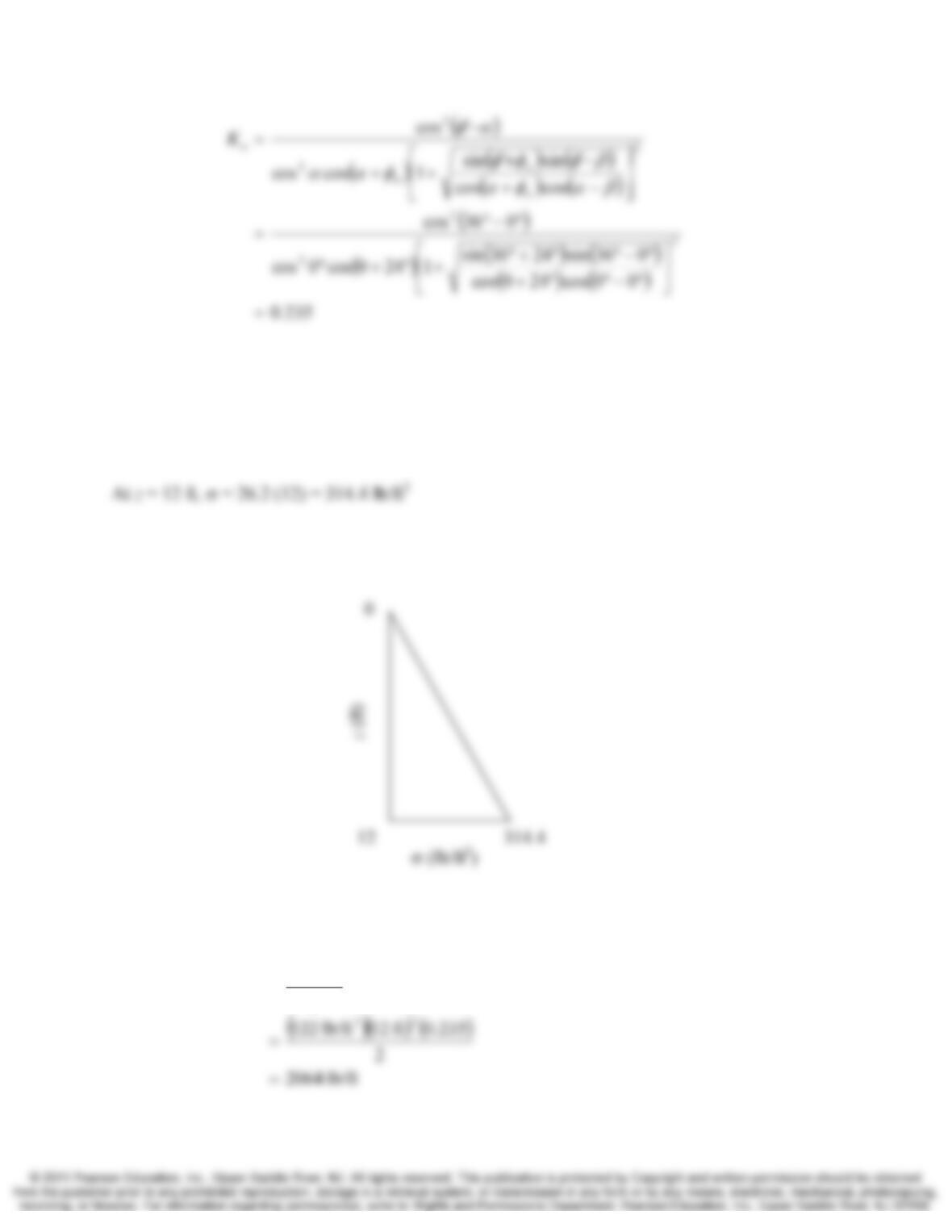
17.19 Repeat Problem 17.17 using Coulomb’s method.
Solution
0
4
17-16 Lateral Earth Pressures Chap. 17
()
()
2
3
lb/ft 26.2z
cos240.235lb/ft 122
cos
cos
=
°=
=
′
=
z
zK
K
wa
waz
φγ
φσσ
2
/
2
=a
a
KH
bP
γ
Chap. 17 Lateral Earth Pressures 17-17
17.20 Repeat Problem 17.18 using Coulomb’s method. Compare the results with those obtained
in Problems 17.17, 17.18 and 17.19.
Solution
Total horizontal pressure on the wall = σ + u
z (ft)
Groundwater at b
u
(lb/ft2)
σ
(lb/ft2)
Total Pressure
(lb/ft2)
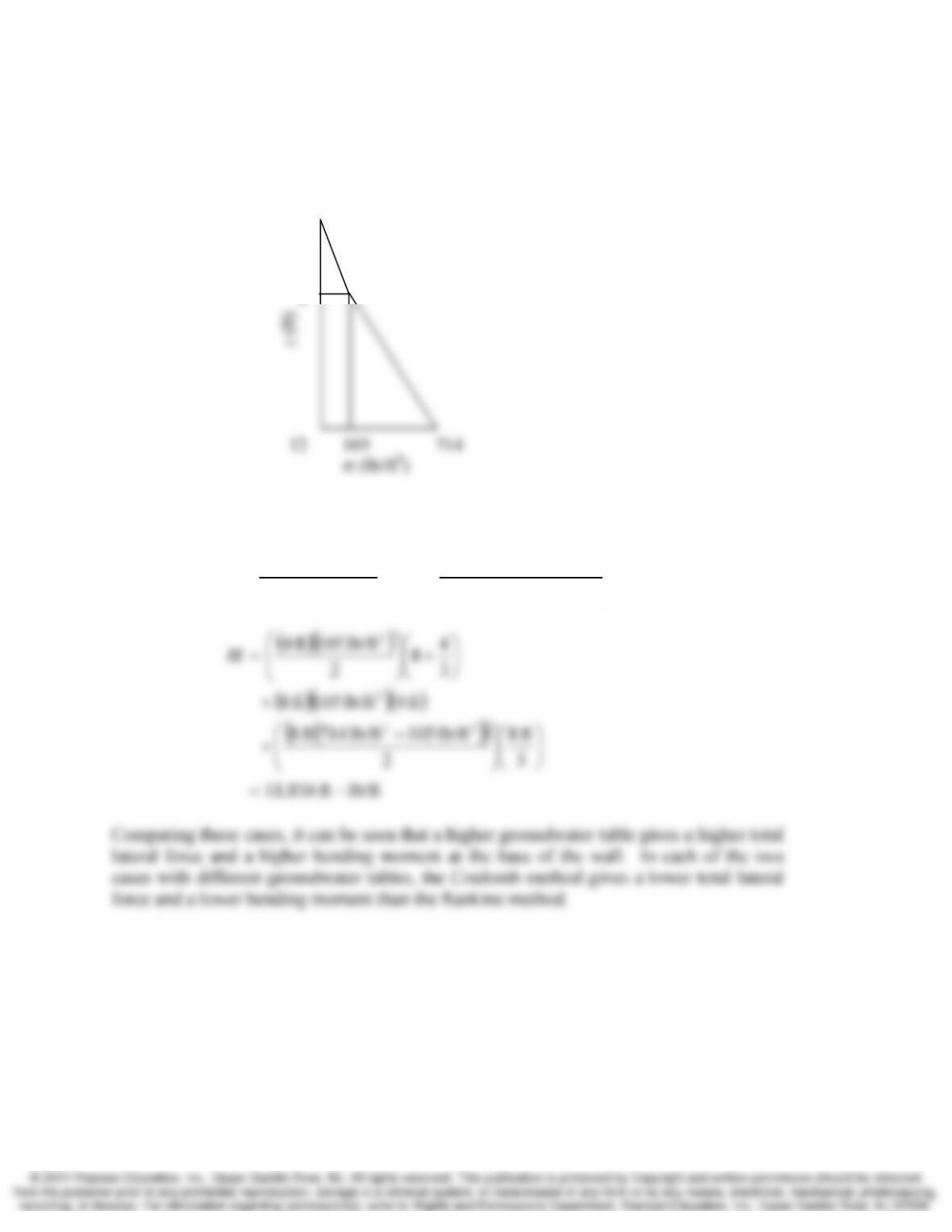
17-18 Lateral Earth Pressures Chap. 17
()
()
()
lb/ft 3486
2
lb/ft 105lb/ft 714
ft 8
2
lb/ft 105ft 4 222
=
⎟
⎟
⎠
⎞
⎜
⎜
⎝
⎛+
+=F
0
4
1
0
5