Chapter 17
Risk Management and the Foreign
Currency Hedging Decision
QUESTIONS
1. Why would an entrepreneur find it desirable to hedge his or her foreign exchange risk?
Answer: An entrepreneur would find it desirable to hedge foreign exchange risk because the
2. Explain Modigliani and Miller’s argument that hedging is irrelevant. What are the
most likely violations of Modigliani and Miller’s assumptions in actual markets?
Answer: Modigliani and Miller argued that a corporation’s financial policies, such as issuing
debt, hedging foreign exchange risk, and other purely financial risk management activities,
do not change the value of the firm’s assets unless these financial transactions lower the
Chapter 17: Risk Management and the Foreign Currency Hedging Decision
2
3. Suppose that after joining the treasury department of a large corporation, you find out
that it avoids hedging because the cost of hedging comes out of the treasury
department’s budget. What argument could you make to the CFO to get the firm
interested in letting you be the firm’s hedging guru?
Answer: There is something wrong with the firm if losses on hedges are booked to treasury
4. Your CFO thinks that the value of your firm fluctuates enormously with the yen–dollar
exchange rate, but he does not want to hedge because he thinks it is an impossible risk
to hedge. Can you convince him otherwise?
Answer: If the value of the firm fluctuates with the yen-dollar exchange rate, the firm must
first determine the sign of the covariance. Suppose that the value of the firm goes up when
5. What does it mean for a tax code to be convex? If a country’s corporate tax rate is flat,
Chapter 17: Risk Management and the Foreign Currency Hedging Decision
3
does it make sense for a firm to hedge?
Answer: A convex tax code imposes a larger tax rate on higher incomes and a smaller tax rate
6. If the tax code is convex and the forward rate equals the expected future spot rate, why
would a firm prefer to pay taxes on the hedged value of a foreign currency cash flow
rather than wait to pay the taxes on the realized foreign currency cash flow?
Answer: In the presence of a convex tax code and if the forward rate equals the expected
7. Why is the gain in a firm’s value greater when more of its future foreign currency
income is in the low tax region of the tax code?
Answer: This question is somewhat poorly phrased. If all of the firm’s foreign currency
8. Why would the managers of a firm take a foreign project with a lower domestic
currency NPV and a higher return variance rather than a foreign project with a higher
domestic currency NPV but a lower return variance?
Answer: This is an example of the asset substitution issue that we covered in Chapter 16.
9. Why would a firm ever forgo a positive NPV project? How can hedging help prevent
this situation from arising?
Answer: If the firm has debt in its capital structure, we know that the managers may forego a
10. Suppose the cash flows from financial hedging are pooled with the cash flows from a
firm’s operations and that the shareholders cannot ascertain the ultimate sources of
profits and losses. Would the managers of the firm want to hedge or to speculate in the
forward foreign exchange market?
Answer: The Peter DeMarzo and Darrell Duffie (1995) argument is the following.
Shareholders must gauge the quality of the firm’s managers based on their observations of
11. Why is an internally generated cash flow of such importance to Merck? Can’t Merck
use the financial markets as a source of funds?
Answer: Merck realized that it was operating in an environment of asymmetric information.
Chapter 17: Risk Management and the Foreign Currency Hedging Decision
5
12. True or false: The cost or benefit of hedging foreign exchange risk when a firm is selling
the foreign currency forward is accurately measured by the forward discount or
premium on the foreign currency.
Answer: We know that if the firm sells the foreign currency in the forward market when the
foreign currency is at a discount, it will generate less domestic currency revenue than if the
PROBLEMS
1. Chapeau Rouge has a Swiss project that will return either CHF300 million or CHF250
million per year of free cash flow indefinitely. Each of the possible CHF cash flows is
equally likely. Chapeau Rouge’s CHF discount rate for these cash flows is 13% per
annum, the cost of the project is €1,100 million, and the current exchange rate is
CHF1.67/EUR. Should Chapeau Rouge accept the project? Suppose that Chapeau
Rouge has a €400 million line of credit with its bank. Will Chapeau Rouge have trouble
hedging the CHF cash flows?
Answer: We need to take the present value of the project in Swiss francs and then convert to
euros at the current spot rate. Since the project’s cash flow is a perpetuity with an expected
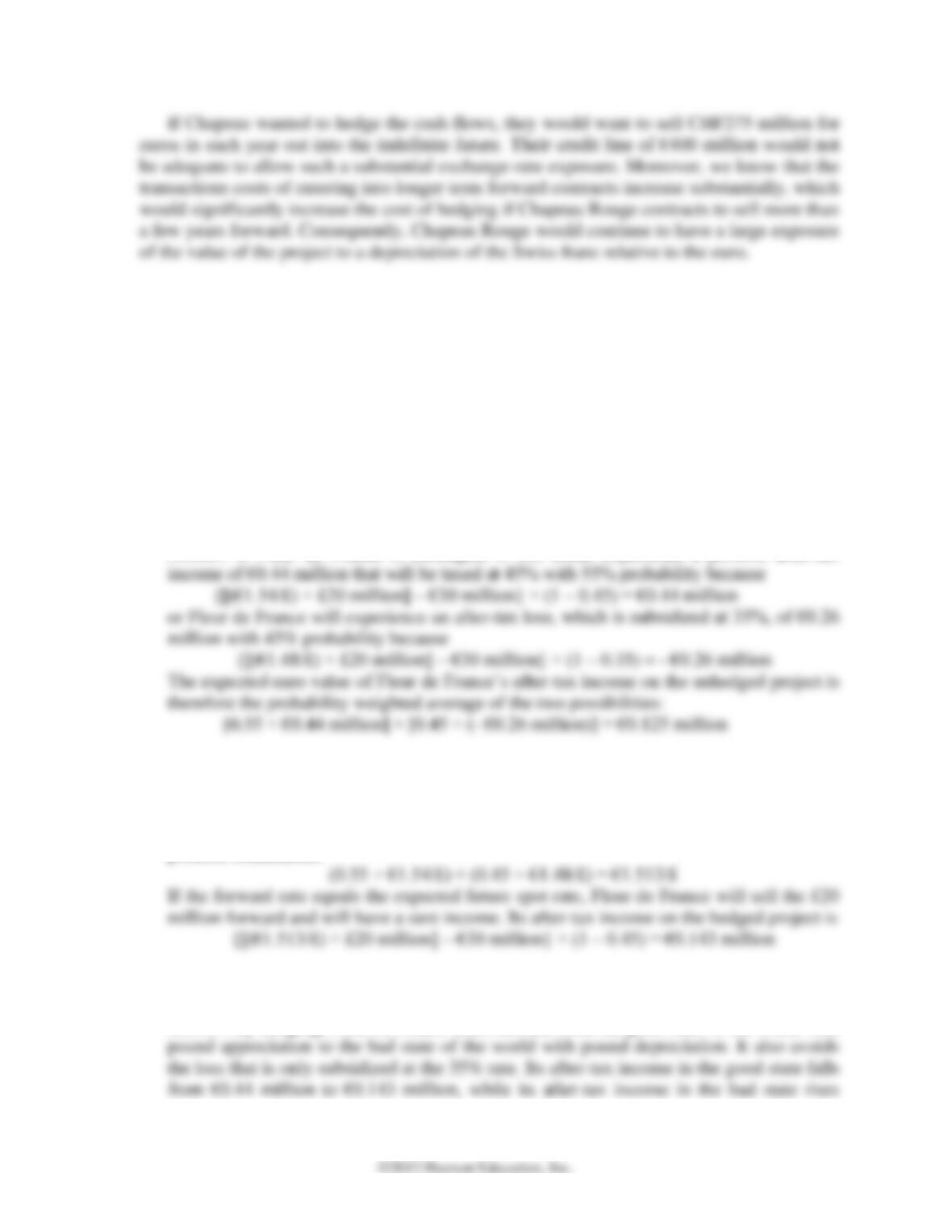
Chapter 17: Risk Management and the Foreign Currency Hedging Decision
6
2. Fleur de France has a project that will provide £20 million in revenue in 1 year. The
project has a euro cost of €30 million that will be paid in 1 year. The cost of the project
is certain, but the future spot exchange rate is not. Assume that there are only two
possible future spot exchange rates. Either the spot rate in 1 year will be €1.54/£ with
55% probability, or it will be €1.48/£ with 45% probability. Assume that the French tax
rate on positive income is 45%, that a firm’s losses are immediately refunded at a rate
of 35%, and that the forward rate of euros per pound equals the expected future spot
rate.
a. If Fleur de France chooses not to hedge its foreign exchange risk, what is the
expected value of its after-tax income on the unhedged project?
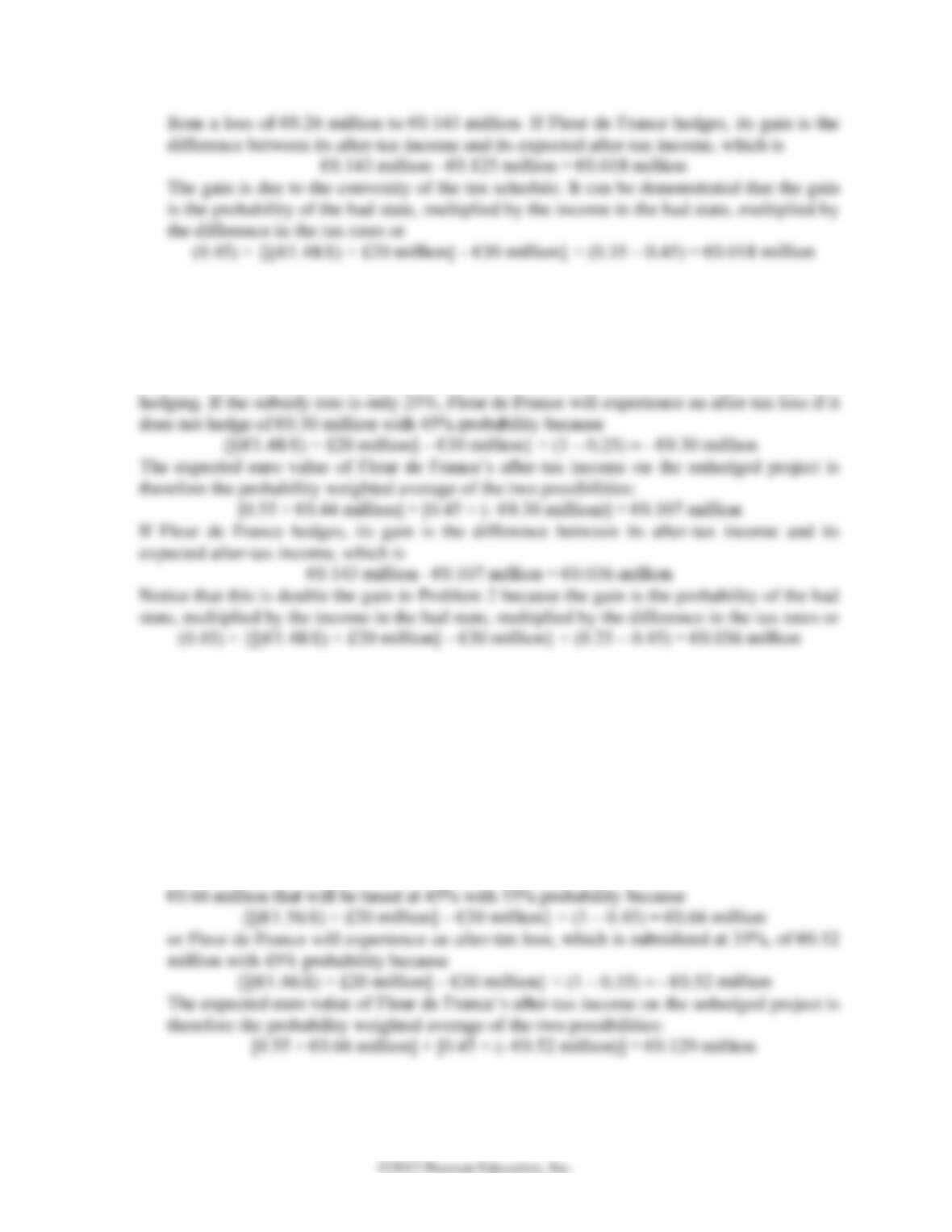
Answer: If Fleur de France is unhedged, it will either experience a positive after-tax
b. If Fleur de France chooses to hedge its foreign exchange risk, what is the expected
value of its after-tax income on the hedged project?
Answer: The expected future spot rate is the probability weighted average of the two
possible realizations:
c. How much does Fleur de France gain by hedging?
Answer: By hedging, Fleur de France shifts income from the good state of the world with
Chapter 17: Risk Management and the Foreign Currency Hedging Decision
7
3. How would your answer to problem 2 change if instead of allowing refunds at 35%, the
refund rate were only 25%?
Answer: We know that the larger the difference between the tax rates, the larger the gain to
4. How would your answer to problem 2 change if the possible exchange rates in the
future were €1.56/£ and €1.46/£?
We know that with a larger variance of the possible future exchange rates, the gain to
hedging is increased. Here are the numbers:
a. If Fleur de France chooses not to hedge its foreign exchange risk, what is the
expected value of its after-tax income on the unhedged project?
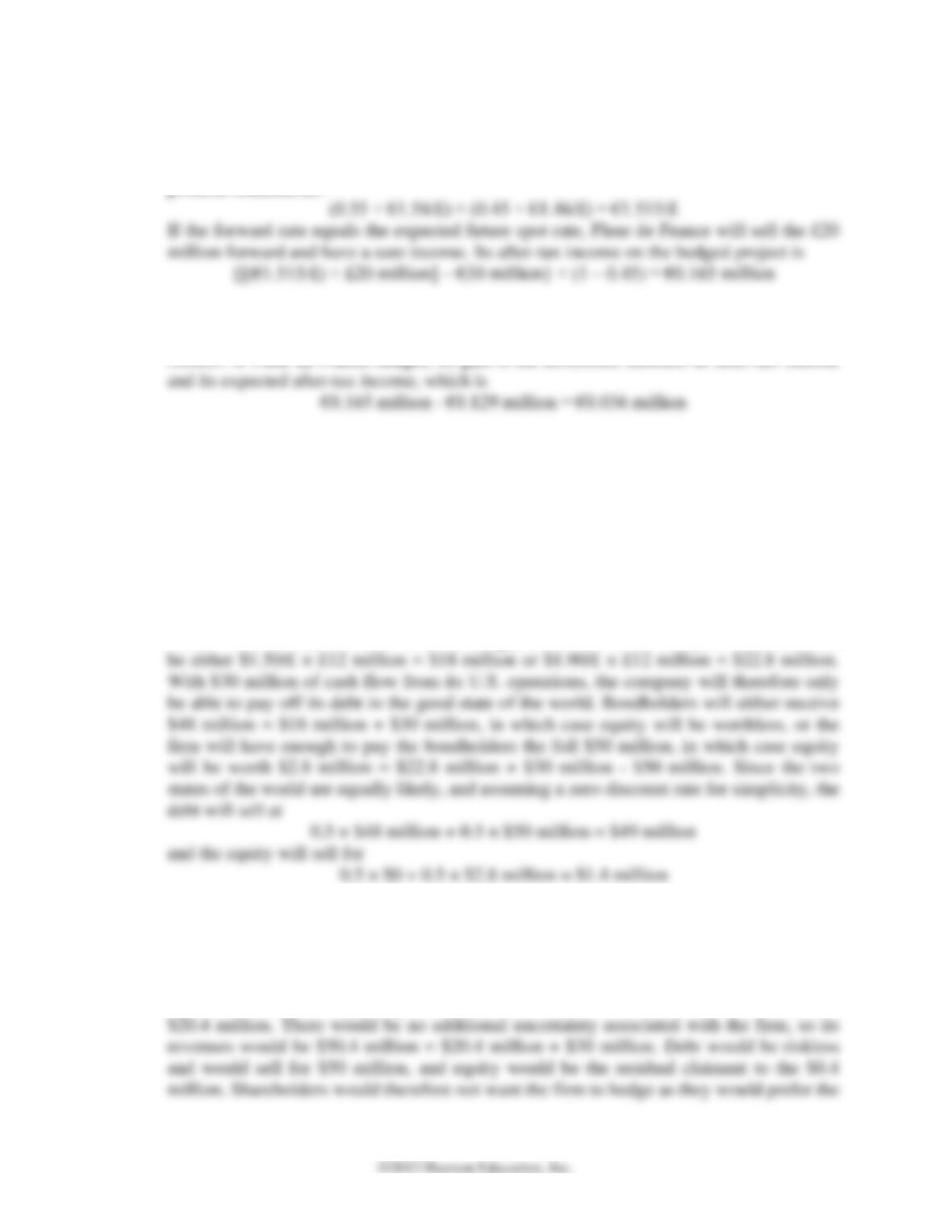
Answer: If Fleur de France is unhedged, it will experience a positive after-tax income of
b. If Fleur de France chooses to hedge its foreign exchange risk, what is the expected
Chapter 17: Risk Management and the Foreign Currency Hedging Decision
8
value of its after-tax income on the hedged project?
Answer: The expected future spot rate is the probability weighted average of the two
possible realizations:
c. How much does Fleur de France gain by hedging?
Answer: If Fleur de France hedges, its gain is the difference between its after-tax income
5. Assume that U.S. Machine Tool has $50 million of debt outstanding that will mature
next year. It currently has cash flows that fluctuate with the dollar–pound exchange
rate. Over the next year, the possible exchange rates are $1.50/£ and $1.90/£, and each
exchange rate is equally likely. The company thinks that it will generate $30 million of
cash flow from its U.S. operations, and its expected pound cash flow is £12 million.
a. If U.S. Machine Tool does not hedge its foreign exchange risk, what will be the
current market value of its debt and equity, assuming, for simplicity, that the
appropriate discount rates are 0?
Answer: If U.S. Machine Tool does not hedge, the dollar value of its pound revenue will
b. Suppose that U.S. Machine Tool has access to forward contracts at a price of
$1.70/£. What is the value of the firm’s debt and equity if it hedges its foreign
exchange risk? Would the shareholders want the management to hedge?
Answer: If the firm hedges its pound revenue, the dollar value is $1.70/£ × £12 million =
Chapter 17: Risk Management and the Foreign Currency Hedging Decision
9
“high variance” project.
c. Suppose U.S. Machine Tool could invest $1 million today in a project that returns
£1 million next period. Is this a good project for the firm?
d. Suppose that U.S. Machine Tool is unhedged, that its managers are trying to
maximize the value of the firm’s equity, and that the $1 million must be raised from
current shareholders. Will the managers accept the project?
Answer: If U.S. Machine Tool does not hedge, the dollar value of its pound revenue will
e. If U.S. Machine Tool hedges its foreign exchange risk, would the firm accept the
project?
6. Example 17.5 demonstrates that hedging is profitable for the Starpower Corporation.
Demonstrate that the benefit to hedging is less if Starpower is more profitable. Do this
by redoing Example 17.5 with possible exchange rates of $0.65/CHF and $0.45/CHF.
Chapter 17: Risk Management and the Foreign Currency Hedging Decision
10
7. Web Question: Go to the Web site of Oanda fxConsulting at
http://fxconsulting.oanda.com and examine their Forex Hedging Policy Statements
document. Do you agree or disagree with their approach? Can you make suggestions
for improving their approach?
Answer: By the time that we had submitted this question and written the answer for the