Accounting Information Systems, 10e 1
SOLUTIONS FOR CHAPTER 17
Each end-of-chapter question in the Solutions Manual is tagged to correspond with AACSB, AICPA
and CISA standards, allowing professors to more easily manage the task of reporting outcomes to these
professional and accrediting bodies. Please see the corresponding spreadsheet file for the tagging
information.
Discussion Questions
DQ 17-1 Discuss several factors affecting (negatively or positively) the achievement of
systems development objectives.
ANS. AIS acquisition and development objectives include acquiring/developing an AIS
that satisfies an organization’s strategic informational and operational needs in an
efficient and effective manner. Possible factors affecting achievement of this
include the following:
a. Lack of senior management support. Management controls the budget for the
acquisition project and directs the priorities for time, effort, and money.
2 Solutions for Chapter 17
DQ 17-2 How might the absence of an organization’s strategic plan for the information
system affect the conduct of a preliminary survey? Hint: Discuss the potential
difficulties of making preliminary survey decisions in the absence of each of the
strategic plan components.
ANS. The purpose of conducting a system survey is to evaluate the importance and need
for the potential system—individually and relative to other projects—and to
DQ 17-3 In doing a preliminary survey for the proposed automation of the payroll system
of Grant Black, Inc, the analyst in charge reached the tentative conclusion that
Ron Clay, the popular cashier with more than 30 years of company service, will
be displaced and perhaps asked to consider early retirement. Discuss how this
scenario relates to the concept of “operational feasibility” presented in this
chapter. Discuss the potential impact on the success of the new disbursements
system.
ANS. An information system is more than hardware, software, and policies. The users
of the system are a very important component, and their attitudes can have an
DQ 17-4 “Choosing among renting, leasing, and purchasing an AIS is strictly a financial
decision and should be done by the finance staff.” Do you agree? Discuss fully.
ANS. In addition to the obvious financial differences among these choices, other
considerations include the following:
• Flexibility
Accounting Information Systems, 10e 3
DQ 17-5 “A vendor would never propose a system that would not meet an organization’s
needs. Therefore, external validation of vendor proposals is not really needed.”
Do you agree? Discuss fully.
ANS. A vendor might submit a proposal that did not meet an organization’s needs in
many situations. For example:
DQ 17-6 “As long as we plan a systems development project and carry out the project in
an orderly manner, we don’t need a formal, documented systems development
methodology.” Do you agree? Discuss fully.
ANS. In one sense, the statement is correct. However, a systems development
methodology offers some features that may improve the development effort:
DQ 17-7 One of the tasks of systems analysis is to choose and justify one of the alternative
design solutions. Would it not be more effective, efficient, and practical for the
systems analyst to pass along all alternative design solutions to top management
(perhaps to the IT steering committee), together with arguments for and against
each alternative, and let top management choose one of them? After all, top
management has a broad perspective that the systems analyst does not possess.
Discuss fully.
ANS. Note: The following answer assumes that the information technology steering
committee (SC) is the top management body to which the systems analyst (SA)
makes her recommendations.
4 Solutions for Chapter 17
• Recall from Chapter 8 in the textbook that the SC generally is composed of
executives from the organization’s major functional areas. This top-level
management committee should be concerned only with broad, global issues
involving resource allocation, goal congruence, and progress in achieving the
firm’s strategic plan. The members have neither the time nor, in general, the
technical expertise to immerse themselves in the details of alternative designs.
For the detailed evaluation of technical, operational, and economic feasibility,
they must delegate responsibility to the experts (i.e., users and SAs), who will
filter the information that is reported upward to the SC.
• Typically, the analysis team does perform a cost/effectiveness study for more
than one alternative. The systems analysis document that is submitted to the
SC might well contain comparative summaries of several alternatives.
DQ 17-8 Discuss the decisions that must be made prior to initiating structured systems
analysis. Indicate how the systems survey contributed to the decision.
ANS. A review of the systems survey goals helps us answer this question. The purpose
of the systems survey was to determine the existence, nature, and scope of the
Accounting Information Systems, 10e 5
DQ 17-9 Indicate who you would include on a systems analysis project team in each of the
following situations, and discuss fully the reasons why you would include each
member you suggest.
ANS. Note: As is the case with many open-ended discussion questions such as this one,
we can only suggest some possibilities in the solution that follows. Obviously,
ANS. In addition to a systems analyst from the information systems department, a
representative from each of the following departments is a likely candidate for
inclusion on the project team. Each department or function is represented because
it has different information needs in respect to the student:
• Admissions
• Student affairs (we assume that this department would embody such
nonacademic student activities as campus housing, meal plans, student
counseling, campus security, and legal)
ANS. Note: This answer assumes that the customer is an individual rather than a
business. However, for a business, some of the departments would be similar (i.e.,
commercial lending rather than mortgage lending for the individual).
6 Solutions for Chapter 17
department is represented because it has different (but sometimes overlapping)
information needs in respect to the customer:
• Depositor accounts (i.e., checking accounts, savings accounts, including
preparing and mailing periodic statements of account activity)
ANS. In addition to a systems analyst from the information systems department, we
would include the following individuals/departments (or their representatives) on
the project team. We include each team member because he interacts either
directly or indirectly with the materials requirements planning system.
• Master production scheduler
DQ 17-10 “If the results of the cost/benefit analysis do not agree with those of the
effectiveness analysis, there is probably no difference among the alternatives.”
Discuss fully.
ANS. The cost/benefit analysis deals with questions of efficiency, addressing only those
factors on which a monetary value can be placed. The end result is a ranking of
DQ 17-11 Discuss why the knowledge of documentation procedures (such as DFDs and
systems flowcharts) is important to the acquisition/development process.
Accounting Information Systems, 10e 7
ANS. It is nearly impossible to understand an existing system without a visual
representation of the system. Typically, when moving to a new system, it is not
enhanced when employees see how their jobs fit into the overall system.
DQ 17-12 The Eureka Company requests bids from vendors for specific configurations
rather than bids for general performance objectives because it “knows what it
needs.” Discuss fully.
ANS. Even if an organization knows what it needs, requests for specific configurations
sacrifice the following advantages of using an RFP with performance objectives:
DQ 17-13 “An organization puts itself at a disadvantage by asking only one vendor (versus
asking several vendors) for a proposal for hardware or software.” Do you agree?
Discuss fully.
ANS. In general, this statement is true. With only one vendor proposal an organization
cannot do the following:
• Obtain much help in generating ideas regarding possible solutions to the
information processing problem
8 Solutions for Chapter 17
DQ 17-14 Compare and contrast the efficiency and effectiveness of an in-house data center,
an arrangement with an outsourcing vendor to own and operate a data center for
you, a service bureau, an applications service provider (ASP),Business Process
Outsourcing (BPO) and software as a service (SaaS).
ANS. In general, a data center over which we have relatively more control will be more
effective at meeting our needs. For example, a decentralized data center will be
designed and operated to meet the needs of the local (decentralized) managers,
A service bureau may be as efficient as a centralized data center because it can
distribute the costs for certain hardware, software, and personnel to many users.
For example, the data center will only need one site license for its systems
software. That software can then be used for multiple clients, and the cost for that
software can be factored into the prices charged to those clients. Each client then
pays only a fraction of the total cost. However, the service bureau may not be
tailored to any particular user’s needs.
An application service provider combines some of the positive and negative
qualities of the service bureau and the outsourced data center; in particular, while
the ASP can provide some of the economies of scale advantages of BPOs, their
primary advantage is in that they can employ highly skilled experts in the service
provided. As with a service bureau, variable pricing often applies; that is, you pay
for only what you use. Like the service bureau, the services may not be tailored to
the particular needs of the acquiring organization.
Accounting Information Systems, 10e 9
DQ 17-15 Assume that you are the manager of an accounts receivable department. How
might you be involved in system testing? Discuss fully.
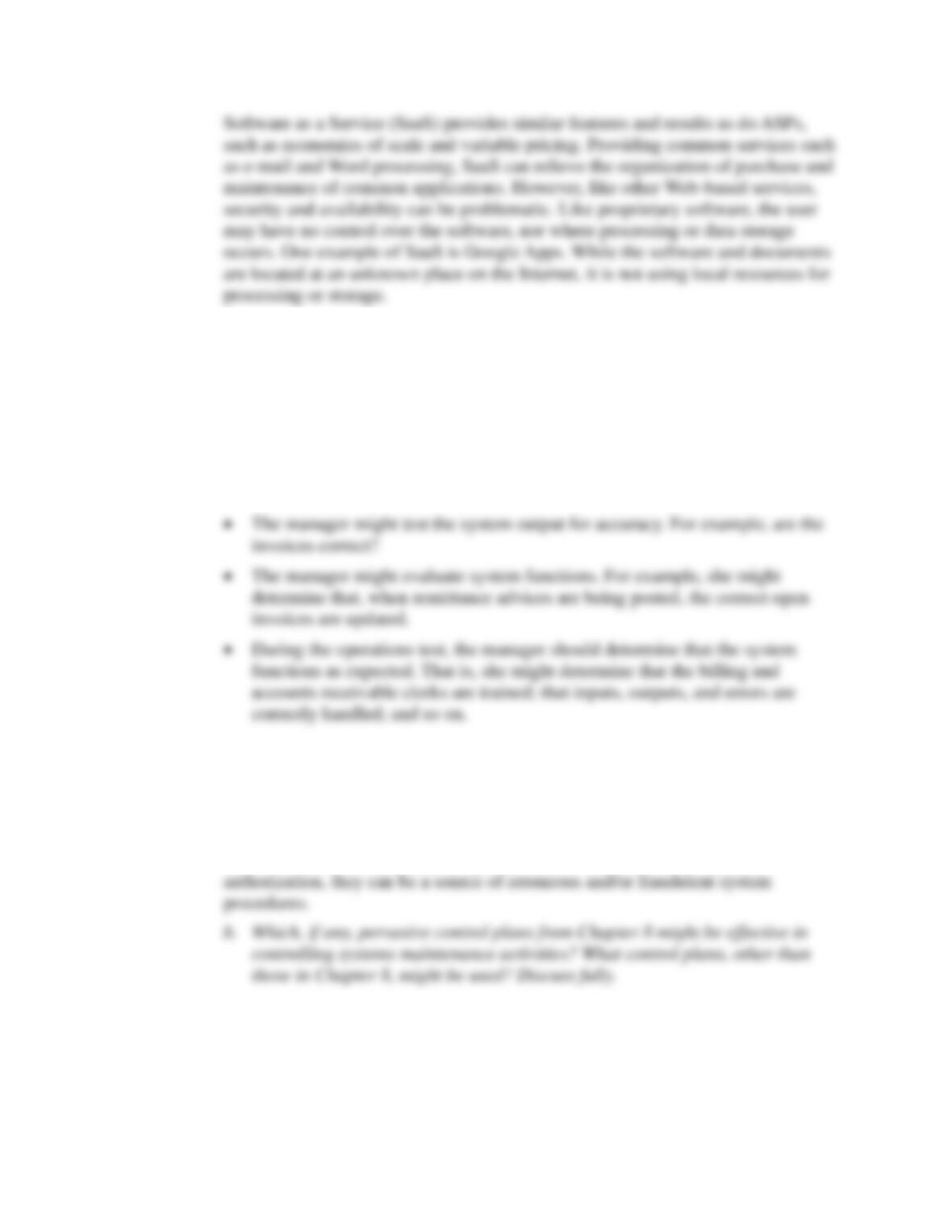
ANS. As a user, the accounts receivable manager can be involved in a system test, an
acceptance test, and an operations or environmental test. The manager’s
involvement might be as follows:
• Determine that the system accomplishes all user requirements. For example,
does the system produce required outputs such as invoices and statements?
DQ 17-16 a. Which, if any, of the categories of application system maintenance—
corrective, perfective, or adaptive—presents the greatest risk from a control
standpoint? Explain.
ANS. Emergency corrective fixes are normally conducted on the spot when a problem
arises. Unless these systems changes are later reviewed for accuracy and
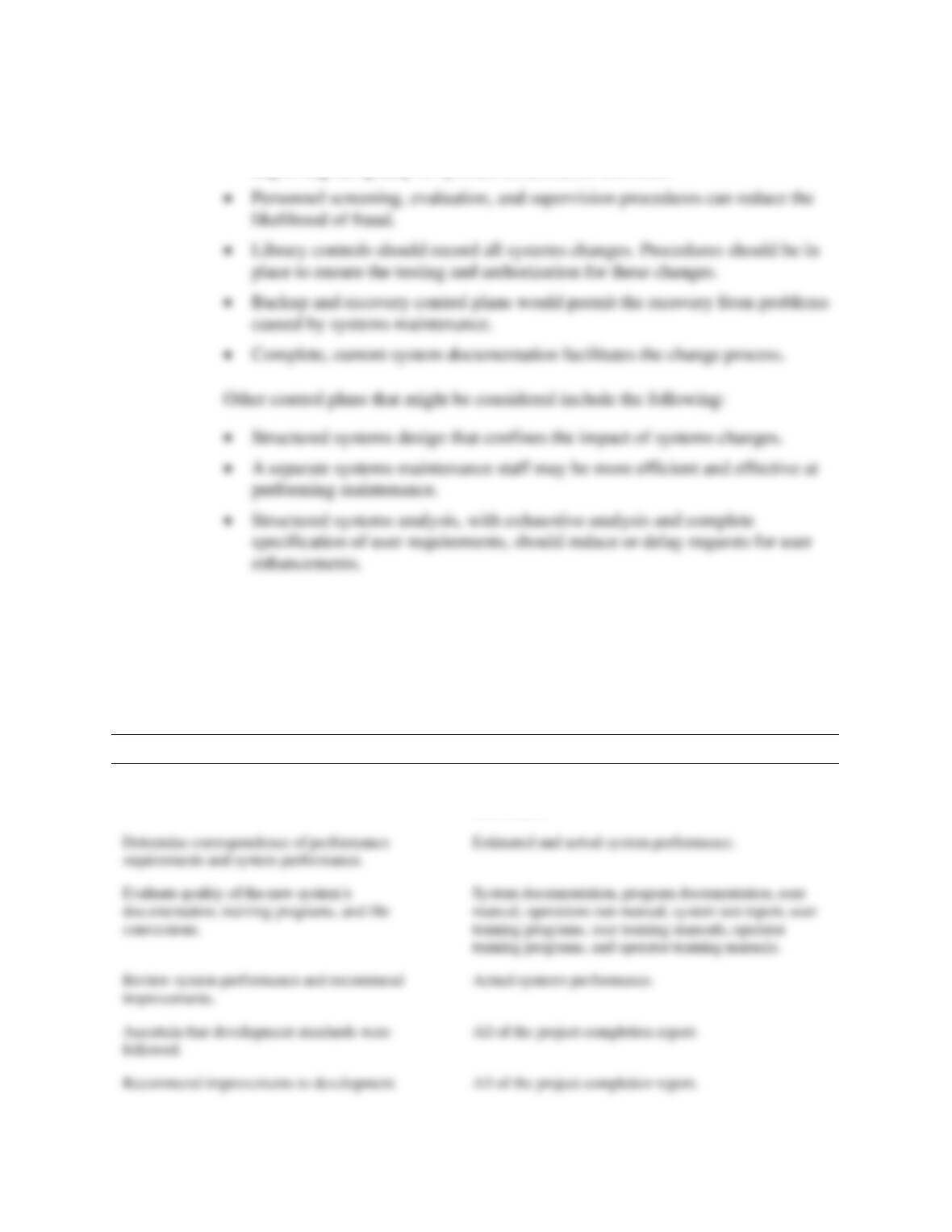
ANS. Among the control plans from Chapter 8 that might be mentioned are the
following:
10 Solutions for Chapter 17
• Personnel control plans can ensure an adequate supply of qualified systems
development staff, thereby reducing the need for systems maintenance and
improving the quality of systems maintenance activities.
DQ 17-17 Refer to the typical contents of a project completion report. Which parts of the
report would be useful in performing a post-implementation review? Discuss
fully.
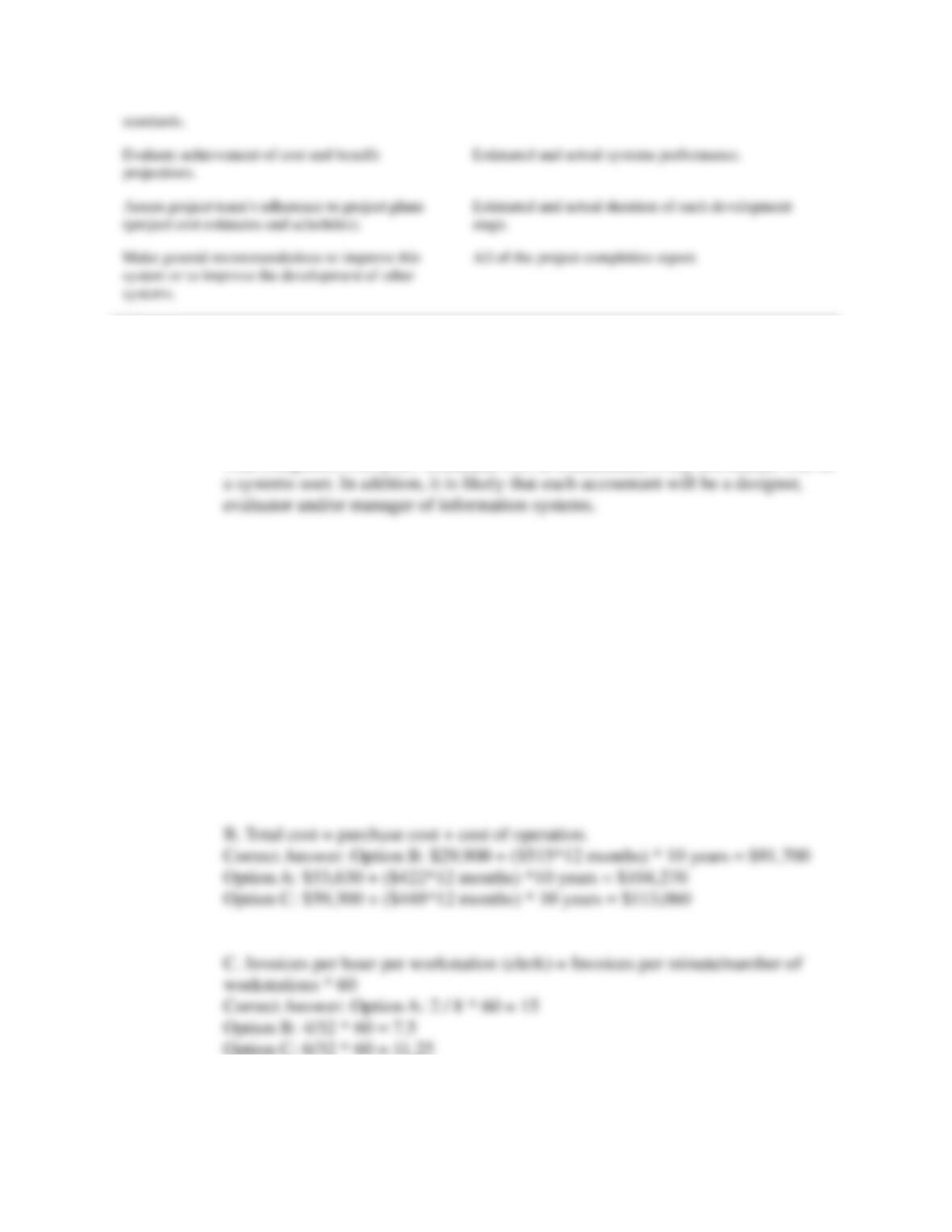
ANS. The goals of the post-implementation review can guide us in answering this
question. For example:
Post-Implementation Review Goals
Elements of the Project Completion Report
Determine user satisfaction.
Summary of requirements satisfied.
Test results.
Accounting Information Systems, 10e 11
DQ 17-18 Periodically, students comment that they are studying to be an accountant, not an
IS worker. Discuss the flaw in such reasoning.
ANS. In today’s environment, it is not possible to be an accountant without working
with computers. Per IFAC Guideline #11, at a minimum, every accountant will be
Short Problems
SP 17-1 ANS.
A. Cost per workstation = Monthly maintenance cost / maximum workstations.
Correct Answer: Option C: $448 / 32 = $14 per workstation
Option A: $422/8 = $52.75
Option B: $515/32 = $16.10
Option C: 6/32 * 60 = 11.25
SP 17-2
12 Solutions for Chapter 17
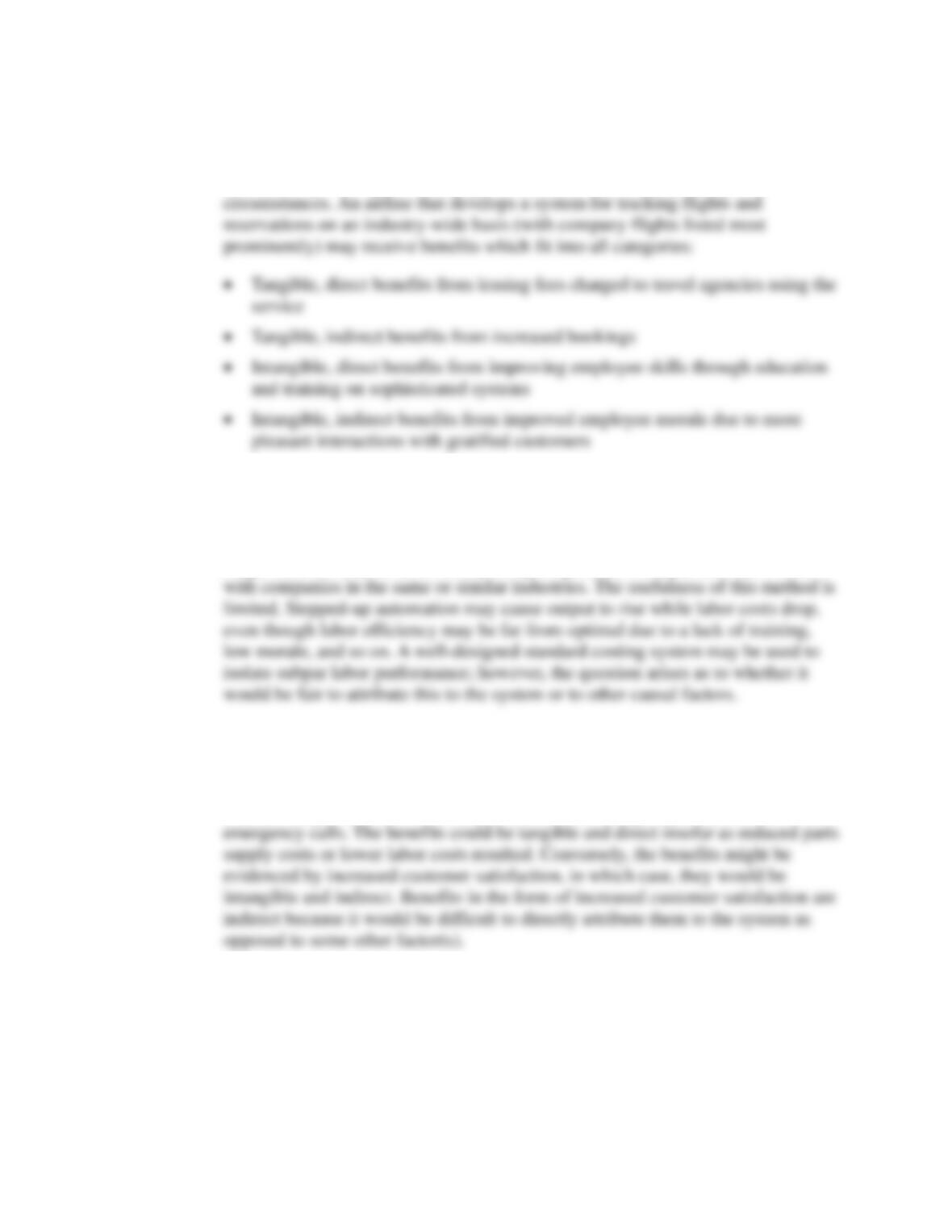
a. Improved competitive advantage.
ANS. A system can provide improved competitive advantage in any number of ways.
Benefits may be tangible or intangible, direct or indirect, depending on the
b. Decreased worker productivity.
ANS. Decreased worker productivity is an intangible, indirect cost. Determining one
precise cause for a decline is difficult—and even more difficult to quantify. A
rough measure may be achieved by comparing trends in output and labor costs
c. Increased customer support in the form of improved product service and
maintenance.
ANS. A system may allow for more efficient scheduling of preventive maintenance
routines on goods leased to customers and better routing of personnel for
d. Increased customer support in the form of more timely and accurate responses
to customer inquiries.
Accounting Information Systems, 10e 13
ANS. A system that gives access to information in a manner that improves the quality
and timeliness of responses to customer inquiries should increase customer
e. Improved management decision making.
ANS. How much revenues grow specifically due to better decision making is not
certain. It could be argued that any increase in revenues comes from better
decisions, but we can also say that improved market conditions and other forces
f. Deteriorated vendor relations, as evidenced by longer lead times, poorer
quality goods, and more frequent backorder situations.
ANS. Costs associated with longer lead times, poorer quality goods, and more frequent
backorders are indirect costs that could be either tangible or intangible. The costs
g. Deteriorated vendor relations, as evidenced by more stringent credit terms
offered by vendors.