17–61
*PROBLEM 17-15
(a) January 7, 2012
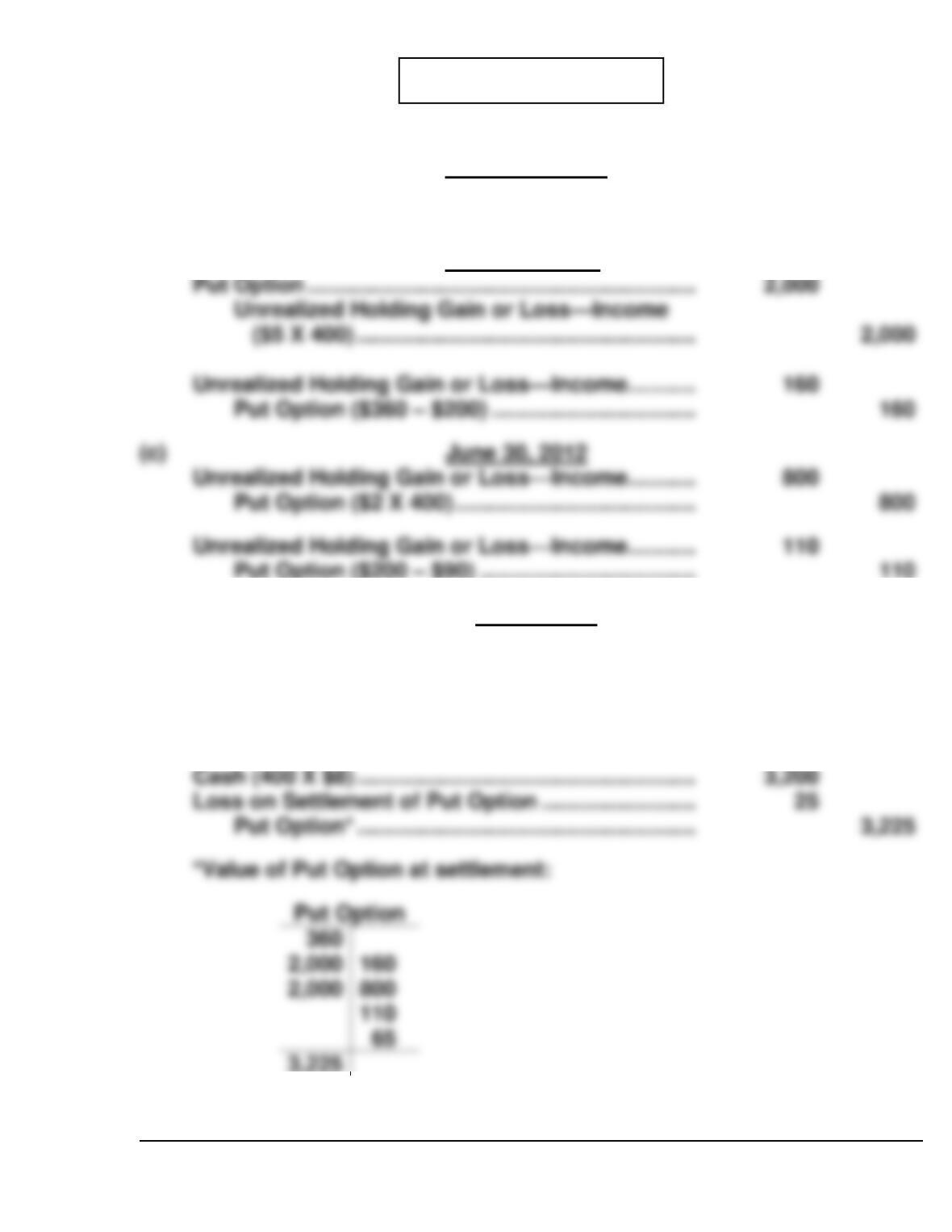
Put Option ……………………………………………………… 360
Cash ………………………………………………………… 360
(b) March 31, 2012
(d) July 6, 2012
Put Option ($5 X $400) …………………………………….. 2,000
Unrealized Holding Gain or Loss—Income …. 2,000
Unrealized Holding Gain or Loss—Income ……….. 65
Put Option ($90 – $25) ………………………………. 65
17–62
*PROBLEM 17-16
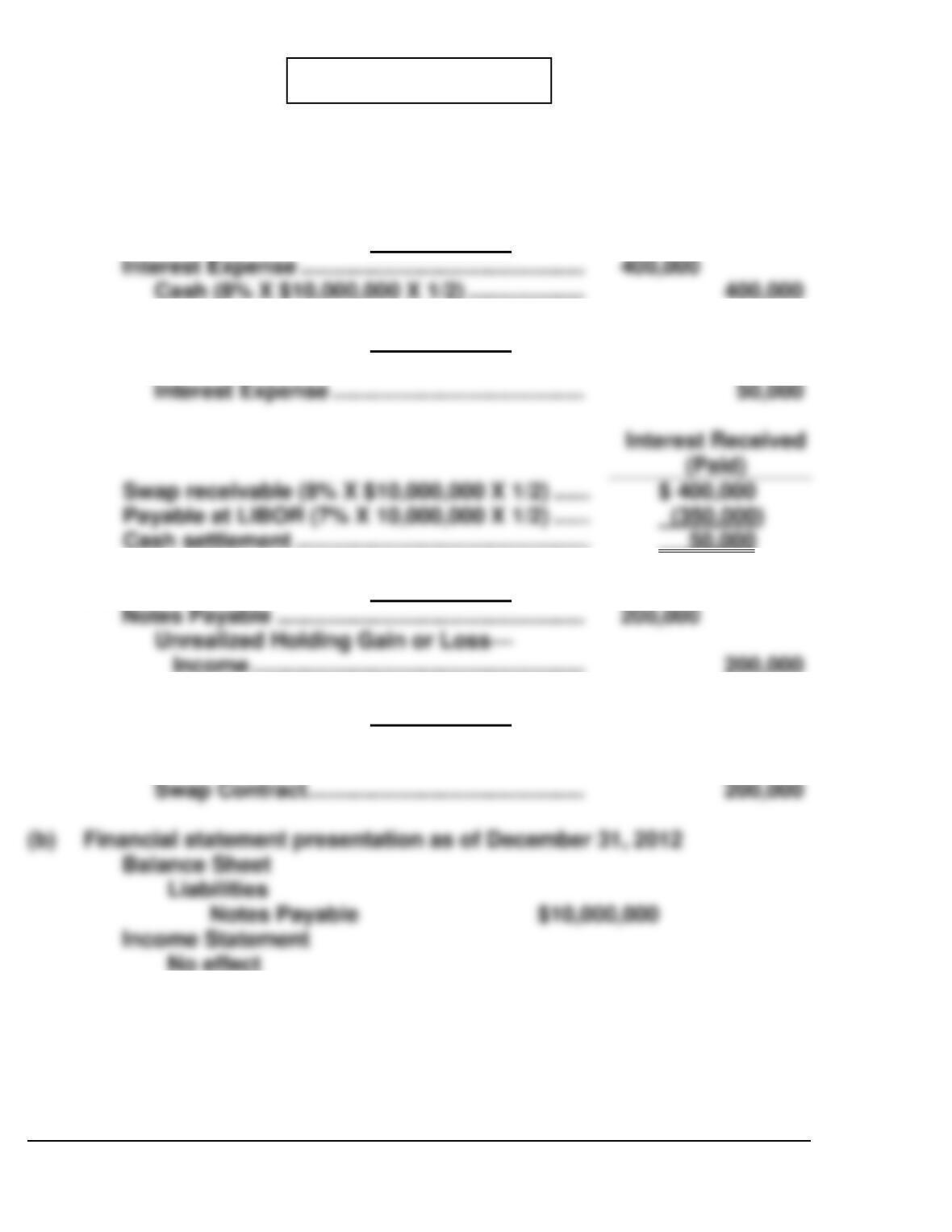
(a) (1) No entry necessary at the date of the swap because the fair value
of the swap at inception is zero.
(2) June 30, 2013
(3) June 30, 2013
Cash ………………………………………………………… 50,000
(4) June 30, 2013
(5) June 30, 2013
Unrealized Holding Gain or Loss—
Income ………………………………………………….. 200,000
17–63
*PROBLEM 17-16 (Continued)
(c) Financial statement presentation as of June 30, 2013
Balance Sheet
Liabilities
Balance Sheet
Assets
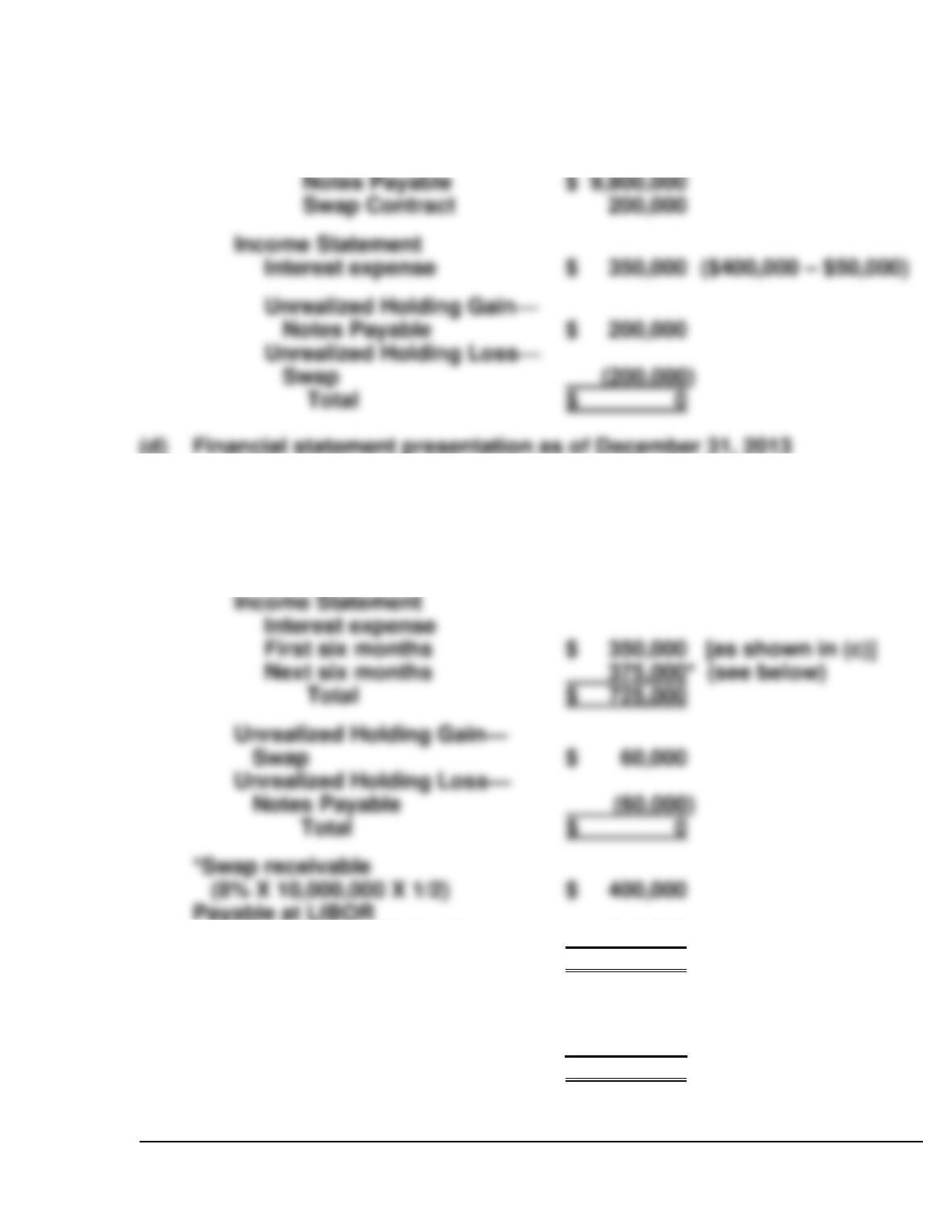
Swap Contract $ 60,000
Liabilities
Notes Payable 10,060,000
(7.5% X 10,000,000 X 1/2) 375,000
Cash settlement $ 25,000
Interest expense unadjusted
June 30–December 31, 2013 $ 400,000
Cash settlement (25,000)
$ 375,000
17–64
*PROBLEM 17-17
(a) April 1, 2012
Memo entry to indicate entering into the futures contract.
(b) June 30, 2012
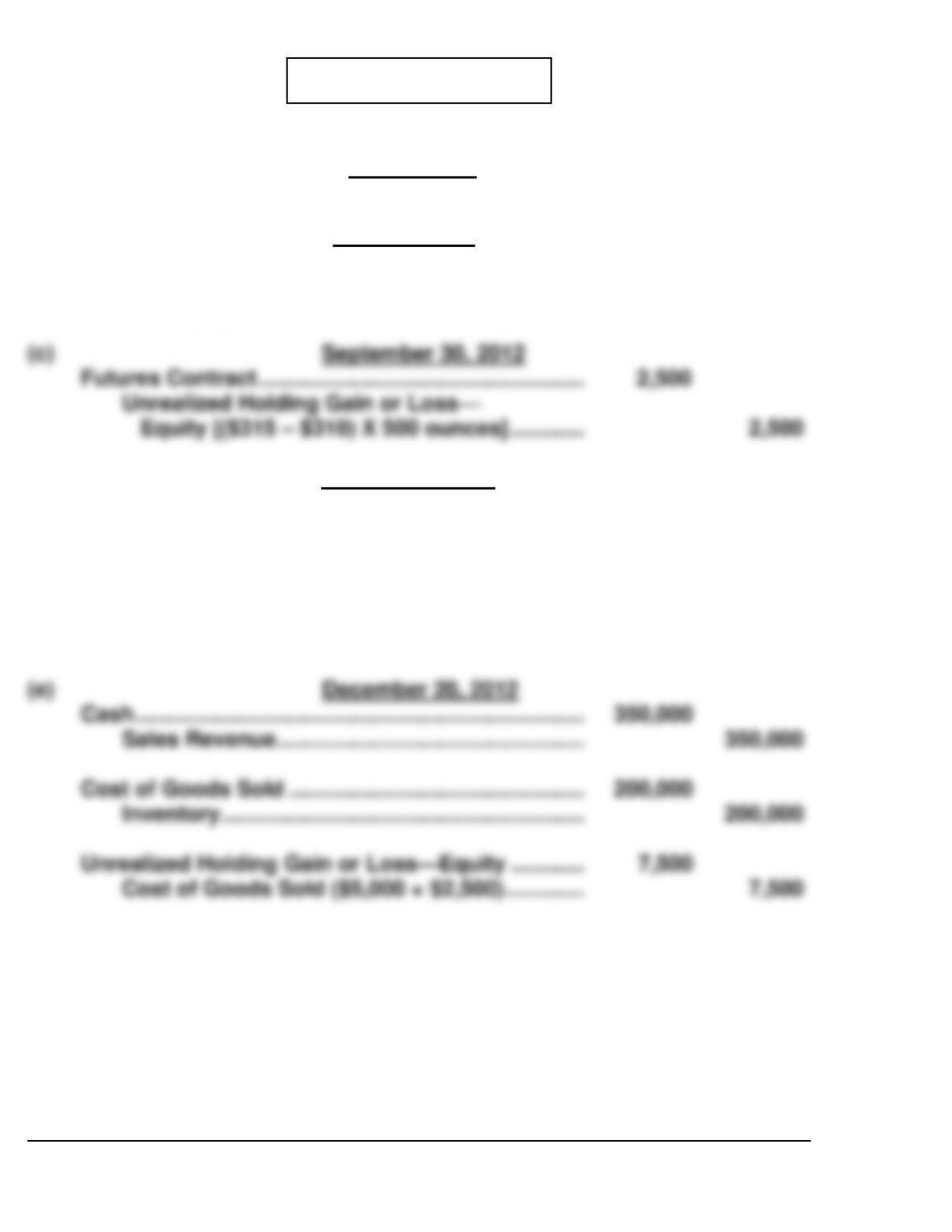
Futures Contract …………………………..………………… 5,000
Unrealized Holding Gain or Loss—
Equity [($310 – $300) X 500 ounces] ………… 5,000
(d) October 10, 2012
Inventory ……………………………………………………….. 157,500
Cash ($315 X 500 ounces) …………………………. 157,500
Cash ………………………………………………………………. 7,500
Futures Contract
[($315 – $300) X 500 ounces] …………………… 7,500
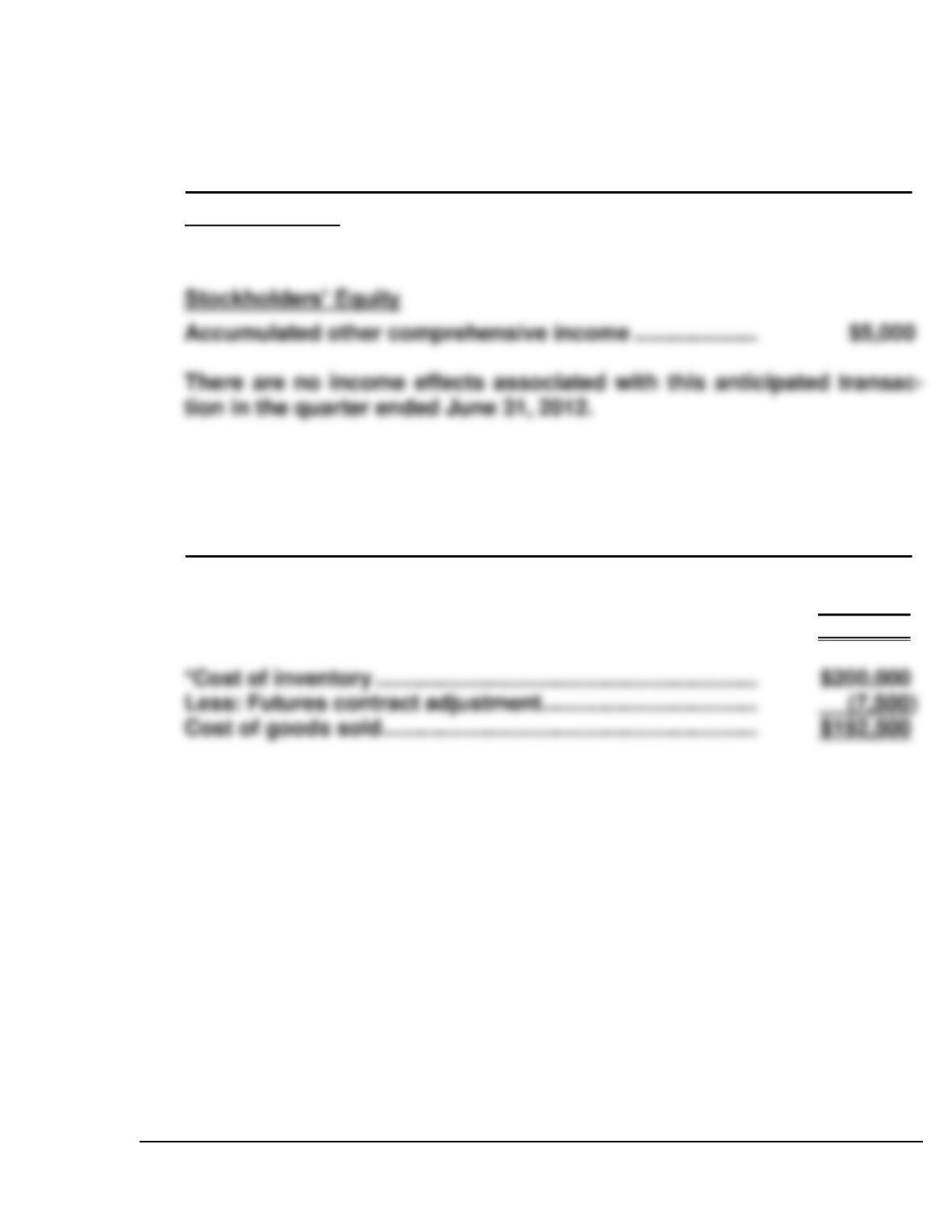
17–65
*PROBLEM 17-17 (Continued)
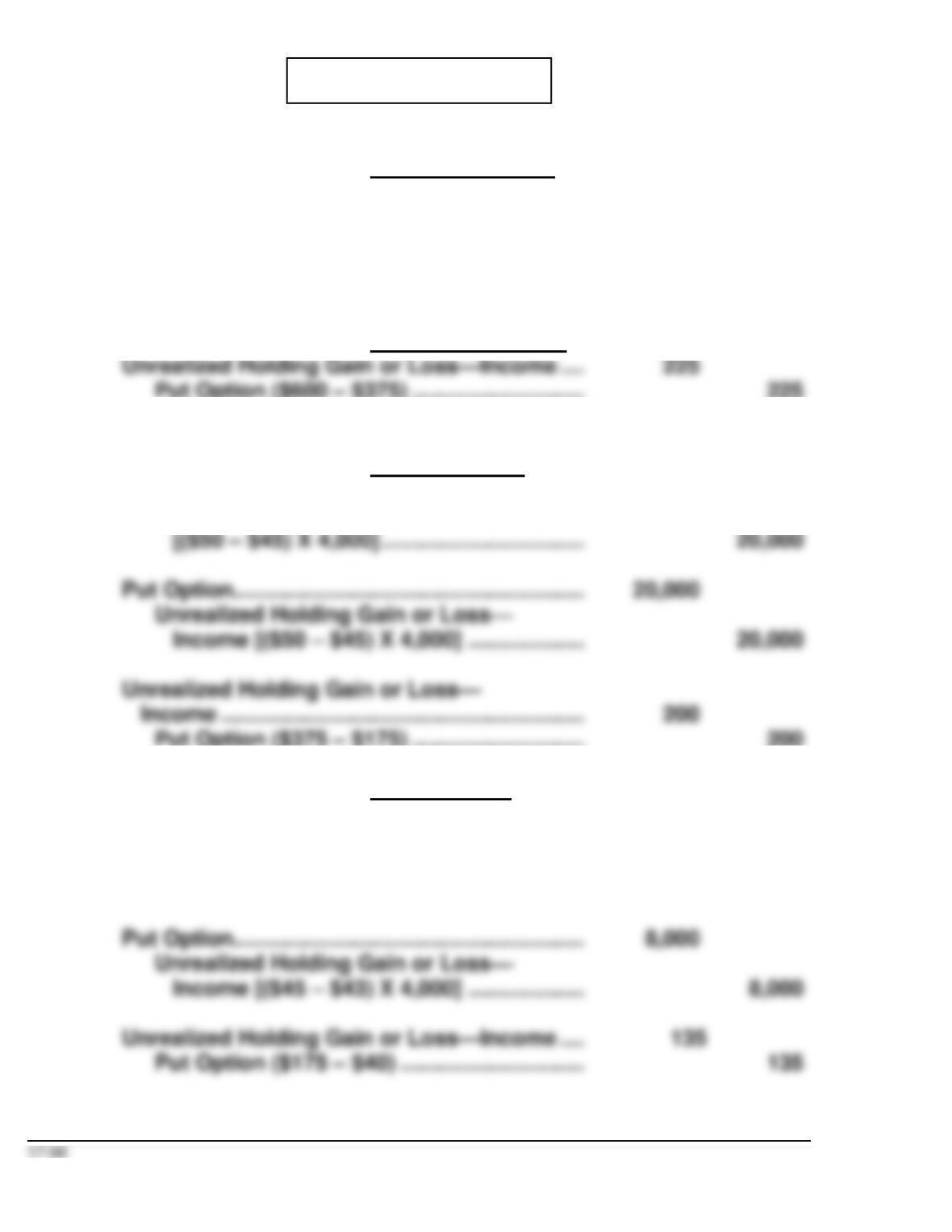
(f) LEW JEWELRY COMPANY
Partial Balance Sheet
At June 30, 2012
Current Assets
Futures contract ……………………………………………………….. $5,000
(g) LEW JEWELRY COMPANY
Income Statement
For the Quarter Ended December 31, 2012
Sales revenue …………………………………………………………… $350,000
Cost of goods sold……………………………………………………. 192,500*
Gross profit ………………………………………………………. $157,500
*PROBLEM 17-18
(a) (1) November 3, 2012
Equity Investments (Available-for-Sale) ……… 200,000
Cash (4,000 X $50) ……………………………….. 200,000
Put Option ………………………………………………… 600
Cash ……………………………………………………. 600
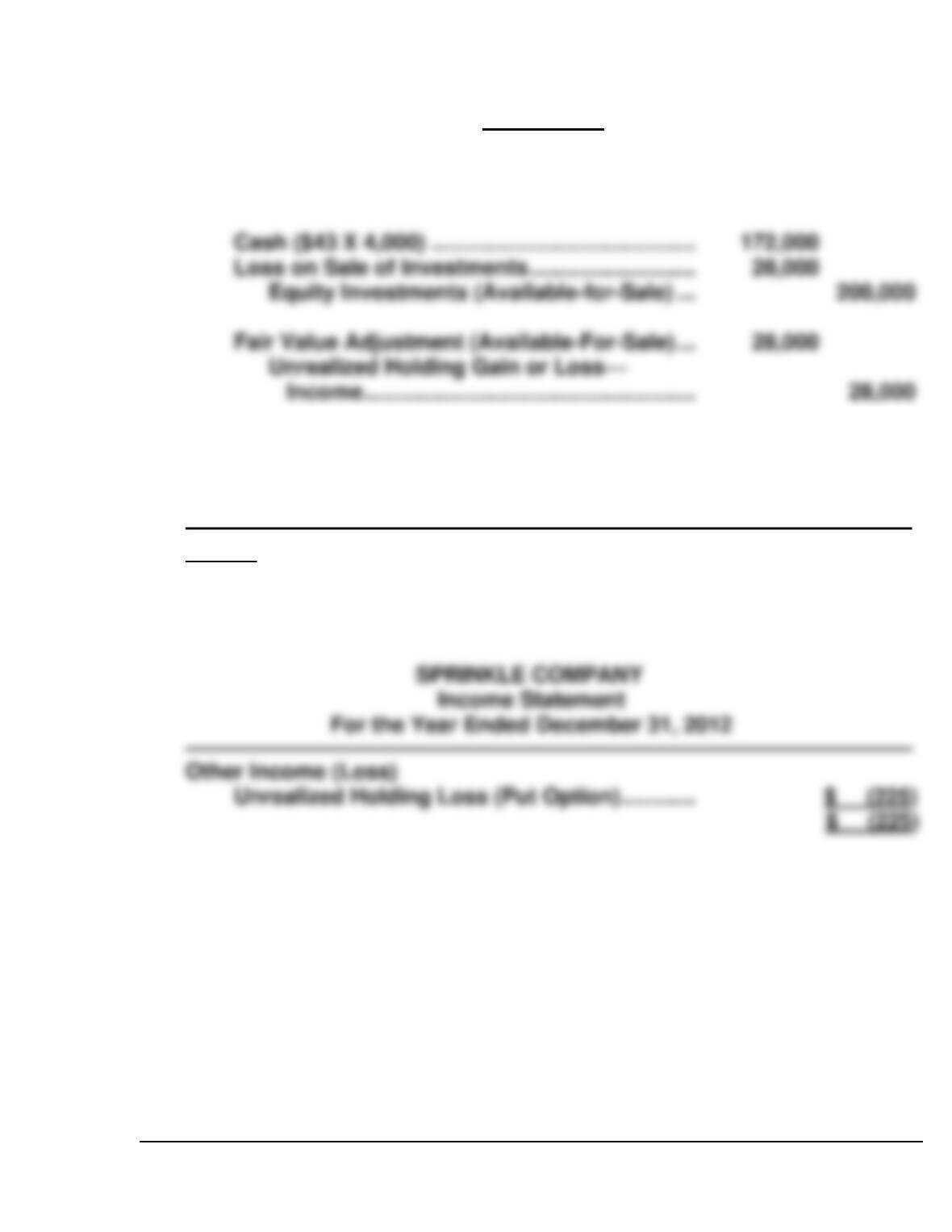
(2) December 31, 2012
(3) March 31, 2013
Unrealized Holding Gain or Loss—Income …. 20,000
Fair Value Adjustment (Available-for-Sale)
(4) June 30, 2013
Unrealized Holding Gain or Loss—Income …. 8,000
Fair Value Adjustment
(Available-for-Sale)
[($45 – $43) X 4,000] …………………………... 8,000
17–67
*PROBLEM 17-18 (Continued)
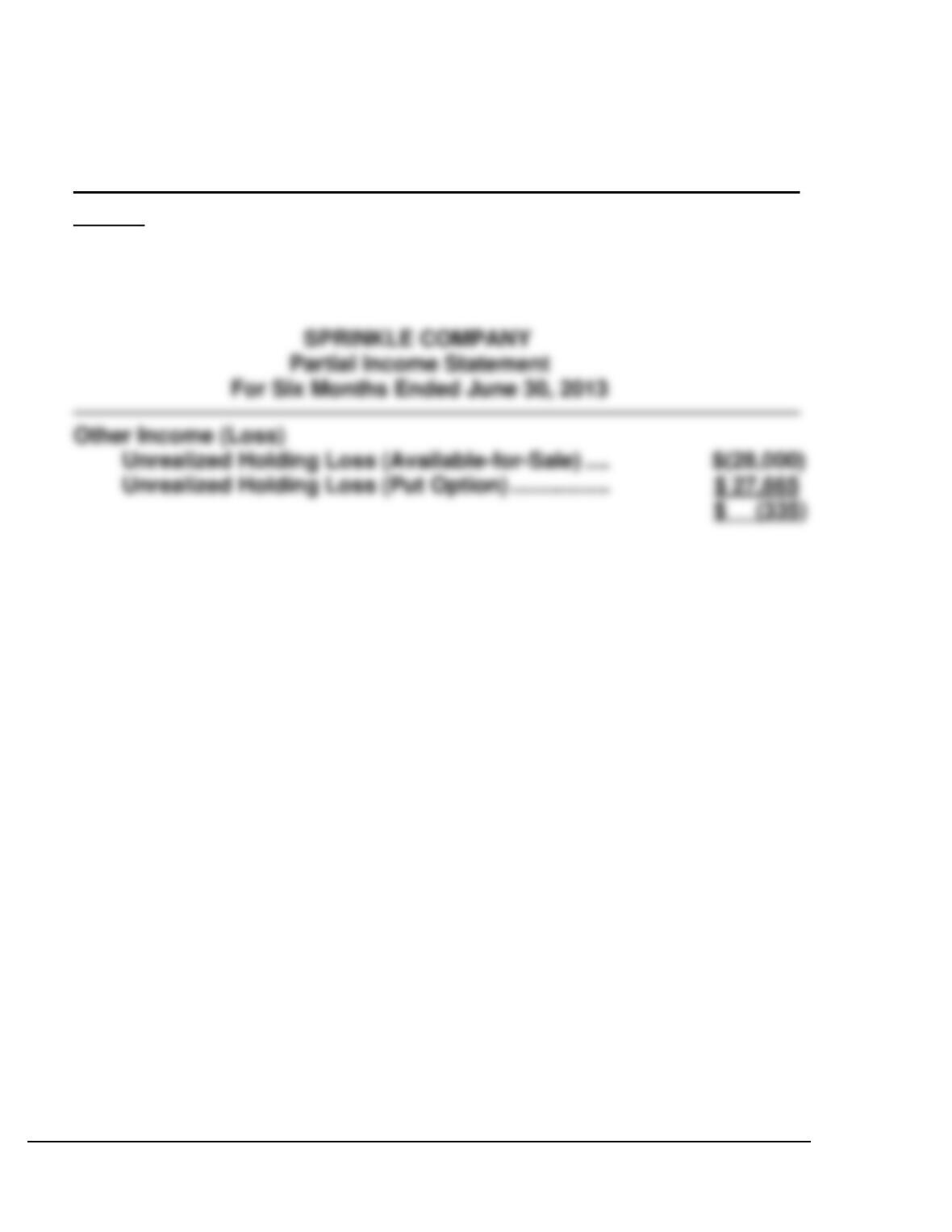
(5) July 1, 2013
Cash ($7 X 4,000) ……………………………………… 28,000
Loss on Settlement of Put Option ……………… 40
Put Option …………………………………………… 28,040
(b) SPRINKLE COMPANY
Partial Balance Sheet
At December 31, 2012
Assets
Equity Investments (Available-for-Sale) …………….. $200,000
Put Option ………………………………………………………. 375
17–68
*PROBLEM 17-18 (Continued)
(c) SPRINKLE COMPANY
Partial Balance Sheet
At June 30, 2013
Assets
Equity Investments (Available-for-Sale) ………………… $172,000
Put Option …………………………………………………………… 28,040

TIME AND PURPOSE OF CONCEPTS FOR ANALYSIS
CA 17-1 (Time 25–30 minutes)
Purpose—To provide the student with an opportunity to discuss the issues raised by FASB in
determining the accounting for investments in certain debt and equity securities. For example, the
proper accounting for the reclassification of securities from trading to available-for-sale must be
discussed. Four other situations involving debt and equity securities investments must be addressed.
CA 17-2 (Time 25–30 minutes)
Purpose—To provide the student with an opportunity to discuss the justification for using fair value as a
basis for reporting equity securities. In addition, a number of computations are necessary to determine
whether the company properly applied the reporting provisions for investments in certain debt and
equity securities.
CA 17-3 (Time 20–30 minutes)
Purpose—To provide the student with an understanding of the accounting applications dealing with
investments in equity securities. This case involves three independent situations for which the student
is required to discuss the effects upon classification, carrying value, and earnings.
CA 17-4 (Time 20–25 minutes)
Purpose—To provide the student with an understanding of the conceptual basis for the distinction
between classifications of certain debt and all equity securities. The student is required to discuss the
factors to be considered in classifying debt and equity security investments and how these factors
affect the accounting treatment for unrealized losses.
CA 17-5 (Time 15–25 minutes)
Purpose—To allow the student to discuss the equity method of accounting for investments and to provide
rationale for this method of accounting.
CA 17-6 (Time 25–35 minutes)
Purpose—To provide the student with an opportunity to discuss the equity method of accounting and
provide rationale in a memorandum.
CA 17-7 (Time 25–35 minutes)
Purpose—To provide the student an opportunity to examine the ethical issues related to fair value
accounting.
17–70
SOLUTIONS TO CONCEPTS FOR ANALYSIS
CA 17-1
Situation 1 GAAP requires that securities which are classified as trading securities be reported
on the balance sheet at their fair value amount. Any changes in the fair value of trad-
ing securities from one period to another are included in earnings. Therefore, the $4,200
decrease will be reported on the income statement as an unrealized holding loss.
Situation 3 The reclassification does not affect earnings and the available-for-sale security will
continue to be reported at its fair value.
Situation 4 When a reduction in the fair value of a security is considered to be an impairment,
the new cost basis of the security is its fair value. The security is written down to the
fair value amount and the loss is included in earnings. In this case, the fair value of
the security at the end of the prior year is the new cost basis. However, since the
security is classified as available-for-sale, the fair value at the end of the current
year is reported on the balance sheet. Therefore, the increase in fair value will not
affect earnings but instead is reported as other comprehensive income and as a
separate component of stockholders’ equity.
CA 17-2
(a) The reporting of available-for-sale securities at fair value provides the financial statement user
with more relevant financial information. The fair value of the securities is essentially the present
value of the securities’ future cash flows and so this helps investors and creditors assess the
CA 17-2 (Continued)
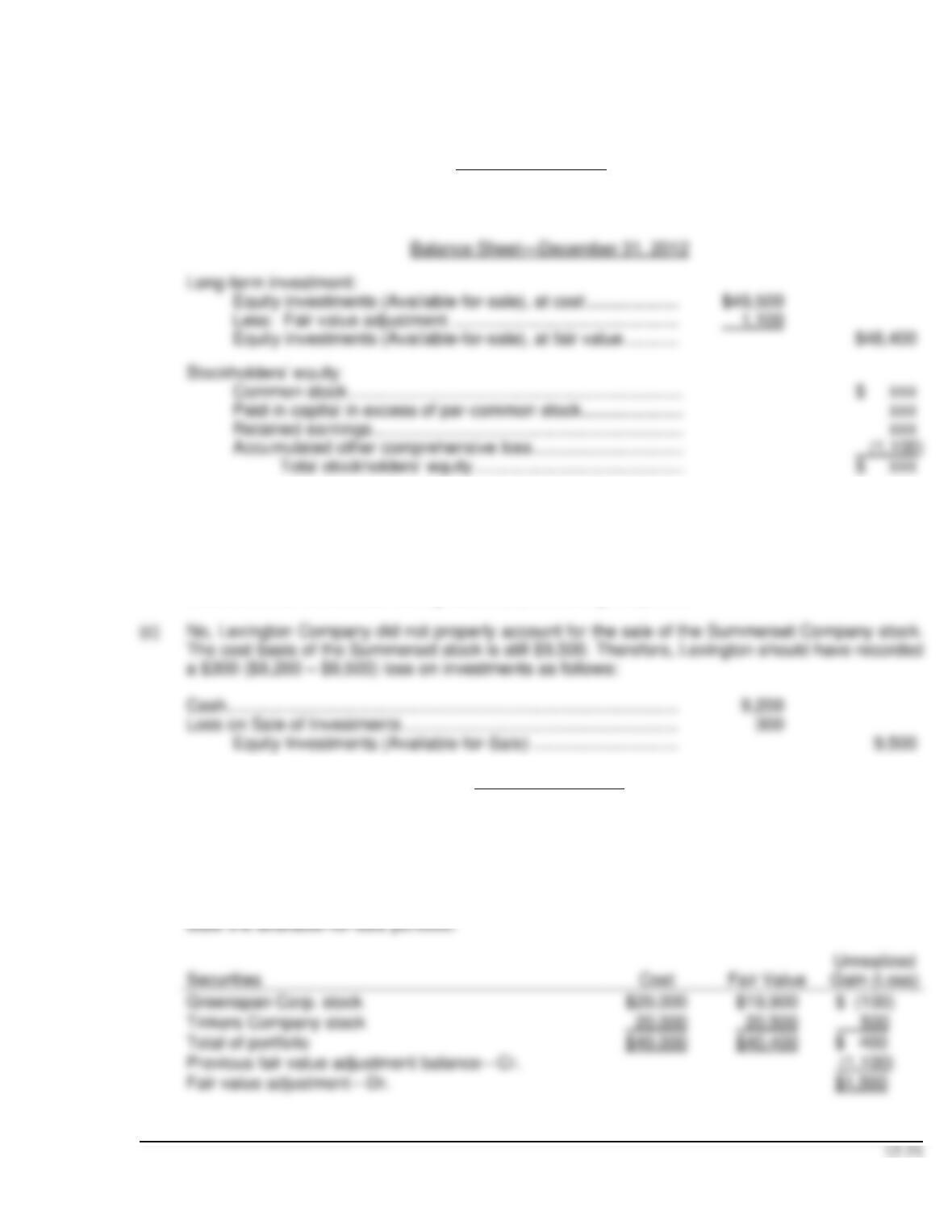
(b) Lexington Company should record the following journal entry and then report the following
amounts on its balance sheet.
December 31, 2012
Unrealized Holding Gain or Loss—Equity ………………………………. 1,100
Fair Value Adjustment (Available-for-Sale) …………………….. 1,100
Investments classified as available-for-sale securities should initially be recorded at their
acquisition price. The valuation of these investments is subsequently reported at their fair value.
Any changes in the fair value of the investments are recorded in an unrealized holding gain or
loss account, which is included as other comprehensive income and as a separate component of
stockholders’ equity. Assuming the company prepared a statement of comprehensive income, it
would show an unrealized holding loss of $1,100 during the period.
(d) December 31, 2013
Fair Value Adjustment (Available-for-Sale) …………………………….. 1,500
Unrealized Holding Gain or Loss—Equity ……………………… 1,500
Available-for-sale securities are reported at their fair value. Therefore, an adjusting entry must be
made to show the $400 excess of fair value over cost in the portfolio. The unrealized holding loss
from the previous period must be reversed. As a result, $1,500 adjustment is needed to correctly
17–72
CA 17-3
Situation 1 The carrying value of the trading investment will be the fair value on the date of the
transfer. The unrealized holding loss, the difference between the current fair value
and the cost, will be recognized immediately.
Situation 3 Both the portfolio of trading securities and the portfolio of available-for-sale securities
are reported at their fair value. The $13,500 decrease in fair value of the trading
portfolio is recorded in the unrealized holding loss account and is included in
CA 17-4
(a) A company maintains the different investment portfolios because each portfolio serves a different
investment objective. Since each portfolio serves a different objective, the possible risks and
returns associated with that objective should be disclosed in the financial statements. This
disclosure allows the financial statement user to assess the investment strategies for the
earn its profit on the basis of any price change, then the security should be classified as a
trading security. On the other hand, if management has the intent and ability to hold the security
until its maturity, then the security should be classified as a held-to–maturity security. This
category is restrictive in the sense that management must have the positive intent to hold the
security to maturity. If management’s intentions do not match either of the above categories, then
the security should be classified as an available-for-sale security.
CA 17-5
Since Fontaine Company purchased 40% of Knoblett Company’s outstanding stock, Fontaine is
considered to have significant influence over Knoblett Company. Therefore, Fontaine will account for
this investment using the equity method. The investment is reported on the December 31 balance sheet
CA 17-6
Memo on accounting treatment to be accorded Investment in Spoor Corporation:
Selig Company should follow the equity method of accounting for its investment in Spoor Corporation
because Selig Company is presumed to be able to exercise significant influence over the operating and
financial policies of Spoor Corporation due to the size of its investment (40%).
In 2013, Selig Company should report its interest in Spoor Corporation’s outstanding capital stock as a
long-term investment. Following the equity method of accounting, Selig Company should record the
cash purchase of 40 percent of Spoor Corporation at acquisition cost.
CA 17-7
(a) Classifying the securities as they propose will indeed have the effect on net income that they say
it will. Classifying all the gains as trading securities will cause all the gains to flow through the
income statement this year and classifying the losses as available-for-sale and held-to-maturity
will defer the losses from this year’s income statement. Classifying the gains and losses just the
opposite will have the opposite effect.

17–74
CA 17-7 (Continued)
(c) The act of selling certain securities (those with gains or those with losses) is management’s
17–75
FINANCIAL REPORTING PROBLEM
(a) P&G does not separately report investment balances in 2009.
Investment securities consist of readily marketable debt and equity
securities. Unrealized gains or losses are charged to earnings for
assets. Other investments that are not controlled, and over which we
do not have the ability to exercise significant influence, are accounted
for under the cost method.
(b) Certain financial instruments are required to be recorded at fair value.
The estimated fair values of such financial instruments (including
certain debt instruments, investment securities and derivatives) have
been determined using market information and valuation methodolo–
17–76
FINANCIAL REPORTING PROBLEM (Continued)
(c) According to Note 5, As a multinational company with diverse product
offerings, we are exposed to market risks, such as changes in interest
rates, currency exchange rates and commodity prices. We evaluate
At inception, we formally designate and document qualifying instru–
ments as hedges of underlying exposures. We formally assess, both
at inception and at least quarterly, whether the financial instruments
used in hedging transactions are effective at offsetting changes in
either the fair value or cash flows of the related underlying exposure.
Fluctuations in the value of these instruments generally are offset by
changes in the fair value or cash flows of the underlying exposures
being hedged. This offset is driven by the high degree of effectiveness
17–77
FINANCIAL REPORTING PROBLEM (Continued)
We have not incurred and do not expect to incur material credit
losses on our risk management or other financial instruments. Certain
of the Company’s financial instruments used in hedging transactions
variable-rate debt. To manage this risk in a cost-efficient manner, we
enter into interest rate swaps in which we agree to exchange with the
counterparty, at specified intervals, the difference between fixed and
variable interest amounts calculated by reference to an agreed upon
notional amount.
17–78
FINANCIAL REPORTING PROBLEM (Continued)
To manage this exchange rate risk, we have historically utilized a
combination of forward contracts, options and currency swaps. As of
June 30, 2009, we had currency swaps with maturities up to five
portion, which is not material for any year presented, is immediately
recognized in earnings.
The change in value of certain non-qualifying instruments used to
manage foreign exchange exposure of intercompany financing transac-
tions, income from international operations and other balance sheet
items subject to revaluation is immediately recognized in earnings,
substantially offsetting the foreign currency mark-to-market impact of
the related exposure. The net earnings impact of such instruments
was a $1,047 loss in 2009 and gains of $1,397 and $56 in 2008 and
2007, respectively.
Net Investment Hedging
FINANCIAL REPORTING PROBLEM (Continued)
Commodity Risk Management
Certain raw materials used in our products or production processes
are subject to price volatility caused by weather, supply conditions,
political and economic variables and other unpredictable factors. To
manage the volatility related to anticipated purchases of certain of
these materials, we use futures and options with maturities generally