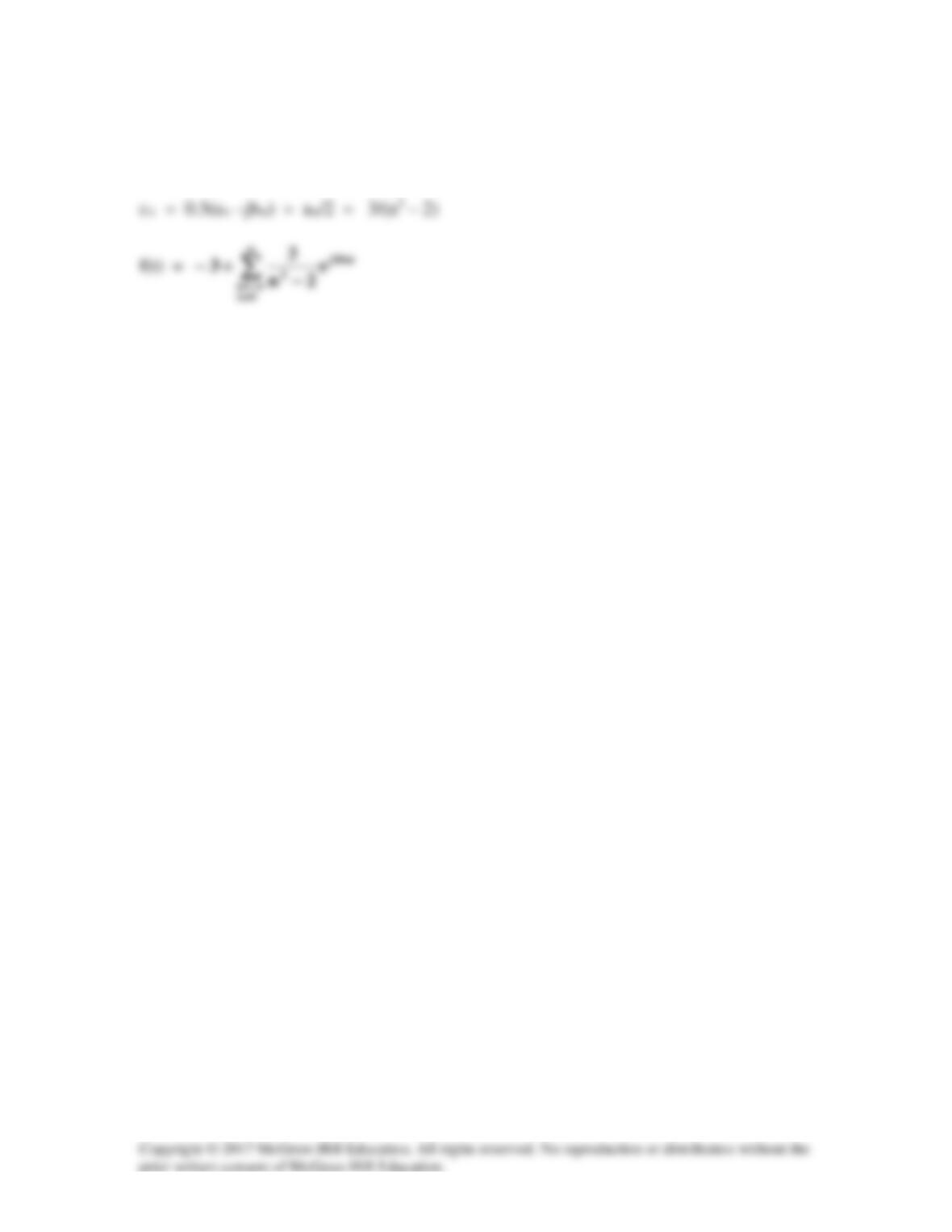
Solution 17.57
ao = (6/–2) = –3 = co
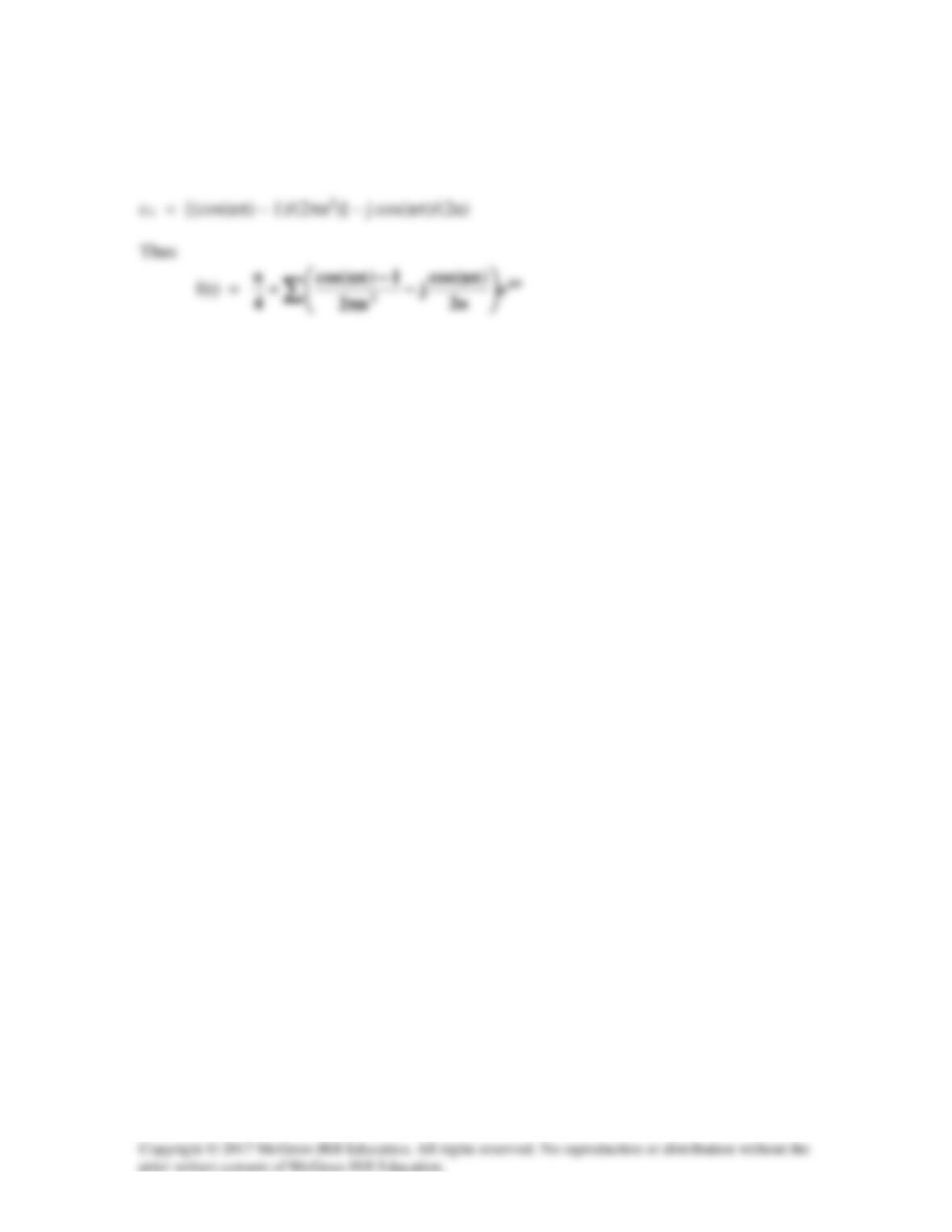
Solution 17.58
cn = (an – jbn)/2, (–1)n = cos(nπ), ωo = 2π/T = 1
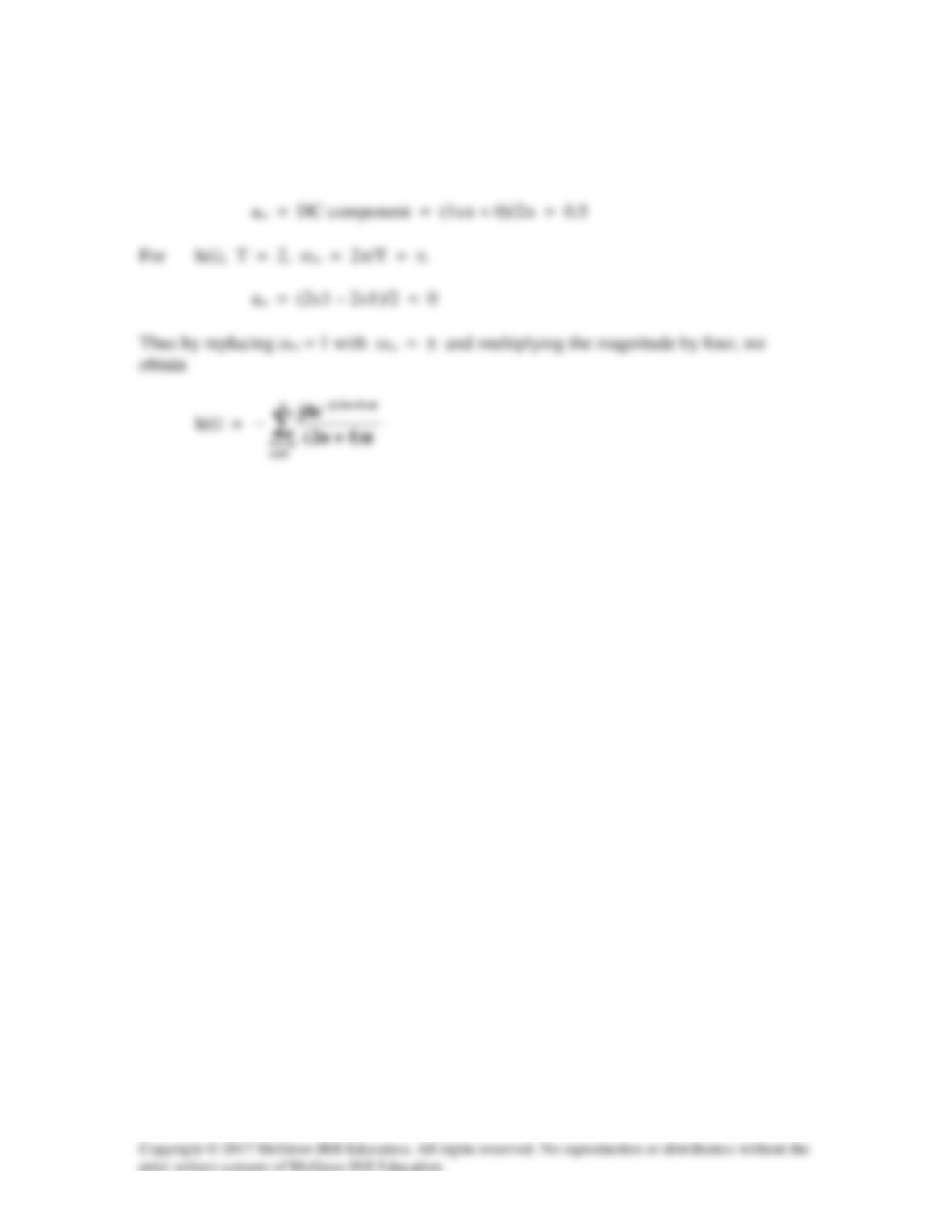
Solution 17.59
For f(t), T = 2π, ωo = 2π/T = 1.
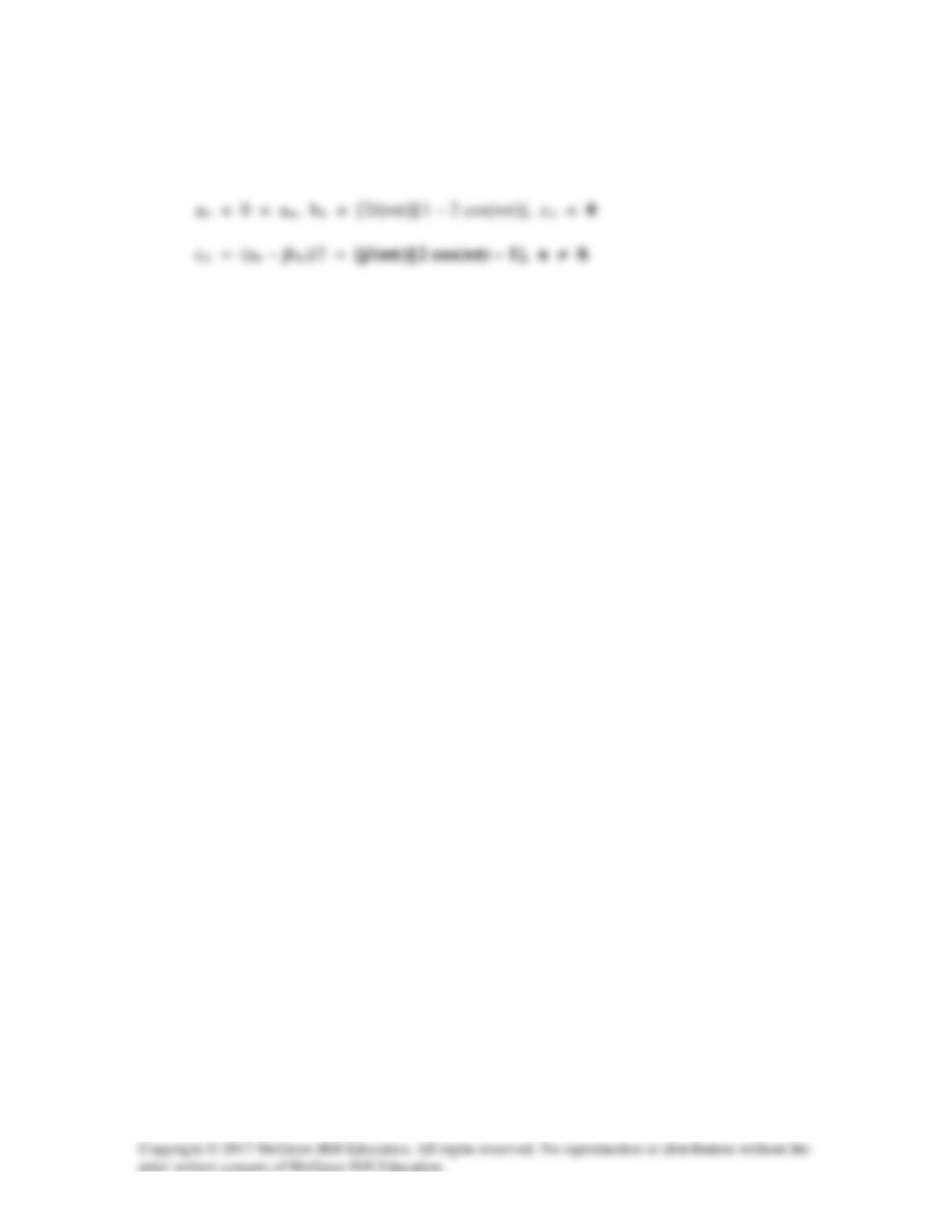
Solution 17.60
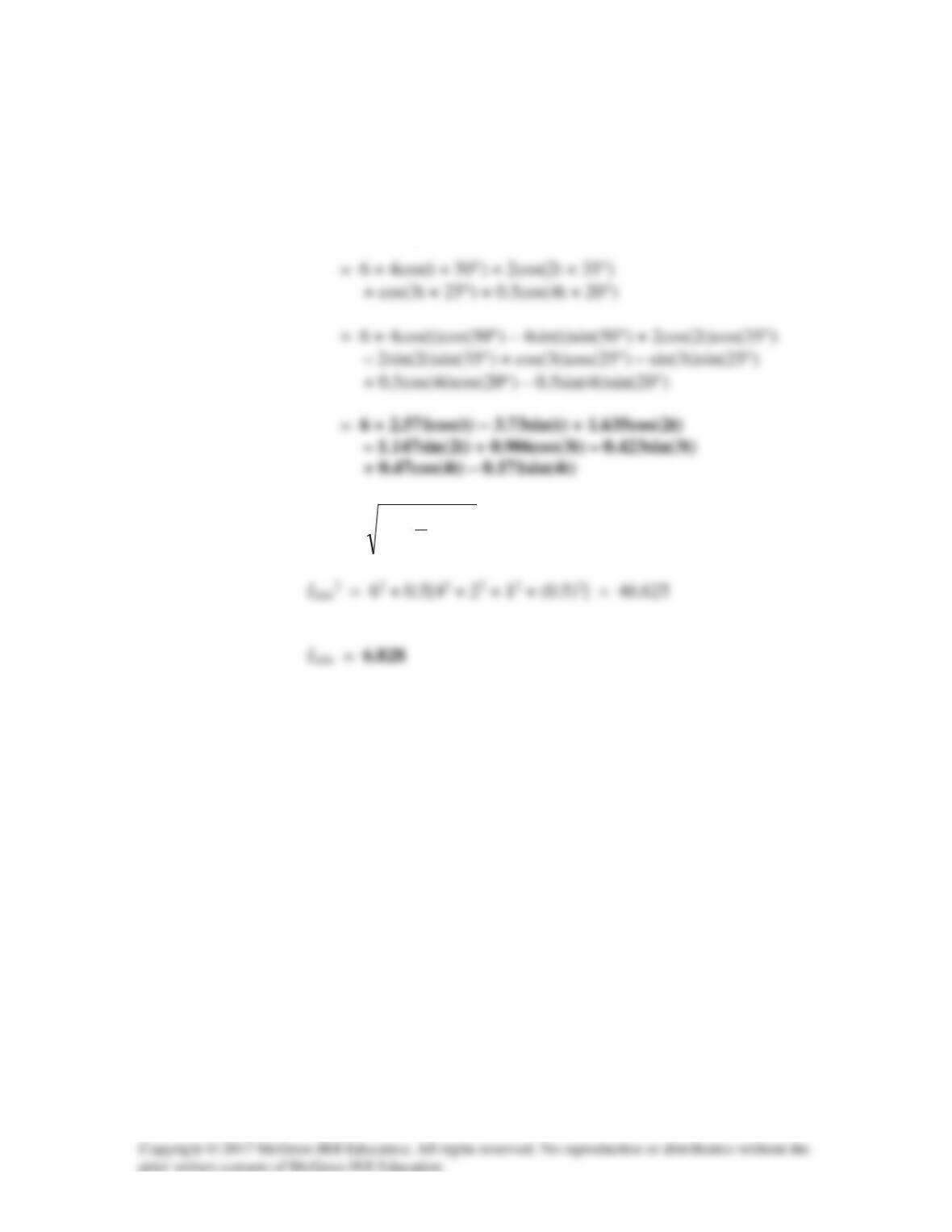
From Problem 17.24,
Solution 17.61
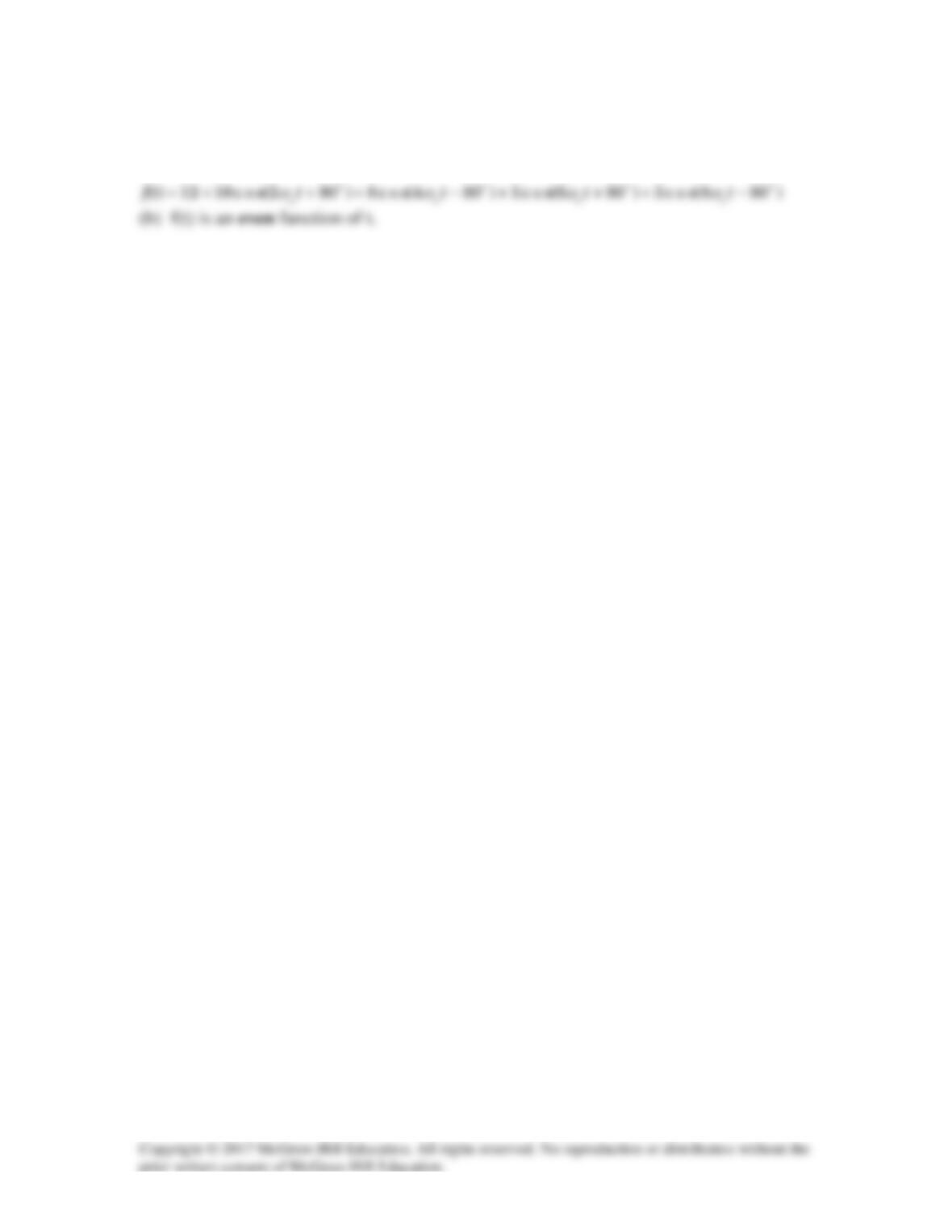
(a) ωo = 1.
f(t) = ao +
∑φ−ω )tncos(A
non
(b) frms =
∑
∞
=
+
1n
2
n
2
oA
2
1
a
Solution 17.62
(a)
Solution 17.63
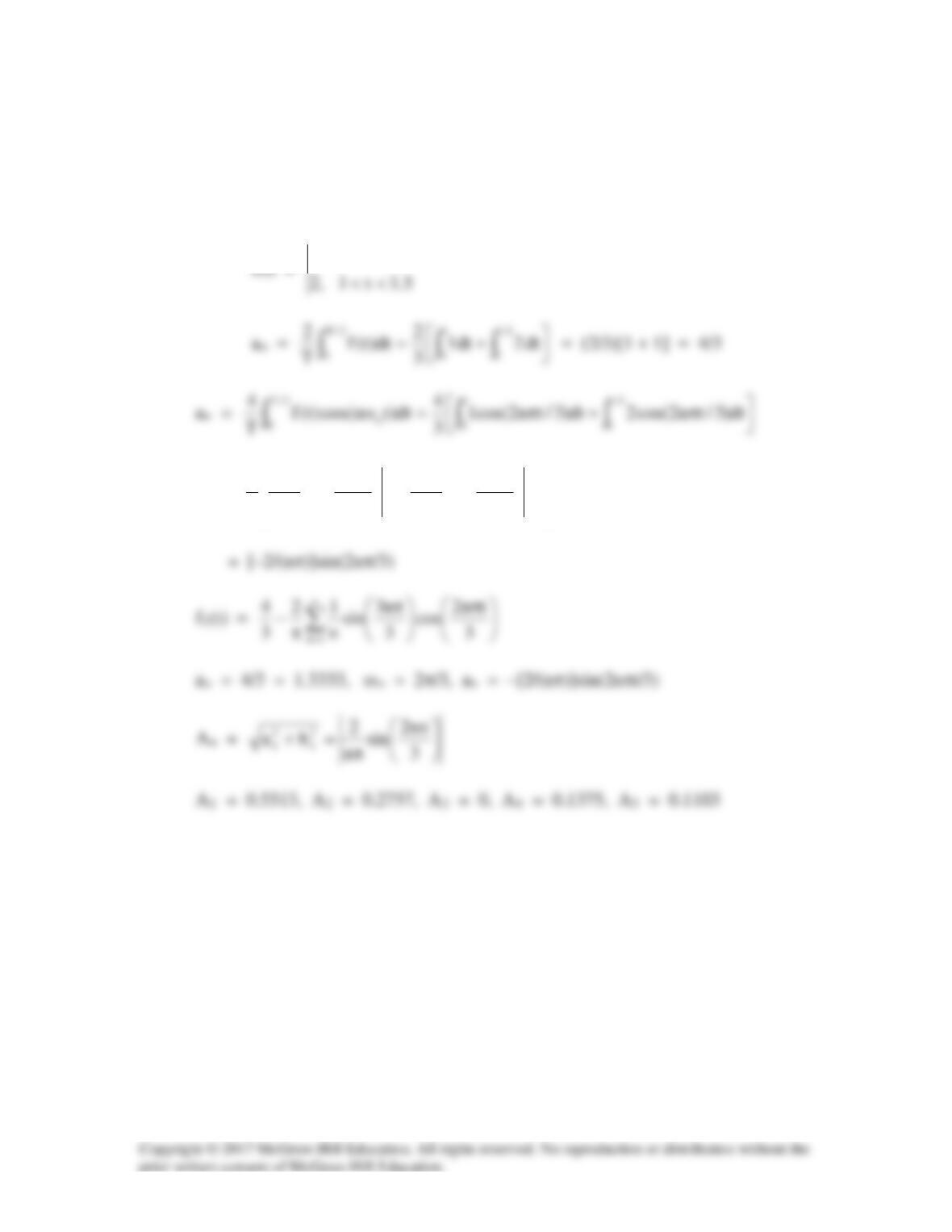
This is an even function.
T = 3, ωo = 2π/3, bn = 0.
1t0,1
<<
=
π
π
+
π
π
5.1
1
1
0
3
tn2
sin
n2
6
3
tn2
sin
n2
3
3
4
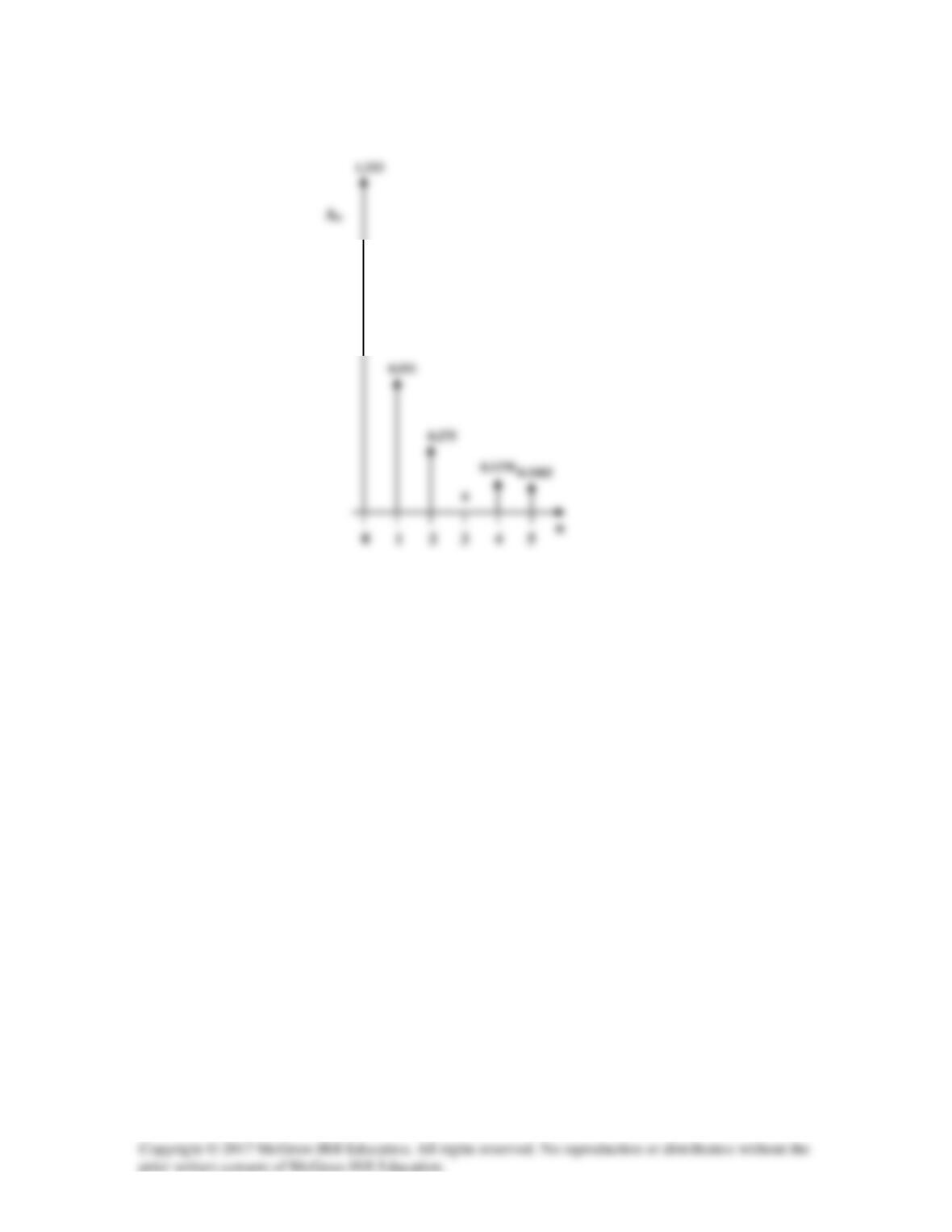
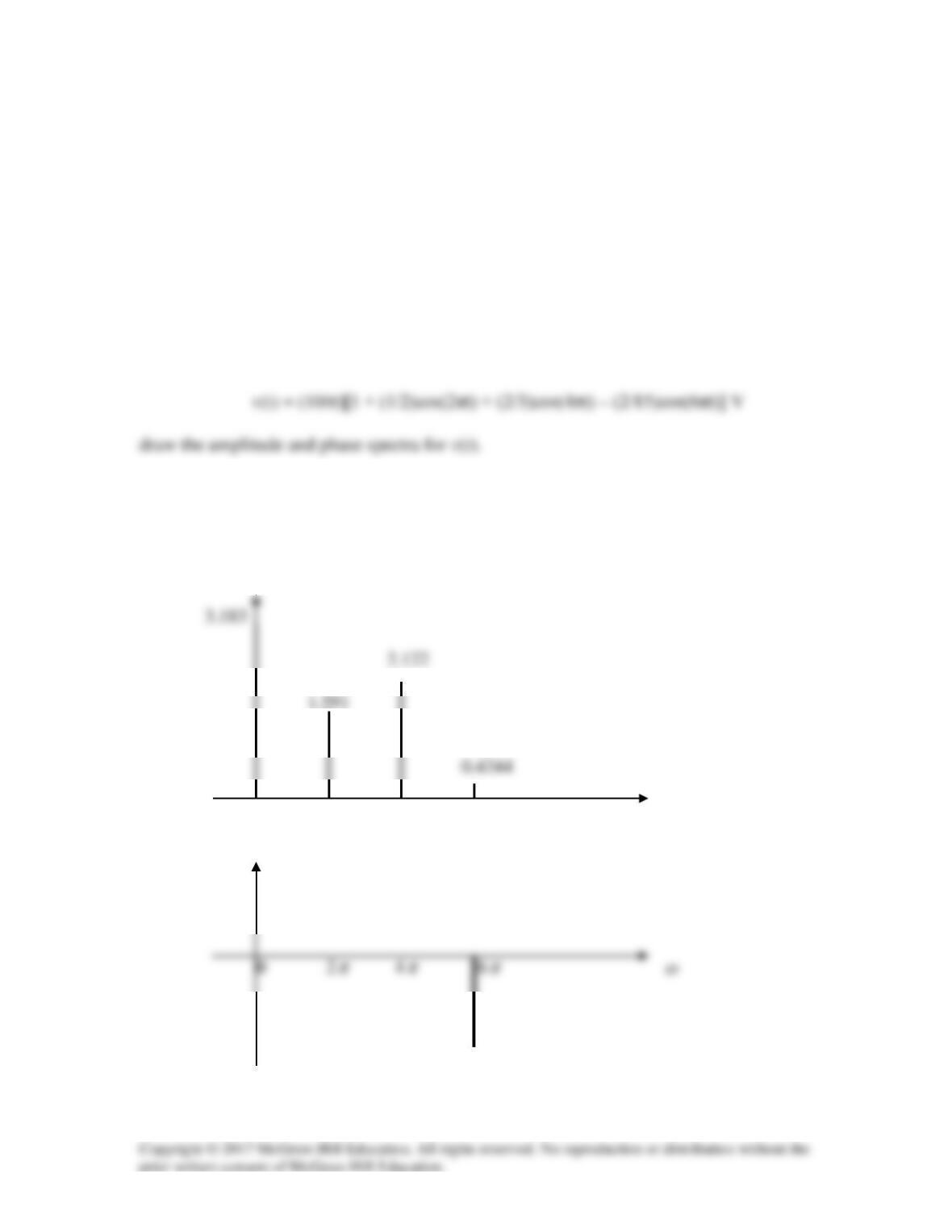
The amplitude spectra are shown below.
Solution 17.64
Design a problem to help other students to better understand the amplitude and phase
spectra of a given Fourier series.
Although there are many ways to solve this problem, this is an example based on the
same kind of problem asked in the third edition.
Problem
Given that
Solution
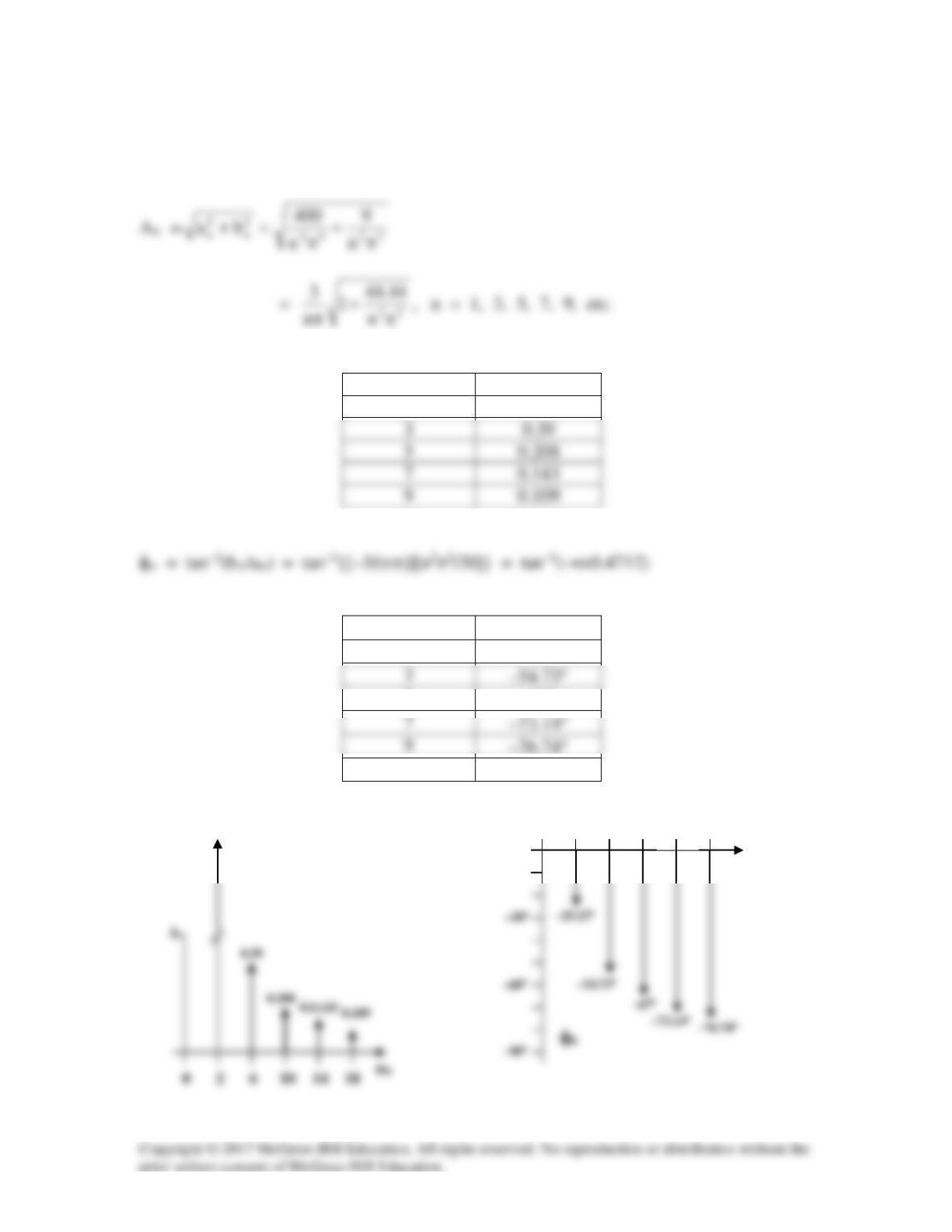
The amplitude and phase spectra are shown below.
An
0 2
π
4
π
6
π
ω
n
φ
-180o
Solution 17.65
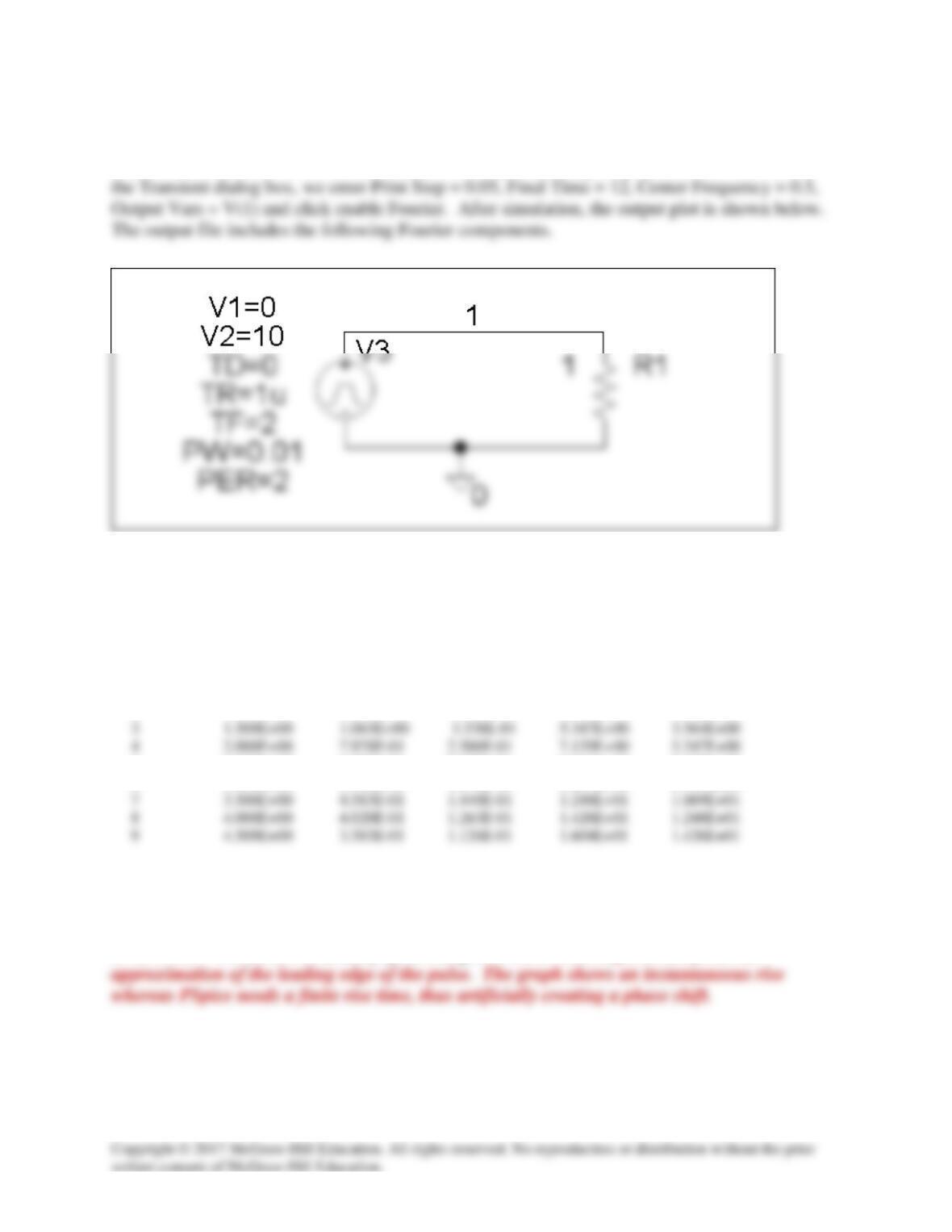
an = 20/(n2π2), bn = –3/(nπ), ωn = 2n
n
An
1
2.24
3
0.39
7
9
n
φn
1
–25.23°
3
5
–67°
7
–73.14°
9
–76.74°
∞
–90°
2.24
0
10
ω
n
14
6
2
18
Solution 17.66
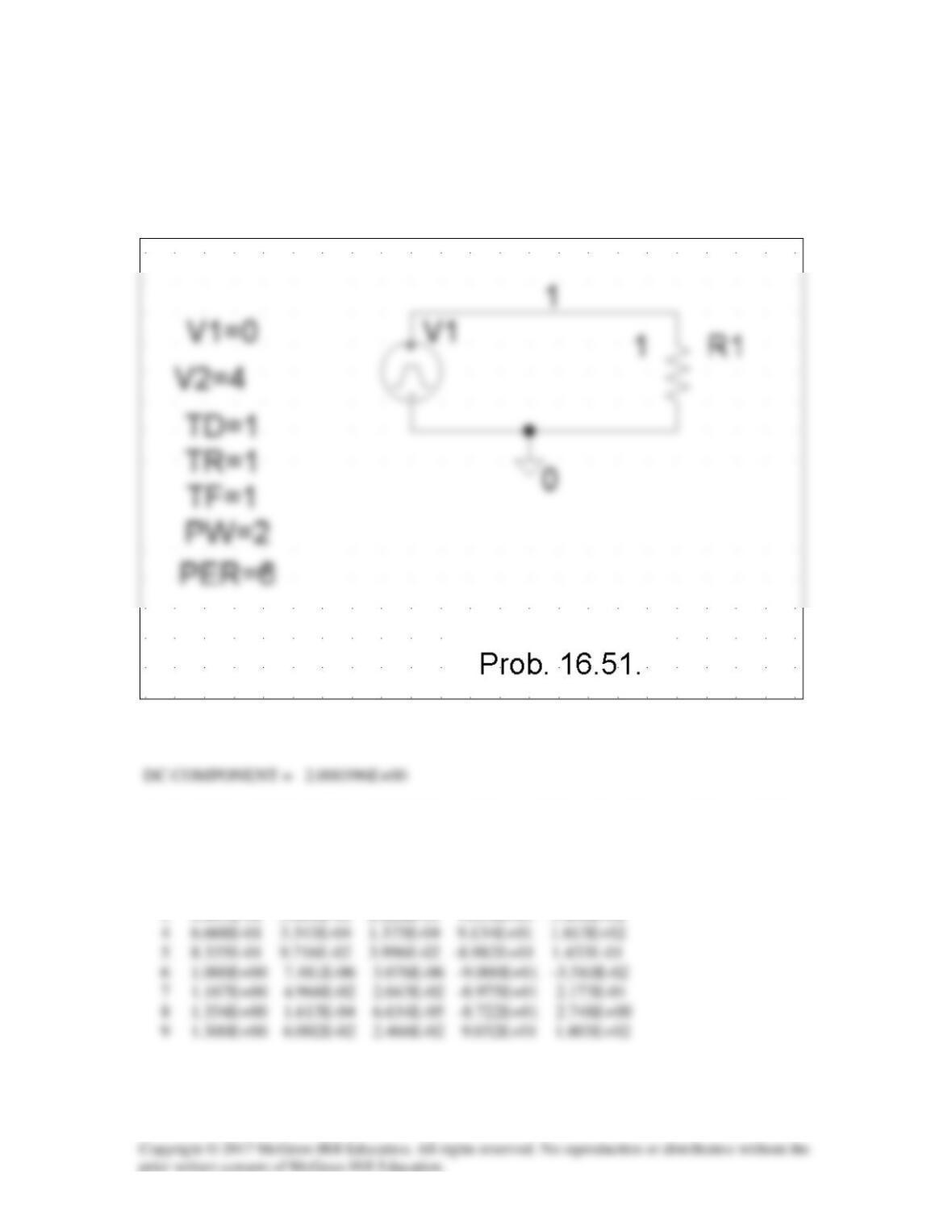
The schematic is shown below. The waveform is inputted using the attributes of VPULSE. In
FOURIER COMPONENTS OF TRANSIENT RESPONSE V(1)
DC COMPONENT = 5.099510E+00
HARMONIC FREQUENCY FOURIER NORMALIZED PHASE NORMALIZED
NO (HZ) COMPONENT COMPONENT (DEG) PHASE (DEG)
1 5.000E–01 3.184E+00 1.000E+00 1.782E+00 0.000E+00
2 1.000E+00 1.593E+00 5.002E–01 3.564E+00 1.782E+00
5 2.500E+00 6.392E–01 2.008E–01 8.911E+00 7.129E+00
6 3.000E+00 5.336E–01 1.676E–01 1.069E+01 8.911E+00
TOTAL HARMONIC DISTORTION = 7.363360E+01 PERCENT
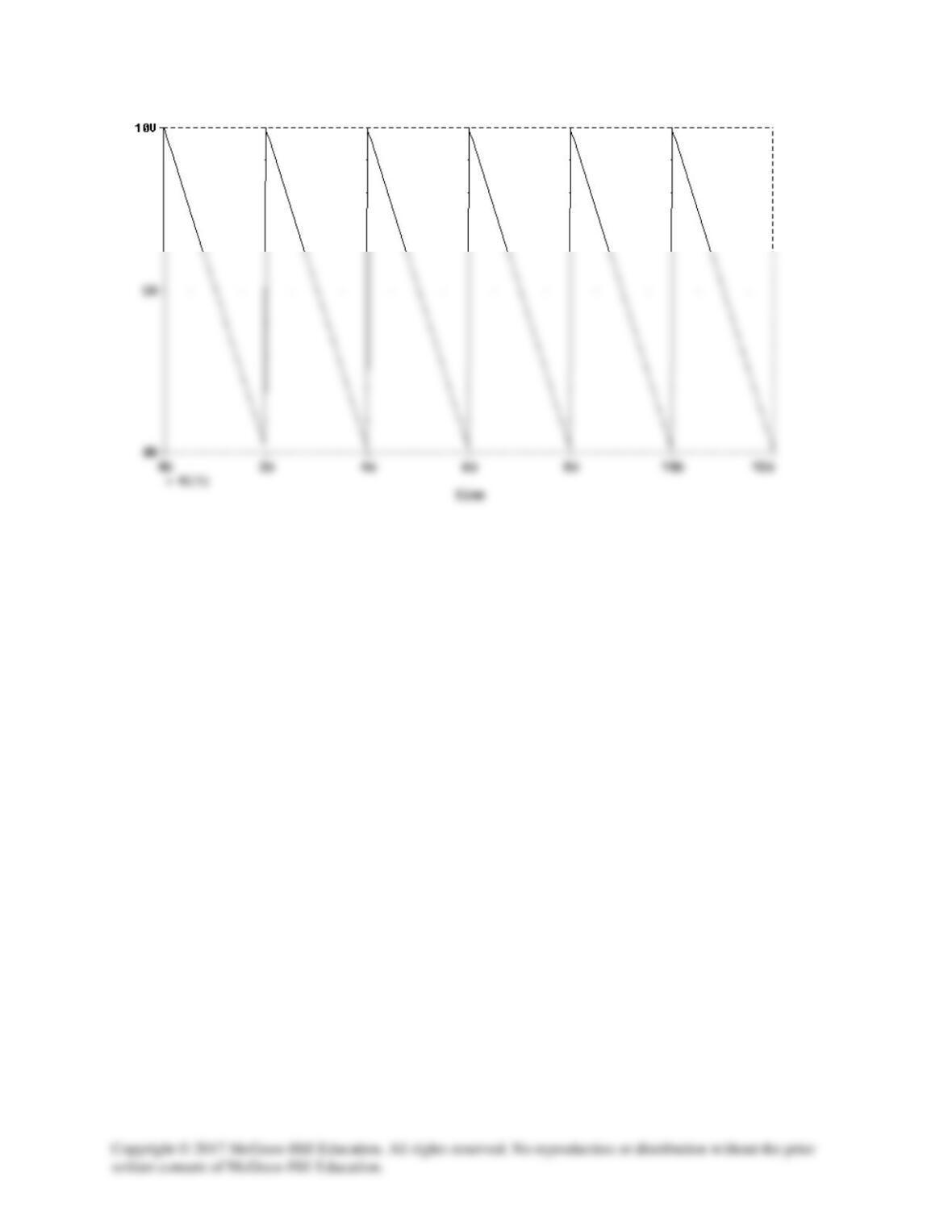
From Prob. 17.4, we know the phase angle should be zero. Why do we have a phase angle equal
to n(1.782)? The answer is actually quite straight forward. The angle comes from the
Solution 17.67
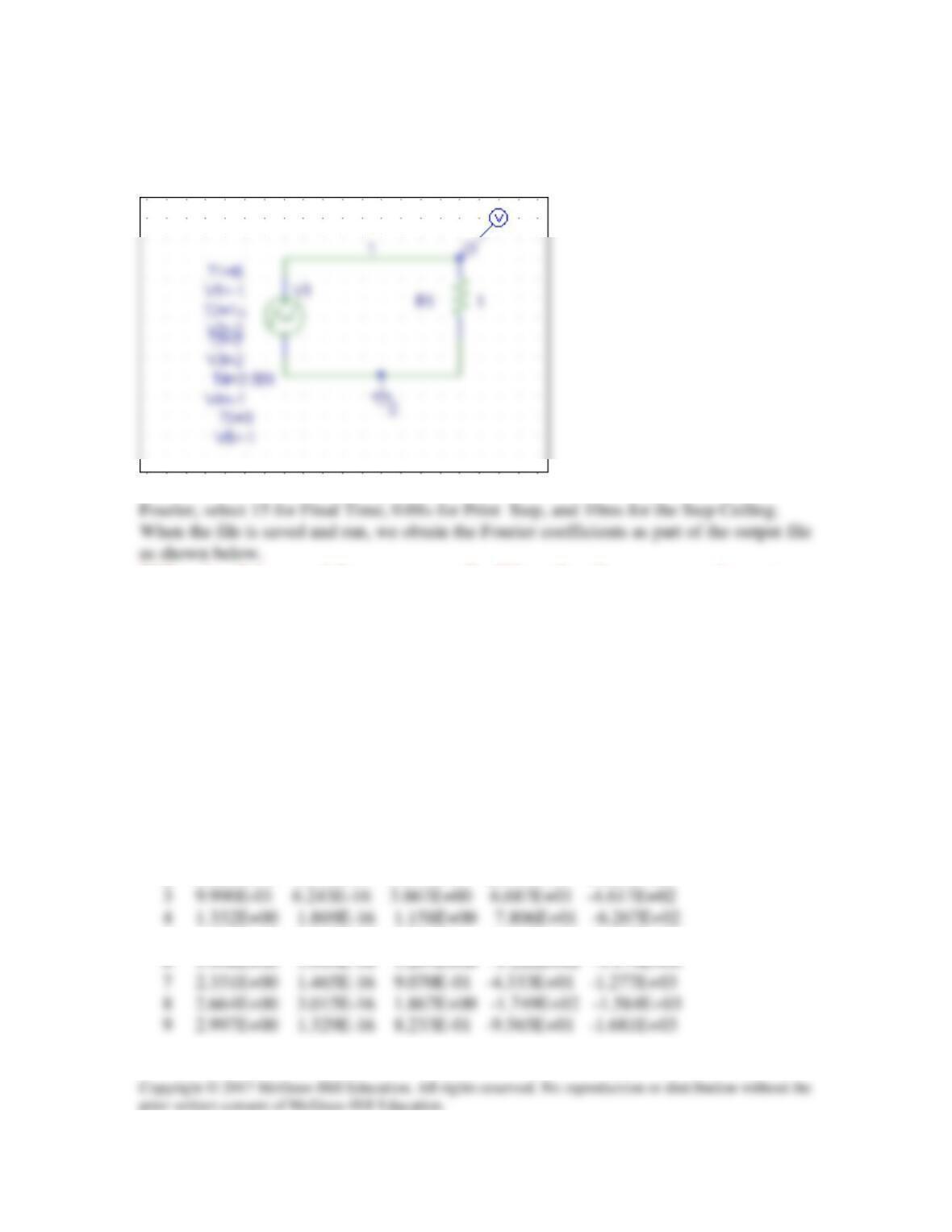
The Schematic is shown below. In the Transient dialog box, we type “Print step = 0.01s,
Final time = 36s, Center frequency = 0.1667, Output vars = v(1),” and click Enable
Fourier. After simulation, the output file includes the following Fourier components,
FOURIER COMPONENTS OF TRANSIENT RESPONSE V(1)
HARMONIC FREQUENCY FOURIER NORMALIZED PHASE NORMALIZED
NO (HZ) COMPONENT COMPONENT (DEG) PHASE (DEG)
1 1.667E-01 2.432E+00 1.000E+00 –8.996E+01 0.000E+00
2 3.334E-01 6.576E-04 2.705E-04 -8.932E+01 6.467E-01
3 5.001E-01 5.403E-01 2.222E-01 9.011E+01 1.801E+02
TOTAL HARMONIC DISTORTION = 2.280065E+01 PERCENT
Solution 17.68
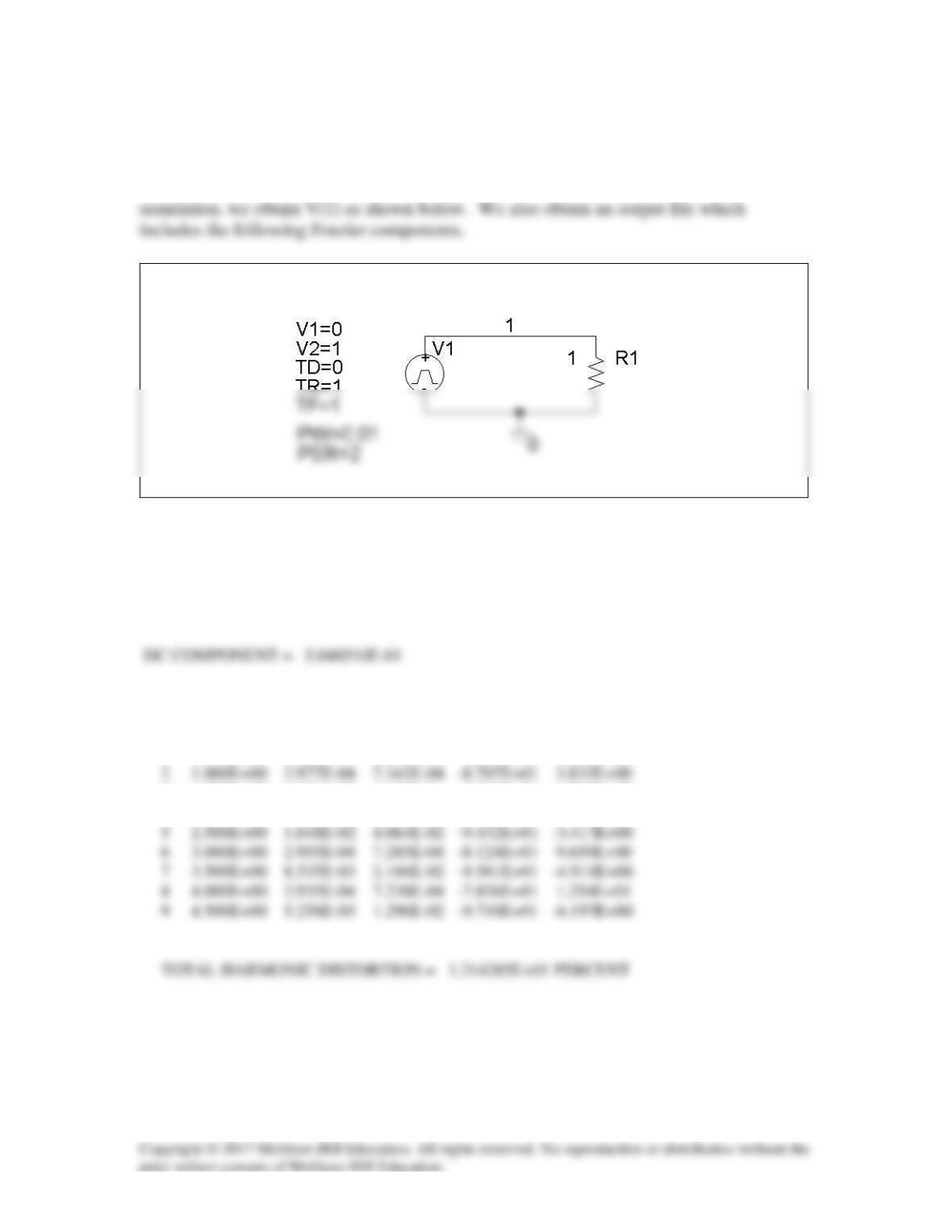
Since T=3, f =1/3 = 0.333 Hz. We use the schematic below.
We use VPWL to enter in the signal as shown. In the transient dialog box, we enable
Why is this problem wrong? Clearly the source is not
periodic. The DC value must be +1!!!!!!!!!!
FOURIER COMPONENTS OF TRANSIENT RESPONSE V(1)
DC COMPONENT = -1.000000E+00
HARMONIC FREQUENCY FOURIER NORMALIZED PHASE
NORMALIZED
NO (HZ) COMPONENT COMPONENT (DEG) PHASE (DEG)
1 3.330E-01 1.615E-16 1.000E+00 1.762E+02 0.000E+00
2 6.660E-01 5.133E-17 3.179E-01 2.999E+01 -3.224E+02
5 1.665E+00 6.806E-17 4.215E-01 1.404E+02 -7.406E+02
Solution 17.69
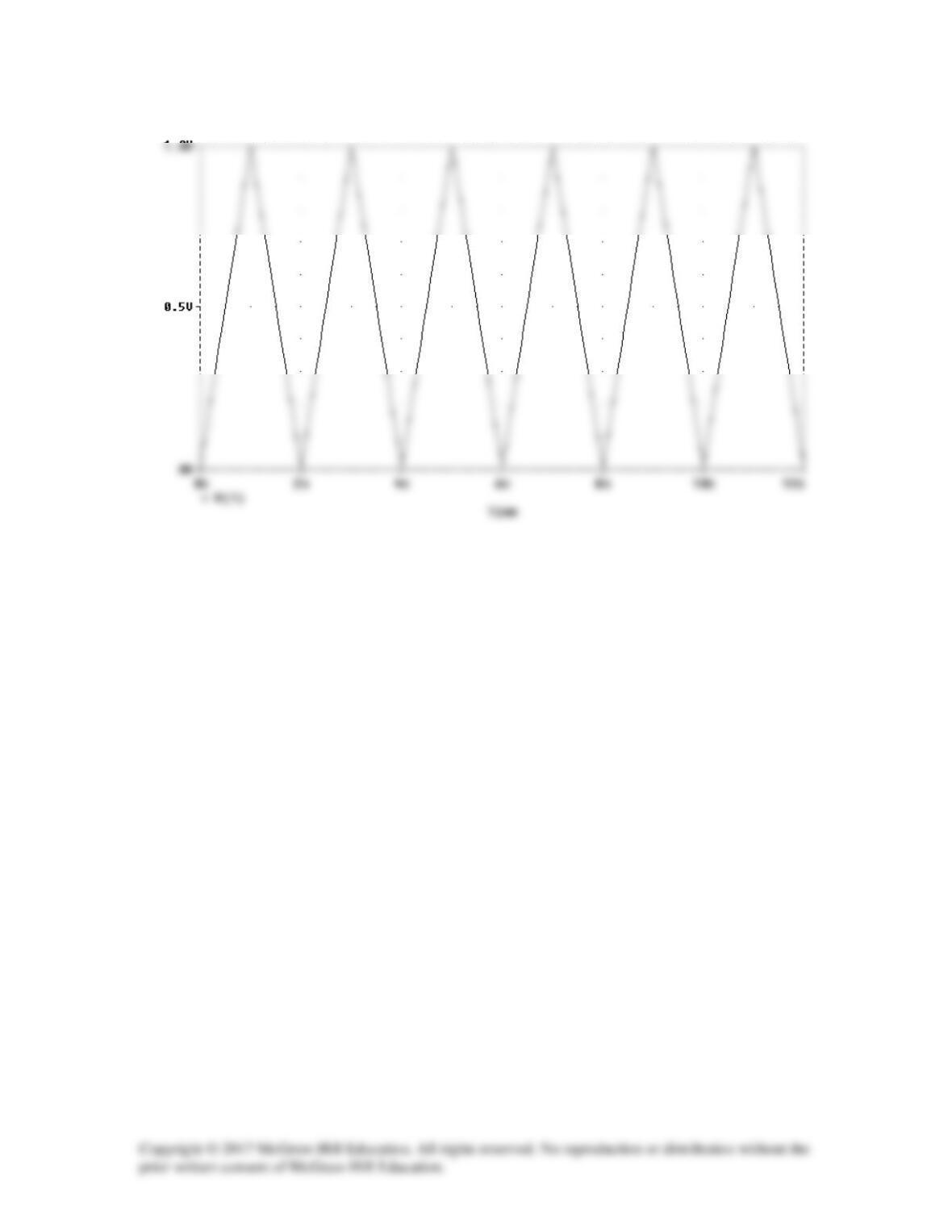
The schematic is shown below. In the Transient dialog box, set Print Step = 0.05 s, Final
Time = 120, Center Frequency = 0.5, Output Vars = V(1) and click enable Fourier. After
FOURIER COMPONENTS OF TRANSIENT RESPONSE V(1)
HARMONIC FREQUENCY FOURIER NORMALIZED PHASE NORMALIZED
NO (HZ) COMPONENT COMPONENT (DEG) PHASE (DEG)
1 5.000E-01 4.056E-01 1.000E+00 –9.090E+01 0.000E+00
3 1.500E+00 4.531E-02 1.117E-01 -9.266E+01 –1.761E+00
4 2.000E+00 2.969E-04 7.320E-04 -8.414E+01 6.757E+00
Solution 17.70
Design a problem to help other students to better understand how to use PSpice to solve
circuit problems with periodic inputs.
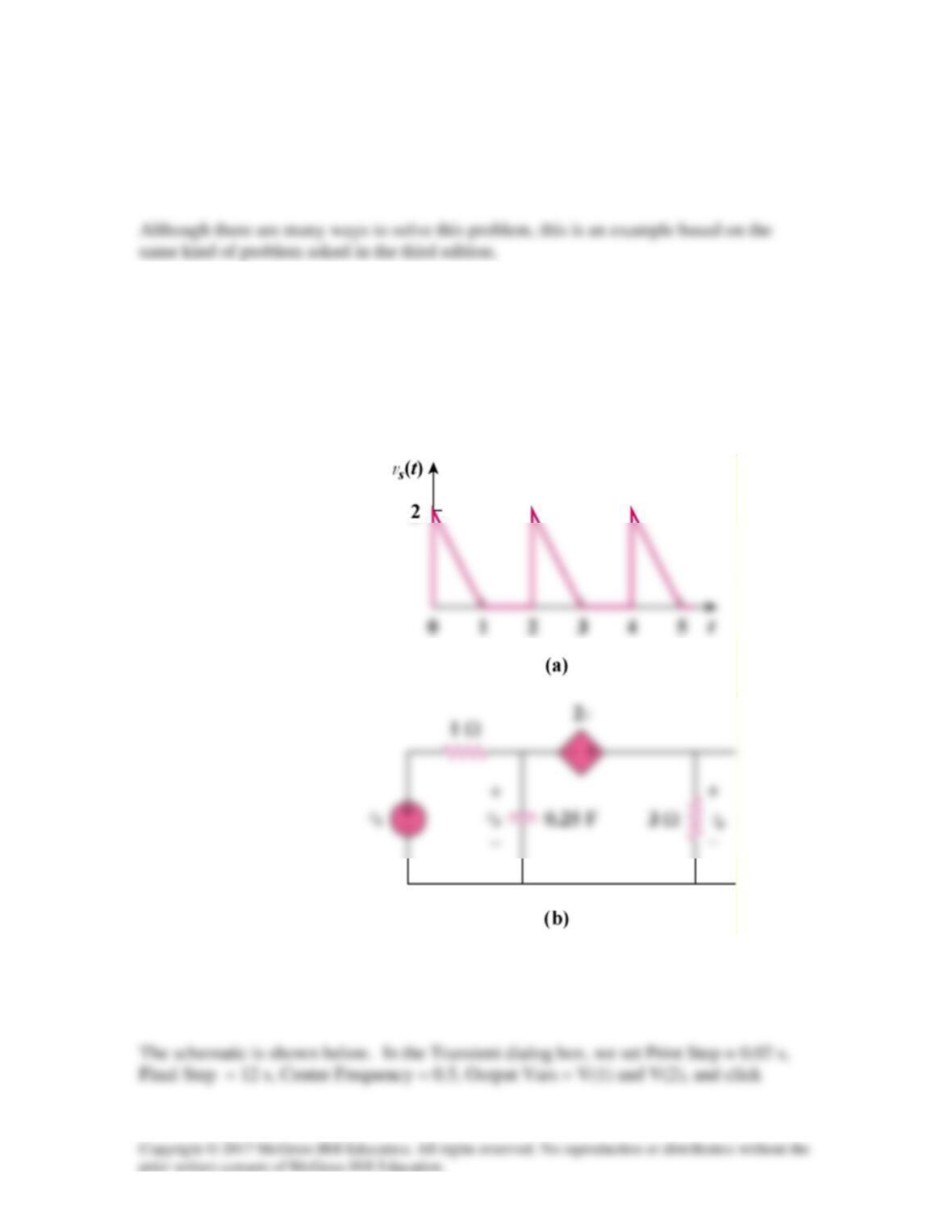
Problem
Rework Prob. 17.40 using PSpice.
Chapter 17, Problem 40.
The signal in Fig. 17.77(a) is applied to the circuit in Fig. 17.77(b). Find vo(t).
Figure 17.77
Solution