June transactions are summarized as follows:
a. Collections on account, $150,000.
b. Selling and administrative expenses incurred and paid, $33,000.
f. Wages incurred during June, $37,000. Labor time records for the month: Job 120,
$3,750; Job 121, $18,500; indirect labor, $14,750.
g. Wages paid in June include the balance in Wages Payable at May 31 plus $35,000 of wages incurred
during June.
h. Depreciation on plant and equipment, $3,000.
i. Manufacturing overhead allocated at the predetermined overhead allocation rate of 50% of direct
labor cost.
j. Jobs completed during the month: Job 120 with 300,000 Large Stars at a total cost of $47,275.
k. Sales on account: all of Job 120 for $105,000.
l. Adjusted for overallocated or underallocated manufacturing overhead.
Requirements
1. Journalize the transactions for the company.
2. Open T-accounts for the general ledger, the Raw Materials Inventory subsidiary ledger, the Work-in–
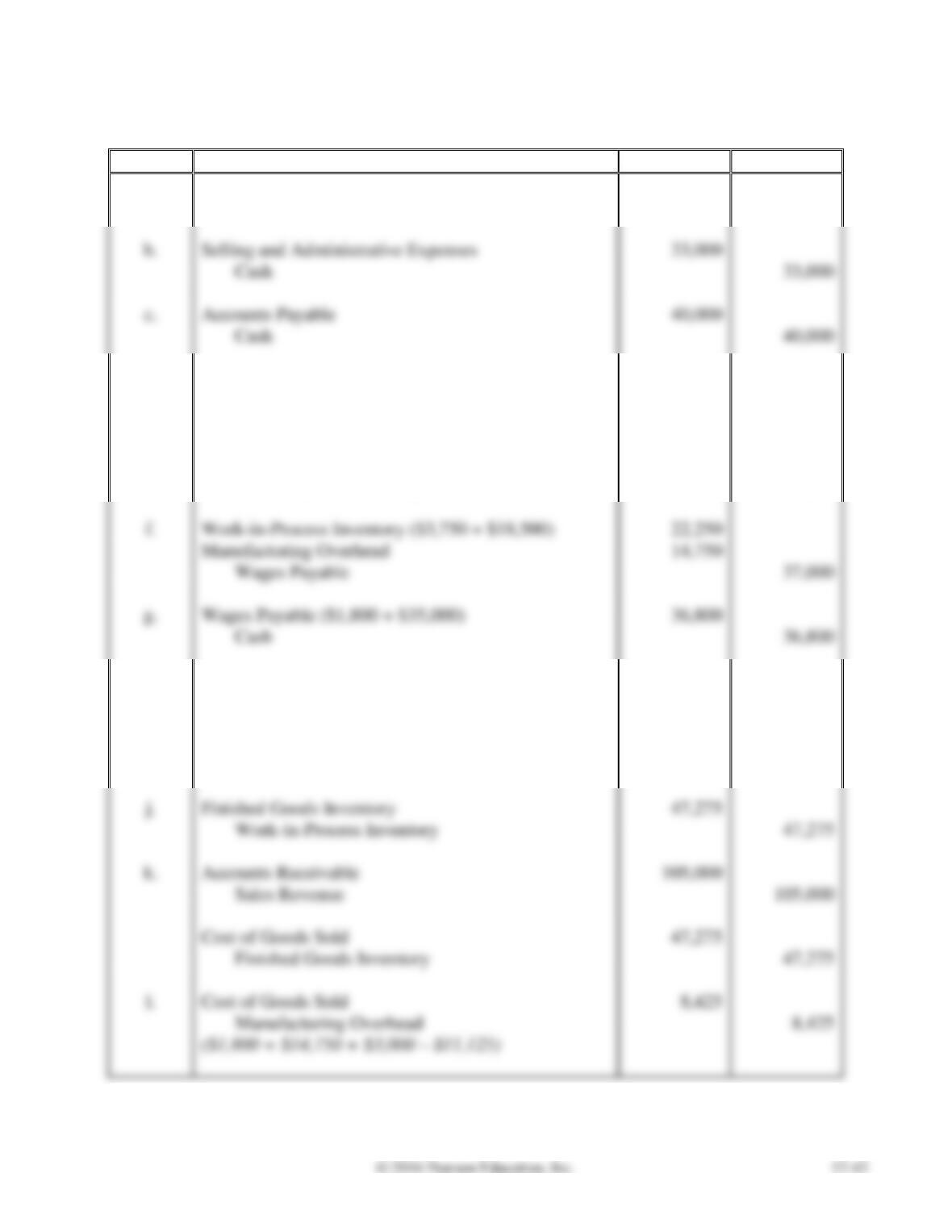
SOLUTION
Requirement 1
Date
Accounts and Explanation
Debit
Credit
a.
Cash
150,000
Accounts Receivable
150,000
b.
Selling and Administrative Expenses
33,000
Cash
33,000
c.
Accounts Payable
40,000
Cash
40,000
d.
Raw Materials Inventory ($20,000 + $5,000)
25,000
Accounts Payable
25,000
e.
Work-in-Process Inventory ($550 + $7,750)
8,300
Manufacturing Overhead
1,800
Raw Materials Inventory
10,100
Work-in-Process Inventory ($3,750 + $18,500)
22,250
Manufacturing Overhead
14,750
Wages Payable
37,000
g.
Wages Payable ($1,800 + $35,000)
36,800
Cash
36,800
h.
Manufacturing Overhead
3,000
Accumulated Depreciation—plant and equipment
3,000
i.
Work-in-Process Inventory
11,125
Manufacturing Overhead ($22,250 × 50%)
11,125
j.
Finished Goods Inventory
47,275
47,275
k.
Accounts Receivable
105,000
Sales Revenue
105,000
Cost of Goods Sold
47,275
Finished Goods Inventory
47,275
l.
Cost of Goods Sold
8,425
Manufacturing Overhead
8,425
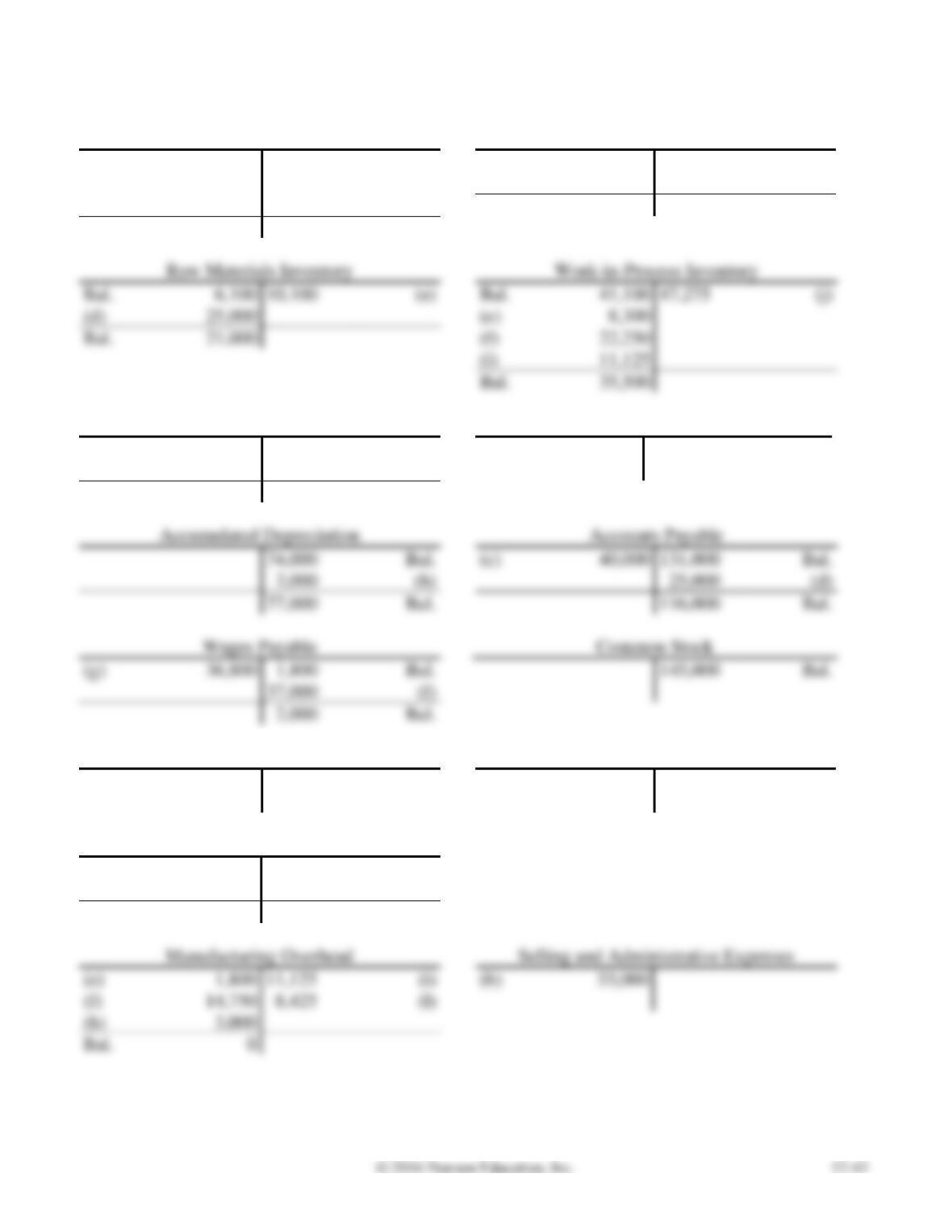
P17-32A, cont.
Requirement 2
Cash
Accounts Receivable
Bal.
18,000
33,000
(b)
Bal.
180,000
150,000
(a)
(a)
150,000
40,000
(c)
(k)
105,000
36,800
(g)
Bal.
135,000
Bal.
58,200
Bal.
6,100
10,100
(e)
Bal.
47,275
(d)
(e)
8,300
Bal.
(i)
Finished Goods Inventory
Plant Assets
Bal.
21,100
47,275
(k)
Bal.
210,000
(j)
47,275
Bal.
21,100
74,000
Bal.
(c)
131,000
Bal.
3,000
(h)
25,000
(d)
77,000
Bal.
Bal.
(g)
1,800
145,000
Bal.
37,000
2,000
Retained Earnings
Sales Revenue
124,500
Bal.
105,000
(k)
Cost of Goods Sold
(k)
47,275
(l)
8,425
Bal.
55,700
Manufacturing Overhead
(e)
1,800
11,125
(b)
8,425
(h)
3,000
Bal.
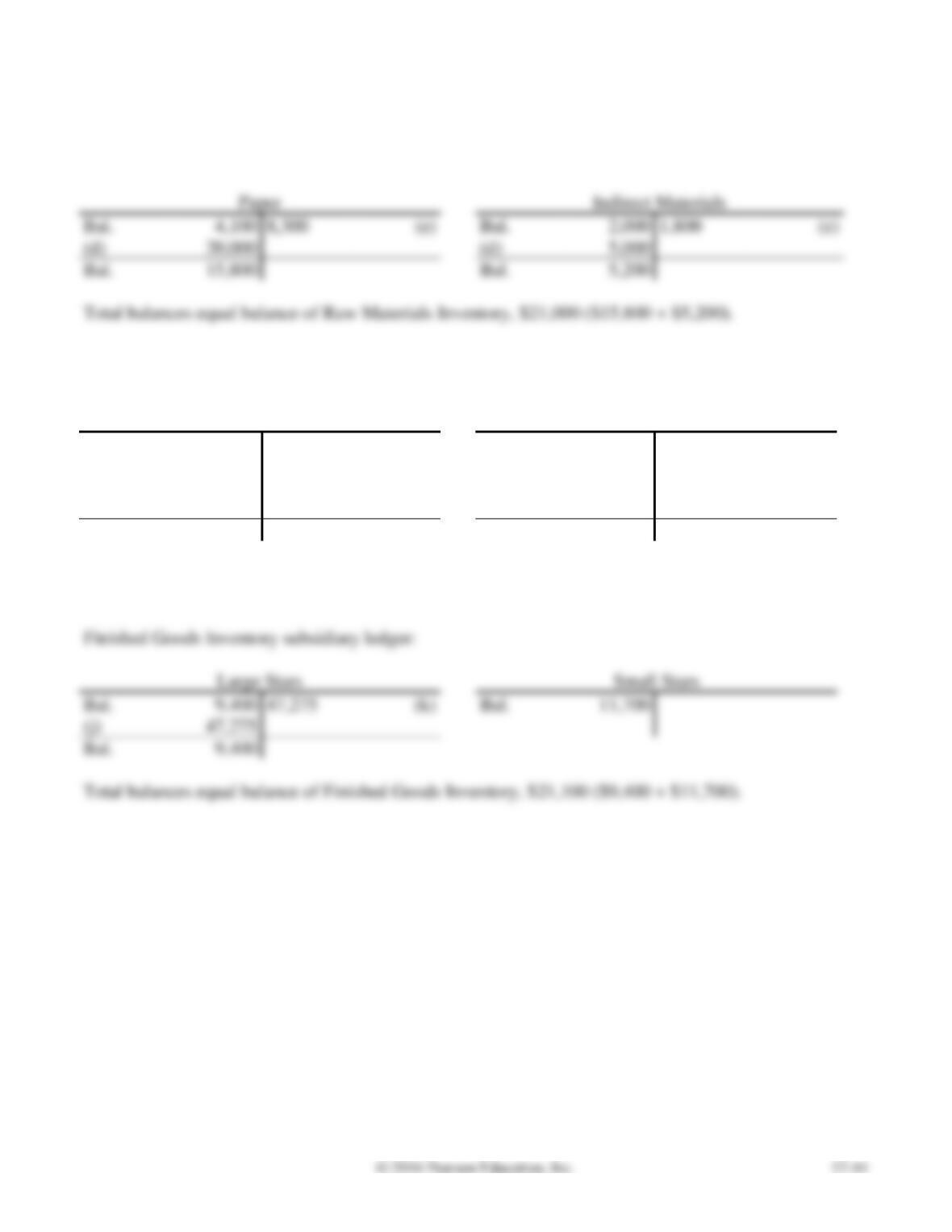
P17-32A, cont.
Requirement 2, cont.
Raw Materials Inventory subsidiary ledger:
Bal.
4,100
8,300
Bal.
2,000
1,800
(d)
20,000
(d)
5,000
Bal.
15,800
Bal.
5,200
Work-in-Process Inventory subsidiary ledger:
Job 120
Job 121
Bal.
41,100
47,275
(j)
Bal.
(e)
0
7,750
(e)
550
(f)
3,750
(f)
18,500
(i)
1,875
(i)
9,250
Bal.
0
Bal.
35,500
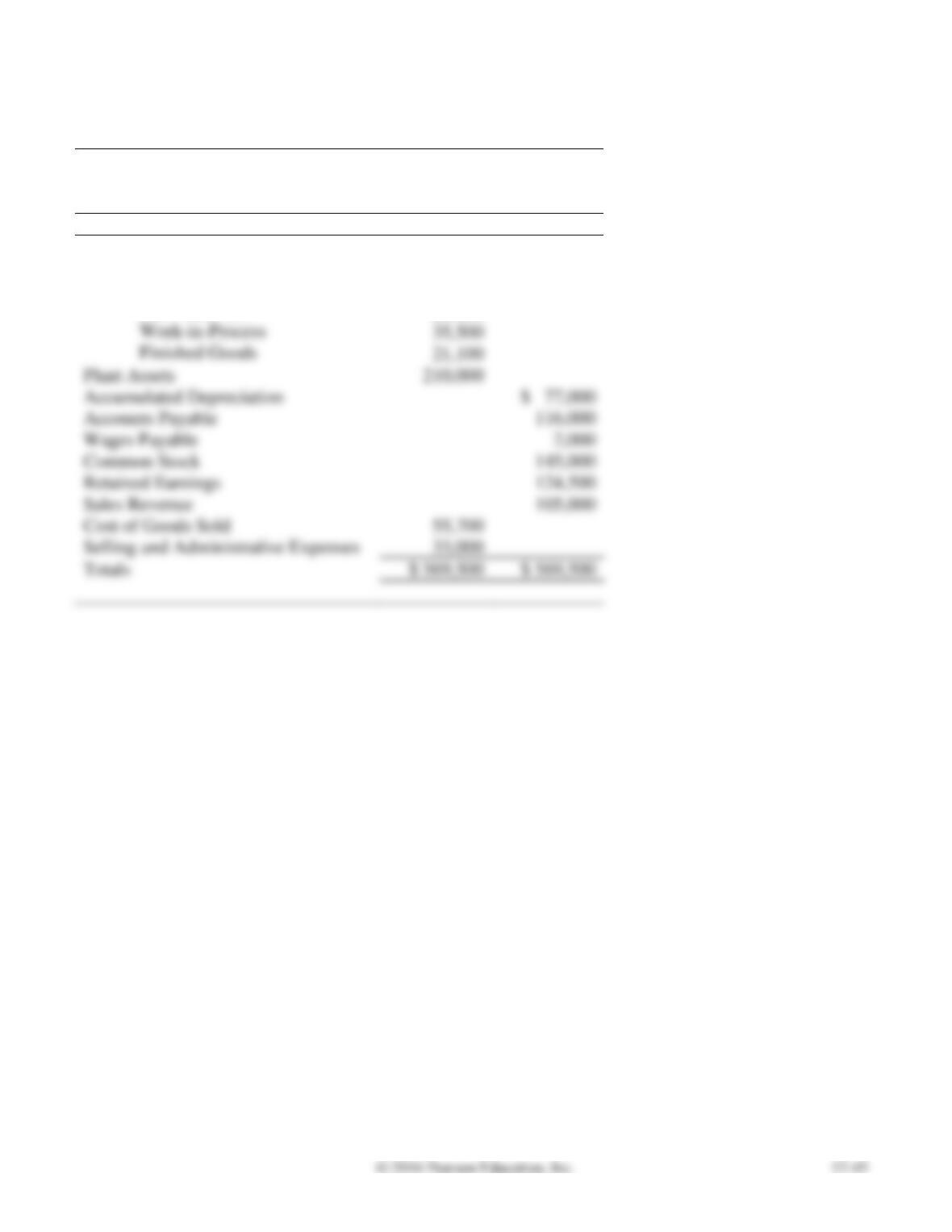
Balance equals balance of Work-in-Process Inventory, $35,500 ($0 + $35,500).
Bal.
9,400
47,275
Bal.
11,700
(j)
47,275
Bal.
9,400
P17-32A, cont.
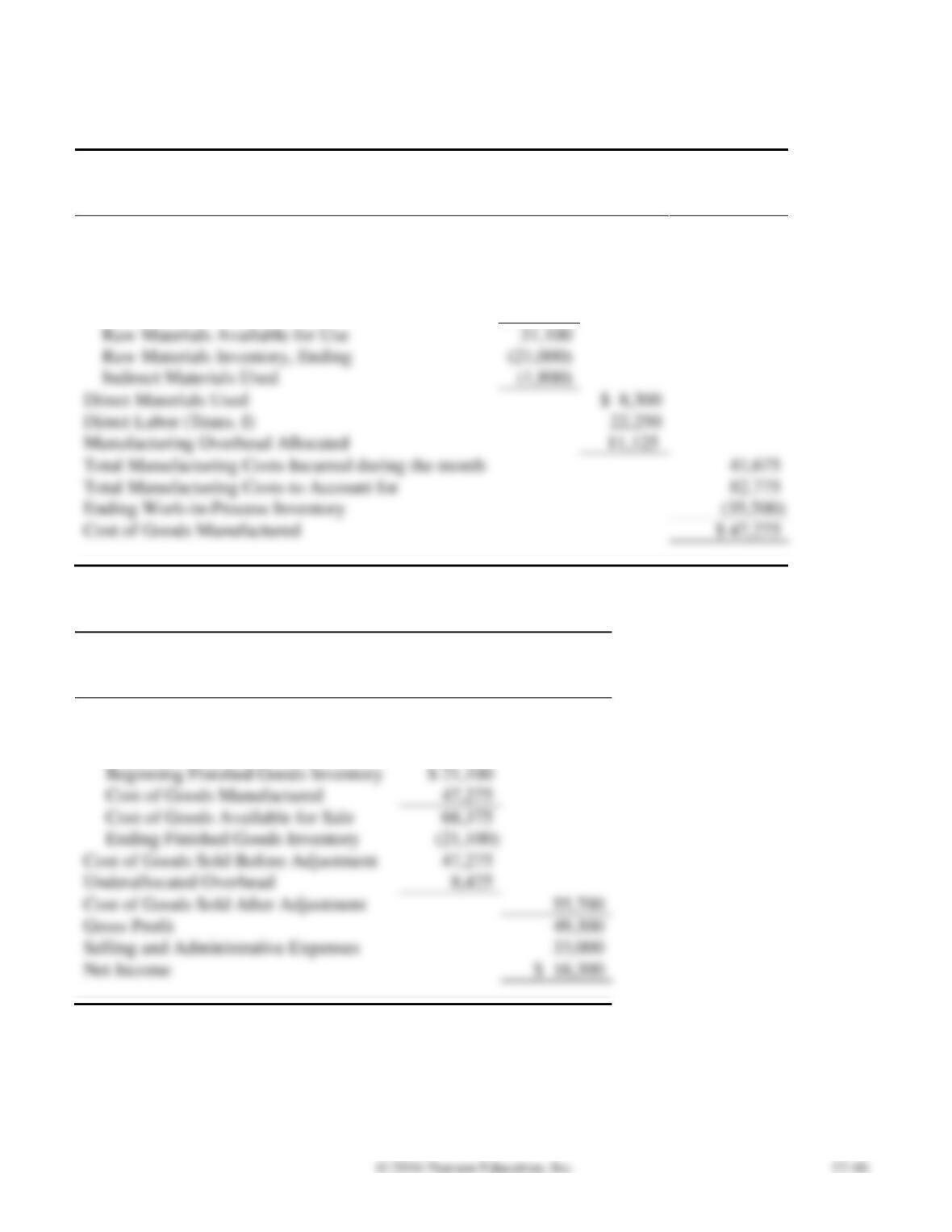
Requirement 3
LEARNING STARS
Trial Balance
June 30, 2016
Account
Debit
Credit
Cash
$ 58,200
Accounts Receivable
135,000
Inventories:
Raw Materials
21,000
35,500
Finished Goods
21,100
Plant Assets
210,000
Accumulated Depreciation
$ 77,000
Accounts Payable
116,000
Wages Payable
Common Stock
145,000
Retained Earnings
124,500
Sales Revenue
105,000
Cost of Goods Sold
55,700
Selling and Administrative Expenses
33,000
Totals
$ 569,500
$ 569,500
P17-32A, cont.
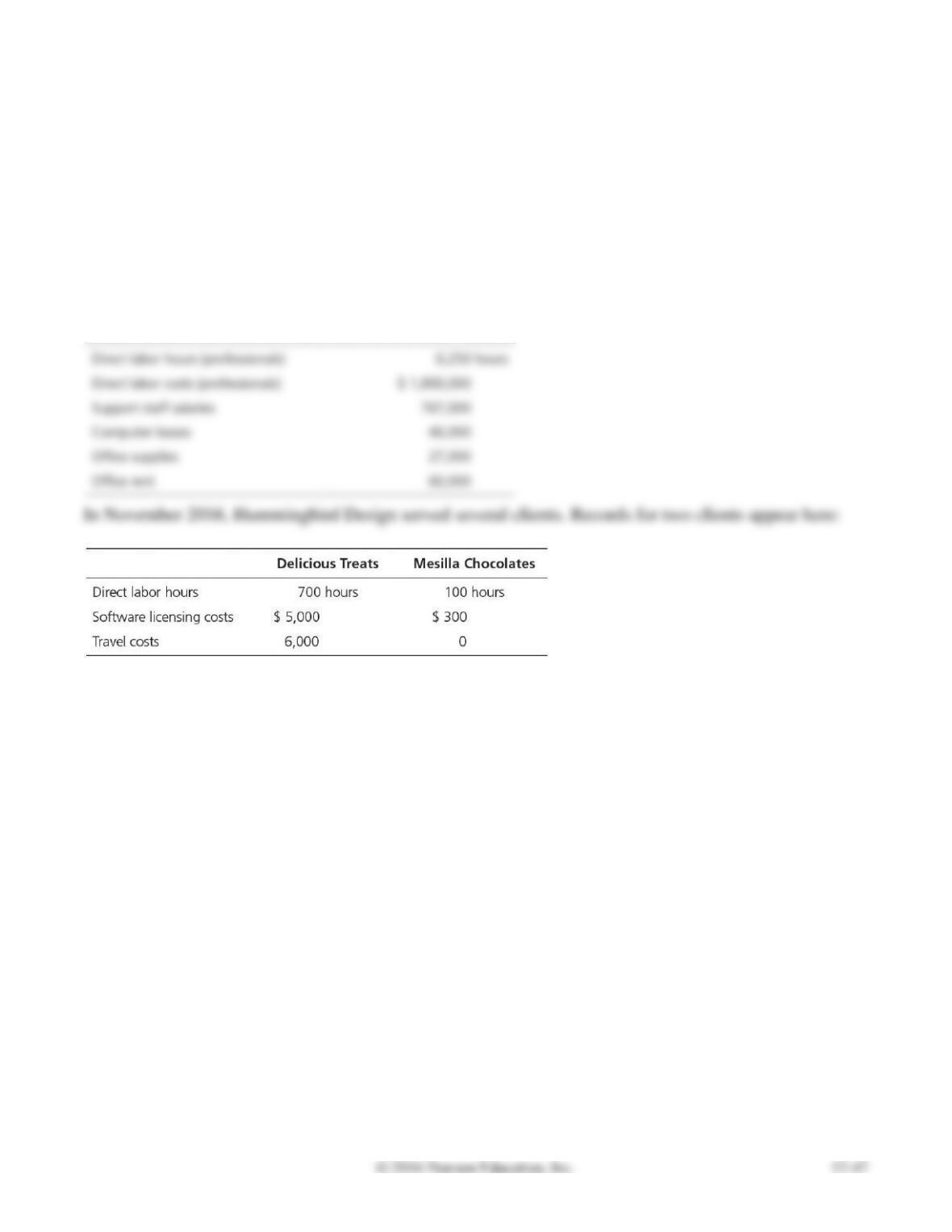
Requirement 4
LEARNING STARS
Schedule of Cost of Goods Manufactured
Month Ended June 30, 2016
Beginning Work-in-Process Inventory
$ 41,100
Direct Materials Used:
Raw Materials Inventory, Beginning
$ 6,100
Purchases
25,000
Raw Materials Available for Use
31,100
Raw Materials Inventory, Ending
(21,000)
Indirect Materials Used
(1,800)
Direct Materials Used
Direct Labor (Trans. f)
Manufacturing Overhead Allocated
11,125
Total Manufacturing Costs Incurred during the month
Total Manufacturing Costs to Account for
Ending Work-in-Process Inventory
Cost of Goods Manufactured
$ 47,275
Requirement 5
LEARNING STARS
Income Statement
Month ended June 30, 2016
Sales Revenue
$ 105,000
Cost of Goods Sold:
(21,100)
Cost of Goods Sold Before Adjustment
Underallocated Overhead
Gross Profit
Selling and Administrative Expenses
Net Income
P17-33A Using job order costing in a service company
Learning Objective 6
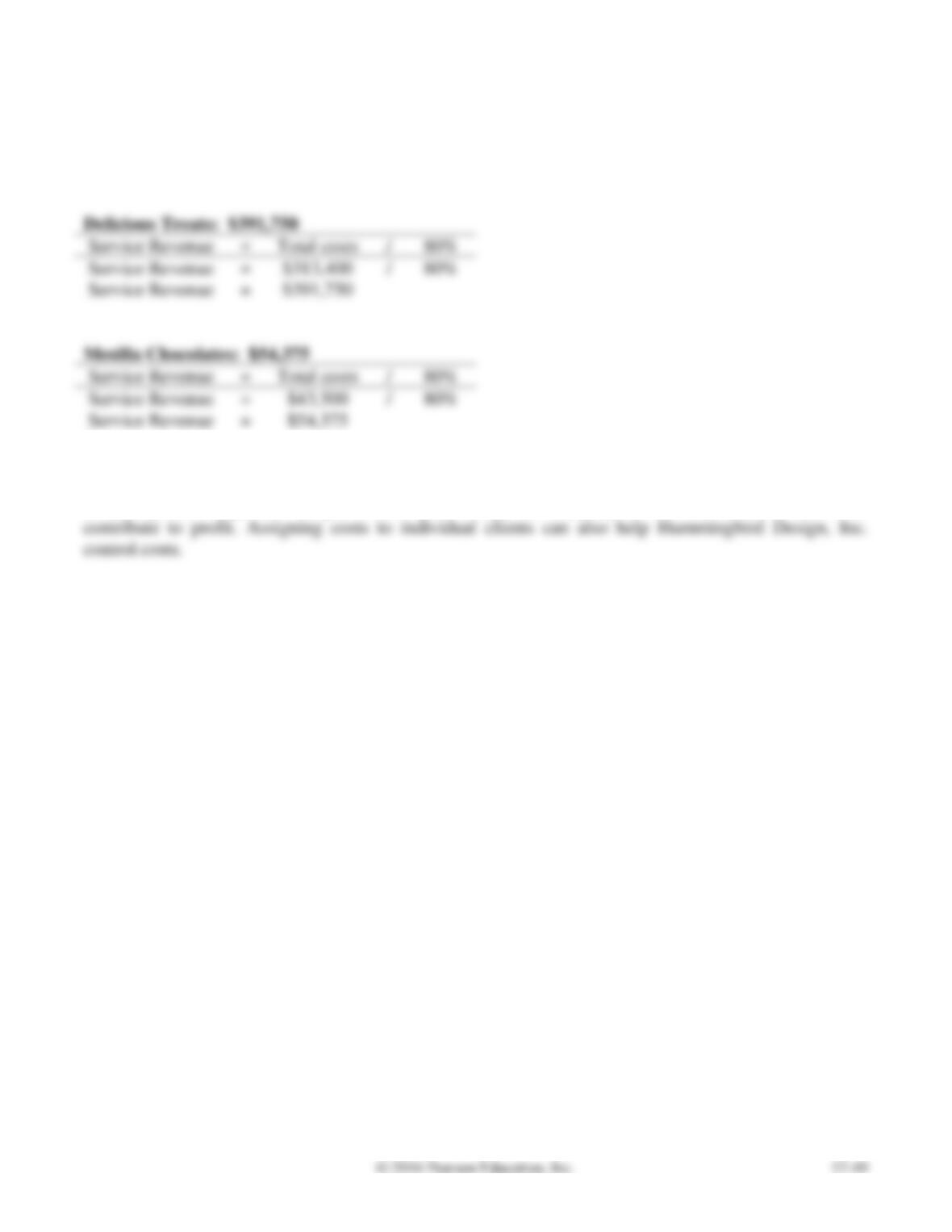
2. Delicious Treats $313,400
(Requirements 1 and 2 only)
Hummingbird Design, Inc. is a Web site design and consulting firm. The firm uses a job order costing
system in which each client is a different job. Hummingbird Design assigns direct labor, licensing costs,
and travel costs directly to each job. It allocates in– direct costs to jobs based on a predetermined
overhead allocation rate, computed as a percentage of direct labor costs.
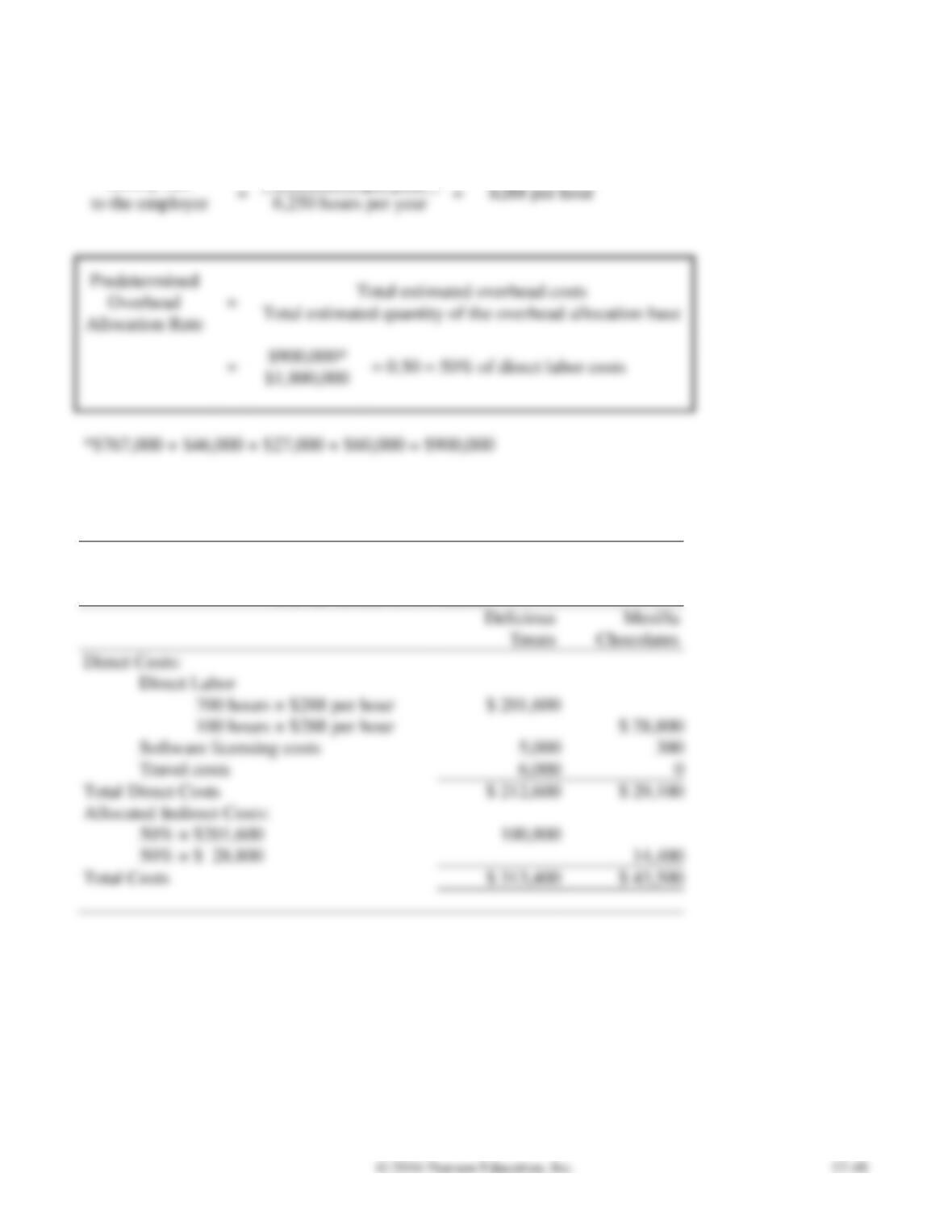
At the beginning of 2016, managing partner Sally Simone prepared the following budget estimates:
Requirements
1. Compute Hummingbird Design’s direct labor rate and its predetermined overhead allocation rate for
2016.
2. Compute the total cost of each job.
3. If Simone wants to earn profits equal to 20% of service revenue, what fee should she charge each of
these two clients?
4. Why does Hummingbird Design assign costs to jobs?
SOLUTION
Requirement 1
$1,800,000
Hourly rate
$1,800,000 per year
Requirement 2
HUMMINGBIRD DESIGN, INC.
Total Cost of Delicious Treats’ and Mesilla Chocolates’ Jobs
For the month of November
P17-33A, cont.
Requirement 3
If profits are 20% of sales, then total costs are 80% of sales.
Therefore, Sales Revenue = Total Costs / 80%.
Requirement 4
Hummingbird Design, Inc. assigns costs to jobs to help the company set fees that cover all costs and
Problems (Group B)
P17-34B Analyzing cost data, recording completion and sales of jobs
Learning Objectives 1, 2, 4
5. Gross profit $400
Sloan Manufacturing makes carrying cases for portable electronic devices. Its costing records yield the
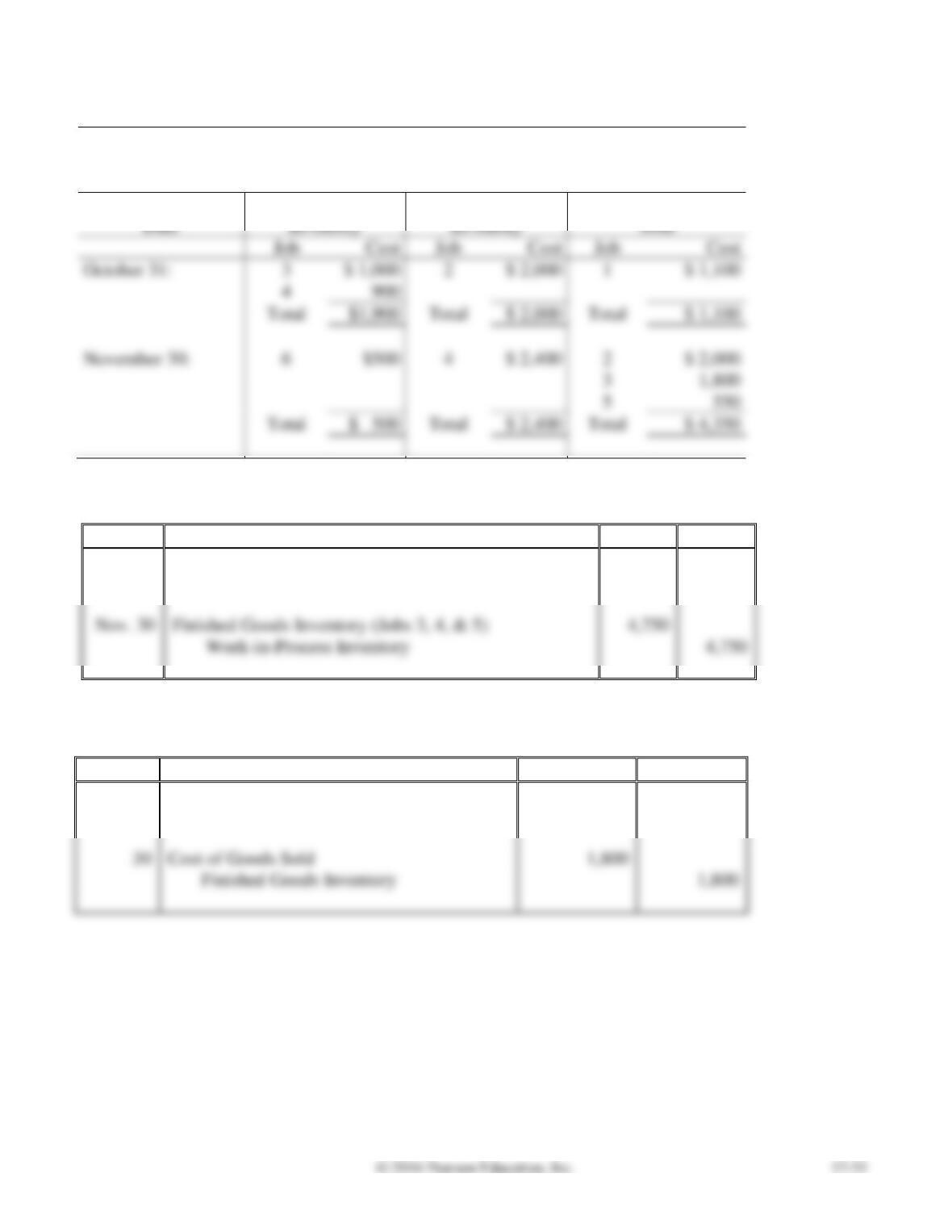
following information:
Requirements
1. Which type of costing system is Sloan using? What piece of data did you base your answer on?
2. Use the dates in the table to identify the status of each job at October 31 and November 30. Compute
Sloan’s account balances at October 31 for Work–in-Process Inventory, Finished Goods Inventory,
and Cost of Goods
Sold. Compute, by job, account balances at November 30 for Work-in-Process Inventory, Finished
Goods Inventory, and Cost of Goods Sold.
3. Prepare journal entries to record the transfer of completed jobs from Work-in– Process Inventory to
Finished Goods Inventory for October and November.
4. Record the sale of Job 3 for $2,200 on account.
5. What is the gross profit for Job 3?
SOLUTION
Requirement 1
Requirement 2
SLOAN MANUFACTURING
Computation of Work-in-Process Inventory, Finished Goods Inventory,
and Cost of Goods Sold for October and November
Sold
Job
Cost
$ 2,000
$ 2,000
$ 2,400
$ 2,400
Work-in-Process
Finished Goods
Cost of Goods
Requirement 3
Date
Accounts and Explanation
Debit
Credit
Oct. 31
Finished Goods Inventory (Jobs 1 & 2)
3,100
Work-in-Process Inventory
3,100
Finished Goods Inventory (Jobs 3, 4, & 5)
4,750
Work-in-Process Inventory
4,750
Requirement 4
Date
Accounts and Explanation
Debit
Credit
Nov. 30
Accounts Receivable
2,200
Sales Revenue
2,200
Cost of Goods Sold
1,800
Finished Goods Inventory
1,800
Requirement 5
The gross profit for Job 3 is:
P17-35B Preparing and using a job cost record to prepare journal entries
Learning Objectives 2, 3, 4
1. Cost per DVD $0.39
Tu Technology Co. manufactures CDs and DVDs for computer software and entertainment companies.
Tu uses job order costing.
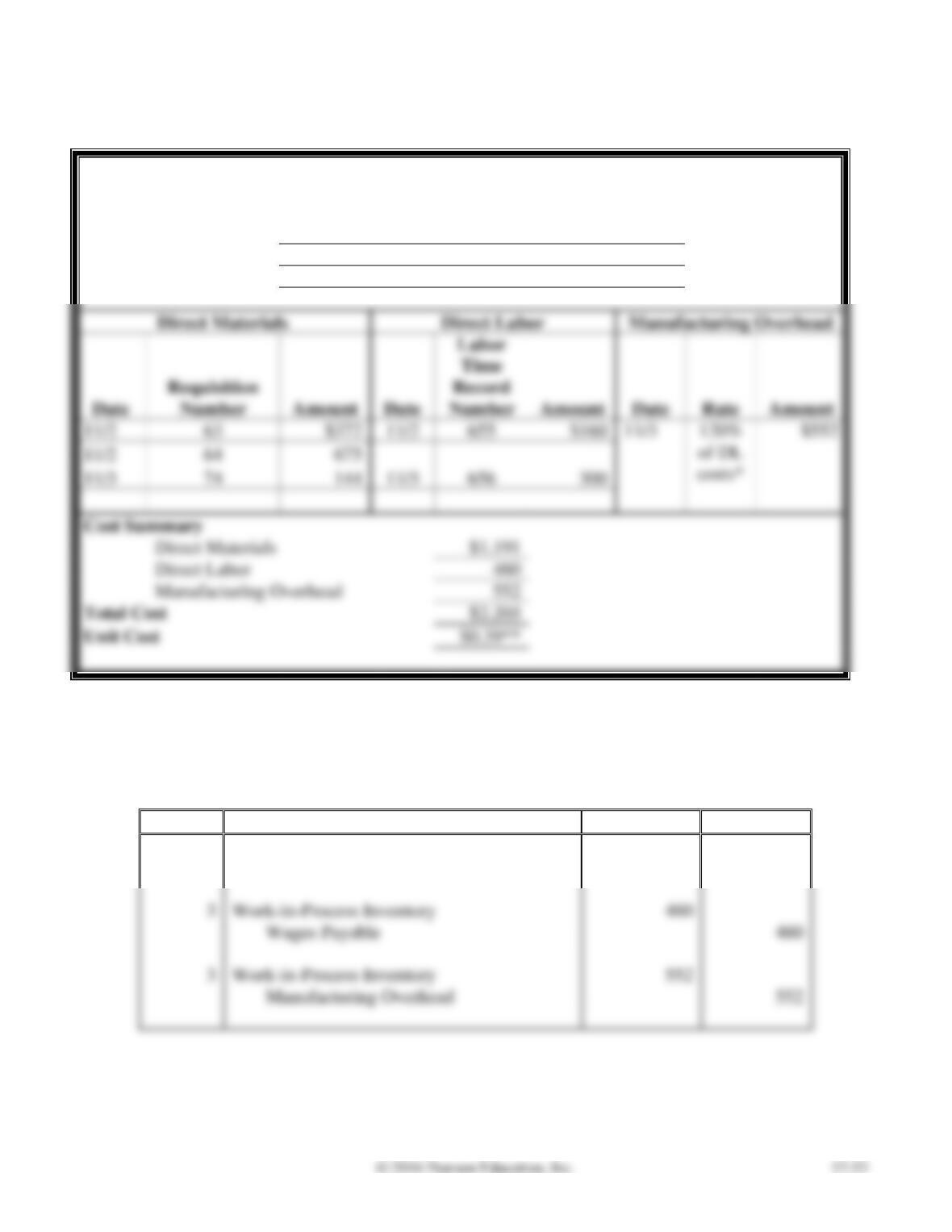
On November 2, Tu began production of 5,700 DVDs, Job 423, for Cyclorama Pictures for $1.50 sales
price per DVD. Tu promised to deliver the DVDs to Cyclorama by November 5. Tu incurred the
following costs:
Requirements
1. Prepare a job cost record for Job 423. Calculate the predetermined overhead allocation rate; then
allocate manufacturing overhead to the job.
2. Journalize in summary form the requisition of direct materials and the assignment of direct labor and
the allocation of manufacturing overhead to Job 423. Wages are not yet paid.
3. Journalize completion of the job and the sale of the 5,700 DVDs on account.
SOLUTION
Requirement 1
JOB COST RECORD
Job Number
423
Customer
Cyclorama Pictures
Job Description
5,700 DVDs
11/2
11/2
11/3
Cost Summary
Direct Materials
Direct Labor
Manufacturing Overhead
Total Cost
Unit Cost
*$564,000 / $470,000 = 120%
**$2,203 / 5,700 DVDs = $0.39 per DVD (rounded)
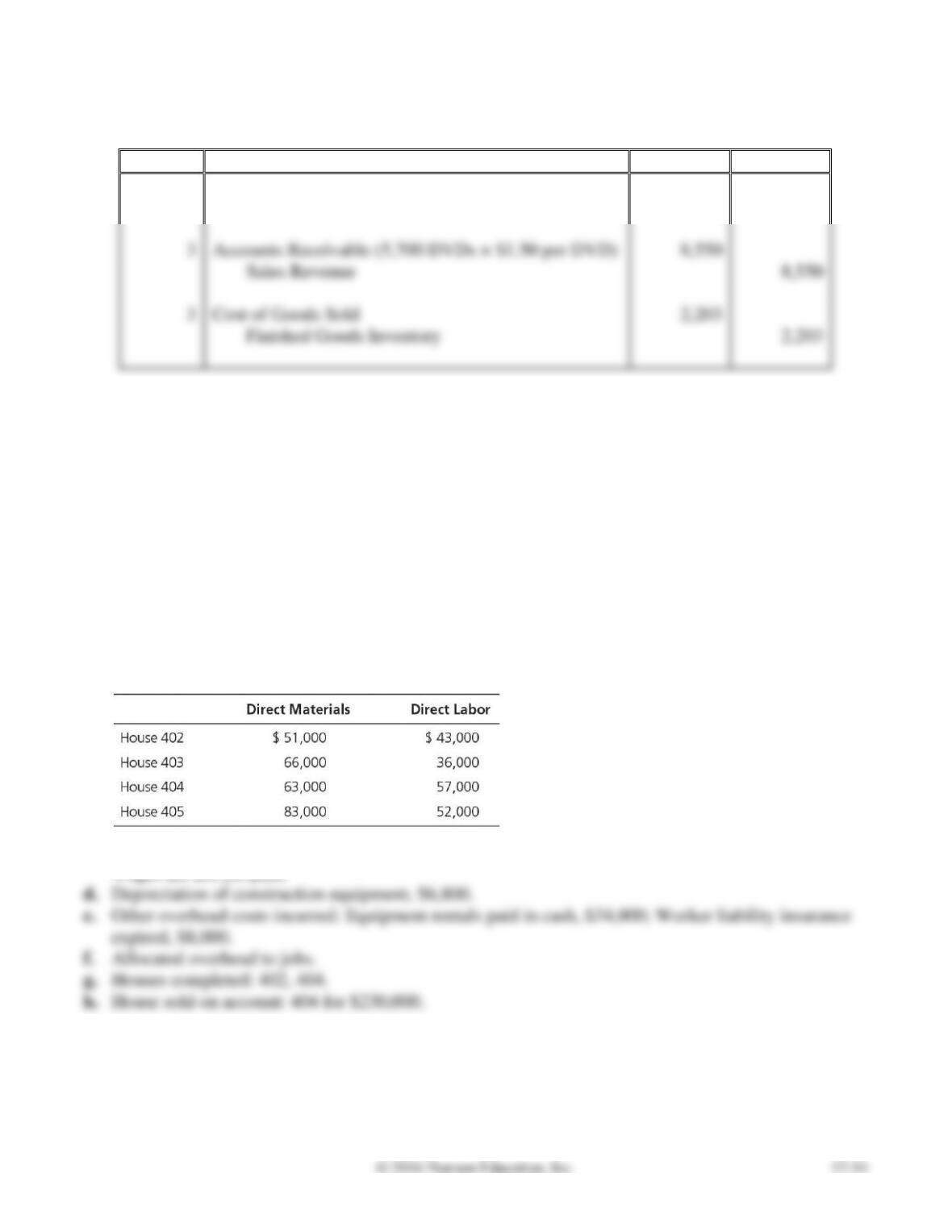
Requirement 2
Date
Accounts and Explanation
Debit
Credit
Nov. 3
Work-in-Process Inventory
1,191
Raw Materials Inventory
1,191
Work-in-Process Inventory
Wages Payable
Work-in-Process Inventory
P17-35B, cont.
Requirement 3
Date
Accounts and Explanation
Debit
Credit
Nov. 3
Finished Goods Inventory
2,203
Work-in-Process Inventory
2,203
Accounts Receivable (5,700 DVDs × $1.50 per DVD)
8,550
Sales Revenue
8,550
Cost of Goods Sold
2,203
Finished Goods Inventory
2,203
P17-36B Accounting for transactions, construction company
Learning Objectives 2, 3, 4
3. WIP Bal. $272,200
Sunrise Construction, Inc. is a home builder in Arizona. Sunrise uses a job order costing system in
which each house is a job. Because it constructs houses, the company uses an account titled
Construction Overhead. The company applies overhead based on estimated direct labor costs. For the
year, it estimated construction overhead of $1,300,000 and total direct labor cost of $3,250,000. The
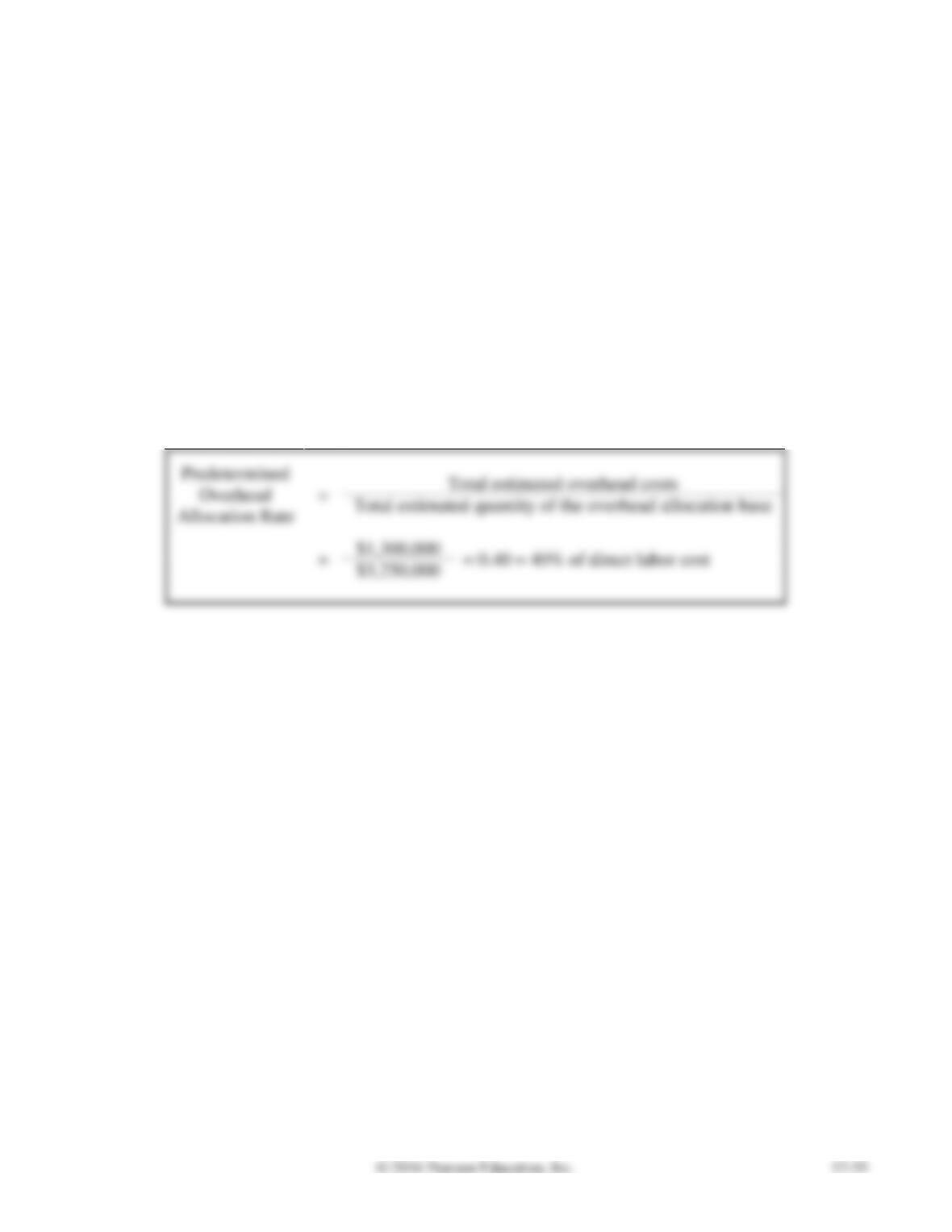
following events occurred during August:
a. Purchased materials on account, $450,000.
b. Requisitioned direct materials and used direct labor in construction. Recorded the materials
requisitioned.
c. The company incurred total wages of $250,000. Use the data from Item b to assign the wages.
Wages are not yet paid.
Requirements
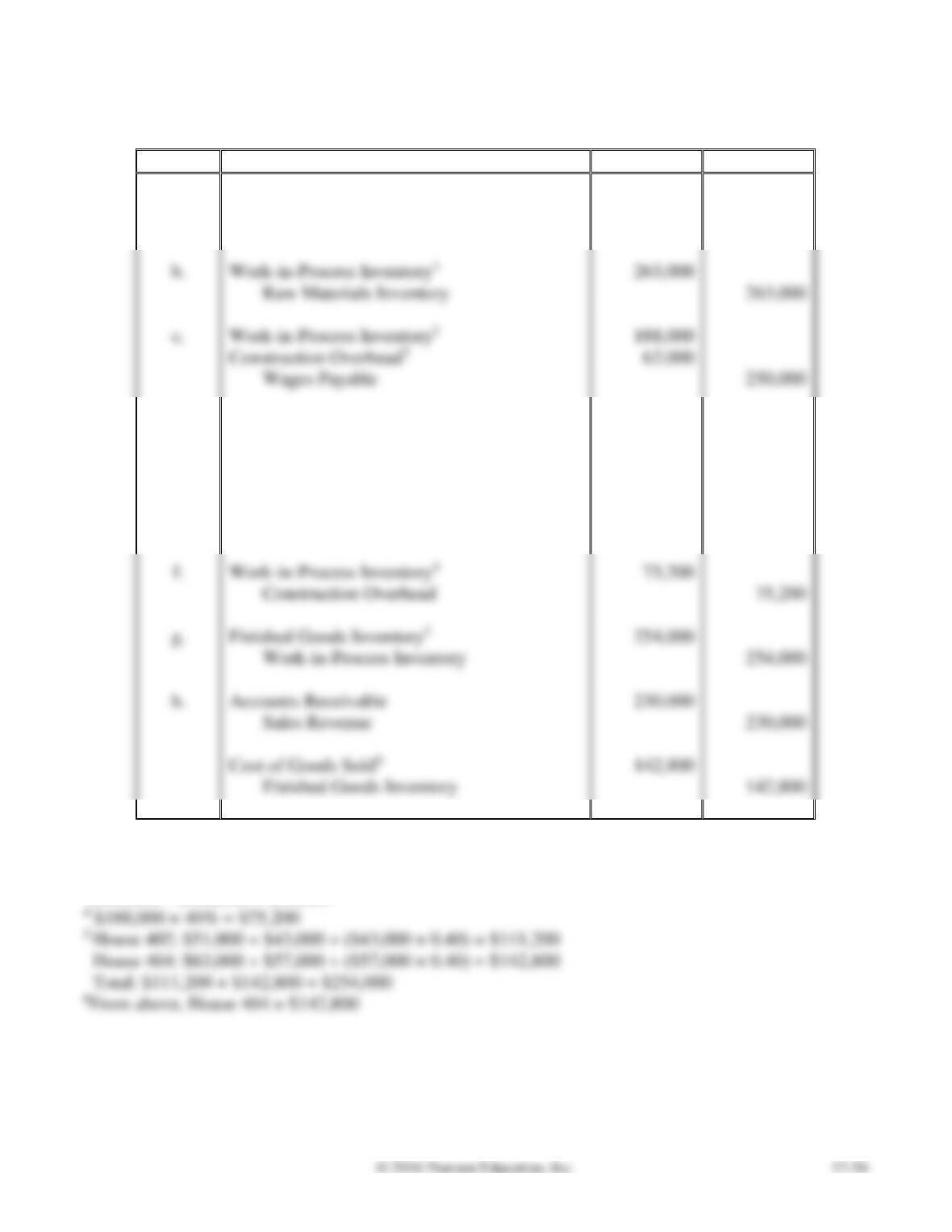
1. Calculate Sunrise’s predetermined overhead allocation rate for the year.
2. Prepare journal entries to record the events in the general journal.
3. Open T-accounts for Work-in-Process Inventory and Finished Goods Inventory. Post the appropriate
entries to these accounts, identifying each entry by letter. Determine the ending account balances,
assuming that the beginning balances were zero.
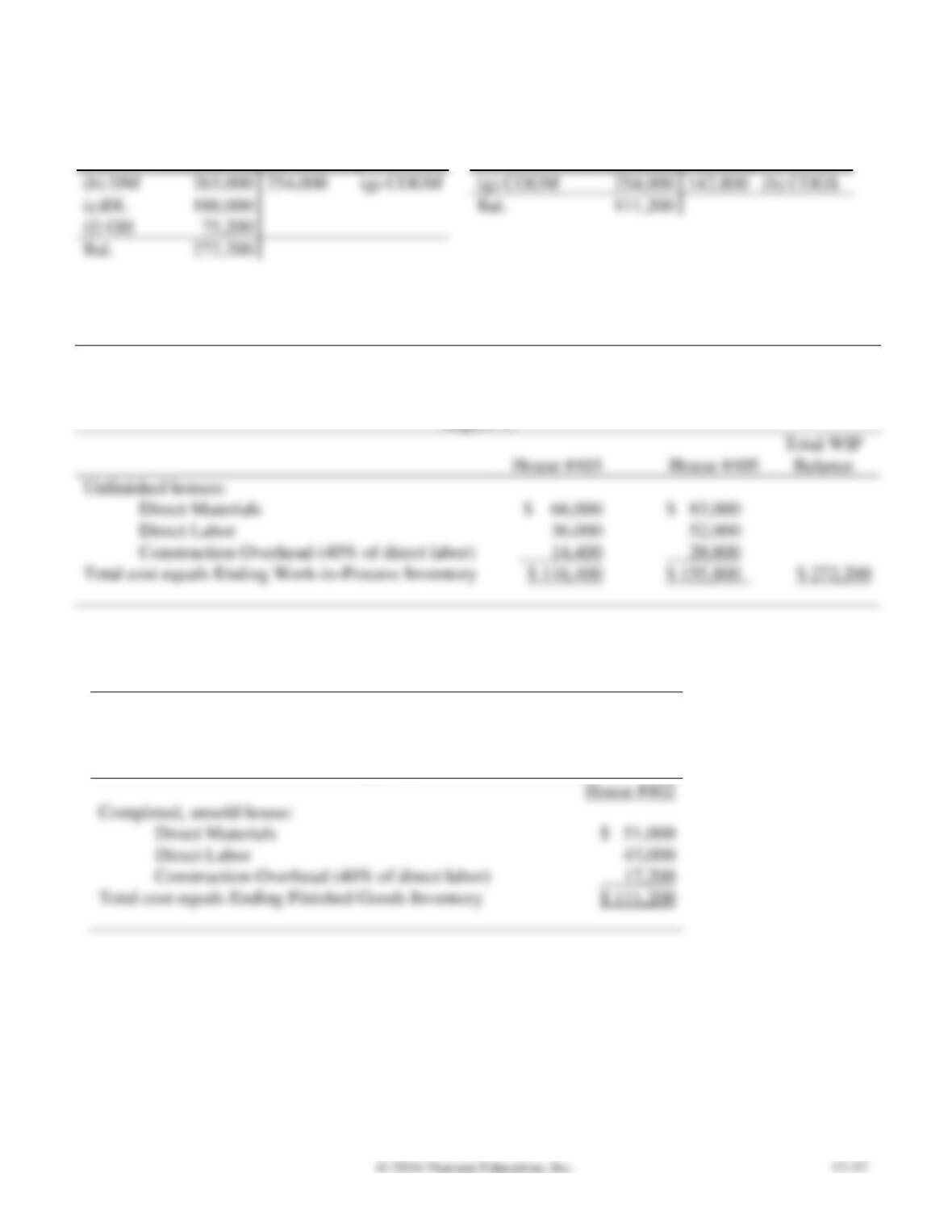
4. Add the costs of the unfinished houses, and show that this total amount equals the ending balance in
the Work-in-Process Inventory account.
5. Add the cost of the completed house that has not yet been sold, and show that this equals the ending
balance in Finished Goods Inventory.
6. Compute gross profit on the house that was sold. What costs must gross profit cover for Sunrise
Construction?
SOLUTION
Requirement 1
P17-36B, cont.
Requirement 2
Date
Accounts and Explanation
Debit
Credit
Aug. 31
a.
Raw Materials Inventory
450,000
Accounts Payable
450,000
b.
263,000
Raw Materials Inventory
263,000
c.
188,000
62,000
Wages Payable
250,000
d.
Construction Overhead
6,800
Accumulated Depreciation––Equipment
6,800
e.
Construction Overhead
42,000
Cash
34,000
Prepaid Insurance
8,000
75,200
Construction Overhead
75,200
g.
254,000
254,000
h.
Accounts Receivable
230,000
Sales Revenue
230,000
142,800
Finished Goods Inventory
142,800
1$51,000 + $66,000 + $63,000 + $83,000 = $263,000
2$43,000 + $36,000 + $57,000 + $52,000 = $188,000
3$250,000 – $188,000 = $62,000
4 $188,000 × 40% = $75,200
6From above, House 404 = $142,800
P17-36B, cont.
Requirement 3
Work-in-Process Inventory
Finished Goods Inventory
(b) DM
254,000
(g) COGM
142,800
(h) COGS
Bal.
(f) OH
Bal.
Requirement 4
SUNRISE CONSTRUCTION, INC.
Reconciliation of Work-in-Process Inventory Subsidiary
and Control Accounts
August 31
Requirement 5
SUNRISE CONSTRUCTION, INC.
Reconciliation of Finished Goods Inventory Subsidiary
and Control Accounts
August 31
P17-36B, cont.
Requirement 6
SUNRISE CONSTRUCTION, INC.
Gross Profit on Homes Sold in August
P17-37B Accounting for manufacturing overhead
Learning Objectives 3, 5
1. $7.50 per machine hour
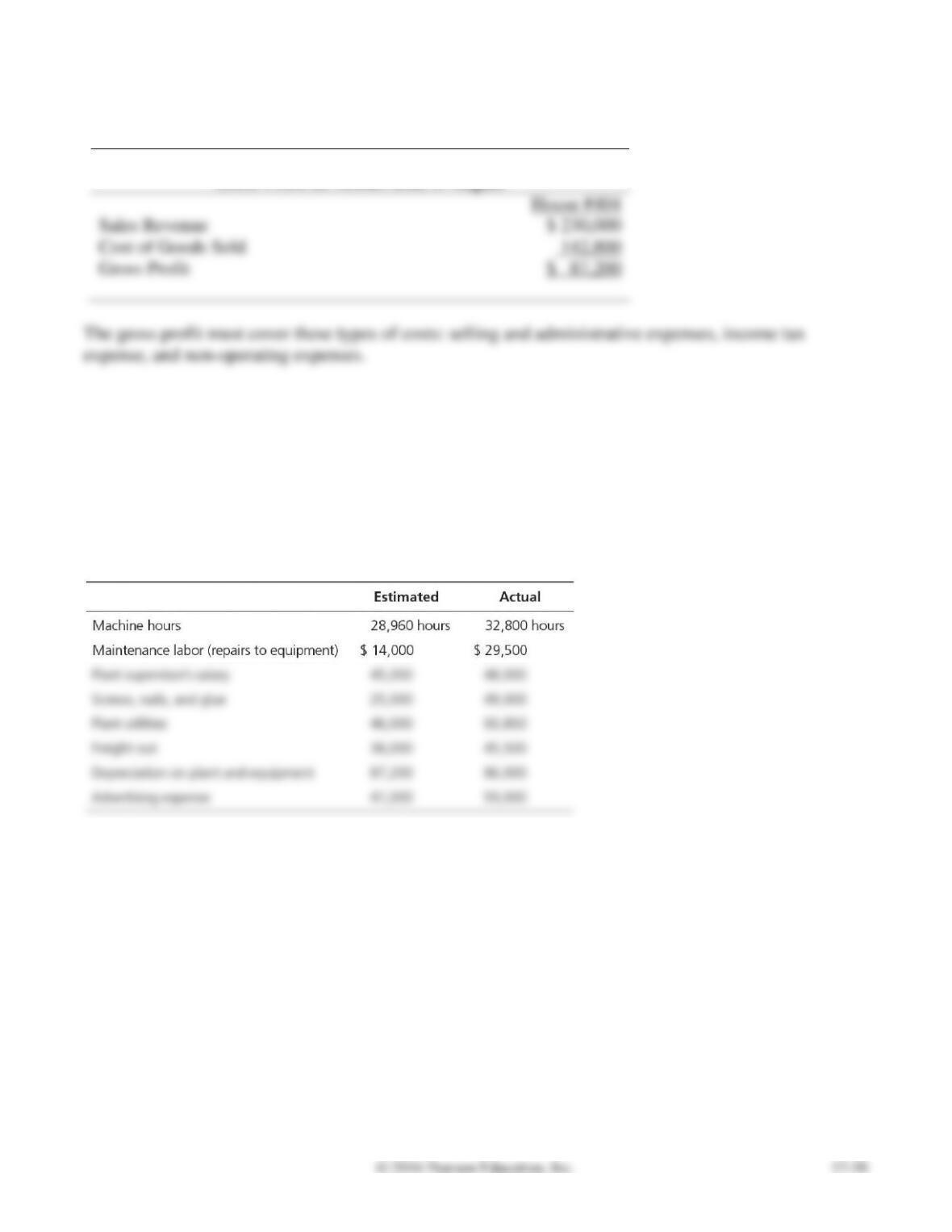
Custom Woods manufactures jewelry boxes. The primary materials (wood, brass, and glass) and direct
labor are assigned directly to the products. Manufacturing overhead costs are allocated based on
machine hours. Data for 2016 follow:
Requirements
1. Compute the predetermined overhead allocation rate.
2. Post actual and allocated manufacturing overhead to the Manufacturing Overhead T-account.
3. Prepare the journal entry to adjust for underallocated or overallocated overhead.
4. The predetermined overhead allocation rate usually turns out to be inaccurate. Why don’t
accountants just use the actual manufacturing overhead rate?