CHAPTER 16 – 1
CHAPTER 17
WORKING CAPITAL MANAGEMENT
Answers to Concepts Review and Critical Thinking Questions
1. Yes. Once a firm has more cash than it needs for operations and planned expenditures, the excess cash
has an opportunity cost. It could be invested (by shareholders) in potentially more profitable ways.
Question 9 discusses another reason.
3. Probably not. Creditors would probably want substantially more.
4. Auto manufacturers often argue that due to the cyclical nature of their business, cash reserves are a
good way to deal with future economic downturns. This is debatable, but it is true that auto
manufacturers’ operating cash flows are very sensitive to the business cycle, and enormous losses have
occurred during recent downturns.
7. The firm has a net disbursement float of $500,000. If this is an ongoing situation, the firm may be
tempted to write checks for more than it actually has in its account.
8. a. About the only disadvantage to holding T-bills are the generally lower yields compared to
alternative money market investments.
9. The concern is that excess cash on hand can lead to poorly thought-out investments. The thought is
that keeping cash levels relatively low forces management to pay careful attention to cash flow and
capital spending.
CHAPTER 16 – 2
11. This is really a capital structure decision. If the firm has an optimal capital structure, paying off debt
moves it to an under-leveraged position. However, a combination of debt reduction and stock buybacks
could be structured to leave capital structure unchanged.
14. Trade credit is usually granted on open account. The invoice is the credit instrument.
15. The costs of granting credit are carrying costs, namely, the cost of debt, possibility of default, and the
cash discount. The major cost of not granting credit is the opportunity cost of lost sales. The
sum of these costs for different levels of receivables creates the total credit cost curve.
17. 1. Perishability and collateral value
2. Consumer demand
3. Cost, profitability, and standardization
4. Credit risk
5. The size of the account
CHAPTER 16 – 3
18. a. B: A is likely to sell for cash only, unless the product really works. If it does, then they might
grant longer credit periods to entice buyers.
19. The three main categories of inventory are: raw material (initial inputs to the firm’s production
process), work-in-progress (partially completed products), and finished goods (products ready for
sale). From the firm’s perspective, the demand for finished goods is independent of the demand for
the other types of inventory. The demand for raw material and work-in-progress is derived from, or
dependent on, the firm’s needs for these inventory types in order to achieve the desired levels of
finished goods.
Solutions to Questions and Problems
NOTE: All end-of-chapter problems were solved using a spreadsheet. Many problems require multiple
steps. Due to space and readability constraints, when these intermediate steps are included in this solutions
manual, rounding may appear to have occurred. However, the final answer for each problem is found
without rounding during any step in the problem.
Basic
1. The available balance is the amount you have on deposit, or $95,000. By writing a check, you now
have a disbursement float. Your book balance is the amount on deposit minus the amount of the check,
or:
CHAPTER 16 – 4
3. Your disbursement float is the amount of the check you wrote, or $4,200. The collection float is the
amount of the check deposited, or –$5,100. The net float is the sum of the disbursement float and
collection float, or:
4. a. There are 30 days until account is overdue. If you take the full period, you must remit:
Remittance = 540($62)
Remittance = $33,480
5. The average daily receipts are the total amount of checks received divided by the number of days in a
month. Assuming 30 days in a month, the average daily float is:
Average daily receipts = $59,200 / 30
Average daily receipts = $1,973.33
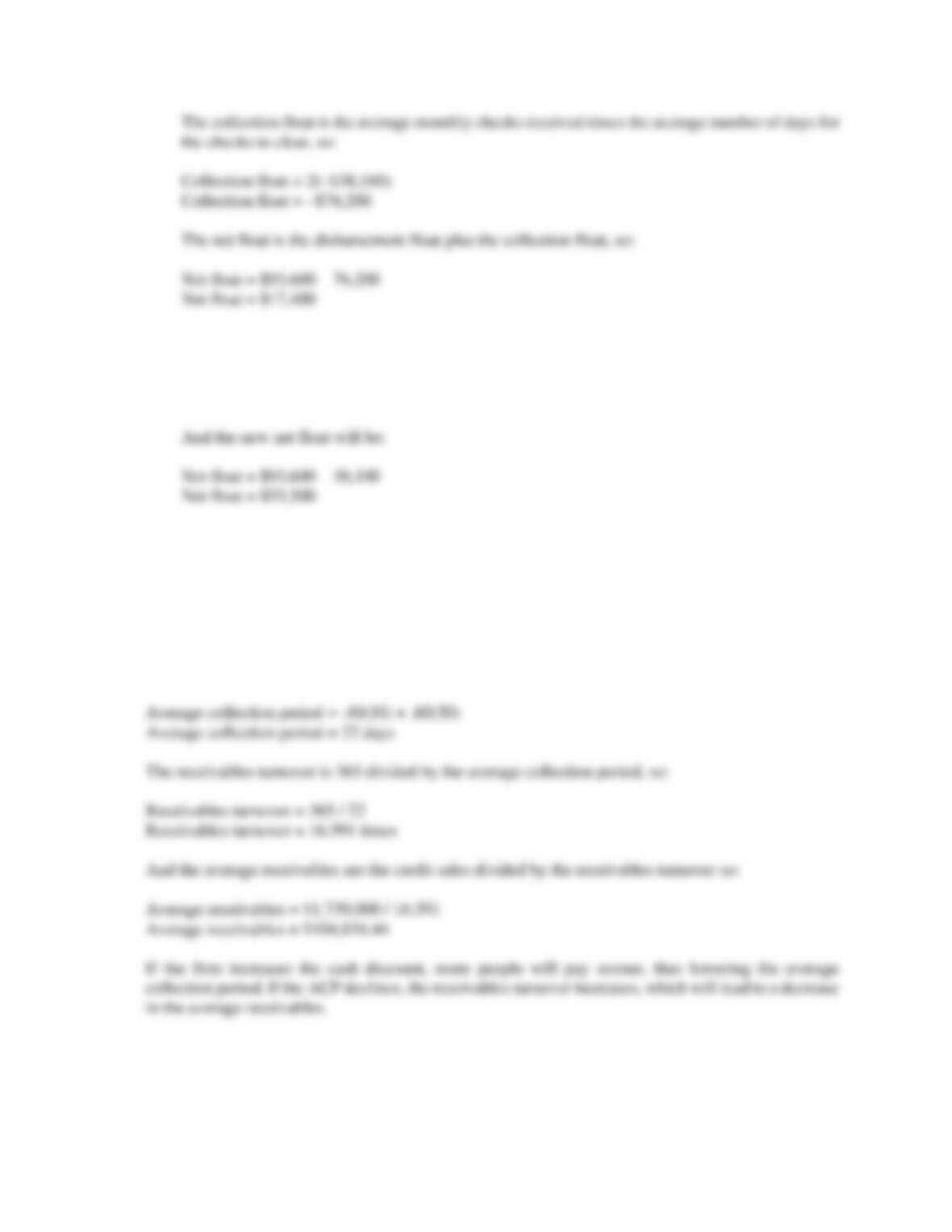
6. a. The disbursement float is the average monthly checks written times the average number of days
for the checks to clear, so:
Disbursement float = 4($23,400)
Disbursement float = $93,600
CHAPTER 16 – 5
b. The new collection float will be:
Collection float = 1(–$38,100)
Collection float = –$38,100
7. The total sales of the firm are equal to the total credit sales since all sales are on credit, so:
Total credit sales = 7,400($235)
Total credit sales = $1,739,000
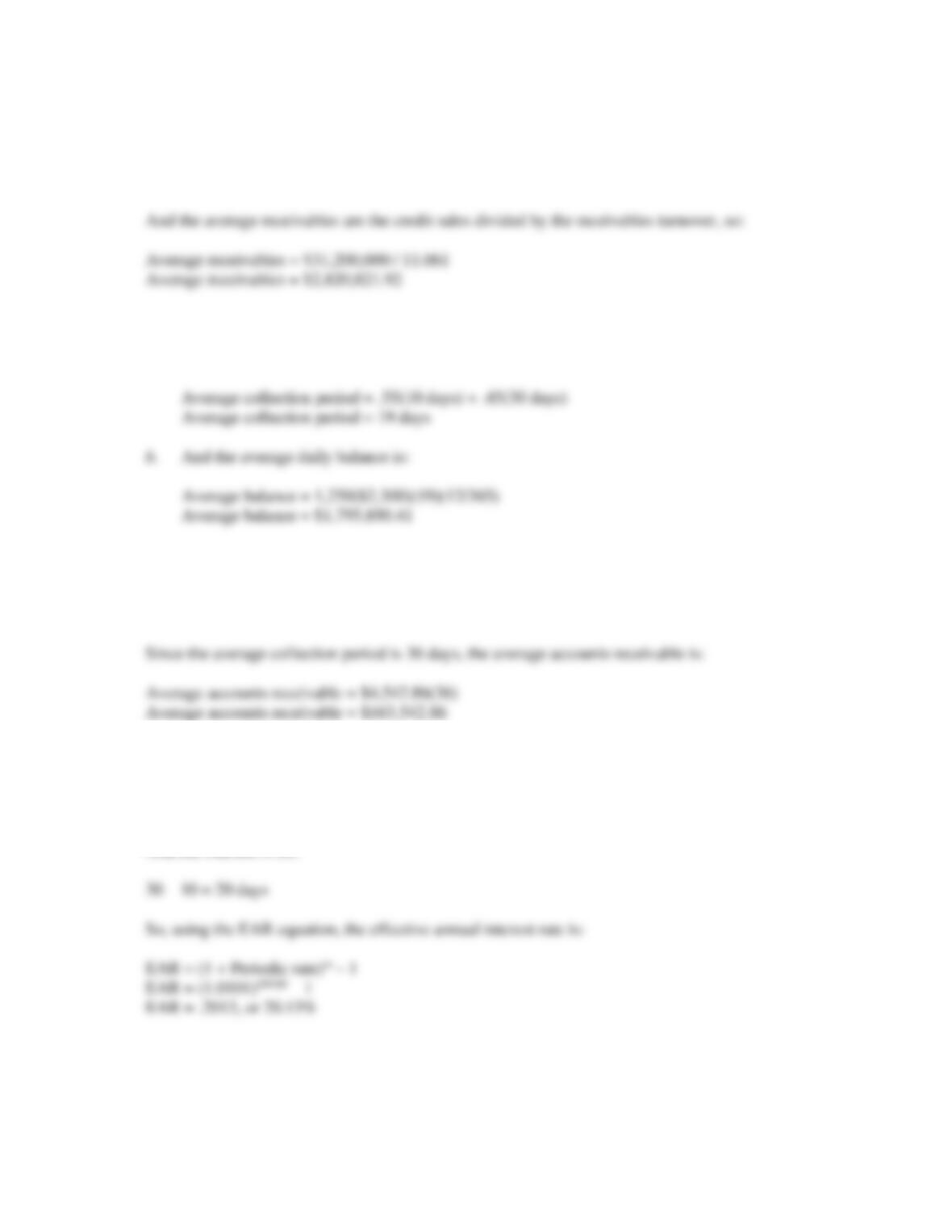
The average collection period is the percentage of accounts taking the discount times the discount
period, plus the percentage of accounts not taking the discount times the days’ until full payment is
required, so:
CHAPTER 16 – 6
8. The receivables turnover is 365 divided by the average collection period, so:
Receivables turnover = 365 / 33
Receivables turnover = 11.061 times
9. a. The average collection period is the percentage of accounts taking the discount times the discount
period, plus the percentage of accounts not taking the discount times the days’ until full payment
is required, so:
10. The daily sales are:
Daily sales = $31,800 / 7
Daily sales = $4,542.86
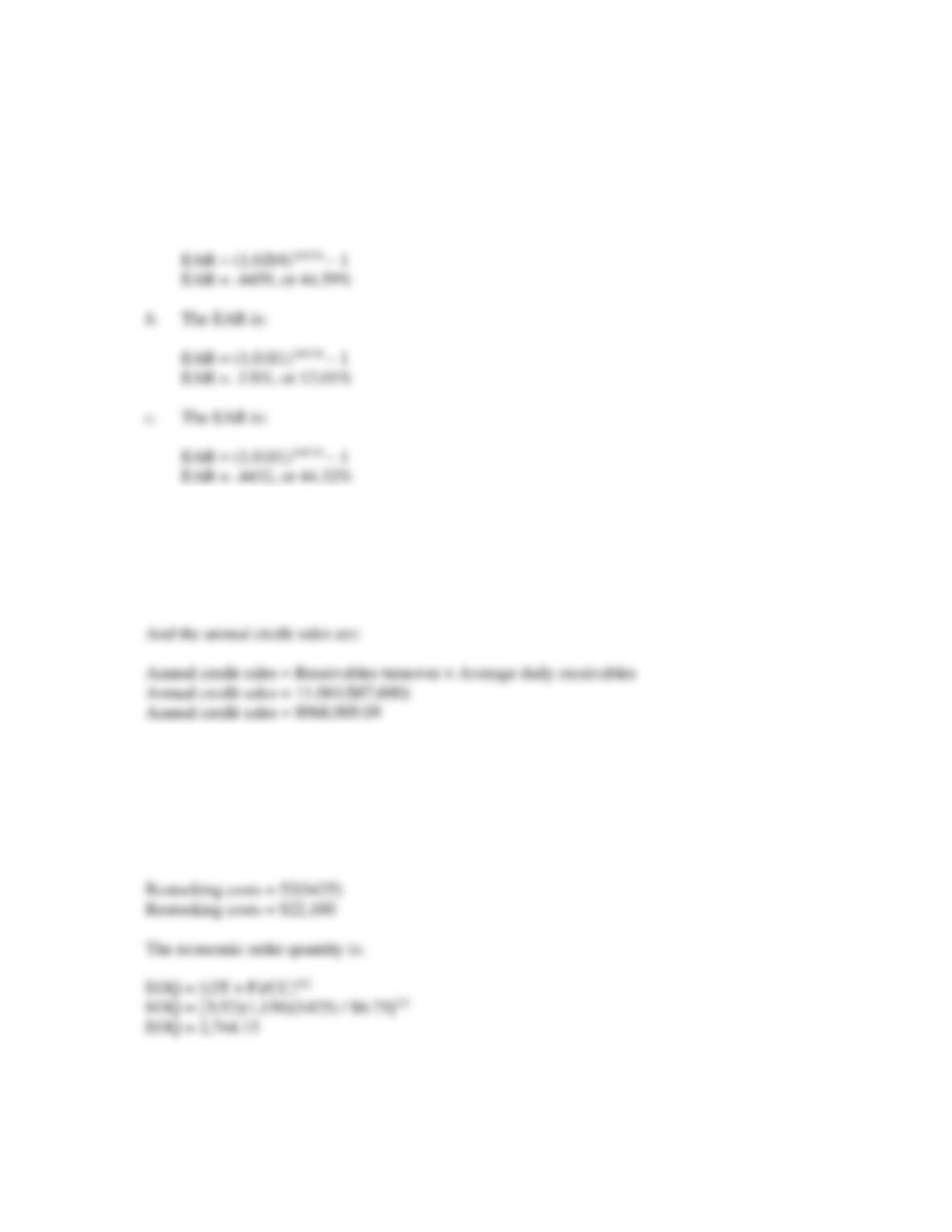
11. The interest rate for the term of the discount is:
Interest rate = .01/.99
Interest rate = .0101, or 1.01%
And the interest is for:
CHAPTER 16 – 7
a. The periodic interest rate is:
Interest rate = .02/.98
Interest rate = .0204, or 2.04%
And the EAR is:
12. The receivables turnover is:
Receivables turnover = 365 / Average collection period
Receivables turnover = 365 / 33
Receivables turnover = 11.061 times
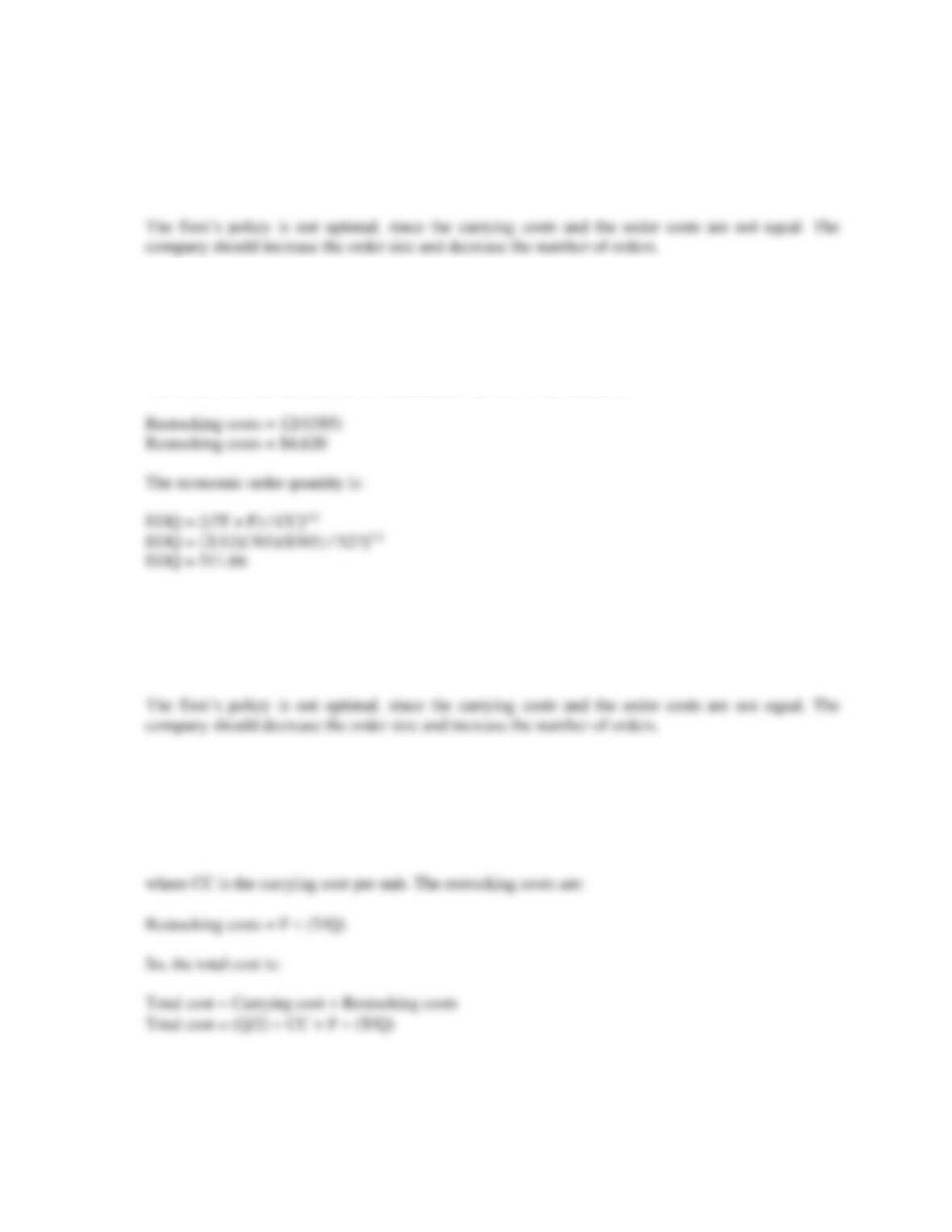
13. The carrying costs are the average inventory times the cost of carrying an individual unit, so:
Carrying costs = (1,150 / 2)($6.75)
Carrying costs = $3,881.25
The order costs are the number of orders times the cost of an order, so:
CHAPTER 16 – 8
The number of orders per year will be the total units sold per year divided by the EOQ, so:
Number of orders per year = 52(1,150) / 2,744.15
Number of orders per year = 21.79
14. The carrying costs are the average inventory times the cost of carrying an individual unit, so:
Carrying costs = (765 / 2)($27)
Carrying costs = $10,327.50
The order costs are the number of orders times the cost of an order, so:
The number of orders per year will be the total units sold per year divided by the EOQ, so:
Number of orders per year = 12(765) / 511.66
Number of orders per year = 17.94
Intermediate
15. The total carrying costs are:
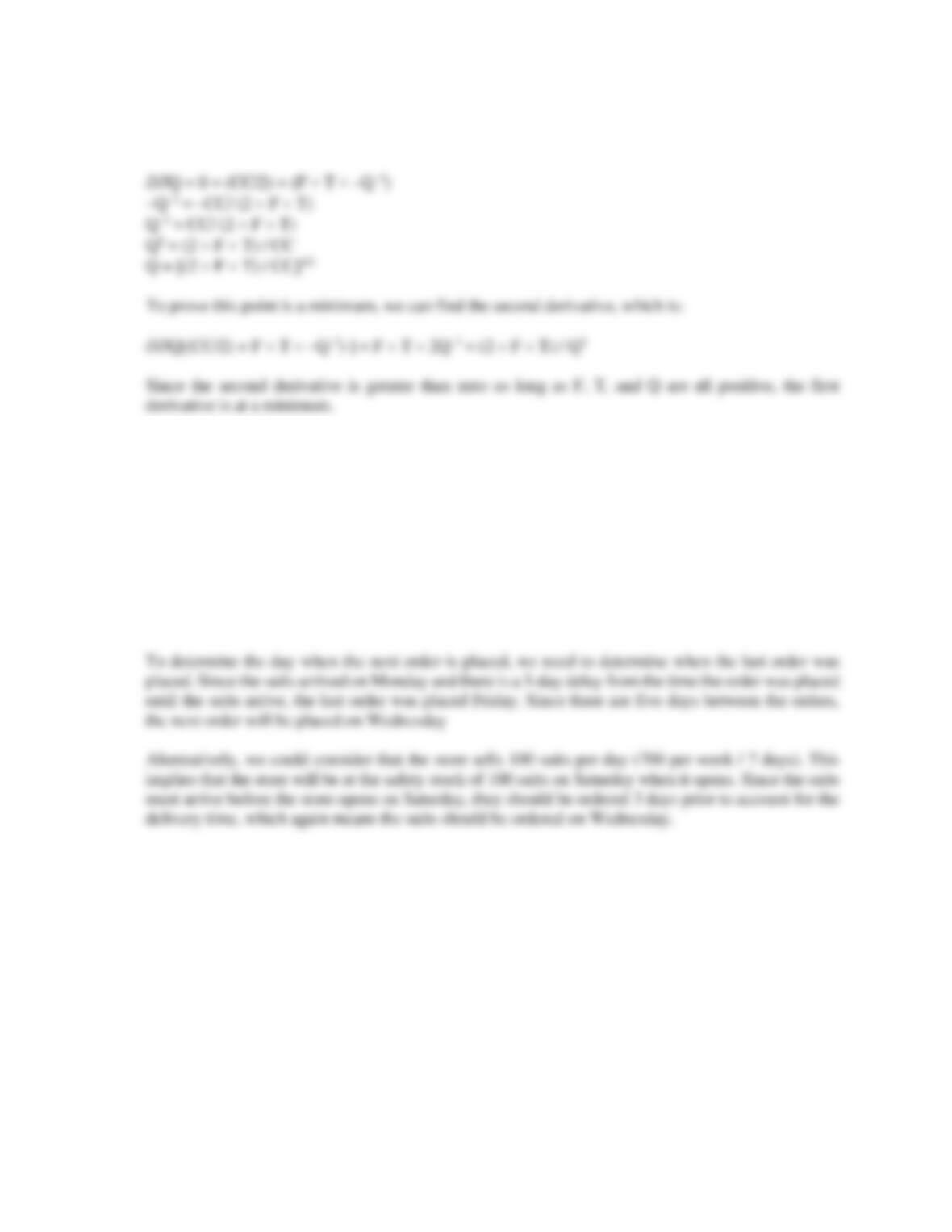
Carrying costs = (Q/2) CC
CHAPTER 16 – 9
Using calculus to find the minimum point of the curve, we take the derivative and set it equal to zero.
Doing so, we find:
Challenge
16. Since the company sells 700 suits per week, and there are 52 weeks per year, the total number of suits
sold is:
Total suits sold = 700 × 52 = 36,400
And, the EOQ is 500 suits, so the number of orders per year is:
Orders per year = 36,400 / 500 = 72.80