CHAPTER 17
LEARNING OBJECTIVES
1. DISCUSS THE USES OF A PROCESS COST SYSTEM
AND HOW IT COMPARES TO A JOB ORDER SYSTEM.
2. EXPLAIN THE FLOW OF COSTS IN A PROCESS
COST SYSTEM AND THE JOURNAL ENTRIES TO
ASSIGN MANUFACTURING COSTS.
CHAPTER REVIEW
Process Cost Systems
1. (L.O. 1) Process cost systems are used to apply costs to similar products that are mass
produced in a continuous fashion, such as the production of ice cream, steel or soft drinks. In
comparison, costs in a job order cost system are assigned to a specific job, such as the
construction of a customized home, the making of a motion picture, or the manufacturing of a
specialized machine.
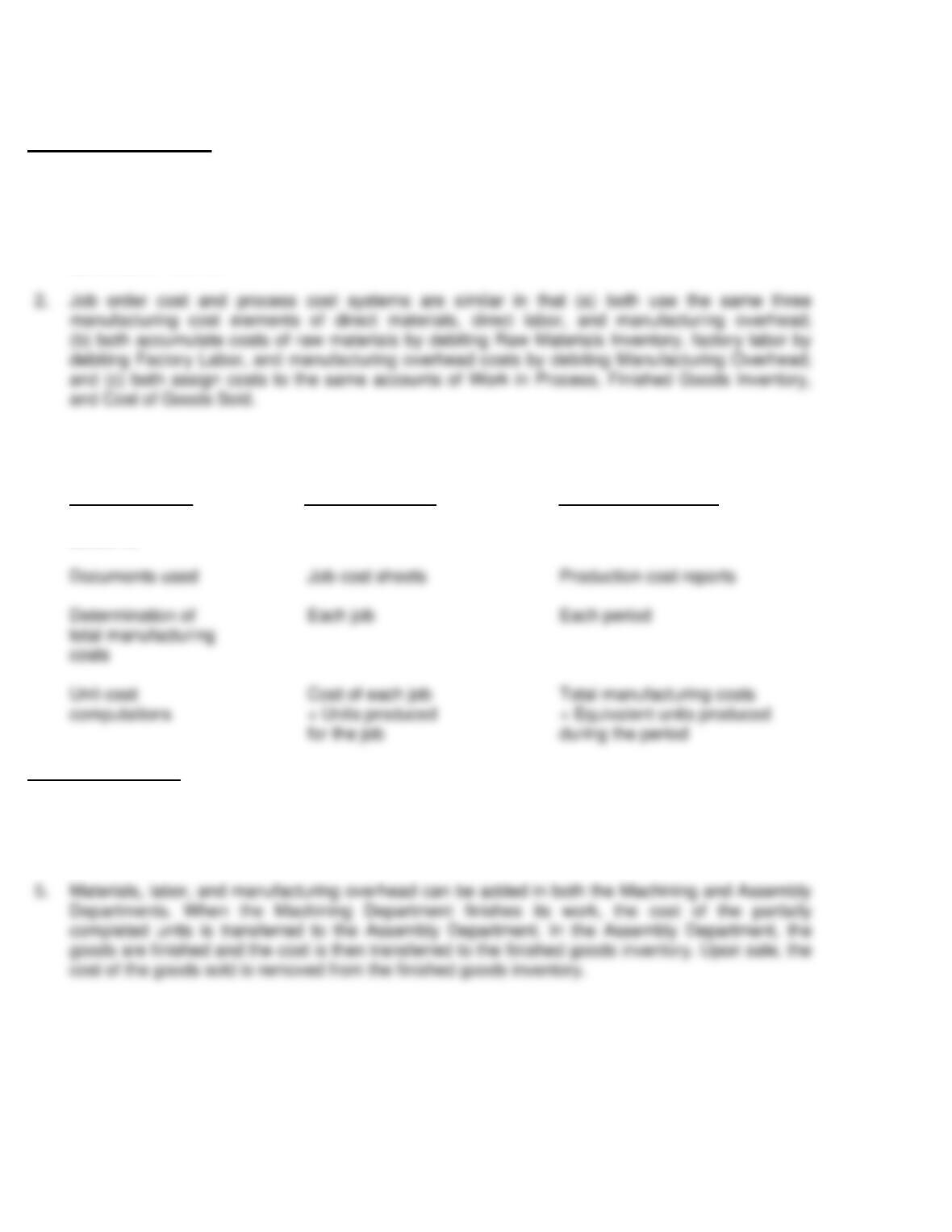
3. The major differences between a job order cost system and a process cost system are as follows:
Job Order Process
Feature Cost System Cost System
Work in process One for each job One for each process
accounts
Process Cost Flow
4. (L.O. 2) In the Tyler Company example in the text book, manufacturing consists of two
processes: machining and assembly. In the Machining Department, the raw materials are shaped,
honed, and drilled. In the Assembly Department, the parts are assembled and packaged.
Assigning Manufacturing Costs
6. All raw materials issued for production are a materials cost to the producing department. Materials
requisition slips may be used in a process cost system, but fewer requisitions are generally
required than in a job order cost system, because the materials are used for processes rather
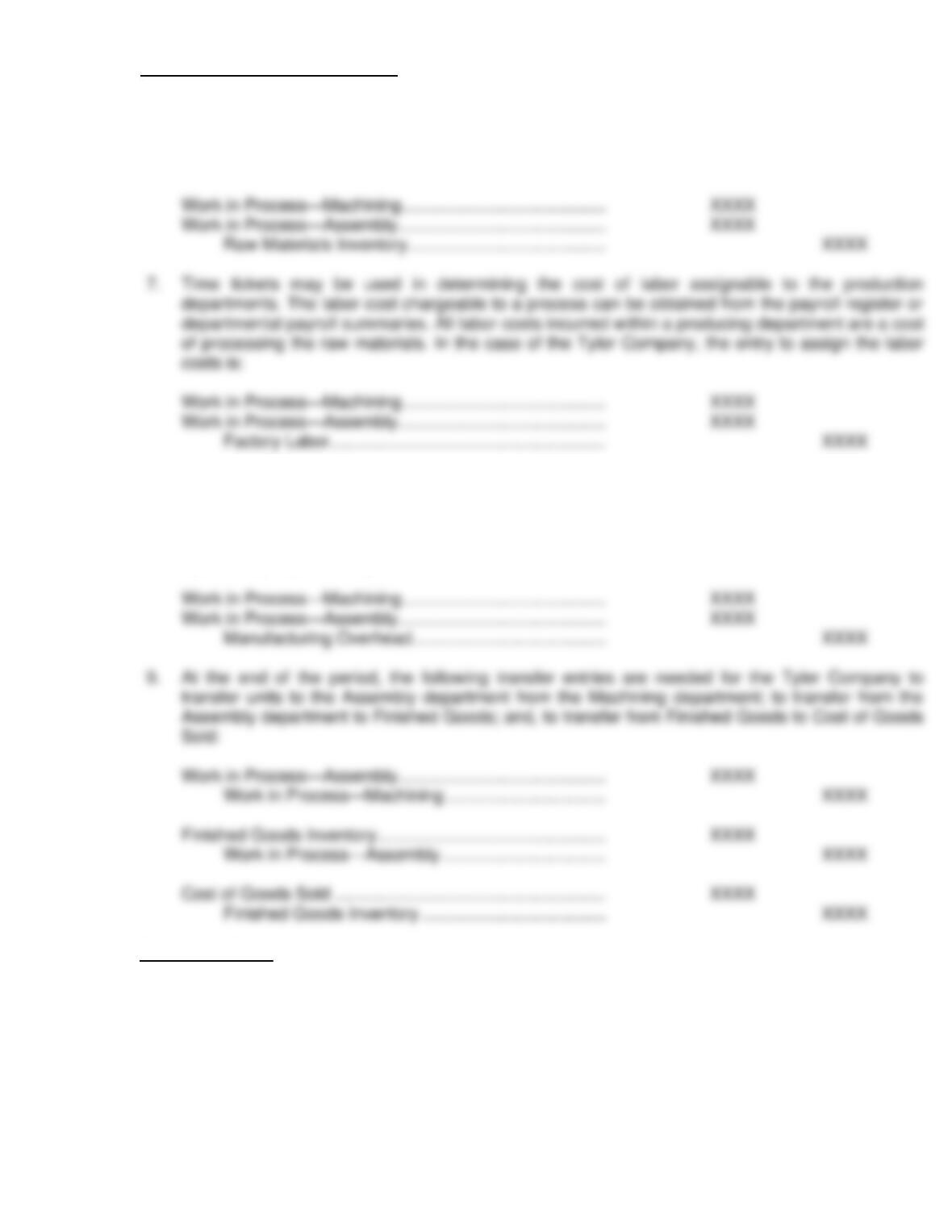
than for specific jobs. In the case of the Tyler Company, the entry to record the materials used is:
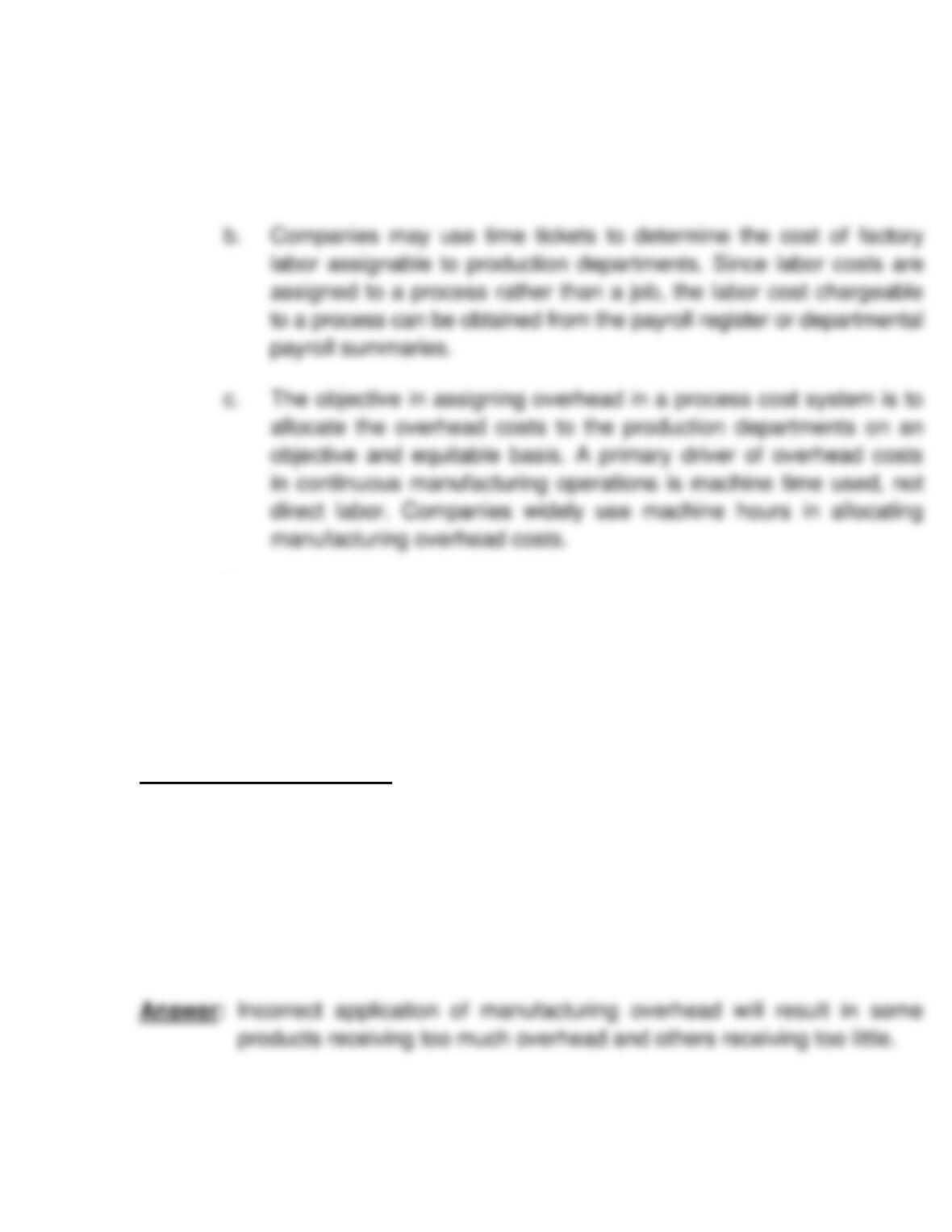
8. The basis for allocating the overhead costs to the production departments in an objective and
equitable manner is the activity that “drives” or causes the costs. A primary driver of overhead
costs in continuous manufacturing operations is machine time used, not direct labor. Thus,
machine hours are widely used in allocating manufacturing overhead costs. In the case of the
Tyler Company, the entry to allocate overhead is:
Equivalent Units
10. (L.O. 3) A major step in process cost accounting is the calculation of equivalent units. Equivalent
units of production measure the work done during the period, expressed in fully completed
units. This concept is used to determine the cost per unit of completed product.
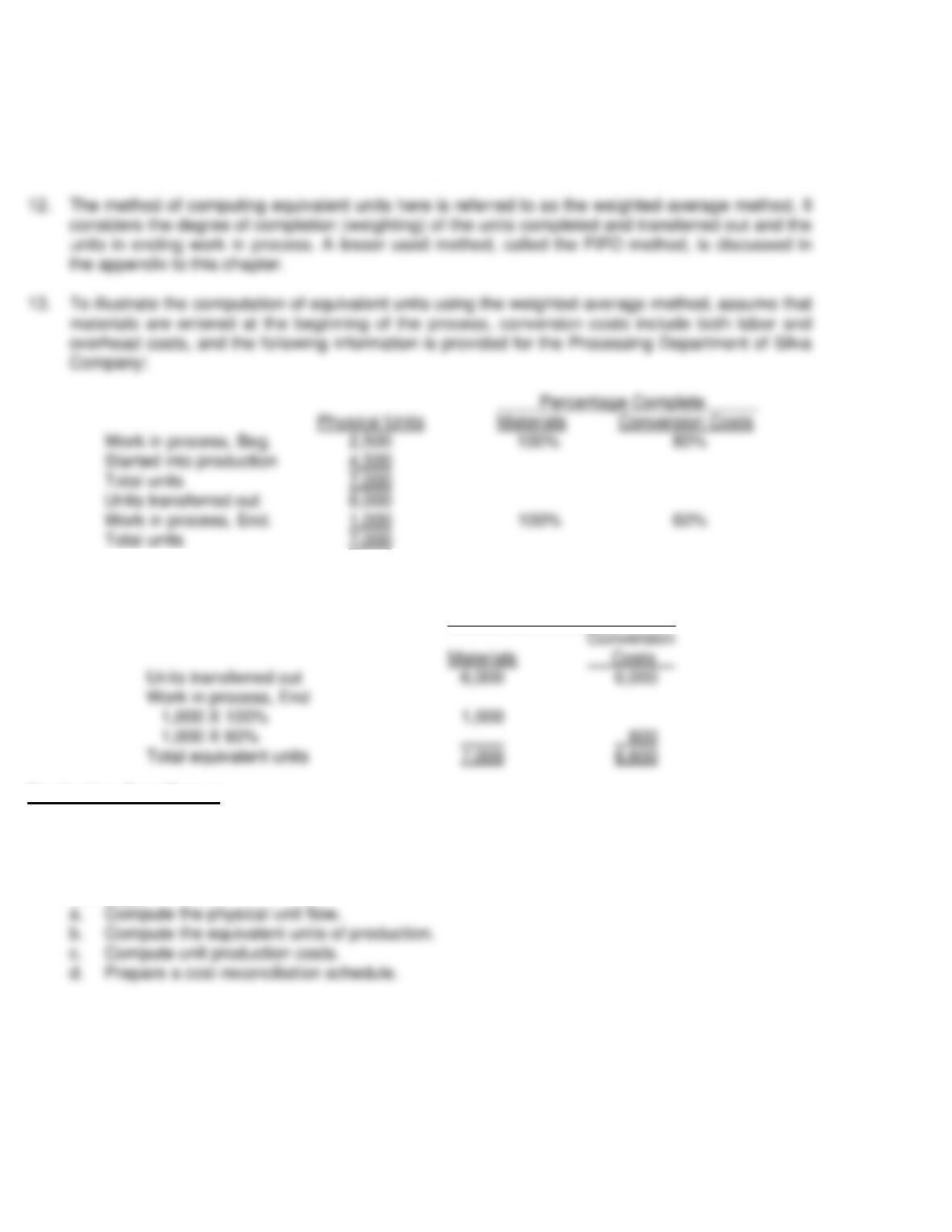
11. The formula to compute equivalent units of production under the weighted-average method is as
follows:
Units Completed and
Transferred Out
+
Equivalent Units of
Ending Work in
Process
=
Equivalent Units of
Production
14. The two equivalent unit computations are as follows:
Equivalent Units
Production Cost Report
15. (L.O. 4) A production cost report is the key document used by management to understand the
activities in a department because it shows the production quantity and cost data related to that
department. In order to be ready to complete a production cost report, the company must perform
four steps:
16. The computation of physical units involves:
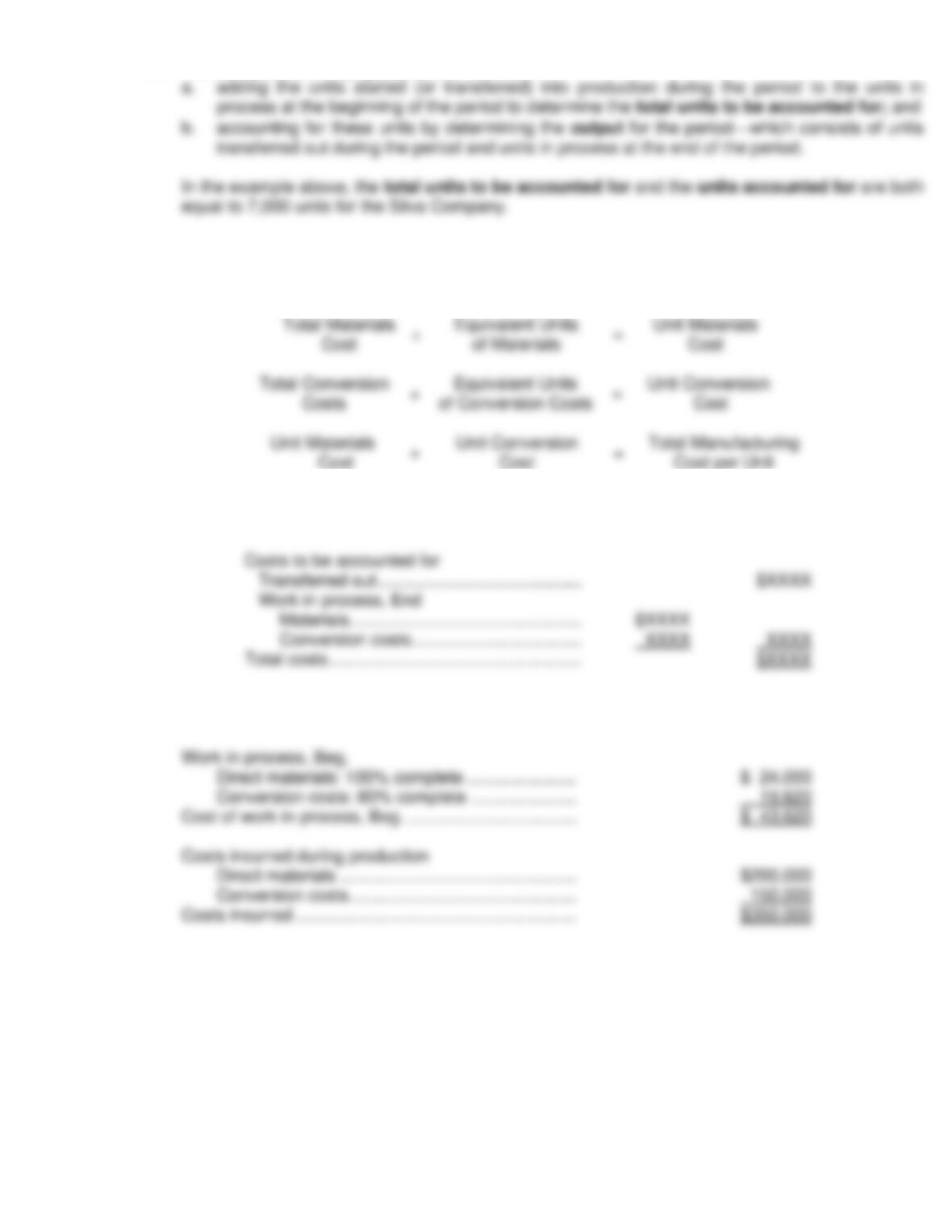
17. In computing unit costs, production costs are expressed in terms of equivalent units of production.
When equivalent units are different for materials and conversion costs, the formulas for computing
unit costs are as follows:
18. The cost reconciliation schedule shows that the total costs accounted for equal the total costs
to be accounted for as follows:
19. Assume the Processing Department of Silva Company has the following additional cost
information:
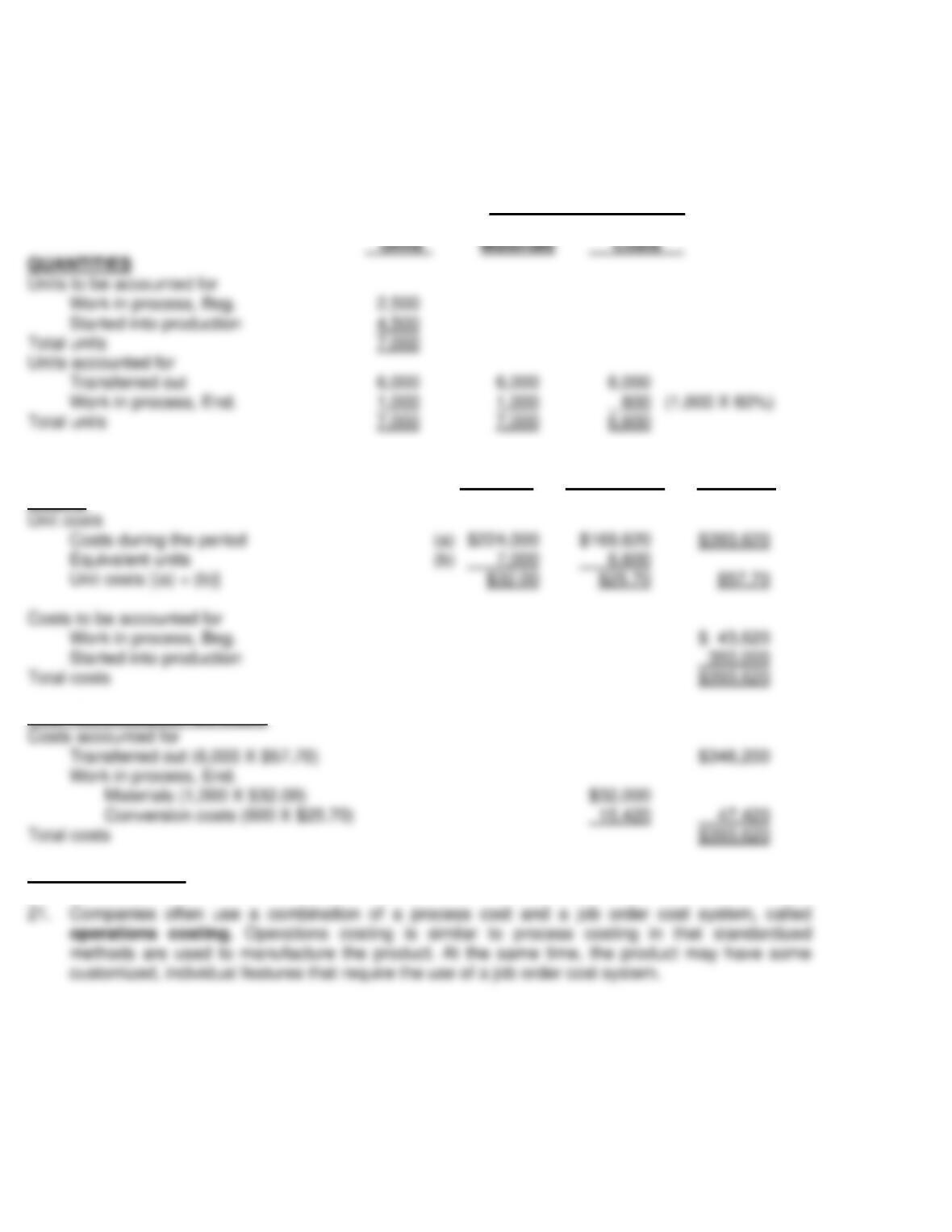
20. Silva Company’s Processing Department Production Cost Report at the end of the period is as
follows:
Processing Department
Production Cost Report
For the Period Ended
Equivalent Units
Physical Conversion
Conversion
Materials Costs Total
COSTS
Cost Reconciliation Schedule
Operations Costing
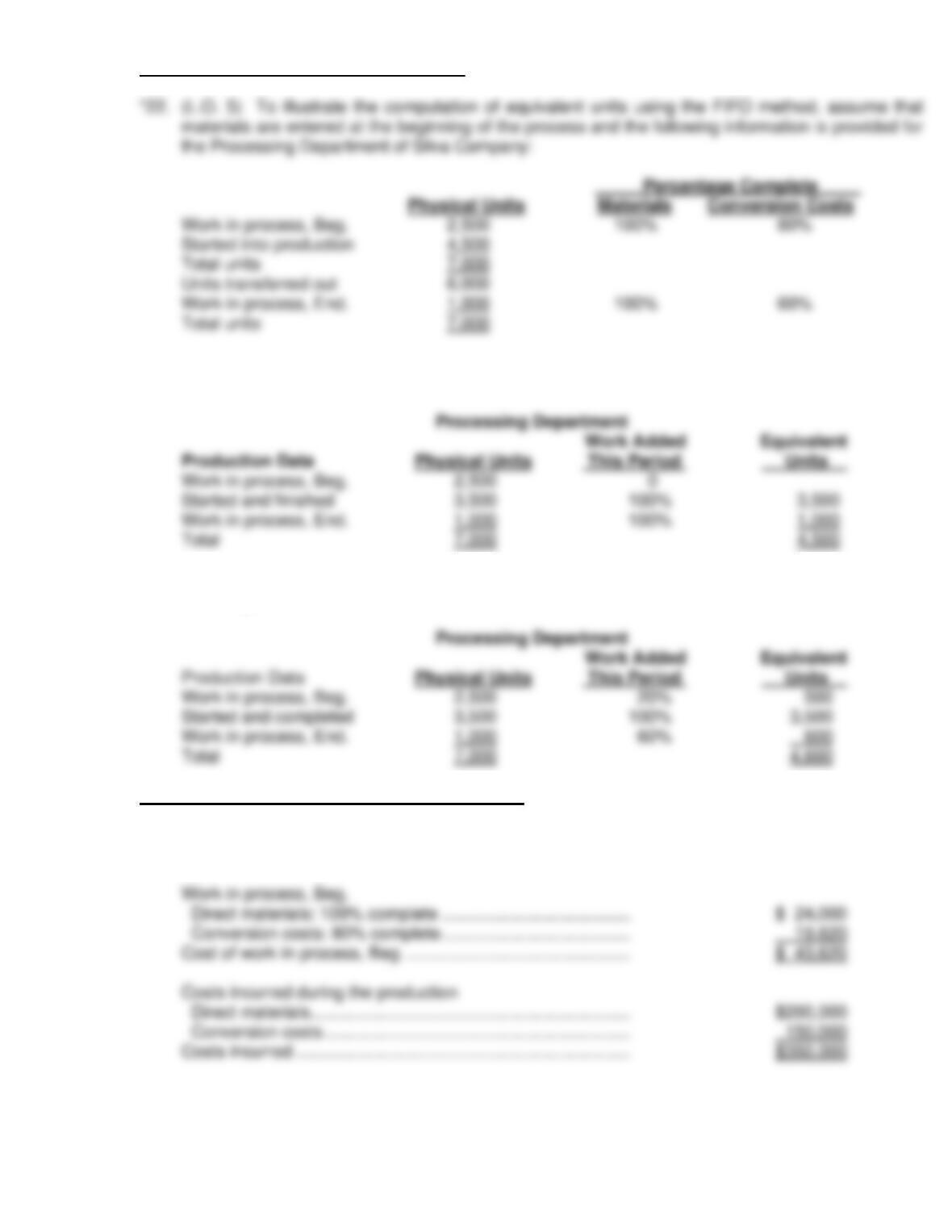
Equivalent Units Using the FIFO Method
*23. The equivalent units for material costs of the Processing Department under the FIFO method are
computed as follows:
*24. The equivalent units for conversion costs of the Processing Department under the FIFO method
are computed as follows:
Production Cost Report Using the FIFO Method
*25. Assume the Processing Department of Silva Company has the following additional cost
information:
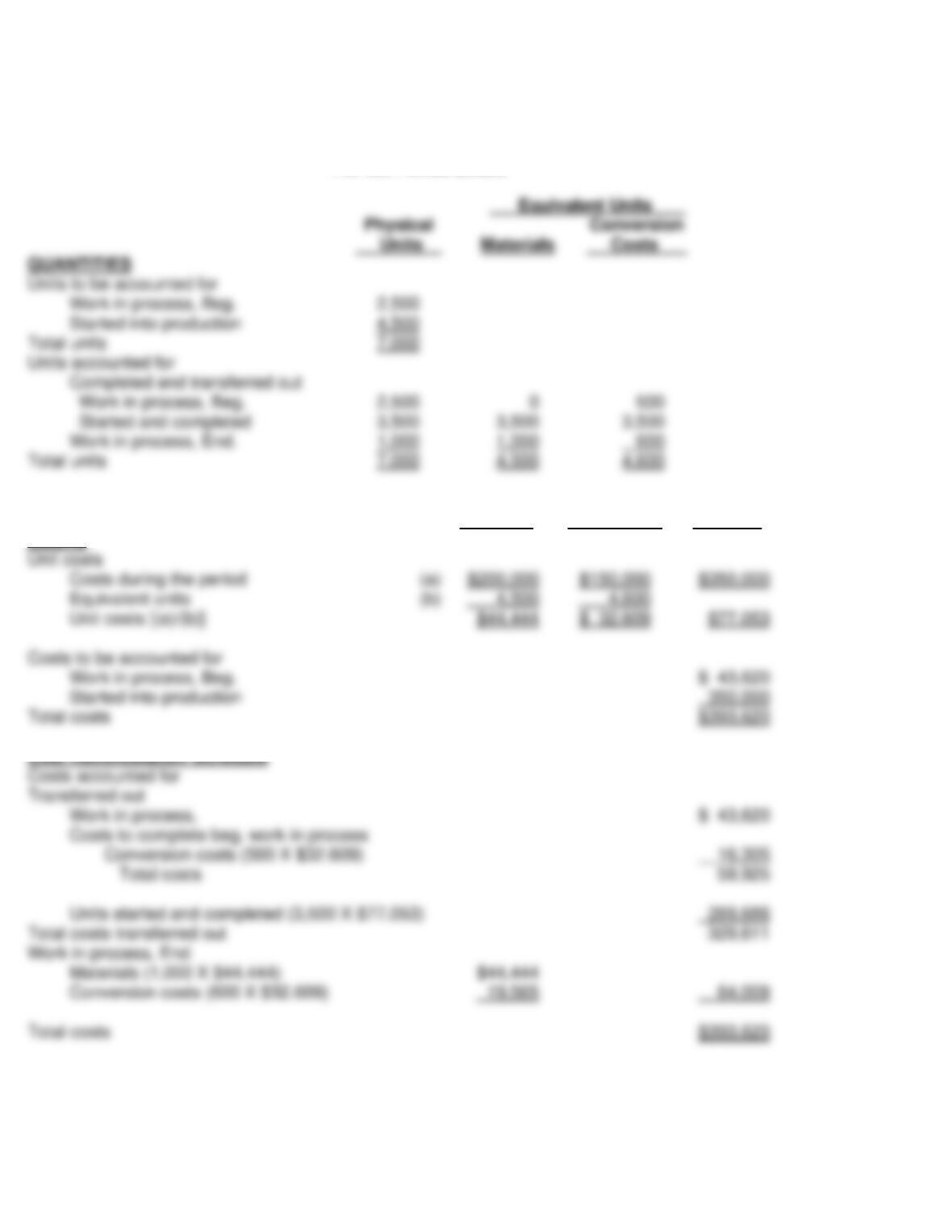
*26. Silva Company’s Processing Department Production Cost Report at the end of the period using
the FIFO method is as follows:
Processing Department
Production Cost Report
For the Period Ended
Conversion
Materials Costs Total
COSTS
LECTURE OUTLINE
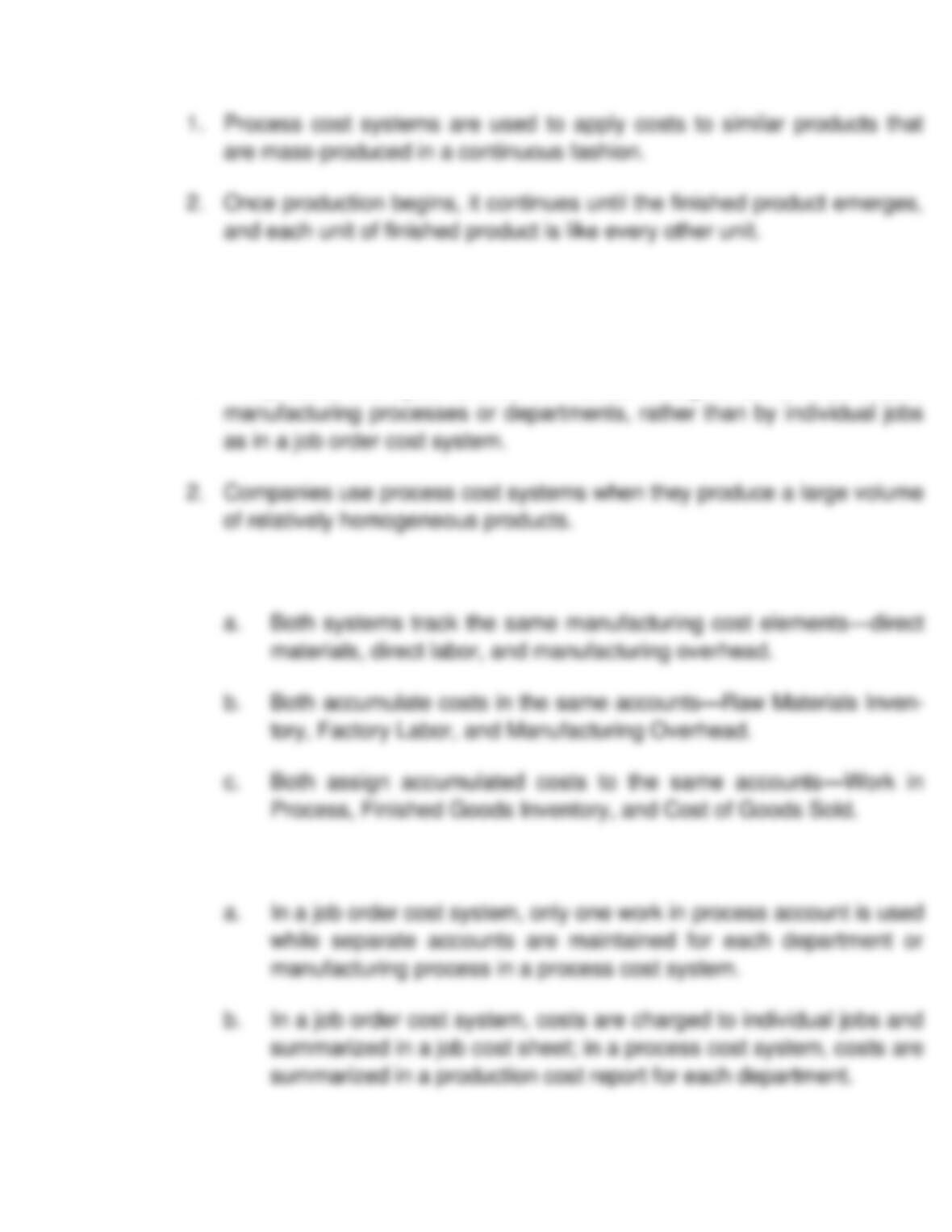
A. Uses of Process Cost Systems.
B. Similarities and Differences Between Job Order Cost and Process Cost
Systems.
1. In a process cost system, costs are tracked through a series of connected
3. Job order cost and process cost systems are similar in three ways:
4. There are four main differences between the two cost systems:
C. Process Cost Flow.
1. The company can add materials, labor, and manufacturing overhead in
each production department.
D. Assigning Manufacturing Costs.
1. The accumulation of the costs of materials, labor, and manufacturing
overhead is the same in a process cost system as in a job order cost
system.
a. All raw materials issued for production are a materials cost to the
producing department. A process cost system may use materials
requisition slips, but fewer requisitions are generally required than
in a job order system, because the materials are used for processes
rather than specific jobs.
4. The entry to record units completed and transferred to the warehouse is
a debit to Finished Goods Inventory and a credit to Work in Process.
5. The entry to record the sale of goods is a debit to Cost of Goods Sold
and a credit to Finished Goods Inventory.
MANAGEMENT INSIGHT
Some companies continue to assign manufacturing overhead on the basis of
direct labor despite the fact that there is no cause-and–effect relationship between
labor and overhead. In such cases, the overhead rates may be misleading.
What is the result if a company uses the wrong “cost driver” to assign manufac–
turing overhead?
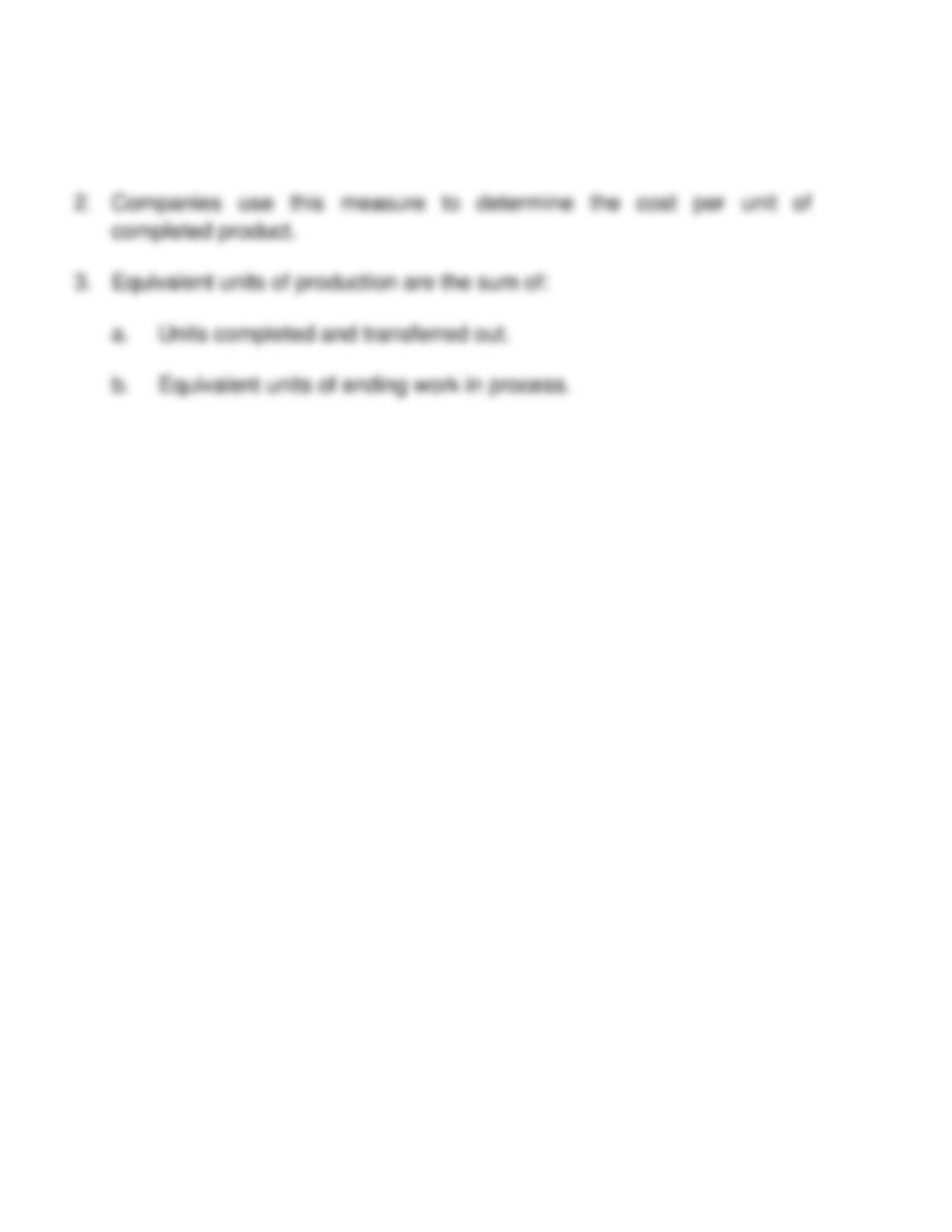
E. Equivalent Units.
1. Equivalent units of production measure the work done during the period,
expressed in fully completed units.
4. The weighted-average method is most commonly used to compute
equivalent units of production.
MANAGEMENT INSIGHT
In recent years more companies have been remanufacturing a wide variety of
products including cell phones, car parts, and medical equipment. Rising
commodity prices and regulations requiring that certain electronic items be recycled
has fueled this trend.
In what ways might the relative composition (materials, labor, and overhead) of a
remanufactured product’s cost differ from that of a newly made product?
F. Production Cost Report.
1. In order to complete a production cost report, the company must perform
four steps:
2. The first step in completing a production cost report requires computing
physical unit flow.
3. The second step in completing a production cost report requires computing
equivalent units of production.
4. The third step in completing a production cost report requires computing
unit production costs.
5. The fourth step in completing a production cost report requires preparing
a cost reconciliation schedule.
G. Preparing the Production Cost Report.
1. The production cost report contains both quantity and cost data for a
production department.
*H. Equivalent Units Under FIFO.
1. Under the FIFO method, companies compute equivalent units on a first–
in, first-out basis.
4. The units started and completed during the current period are the units
transferred out minus the units in beginning work in process.
a. When companies add materials at the beginning of the process, no
additional materials costs are required to complete the beginning
work in process. However, sometimes companies add materials
evenly throughout the process. When this occurs, computations for
materials would mirror those for conversion costs.
7. The unit production costs are based entirely on the production costs
incurred during the month. The costs in the beginning work in process
are ignored because they were incurred on work done in the preceding
month.
8. In preparing a cost reconciliation schedule under the FIFO method:

20 MINUTE QUIZ
Circle the correct answer.
True/False
1. Costs are assigned to each specific job in a process cost system.
True False
2. In a process cost system, total costs are determined at the end of a period of time, such
as a month.
True False
3. In a process cost system, the unit cost is total manufacturing costs divided by the
equivalent units produced during the period.
True False
4. The accumulation of the costs of materials, labor, and manufacturing overhead is the
same in a process cost system as in a job order cost system.
True False
5. More materials requisitions are generally required in a process cost system than in a job
order cost system.
True False
6. Equivalent units of production equals units completed and transferred out + units in
beginning work in process.
True False
7. Two equivalent unit computations are necessary—one for materials and the other for
conversion costs.
True False
8. The first step in preparing a production cost report is to compute the equivalent units of
production.
True False
9. The cost reconciliation schedule shows that the total costs accounted for equal the total
costs to be accounted for.
True False
*10. Units in work in process at the beginning of the period are included in units “started and
completed” under the FIFO method.
True False
Multiple Choice
1. Which of the following is not a step in preparing a production cost report?
a. Prepare a cost reconciliation schedule.
b. Compute equivalent units of production.
c. Compute the physical unit flow.
d. Assign costs to particular jobs.
2. A department has no beginning work in process, has started 80,000 units and completed
50,000 units. Its ending work in process is 30,000 units, 60% complete as to conversion
costs and fully complete as to materials. Its equivalent units for conversion costs are
a. 50,000.
b. 80,000.
c. 68,000.
d. 44,000.
3. In process costing, the computation of unit production costs requires
a. the accumulation of material and conversion costs in work in process for each
department or process.
b. the computation of equivalent units for material and conversion costs.
c. both a and b.
d. neither a nor b.
4. Which of the following is not included in a production cost report?
a. Costs accounted for.
b. Entries to assign cost.
c. Units accounted for.
d. Units to be accounted for.
5. Unit costs for materials and conversion costs amount to $4 and $5 respectively. The
ending work in process costs for 8,000 units (100% complete as to material and 70%
complete as to conversion costs) amount to
a. $60,000.
b. $72,000.
c. $44,000.
d. $40,000.

ANSWERS TO QUIZ
True/False
Multiple Choice