17–80
COMPARATIVE ANALYSIS CASE
THE COCA-COLA COMPANY and PEPSICO, INC.
(a)
Coca-Cola
PepsiCo
(1)
Cash used in investing activities
$(4,149)
$(2,401)
(2)
Cash used for acquisitions and
investments
$ (300)
$ (500)
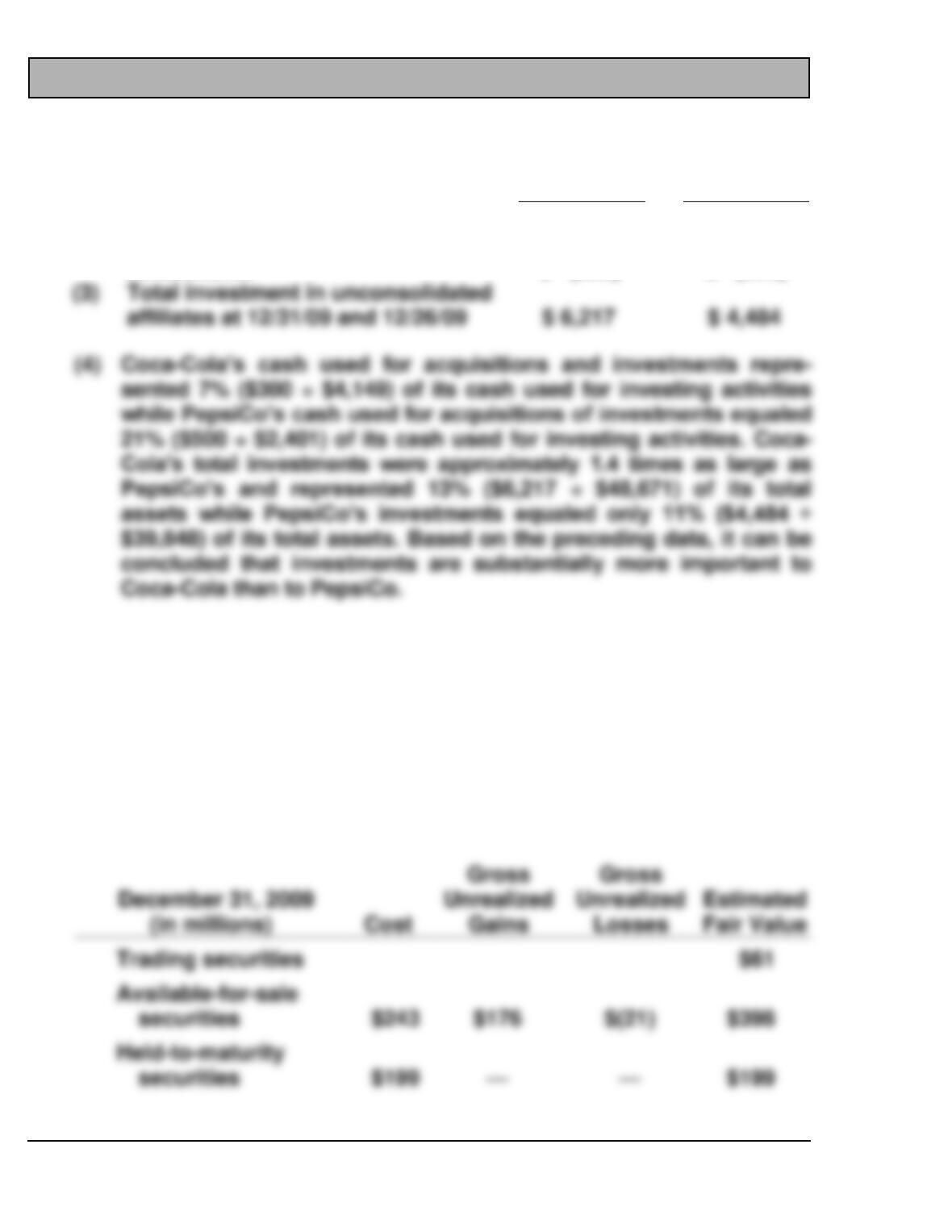
(b) (1) Coca-Cola reported the $6,217 million of equity investments on
its December 31, 2009 balance sheet.
(2) Coca-Cola reported “cost method investments, principally bottling
companies” in the amount of $538 million in its December 31, 2009
balance sheet.
(c) At December 31, 2009, Coca-Cola reported in its Note 2 on Investments
the following:
17–81
FINANCIAL STATEMENT ANALYSIS CASE
UNION PLANTERS
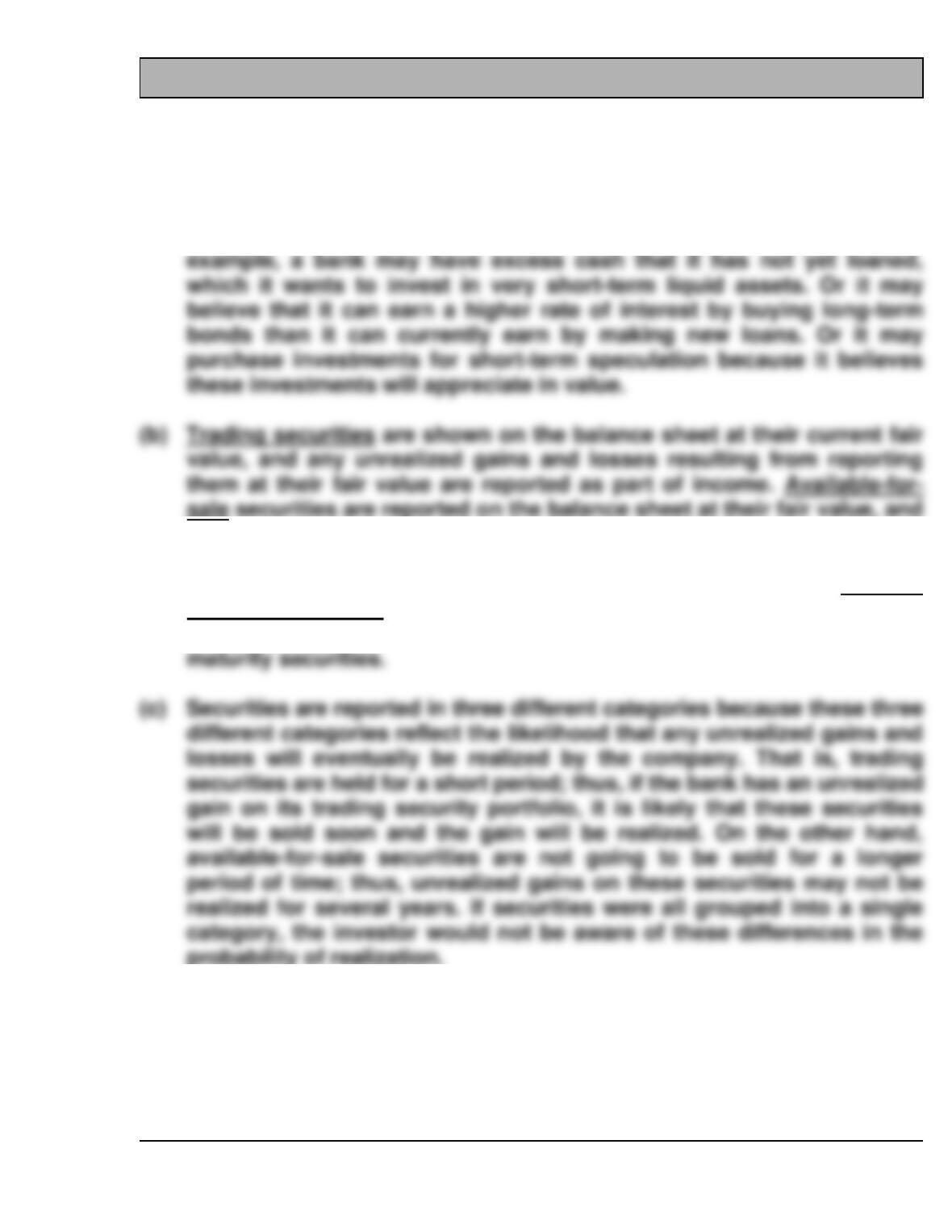
(a) While banks are primarily in the business of lending money, they also
need to balance their asset portfolio by investing in other assets. For
any unrealized gains and losses resulting from reporting them at their
fair values are reported as other comprehensive income and as a
separate component of stockholders’ equity until realized. Held-to–
maturity securities are reported at their amortized cost; that is, they
are not reported at fair value. Note that Union Planters has no held–to–
17–82
FINANCIAL STATEMENT ANALYSIS CASE (Continued)
(d) The answer to this involves selling your “winner” stocks in your available–
for-sale portfolio at year-end. Union Planters could have increased
reported net income by $108 million (clearly, a material amount when
17–83
ACCOUNTING, ANALYSIS, AND PRINCIPLES
Accounting
(a) Instar’s investment in Dorsel Corp. bonds should be classified as
held-to-maturity because they have a specific maturity date and Instar
has the intent and ability to hold them until the maturity date.
Instar’s investment of idle cash in equity securities should be
classified as trading.
For similar reasons, Instar’s investment in Forter Corp. stock should
be classified as available-for-sale.
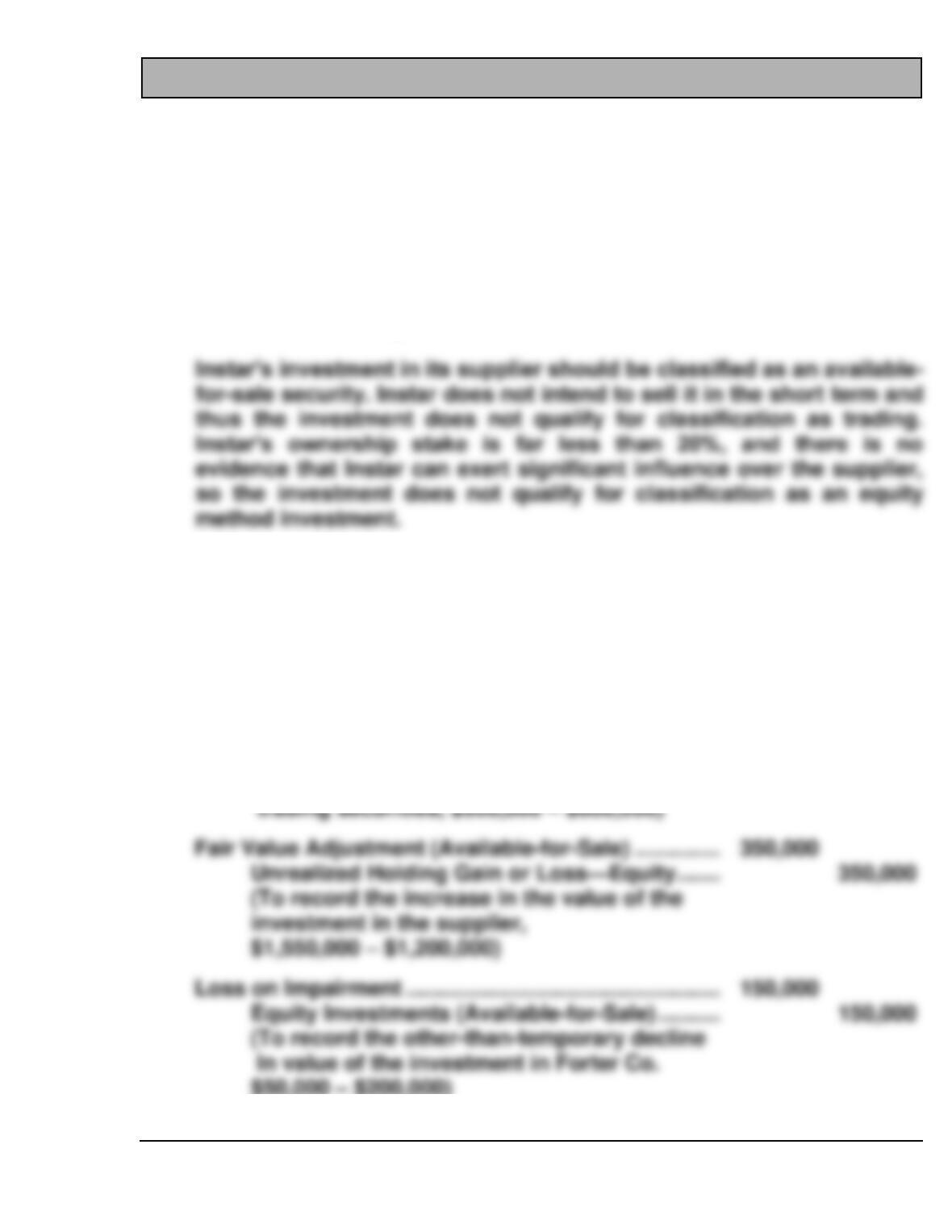
Instar’s investment in Slobbaer Co. common stock should be classified
as an equity method investment because its holdings are greater than
20% and Instar exerts significant influence over Slobbaer.
(b)
Fair Value Adjustment (Trading) ………………………….
120,000
Unrealized Holding Gain or Loss—Income …..
120,000
Unrealized Holding Gain or Loss—Equity …….
350,000
Equity Investments (Available-for-Sale) ……….
150,000
(To record the increase in value of the
$50,000 – $200,000)
17–84
ACCOUNTING, ANALYSIS, AND PRINCIPLES (Continued)
Equity Investment (Slobbaer) ………………………………
75,000
Revenue from Investments ………………………….
75,000
(To record income on the equity method,
$300,000 X 25% = $75,000)
Analysis
The total effect on net income is $120,000 – $150,000 + $75,000 = $45,000.
Note that the gain on the available-for-sale securities is a component of
other comprehensive income, not net income reported on Instar’s income
Principles
The rationale for reporting held–to-maturity securities at amortized cost is
that if management intends to hold the securities to maturity, fair values
are not relevant for evaluating the cash flows associated with these
securities.
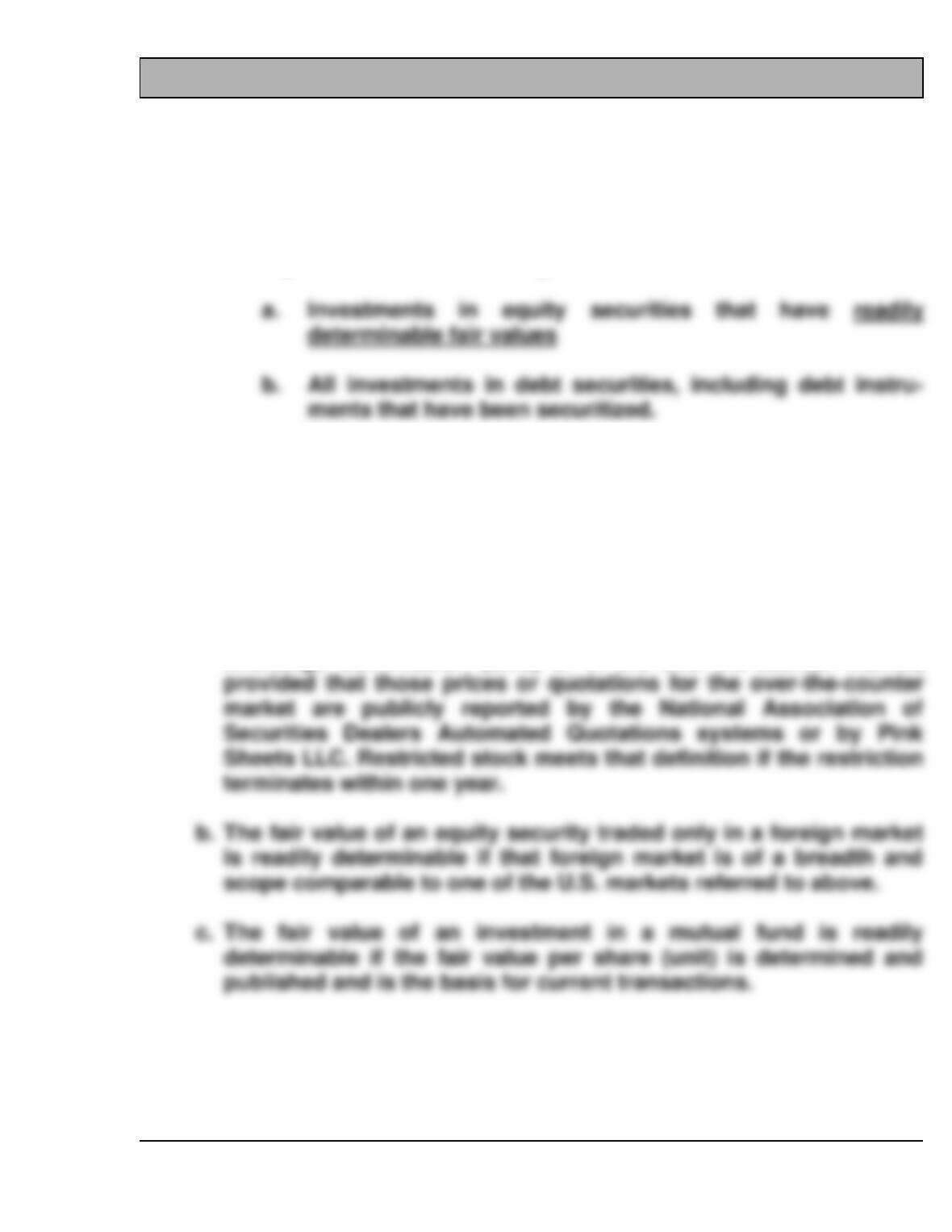
Equity Investments (Slobbaer) …………………….
25,000
17–85
PROFESSIONAL RESEARCH
(a) According to FASB ASC 320-10:
15-5 The guidance in the Investments—Debt and Equity Securities
Topic establishes standards of financial accounting and report-
ing for both of the following:
Readily Determinable Fair Value (FASB ASC 320–10-20 Glossary)
An equity security has a readily determinable fair value if it meets any
of the following conditions:
a. The fair value of an equity security is readily determinable if sales
prices or bid-and-asked quotations are currently available on a
securities exchange registered with the U.S. Securities and
Exchange Commission (SEC) or in the over-the-counter market,
17–86
PROFESSIONAL RESEARCH (Continued)
(b) See FASB ASC 320-10-35
35–18 For individual securities classified as either available for sale or
held to maturity, an entity shall determine whether a decline in
35–30 If the fair value of an investment is less than its amortized cost
basis at the balance sheet date of the reporting period for
which impairment is assessed, the impairment is either
(c) See FASB ASC 320-10–25
25–14 Sales of debt securities that meet either of the following
conditions may be considered as maturities for purposes of the
classification of securities and the disclosure requirements
under this Subtopic:
1. The sale of a security occurs near enough to its maturity
date (or call date if exercise of the call is probable) that
2. The sale of a security occurs after the entity has already
collected a substantial portion (at least 85 percent) of the
17–87
PROFESSIONAL RESEARCH (Continued)
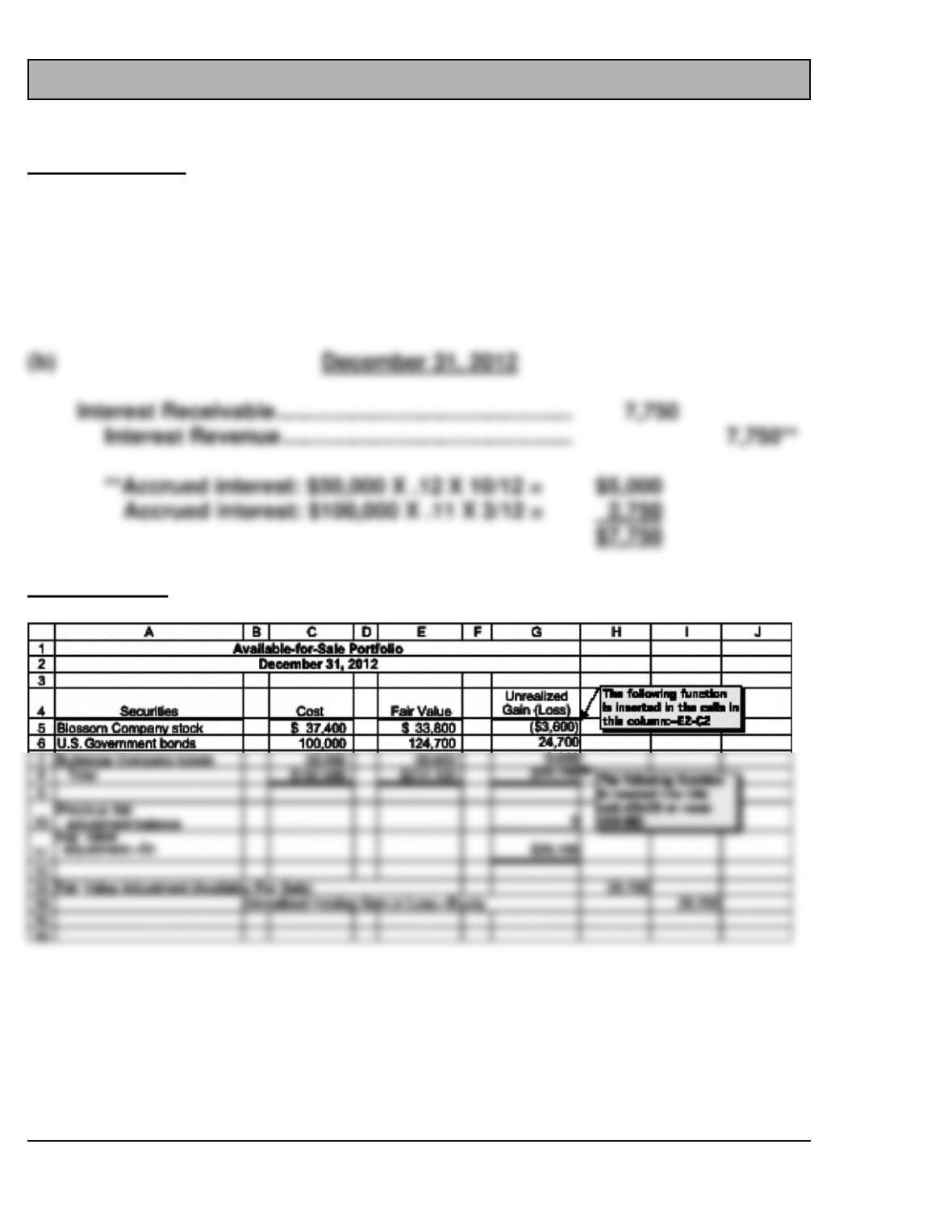
(d) See FASB ASC 320-10–50
50–10 For any sales of or transfers from securities classified as held–
1. The net carrying amount of the sold or transferred security
2. The net gain or loss in accumulated other comprehensive
income for any derivative that hedged the forecasted
acquisition of the held-to-maturity security
17–88
PROFESSIONAL SIMULATION
Journal Entries
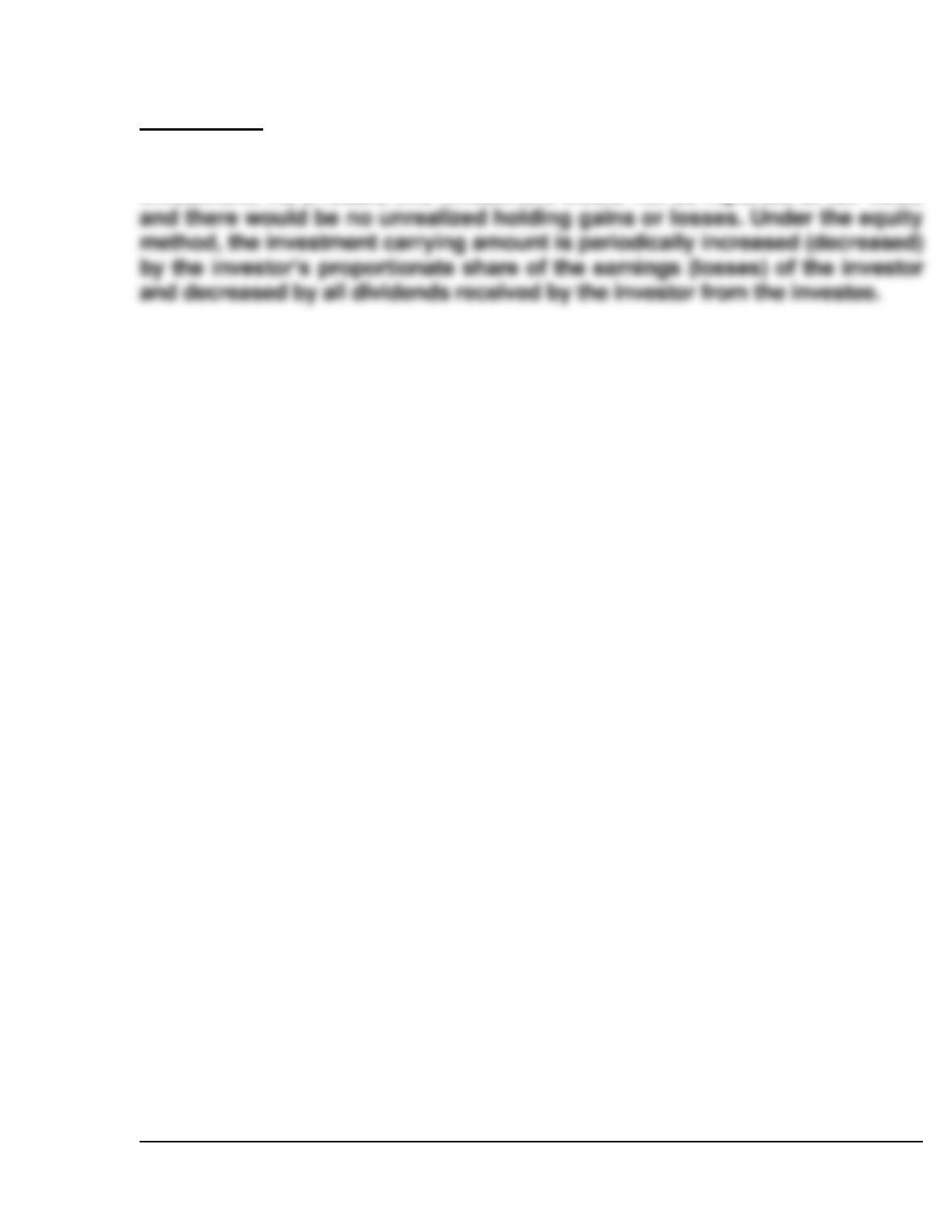
(a) Debt Investments (Available-for-Sale) …………….. 187,400*
Interest Revenue ($50,000 X .12 X 4/12) …………… 2,000
Investments ………………………………………………. 189,400
*($37,400 + $100,000 + $50,000)
Measurement
17–89
PROFESSIONAL SIMULATION (Continued)
Explanation
If Powerpuff owns 30%, it will use the equity method to account for the
investment. As a result, this investment would not be reported at fair value
17–90
IFRS CONCEPTS AND APPLICATION
IFRS17-1
The accounting for investment securities is discussed in IAS 27 (“Consoli–
IFRS17-2
GAAP classifies investments as trading, available-for–sale (both debt and
equity investments), and held-to-maturity (debt investments). IFRS uses held-
for-collection (debt investments), trading (both debt and equity investments),
and non-trading equity investment classifications.
The basis for consolidation under IFRS is control. Under GAAP, a bipolar
approach is used, which is a risk-and-reward model (often referred to as a
variable-entity approach) and a voting interest approach. However, under both
systems, for consolidation to occur, the investor company must generally
own 50 percent of another company.
17–91
IFRS17-3
The two criteria for determining the valuation of financial assets are the
IFRS17-4
Only debt investments such as loans and bond investments are valued at
amortized cost. A company should use amortized cost if it has a business
IFRS17-5
Lady Gaga should classify this investment as a trading investment because
companies frequently buy and sell this type of investment to generate profits
in short term differences in price.
IFRS17-6
IFRS17-7
Unrealized holding gains and losses for trading investments should be
included in net income for the current period. Unrealized holding gains and
losses are not recognized for held-for–collection investments.
IFRS17-8
17–92
IFRS17-9
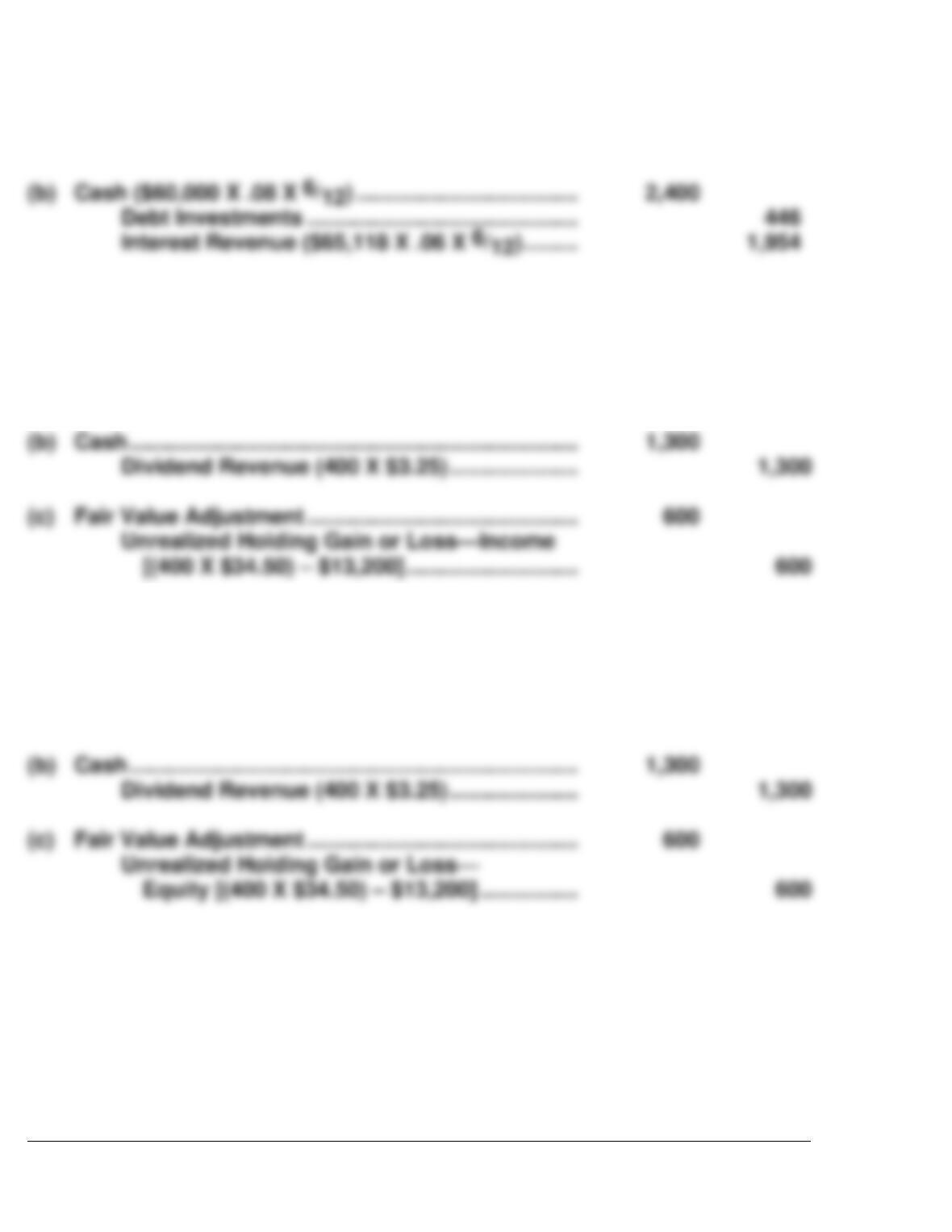
(a) Debt Investments ……………………………………………. 65,118
Cash ……………………………………………………….. 65,118
IFRS17-10
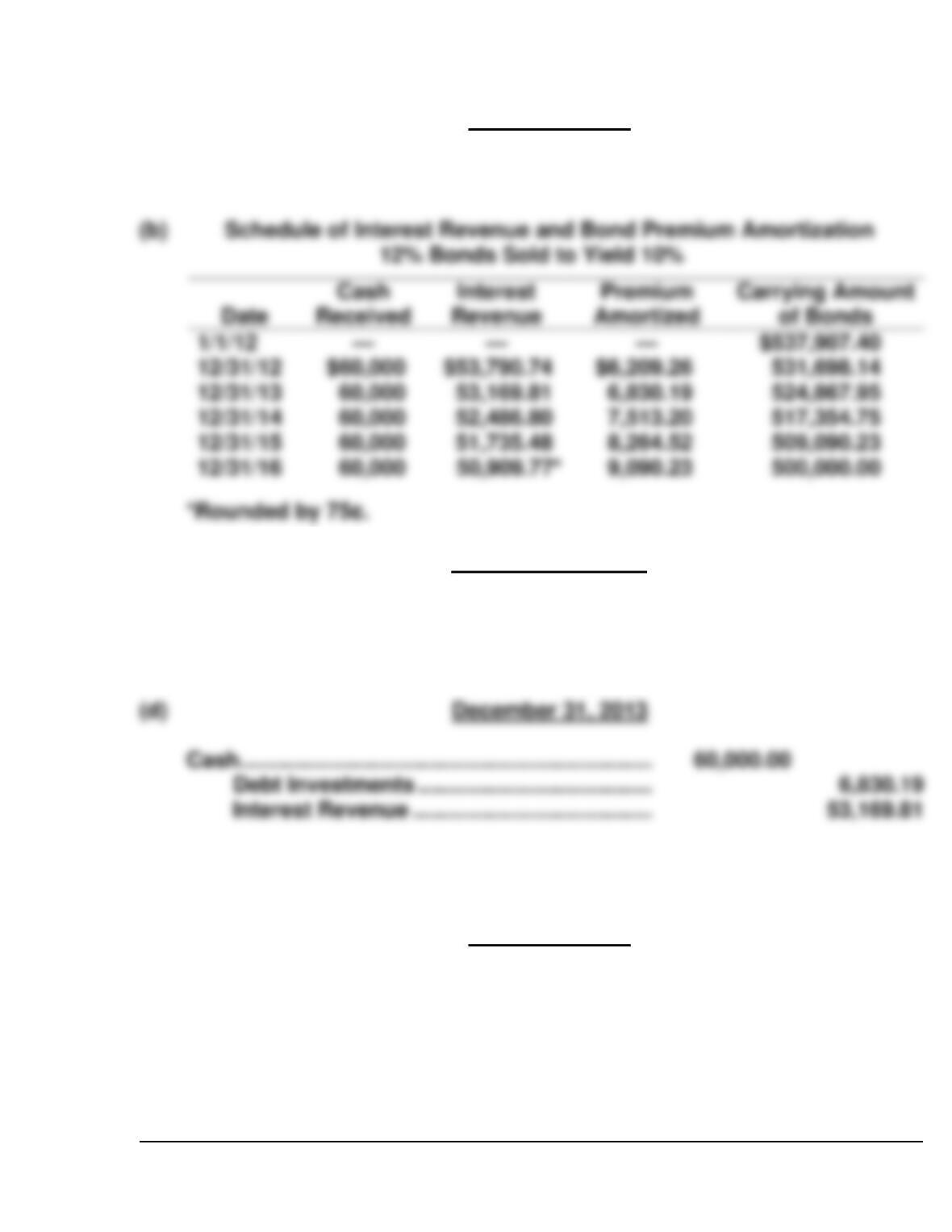
(a) Equity Investments …………………………………………. 13,200
Cash ……………………………………………………….. 13,200
IFRS17-11
(a) Equity Investments …………………………………………. 13,200
Cash ……………………………………………………….. 13,200
17–93
IFRS17-12
(a) January 1, 2012
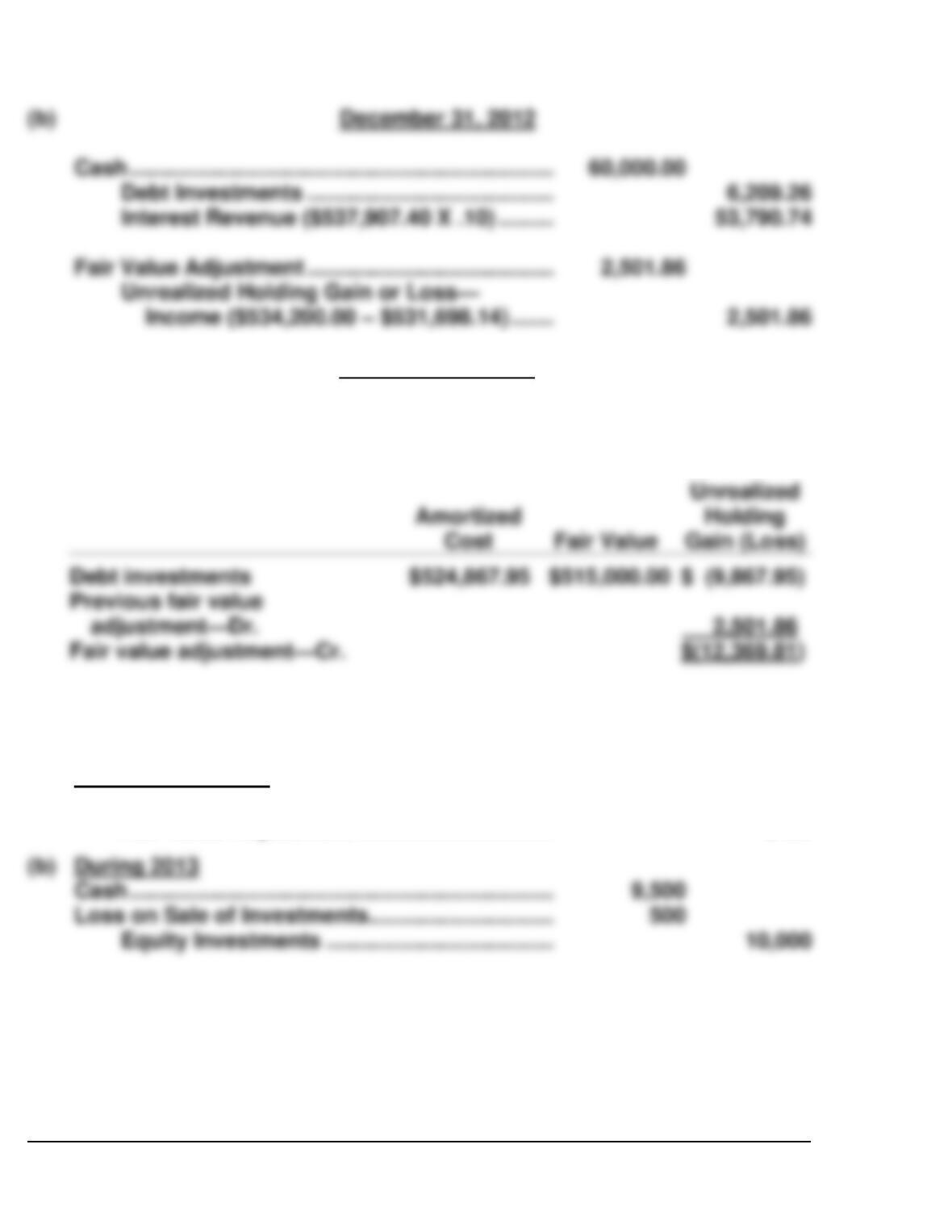
Debt Investments ………………………………………. 537,907.40
Cash ………………………………………………….. 537,907.40
(c) December 31, 2012
Cash …………………………………………………………. 60,000.00
Debt Investments ……………………………….. 6,209.26
Interest Revenue ………………………………… 53,790.74
IFRS17-13
(a) January 1, 2012
Debt Investments ………………………………………. 537,907.40
Cash ………………………………………………….. 537,907.40
17–94
IFRS17-13 (Continued)
(c) December 31, 2013
Unrealized Holding Gain or Loss—Income ……. 12,369.81
Fair Value Adjustment ………………………….. 12,369.81
IFRS17-14
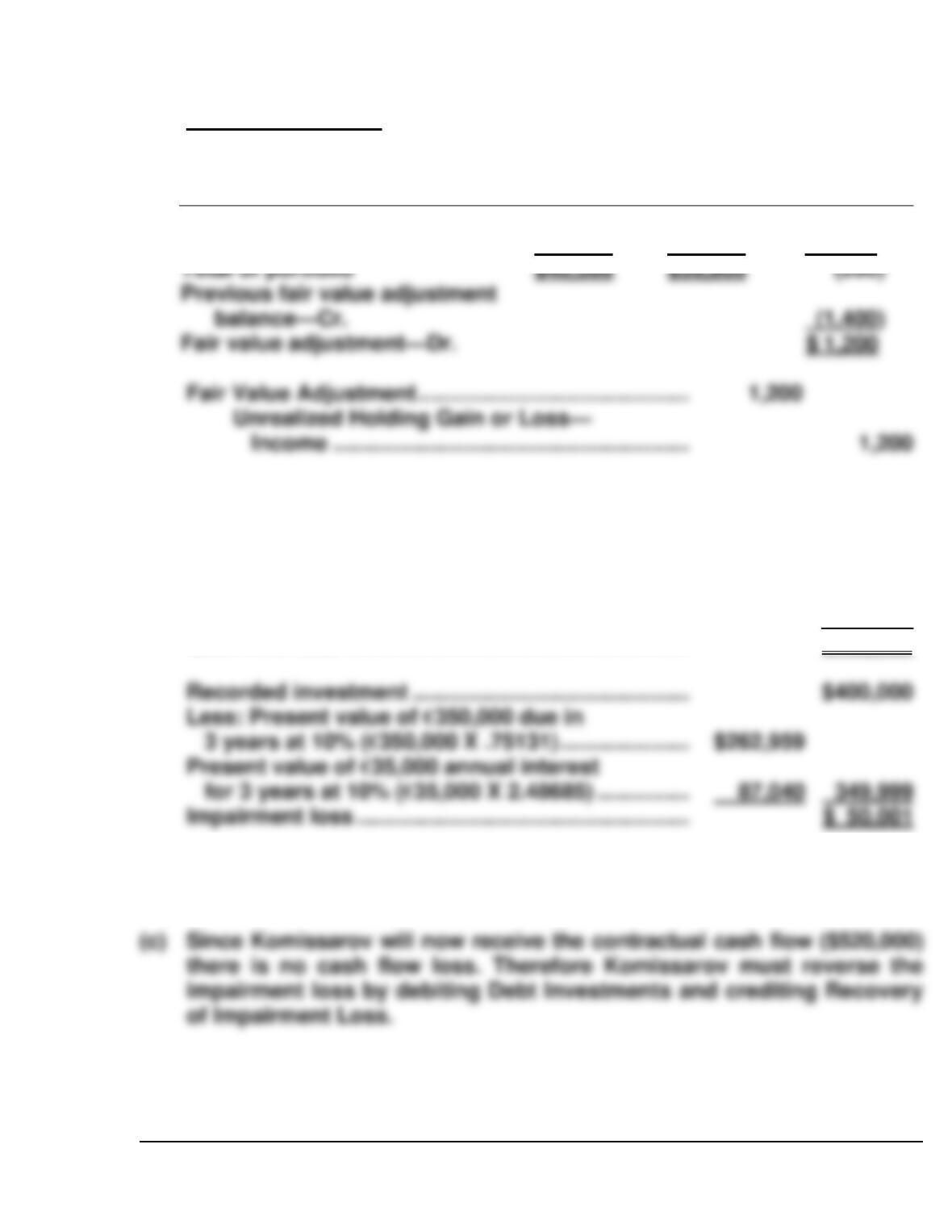
(a) December 31, 2012
Unrealized Holding Gain or Loss—Income ……. 1,400
Fair Value Adjustment ………………………….. 1,400
17–95
IFRS17-14 (Continued)
(c) December 31, 2013
Investments
Cost
Fair Value
Unrealized
Gain (Loss)
Stargate Corp. shares
$20,000
$19,300
$ (700)
Vectorman Co. shares
20,000
20,500
500)
IFRS17-15
(a) Contractual cash flow
[($400,000 X .10 X 3) + $400,000]……………………. $520,000
Expected cash flow ………………………………………… (455,000)
Cash flow loss ……………………………………………….. $ 65,000
(b) Loss on Impairment …………………………..……………. 50,001
Debt Investments …………………………………….. 50,001
17–96
IFRS17-16
(a) According to IAS 39, paragraph AG71, “A financial instrument is
regarded as quoted in an active market if quoted prices are readily
and regularly available from an exchange, dealer, broker, industry
group, pricing service or regulatory agency, and those prices
represent actual and regularly occurring market transactions on an
arm’s length basis.”
(c) According to IFRS 9, paragraph B4.3,
Although the objective of an entity’s business model may be to hold
financial assets in order to collect contractual cash flows, the entity
need not hold all of those instruments until maturity. Thus an entity’s
business model can be to hold financial assets to collect contractual
cash flows even when sales of financial assets occur. For example,
the entity may sell a financial asset if:
1. the financial asset no longer meets the entity’s investment policy
(e.g., the credit rating of the asset declines below that required by
the entity’s investment policy);
17–97
IFRS17-17
(a) M&S reports both current and non-current “other financial assets,” along
with both current and non-current derivative financial instruments.
These investments are reported on the statement of financial position
and in the notes to the financial statements.