83
Chapter 17: World Markets in Goods and Credit
Chapter Summary:
The analysis so far has been conducted under the assumption of a closed
economy. The final two chapters extend the model to include the flows of goods and
assets across national borders. This chapter introduces basic concepts of balance of
Of course, differences in the real interest rate are not the only determinant of
current account balances. Temporary changes in national savings rates can have any
number of other causes, war or political instability are two common examples. The
twin deficits theory is also presented and it is shown that when Ricardian
equivalence does not hold, government deficits will tend to increase the current
account deficit. Empirical evidence on the twin deficits theory is examined in the
Chapter Outline:
I. History of the U.S Current-Account Balance
II. Determinants of the Current-Account Balance
a. Economic Fluctuations
b. Harvest Failures, Government Purchases, Developing Countries
84
III. The Terms of Trade
a. The Terms of Trade and the Current-Account Balance
IV. The Volume Of International Trade
Teaching Tips:
1. I recall very little of what my professors said during my freshman year of college.
But I recall vividly the day that my economics professor opined that the central bank
2. The previous chapter reviewed the various explanations for the Great Depression,
but the current chapter adds another potential candidate: the collapse in the volume
3. A simple review of the principle of comparative advantage can help students
understand how the volume of trade relates to productivity.
4. Is the U.S. suffering from an unhealthy addiction to foreign capital? Consider
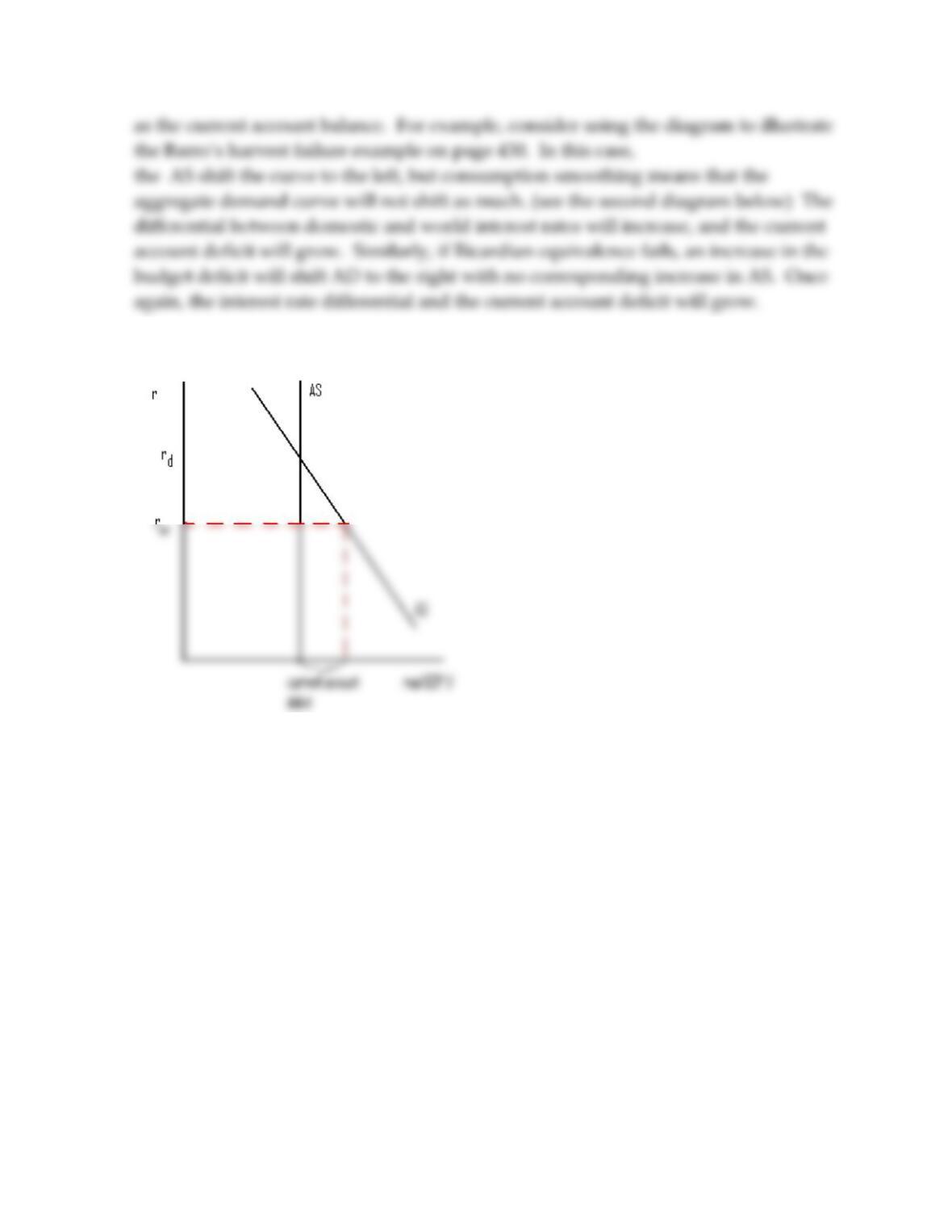
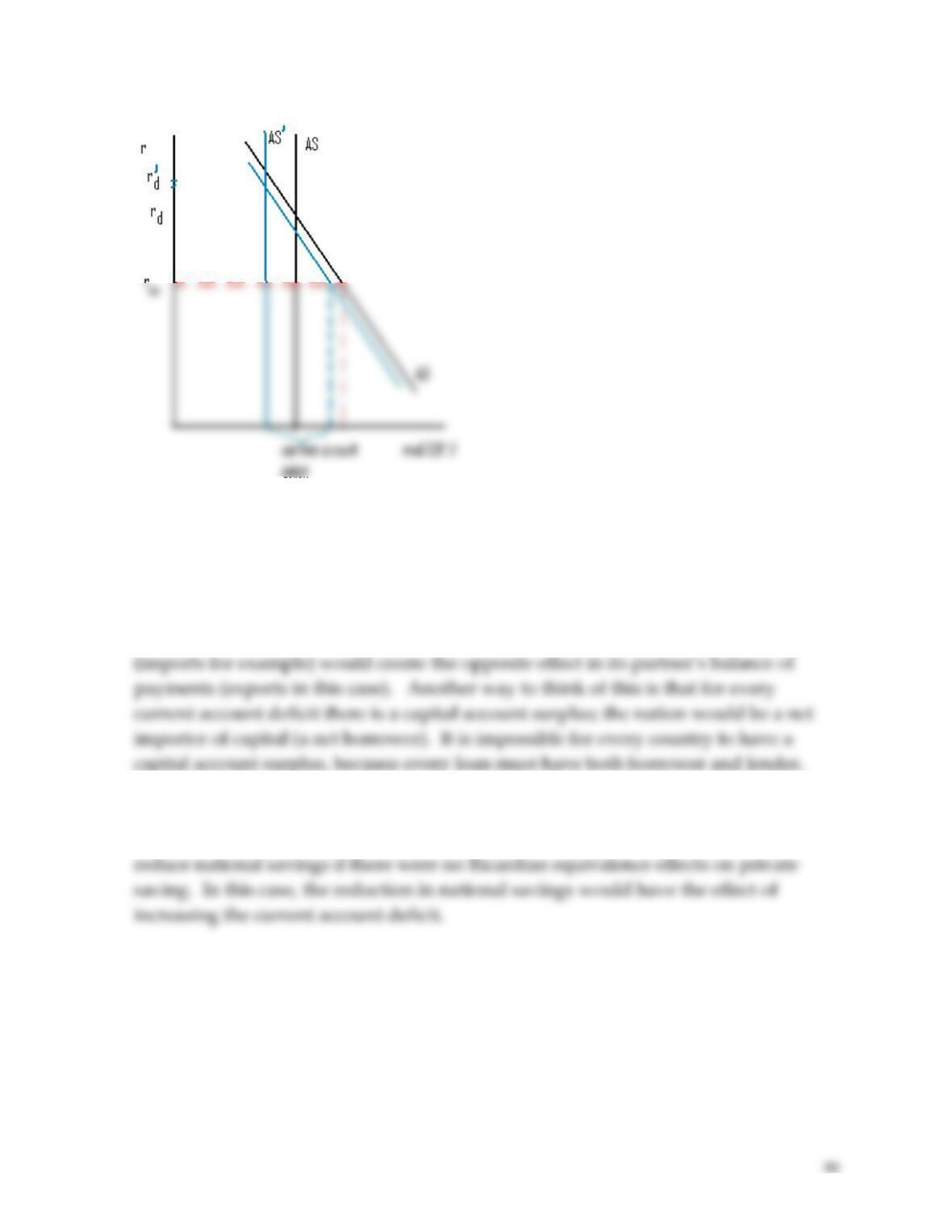
5. This is a dense chapter which can be overwhelming to students who have
encountered these kinds of concepts before. In this case, a simple diagram (shown
below) may help to illustrate some of the major points. Using interest rates on the
vertical axis and real GDP on the horizontal axis, and assuming, for simplicity, a
85
Answers to review questions, pg. 440
1. The current account in the balance of payments includes trade flows and net
asset income. Every transaction which contributes to a deficit in one country
2. The current account deficit is the different between national savings and
investment (see equation 17.11 on page 427). An increase in the budget deficit would
87
Answers to Problems for discussion, pg. 440
3. a. As discussed in chapter 9, the technology shock would increase employment,
capital utilization and real GDP,Y.
b. Consumption will increase, although not as much as real GDP,Y. This means
4. For all answers, assume Ricardian equivalence holds, so that consumers reduce
private savings in response to the increase in government saving. We will assume
that the tax revenue is used to reduce a budget deficit rather than an increase in
government spending.
a. Because the change in wage rates is permanent, there is no intertemporal
substitution effect on labor income. Any effects on labor supply will be relatively
b. The effects here are similar to part (a) above, but magnified due to the
intertemporal substitution effect. The current account will move toward a surplus
while the tax is in effect, then move back to a deficit when the tax is removed.
c. The tax on asset income permanently reduces the after tax rate of return on
capital ownership, reducing investment and moving the economy toward surplus.
5. In the case where the terms of trade improve due to foreign demand fo the
exported good, the current account moves toward a surplus. However in this