17-1
CHAPTER 17
EARNINGS PER SHARE AND RETAINED EARNINGS
CONTENT ANALYSIS OF EXERCISES AND PROBLEMS
Number
Content
Time Range
(minutes)
E17-1
Weighted Average Shares. (Moderate) Stock dividend, stock
split, reacquisition.
10-20
E17-2
Comparative EPS. (Easy) Weighted average shares, stock split,
stock dividend, comparative analysis.
10-20
E17-7
Convertible Preferred Stock and EPS. (Moderate) Weighted
average shares. Diluted EPS calculation.
10-20
E17-8
Convertible Bonds and EPS. (Moderate) Weighted average
shares. Diluted EPS calculation.
10-20
17-2
Number
Content
Time Range
(minutes)
E17-13
Various Dividends. (Moderate) Journal entries for payment of
cash, property, stock, and scrip dividends. Balance sheet
presentation.
10-20
E17-18
Retained Earnings Statement. (Moderate) Prior period
adjustments, cash and stock dividends, stock retirement,
acquisition of treasury stock.
10-20
E17-19
Retained Earnings Statement. (Moderate) Prior period
adjustments, cash and stock dividends, stock retirement,
acquisition of treasury stock.
10-20
E17-20
Stockholders’ Equity. (Moderate) Balance sheet preparation.
Preferred, common, treasury stock.
10-20
operations, extraordinary gain, weighted average.
P17-2
Comparative Income Statements and Basic EPS. (Moderate)
Preparation of multiple-step income statements for two years.
Extraordinary items, stock dividend, weighted average.
Compute and discuss price/earnings ratios.
30-45
17-3
Number
Content
Time Range
(minutes)
P17-5
Comprehensive: EPS. (Challenging) Weighted average shares,
stock dividends, share options, convertible stocks and bonds.
Extraordinary loss. Basic and diluted EPS computation. Income
statement disclosures.
30-45
P17-9
Dividends. (Moderate) Fully participating, partially
participating, nonparticipating preferred stock. Cumulative,
noncumulative. Computation of amounts to be paid.
30-45
P17-10
(AICPA adapted). Dividends. (Moderate) Nonparticipating,
noncumulative preferred stock. Fully participating, cumulative.
Five years net income or loss given. Worksheet to show
maximum amount available for cash dividends.
20-30
P17-11
Comprehensive: Dividends. (Moderate) Cash, stock, and
property dividends, stock split, reacquisition. Journal entries
and stockholders’ equity presentation.
30-45
P17-15
Retained Earnings Statement. (Moderate) Cash and stock
dividends, retirement, prior period adjustment. Journal entries
and statement of retained earnings.
20-30
17-4
Number
Content
Time Range
(minutes)
P17-17
Corrections. (Challenging) Account analysis with correcting
journal entries. Preparation of corrected stockholders’ equity
section.
30-45
P17-20
Comprehensive: Stockholders‘ Equity. (Challenging) Journal
entries. Reacquisition, reissuance, retirement. Cost method for
treasury stock. Donation, dividends. Statement of changes in
stockholders’ equity. Balance sheet disclosure with related
notes.
35-50
P17-21
Comprehensive: Stockholders‘ Equity. (Challenging) Journal
entries. Reissuance of treasury stock. Share option plan,
donation, dividends. Statement of changes in stockholders’
equity. Balance sheet disclosure with related notes. Compute
return on stockholders’ equity.
35-50

ANSWERS TO QUESTIONS
Q17-1 A simple capital structure is one that consists only of common stock outstanding (or
also has non-convertible preferred stock outstanding).
Q17-2 For a corporation with a simple capital structure, basic earnings per share is
Q17-3 The “weighted average” number of shares is the equivalent whole shares of common
stock outstanding during the period. It is calculated by starting with the actual
number of common shares outstanding at the beginning of the period and
Q17-4 For computing earnings per share, stock dividends and splits are given retroactive
recognition. That is, regardless of when they were actually issued, stock dividends
Q17-5 Several securities such as share options and warrants, convertible preferred stock and
convertible bonds, participating securities and two-class stocks, and contingent
shares might be found in the complex capital structure of a corporation.
Q17-6 The two earnings per share amounts generally reported by a corporation with a
complex capital structure are basic earnings per share and diluted earnings per
Q17-7 The treasury stock method is used to determine the change in the number of shares
for a corporation’s diluted earnings-per-share calculations when the corporation has
Q17-8 To develop the ranking, the if-converted method is used. First, the impact of the
conversion of each convertible security upon earnings per share is computed. This
impact is calculated by dividing the change in the numerator (that is, the savings in
17-6
Q17-9 The additional disclosures made by a corporation in the notes to its financial
statements include a schedule identifying and reconciling the numerators and
denominators on which both basic and diluted earnings per share figures are
Q17-10 Under IFRS, if a company has potentially dilutive stock options, it will use the treasury
stock method to determine the dilutive effect of these options. However, IFRS do not
require a company to include any unrecognized compensation cost in the assumed
Q17-11 Even though the loss is unusual and infrequent, IFRS do not have the concept of
extraordinary items. Therefore, Parker Company would make no EPS disclosure
related to this loss.
Q17-12 The four important dates are (1) the date of declaration, (2) the ex-dividend date, (3)
the date of record, and (4) the date of payment. On the date of declaration, the
Q17-13 Stockholders of fully participating preferred stock share with the common
stockholders in any extra dividends. These extra dividends are distributed
Q17-14 A property dividend is considered a nonreciprocal nonmonetary exchange where
the corporation gives up an asset and receives no asset or service in return. The
Q17-15 An ordinary stock dividend consists of the issuance of the same class of stock (i.e.
Q17-16 A small stock dividend is one that presumably has no significant impact on the
market price per share of the stock. A stock dividend of less than 20 to 25% of the
previously outstanding shares is considered a small stock dividend. A stock dividend
Q17-17 A liquidating dividend is treated as a reduction in contributed capital whereas a
normal cash dividend is treated as a reduction in retained earnings.
Q17-18 A corporation treats a correction of a material error made in a previous year as a
prior period adjustment. The asset or liability account balance is corrected and
Q17-19 A corporation may restrict its retained earnings to meet legal requirements (for
Q17-20 The suggested format is shown below. The two most common elements are net
income and dividends.
Beginning retained earnings, as previously reported
Q17-21 A corporation might include in the accumulated other comprehensive income
section of its stockholders’ equity the following items (amounts accumulated to date):
1. Unrealized increases (gains) or decreases (losses) in the fair value of investments
in available-for-sale securities.

16-8
Q17-22 GAAP requires a corporation to disclose the separate changes in all its stockholders’
equity accounts as well as the changes in the number of shares of capital stock.
ANSWERS TO MULTIPLE CHOICE
17-9
SOLUTIONS TO REVIEW EXERCISES
RE17-1
Months Shares
Shares
Fraction of
Equivalent
RE17-2
RE17-3
Shares issued from assumed exercise: 2,000
RE17-4
Security
Impact
RE17-5
Security Impact
RE17-6
Explanation
Earnings
(Adjustments)
/
Shares
(Adjustments)
=
Earnings
per share
Basic earnings per share $4,000 /
1,000 = $4.00 Basic
RE17-6 (continued)
*Calculation:
RE17-7
Preferred
Common
10% dividend to preferred
(on $22,000 par) $2,200
RE17-8
Investment in Violet Company Bonds
RE17-9
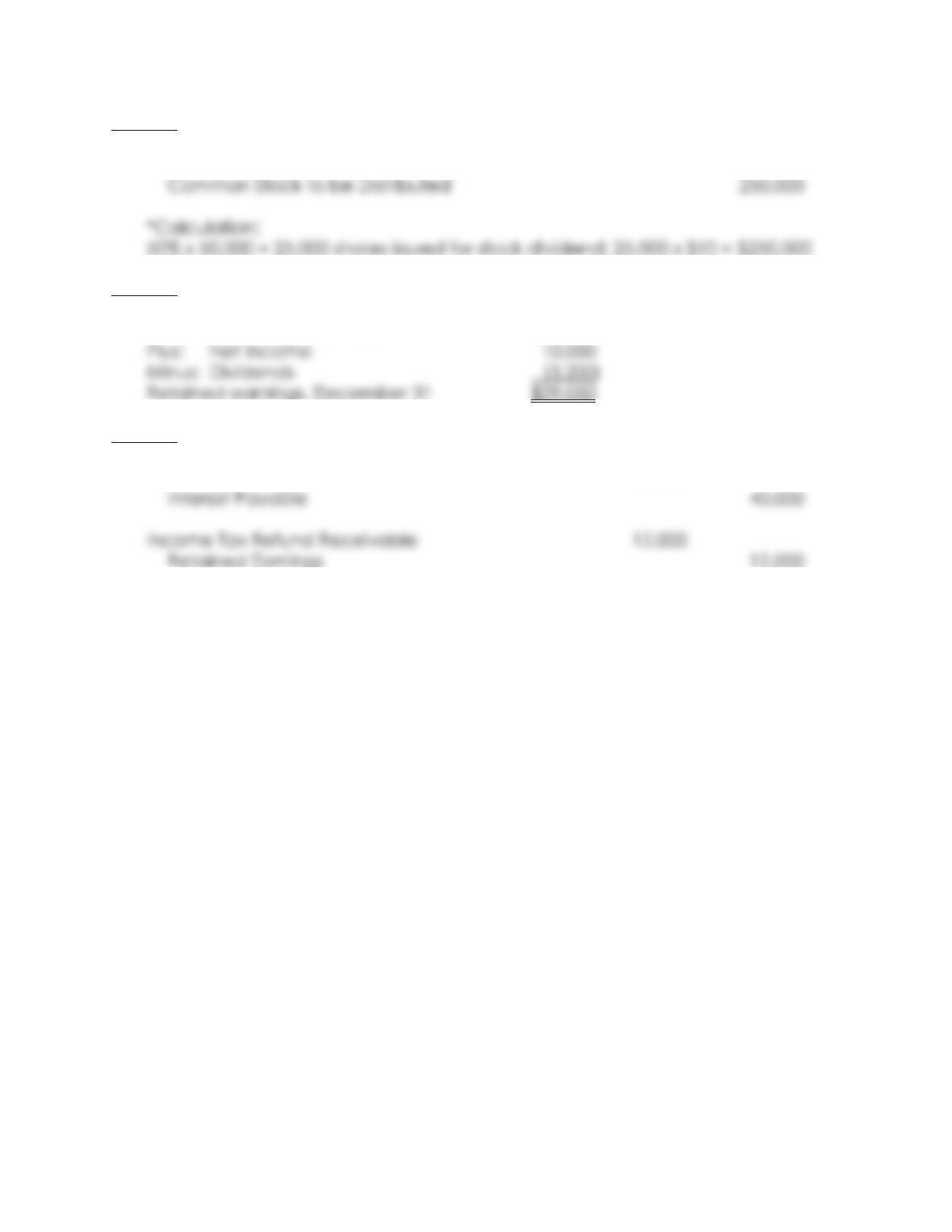
Retained Earnings ($30 x 7,500) 225,000
17-11
RE17-10
Retained Earnings ($10 par x 25,000) 250,000*
RE17-11
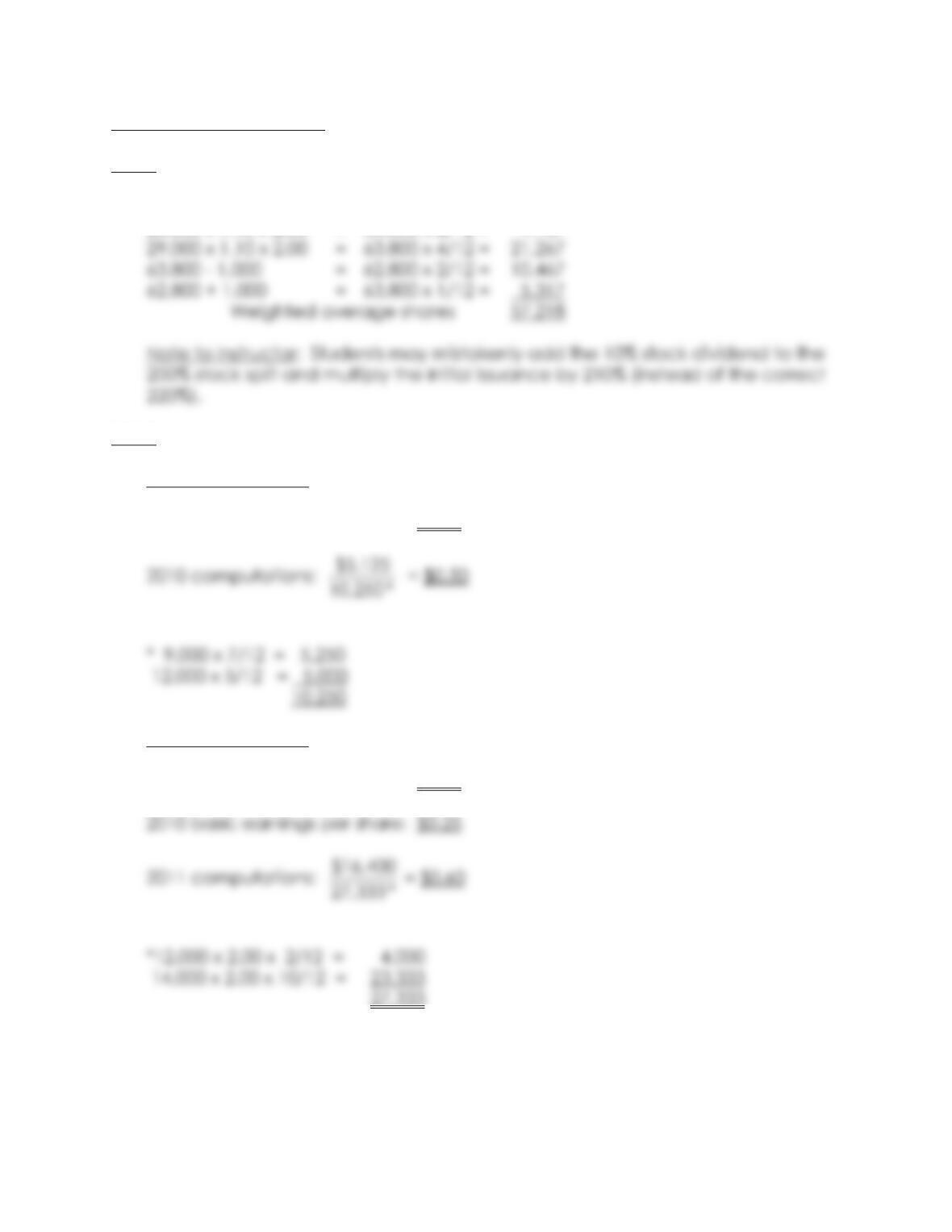
Retained Earnings, January 1 $22,250
RE17-12
Retained Earnings 40,000
17-12
SOLUTIONS TO EXERCISES
E17-1
20,000 x 1.10 x 2.00 = 44,000 x 3/12 = 11,000
25,000 x 1.10 x 2.00 = 55,000 x 2/12 = 9,167
E17-2
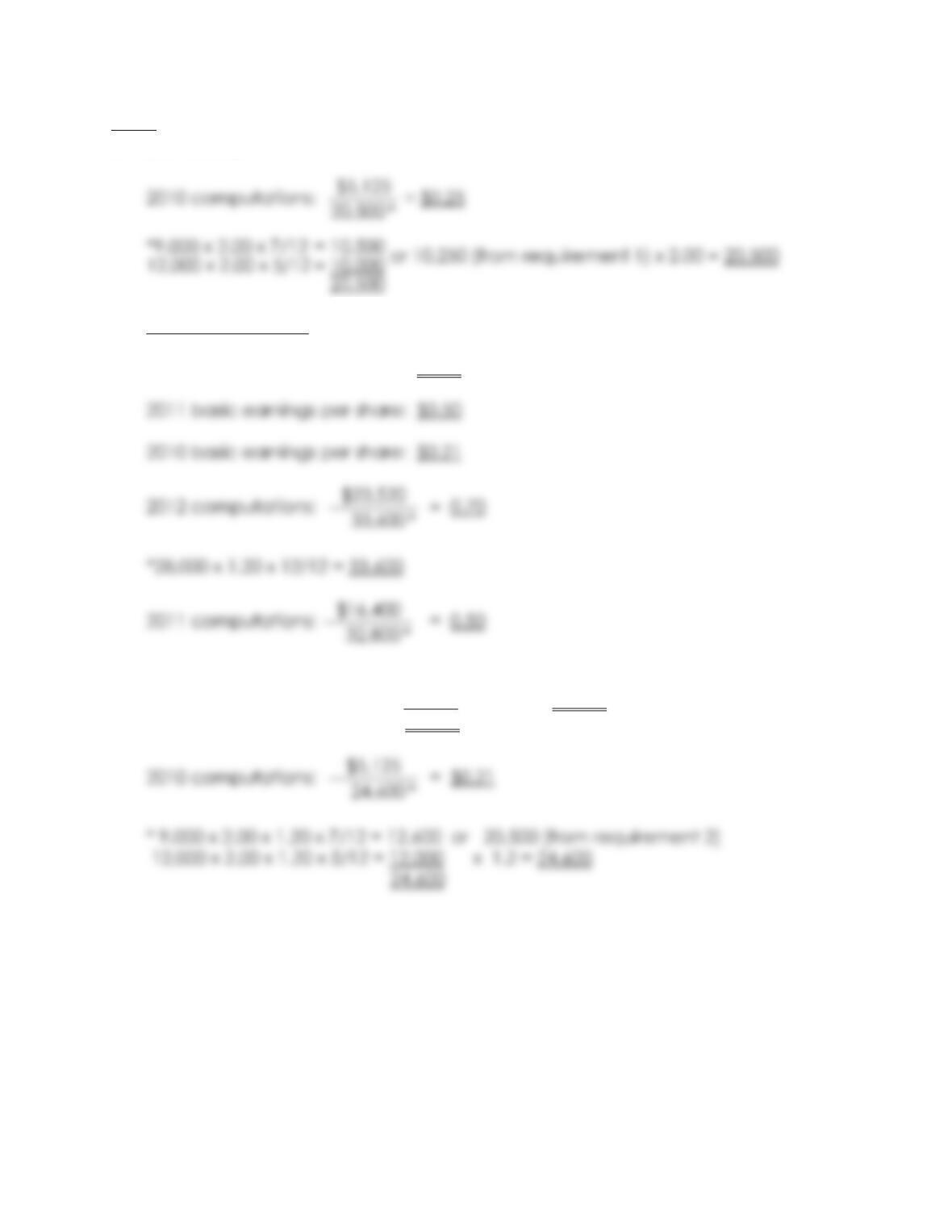
1. 2010 annual report:
2010 basic earnings per share: $0.50
2. 2011 annual report:
2011 basic earnings per share: $0.60
17-13
E17-2 (continued)
2. (continued)
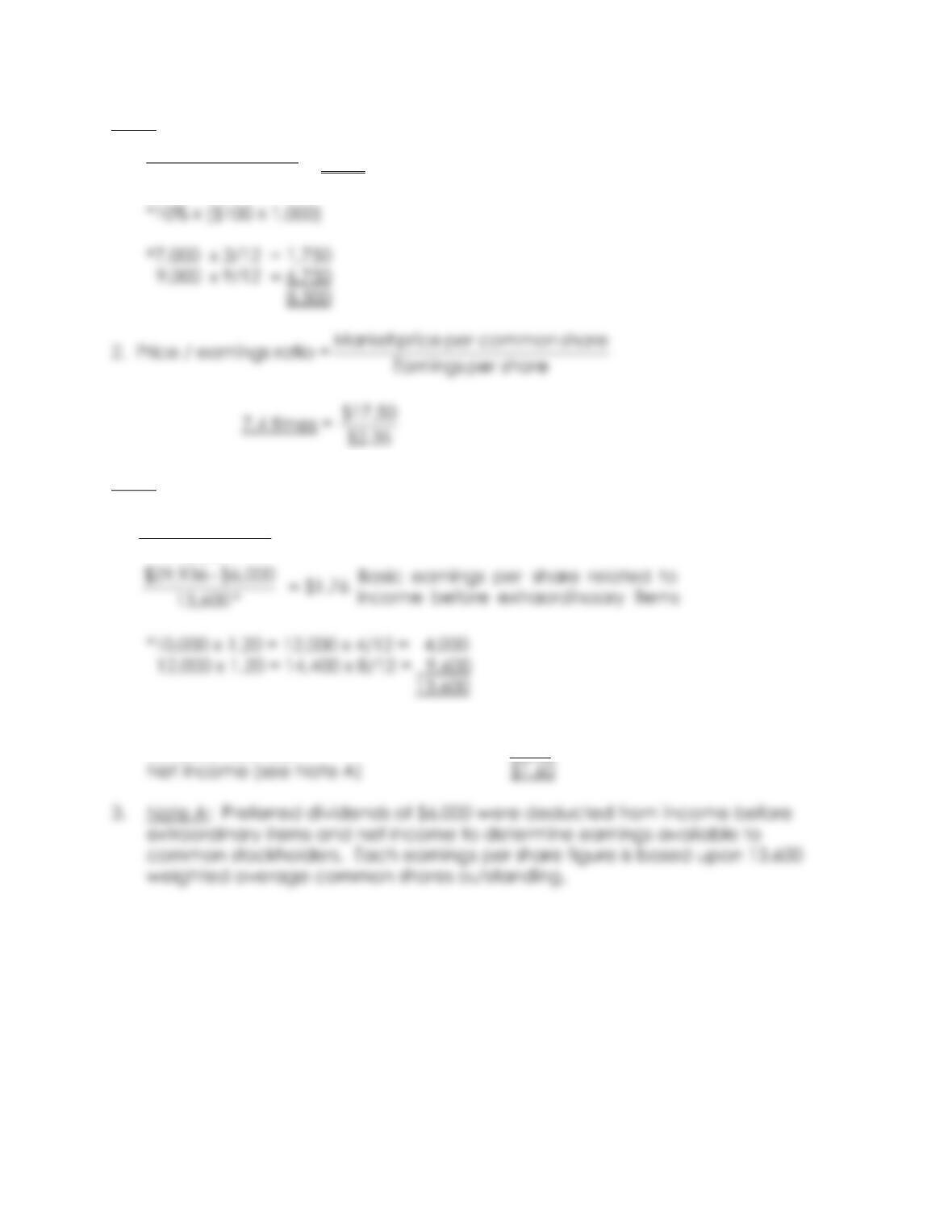
3. 2012 annual report:
2012 basic earnings per share: $0.70
*12,000 x 2.00 x 1.20 x 2/12 = 4,800 or 27,333 (from requirement 2)
14,000 x 2.00 x 1.20 x 10/12 = 28,000 x 1.2 = 32,800
32,800
17-14
E17-3
$29,975 – $10,000*
1. = $2.35
8,500#
E17-4
1. *13,600
$6,000–$27,760 = $1.60 Basic earnings per share
2. Income before extraordinary items $1.76
Extraordinary loss (0.16)
17-15
E17-5
1. 9.5% preferred stock: $2.26
8,400
$19,000
4.2x2,000
$200,000x0.095 ==
2. Security Impact Ranking
9.5%
preferred
$2.26
5
E17-6
$36,000
1. Diluted EPS: = $1.17
30,000 + 889*
2. Under IFRS, Butler Company would not include the unrecognized compensation
cost in the assumed proceeds from issuing the shares under the treasury stock
method. Therefore, the earnings per share would be $1.16 (instead of $1.17) as
E17-7
Earnings Shares Earnings
Explanation (Adjustments) ÷ (Adjustments) = Per Share
Basic earnings and shares $39,000a ÷ 12,000b = $3.25 Basic
E17-8
Earnings Shares Earnings
Explanation (Adjustments) ÷ (Adjustments) = Per Share
Basic earnings and shares $79,200 ÷ 18,000a = $4.40 Basic
Bond interest expense savingsb 3,920c
E17-9
Earnings Shares Earnings
Explanation (Adjustments) ÷ (Adjustments) = Per Share
Basic earnings and shares $45,000a ÷ 15,000b = $3.00 Basic
Bond interest expense savings
E17-9 (continued)
E17-10
Earnings Shares Earnings
Explanation (Adjustments) ÷ (Adjustments) = Per Share
Basic earnings and shares $52,000a ÷ 20,000b = $2.60 Basic
Preferred dividend savingsd 9,500c
cImpact on diluted earnings per share and ranking:
Impact Ranking
E17-10 (co ntin ued)
dConvertible preferred stock is included in diluted earnings per share
because $1.58 < $2.60, so individually dilutive.
E17-11
1. Preferred
Common
a. Preferred dividend (2,000 x 0.10 x $100) $20,000
Remainder to common ($80,000 – $20,000) $60,000
Total $20,000 $60,000
c. Dividends in arrears (1 x 2,000 x 0.10 x $100) $20,000
d. Preferred dividend $20,000
Common proportional share (0.10 x 30,000 x $10) $30,000
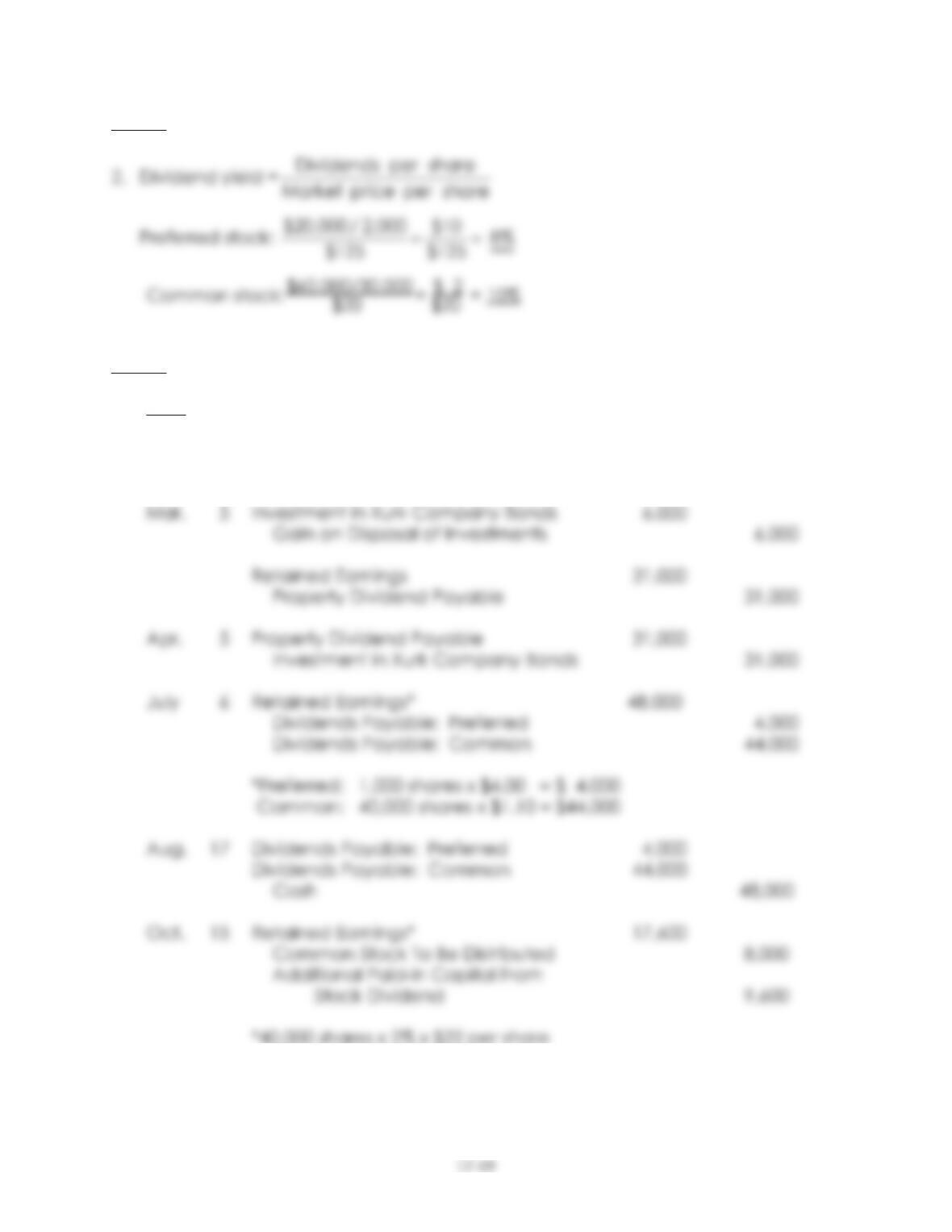
E17-11 (co ntin ued)
E17-12
2010
Feb. 2 Dividends Payable: Preferred 4,000
Dividends Payable: Common 40,000
Cash 44,000
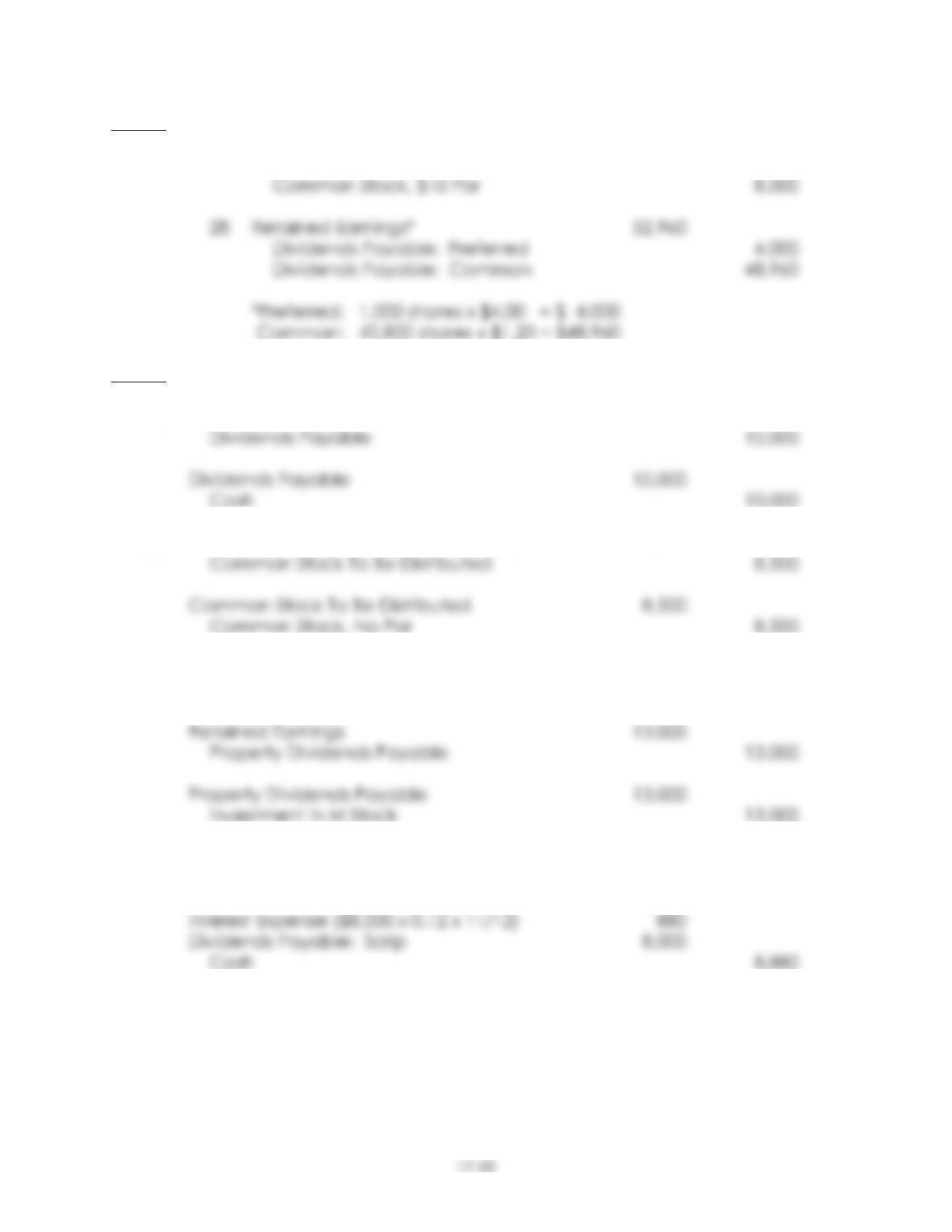
E17-12 (continued)
Dec. 3 Common Stock To Be Distributed 8,000
E17-13
1. (1) Retained Earnings 10,000
(2) Retained Earnings (10,000 x 0.05 x $17) 8,500
(3) Investment in M Bonds ($13,000 – $9,000) 4,000
Gain on Disposal of Investment 4,000
(4) Retained Earnings 8,000
Dividends Payable: Scrip 8,000