Continuing Case Solution
7
Chapter 17
(a)
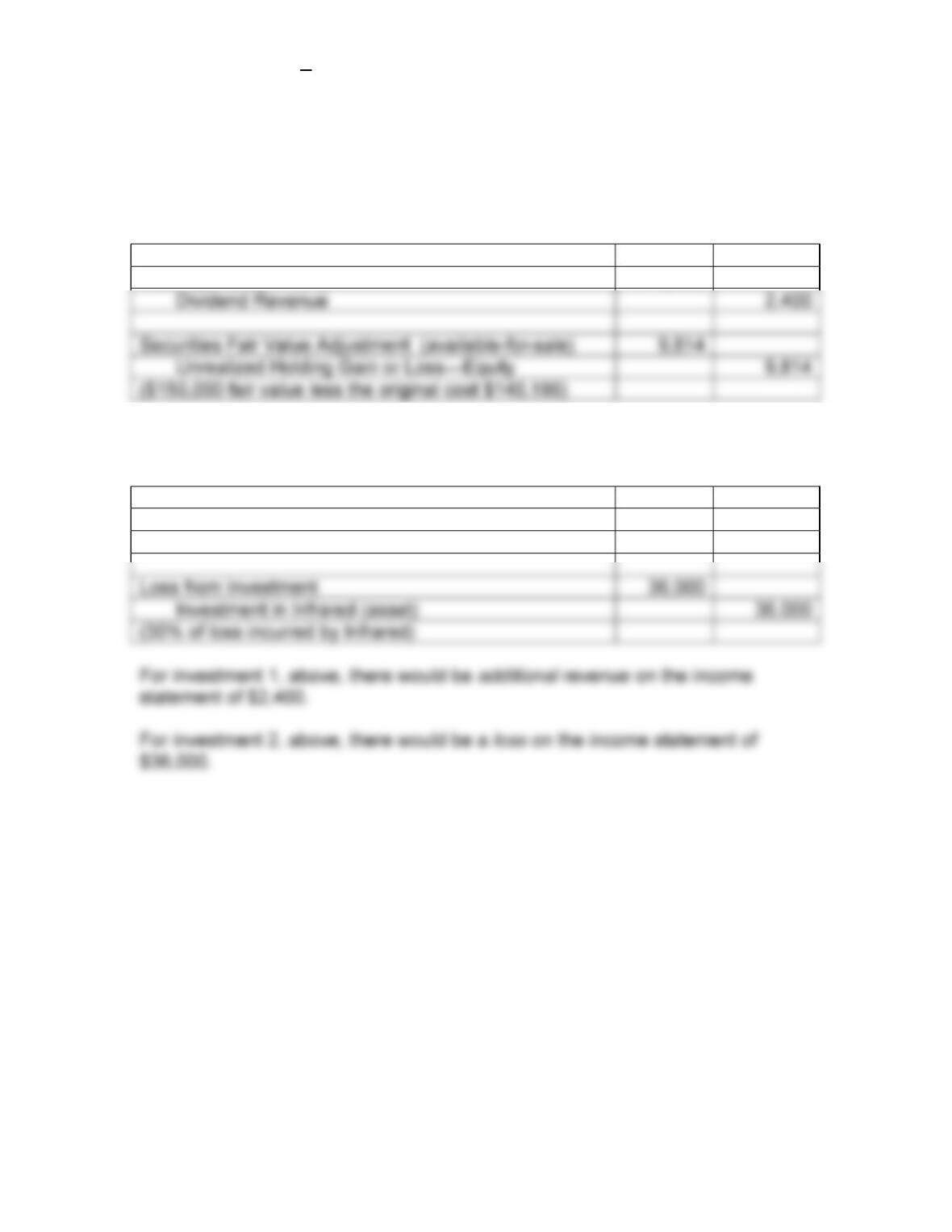
1. Stock investment in Infrared of 10% of the outstanding voting stock:
DR CR
Cash ($24,000 x 10%) 2,400
2. Stock investment in Infrared of 30% of the outstanding voting stock:
DR CR
Cash ($24,000 x 30%) 7,200
Investment in Infrared (asset)
7,200
Continuing Case Solution
8
(b)
Memorandum
To: Eric Conner and Phil Martin, CM2
From: L. Harbach
Re: Stock Investments in Publicly-held Companies
Date: January 31, 2013
Below you will find the specific authoritative literature guidance on the accounting
for stock investments of publicly-held companies when there are differing levels
of ownership of the voting stock.
Stock investments of 20% or more and up to 50% of the voting stock:
The equity method. An investor initially records an investment in the stock of an investee
at cost (FASB ASC 323-10-30-2), and adjusts the carrying amount of the investment to
recognize the investor‘s share of the earnings or losses of the investee after the date of
FASB ASC 323-10-15-6 describes the conditions for which the equity method
would be appropriate:
The Board concludes that the equity method of accounting for an investment in
common stock should also be followed by an investor whose investment in voting
stock gives it the ability to exercise significant influence over operating and
financial policies of an investee even though the investor holds 50% or less of the
Continuing Case Solution
9
judgment is necessary to assess the status of each investment (FASB ASC 323-10-
15-7). In order to achieve a reasonable degree of uniformity in application, the
Board concludes that an investment (direct or indirect) of 20% or more of the
Stock investments of 20% or less of the voting stock:
FASB ASC 320-10-35 describes the accounting for stock investments of less
than 20% of the voting stock:
For investments in debt securities that management does not have the positive
intent and ability to hold to maturity, and for investments in equity securities with
All investments in equity securities are valued at fair value and are classified as
trading securities or available-for-sale securities (FASB ASC 320-10-35-1).
Unrealized holding gains and losses on trading securities are included in the
Summary
If a company owns less than 20% of a publicly-
the stock has a ready fair market value (e.g., the stock is traded on a national
exchange), that fair market value should be reported on the balance sheet for
this stock investment.
Continuing Case Solution
revenue. If the investment declines in value and management believes this value
is permanent, the company must write down the asset and record a realized loss.
the assumption is that the company can exert significant influence over the
affairs of the investee corporation, and therefore the equity method is required.