Chapter 17
Glycolysis
1
SUMMARY
Section 17.1
In glycolysis, glucose is converted to pyruvate in a multistep pathway.
When pyruvate is formed, it can be converted to carbon dioxide and water in
Section 17.2
In the first stages of glycolysis, glucose is converted to two molecules of
glyceraldehyde- 3-phosphate.
Section 17.3
In the final stages of glycolysis, two molecules of pyruvate are produced for each
molecule of glucose that entered the pathway.
Section 17.4
Pyruvate is converted to lactate in anaerobic tissues, such as actively
metabolizing muscle. NAD+ is recycled in the process.
Section 17.5
Glycolysis is an exergonic process, releasing 73.4 kilojoules for every mole of
glucose converted to two moles of pyruvate, accompanied by phosphorylation of
Section 17.6
There are three major control points of glycolysis
The first is the conversion of glucose to glucose 6-phosphate
2 Chapter 17
LECTURE NOTES
Glycolysis is, arguably, is best understood biochemical pathway, and thus serves
an excellent introduction to metabolism in general. A general description of the enzymes
LECTURE OUTLINE
I. Overview of glycolysis
A. 1 glucose converted to 2 pyruvate
B. Net gain of 2 ATP
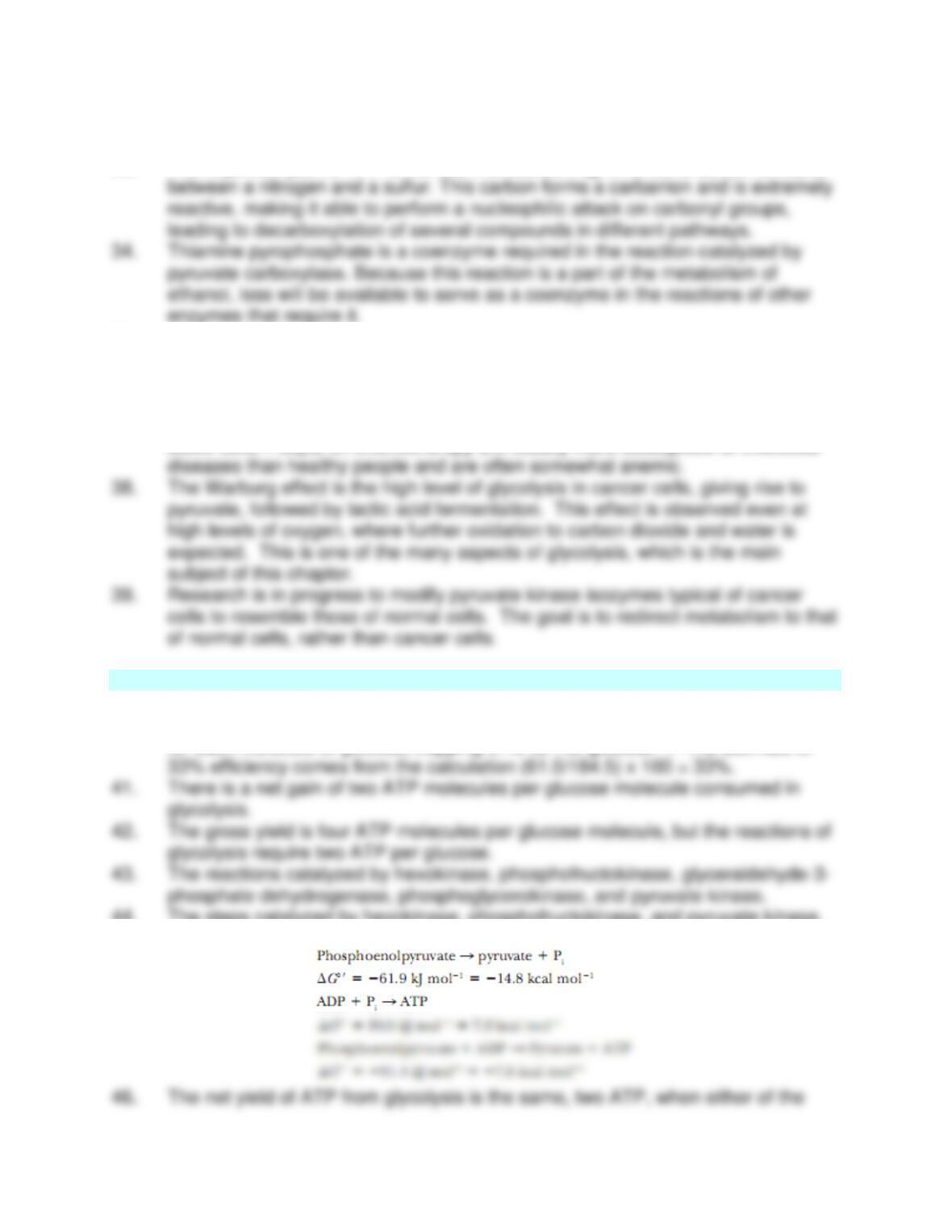
C. Anaerobic pathway
II. Reaction summary
A. Phosphorylation
B. Isomerization
III. Preparation phase
A. Phosphorylation
1. Coupling of exergonic ATP hydrolysis to endergonic phosphorylation
of glucose
B. Isomerization
1. Glucose-6-phosphate isomerase
2. Conversion from aldose to ketose
C. Phosphorylation
1. Similarity to step 1
Glycolysis 3
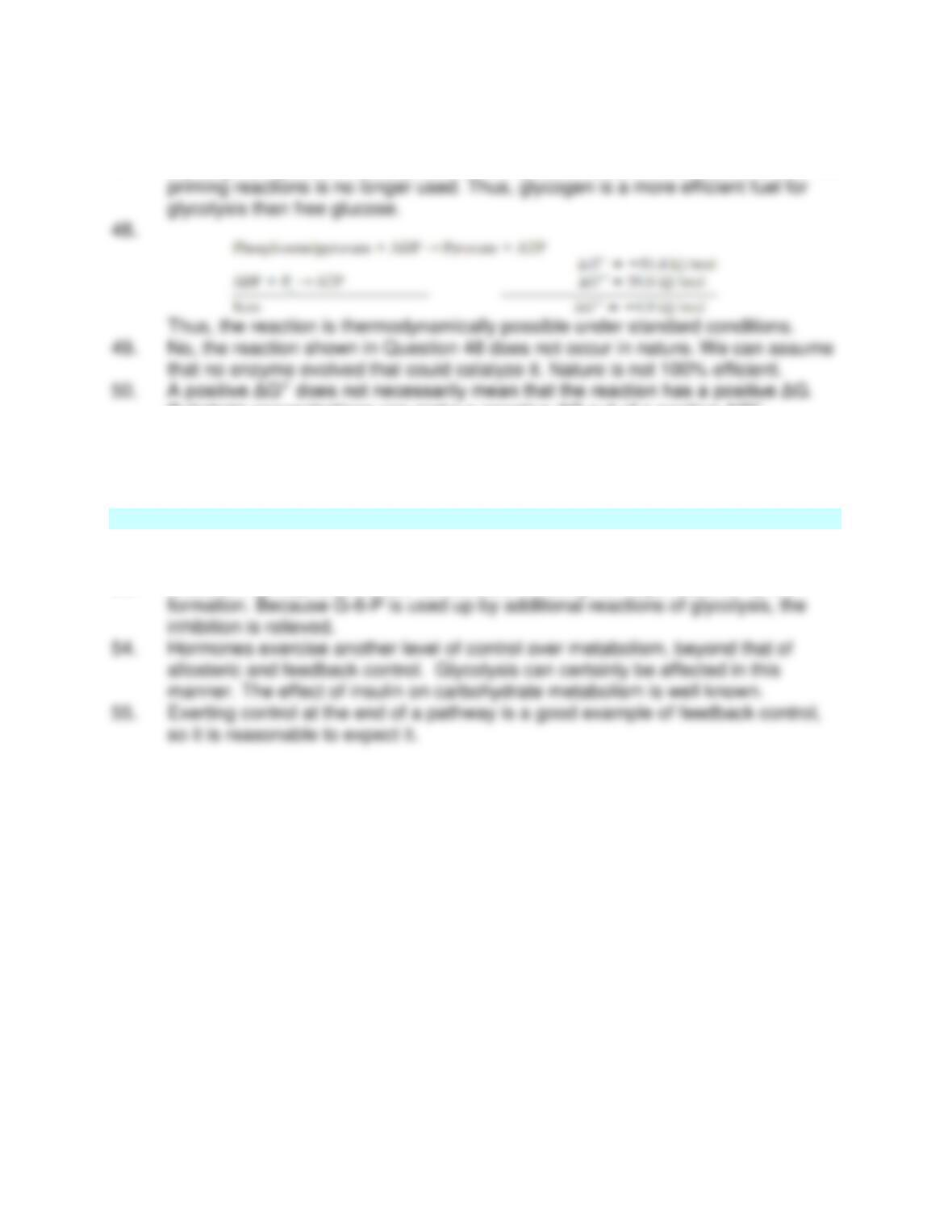
5. Isozymes
6. Inhibition by ATP
D. Cleavage
IV. Payoff phase
A. Oxidation
1. Phosphate addition
5. Glyceraldehyde-3-phosphate dehydrogenase mechanism
B. Phosphate transfer
1. Production of ATP
2. Phosphoglycerate kinase
3. Substrate-level phosphorylation
2. Transfer of phosphate from C-3 to C-2
D. Dehydration
1. Enolase
ANSWERS TO PROBLEMS
17.1 The Overall Pathway of Glycolysis
1. Reactions that require ATP: phosphorylation of glucose to give glucose-6-
phosphate and phosphorylation of fructose-6-phosphate to give fructose-1,6-
2. Reactions that require NADH: reduction of pyruvate to lactate and reduction of
acetaldehyde to ethanol. Reactions that require NAD+: oxidation of
4 Chapter 17
17.2 Conversion of six-carbon glucose to three-carbon glyceraldehydes-3-phosphate
4. Aldolase catalyzes the reverse aldol condensation of fructose-1,6-bisphosphate
to glyceraldehyde-3-phosphate and dihydroxyacetone phosphate.
5. Isozymes are oligomeric enzymes that have slightly different amino acid
6. Isozymes allow for subtle control of the enzyme to respond to different cellular
needs. For example, in the liver, lactate dehydrogenase is most often used to
convert lactate to pyruvate, but the reaction is often reversed in the muscle.
Having a different isozyme in the muscle and liver allows for those reactions to
be optimized.
7. Fructose-1,6-bisphosphate can only undergo the reactions of glycolysis. The
components of the pathway up to this point can have other metabolic fates.
8. Add the ΔG°’ mol–1 values for the reactions from glucose to glyceraldehyde-3-
10. Individuals who lack the gene that directs the synthesis of the M form of the
enzyme can carry on glycolysis in their livers but experience muscle weakness
because they lack the enzyme in muscle.
11. The hexokinase molecule changes shape drastically on binding to substrate,
17.3 Glyceraldehyde-3-phosphate is converted to pyruvate
13. From the point at which aldolase splits fructose-1,6-bisphosphate into
dihydroxyacetone phosphate and glyceraldehyde-3-phosphate; all reactions of
the pathway are doubled (only the path from one glyceraldehyde-3-phosphate is
Glycolysis 5
phosphofructokinase, and pyruvate kinase.
17. Hexokinase is inhibited by glucose-6-phosphate. Phosphofructokinase is
conserved, since many dehydrogenases use that coenzyme.
19.
(a) Using a high-energy phosphate to phosphorylate a substrate.
(b) Changing the form of a molecule without changing its empirical formula (i.e.,
20. An isomerase is a general term for an enzyme that changes the form of a
substrate without changing its empirical formula. A mutase is an enzyme that
22. Carbon-1 of glyceraldehyde is the aldehyde group. It changes oxidation state to a
carboxylic acid, which is phosphorylated simultaneously.
23. ATP is an inhibitor of several steps of glycolysis as well as other catabolic
pathways. The purpose of catabolic pathways is to produce energy, and high
levels of ATP mean the cell already has sufficient energy. Glucose-6-phosphate
inhibits hexokinase and is an example of product inhibition. If the glucose-6-
24. There would be 15 possible isozymes of LDH, combining three different subunits
into combinations of four. Besides the five isozymes containing only M and H,
there would also be C4, CH3, C2H2, C3H, CH2M, C2HM, C3M, CHM2, C2M2, and
CM3.
25. Glutamic acid has an acidic side chain with a pKa of 4.25. Therefore, it would be
6 Chapter 17
26. With few exceptions, a biochemical reaction typically results in only one
chemical modification of the substrate. Accordingly, several to many steps are
needed to reach the ultimate goal.
27. The enzyme contains a phosphate group on a suitable amino acid, such as
serine, threonine, and histidine. The substrate donates its phosphate group from
17.4 Structures and Functions of Polysaccharides
28. The bubbles in beer are CO2, produced by alcoholic fermentation. Tired and
aching muscles are caused in part by a buildup of lactic acid, a product of
30. The purpose of the step that produces lactic acid is to reduce pyruvate so that
NADH can be oxidized to NAD+, which is needed for the step catalyzed by
glyceraldehyde-3-phosphate dehydrogenase.
31.
Glycolysis 7
32. Thiamine pyrophosphate is a coenzyme in the transfer of two-carbon units. It is
required for catalysis by pyruvate decarboxylase in alcoholic fermentation.
33. The important part of TPP is the five-membered ring, in which a carbon is found
35. Animals that have been run to death have accumulated large amounts of lactic
acid in their muscle tissue, accounting for the sour taste of the meat.
36. Conversion of glucose to lactate rather than pyruvate recycles NADH.
37. This is possible, and it is done. These poisons also affect other tissues, including
skin, hair, cells of the intestinal lining, and especially the immune system and red
blood cells. People on chemotherapy are usually more susceptible to infectious
17.5 Energy Production in Glycolysis
40. The energy released by all the reactions of glycolysis is 184.5 kJ mol glucose–1.
The energy released by glycolysis drives the phosphorylation of two ADP to ATP
for each molecule of glucose, trapping 61.0 kJ mol glucose–1. The estimate of
44. The steps catalyzed by hexokinase, phosphofructokinase, and pyruvate kinase.
45.
8 Chapter 17
three substrates is used. The energetics of the conversion of hexoses to
pyruvate are the same, regardless of hexose type.
47. Starting with glucose-1-phosphate, the net yield is three ATP, because one of the
Substrate concentrations can make a negative ΔG out of a positive ΔG°’.
51. The entire pathway can be looked at as a large coupled reaction. Thus, if the
overall pathway has a negative ΔG, an individual step may be able to have a
positive ΔG, and the pathway can still continue.
17.6 Control of Glycolysis
52. The formation of fructose-1,6-bisphosphate is the committed step in the glycolytic
pathway. It is also one of the energy-requiring steps of the pathway.
53. Glucose-6-phosphate inhibits hexokinase, the enzyme responsible for its own