Chap. 17 Auger Piles: Axial Load Capacity Based on Static Analysis Methods
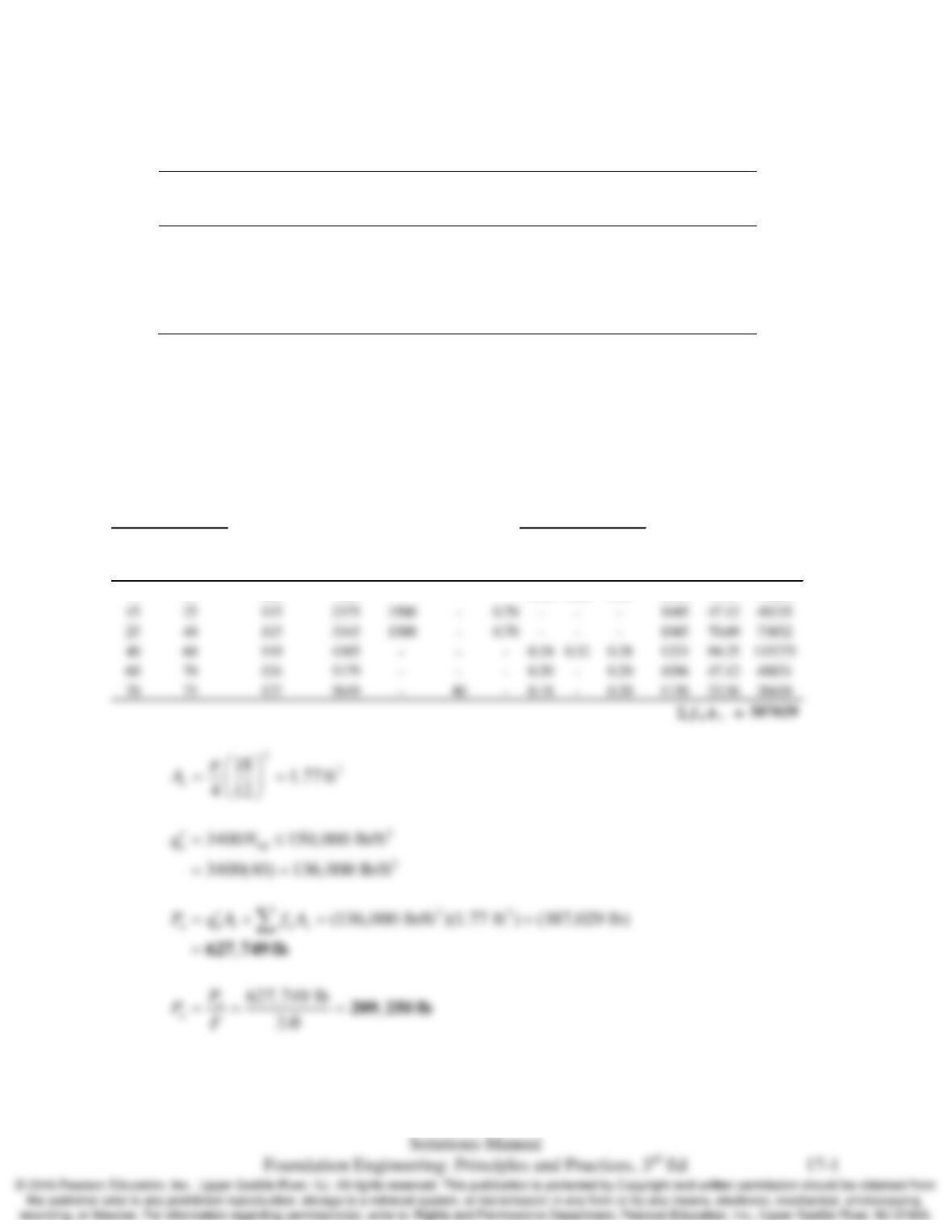
17.1 An 18 inch diameter, 75 ft long ACIP pile is to be constructed in the following soil profile:
Depth (ft) Soil Description
Unit
Weight
(lb/ft
3
)
Undrained
Shear Strength
(lb/ft
2
)
Effective
Friction
Angle (deg)
SPT
N60
0–15
Silty sand
120
28
15–40
Clayey silt
115
1500
40–60
Sandy silt
(nonplastic)
119 25
60–70
Well graded sand
124
32
70–90
Well graded sand
127
35
40
The groundwater table is at a depth of 25 ft. Using a factor of safety of 3.0, determine the ASD
allowable downward load capacity.
Solution
The clayey silt stratum may be treated as a cohesive soil, so use the method. The silty sand is a
cohesionless soil, so use β values halfway between Coleman and Arcement’s values for silt and
for sand.
Top Bottom
Unit Weight
(lb/ft
3
)
σ’
z
(lb/ft
2
)
s
u
(lb/ft
2
)
SPT N
60 α
Sand Silt Design
f
n
(lb/ft
2
)
A
s
(ft
2
)
f
n
A
s
(lb)
015 120 900
–– – 1.48 0.82 1.15 1036 70.69 73218
Depth Range (ft)
β
Chap. 17 Auger Piles: Axial Load Capacity Based on Static Analysis Methods
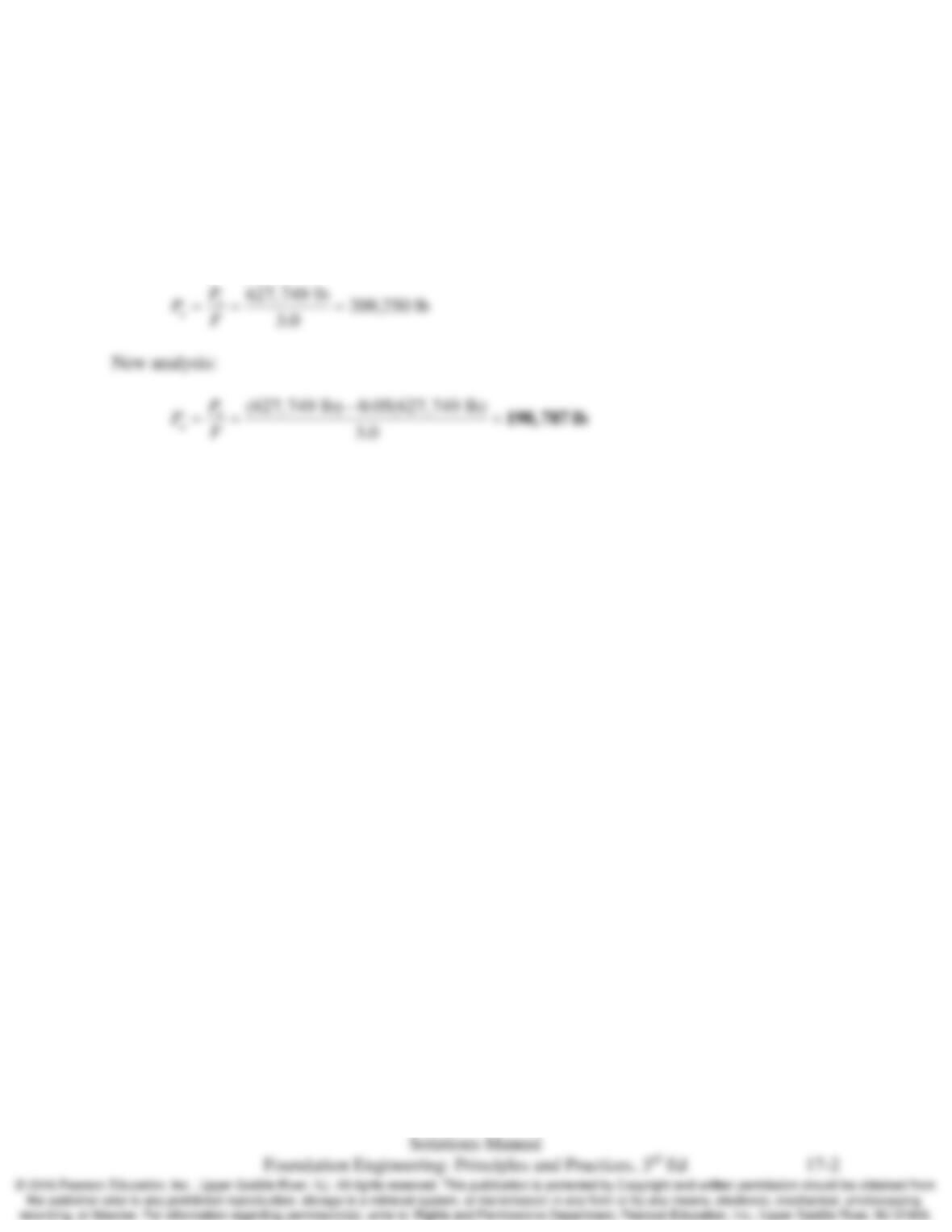
17.2 A static load test was conducted on the pile described in Problem 17.1. The test results produced
a nominal downward load capacity 5% less than the computed static capacity. Given this new
information, determine the revised ASD allowable downward load capacity.
Solution
From Problem 17.1:
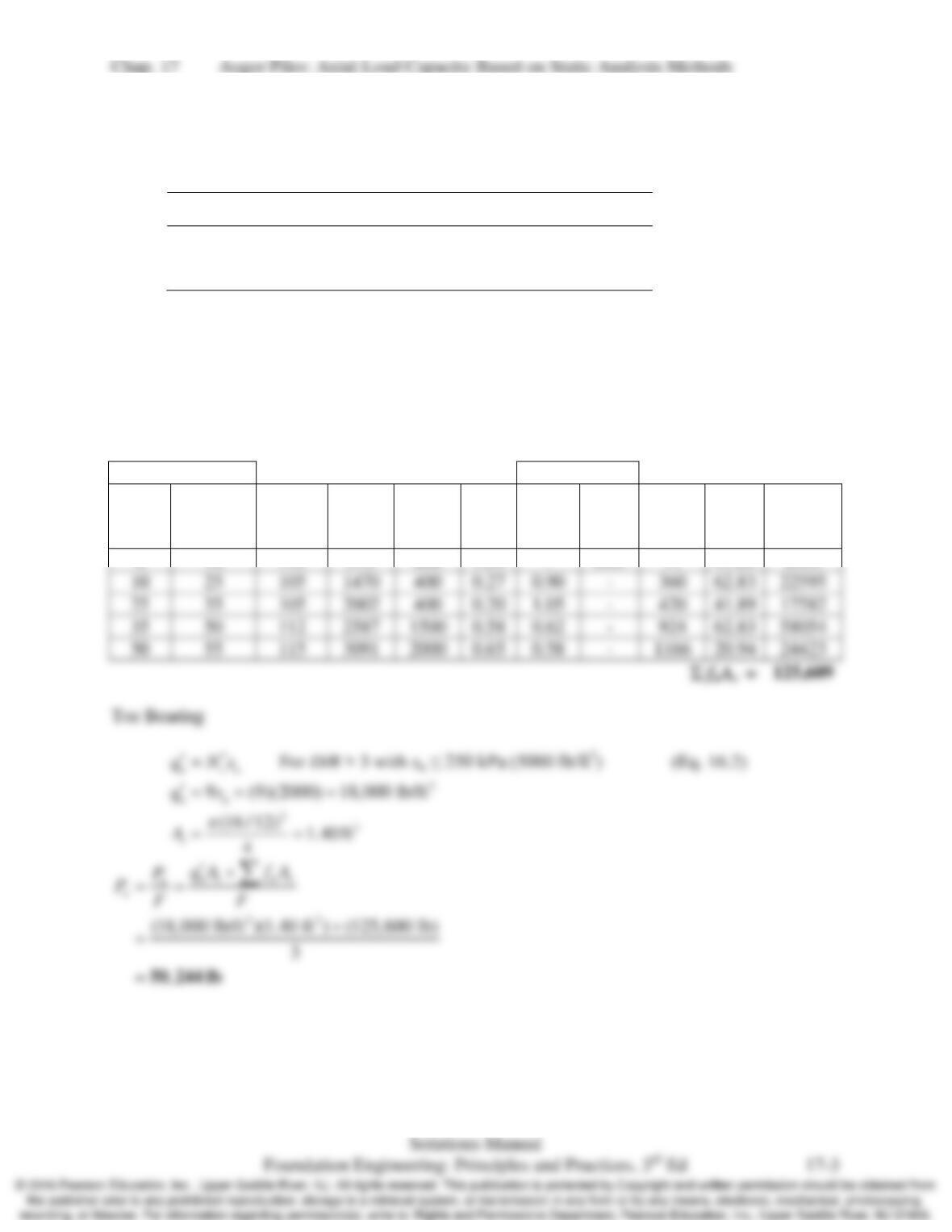
17.3 A 16 inch diameter, 55 ft long drilled displacement pile is to be constructed in the following soil
profile.
Depth (ft)
Soil Description
Unit Weight
(lb/ft
3
)
Undrained Shear
Strength (lb/ft
2
)
0–10
Sandy silt
115
800
10–35
Silty clay
105
400
35–50
Silty clay
112
1500
50–65
Clay
115
2000
The groundwater table is at a depth of 10 ft. Using a factor of safety of 3.0, determine the ASD
allowable downward load capacity.
Solution
Side Friction
Depth Range (ft)
α
Top Bottom
Unit
Weight
(lb/ft
3
)
σ’z
(lb/ft2) su
(lb/ft2) su/σ’z Eq.
15.15 Eq.
15.16 fn
(lb/ft2) As
(ft2) fn As
(lb)
0
10
115
575
800
1.39
–
0.09
71
41.89
2955
10
25
105
400
0.27
–
360
62.83
25
35
105
400
0.20
–
420
41.89
35
50
112
0.58
–
924
62.83
50
55
115
0.65
–
20.94
Chap. 17 Auger Piles: Axial Load Capacity Based on Static Analysis Methods
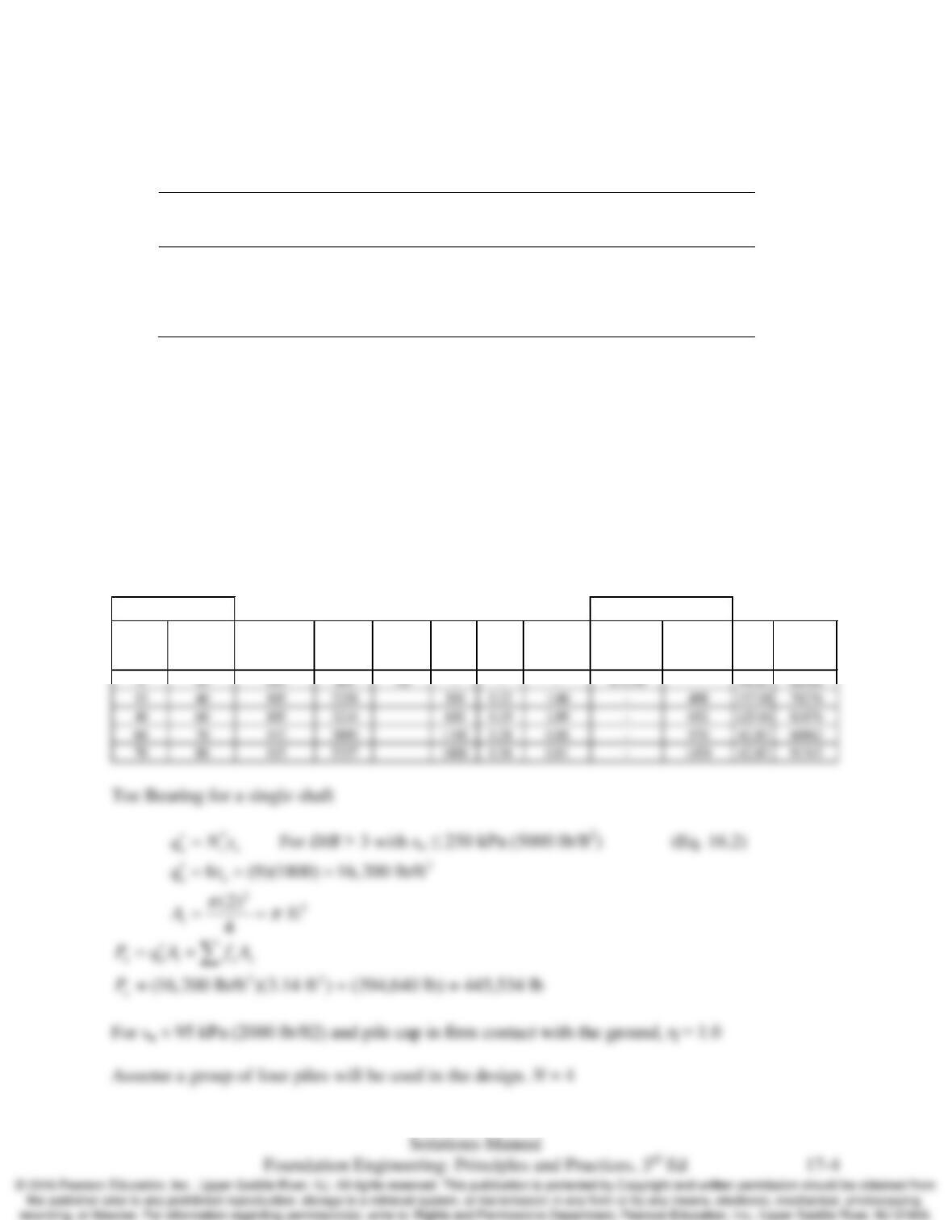
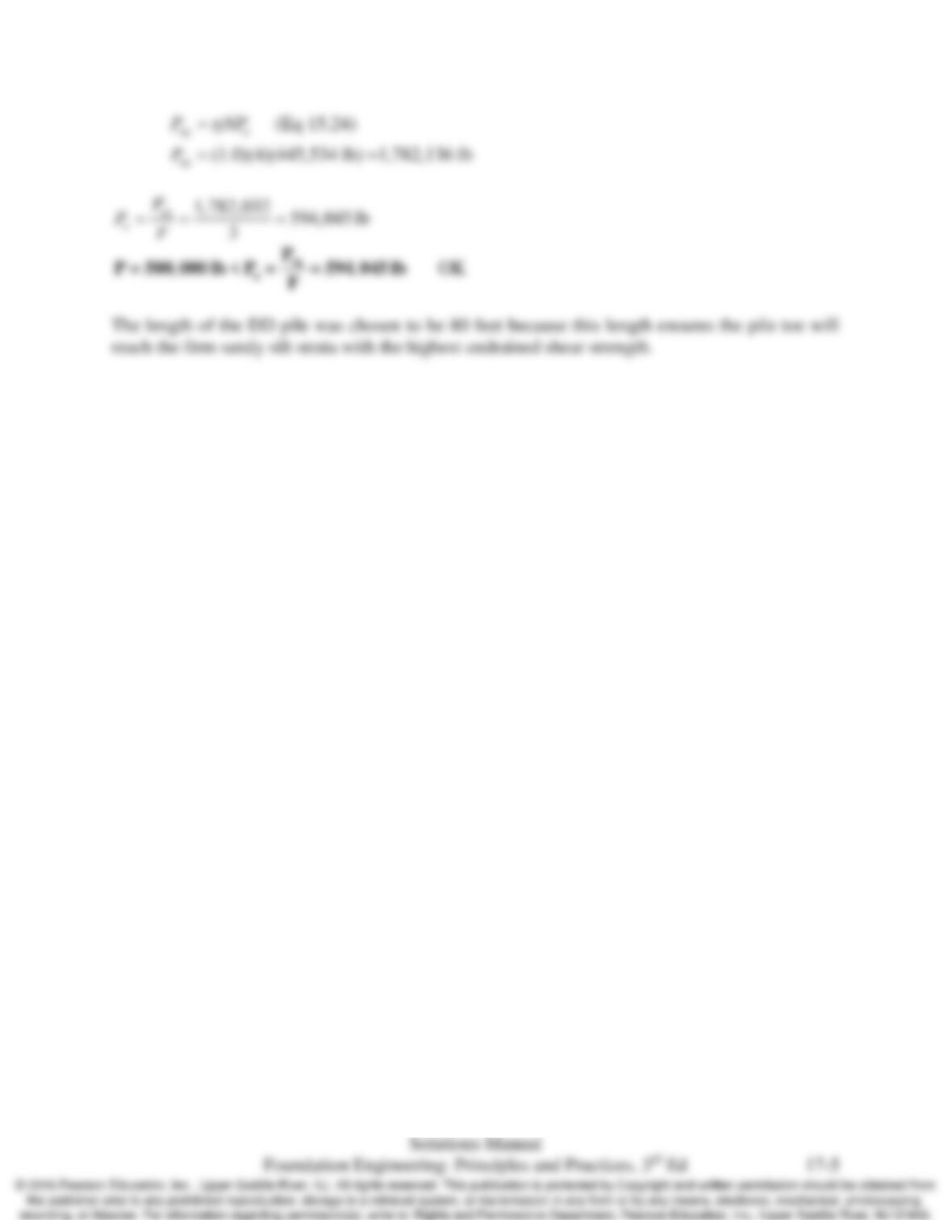
17.4 An ASD downward column load of 500 k is to be supported on a group of drilled displacement
piles constructed in the following soil profile:
Depth (ft)
Soil Description
Unit Weight
(lb/ft
3
)
Undrained Shear
Strength
(lb/ft
2
)
Effective
Friction Angle
(deg)
0–15
Silty sand
120
32
15–40
Clayey silt
112
500
40–60
Clay
110
600
60–70
Silty clay
112
1100
70–90
Sandy silt
114
1800
The groundwater table is at a depth of 15 ft.
Determine the required number of piles, their diameter, and their length. No static load tests
have been conducted. Note that there are many solutions to this problem, but select a design that
you feel is most appropriate.
Solution
Side Friction
Assume B = 2 feet
Top Bottom
Unit Weight
(lb/ft
3
)
σ’
z
(lb/ft
2
)
φ‘
s
u
(lb/ft
2
)
s
u
/ σ’
z
α
( Eq 15.15)
(Eq 15.11) (Eq 17.6)
A
s
(ft
2
)
f
n
A
s
(lb)
Range of Depth (ft)
f
n
(lb/ft
2
)
Chap. 17 Auger Piles: Axial Load Capacity Based on Static Analysis Methods
Chap. 17 Auger Piles: Axial Load Capacity Based on Static Analysis Methods
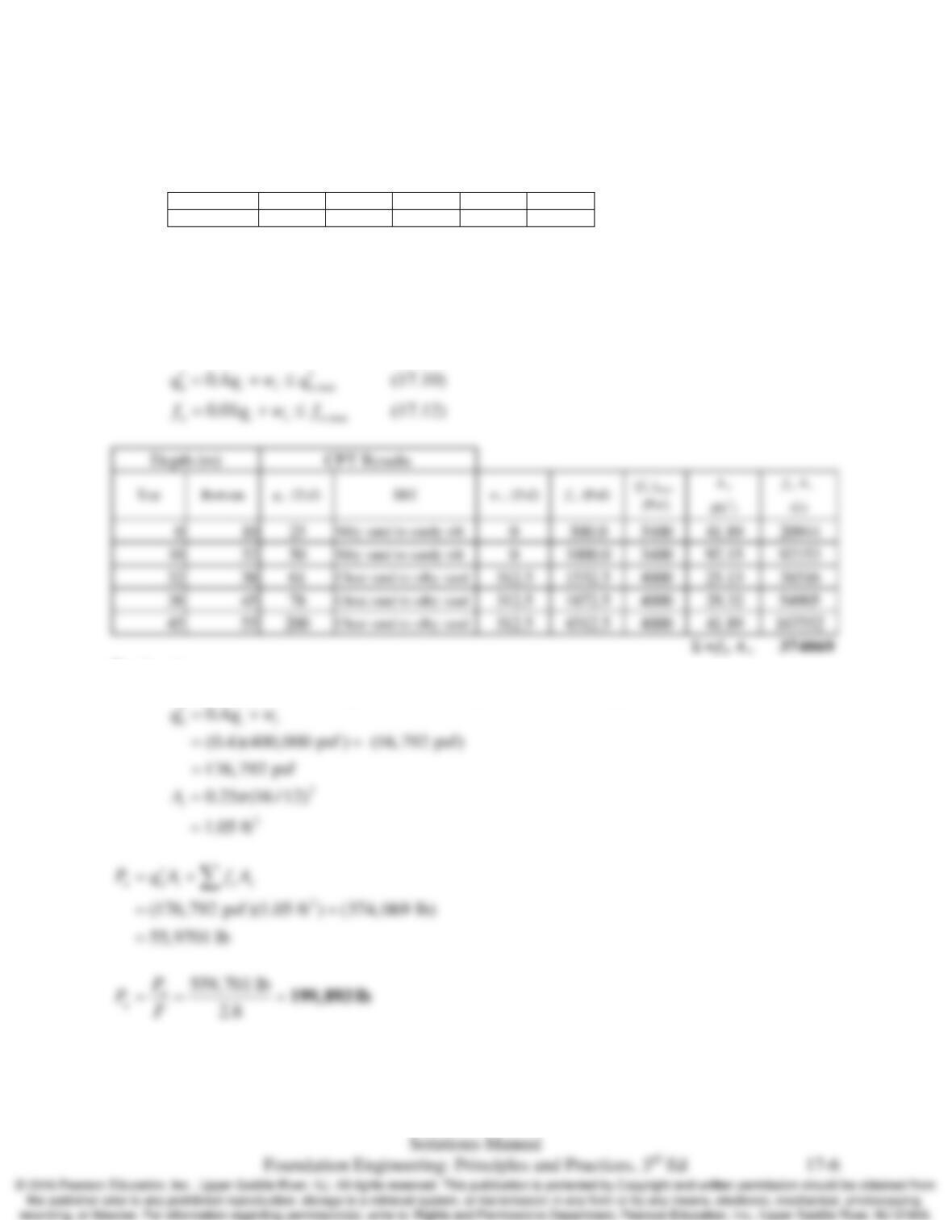
17.5 A 16 in diameter, 45 ft long drilled displacement pile is to be constructed in a silty sand with 30%
fines, a mix of angular and rounded particles, and the following CPT profile:
Depth (ft)
0–10
10–32
32–38
38–45
45–55
qc (tsf)
25
50
61
78
200
The groundwater table is at a depth of 20 ft. Using NeSmith’s method and a factor of safety of
2.8, compute the ASD nominal downward load capacity, Pa.
Solution
Use average qc in vicinity of toe and interpolate NeSmith’s parameters.
Toe bearing
Use average qc in vicinity of toe and interpolate NeSmith’s parameters.