16-1
CHAPTER 16
CONTRIBUTED CAPITAL
CONTENT ANALYSIS OF EXERCISES AND PROBLEMS
Number
Content
Time Range
(minutes)
E16-1
Common Stock Issuance. (Easy) Par-value, no-par (with and
without a stated value). Record sale.
5-10
E16-5
Stock Subscription. (Easy) Journal entries to record the
contract, down payment, receipt, default.
10-15
E16-6
Stock Split. (Easy) Three-for-one. Various changes in par value.
Journal entries.
10-15
E16-7
Compensatory Share Options. (Moderate) Fair value method.
5-10
E16-11
Convertible Preferred Stock. (Easy) Record issuance and
conversion.
10-15
E16-12
Callable Preferred Stock. (Easy) Journal entries to record
issuance and recall.
5-15

16-2
Number
Content
Time Range
(minutes)
E16-14
Various Journal Entries. (Moderate) No-par, stated-value
common, par-value preferred. Sale, stock split, subscription,
exchange.
10-20
E16-18
Treasury Stock. (Moderate) Cost, par-value methods.
Reacquisition, reissuance. Journal entries.
10-15
E16-19
Treasury Stock. (Moderate) No-par. Cost method. Issuance,
reacquisition, reissuance. Journal entries.
10-20
P16-1
Stock Issuances. (Moderate) No-par, no-stated value
common; convertible, callable preferred. Exchange,
combined common and preferred. Journal entries. Discussion
of reasons for values used.
40-55
P16-5
Stock Rights. (Moderate) Journal entries to record issuance,
sale, exercise, and expiration of warrants.
30-40
P16-6
Compensatory Share Options. (Moderate) Fair value method.
Fixed plan. Changes in estimates. Schedule. Journal entries.
Disclosure.
25-35
16-3
Number
Content
Time Range
(minutes)
P16-10
Comprehensive. (Challenging) Determination of legal capital,
average price of preferred stock issued, number of common
shares issued. Journal entries for subscription, dividends,
exchange, sale, treasury stock. Contributed capital portion of
balance sheet.
35-50
P16-14
Journal Entries. (Challenging) Reconstruction. Subscription,
stock issuance, dividends, net income.
45-75
ANSWERS TO QUESTIONS
Q16-1 A corporation’s articles of incorporation usually include the names and addresses of
the incorporators, the name and address of the corporation, the reason for its
Q16-2 (a) A public corporation is one owned or operated by a governmental unit. A
private corporation is privately owned and may be a nonstock company organized
Q16-3 (a) A stock certificate is a serially numbered document evidencing ownership in a
corporation and stating the number of shares owned and the par value (if any) per
share. (b) A stockholders’ ledger is a ledger containing the names and addresses of
Q16-4 The various rights of a stockholder are: (a) to elect directors and to establish
corporate issues, (b) to share in profits when a dividend is declared, (c) to maintain
Q16-5 (a) Authorized capital stock is the maximum number of shares of stock a corporation
may issue as established in the corporate charter.
(b) Issued capital stock is the number of shares of capital stock legally issued by a
Q16-6 A corporation’s legal capital is the amount of stockholders’ equity that it cannot
Q16-7 A corporation’s legal capital is determined according to the laws of each state.
However, the par value or stated value of stock issued and subscribed or the entire
proceeds of no-par stock issued and subscribed is usually the corporate legal capital.
Q16-8 The three components of stockholders’ equity are contributed capital, unrealized
capital (if any), retained earnings, and accumulated other comprehensive income
(if any). The basic framework is as follows:
Stockholders’ Equity
Contributed capital
Q16-9 Preferred stock differs from common stock in that preferred dividends are stated as a
per share amount or percentage of par, and certain rights or preferences are
Q16-10 The entire amount of the proceeds received from the issuance of no-par, no-stated
value stock is recorded in the Capital Stock account. No additional paid-in capital
arises from the issuance of true no-par stock.
Q16-11 A stock subscription is a legally binding agreement between the corporation and the
investor (subscriber) for a future purchase of the corporation=s stock on an
installment basis. A corporation may report the account Subscriptions Receivable as
Q16-12 If a subscriber defaults on a stock subscription, a corporation can (a) return to the
subscriber the entire amount paid in; (b) return to the subscriber the amount paid in,
Q16-13 The proceeds should be allocated to the common stock and the preferred stock on
the basis of the relative fair values of the separate securities. In the case where the
Q16-14 The amount to be recorded should be either the fair value of the stock issued or the
asset received, whichever is more reliable.
Q16-15 (a) Watered stock results when the stockholders’ equity and asset sections of a
corporation’s balance sheet are inflated due to the use of an unrealistically high
16-6
Q16-16 A stock split increases the number of shares issued and proportionally decreases the
par or stated value of the capital stock. A disproportionate stock split occurs when
Q16-17 (a) The criteria for a noncompensatory share option plan include the following:
(1) Substantially all employees qualify for participation in the plan on an
equitable basis.
(b) A compensatory share option plan differs from a noncompensatory plan in that it
does not possess all of the three criteria listed in (a).
(c) The intent of a noncompensatory plan is to raise capital or to obtain more
Q16-18 Under the fair value method, the total compensation cost for a compensatory share
Q16-19 Share appreciation rights (SAR’s) are rights granted to key employees that enable
them to receive cash, stock, or a combination of both equal to the excess of the
Q16-20 a. A dividend preference is the right to a dividend of a predetermined amount
before dividends are paid to common stockholders.
e. Warrants represent rights (that might be attached to preferred stock) that allow
the holder to purchase additional shares of common stock at a specified price
over some future period.
Q16-21 A preferred stock is similar to a long-term bond because the preferred dividend
payments are often fixed as a percentage of the face (par) value, similar to interest
on bonds. Dividend payments may also be cumulative, which is a type of
“guarantee” like that given in regard to interest payments. A preferred stockholder
Q16-22 The two segments of a corporation’s contributed capital are capital stock and
additional paid-in capital. The capital stock segment might include the par value of

16-8
Q16-23 (a) Treasury stock is a corporation’s own stock that has been legally issued, has been
reacquired by the corporation, and is being held by the corporation for future
Q16-24 Under the cost method, the treasury stock “event” is viewed as consisting of the
reacquisition part and the reissuance part, neither of which is totally separable from
the other. This leads to recording and carrying the Treasury Stock account at the
Q16-25 Under the cost method, a corporation reports the Treasury Stock account as a
deduction from the total of contributed capital, retained earnings, and
Q16-26 When a corporation using the cost method retires treasury stock, the Capital Stock
account is reduced and the Additional Paid-in Capital account related to the
Q16-27 Under IFRS, when a company revalues its property, plant, and equipment upward, it
credits a revaluation surplus, or reserve account. This revaluation surplus account is
ANSWERS TO MULTIPLE CHOICE
SOLUTIONS TO REVIEW EXERCISES
RE16-1
RE16-2
Cash ($5 x 2,000) 10,000
RE16-3
Cash 16,000
Common Stock, $5 par (800 shares) 4,000
Additional Paid-in Capital on Common Stock 4,533
RE16-4
Patent ($37 x 500) 18,500
16-10
RE16-5
Common Stock, $12 par (10,000 x $12) 120,000
RE16-6
RE16-7
RE16-8
Year 1 compensation expense = ($15 x 1,000) x 1/3 = $5,000
RE16-9
Preferred Stock, $50 par 15,000
RE16-10
Cash ($200 x 1,200) 240,000
RE16-11
Preferred Stock, $150 par 225,000
RE16-12
Treasury Stock 24,000
SOLUTIONS TO EXERCISES
E16-1
1. Cash (6,000 x $19) 114,000
2. Cash 114,000
E16-2
1. Cash 39,000
Common Stock, $10 par (1,000 x $10) 10,000
Additional Paid-in Capital on Common
Aggregate fair value:
16-13
E16-2 (continued)
2. (continued)
Allocation:
E16-3
1. Cash 23,000
Premium on Bonds Payable ($10,400 – $10,000) 400
Bonds Payable 10,000
2. Cash 23,000
Discount on Bonds Payable ($10,000 – $9,200) 800
Bonds Payable 10,000
Common Stock, $10 par 6,000
E16-4
1.
a. Land ($120 x 500) 60,000
Preferred Stock, $100 par 50,000
2. The preferred stock price was used as the value in journal entry 1(c) because it
E16-5
1. Cash [($16 x 5,000) x 0.25] 20,000
2. Cash [($16 x 0.75) x 4,000] 48,000
3. Cash ($17 x 1,000) 17,000
Common Stock, $10 par 10,000
E16-6
1. Memorandum entry: The company declared a three for one stock split,
reducing the par value from $12 to $4 per share. The number of shares issued
has increased proportionately from 9,000 to 27,000 shares.
E16-7
2010
Jan. 1 Memorandum entry: On January 1, 2010, the company granted
2010, 2011, and 2012
E16-8
1. 2010 2011 2012
Estimated (actual) total
compensation cost $123,863a $120,033b $120,400c
2. 2010
Jan. 1 Memorandum entry: On January 1, 2010, the company granted
compensatory share options to 30 executives. The plan allows
each executive to exercise 200 options to acquire the same
number of shares of $2 par common stock at an exercise price of
16-17
E16-9
1. 2010 2011 2012
Estimated (actual) total
compensation cost $ 50,448a $ 50,448 $ 69,412b
2. 2010
Dec. 31 Compensation Expense 16,816
Common Stock Option Warrants 16,816
E16-10
1. SAR Annual Compensation Expense
Date
Fair
Value
per
SAR
Percent
Accruedb
Total
Compen-
sation
Expense
to Datec
Accrued
Compen-
sation
Expense
to Dated
Yearly
Compen-
sation
Expensee
12/31/09
$3.00
33a%
$ 4,000
—
$ 4,000
Estimated
Total
Compensation
Costa
$12,000
2. 2012
Dec. 31 Compensation Expense 4,000
16-18
E16-11
1. Cash ($117 x 900) 105,300
2. a. Preferred Stock, $100 par 90,000
Additional Paid-in Capital on Preferred Stock 15,300
Common Stock, $10 par (7 x 900 x $10) 63,000
E16-12
1. Cash 125,000
2. a. Preferred Stock, $100 par 100,000
Additional Paid-in Capital on
Preferred Stock 25,000
E16-13
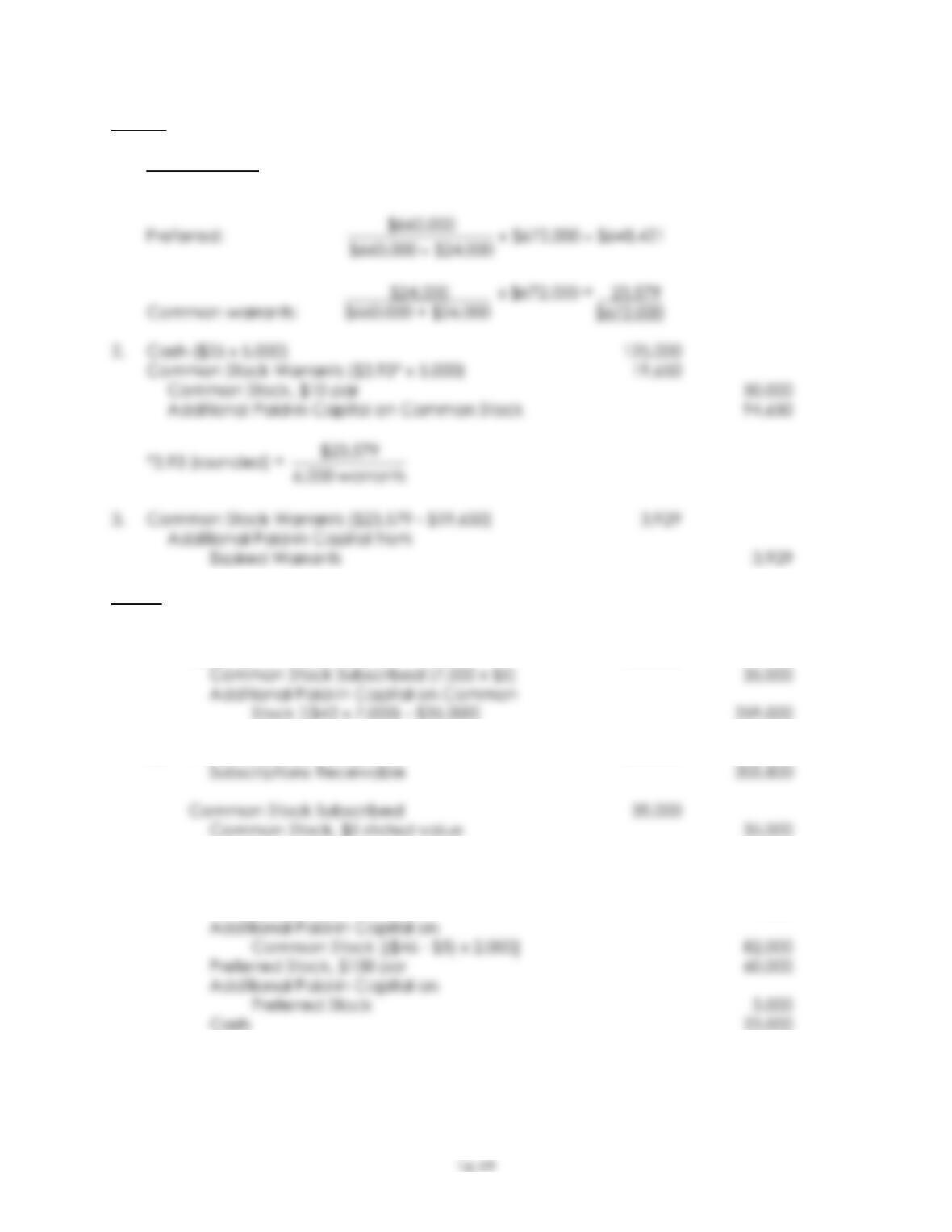
1. Cash ($112 x 6,000) 672,000
Preferred Stock, $100 par 600,000
E16-13 (con tinu ed)
Computations
E16-14
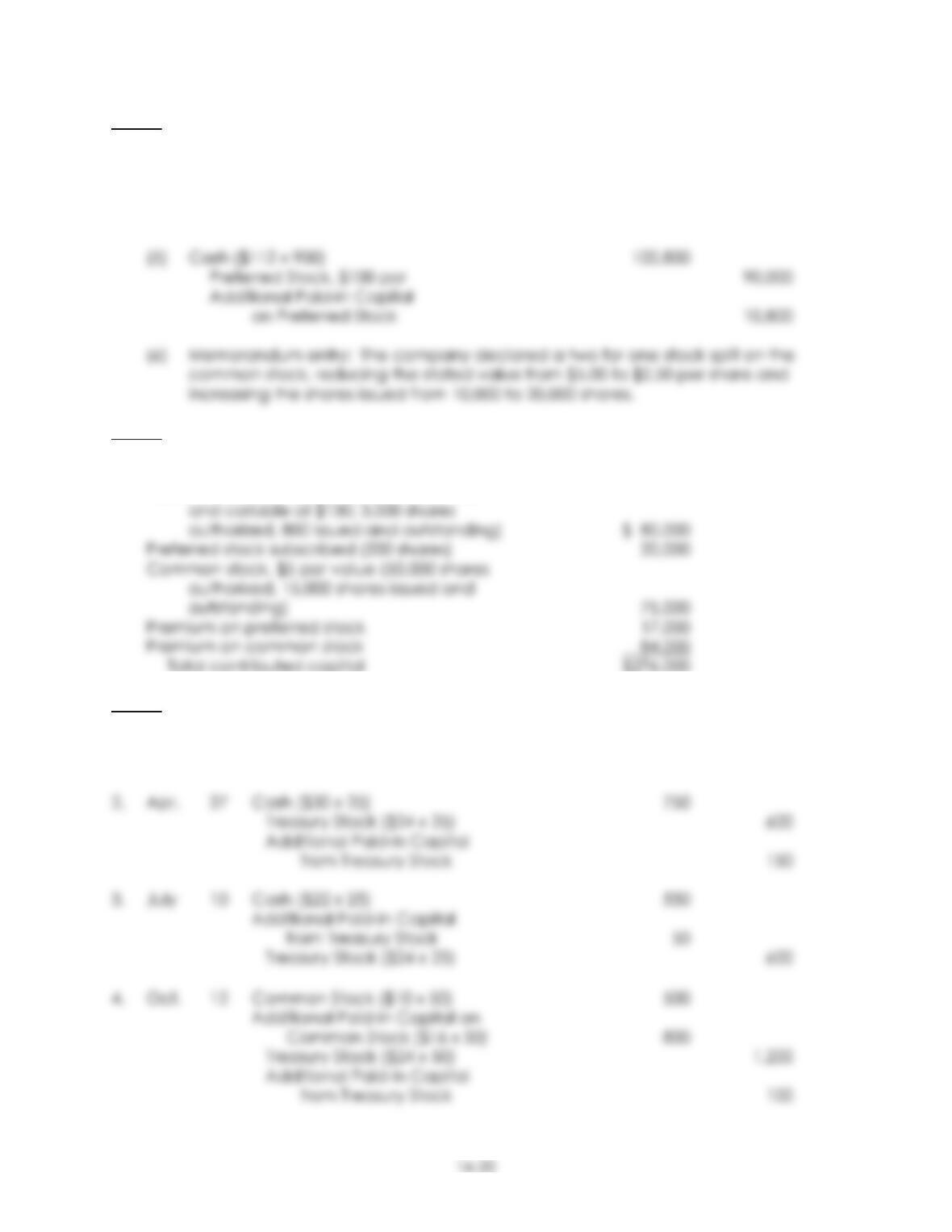
(1) Cash (0.30 x 7,000 x $42) 88,200
Subscriptions Receivable 205,800
(2) Cash 205,800
(3) Building 180,000
Common Stock, $5 stated value
(2,000 x $5) 10,000
E16-14 (continued)
(4) Cash 45,000
Common Stock, $5 stated value 5,000
Additional Paid-in Capital on
Common Stock 40,000
E16-15
Contributed Capital
Preferred stock, $100 par (8%, cumulative,
E16-16
1. Mar. 3 Treasury Stock ($24 x 100) 2,400
Cash 2,400