PROBLEM 16-1 (Continued)
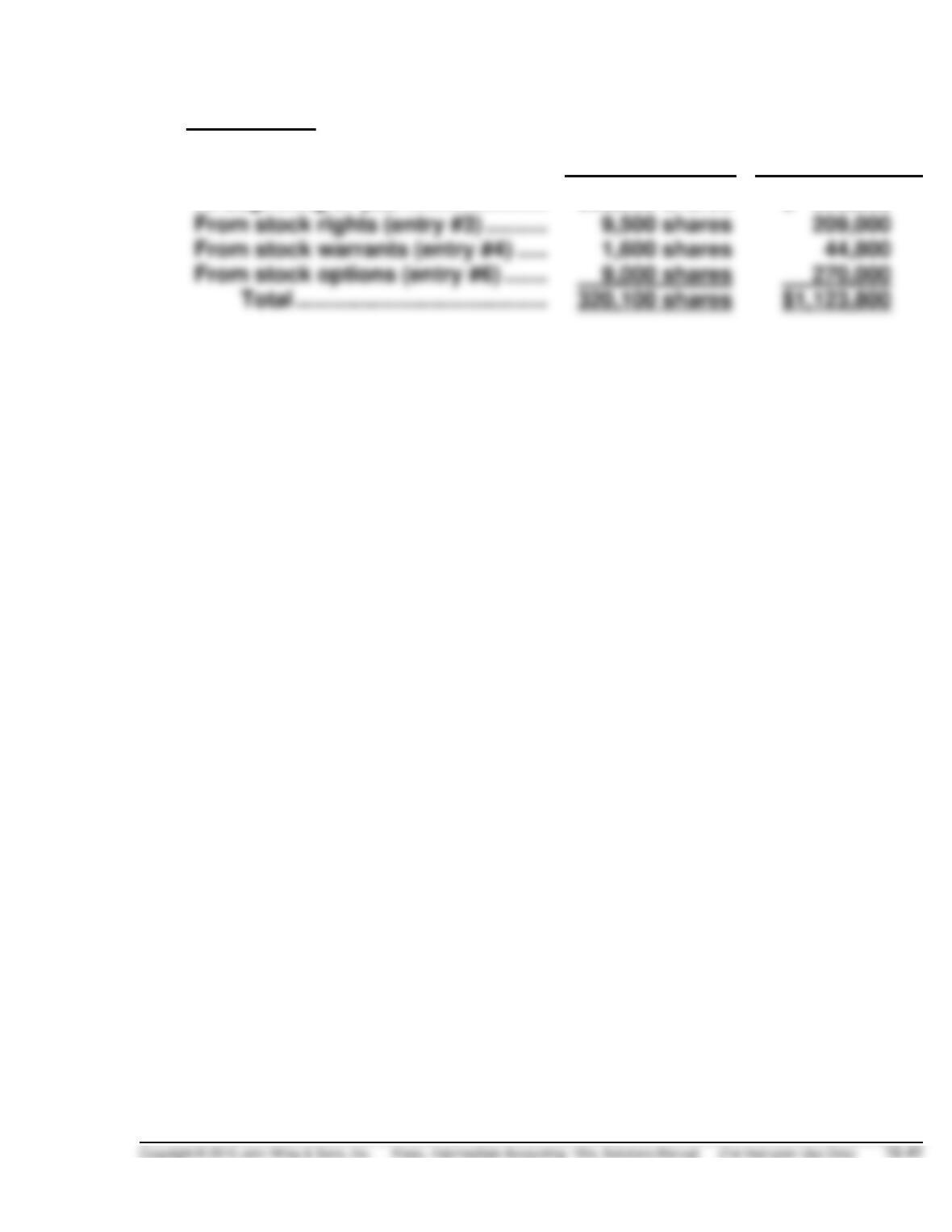
Calculations:
Common Stock
Paid-in Capital
in Excess of Par
At beginning of year …………………..
300,000 shares
$ 600,000
From stock rights (entry #3) ……….
From stock warrants (entry #4) …..
Total …………………………………..
320,100 shares
$1,123,800
PROBLEM 16-2
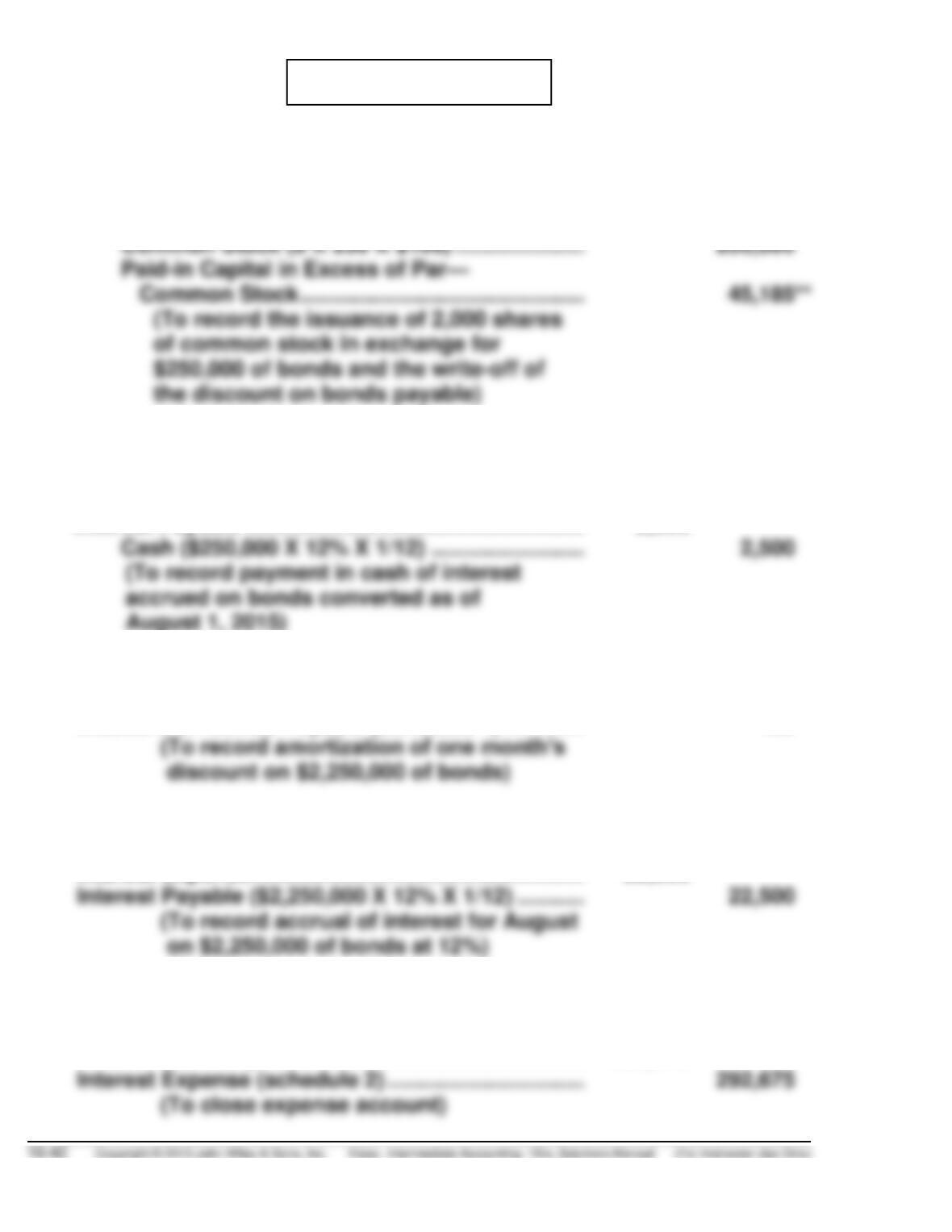
(a) Entries at August 1, 2015
Bonds Payable ………………………………………………… 250,000
Discount on Bonds Payable (Schedule 1) …… 4,815*
*($54,000 X 1/10) X (107/120)
**($250,000 – $4,815) – $200,000
Interest Payable ………………………………………………. 2,500
(b) Entries at August 31, 2015
Interest Expense ……………………………………………… 405*
Discount on Bonds Payable (Schedule 1) …………. 405
*($54,000 X 90%) X (1/120)
Interest Expense ……………………………………………… 22,500
(c) Entries at December 31, 2015
(Same as August 31, 2015, and the following closing entry)
Income Summary…………………………………………….. 292,675
PROBLEM 16-2 (Continued)
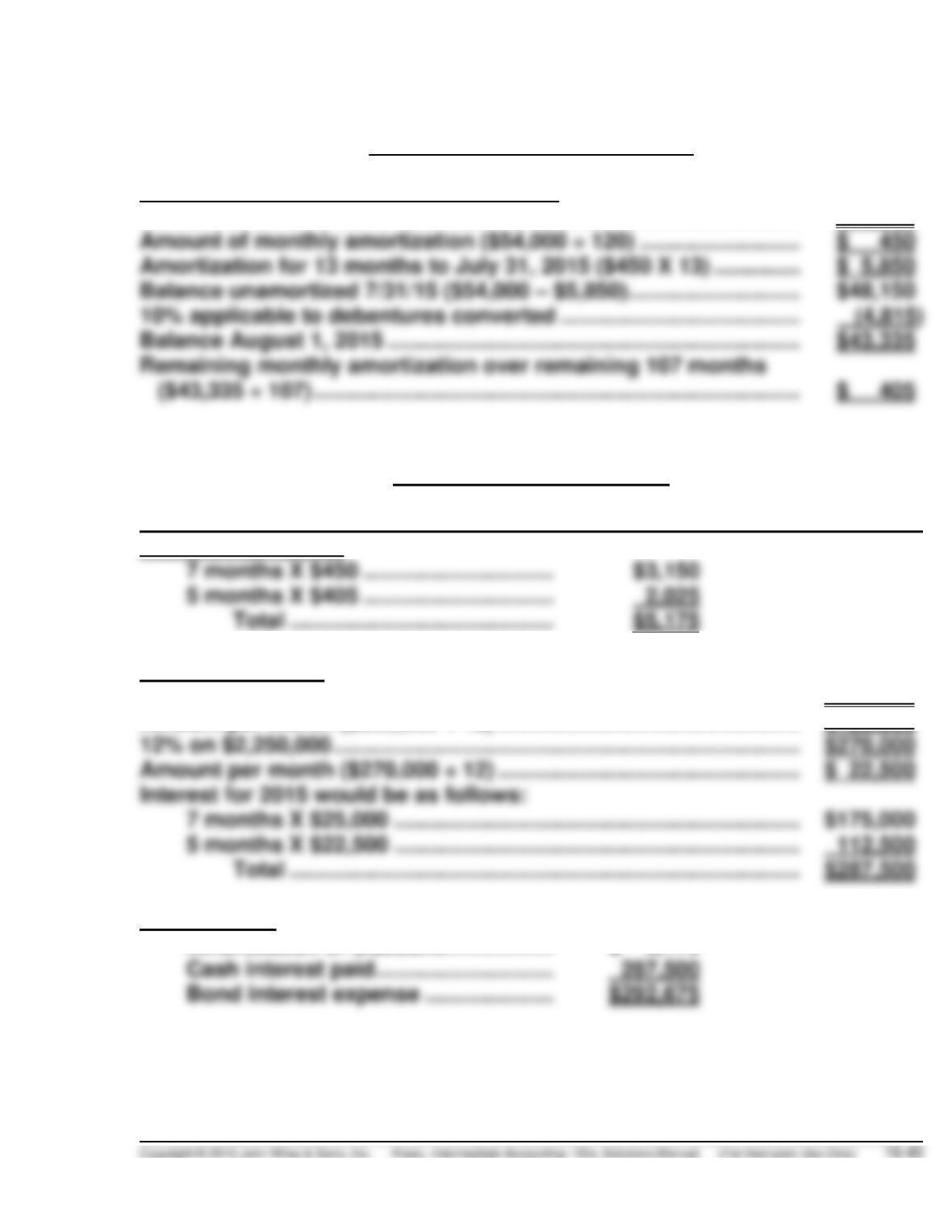
Schedule 1
Monthly Amortization Schedule
Unamortized discount on bonds payable:
Amount to be amortized over 120 months ………………………………. $54,000
Schedule 2
Interest Expense Schedule
Amortization of bond discount charged to bond interest expense in 2015
would be as follows:
Interest on Bonds:
12% on $2,500,000 …………………………………………………………………. $300,000
Amount per month ($300,000 ÷ 12) …………………………………………. $ 25,000
Total interest
Amortization of discount ……………… $ 5,175
PROBLEM 16-3
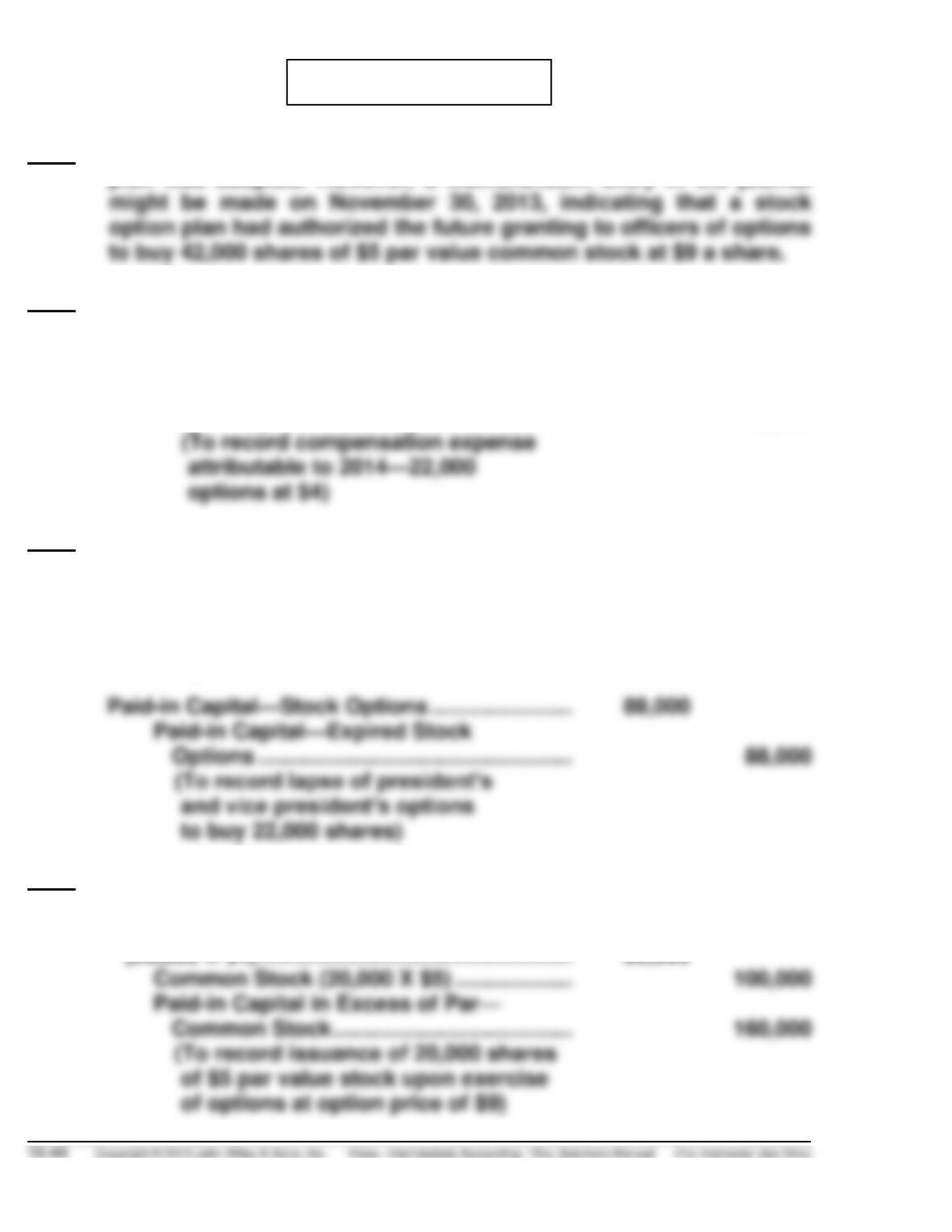
2013 No journal entry would be recorded at the time the stock option
plan was adopted. However, a memorandum entry in the journal
2014 January 2
No entry
December 31
Compensation Expense …………………………….. 88,000
Paid-in Capital—Stock Options …………… 88,000
2015 December 31
Compensation Expense …………………………….. 80,000
Paid-in Capital—Stock Options …………… 80,000
(To record compensation expense
attributable to 2015—20,000
options at $4)
2016 December 31
Cash (20,000 X $9) …………………………………….. 180,000
Paid-in Capital—Stock Options
(20,000 X $4) …………………………………………… 80,000
PROBLEM 16-4
(a) 1/1/14 No entry
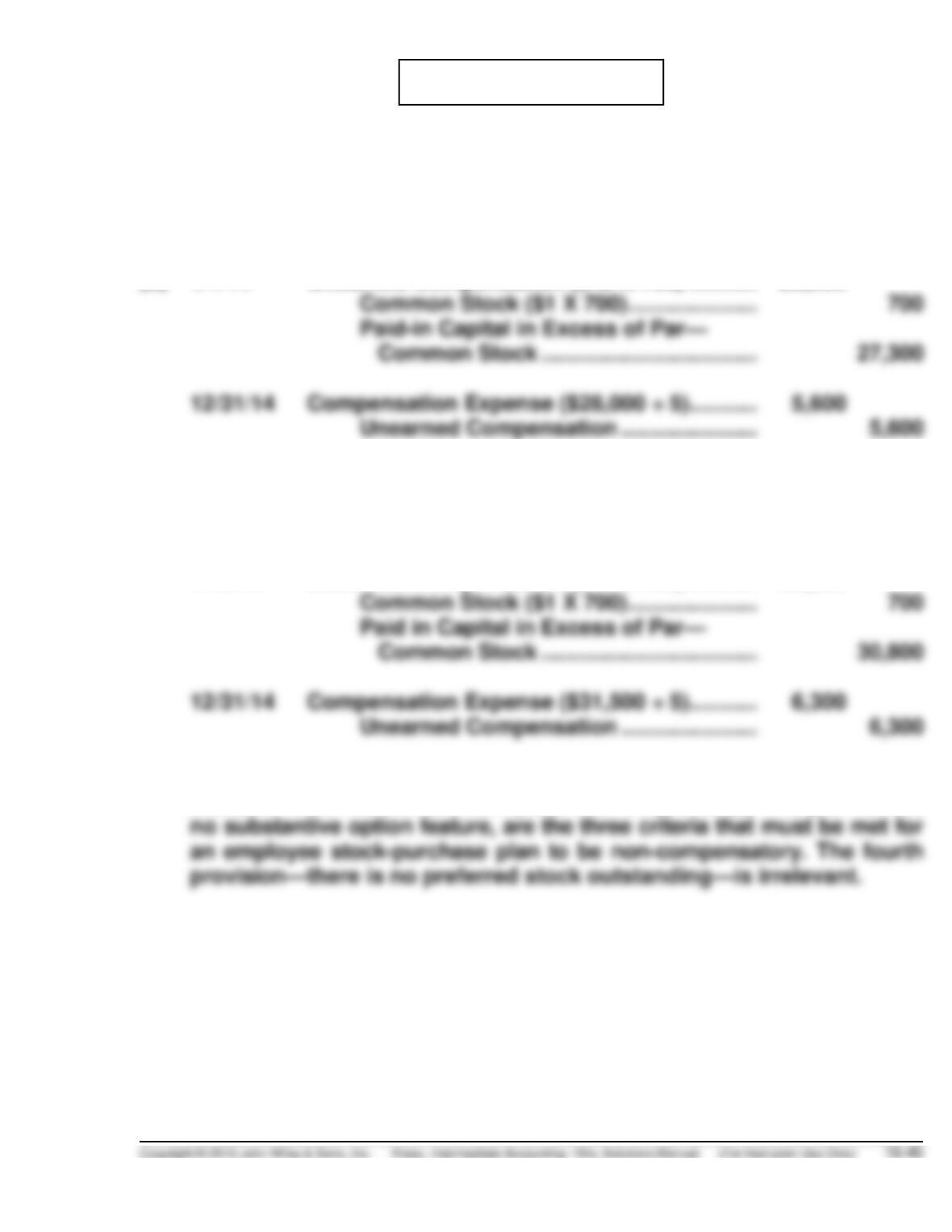
12/31/14 Compensation Expense ($6 X 5,000 ÷ 5) …… 6,000
Paid-in Capital—Stock Options ………… 6,000
(b) 1/1/14 Unearned Compensation ($40 X 700) ……….. 28,000
(c) No change for part (a), unless the fair value of the options change.
For part (b):
1/10/14 Unearned Compensation ($45 X 700) ……….. 31,500
(d) Numbers (1) substantially all employees may participate; (2) The
discount from market is small (less than 5%); and (3) The plan offers
PROBLEM 16-5
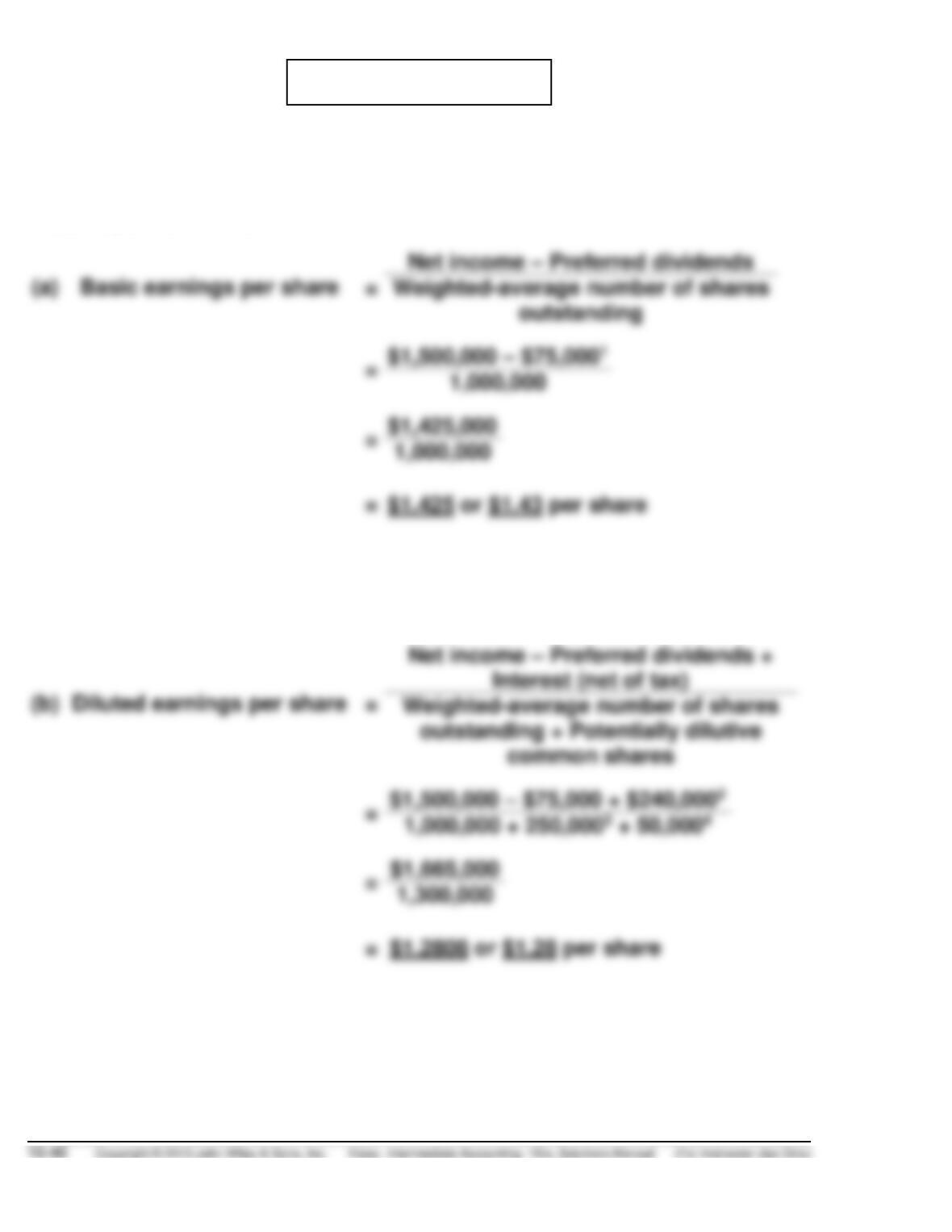
The computation of Fitzgerald Pharmaceutical Industries’ basic earnings
per share and the diluted earnings per share for the fiscal year ended June
30, 2014, are shown below.
1Preferred dividend = .06 X $1,250,000
= $75,000
2Use “if converted” method for 8% bonds
Adjustment for interest expense (net of tax)
($5,000,000 X .08 X .6) ……………………………………… $240,000
PROBLEM 16-5 (Continued)
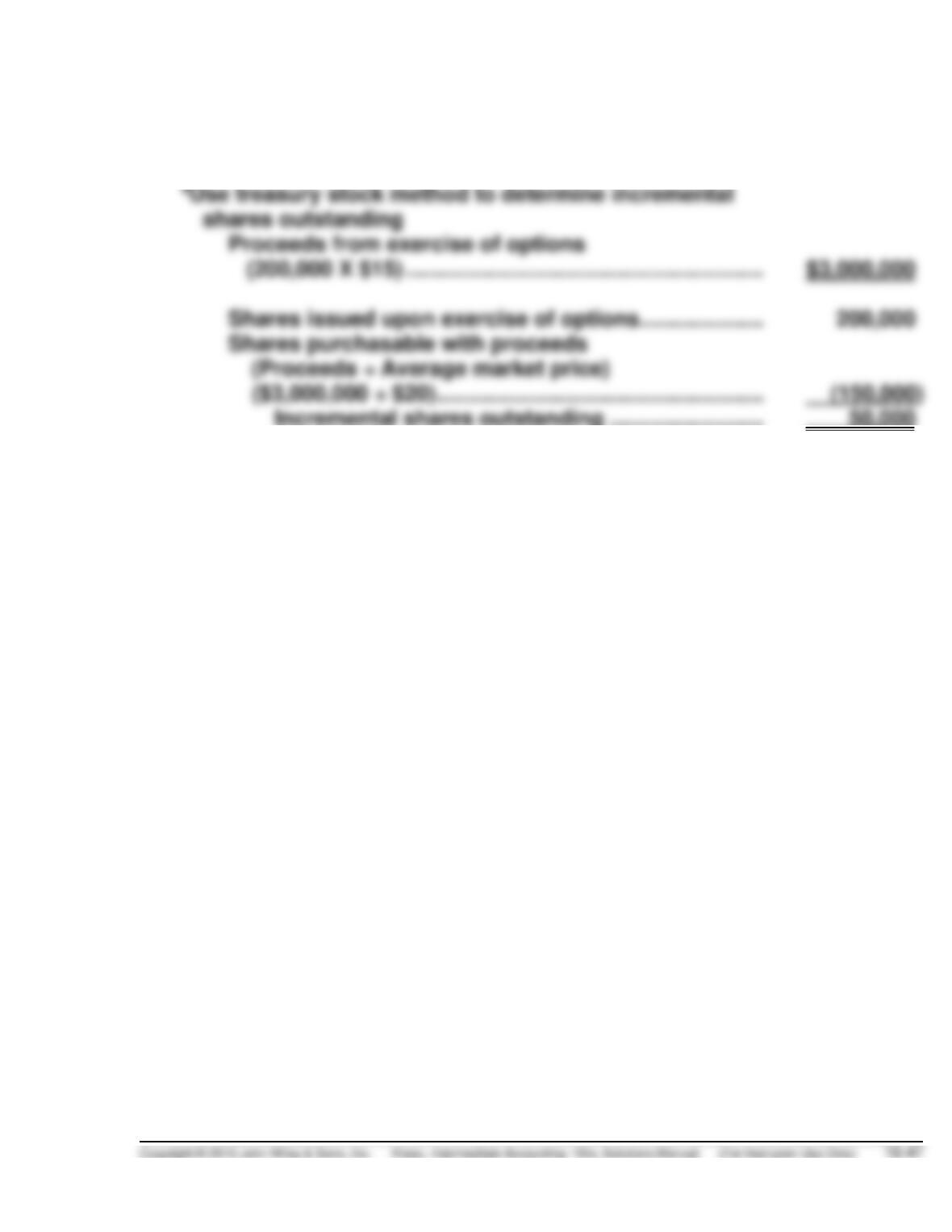
3Shares assumed to be issued if converted
$5,000,000 ÷ $1,000/bond X 50 shares …………………… 250,000
PROBLEM 16-6
(a) Melton Corporation has a simple capital structure since it does not
(b) The weighted-average number of shares outstanding that Melton
Corporation would use in calculating earnings per share for the fiscal
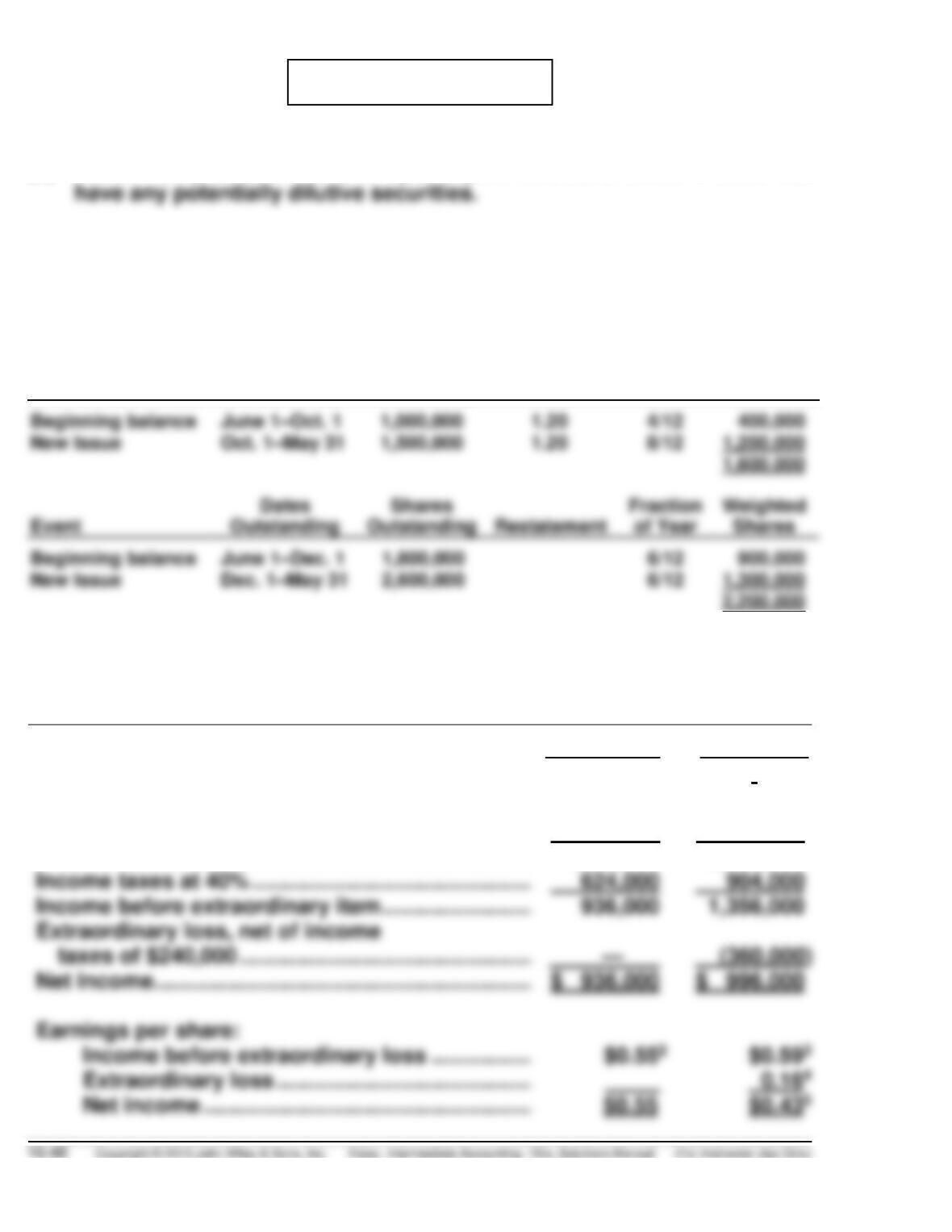
years ended May 31, 2014, and May 31, 2015, is 1,600,000 and 2,200,000
respectively, calculated as follows:
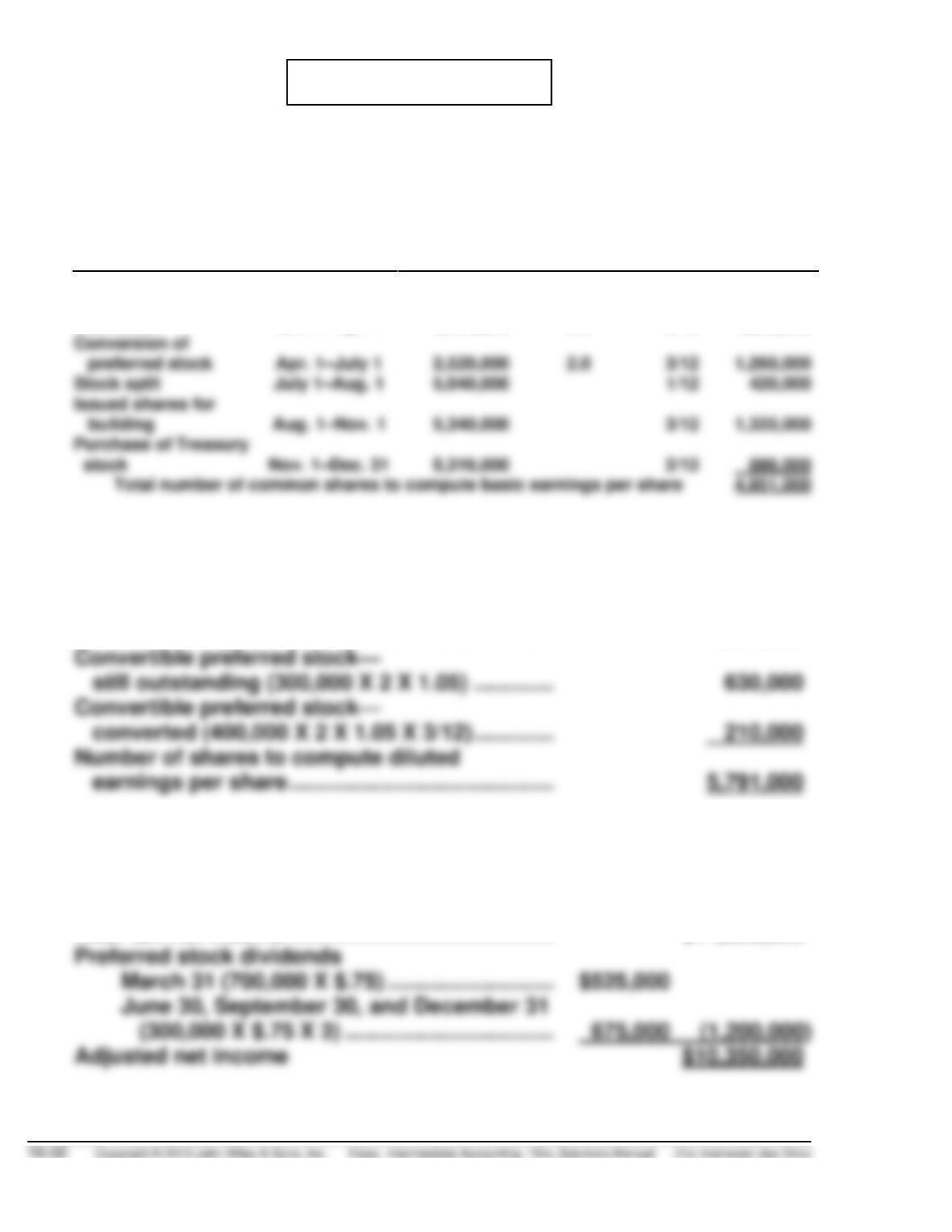
Event
Dates
Outstanding
Shares
Outstanding
Restatement
Fraction
of Year
Weighted
Shares
(c) MELTON CORPORATION
Comparative Income Statement
For Fiscal Years Ended May 31, 2014 and 2015
2014
2015
Income from operations ……………………………………
$1,800,000
$2,500,000
Interest expense1 ……………………………………………..
240,000
240,000
Income before taxes …………………………………………
1,560,000
2,260,000
Income before extraordinary item ………………………
1,356,000
Extraordinary loss, net of income
Net income ……………………………………………………….
$ 936,000
$ 996,000
Income before extraordinary loss ……………….
PROBLEM 16-6 (Continued)
1Interest expense = $2,400,000 X .10
= $240,000
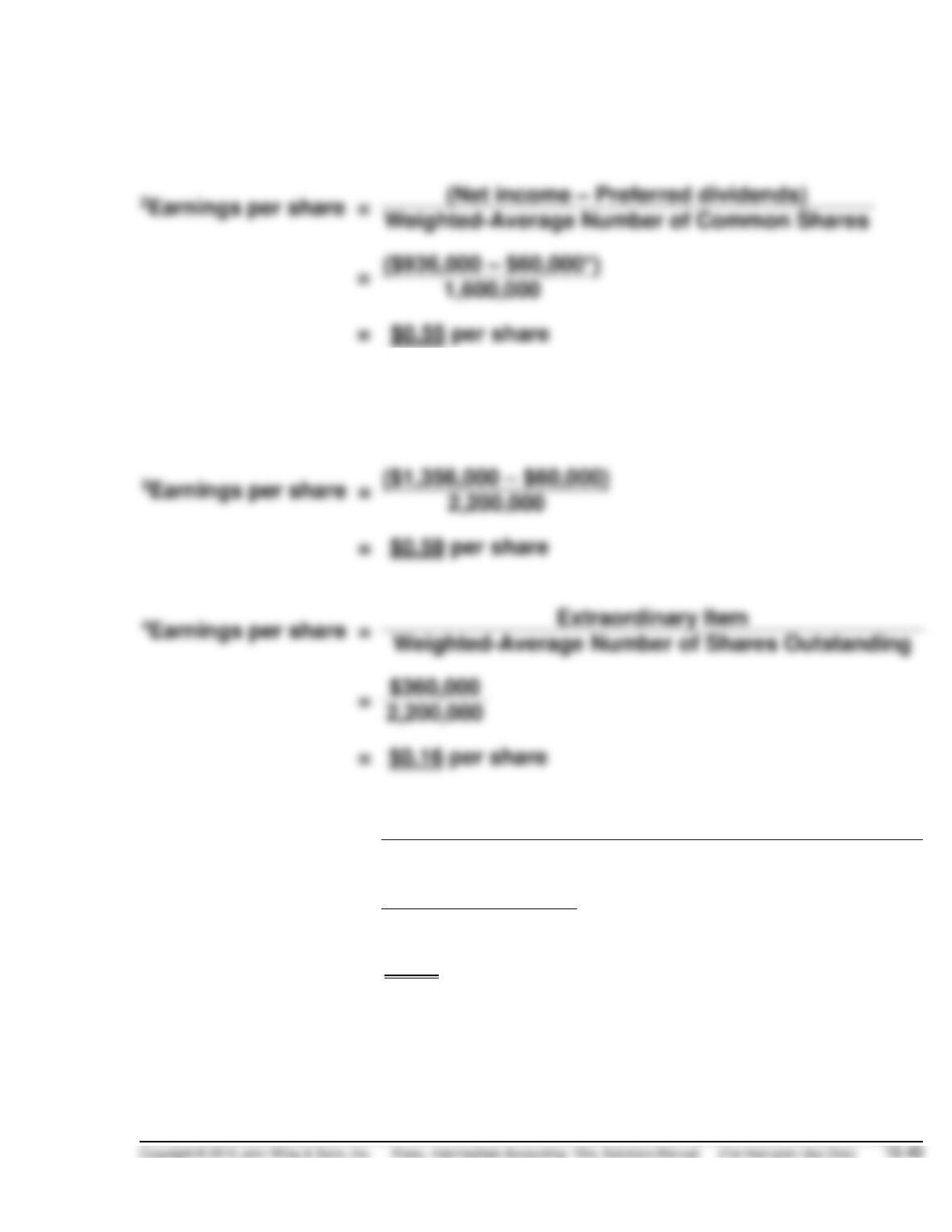
($936,000 – $60,000*)
=
*Preferred dividends = (No. of Shares X Par Value X Dividend %)
= (20,000 X $50 X .06)
= $60,000 per year
3Earnings per share
=
=
$0.59 per share
Weighted-Average Number of Shares Outstanding
=
$0.16 per share
5Earnings per share
=
Net Income – Preferred Dividends
Weighted-Average Number of Shares Outstanding
=
$996,000 – $60,000
2,200,000
=
$0.43
PROBLEM 16-7
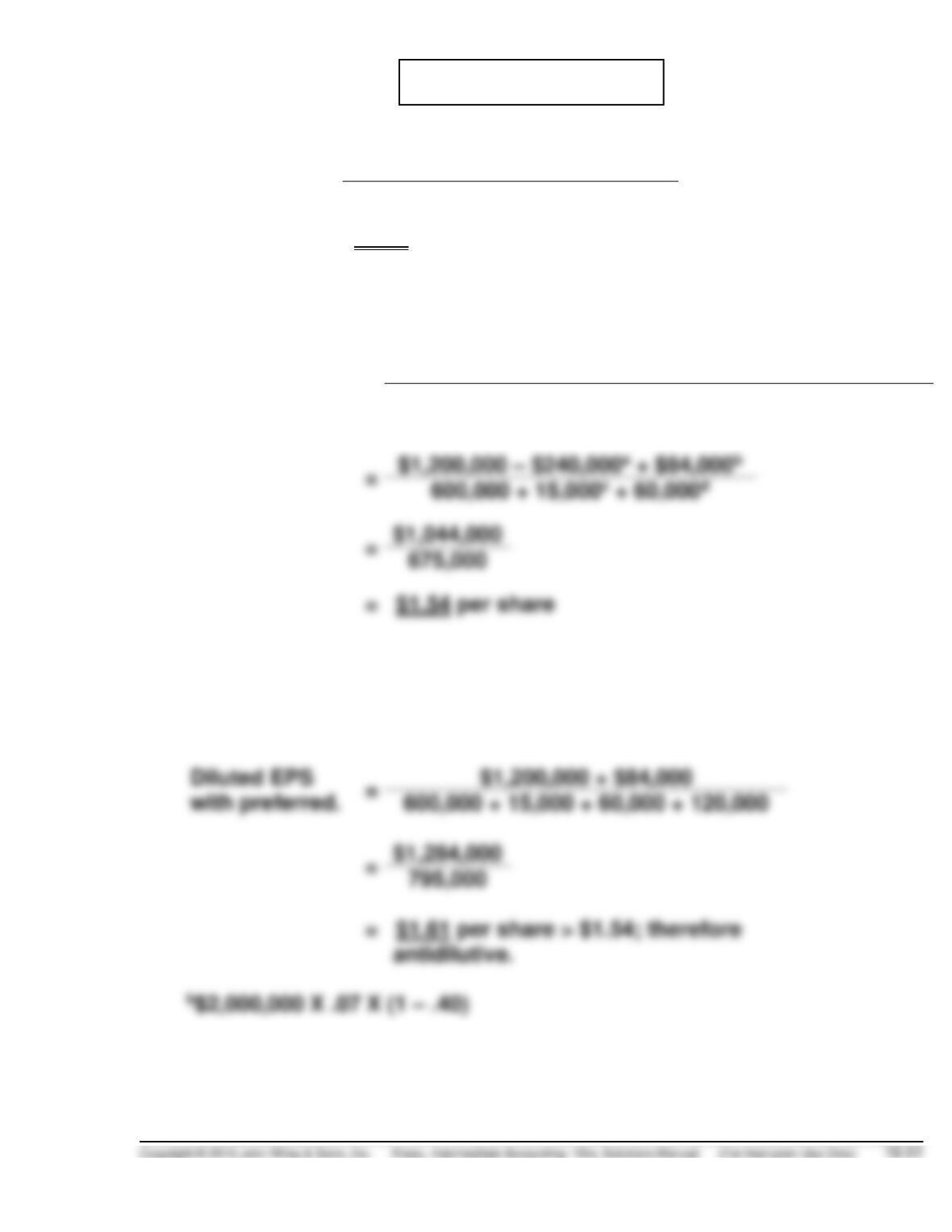
(a) The number of shares used to compute basic earnings per share is
4,951,000, as calculated below.
Event
Dates
Outstanding
Shares
Outstanding
Restatement
Fraction
of Year
Weighted
Shares
Beginning Balance,
including 5% stock
dividend
Jan. 1–Apr. 1
2,100,000
2.0
3/12
1,050,000
Conversion of
1,260,000
Issued shares for
building
1,335,000
(b) The number of shares used to compute diluted earnings per share is
5,791,000, as shown below.
Number of shares to compute
basic earnings per share …………………………... 4,951,000
(c) The adjusted net income to be used as the numerator in the basic
earnings per share calculation for the year ended December 31, 2015, is
$10,350,000, as computed below.
After-tax net income ……………………………………. $11,550,000
PROBLEM 16-8
(a)
Basic EPS
=
$1,200,000 – ($4,000,000 X .06)
600,000*
=
$1.60 per share
*$6,000,000 ÷ $10
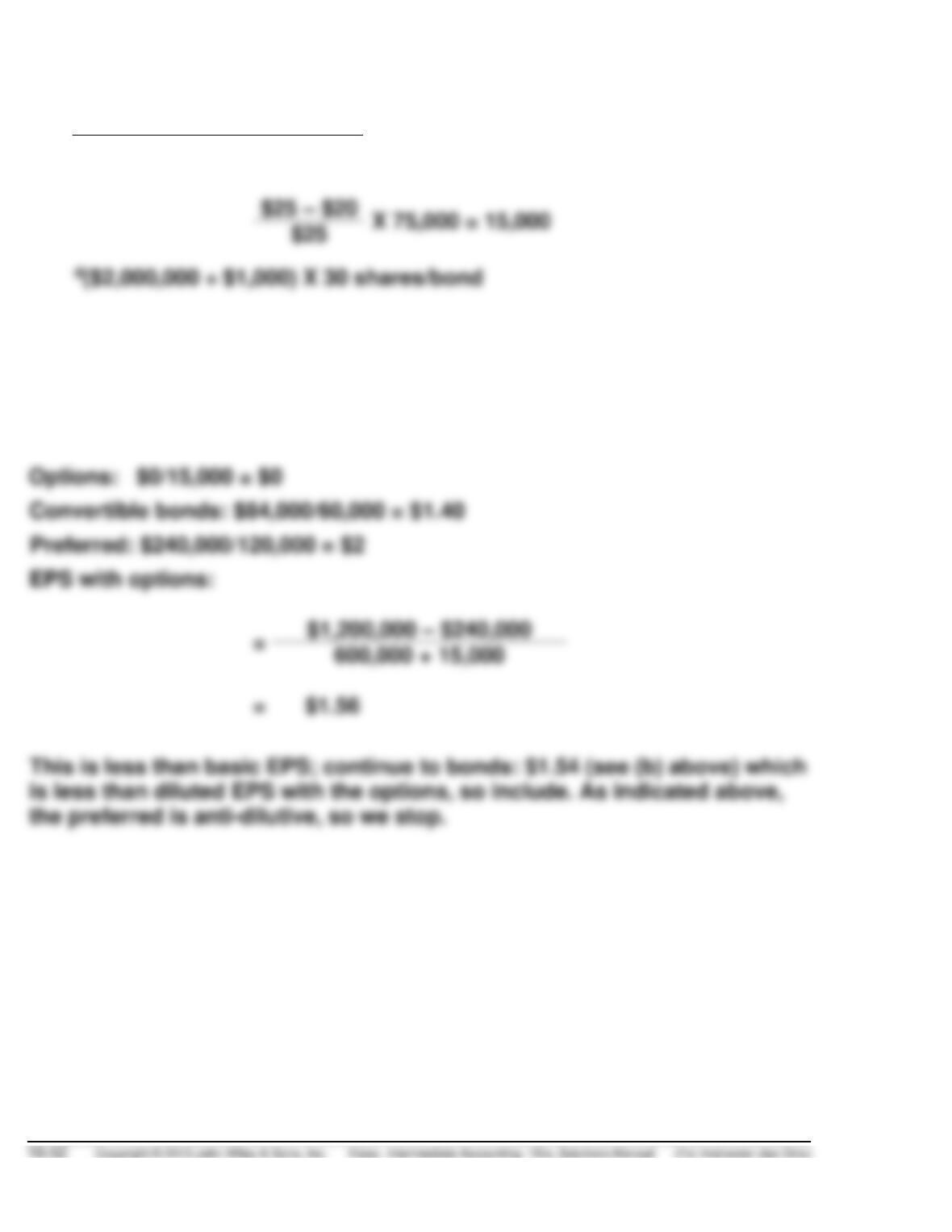
(b)
Diluted EPS
=
(Net income – Preferred dividends) + Interest
savings (net of tax)
Weighted-average number of shares outstanding +
Potentially dilutive common shares
=
=
=
aPreferred stock is not included since conversion would be antidilutive.
That is, conversion of the preferred stock increases the numerator
$240,000 ($4,000,000 X .06) and the denominator 120,000 shares
[(4,000,000 ÷ 100) X 3] as shown in the following:
=
$1.61 per share > $1.54; therefore
PROBLEM 16-8 (Continued)
cMarket price – Option price
X Number of options = incremental shares
Market price
Note to instructor: This problem can be used to apply the procedures in
Appendix 17B for analysis of multiple dilutive securities.
First, compute the dilutive effect for each security and rank from smallest
to largest:
PROBLEM 16-9
(a)
Weighted-Average Shares
Before Stock
Dividend
After Stock
Dividend
Total as of June 1, 2013
1,000,000
1,200,000
Issue of September 1, 2013
400,000
Total as of May 31, 2015
1,400,000
Total
(b) AGASSI CORPORATION
Comparative Income Statement
For the Years Ended May 31, 2015 and 2014
2015
2014
Income from operations before income taxes ….
$1,400,000
$660,000
Income taxes …………………………………………………
560,000
Net income …………………………………………………….
$ 600,000
Per share of common stock
Income before extraordinary item …………………
Extraordinary loss, net of tax ……………………….
Net income …………………………………………………….
PROBLEM 16-9 (Continued)
EPS calculations =
Net income – Preferred dividends
Weighted-average common shares
Preferred dividends = 40,000 X $100 X .06 = $240,000
(c) 1. A corporation’s capital structure is regarded as simple if it
consists only of common stock or includes no potentially dilutive
2. A corporation having a complex capital structure would be
required to make a dual presentation of earnings per share; i.e.,
TIME AND PURPOSE OF CONCEPTS FOR ANALYSIS
CA 16-1 (Time 20–25 minutes)
Purpose—to provide the student with an understanding of the underlying rationale behind the
CA 16-2 (Time 15–20 minutes)
CA 16-3 (Time 15–20 minutes)
Purpose—to provide the student with an understanding of the proper accounting and conceptual merits
CA 16-4 (Time 25–35 minutes)
CA 16-5 (Time 25–35 minutes)
Purpose—to provide the student with an understanding of how earnings per share is affected by
preferred dividends and convertible debt. The student is required to explain how preferred dividends
and convertible debt are handled for EPS computations. The student is also required to explain when
the “treasury stock method” is applicable in EPS computations.
CA 16-6 (Time 25–35 minutes)
SOLUTIONS TO CONCEPTS FOR ANALYSIS
CA 16-1
(a) (1) When the debt instrument and the option to acquire common stock are inseparable, as in
the case of convertible bonds, the entire proceeds of the bond issue should be allocated to
the debt and the related premium or discount accounts.
When the debt and the warrants are separable, the proceeds of their sale should be
(2) In the case of convertible debt there are two principal reasons why all the proceeds should
be ascribed to the debt. First, the option is inseparable from the debt. The investor in such
(3) Arguments have been advanced that accounting for convertible debt should be the same as
for debt issued with detachable stock purchase warrants. Convertible debt has features of
debt and stockholders’ equity, and separate recognition should be given to those
characteristics at the time of issuance. Difficulties encountered in separating the relative
values of the features are not insurmountable and, in any case, should not result in a
(b) Incremental Cash……………………………………………………………….. 20,040,000
Discount on Bonds Payable ($18,000,000 X 22%)…………………… 3,960,000
Bonds Payable ……………………………………………………………. 18,000,000
Paid-in Capital—Stock Warrants ……………………………………. 6,000,000
CA 16-2
(a) Devers recognizes that altering the estimate will benefit Adkins and other executive officers of the
CA 16-3
(a) 1. The objective of issuing warrants to existing stockholders on a pro-rata basis is to raise new
equity capital. This method of raising equity capital may be used because of preemptive
rights on the part of a company’s stockholders and also because it is likely to be less
expensive than a public offering.
2. The purpose of issuing stock warrants to certain key employees, usually in the form of a
non-qualified stock option plan, is to increase their interest in the long-term growth and
3. Warrants to purchase shares of its common stock may be issued to purchasers of a
company’s bonds in order to stimulate the sale of the bonds by increasing their speculative
appeal and aiding in overcoming the objection that rising price levels cause money invested
2. Warrants may be offered to key employees below, at, or above the market price of the stock
on the day the rights are granted except for incentive stock-option plans. If a stock-option
plan is to provide a strong incentive, warrants that can be exercised shortly after they are
3. Income tax laws impose no restrictions on the exercise price of warrants issued to purchasers
of a company’s bonds. The exercise price may be above, equal to, or below the current
CA 16-3 (Continued)
(c) 1. Financial statement information concerning outstanding stock warrants issued to a
2. Financial statement information concerning stock warrants issued to key employees should
include the following: status of these plans at the end of each period presented, including
3. Financial statement disclosure of outstanding stock warrants that have been issued to
CA 16-4
(a) In 2004, FASB issued an accounting standard related to stock compensation plans.
Generally, the rule indicates that employee stock options be treated like all other types of
compensation and that their value be included in financial statements as part of the costs of
employee services. The rule requires that all types of stock options be recognized as
(b) According to Ciesielski’s commentary, the bill in Congress would only record expense for the
options granted to the top five executives. They also are recommending that the SEC conduct
(c) Here is an excerpt from a presentation given by Dennis Beresford on the concept of neutrality,
which says it well.
The FASB often hears that it should take a broader view, that it must consider the economic
consequences of a new accounting standard. The FASB should not act, critics maintain, if a new
accounting standard would have undesirable economic consequences. We have been told that
providing retiree health care or creating employee incentives.
CA 16-4 (Continued)
There is a common element in those assertions. The goals are desirable but the means require
that the Board abandon neutrality and establish reporting standards that conceal the financial
impact of certain transactions from those who use financial statements. Costs of transactions
exist whether or not the FASB mandates their recognition in financial statements. For example,
Many observers believe that the effect was to delay action and hide the true dimensions of the
problem. The public interest is best served by neutral accounting standards that inform policy
rather than promote it. Stated simply, truth in accounting is always good policy.
Neutrality does not mean that accounting should not influence human behavior. We expect that
changes in financial reporting will have economic consequences, just as economic
Indeed, most people are repelled by the notion that some “big brother,” whether
government or private, would tamper with scales or speedometers surreptitiously to
CA 16-5
(a) Dividends on outstanding preferred stock must be subtracted from net income or added to net loss
for the period before computing EPS on the common shares. This generalization will be modified
by the various features and different requirements preferred stock may have with respect to
CA 16-5 (Continued)
(b) When options and warrants to buy common stock are outstanding and their exercise price (i.e.,
proceeds the corporation would derive from issuance of common stock pursuant to the warrants
and options) is less than the average price at which the company could acquire its outstanding
shares as treasury stock, the treasury stock method is generally applicable. In these
circumstances, existence of the options and warrants would be dilutive. However, if the exercise
(c) In arriving at the calculation of diluted EPS where convertible debentures are assumed to be
converted, their interest (net of tax) is added back to net income as the numerator element of the
EPS calculation while the weighted-average number of shares of common stock into which they
would be convertible is added to the shares outstanding to arrive at the denominator element of
the calculation.
CA 16-6
Dear Mr. Dolan:
I hope that the following brief explanation helps you understand why your warrants were not included in
Rhode’s earnings per share calculations.
Earnings per share (EPS) provides income statement users a quick assessment of the earnings that
In order not to mislead users of financial information, the accounting profession insists that EPS
calculations be transparent. Thus, a security which might dilute EPS must be figured into EPS
calculations as though it had been converted into common stock. Basic EPS assumes a weighted-
average of common stock outstanding while diluted EPS assumes that any potentially dilutive security
has been converted.