
Chapter 16
Additional Topics in International Capital
Budgeting
QUESTIONS
1. Why should the required rate of return for a capital budgeting problem be project
specific? Doesn’t the firm just have to satisfy an overall cost-of-capital requirement?
Answer: The required rate of return for a capital budgeting problem is project specific
because the firm is viewed as a portfolio of projects owned by the shareholders. It is the
2. What is the conceptual foundation of the flow-to-equity approach to capital budgeting?
Answer: In the flow-to-equity approach to capital budgeting, the after-tax cash flows that are
3. What is the weighted average cost of capital?
Answer: The weighted average cost of capital (WACC) approach to capital budgeting
4. Should a firm ever accept a project that has a negative NPV when discounted at the
weighted average cost of capital?
Answer: One reason we like the adjusted net present value approach to valuation is that it
specifies all of the possible sources of value for a project. The WACC approach works well
5. Can you do capital budgeting for a foreign project using a domestic currency discount
rate? Explain your answer.
Answer: The answer to the question is yes; you certainly can do capital budgeting for a
foreign project using a domestic currency discount rate. You just have to be careful to match
6. Why might it be important to use period-specific discount rates when doing capital
budgeting?
Answer: We know that risk free spot interest rates are the appropriate discount rates for cash
flows from risk free pure discount bonds. If the term structure of spot interest rates is not flat,
7. Why is it necessary to consider forecasts of real currency appreciation and depreciation
when doing an international capital budgeting analysis?
Answer: The most important reason to consider forecasts of real currency appreciation or
depreciation is that it is likely that a change in the real exchange rate will affect the cash
8. What is the rate of return on invested capital? How is it calculated?
Answer: The rate of return on invested capital is the free cash flow of the firm divided by the
9. If you borrow a foreign currency, what interest deduction would you receive on your
taxes?
10. If you borrow a foreign currency, are there any capital gains taxes to worry about?
Answer: If you borrow in a foreign currency, there are capital gains taxes to worry about. If
the domestic currency has appreciated relative to the foreign currency between when the
Chapter 16: Additional Topics in International Capital Budgeting
4
11. Why might a manager accept a high-variance, low-value project instead of a low–
variance, high-value project?
12. Why would a manager not accept a positive net present value project?
Answer: The value of the project accrues to the firm as a whole. Thus, if the firm has risky
PROBLEMS
1. Suppose that the required rate of return on a firm’s debt is 8%, the corporate tax rate
is 34%, and the required rate of return on the firm’s equity is 15%. If the firm finances
its projects with 40% debt, what is the firm’s WACC?
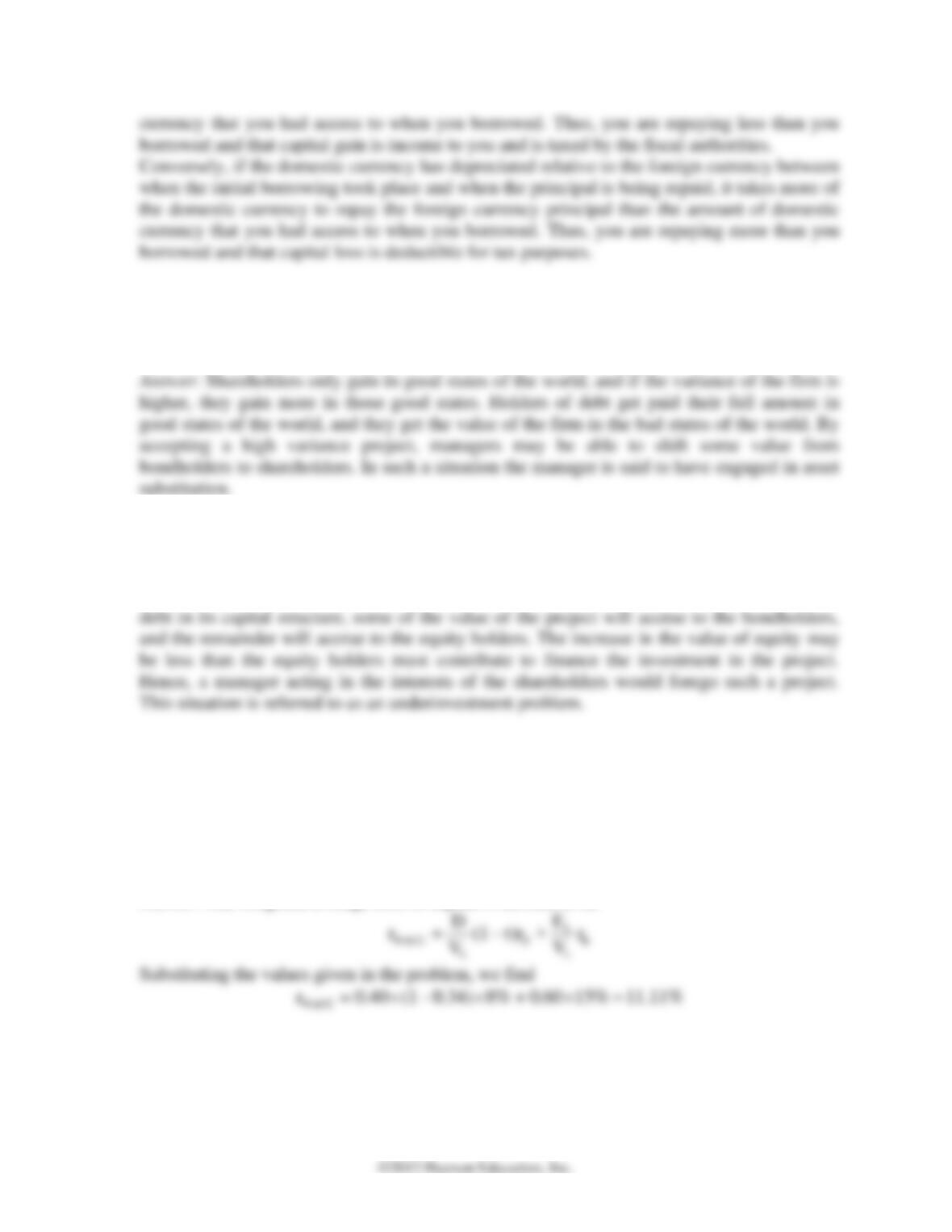
Answer: The weighted average cost of capital is defined to be
2. Suppose that UK Motors Ltd. is considering an investment of £30 million to develop a
new factory. Assume that the company’s stockholders require a 22% rate of return,
that the company’s bondholders require a 9% rate of return, that the UK corporate tax

Chapter 16: Additional Topics in International Capital Budgeting
5
rate is 40%, that 35% of the project will be financed by debt, and that 65% of the
project will be financed with equity. What must be the annual income from the project
if it is to be a zero net present value investment?
Answer: The perpetual income from the project, when discounted at the weighted average
3. If the risk-free rate is 5%, the firm’s required rate of return on its debt is 6%, the
equity beta is 1.4, the equity risk premium is 5.5%, the corporate tax rate is 34%, and
the debt–equity ratio is 0.5, what is the expected rate of return on the assets of the firm
that is predicted by the capital asset pricing model (CAPM)?
Answer: The return on the assets of the firm, rA, is a weighted average of the return on the
firm’s debt and the return on the levered firm’s equity. It differs from the weighted average
4. Suppose that a firm’s corporate headquarters thinks that the appropriate dollar rate of
return on investments in Japan is thought to be 18% per annum. If the dollar is
expected to weaken relative to the yen by 4% per annum, what is the Japanese yen
required rate of return on the expected yen cash flows?
Answer: We know that the appropriate yen discount rate will be lower than the dollar

5. Which is a better deal: borrowing at 1% in yen when the risk-free yen interest rate is
3% and the firm’s market-debt rate is 4% or borrowing in euros at 3% when the risk–
free euro interest rate is 5% and the firm’s market-debt rate is 6%? Assume that
uncovered interest rate parity holds and that the corporate tax rate is 34%.
Answer: The most straightforward way to attack this problem is to recognize that the
subsidized loan with the lowest effective dollar borrowing rate is the best deal. From the
discussion of borrowing rates in Chapter 11, we know that we must compare multiplicative
credit spreads to convert between borrowing rates in different currencies. We must also
6. Consider a firm that owes $700 to its bondholders facing the following two mutually
exclusive projects:
Project A
Probability
Value of Firm
Dollar
Appreciation
0.5
$700
Dollar Depreciation
0.5
$800
Project B
Probability
Value of Firm
Dollar
Appreciation
0.5
$650
Dollar Depreciation
0.5
$830
If the managers are operating in the interest of the stockholders, which project will the
firm take? Why?
Answer: The managers would take Project B. The reasoning is the following. For Project A,

7. Suppose that a firm has $700 of bonds outstanding, and its cash flows without a new
project will be as follows:
Firm Without a New Project
Probability
Value of Firm
Dollar
Appreciation
0.5
$600
Dollar Depreciation
0.5
$800
Suppose that the cash flows of the firm with a new project that costs $60 would be as
follows:
Firm with a New Project
Probability
Value of Firm
Dollar
Appreciation
0.5
$700
Dollar Depreciation
0.5
$840
If the managers are acting in the interests of the shareholders, will they accept this
project? Why or why not?
Answer: If the managers do not take the project, the value of the firm will be $700 = ($600 +
8. Web Question: Go to www.vodafone.com and determine the outstanding amounts of
debt and equity. If the required rate of return on its debt is 75 basis points over the 10–
year U.K. Treasury yield, and the equity premium is 5.5%, what is Vodafone’s
weighted average cost of capital? Hint: Don’t forget to find the U.K. tax rate.

Chapter 16: Additional Topics in International Capital Budgeting
9