16-1
CHAPTER 16
Dilutive Securities and Earnings Per Share
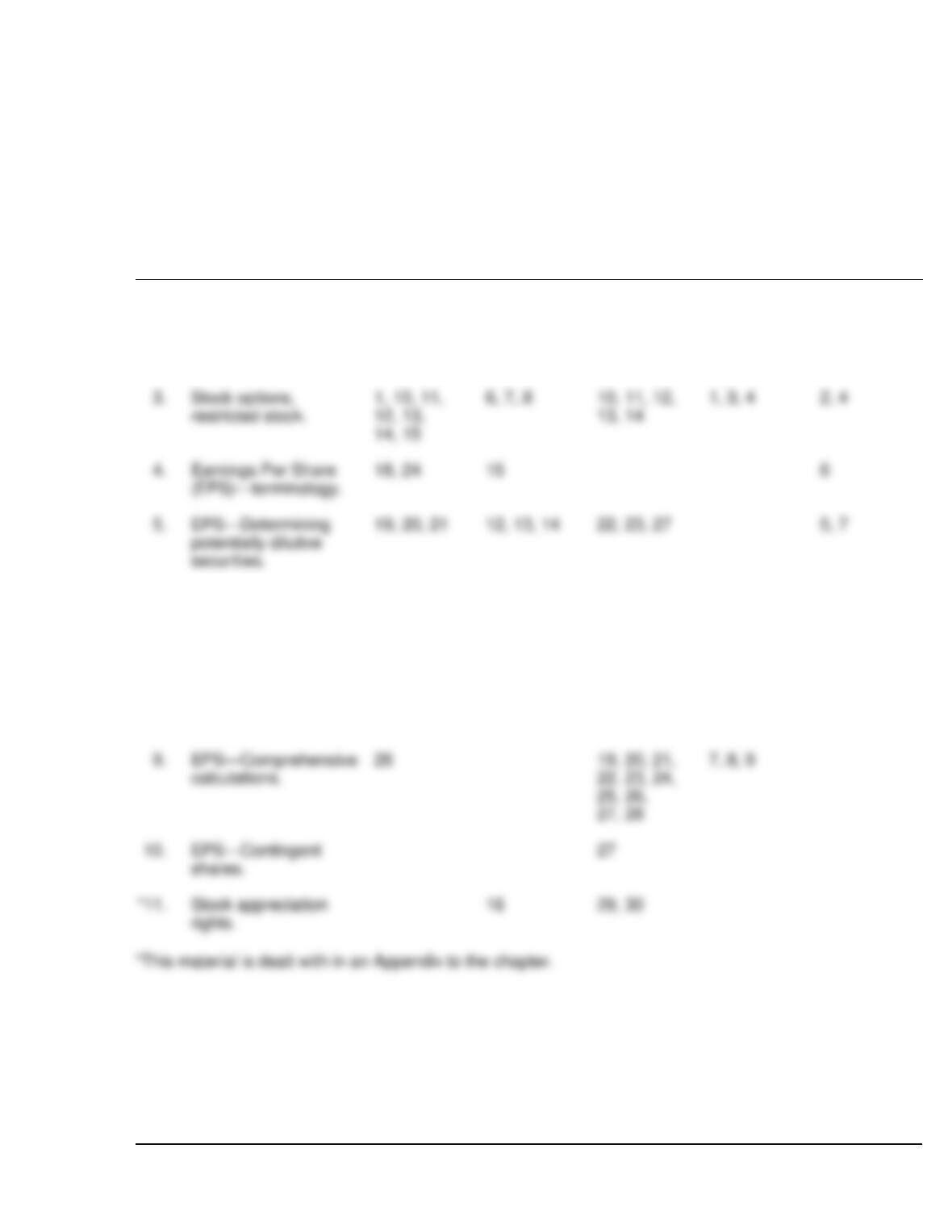
ASSIGNMENT CLASSIFICATION TABLE (BY TOPIC)
Topics
Questions
Brief
Exercises
Exercises
Problems
Concepts
for Analysis
1.
Convertible debt
and preferred stock.
1, 2, 3, 4,
5, 6, 7
1, 2, 3
1, 2, 3, 4, 5,
6, 7, 24, 25,
2
1
2.
Warrants and debt.
2, 3, 8, 9
4, 5
7, 8, 9, 28
1, 3
6.
EPS—Treasury stock
method.
22, 23
28
5, 7
7.
EPS—Weighted-
average computation.
16, 17
10, 11
15, 16, 17,
18, 21
5, 6, 7,
8, 9
8.
EPS—General
objectives.
24, 25
9, 15
5, 6, 7
25, 26,
27, 28
10.
EPS—Contingent
shares.
27
Stock appreciation
rights.
16
29, 30
restricted stock.
12, 13,
14, 15
13, 14
4.
Earnings Per Share
18, 24
15
6
potentially dilutive
securities.
16-2
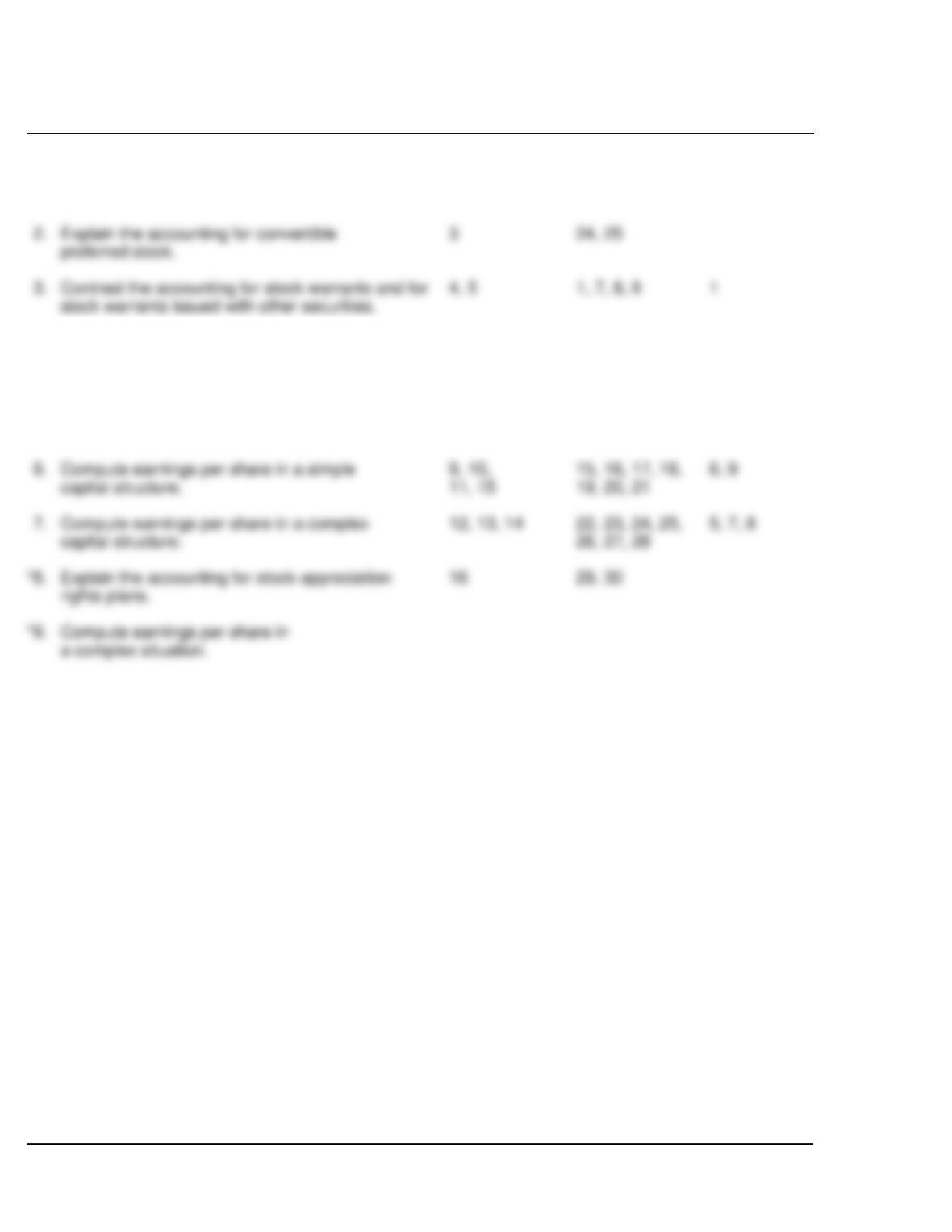
ASSIGNMENT CLASSIFICATION TABLE (BY LEARNING OBJECTIVE)
Learning Objectives
Brief
Exercises
Exercises
Problems
1. Describe the accounting for the issuance,
conversion, and retirement of convertible
securities.
1, 2
1, 2, 3, 4, 5, 6
1, 2
4. Describe the accounting for stock compensation
plans under generally accepted accounting
principles.
6, 7, 8
10, 11, 12,
13, 14
1, 3, 4
5. Discuss the controversy involving stock
compensation plans.
6. Compute earnings per share in a simple
capital structure.
9, 10,
15, 16, 17, 18,
7. Compute earnings per share in a complex
capital structure.
12, 13, 14
22, 23, 24, 25,
5, 7, 8
a complex situation.
2. Explain the accounting for convertible
preferred stock.
3
24, 25
3. Contrast the accounting for stock warrants and for
stock warrants issued with other securities.
4, 5
1, 7, 8, 9
1
16-3
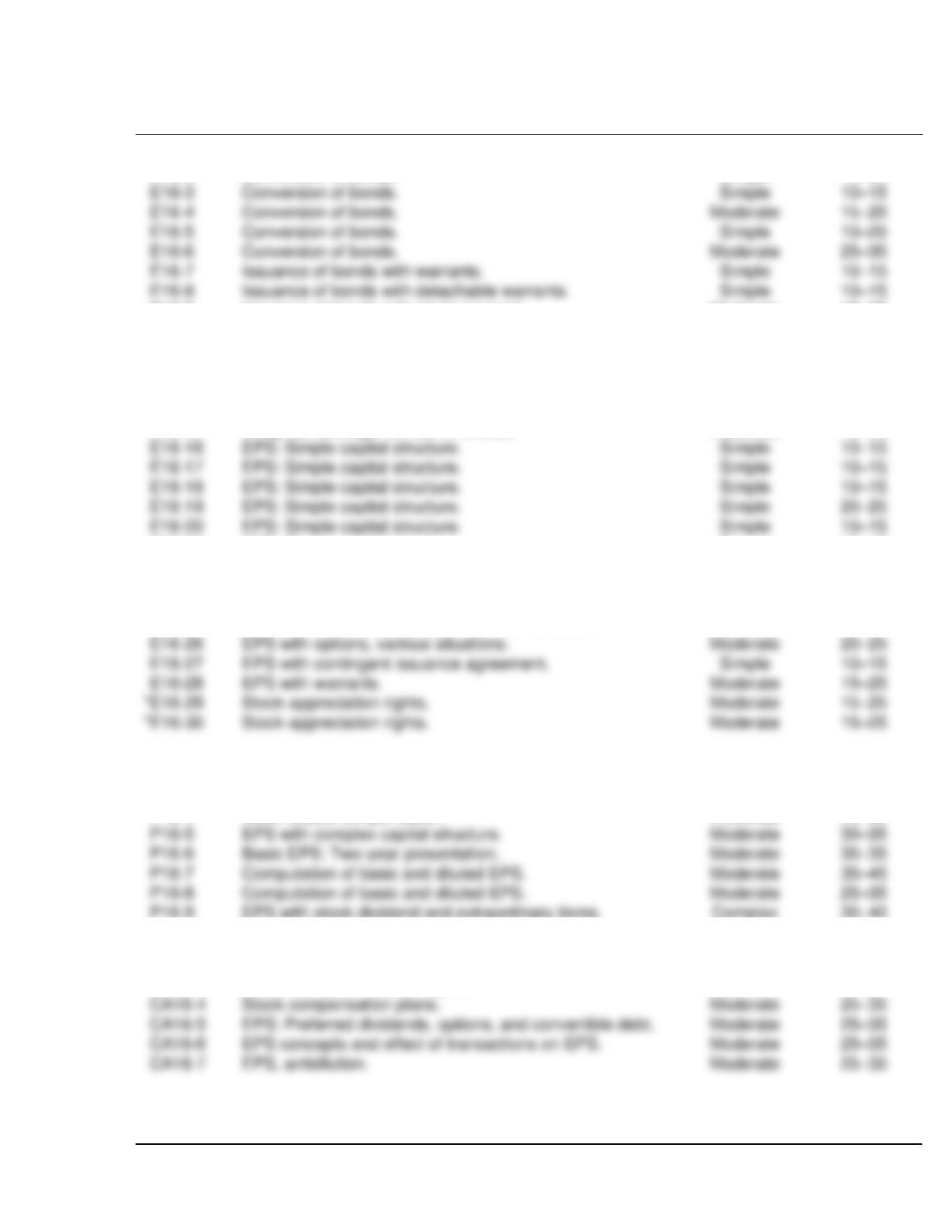
ASSIGNMENT CHARACTERISTICS TABLE
Item
Description
Level of
Difficulty
Time
(minutes)
E16-1
Issuance and conversion of bonds.
Simple
15–20
E16-2
Conversion of bonds.
Simple
15–20
E16-9
Issuance of bonds with stock warrants.
Moderate
15–20
E16-10
Issuance and exercise of stock options.
Moderate
15–25
E16-11
Issuance, exercise, and termination of stock options.
Moderate
15–25
E16-12
Issuance, exercise, and termination of stock options.
Moderate
15–25
E16-13
Accounting for restricted stock.
Simple
10–15
E16-14
Accounting for restricted stock.
Simple
10–15
E16-15
Weighted-average number of shares.
Moderate
15–25
E16-16
EPS: Simple capital structure.
Simple
10–15
E16-17
EPS: Simple capital structure.
Simple
10–15
E16-18
EPS: Simple capital structure.
Simple
10–15
E16-19
EPS: Simple capital structure.
Simple
20–25
E16-20
EPS: Simple capital structure.
Simple
10–15
E16-21
EPS: Simple capital structure.
Simple
10–15
E16-22
EPS with convertible bonds, various situations.
Complex
20–25
E16-23
EPS with convertible bonds.
Moderate
15–20
E16-24
EPS with convertible bonds and preferred stock.
Moderate
20–25
E16-25
EPS with convertible bonds and preferred stock.
Moderate
10–15
E16-26
EPS with options, various situations.
Moderate
20–25
E16-27
EPS with contingent issuance agreement.
Simple
10–15
E16-28
EPS with warrants.
Moderate
15–20
Stock-appreciation rights.
Moderate
15–25
Stock-appreciation rights.
Moderate
15–25
P16-1
Entries for various dilutive securities.
Moderate
35–40
P16-2
Entries for conversion, amortization, and interest of bonds.
Moderate
45–50
P16-3
Stock option plan.
Moderate
30–35
P16-4
Stock-based compensation.
Moderate
25–30
P16-5
EPS with complex capital structure.
Moderate
30–35
P16-6
Basic EPS: Two-year presentation.
Moderate
30–35
P16-7
Computation of basic and diluted EPS.
Moderate
35–45
P16-8
Computation of basic and diluted EPS.
Moderate
25–35
P16-9
EPS with stock dividend and extraordinary items.
Complex
30–40
CA16-1
Warrants issued with bonds and convertible bonds.
Moderate
20–25
CA16-2
Ethical issues—compensation plan.
Simple
15–20
CA16-3
Stock warrants—various types.
Moderate
15–20
CA16-4
Stock compensation plans.
Moderate
25–35
CA16-5
EPS: Preferred dividends, options, and convertible debt.
Moderate
25–35
CA16-6
EPS concepts and effect of transactions on EPS.
Moderate
25–35
CA16-7
EPS, antidilution.
Moderate
25–35
E16-3
Conversion of bonds.
Simple
10–15
E16-4
Conversion of bonds.
Moderate
15–20
E16-5
Conversion of bonds.
Simple
10–20
E16-6
Conversion of bonds.
Moderate
25–35
E16-7
Issuance of bonds with warrants.
Simple
10–15
E16-8
Issuance of bonds with detachable warrants.
Simple
10–15
16-4
SOLUTIONS TO CODIFICATION EXERCISES
CE16-1
Master Glossary
(a) The amount of earnings for the period available to each share of common stock outstanding during
the reporting period.
(d) The date at which an employer and an employee reach a mutual understanding of the key terms and
conditions of a share-based payment award. The employer becomes contingently obligated on the
grant date to issue equity instruments or transfer assets to an employee who renders the requisite
service. Awards made under an arrangement that is subject to shareholder approval are not deemed to
be granted until that approval is obtained unless approval is essentially a formality (or perfunctory), for
example, if management and the members of the board of directors control enough votes to approve
CE16-2
According to FASB ASC 260-10–45-7 (Earnings Per Share—Other Presentation Matters):
CE16-3
According to FASB ASC 260-10–50-1 (Earnings Per Share—Disclosure):
For each period for which an income statement is presented, an entity shall disclose all of the following:
(a) A reconciliation of the numerators and the denominators of the basic and diluted per-share computa-
tions for income from continuing operations. The reconciliation shall include the individual income and
16-5
CE16-3 (Continued)
(b) The effect that has been given to preferred dividends in arriving at income available to common
stockholders in computing basic EPS.
CE16-4
According to FASB ASC 260-10–55-12 (Earnings Per Share—Implementation—Restatement of EPS Data):
If the number of common shares outstanding increases as a result of a stock dividend or stock split
(see Subtopic 505–20) or decreases as a result of a reverse stock split, the computations of basic and diluted
ANSWERS TO QUESTIONS
1. Securities such as convertible debt or stock options are dilutive because their features indicate that
2. Corporations issue convertible securities for two reasons. One is to raise equity capital without giving
3. Convertible debt and debt issued with stock warrants are similar in that: (1) both allow the issuer to
issue debt at a lower interest cost than would generally be available for straight debt; (2) both allow
the holders to purchase the issuer’s stock at less than market value if the stock appreciates
sufficiently in the future; (3) both provide the holder the protection of a debt security if the value of the
4. The accounting treatment of the $160,000 “sweetener” to induce conversion of the bonds into common
5. (a) From the point of view of the issuer, the conversion feature of convertible debt results in a lower
cash interest cost than in the case of nonconvertible debt. In addition, the issuer in planning its
long-range financing may view the convertible debt as a means of raising equity capital over the
long term. Thus, if the market value of the underlying common stock increases sufficiently after
16-7
Questions Chapter 16 (Continued)
6. The view that separate accounting recognition should be accorded the conversion feature of
convertible debt is based on the premise that there is an economic value inherent in the conversion
feature or call on the common stock and that the value of this feature should be recognized for
accounting purposes by the issuer. It may be argued that the call is not significantly different in nature
7. The method used by the company to record the exchange of convertible debentures for common
stock can be supported on the grounds that when the company issued the convertible debentures,
the proceeds could represent consideration received for the stock. Therefore, when conversion
occurs, the book value of the obligation is simply transferred to the stock exchanged for it. Further
8. Cash ………………………………………………………………………………….. 3,000,000
Discount on Bonds Payable …………………………………………………… 100,000
Bonds Payable ……………………………………………………………… 3,000,000
9. If a corporation decides to issue new shares of stock, the old stockholders generally have the right,
referred to as a stock right, to purchase newly issued shares in proportion to their holdings. No entry
10. Companies are required to use the fair value method to recognize compensation cost. For most stock
option plans compensation cost is measured at the grant date and allocated to expense over the
service period, which typically ends on the vesting date.
16-8
Questions Chapter 16 (Continued)
11. This plan would not be considered compensatory since it meets the conditions of a noncompensatory
12. The profession recommends that the fair value of a stock option be determined on the date on which
the option is granted to a specific individual.
13. GAAP requires that compensation expense be recognized over the service period. Unless otherwise
14. Using the fair value approach, total compensation expense is computed based on the fair value of
the options on the date the options are granted to the employees. Fair value is estimated using an
acceptable option pricing model (such as the Black-Scholes option-pricing model).
15. The advantages of using restricted stock to compensate employees are: (1) The restricted stock
never becomes completely worthless; (2) it generally results in less dilution than stock options; and
(3) it better aligns the employee incentives with the companies’ incentives.
16. Weighted-average shares outstanding
Outstanding shares (all year) = ……………………………………………… 400,000
October 1 to December 31 (200,000 X 1/4) = …………………………... 50,000
17. The computation of the weighted-average number of shares requires restatement of the shares
outstanding before the stock dividend or split. The additional shares outstanding as a result of a
18. (a) Basic earnings per share is the amount of earnings for the period available to each share of
common stock outstanding during the reporting period.
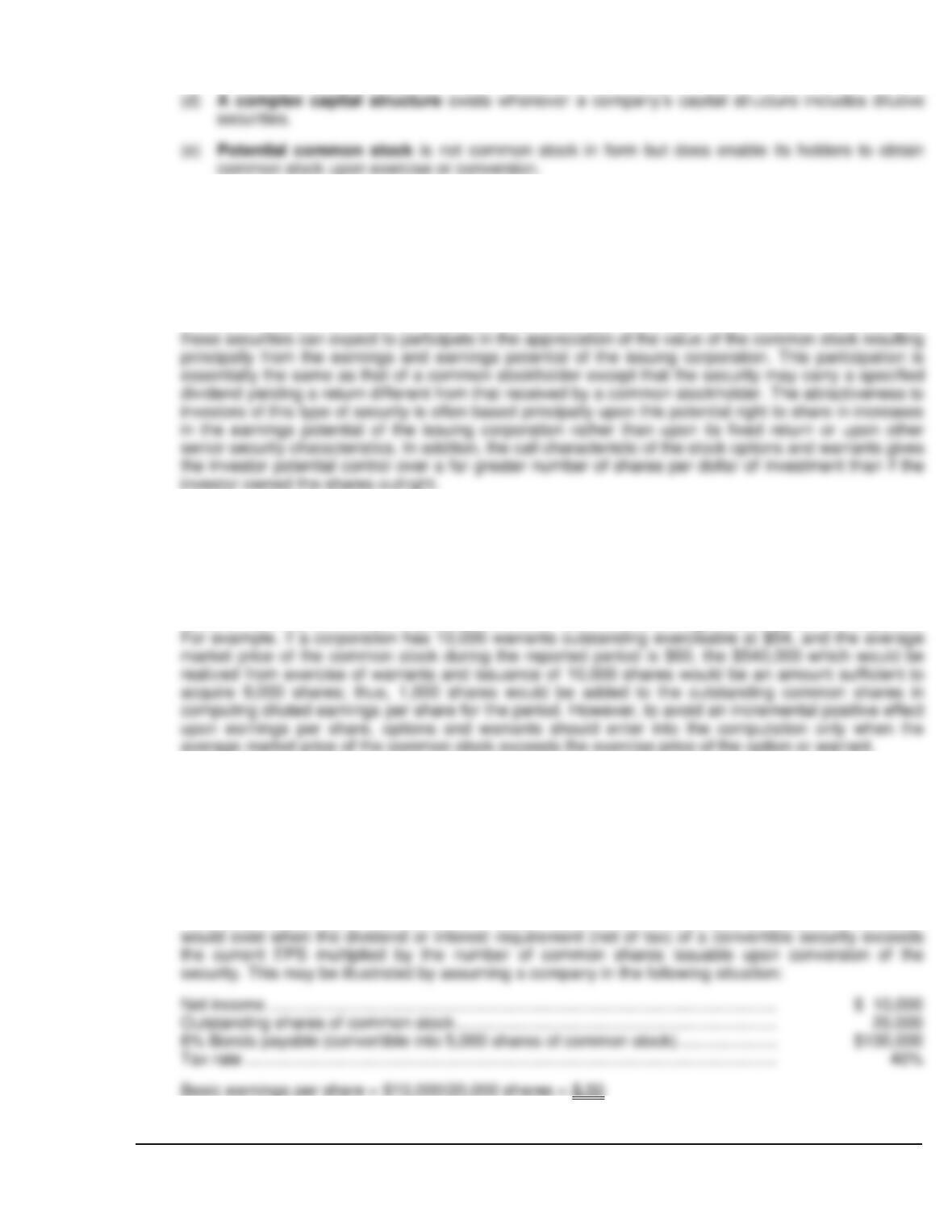
(b) A potentially dilutive security is a security which can be exchanged for or converted into
16-9
Questions Chapter 16 (Continued)
19. Convertible securities are potentially dilutive securities and part of diluted earnings per share if their
conversion increases the EPS numerator less than it increases the EPS denominator; i.e., the EPS
with conversion is less than the EPS before conversion.
20. The concept that a security may be the equivalent of common stock has evolved to meet the
reporting needs of investors in corporations that have issued certain types of convertible securities,
options, and warrants. A potentially dilutive security is a security which is not, in form, common stock
but which enables its holder to obtain common stock upon exercise or conversion. The holders of
21. Convertible securities are considered to be potentially dilutive securities whenever their conversion
would decrease earnings per share. If this situation does not result, conversion is not assumed and
only basic EPS is reported.
22. Under the treasury-stock method, diluted earnings per share should be determined as if outstanding
options and warrants were exercised at the beginning of year (or date of issue if later) and the funds
obtained thereby were used to purchase common stock at the average market price for the period.
23. Yes, if warrants or options are present, an increase in the market price of the common stock can
increase the number of potentially dilutive common shares by decreasing the number of shares
repurchasable. In addition, an increase in the market price of common stock can increase the
compensation expense reported in a stock-appreciation rights plan. This would decrease net income
and, consequently, earnings per share.
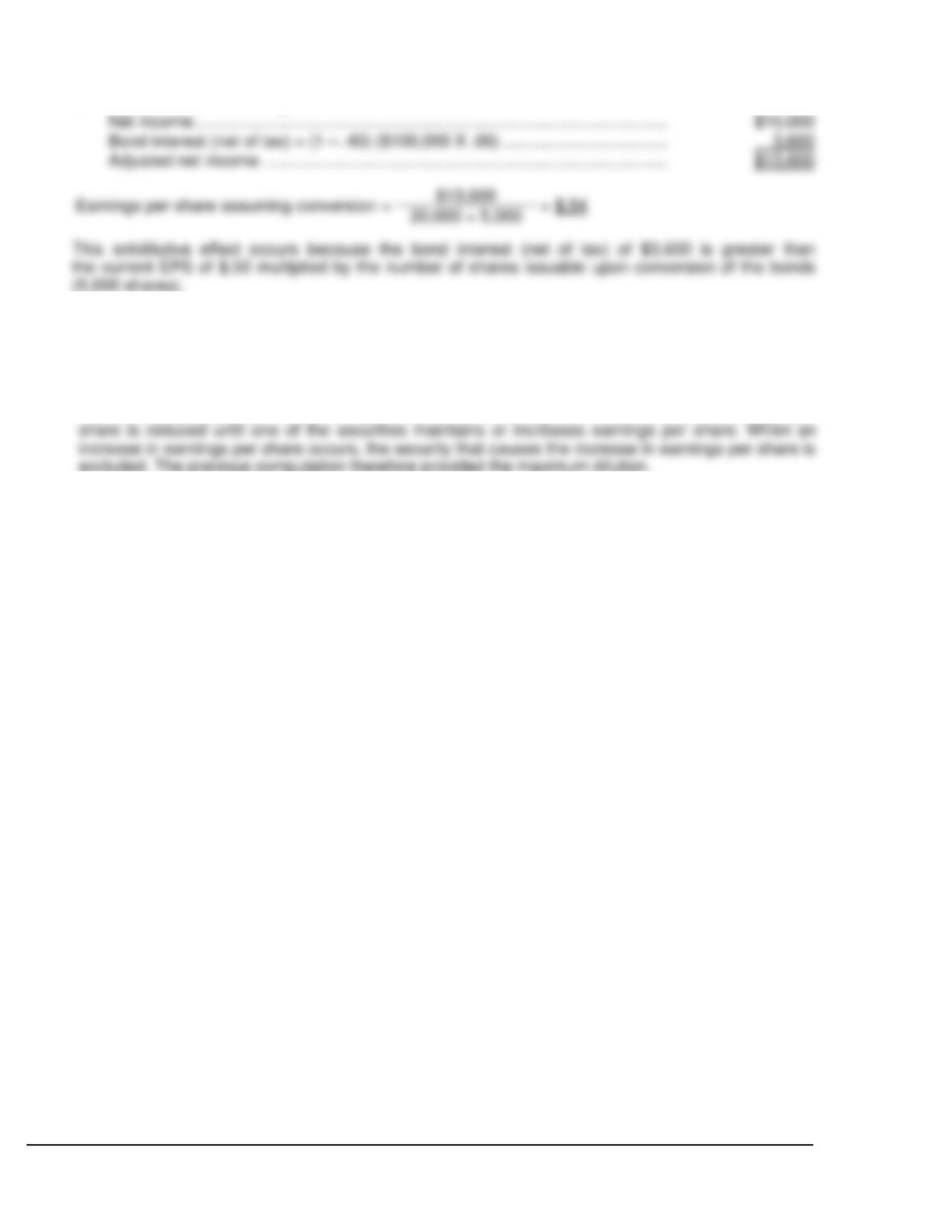
24. Antidilution is an increase in earnings per share resulting from the assumption that convertible
securities have been converted or that options and warrants have been exercised, or other shares
have been issued upon the fulfillment of certain conditions. For example, an antidilutive condition
16–10
Questions Chapter 16 (Continued)
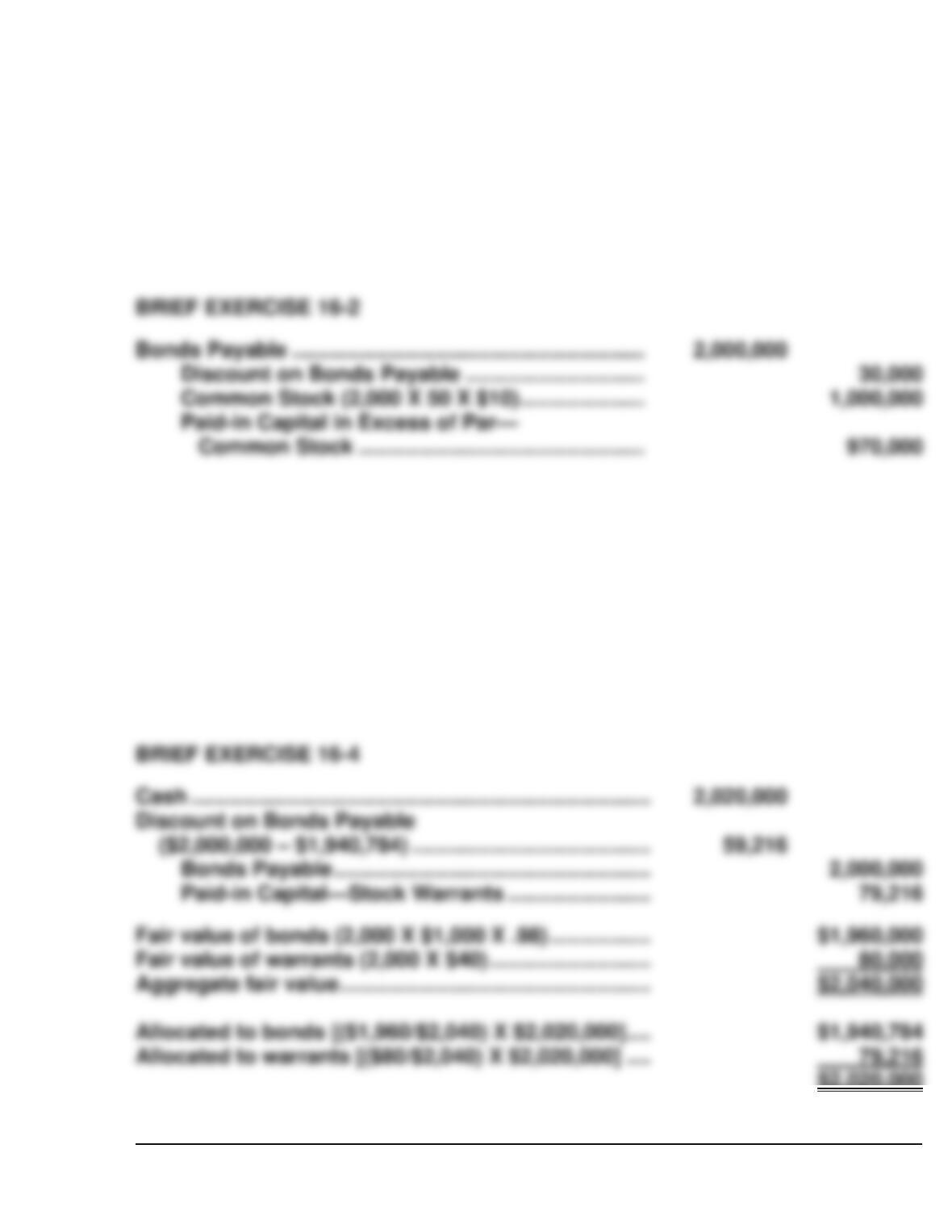
Earnings per share assuming conversion of the bonds:
25. Both basic earnings per share and diluted earnings per share must be presented in a complex
capital structure. When irregular items are reported, per share amounts should be shown for income
from continuing operations, income before extraordinary items, and net income.
*26. Antidilution when multiple securities are involved is determined by ranking the securities for
maximum possible dilution in terms of per share effect. Starting with the most dilutive, earnings per
16–11
SOLUTIONS TO BRIEF EXERCISES
BRIEF EXERCISE 16-1
Cash ………………………………………………………………….. 3,960,000
Discount on Bonds Payable ………………………………… 40,000
Bonds Payable …………………………………………….. 4,000,000
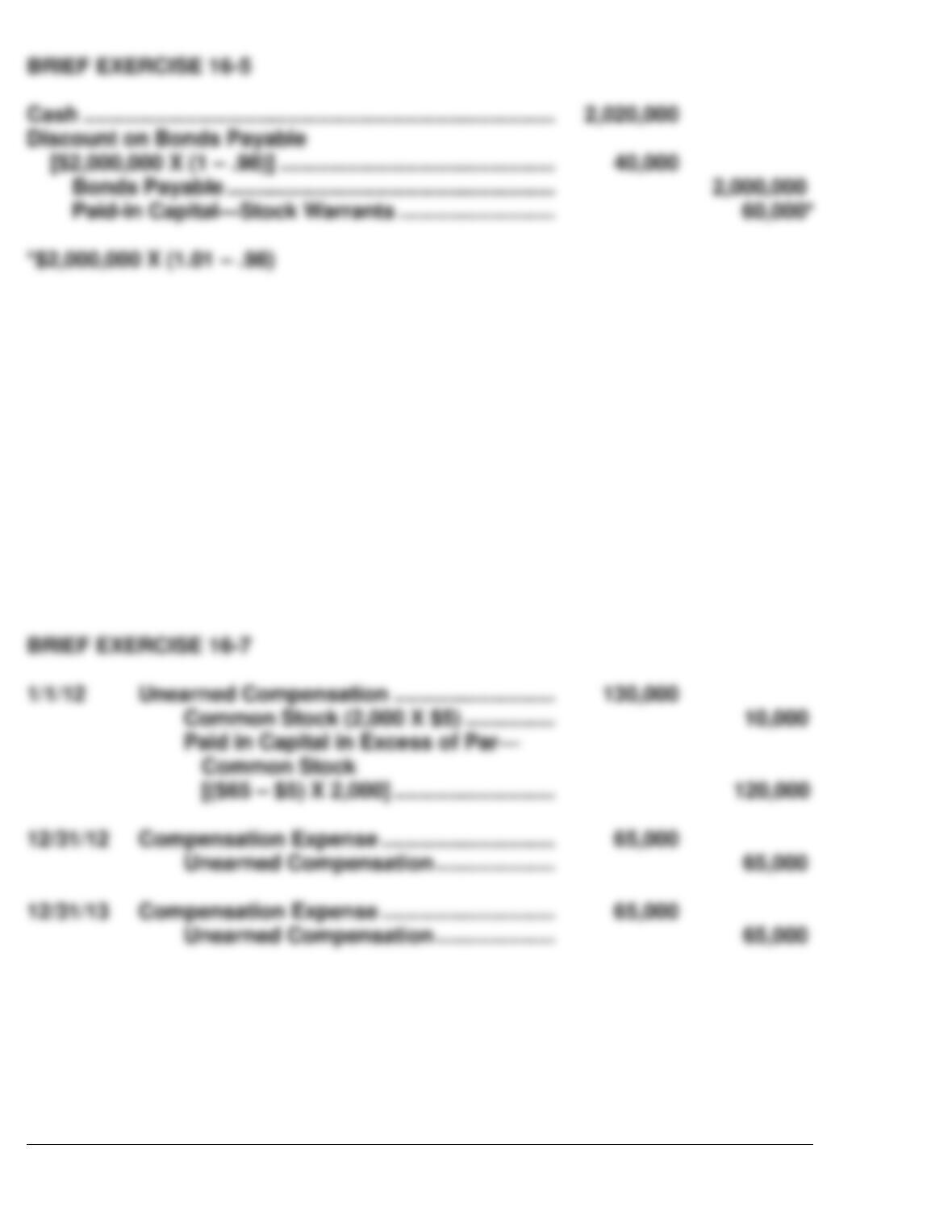
BRIEF EXERCISE 16-3
Preferred Stock (1,000 X $50) ………………………………. 50,000
Paid-in Capital in Excess of Par—
Preferred Stock ($60 – $50) X 1,000 ………………….. 10,000
Common Stock (2,000 X $10) ………………………… 20,000
Paid-in Capital in Excess of Par—Common
Stock ($60 X 1,000) – (2,000 X $10) ……………… 40,000
$2,020,000
16–12
BRIEF EXERCISE 16-6
1/1/12 No entry
12/31/12 Compensation Expense ……………………….. 75,000
Paid-in Capital—Stock
Options …………………………………….. 75,000
12/31/13 Compensation Expense ……………………….. 75,000
Paid-in Capital—Stock
Options …………………………………….. 75,000
16–13
BRIEF EXERCISE 16-8
1/1/12 Unearned Compensation ……………………….. 75,000
Common Stock …………………………………… 10,000
Paid-in Capital in Excess of Par—
Common Stock ……………………………….. 65,000
12/31/12 Compensation Expense …………………………. 25,000
Unearned Compensation ($75,000 ÷ 3) …. 25,000
BRIEF EXERCISE 16–11
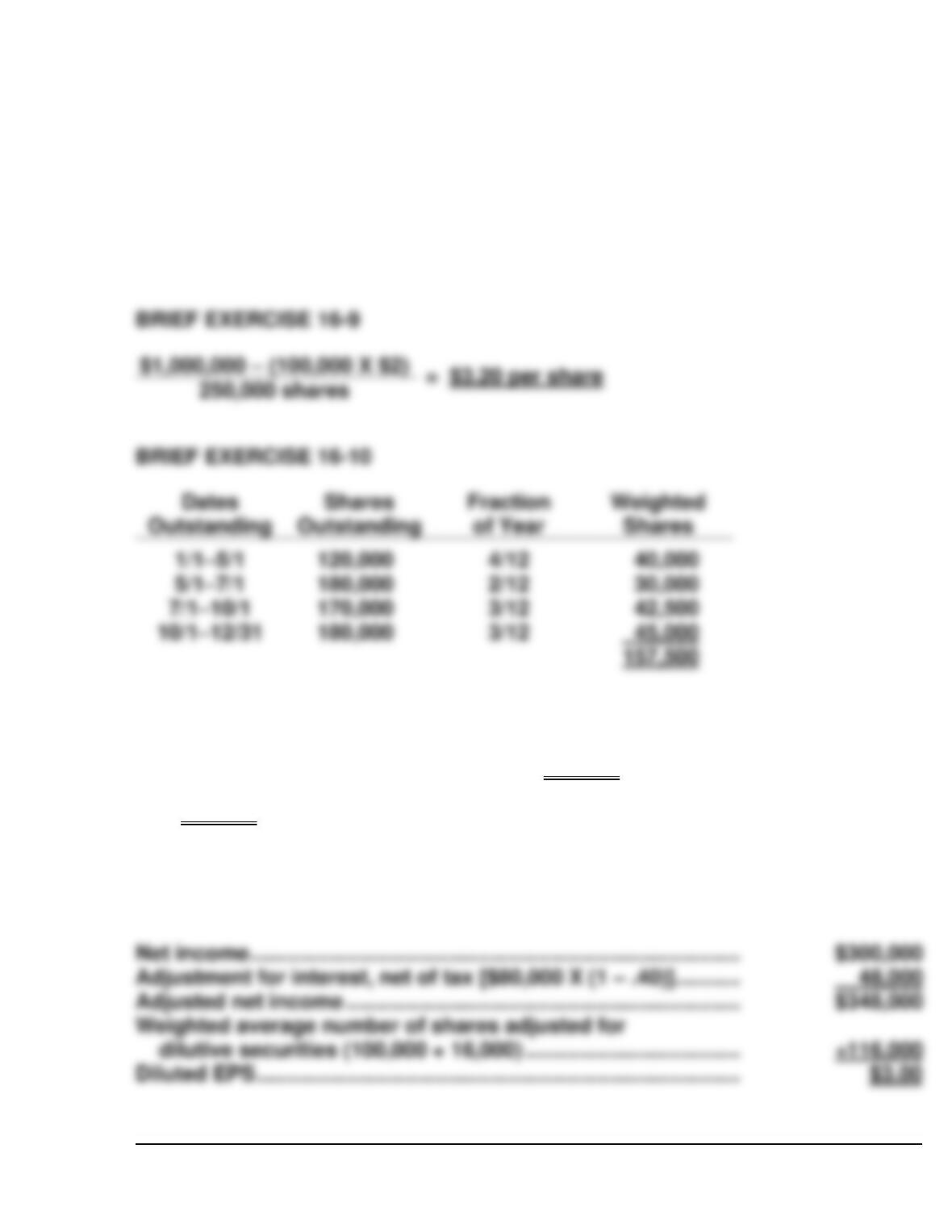
(a) (300,000 X 4/12) + (330,000 X 8/12) = 320,000
(b) 330,000 (The 30,000 shares issued in the stock dividend are assumed
outstanding from the beginning of the year.)
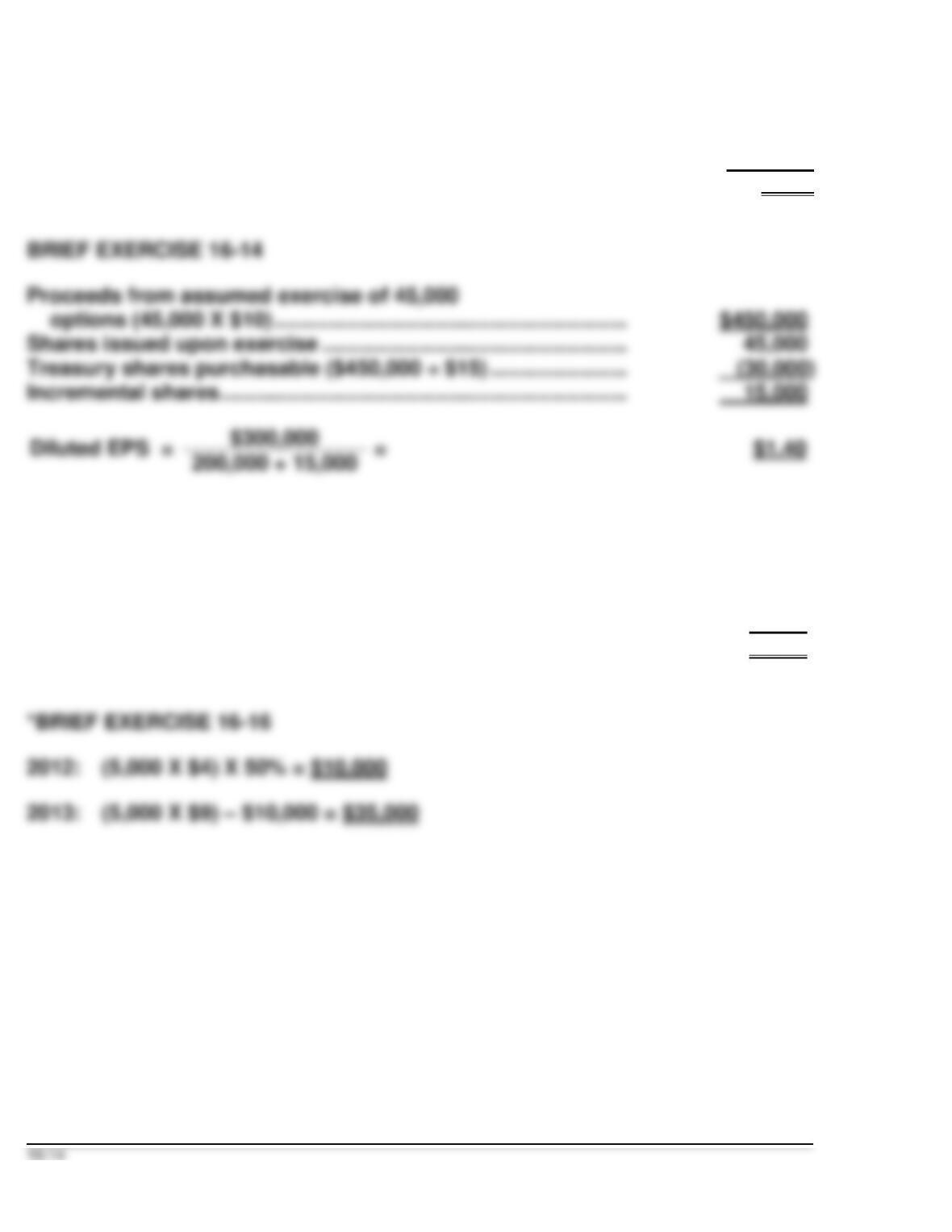
BRIEF EXERCISE 16-12
BRIEF EXERCISE 16-13
Net income ……………………………………………………………………… $270,000
Weighted average number of shares adjusted
for dilutive securities (50,000 + 10,000) …………………………. ÷ 60,000
Diluted EPS …………………………………………………………………….. $4.50
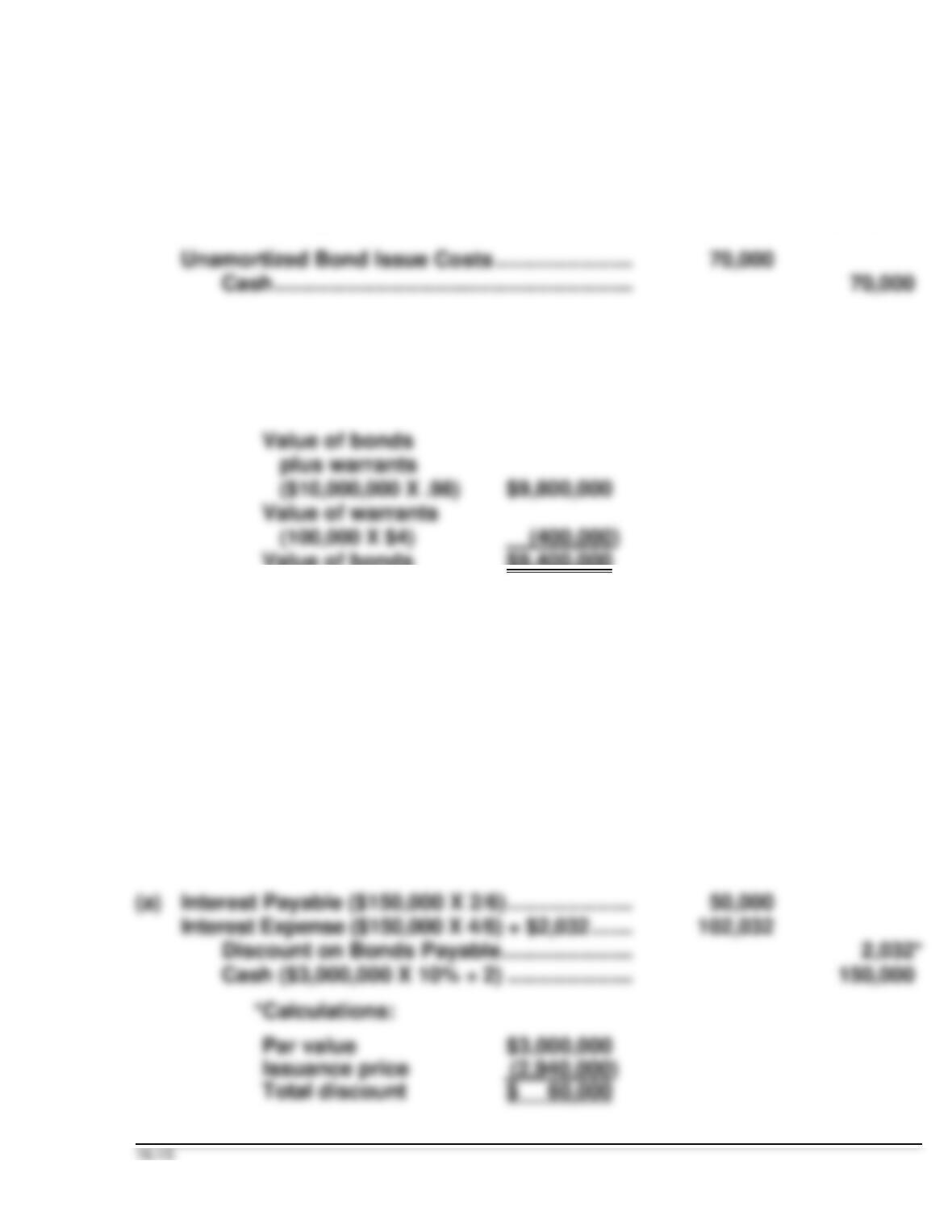
BRIEF EXERCISE 16-15
Earnings per share
Income before extraordinary loss ($600,000/100,000) ….. $ 6.00
Extraordinary loss ($120,000/100,000) ……………………….. 1.20
Net income ($480,000/100,000) ………………………………….. $ 4.80
SOLUTIONS TO EXERCISES
EXERCISE 16-1 (15–20 minutes)
1. Cash ($10,000,000 X .99) ……………………………. 9,900,000
Discount on Bonds Payable ………………………. 100,000
Bonds Payable ……………………………………. 10,000,000
2. Cash …………………………………………………………. 9,800,000
Discount on Bonds Payable ………………………. 600,000
Bonds Payable ……………………………………. 10,000,000
Paid-in Capital—Stock Warrants ………….. 400,000
Value of bonds $9,400,000
3. Debt Conversion Expense …………………………. 75,000
Bonds Payable ………………………………………….. 10,000,000
Discount on Bonds Payable …………………. 55,000
Common Stock …………………………………… 1,000,000
Paid-in Capital in Excess of Par—
Common Stock ………………………………… 8,945,000*
Cash …………………………………………………… 75,000
*[($10,000,000 – $55,000) – $1,000,000]
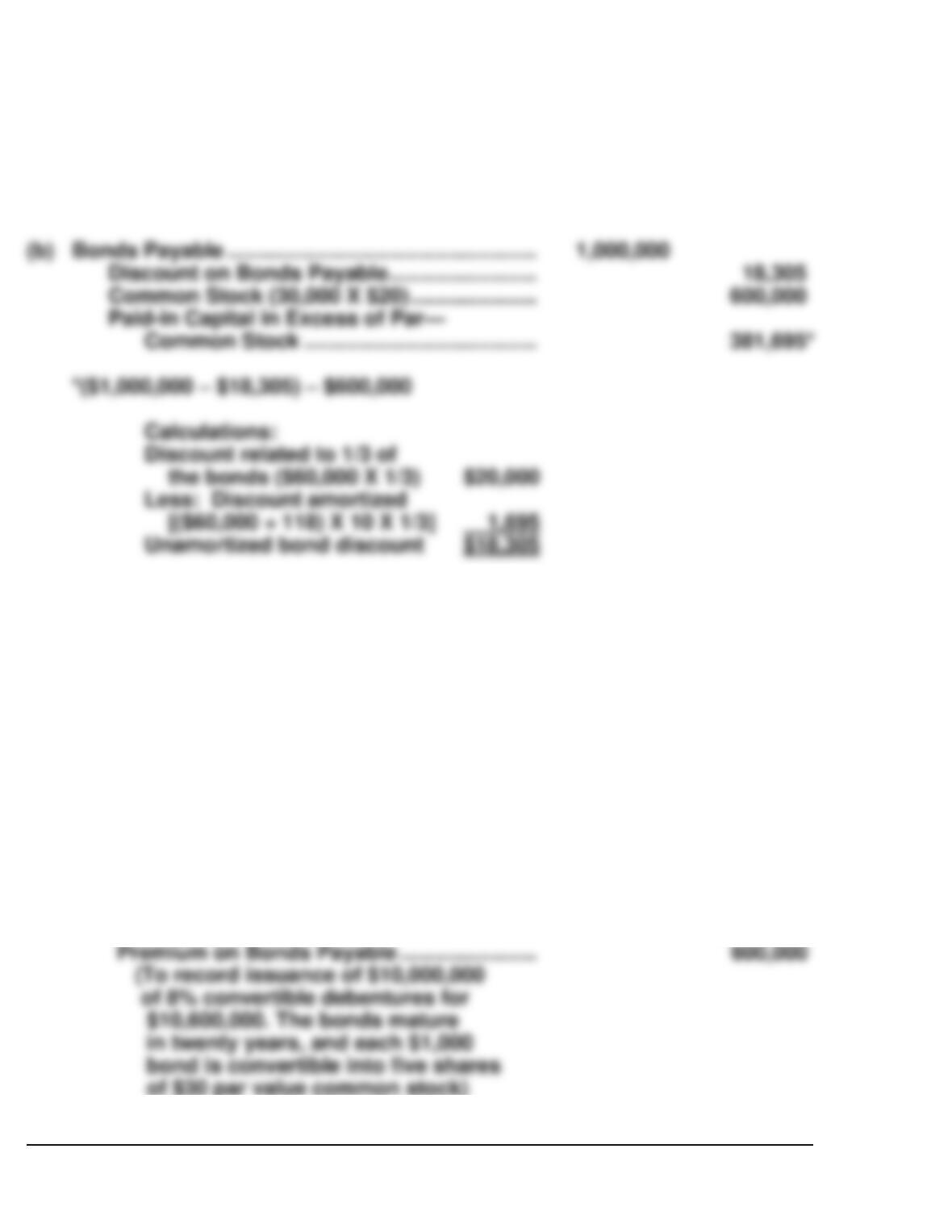
EXERCISE 16-2 (15–20 minutes)
16–16
EXERCISE 16-2 (Continued)
Months remaining 118
Discount per month
($60,000 ÷ 118) $508
Discount amortized
(4 X $508) $2,032
EXERCISE 16-3 (10–15 minutes)
Conversion recorded at book value of the bonds:
Bonds Payable …………………………………………………… 400,000
Premium on Bonds Payable ……………………………….. 6,000
Preferred Stock (400 X 20 X $50) ………………….. 400,000
Paid-in Capital in Excess of Par—
Preferred Stock ……………………………………….. 6,000
EXERCISE 16-4 (15–20 minutes)
(a) Cash …………………………………………………………… 10,600,000
Bonds Payable …………………………………….. 10,000,000
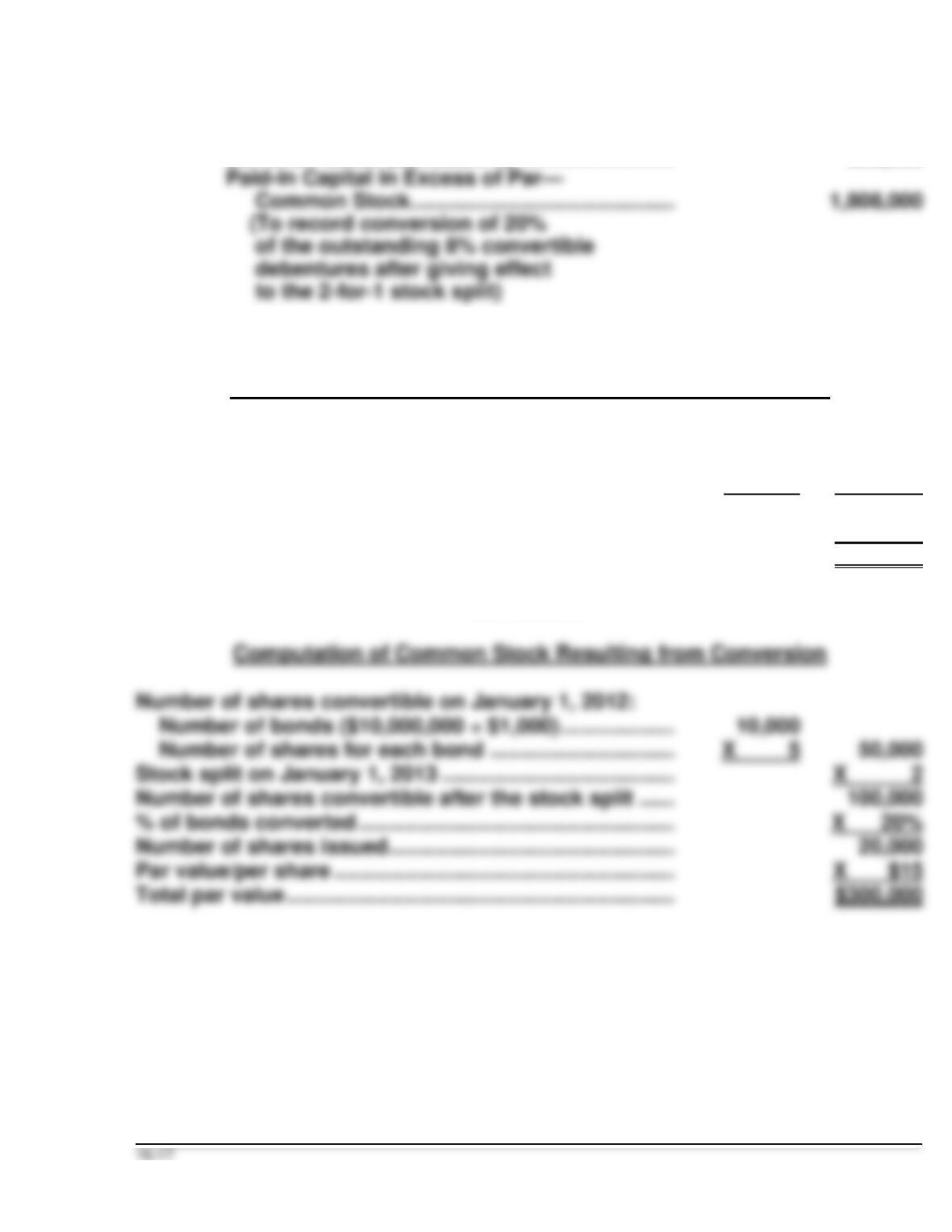
EXERCISE 16-4 (Continued)
(b) Bonds Payable ………………………………………………… 2,000,000
Premium on Bonds Payable (Schedule 1) …………. 108,000
Common Stock (Schedule 2) …………………….. 300,000
Schedule 1
Computation of Unamortized Premium on Bonds Converted
Premium on bonds payable on January 1, 2012 ……….. $600,000
Amortization for 2012 ($600,000 ÷ 20) ………………………. $30,000
Amortization for 2013 ($600,000 ÷ 20) ………………………. 30,000 60,000
Premium on bonds payable on January 1, 2014 ……….. 540,000
Bonds converted ……………………………………………………. X 20%
Unamortized premium on bonds converted ……………… $108,000
Schedule 2
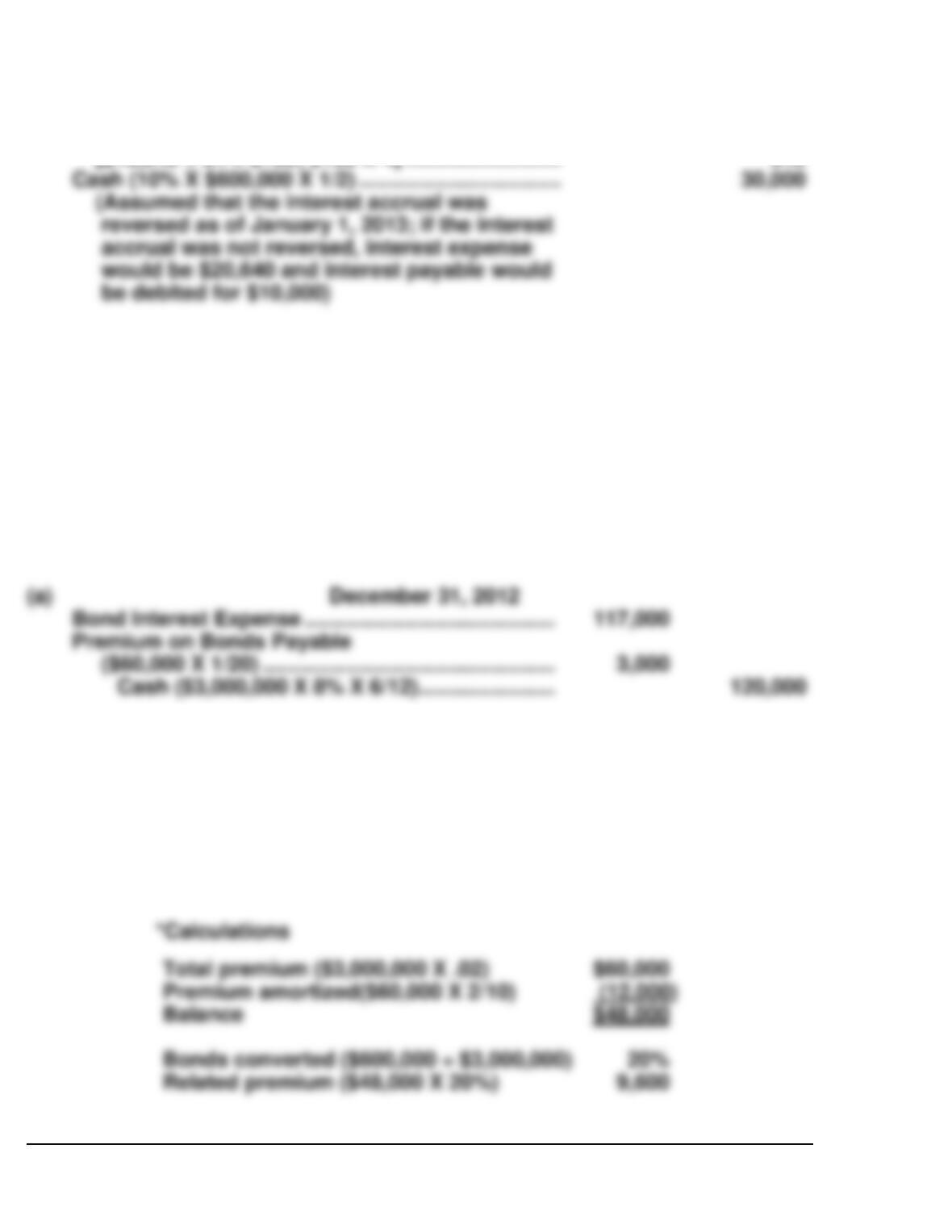
16–18
EXERCISE 16-5 (10–20 minutes)
Interest Expense ……………………………………………………. 30,640
Discount on Bonds Payable
[$10,240 ÷ 64 = $160; $160 X 4] …………………….. 640
Bonds Payable ………………………………………………………. 600,000
Discount on Bonds Payable ($10,240 – $640) ……. 9,600
Common Stock ($25 X 6 X 600) ………………………… 90,000
Paid-in Capital in Excess of Par—
Common Stock…………………………………………….. 500,400*
*($600,000 – $9,600) – $90,000
EXERCISE 16-6 (25–35 minutes)
(b) January 1, 2013
Bonds Payable ………………………………………………. 600,000
Premium on Bonds Payable ……………………………. 9,600*
Common Stock
[8 X $100 X ($600,000/$1,000)] ……………… 480,000
Paid-in Capital in Excess of Par—
Common Stock …………………………………… 129,600
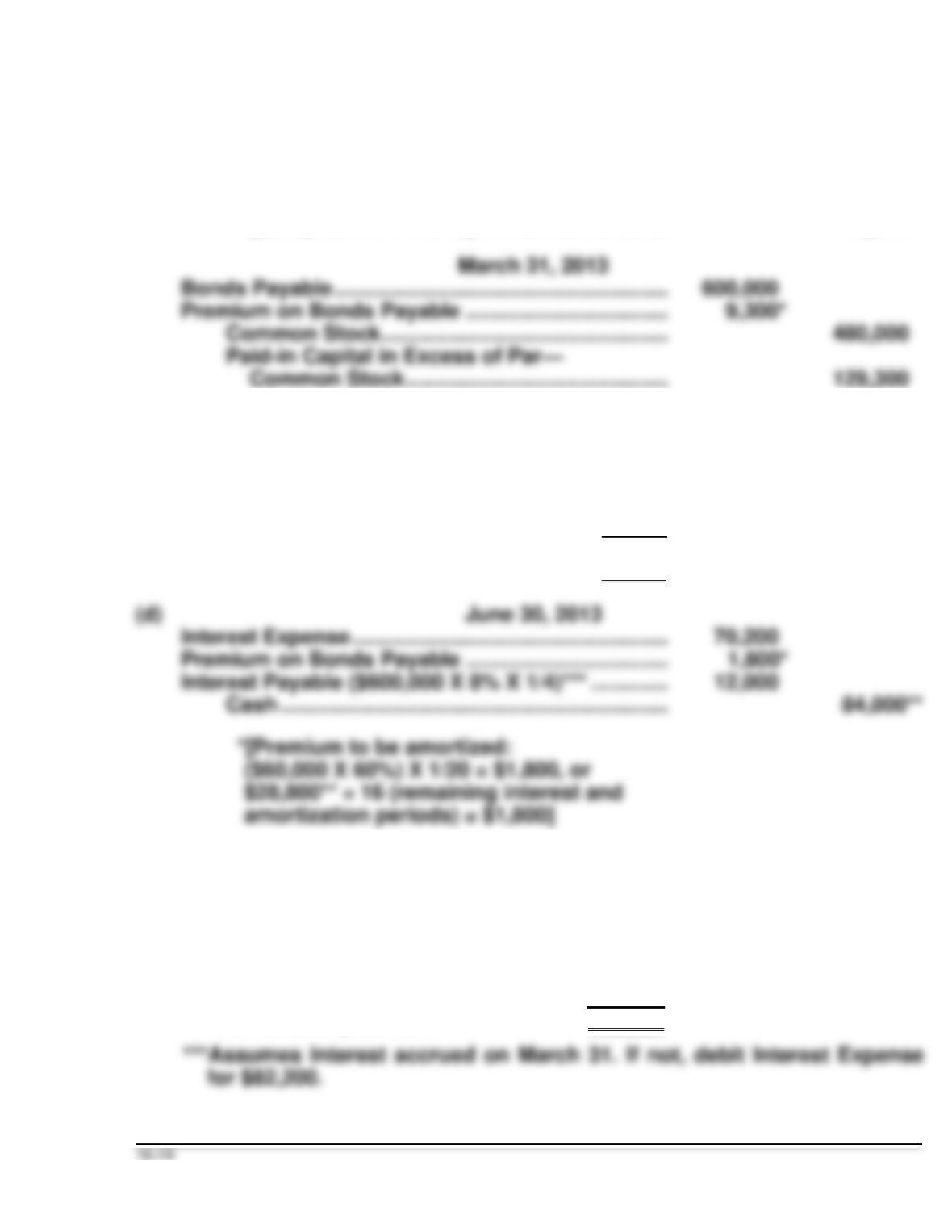
EXERCISE 16-6 (Continued)
(c) March 31, 2013
Interest Expense …………………………………………….. 11,700
Premium on Bonds Payable
($9,600 ÷ 8 years) X 3/12 ………………………………. 300
Interest Payable
($600,000 X 8% X 3/12) ………………………….. 12,000
*Calculations
Premium as of January 1, 2013
for $600,000 of bonds $9,600
$9,600 ÷ 8 years remaining
X 3/12 (300)
Premium as of March 31, 2013
for $600,000 of bonds $9,300
**Total to be paid: ($1,800,000 X 8% ÷ 2) + $12,000 = $84,000
***Original premium $60,000
2011 amortization (6,000)
2012 amortization (6,000)
Jan. 1, 2013 write-off (9,600)
Mar. 31, 2013 amortization (300)
Mar. 31, 2013 write-off (9,300)
Unamortized premium $28,800
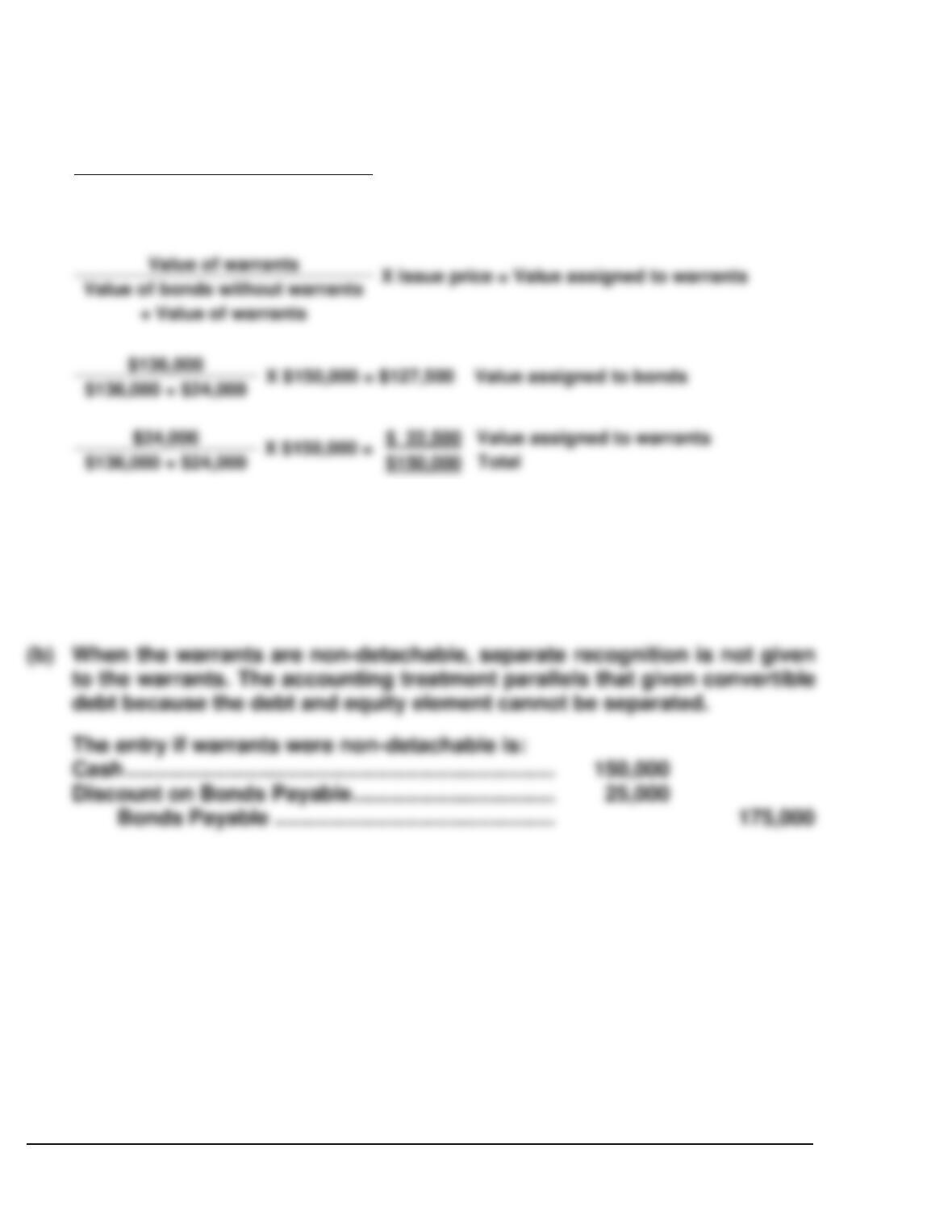
16–20
EXERCISE 16-7 (10–15 minutes)
(a) Basic formulas:
Value of bonds without warrants
X Issue price = Value assigned to bonds
Value of bonds without warrants
+ Value of warrants
Cash ……………………………………………………………… 150,000
Discount on Bonds Payable
($175,000 – $127,500) …………………………………… 47,500
Bonds Payable ……………………………………….. 175,000
Paid-in Capital—Stock Warrants ………………. 22,500
Value of bonds without warrants
+ Value of warrants