CHAPTER 15 – 1
CHAPTER 16
SHORT-TERM FINANCIAL PLANNING
Answers to Concepts Review and Critical Thinking Questions
1. These are firms with relatively long inventory periods and/or relatively long receivables periods. Thus,
such firms tend to keep inventory on hand, and they allow customers to purchase on credit and take a
relatively long time to pay.
3. a. Use: The cash balance declined by $200 to pay the dividend.
b. Source: The cash balance increased by $500 assuming the goods bought on payables credit
were sold for cash.
c. Use: The cash balance declined by $900 to pay for the fixed assets.
d. Use: The cash balance declined by $625 to pay for the higher level of inventory.
e. Use: The cash balance declined by $1,200 to pay for the redemption of debt.
6. It lengthened its payables period, thereby shortening its cash cycle. There was no effect on the
operating cycle.
7. Their receivables period increased, thereby increasing their operating and cash cycles.
8. It is sometimes argued that large firms “take advantage of” smaller firms by threatening to take their
business elsewhere. However, considering a move to another supplier to get better terms is the nature
of competitive free enterprise.
CHAPTER 15 – 2
Solutions to Questions and Problems
NOTE: All end-of–chapter problems were solved using a spreadsheet. Many problems require multiple
steps. Due to space and readability constraints, when these intermediate steps are included in this solutions
manual, rounding may appear to have occurred. However, the final answer for each problem is found
without rounding during any step in the problem.
Basic
1. a. No change. A dividend paid for by the sale of debt will not change cash since the cash raised
from the debt offer goes immediately to shareholders.
b. No change. The real estate is paid for by the cash raised from the debt, so this will not change
the cash balance.
g. No change. Accounts receivable will increase, but cash will not increase until the sales are paid
off.
h. Decrease. The interest is paid with cash, which will reduce the cash balance.
i. Increase. When payments for previous sales, or accounts receivable, are paid off, the cash balance
increases since the payment must be made in cash.
CHAPTER 15 – 3
2. The total liabilities and equity of the company are the book value of equity, plus current liabilities and
long-term debt, so:
Total liabilities and equity = $13,465 + 1,630 + 8,200
Total liabilities and equity = $23,295
Since total assets must equal total liabilities and equity, we can solve for cash as:
Cash = Total assets – Fixed assets – (Accounts receivable + Inventory)
Cash = $23,295 – 18,380 – 3,905
Cash = $1,010
3. a. Increase. If receivables go up, the time to collect the receivables would increase, which increases
the operating cycle.
b. Increase. If credit repayment times are increased, customers will take longer to pay their bills,
which will lead to an increase in the operating cycle.
4. a. Increase; Increase. If the terms of the cash discount are made less favorable to customers, the
accounts receivable period will lengthen. This will increase both the cash cycle and the operating
cycle.
b. Increase; No change. This will shorten the accounts payable period, which will increase the cash
cycle. It will have no effect on the operating cycle since the length of the operating cycle is not
affected by the payables period.
CHAPTER 15 – 4
d. Decrease; Decrease. Fewer raw materials purchased will reduce the inventory period, which will
decrease both the cash cycle and the operating cycle.
5. a. 45-day collection period implies all receivables outstanding from previous quarter are collected
in the current quarter, and (90 – 45) / 90 = 1/2 of current sales are collected.
Q1
Q2
Q3
Q4
Beginning receivables
$330
$293
$338
$315
Sales
585
675
630
895
Cash collections
623
630
653
763
Ending receivables
$293
$338
$315
$448
Q1
Q2
Q3
Q4
Beginning receivables
$330
$390
$450
$420
Sales
585
Cash collections
525
Ending receivables
$390
$450
$420
$597
b. 60-day collection period implies all receivables outstanding from previous quarter are collected
in the current quarter, and (90 – 60) / 90 = 1/3 of current sales are collected.
c. 30-day collection period implies all receivables outstanding from previous quarter are collected
in the current quarter, and (90 – 30) / 90 = 2/3 of current sales are collected.
Beginning receivables
$330
$195
$225
$210
Sales
585
675
630
895
Cash collections
720
645
645
807
Ending receivables
$195
$225
$210
$298
CHAPTER 15 – 5
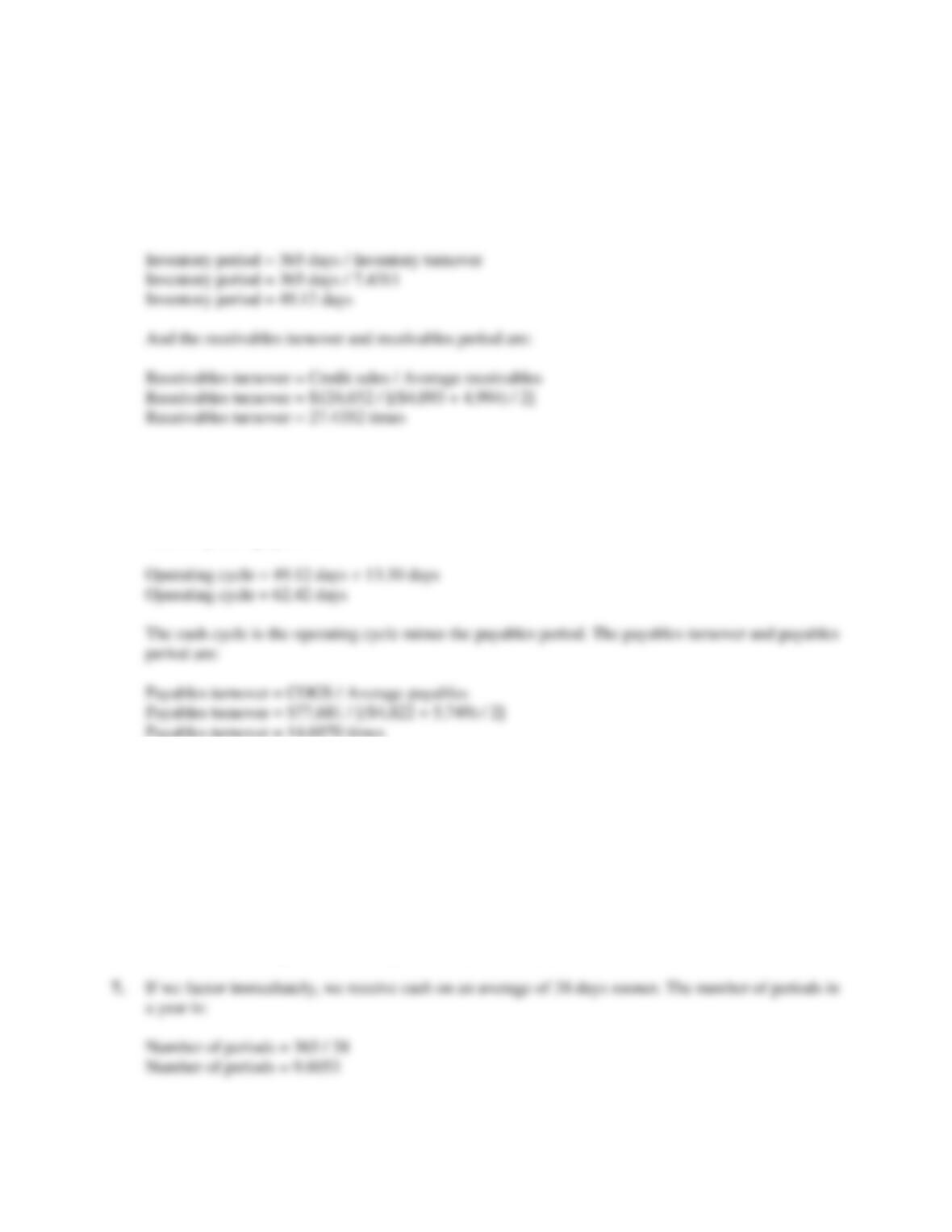
6. The operating cycle is the inventory period plus the receivables period. The inventory turnover and
inventory period are:
Inventory turnover = COGS / Average inventory
Inventory turnover = $77,681 / [($9,605 + 11,302) / 2]
Inventory turnover = 7.4311 times
Receivables period = 365 days / Receivables turnover
Receivables period = 365 days / 27.4352
Receivables period = 13.30 days
So, the operating cycle is:
Payables turnover = 14.6970 times
Payables period = 365 days / Payables turnover
Payables period = 365 days / 14.6970
Payables period = 24.83 days
So, the cash cycle is:
Cash cycle = 62.42 days – 24.83 days
Cash cycle = 37.59 days
The firm is receiving cash on average 37.59 days after it pays its bills.
CHAPTER 15 – 6
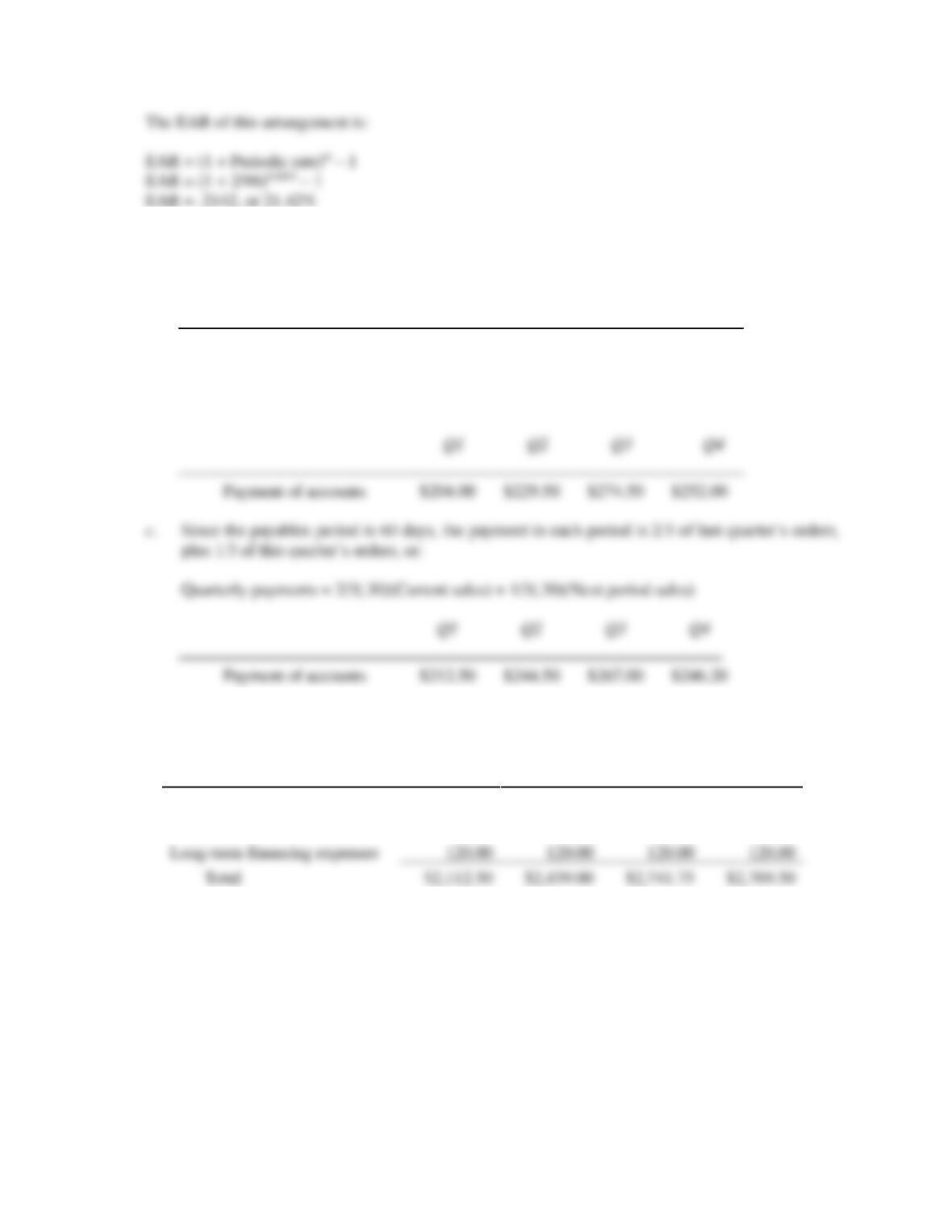
8. a. The payables period is zero since the company pays immediately. The payment in each period is
30 percent of next period’s sales, so:
Q1 Q2 Q3 Q4
Payment of accounts $229.50 $274.50 $252.00 $234.60
b. Since the payables period is 90 days, the payment in each period is 30 percent of the current
period sales, so:
9. Since the payables period is 60 days, payables in each period = 2/3 of last quarter’s orders, and 1/3 of
this quarter’s orders, or 2/3(.75)(Current sales) + 1/3(.75)(Next period sales)
Q1
Q2
Q3
Q4
Payment of accounts
$1,445.00
$1,680.00
$1,883.75
$1,865.00
Wages, taxes, other expenses
547.50
639.00
738.00
784.50
Long-term financing expenses
120.00
120.00
120.00
120.00
Total
$2,112.50
$2,439.00
$2,741.75
$2,769.50
10. a. The November sales must have been the total uncollected sales minus the uncollected sales from
December, divided by the collection rate two months after the sale, so:
November sales = ($97,000 – 71,000) / .15
November sales = $173,333.33
CHAPTER 15 – 7
b. The December sales are the uncollected sales from December divided by the sum of the collection
rates from the previous two months’ sales, so:
11. The sales collections each month will be:
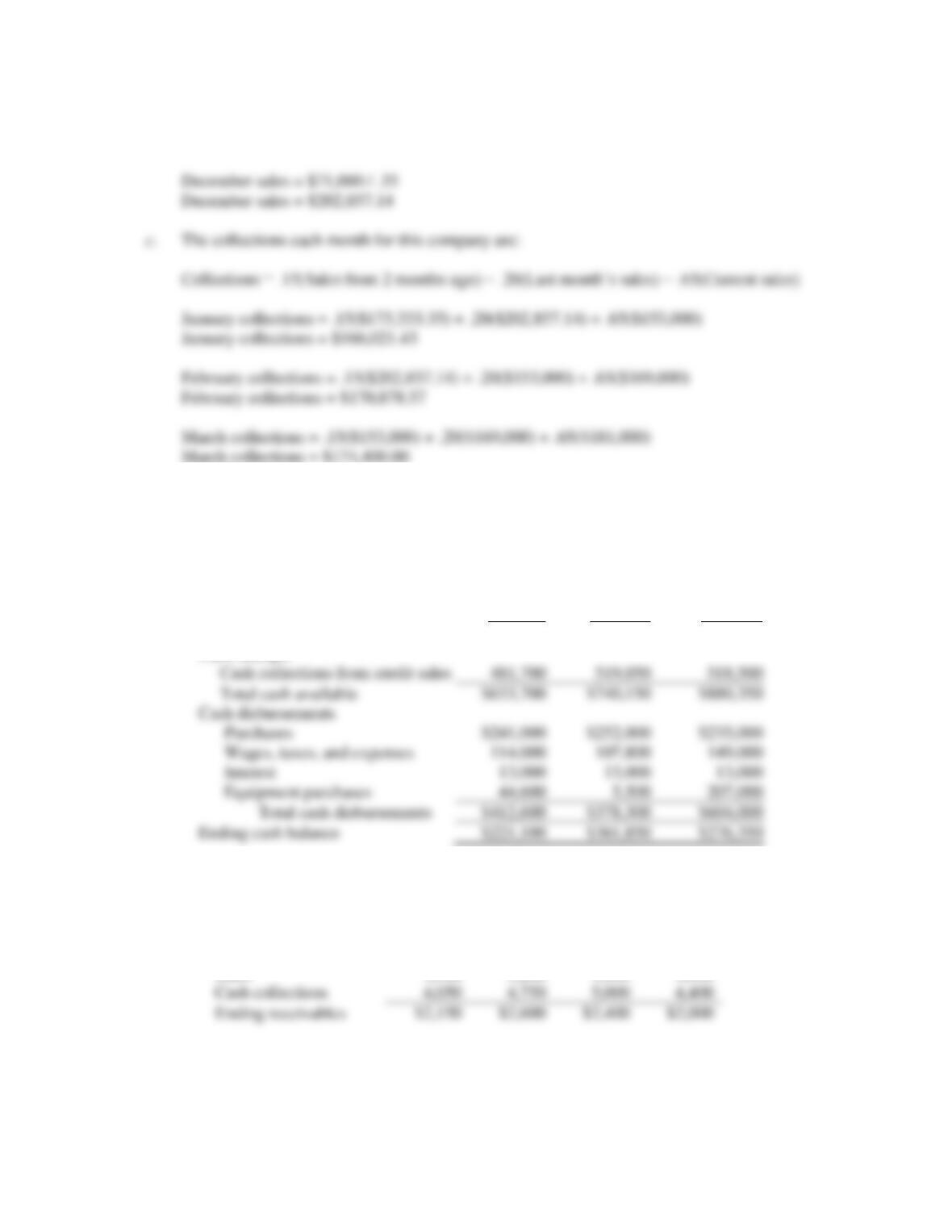
Sales collections = .35(Current month sales) + .60(Previous month sales)
Given this collection, the cash budget will be:
April
May
June
Beginning cash balance
$152,000
$221,100
$361,850
Cash receipts
Cash collections from credit sales
Total cash available
$633,700
$740,150
$880,350
Cash disbursements
Purchases
$241,000
$252,000
$235,000
Wages, taxes, and expenses
Interest
Equipment purchases
Total cash disbursements
$412,600
$378,300
$604,000
Ending cash balance
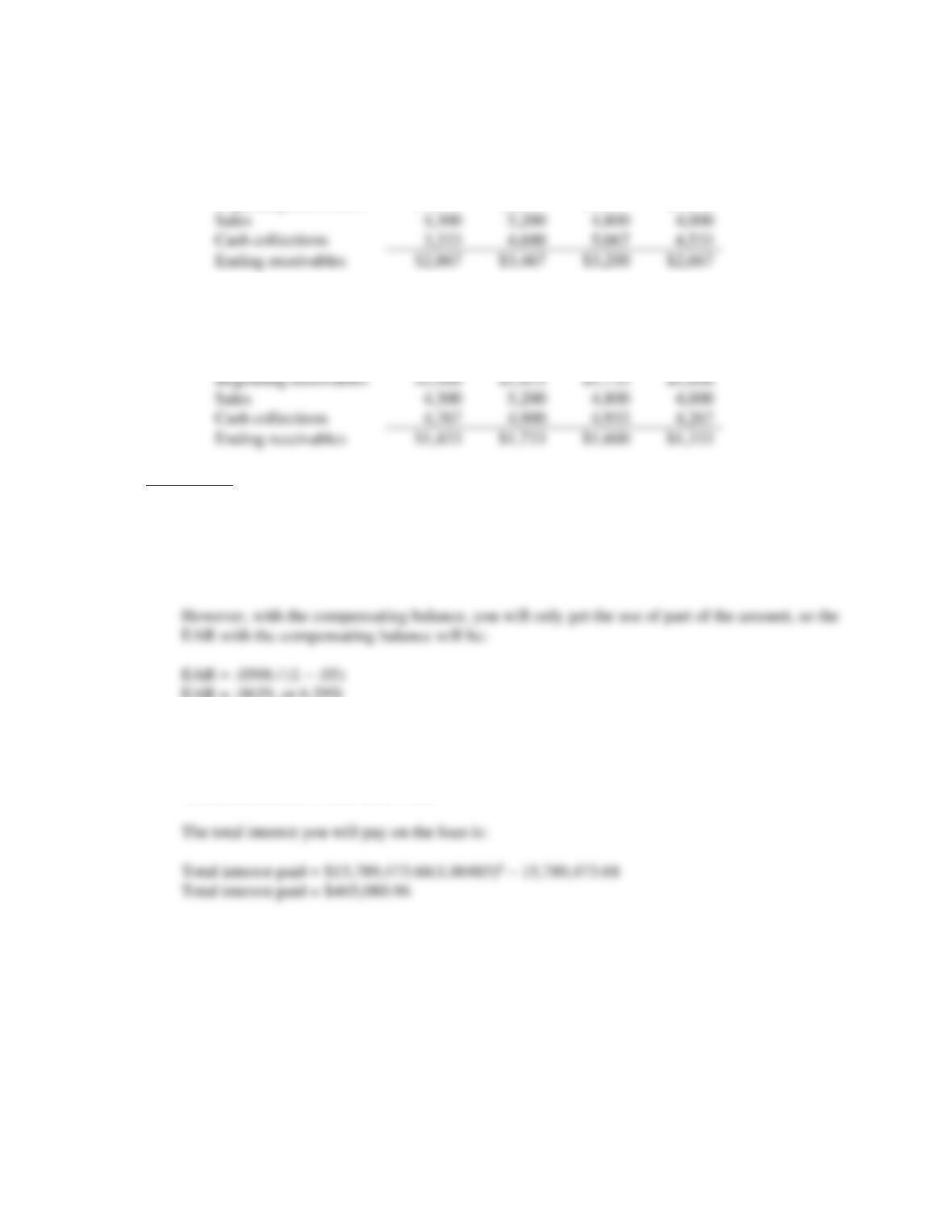
12. a. 45-day collection period implies all receivables outstanding from previous quarter are collected
in the current quarter, and (90 – 45) / 90 = 1/2 of current sales are collected.
Q1
Q2
Q3
Q4
Beginning receivables
$1,900
$2,150
$2,600
$2,400
Sales
4,300
5,200
4,800
4,000
Cash collections
4,050
4,750
5,000
4,400
Ending receivables
CHAPTER 15 – 8
b. 60-day collection period implies all receivables outstanding from previous quarter are collected
in the current quarter, and (90 – 60) / 90 = 1/3 of current sales are collected.
Q1
Q2
Q3
Q4
Beginning receivables
$1,900
$2,867
$3,467
$3,200
c. 30-day collection period implies all receivables outstanding from previous quarter are collected
in the current quarter, and (90 – 30) / 90 = 2/3 of current sales are collected.
Q1
Q2
Q3
Q4
Beginning receivables
Sales
Cash collections
Ending receivables
$1,433
$1,733
$1,600
$1,333
Intermediate
13. a. The EAR of the loan without the compensating balance is:
EAR = (1 + .00485)12 – 1
EAR = .0598, or 5.98%
EAR = .0629, or 6.29%
b. To end up with $15,000,000, you must borrow:
Amount to borrow = $15,000,000 / (1 – .05)
Amount to borrow = $15,789,473.68
Sales
Cash collections
Ending receivables
$2,867
$3,467
$3,200
$2,667
CHAPTER 15 – 9
14. a. The EAR of your investment account is:
EAR = 1.00494 – 1
EAR = .0197, or 1.97%
b. To calculate the EAR of the loan, we can divide the interest on the loan by the amount of the
loan. The interest on the loan includes the opportunity cost of the compensating balance. The
opportunity cost is the amount of the compensating balance times the potential interest rate you
could have earned. The compensating balance is only on the unused portion of the credit line, so:
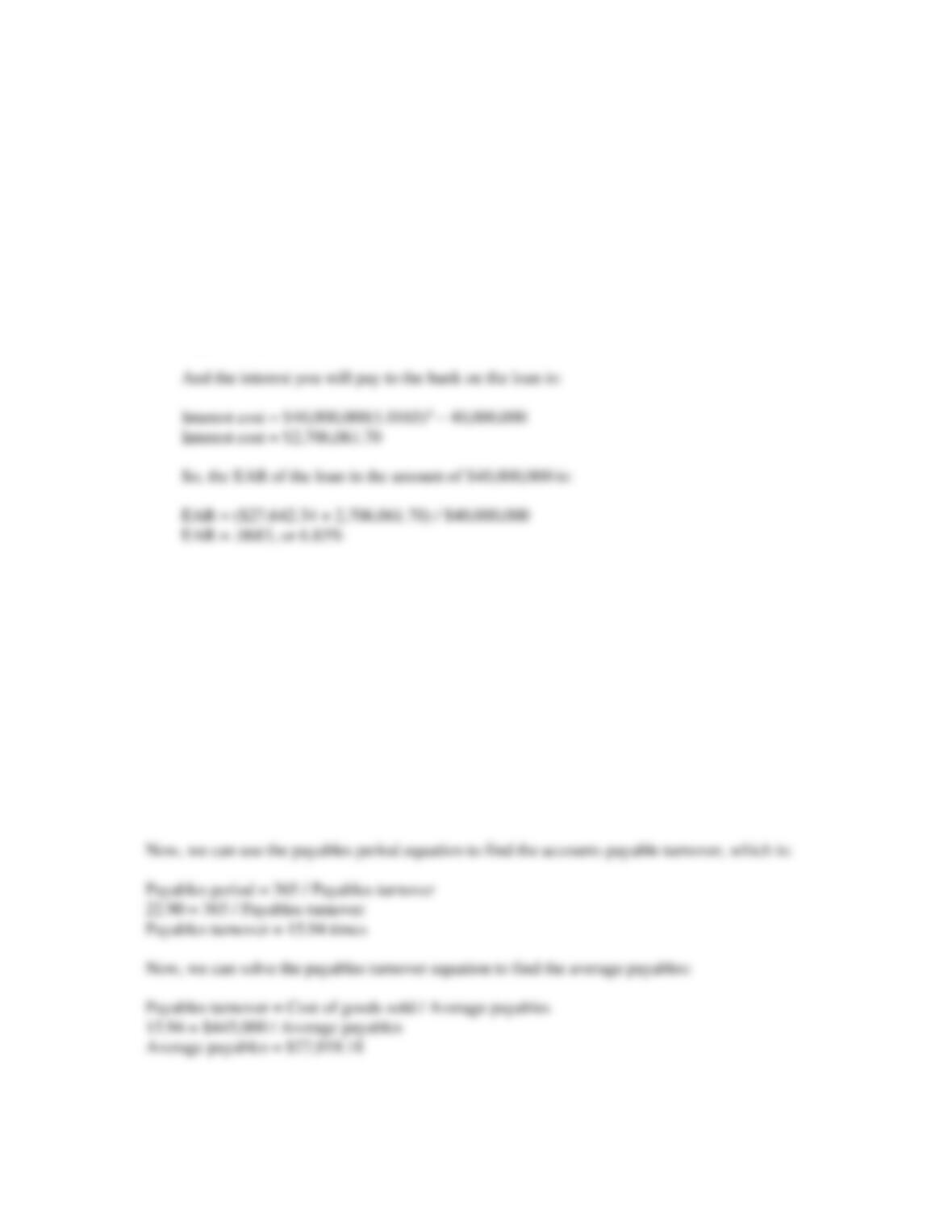
Opportunity cost = .04($75,000,000 – 40,000,000)(1.0049)4 – .04($75,000,000 – 40,000,000)
Opportunity cost = $27,642.34
c. The compensating balance is only applied to the unused portion of the credit line, so the EAR of
a loan on the full credit line is:
EAR = 1.01654 – 1
EAR = .0677, or 6.77%
15. Here, we need to use the cash cycle and operating cycles to calculate the average accounts payable
and average accounts receivable. We are given the cash cycle and the operating cycle, so the payables
period is:
Cash cycle = Operating cycle – Payables period
36.50 days = 59.40 days – Accounts payable period
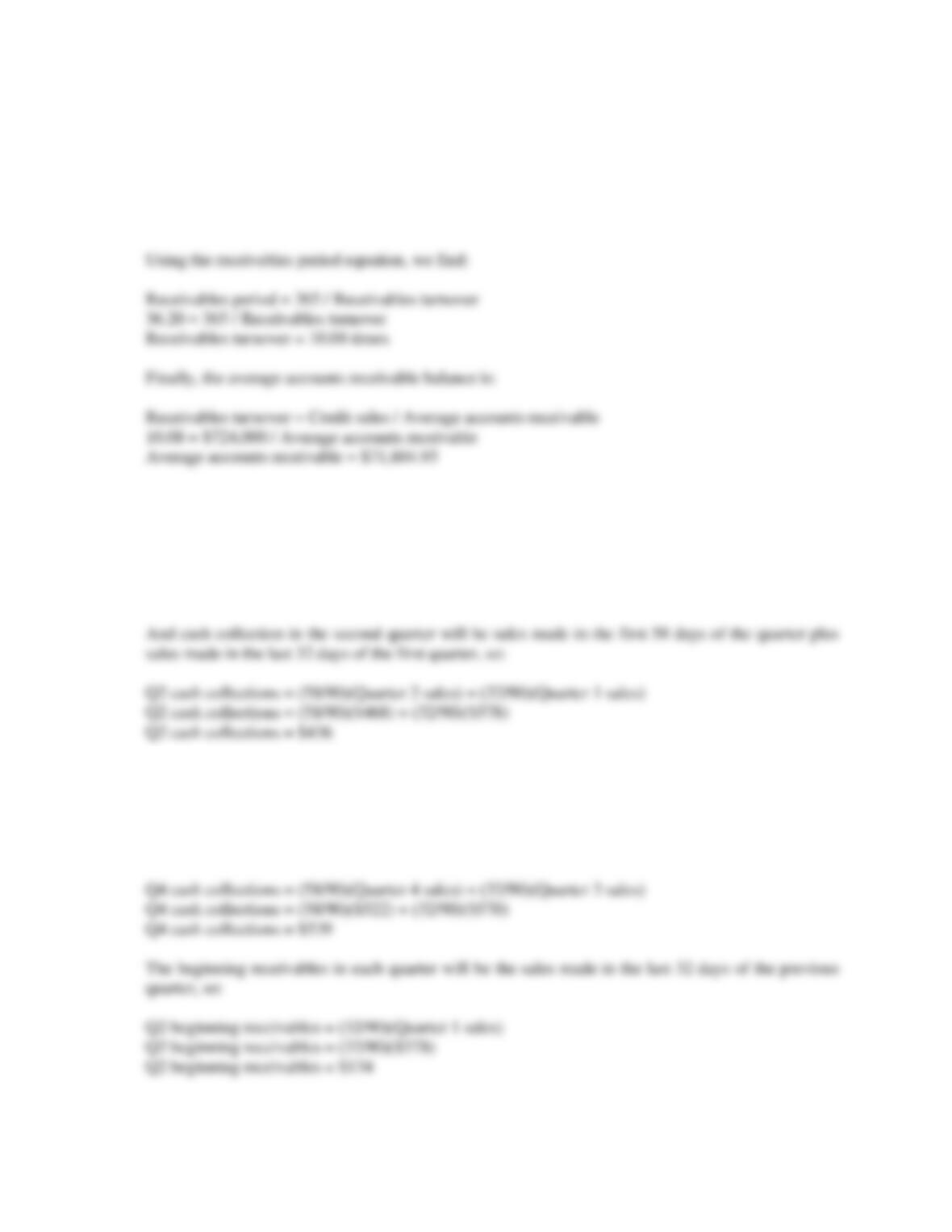
Accounts payable period = 22.90 days
CHAPTER 15 – 10
Next, we can find the average accounts receivable. Using the equation for the operating cycle, the
accounts receivable period is:
Operating cycle = Inventory period + Receivables period
59.40 days = 23.20 days + Receivables period
Receivables period = 36.20 days
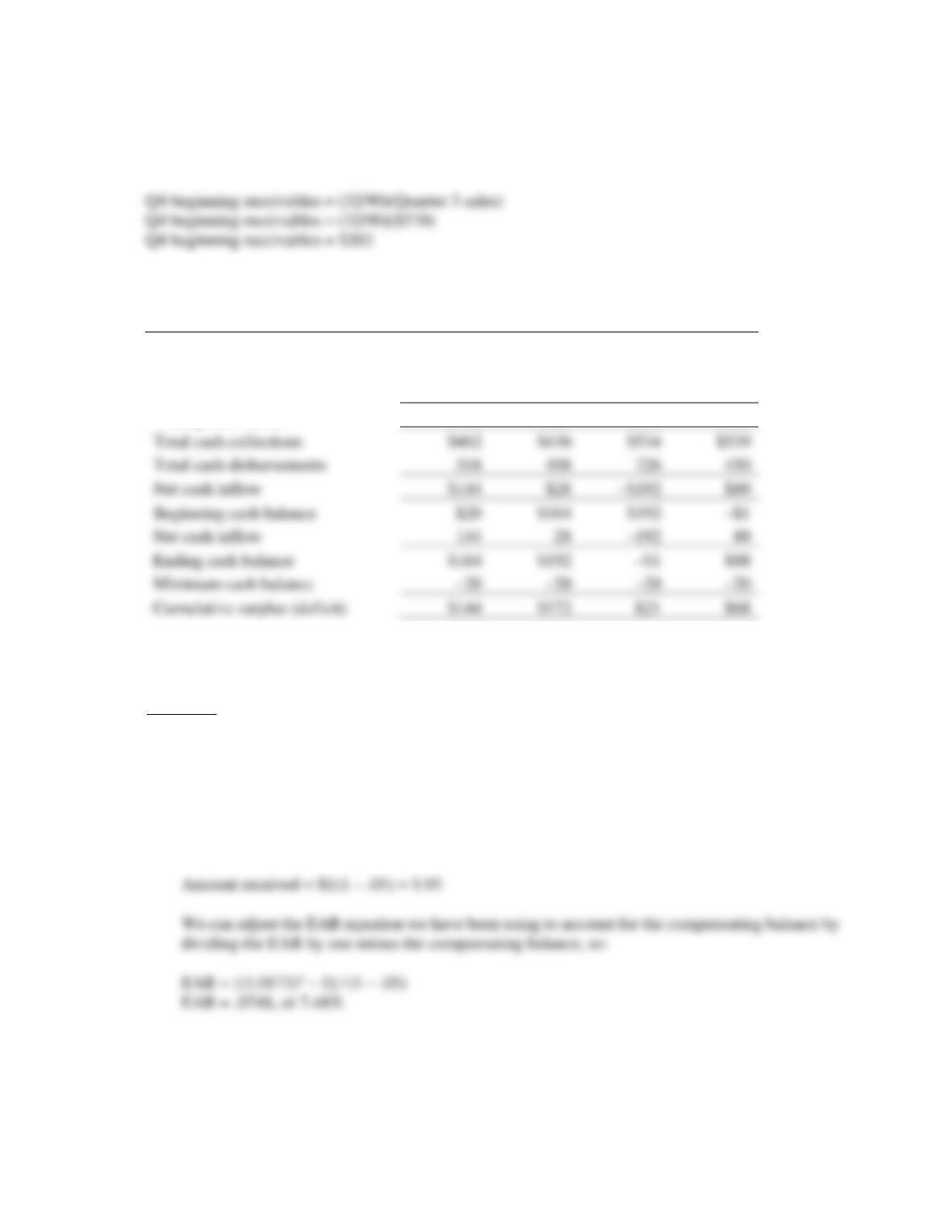
16. Since the company has a 32-day collection period, only those sales made in the first 58 days of the
quarter will be collected in that quarter. Total cash collections in the first quarter will be:
Q1 cash collections = Beginning receivables + (58/90)(Quarter 1 sales)
Q1 cash collections = $218 + (58/90)($378)
Q1 cash collections = $462
Quarter 3 and Quarter 4 collections will be:
Q3 cash collections = (58/90)(Quarter 3 sales) + (32/90)(Quarter 2 sales)
Q3 cash collections = (58/90)($570) + (32/90)($468)
Q3 cash collections = $534
CHAPTER 15 – 11
Q3 beginning receivables = (32/90)(Quarter 2 sales)
Q3 beginning receivables = (32/90)($468)
Q3 beginning receivables = $166
The cash budget (in millions) for the company is:
Q1
Q2
Q3
Q4
Beginning receivables
$218
$134
$166
$203
Sales
378
468
570
522
Cash collections
462
436
534
539
Ending receivables
$134
$166
$203
$186
Beginning cash balance
$20
$164
$192
Net cash inflow
144
Ending cash balance
$164
$192
$88
Minimum cash balance
Cumulative surplus (deficit)
$144
$172
$68
The company has a cash surplus for much of the year, but in Quarter 3, it will need to raise $21 million
to cover its cash flows.
Challenge
17. a. For every dollar borrowed, you pay quarterly interest of:
Interest = $1(.0173) = $.0173
You also must maintain a compensating balance of 5 percent of the funds borrowed, so for each
dollar borrowed, you will only receive:
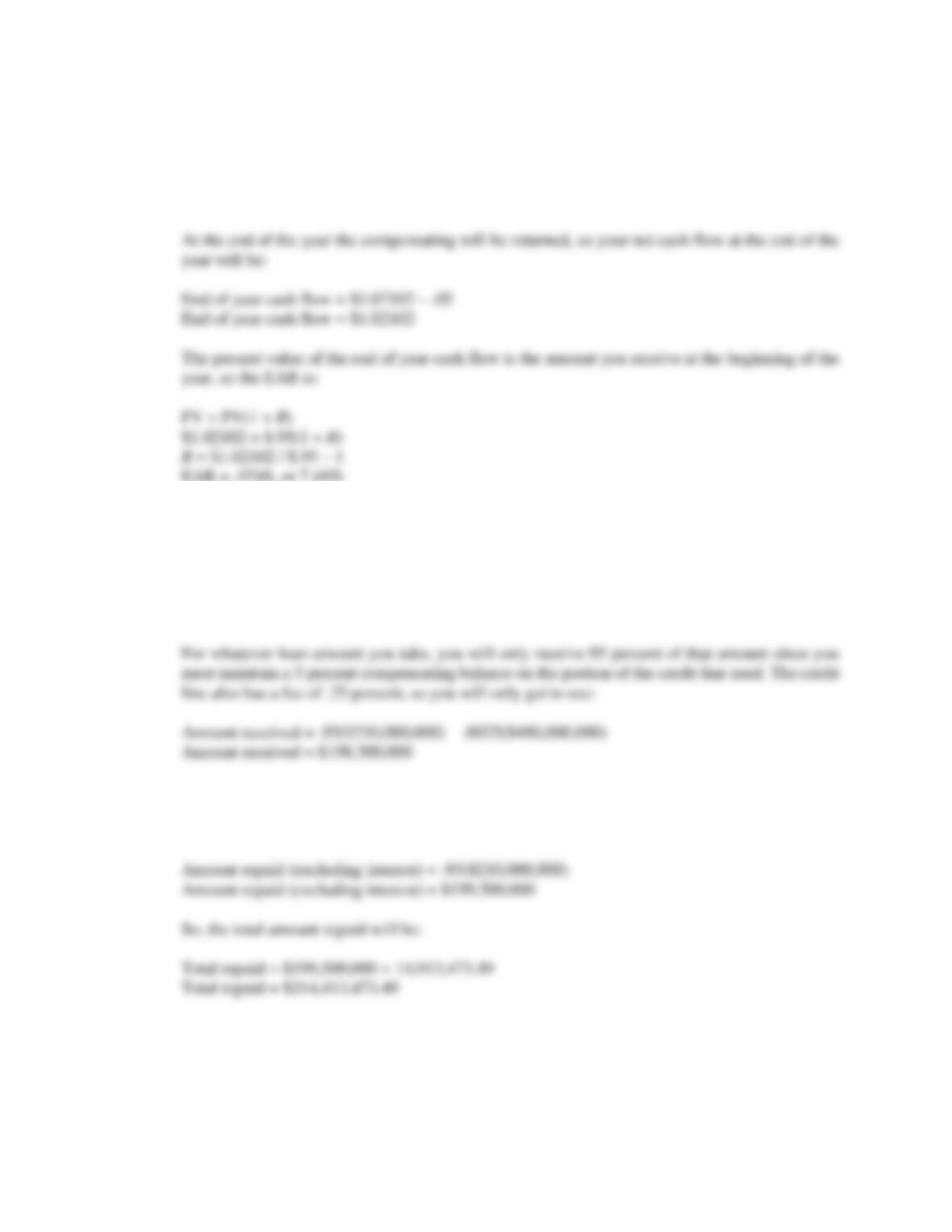
CHAPTER 15 – 12
Another way to calculate the EAR is using the FVIF (or PVIF). For each dollar borrowed, we
must repay:
Amount owed = $1(1.0173)4
Amount owed = $1.07102
EAR = .0748, or 7.48%
b. The EAR is the amount of interest paid on the loan divided by the amount received when the loan
is originated. The amount of interest you will pay on the loan is the amount of the loan times the
effective annual interest rate, so:
Interest = $210,000,000[(1.0173)4 – 1]
Interest = $14,913,473.49
At the end of the loan, you will not repay the amount received since the commitment fee is a one–
time fee paid up front. The amount you will repay (excluding interest) at the end of the loan will
be the amount received plus the commitment, or:
CHAPTER 15 – 13
So, the EAR of the loan is:
FV = PV(1 + R)
$214,413,473.49 = $198,500,000(1 + R)
R = .0802, or 8.02%
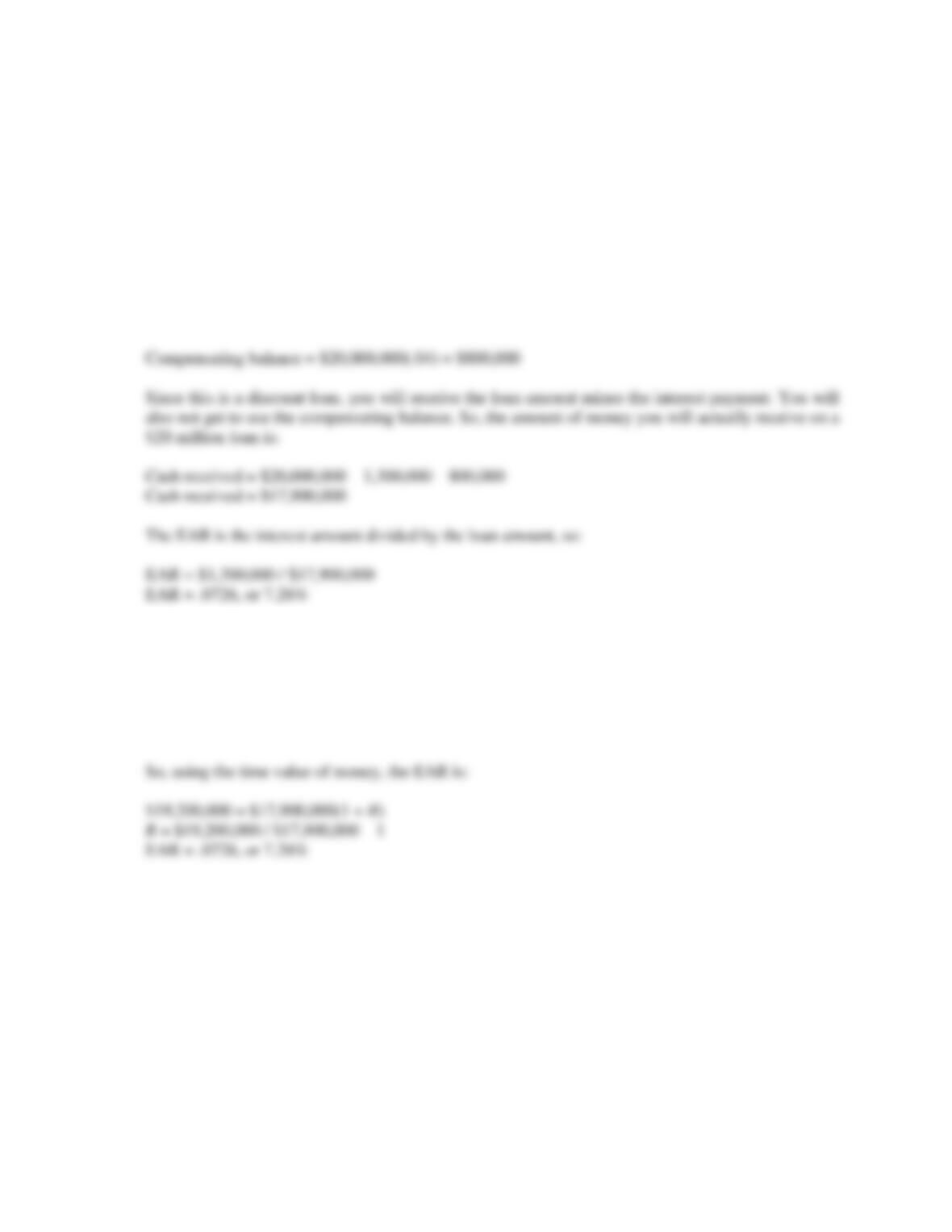
18. You will pay interest of:
Interest = $20,000,000(.065) = $1,300,000
Additionally, the compensating balance on the loan is:
We can also use the FVIF (or PVIF) here to calculate the EAR. Your cash flow at the beginning of the
year is $17,900,000. At the end of the year, your cash flow is the loan repayment, but you will also
receive your compensating balance back, so:
End of year cash flow = $20,000,000 – 800,000
End of year cash flow = $19,200,000