
Accounting Information Systems, 10e 1
SOLUTIONS FOR CHAPTER 16
Each end-of-chapter question in the Solutions Manual is tagged to correspond with AACSB, AICPA
and CISA standards, allowing professors to more easily manage the task of reporting outcomes to these
professional and accrediting bodies. Please see the corresponding spreadsheet file for the tagging
information.
Discussion Questions
DQ 16-1 Discuss fully the difference between the “contexts” of Figure 16.1 and Figure
16.4.
ANS. Figure 16.1’s representation of the general ledger/business reporting (GL/BR)
process considers the controller, the treasurer, the budgeting department, and the
managerial reporting officer to be within the process. Figure 16.4 considers all
these entities to be external to the GL/BR process.
Flow Number
in Figure 16.1
Discussion
2, 3, 5, and 6
These flows are shown within the GL/BR process in Figure 16.1. In Figure 16.4, they all
appear as data flows running from or to external entities.

2 Solutions for Chapter 16
1. Flow number 1, shown as a single flow in Figure 16.1, appears in Figure 16.4
as several data flows from specific AIS feeder processes. This is merely a
difference in presentation.
2. Flow number 4 in Figure 16.1 is buried within the single context bubble in
Figure 16.4. It does not appear as a data flow until the context diagram is
exploded into a level 0 DFD (see Figure 16.6).
DQ 16-2 Four managers (or departments) are shown in Figure 16.1 as reporting to the
controller. Setting aside your personal career inclinations and aspirations and
ignoring any work experience you have, for which position do you think your
college academic studies to date have best prepared you? Discuss. Does your
answer hold any implications for the curriculum design at your college? Explain.
ANS. Although student answers to this question depend on their college’s curriculum,
their answers may also be largely personal. The following notes and questions
provide the foundations for an answer.
We suspect that the majority of students at most institutions will identify more
with the roles of the manager of the business reporting department or the financial
reporting officer than they will with the roles of the other two areas shown in
Figure 16.1. We suspect that they will make this identification because of the
heavy emphasis on financial accounting and on public accounting practice that
exists in many college curricula (and accounting textbooks), including the
curriculum at our universities.
Accounting Information Systems, 10e 3
• The influence of the CPA examination on the content of accounting textbooks
and, in turn, on curriculum design.
environment).
DQ 16-3 In the real world, what problems might an organization face in performing
interim closings? For example, the books might be left open after a December 31
closing until adjusting entries are made in March or April. During the same
period, interim financial statements for the new year are required. Can you
suggest any solutions for those problems? Discuss fully.
ANS. The term “interim closings” refers to the process of preparing interim financial
statements at times other than at end-of-year. Although these statements provide
useful information to management (and are required for certain SEC filings), an
4 Solutions for Chapter 16
Other practical problems associated with interim closings include but are not
limited to the following:
• The length of time to perform the interim closings. Can operating managers
respond effectively and efficiently to problems if they do not receive
information on a timely basis? In many companies, lags in interim closings
range from one workday to eight months after the end of the period being
reported.
o Some of the feeder processes are manual, whereas others are
computerized.
o The organization uses a combination of in-house as well as service
bureau software and hardware.
o The operating units are different companies that are scattered
internationally.
Improvements in technology in recent years (i.e., the increased interconnectivity
of hardware, improved telecommunications, the maturing of application process
software, and the availability of ERP software) have lessened this problem in
most organizations.
DQ 16-4 The chapter assumed that the controller was the source of all adjusting entry
journal vouchers. Mention at least one alternative source for each of the
following adjustments (and explain your answers):
ANS. In addition to the controller, the following might be the source of these adjusting
journal entry vouchers:
Accounting Information Systems, 10e 5
c. Lower of cost or market adjustments for inventories: Because these
adjustments relate to the inventory asset, inventory control would be a logical
source for them.
d. Lower of cost or market adjustments for investments: As in the case of interest
earned (see the preceding part b), these adjustments relate to investment
activities and could be reported to the GL/BR process by the treasurer.
DQ 16-5 “Defining the codes for a chart of accounts is no big deal
⎯
nothing is
permanent
⎯
I can change it at any time in the future.” Why do you agree (or
disagree) with this statement?

6 Solutions for Chapter 16
ANS. Although assigning the chart of accounts is not permanent, changes are difficult to
make. The choices are to set a date and change future entries or to make the
changes retroactive. Let’s begin with retroactive changes. This usually has to be
DQ 16-6 “Overstating receivables will keep the bank from calling our loan. Although some may
think it is fraud, no one is really hurt.” Why do you agree (or disagree) with this
statement?
ANS. While this is a rationalization for many frauds, in fact, the reason for most loan
covenants, is to protect the assets of the bank. The assumption is when the values
DQ 16-7 Read Section 409 from the Sarbanes-Oxley Act of 2002. Do you agree that this
supports real-time financial reporting? Research both sides of the issue, and
provide a conclusion based on your findings.
ANS. Section 409 includes the following: “. . . shall disclose to the public on a rapid and
current basis such additional information concerning material changes in the
reporting.
DQ 16-8 What is the overall significance of the Sarbanes-Oxley Act of 2002 to financial
reporting?
Accounting Information Systems, 10e 7
ANS. The purpose of an accounting information system is the production of reports for
DQ 16-9 Discuss why internal auditors may be more open to continuous assurance than
external auditors.
ANS. The issue is twofold. First, internal auditors may be open because they see
immediate benefits for their organizations. When a reliable system is in place to
Short Problems
SP 16-1 ANS. The chart of accounts may take many forms. One example solution includes
a sales account 7812300 (7 = revenue, 8 = sales, 1 = wholesale, 2 = country, 2 =
SP 16-2 ANS.
Note: A is not an accounting transaction and does not feed to the GL.
8 Solutions for Chapter 16
Problems
P 16-1 a. ANS.
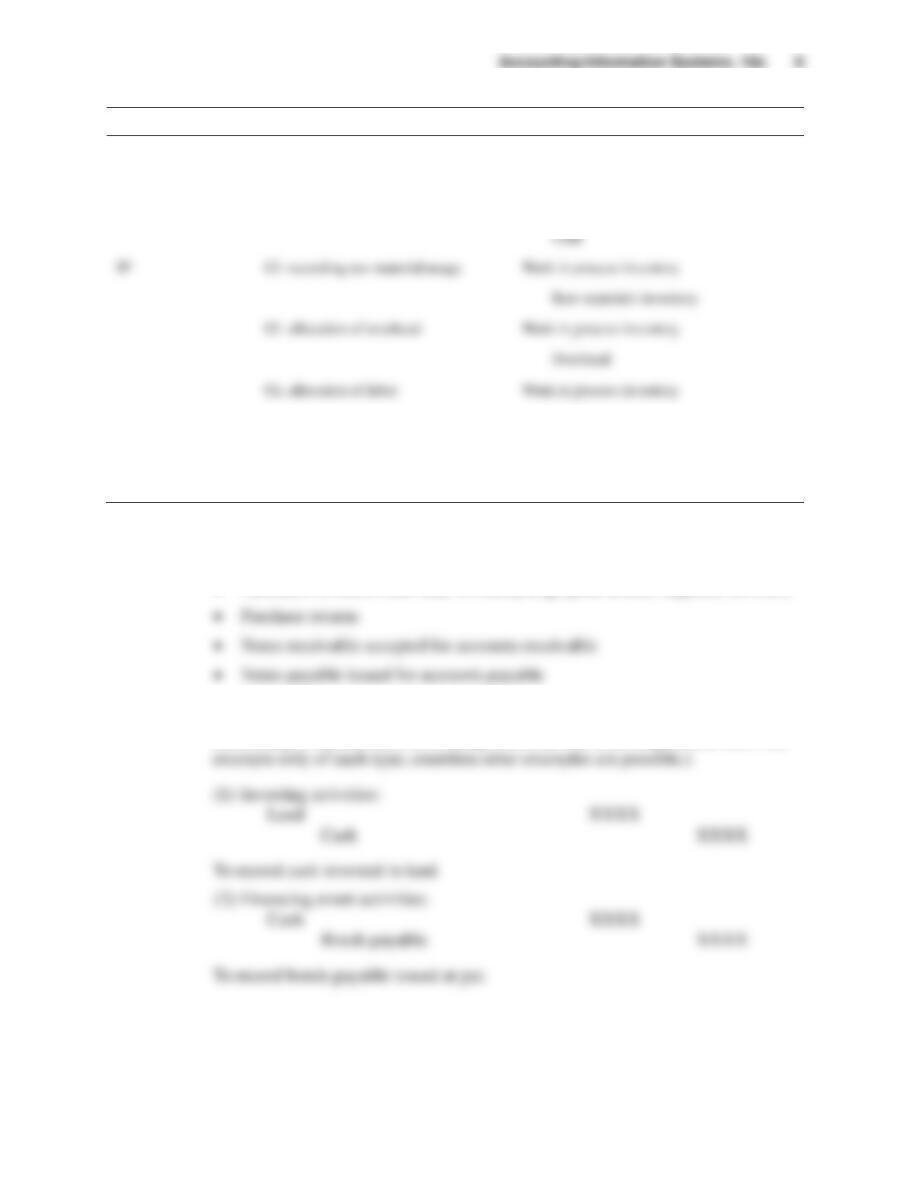
Assumptions:
Feeder Process
Data Flow Name
Entry
OE/S
GL inventory sale update
Cost of goods sold
Inventory
B/AR/CR
GL invoice update
Accounts receivable
Sales
GL estimated bad debts update
Bad debts expense
Allowance for uncollectible accounts
GL writeoff update
Allowance for uncollectible accounts
Accounts receivable
GL sales return update
Sales returns and allowances
Accounts receivable
GL cash receipts update
Cash
Accounts receivable
Purchasing
GL inventory received update
Inventory
“Clearing account”
AP/CD
GL payable update
“Clearing account”
Accounts payable
GL cash disbursements update
Accounts payable
Cash
Payroll
GL disbursement voucher update
Payroll expense
Accounts payable
GL labor distribution update
Inventory
Payroll expense
Feeder Process
Data Flow Name
Entry
GL employer tax accrual update
Payroll tax expense
Payroll tax payable
GL tax deposit update
Payroll tax payable
Cash
GL recording raw material usage
Work in process inventory
Raw materials inventory
GL allocation of overhead
Work in process inventory
GL allocation of labor
Work in process inventory
Payroll expense
GL recording completion of process
Finished goods inventory
Work in process inventory
b. ANS. Some other entries that might come from the feeder processes studied in Chapters
10 through 15 include the following:
• Purchases of items other than inventory (e.g., plant assets, supplies, services)
c. ANS. (For a complete coverage of financing and investing events, consult a financial
accounting or intermediate accounting textbook. The following entries show one
10 Solutions for Chapter 16
P 16-2 ANS.
3.1
Validate
adjusting entry
Adjusting entry
journal vouchers
3.2
Post adjusting
Validated adjusting
entry journal
vouchers
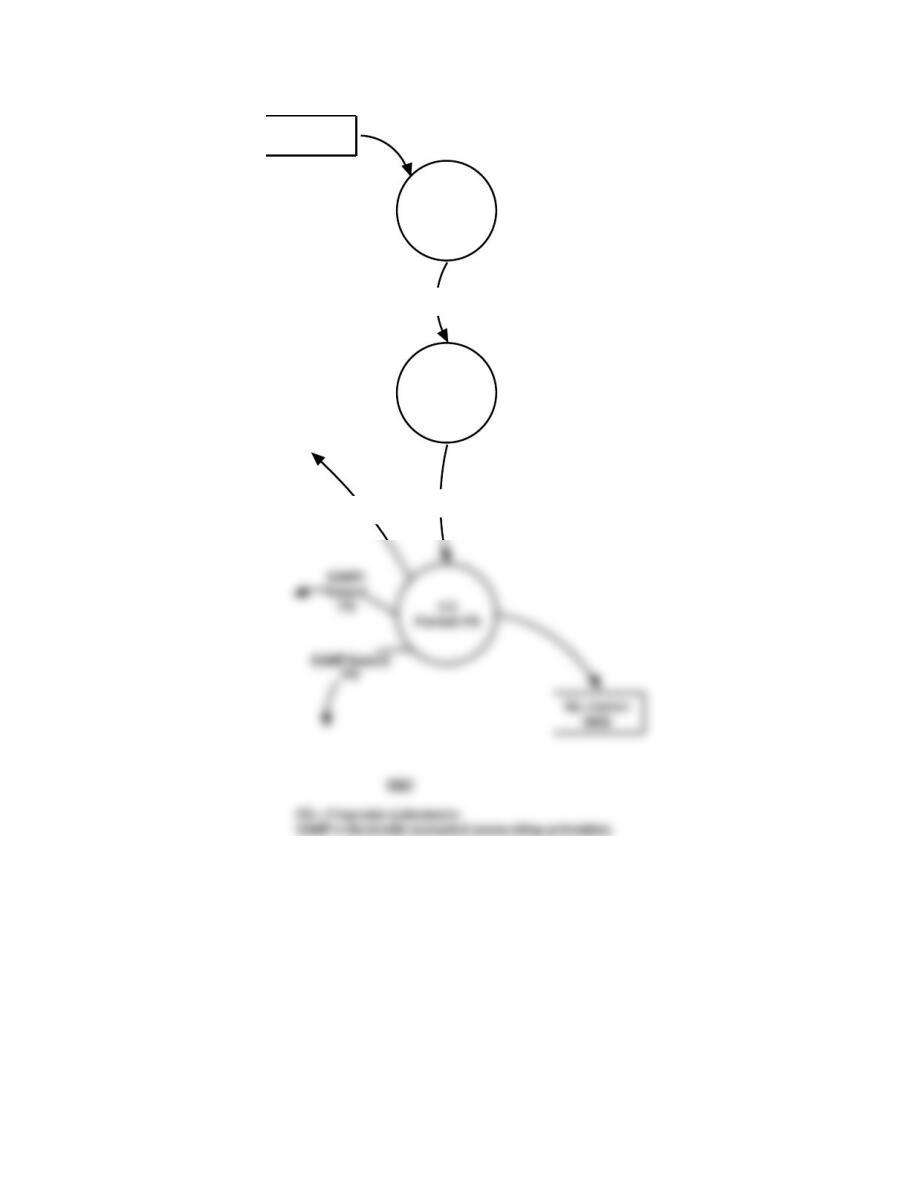
FIGURE SM-16.1 Problem 16-2, Part a Solution
Accounting Information Systems, 10e 11
4.1
Draft FS
4.2
Prepare FS
footnotes
FS drafts
FS with
footnotes
GAAP-based
FS
GL master
data
FIGURE SM-16.2 Problem 16-2, Part b Solution
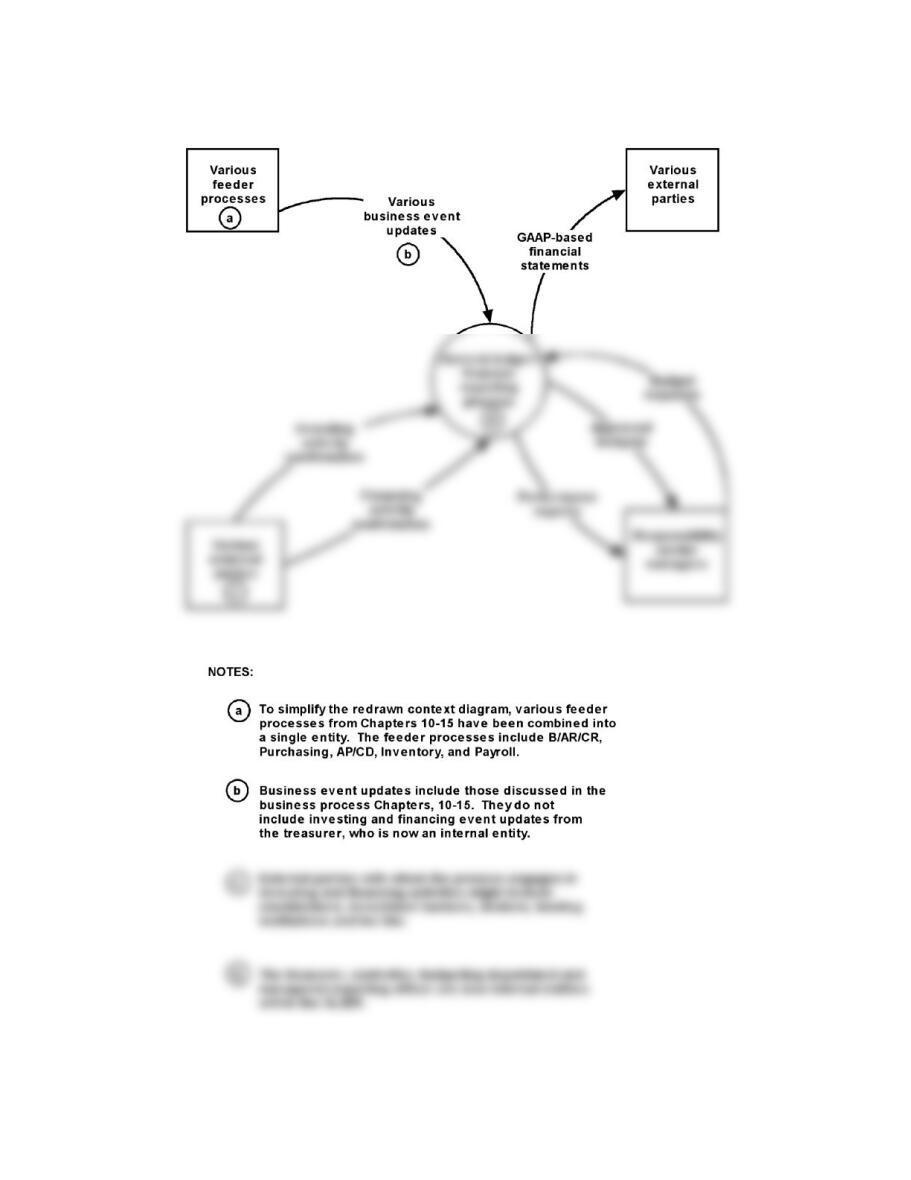
12 Solutions for Chapter 16
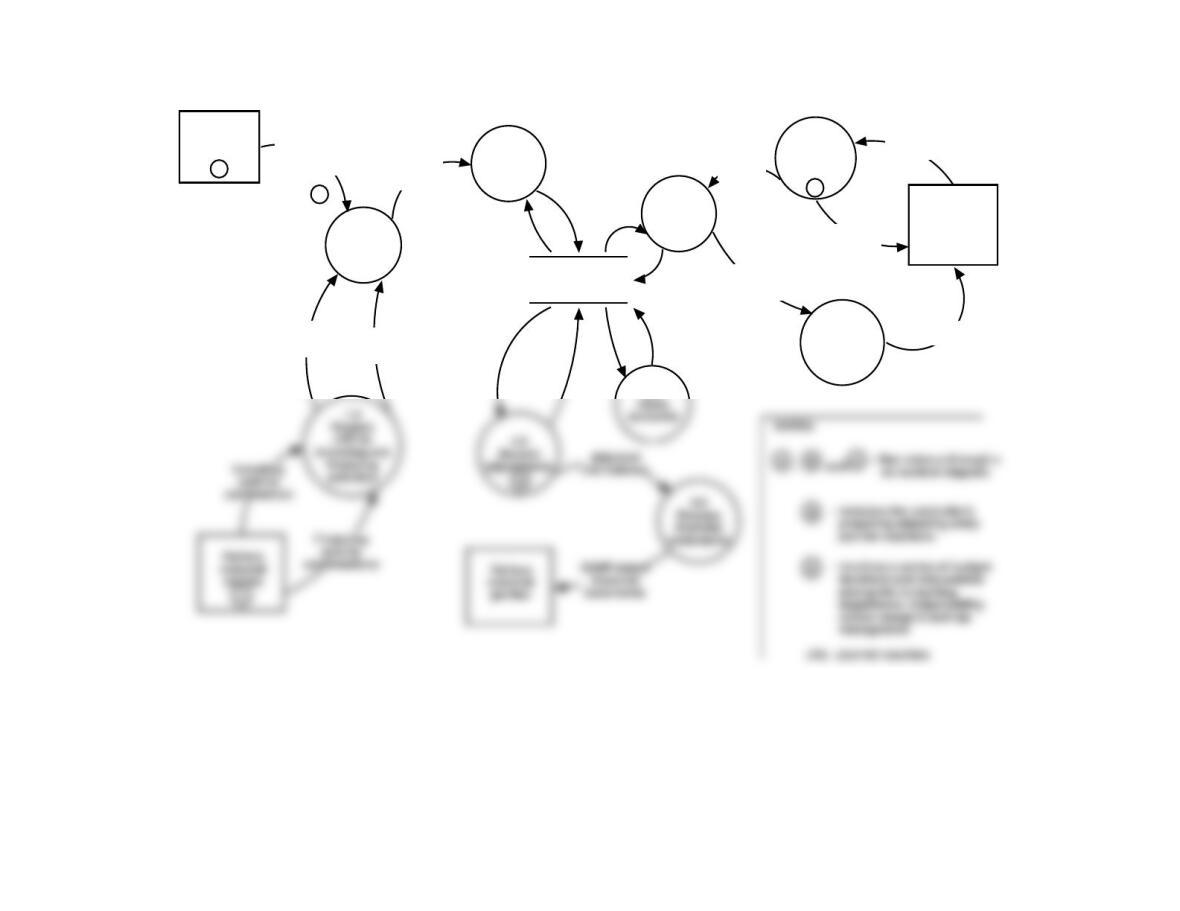
P16-3 ANS.
FIGURE SM-16.3 Problem 16-3 Solution—Context Diagram
Accounting Information Systems, 10e 13
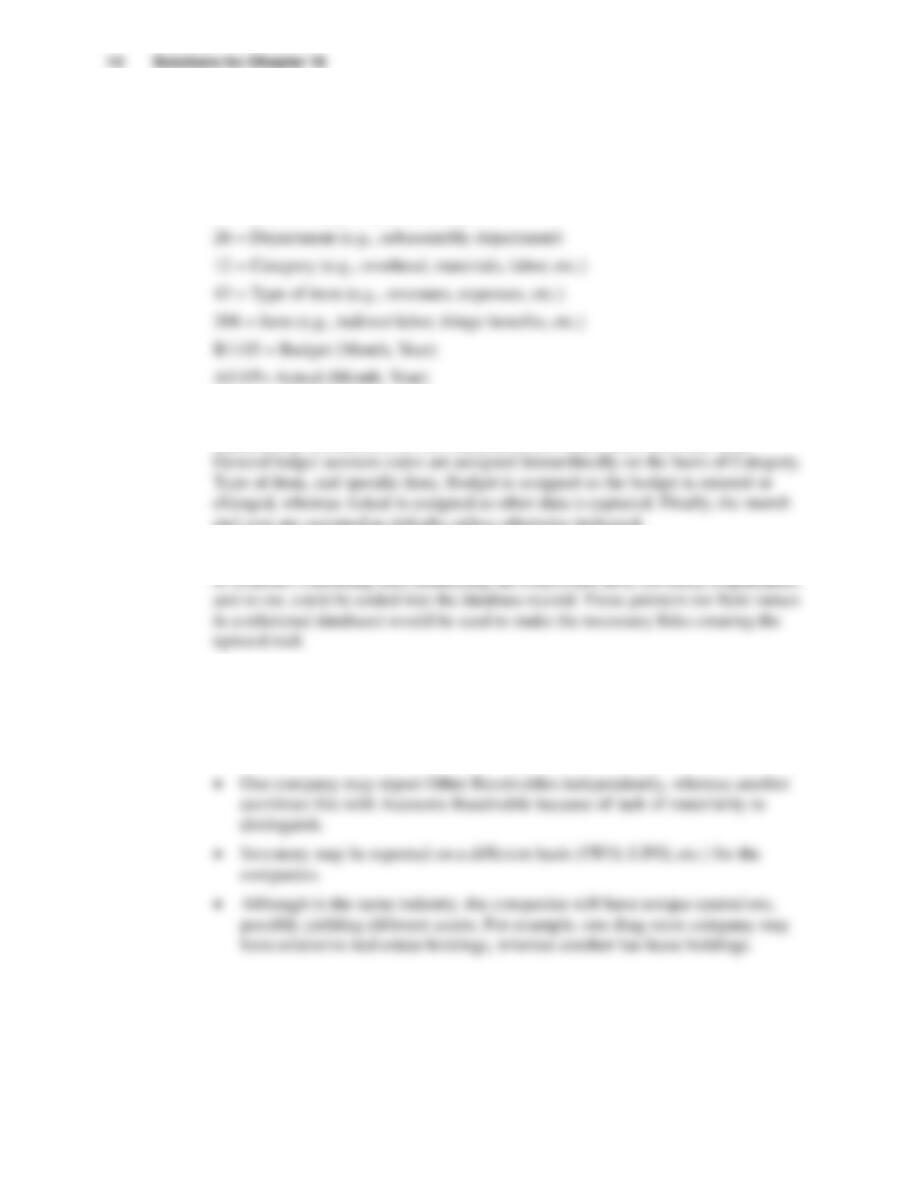
2.0
Validate
event
updates General ledger
master data
Various
feeder
processes
a
Various
business event
updates
b
3.0
Post
event
Validated
event
updates
6.0
Approve
budgets
7.0
Record
budget
Finalized
budget
Responsibility
center
managers
Approved
budgets
Budget
requests
8.0
Prepare
performance
reports
Performance
reports
Budget
and actual
trial balance
9.0
Investing
event
update
Financing
event
update
e
FIGURE SM-16.4 Problem 16-3 Solution—Level 0 DFD
P 16-4 a. ANS. The following coding scheme is suggested:
02 04 26 12 43208 B0589 A0589
02 = Functional area (e.g., vice-president)
04 = Division (e.g., superintendent)
b. ANS. This hierarchical code works as follows. Financial data is captured and
immediately classified as to the Department, Division, and Functional area.
and year are assigned as defaults unless otherwise indicated.
c. ANS. In a database environment, instead of coding all of the information specified, links
P 16-5 ANS. Some of the more basic comparison problems that may exist include the
following:
• Category descriptions may differ. For example, Accounts Receivable may be
reported by one company and Net Receivables for the other.
Accounting Information Systems, 10e 15
P 16-6 ANS. Student answers will vary based on the enterprise packages chosen.
a. The feeder modules may include precisely what we presented, but that is
doubtful. For example, Microsoft Dynamics GP groups B/AR/CR with OR/S
into the Sales module, whereas Oracle’s E-Business Suite Financials includes
P 16-7 ANS. Student answers will vary based on the article chosen.
It is important that students see how to apply new technology to old problems, but
at the same time see that even for good ideas, there is another side of the story that
should be considered.
P 16-8 ANS. Student answers will vary based on the product identified.
Some answers may include positives for outsourcing that may include items such
as the service provider (1) has more expertise in the process than individual
companies (including tagging and the actual filing), (2) has the software tools
required, (3) can better deal with rejected filings.

16 Solutions for Chapter 16
P 16-9 ANS. Unlike the other business processes, the GL/BR process has fewer operational
functions and focuses mainly on information functions. Other processes perform
important functions related to their purpose of providing goods and services to
customers, but the main purpose of the GL/BR process is to process and
case typically includes a description of the charge/fraud and any fines that
are assessed.
P 16-11 ANS. With emerging technologies, many organizations have chosen to make their
financial information available on the Internet. As part of the GL/BR process, the
financial reporting officer sends GAAP-based financial statements to owners,
potential investors, banks, and potential lenders. This role is now expanding into
P 16-12 ANS. Solutions will vary according to how the tables are implemented, especially which
attributes are placed in the tables and how the tables are populated. However, the
following guidelines should be helpful for grading the solutions:
1. From the file, ensure that the tables are linked in relationships with
cardinalities.
Accounting Information Systems, 10e 17
4. From the printouts, ensure that the explanations of the importance of the query
are credible, e.g., the accounts receivables department might use the query
output for the next invoicing cycle or the query output could be used to ensure
that a customer is not over his or her credit limit. Using the file, examine the
design of the query for any obvious problems, e.g., tables not being linked
together.
a. Here is an example of the query design: Using the SALES_INVOICES