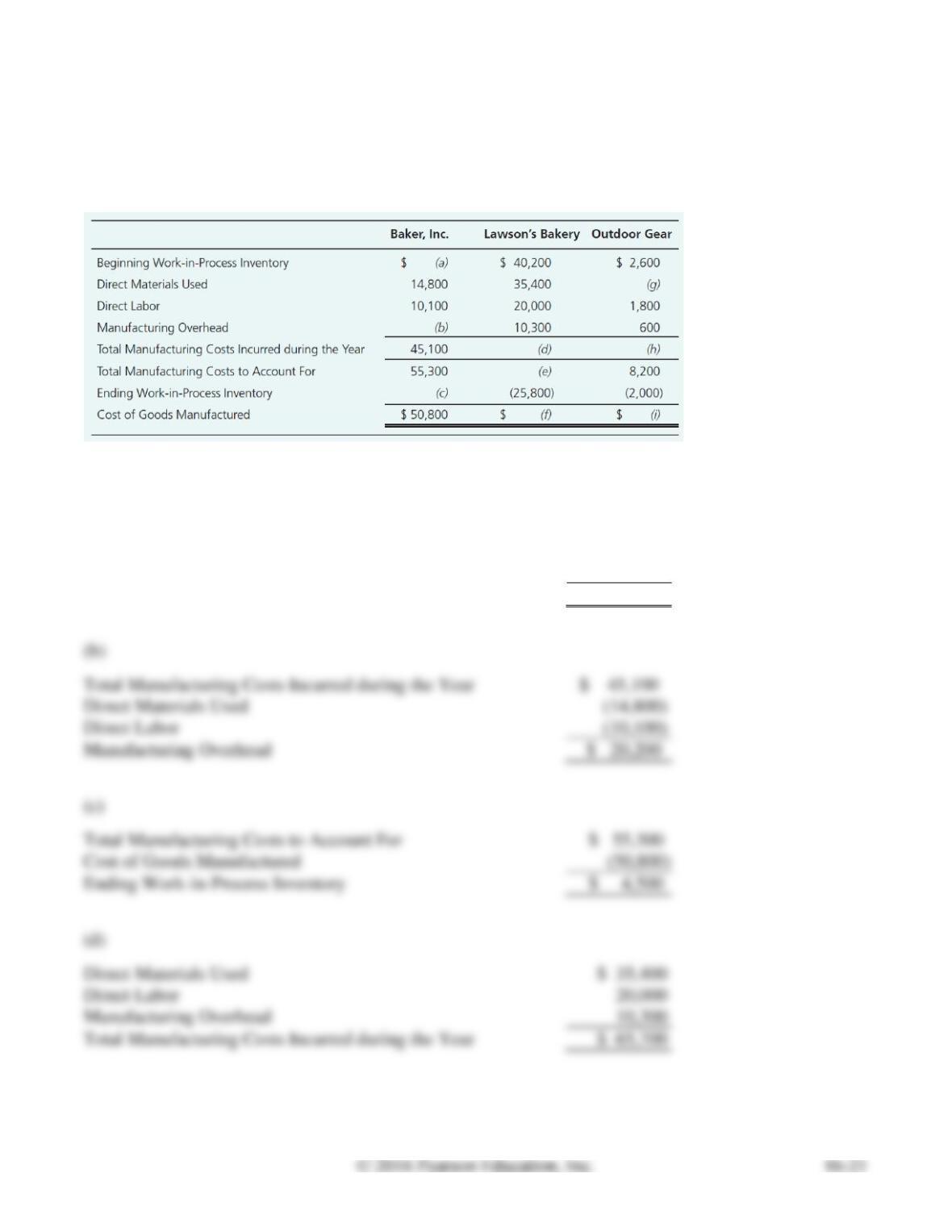
E16-21 Computing cost of goods manufactured
Learning Objective 4
Consider the following partially completed schedules of cost of goods manufactured. Compute the miss-
ing amounts.
SOLUTION
(a)
Total Manufacturing Costs to Account For
$ 55,300
Total Manufacturing Costs Incurred during the Year
(45,100)
Beginning Work-in-Process Inventory
$ 10,200
(b)
Total Manufacturing Costs Incurred during the Year
$ 45,100
Direct Materials Used
Direct Labor
(10,100)
Manufacturing Overhead
(c)
Total Manufacturing Costs to Account For
Cost of Goods Manufactured
Ending Work-in-Process Inventory
(d)
Direct Materials Used
Direct Labor
Manufacturing Overhead
Total Manufacturing Costs Incurred during the Year
(e)
Beginning Work-in-Process Inventory
$ 40,200
Total Manufacturing Costs Incurred during the Year [d, above]
65,700
Total Manufacturing Costs to Account For
$ 105,900
Total Manufacturing Costs to Account For [e, above]
Ending Work-in-Process Inventory
Cost of Goods Manufactured
(g)
Total Manufacturing Costs Incurred during the Year [h, below]
$ 5,600
Direct Labor
Manufacturing Overhead
Direct Materials Used
$ 3,200
(h)
Total Manufacturing Costs to Account For
$ 8,200
Beginning Work-in-Process Inventory
(2,600)
Total Manufacturing Costs Incurred During the Year
$ 5,600
(i)
Total Manufacturing Costs to Account For
$ 8,200
Ending Work-in-Process Inventory
(2,000)
Cost of Goods Manufactured
$ 6,200
E16-22 Preparing a schedule of cost of goods manufactured
Learning Objective 4
1. COGM: $427,000
(Requirement 1 only)
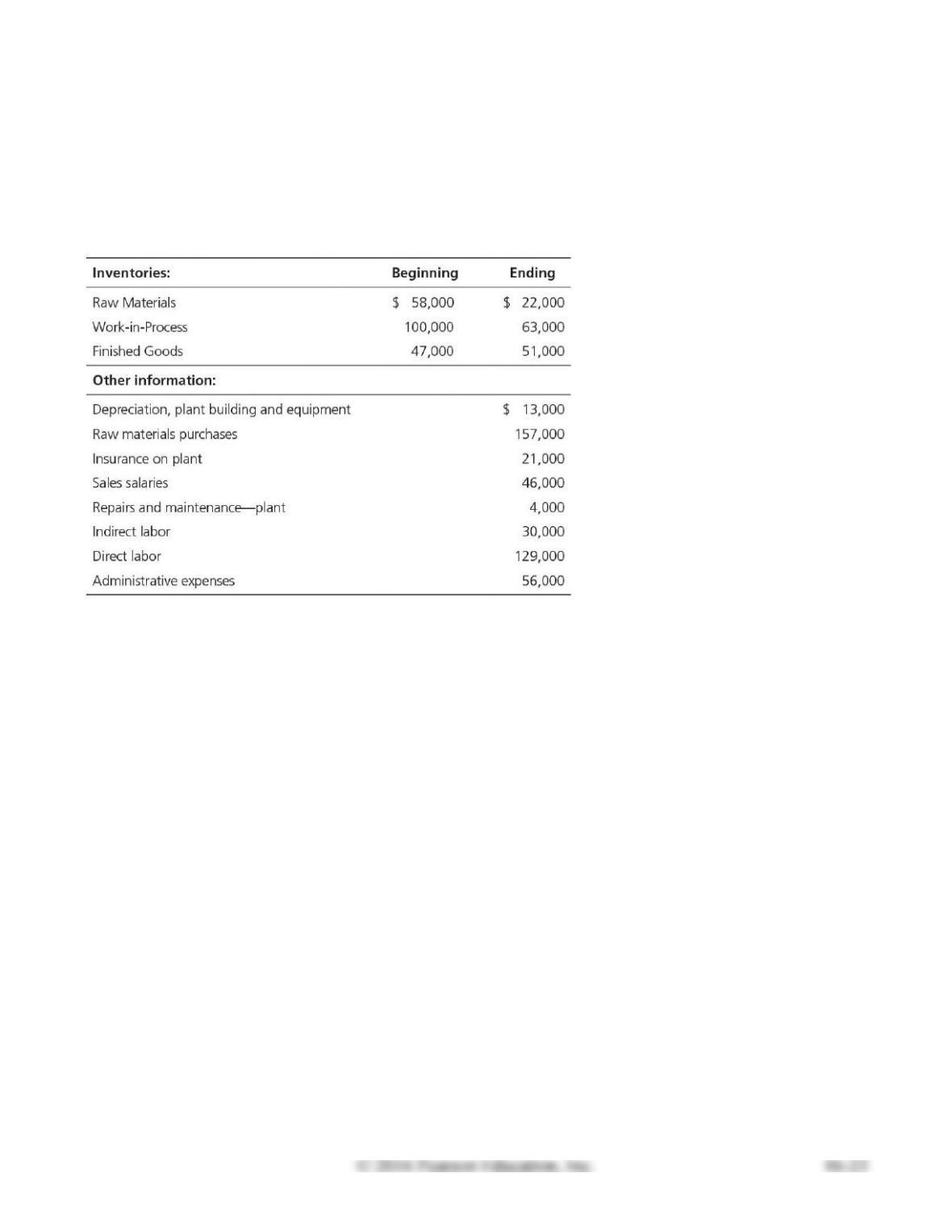
Clarkson Corp., a lamp manufacturer, provided the following information for the year ended December
31, 2016:
Requirements
1. Use the information to prepare a schedule of cost of goods manufactured.
2. What is the unit product cost if Clarkson manufactured 2,135 lamps for the year?
SOLUTION
Requirement 1
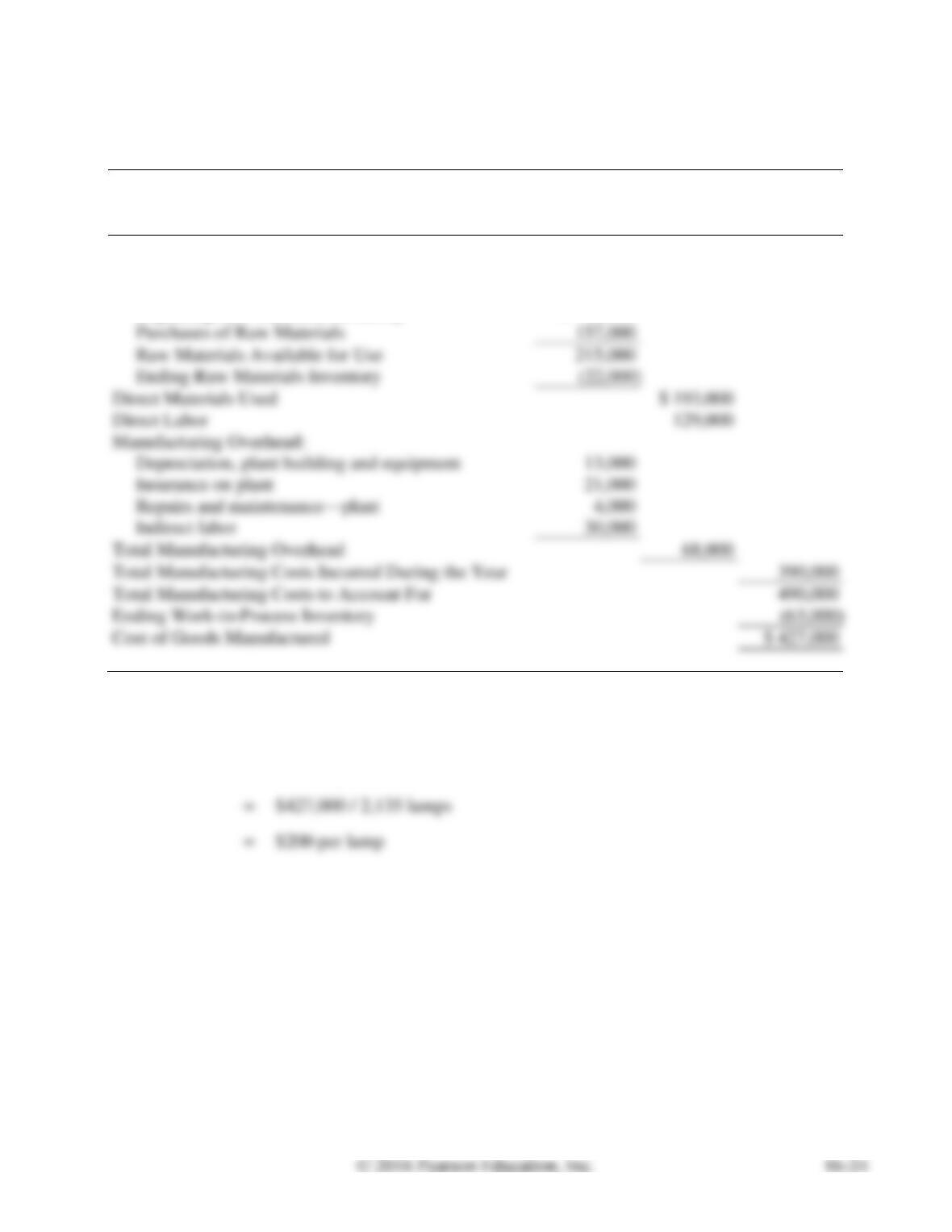
CLARKSON CORP.
Schedule of Cost of Goods Manufactured
Year Ended December 31, 2016
Beginning Work-in-Process Inventory
$ 100,000
Direct Materials Used:
Beginning Raw Materials Inventory
$ 58,000
Purchases of Raw Materials
Raw Materials Available for Use
Ending Raw Materials Inventory
Direct Materials Used
Direct Labor
Manufacturing Overhead:
Depreciation, plant building and equipment
Insurance on plant
Repairs and maintenance—plant
Indirect labor
Total Manufacturing Overhead
Total Manufacturing Costs Incurred During the Year
Total Manufacturing Costs to Account For
Ending Work-in-Process Inventory
Cost of Goods Manufactured
$ 427,000
Requirement 2
Unit product cost
=
Cost of goods manufactured / Total units produced
=
$427,000 / 2,135 lamps
=
$200 per lamp
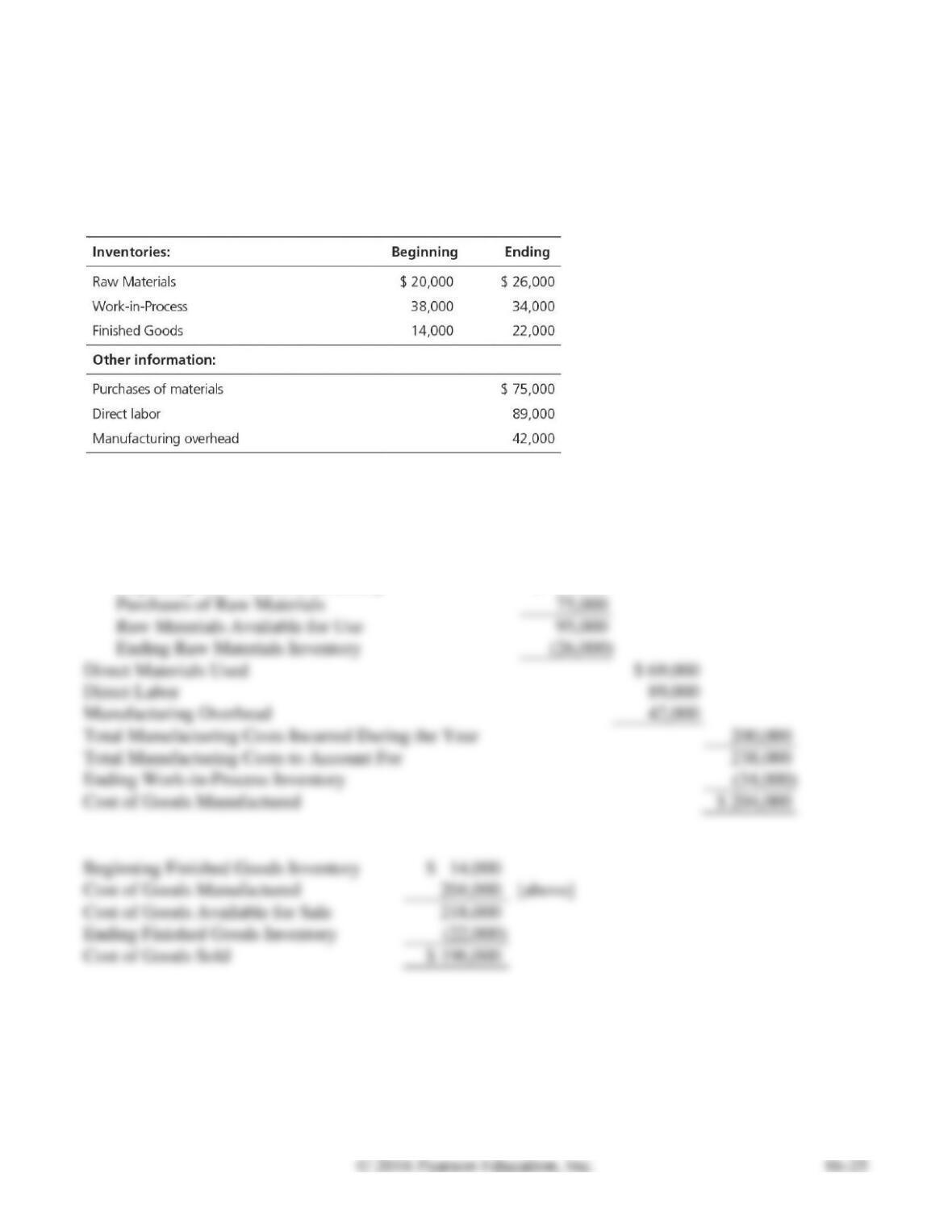
E16-23 Computing cost of goods manufactured and cost of goods sold
Learning Objective 4
COGM: $204,000
Use the following information for a manufacturer to compute cost of goods manufactured and cost of
goods sold:
SOLUTION
Beginning Work-in-Process Inventory
$ 38,000
Direct Materials Used:
Beginning Raw Materials Inventory
$ 20,000
Purchases of Raw Materials
Raw Materials Available for Use
Ending Raw Materials Inventory
Direct Materials Used
$ 69,000
Direct Labor
Manufacturing Overhead
Total Manufacturing Costs Incurred During the Year
200,000
Total Manufacturing Costs to Account For
Ending Work-in-Process Inventory
Cost of Goods Manufactured
$ 204,000
204,000
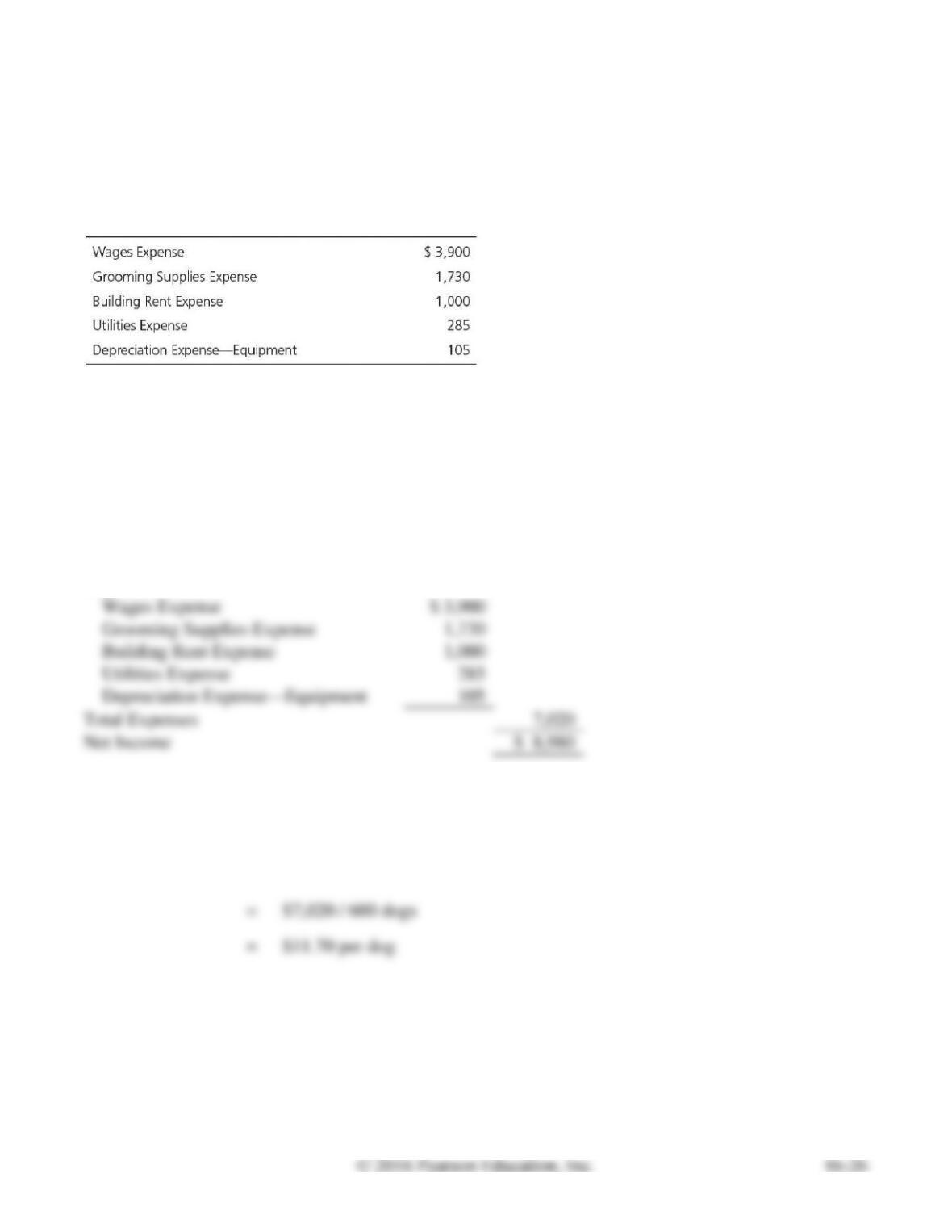
E16-24 Calculating income and cost per service for a service company
Learning Objective 5
1. $8,980
One Stop Grooming provides grooming services for pets. In April, the company earned
$16,000 in revenues and incurred the following operating costs to groom 600 dogs:
Requirements
1. What is One Stop’s net income for April?
2. What is the cost of service to groom one dog?
SOLUTION
Requirement 1
Grooming Revenue
$ 16,000
Expenses:
Wages Expense
Grooming Supplies Expense
Building Rent Expense
Utilities Expense
Depreciation Expense—Equipment
Total Expenses
Net Income
Requirement 2
Cost of Service to
Groom One Dog
=
Total expenses / Total number of dogs groomed
$7,020 / 600 dogs
$11.70 per dog
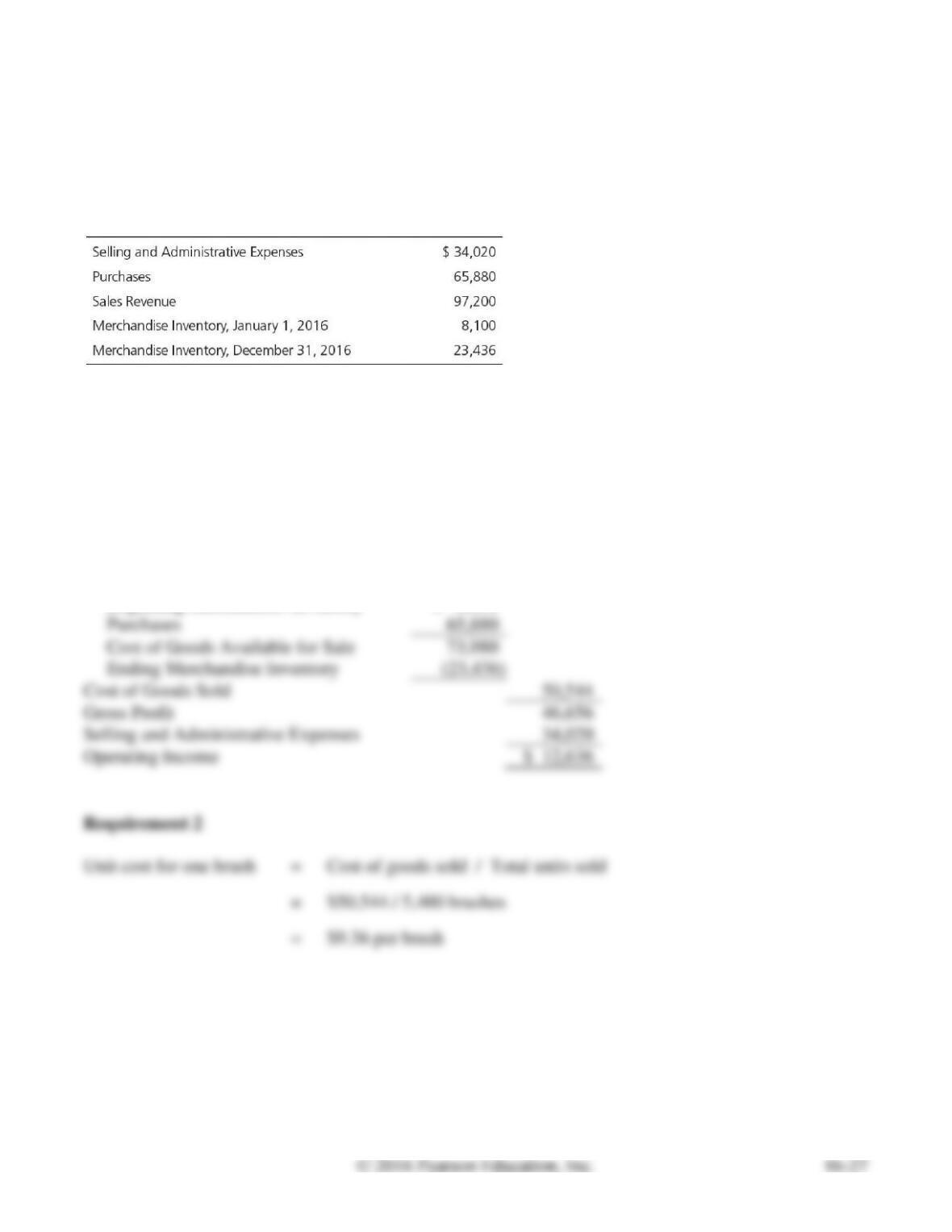
E16-25 Calculating income and cost per unit for a merchandising company
Learning Objective 5
2. $9.36
White Brush Company sells standard hair brushes. The following information summarizes White’s op-
erating activities for 2016:
Requirements
1. Calculate the operating income for 2016.
2. White sold 5,400 brushes in 2016. Compute the unit cost for one brush.
SOLUTION
Requirement 1
Sales Revenue
$ 97,200
Cost of Goods Sold:
Beginning Merchandise Inventory
$ 8,100
Purchases
Cost of Goods Available for Sale
Ending Merchandise Inventory
Cost of Goods Sold
Gross Profit
Selling and Administrative Expenses
Operating Income
Unit cost for one brush
Cost of goods sold / Total units sold
$9.36 per brush
Problems (Group A)
P16-26A Applying ethical standards, management accountability
Learning Objective 1
Natalia Wallace is the new controller for Smart Software, Inc. which develops and sells education soft-
ware. Shortly before the December 31 fiscal year-end, James Cauvet, the company president, asks Wal-
lace how things look for the year-end numbers. He is not happy to learn that earnings growth may be
below 13% for the first time in the company’s five-year history. Cauvet explains that financial analysts
have again predicted a 13% earnings growth for the company and that he does not intend to disappoint
them. He suggests that Wallace talk to the assistant controller, who can explain how the previous con-
troller dealt with such situations. The assistant controller suggests the following strategies:
a. Persuade suppliers to postpone billing $13,000 in invoices until January 1.
b. Record as sales $115,000 in certain software awaiting sale that is held in a public warehouse.
c. Delay the year-end closing a few days into January of the next year so that some of the next year’s
sales are included in this year’s sales.
d. Reduce the estimated Bad Debts Expense from 5% of Sales Revenue to 3%, given the company’s
continued strong performance.
e. Postpone routine monthly maintenance expenditures from December to January.
Requirements
1. Which of these suggested strategies are inconsistent with IMA standards?
2. How might these inconsistencies affect the company’s stakeholders?
3. What should Wallace do if Cauvet insists that she follow all of these suggestions?
SOLUTION
Requirement 1
a. If the goods have been received, postponing recording of the purchases understates liabilities. This is
unethical and inconsistent with the IMA standards even if the suppliers agree to delay billing.
Requirement 2
Management accountability is management’s responsibility to the various stakeholders of the company.
Each group of stakeholders has an interest of some sort in the business. Stakeholders include suppliers,
employees, customers, vendors, investors, creditors, governments, and communities. Managers are ac-
countable to the stakeholders and have a responsibility to wisely manage the company’s resources.
Requirement 3
The controller should resist attempts to implement a, b, and c and should gather more information about
P16-27A Classifying period costs and product costs
Learning Objective 3
Lawlor, Inc. is the manufacturer of lawn care equipment. The company incurs the following costs while
manufacturing weed trimmers:
• Shaft and handle of weed trimmer
• Motor of weed trimmer
• Factory labor for workers assembling weed trimmers
• Nylon thread used by the weed trimmer (not traced to the product)
• Glue to hold the housing together
• Plant janitorial wages
• Depreciation on factory equipment
• Rent on plant
• Sales commissions
• Administrative salaries
• Plant utilities
• Shipping costs to deliver finished weed trimmers to customers
Requirements
1. Describe the difference between period costs and product costs.
2. Classify Lawlor’s costs as period costs or product costs. If the costs are product costs, further classi-
fy them as direct materials, direct labor, or manufacturing overhead.
SOLUTION
Requirement 1
Period costs are operating costs that are expensed in the accounting period in which they are incurred.
Requirement 2
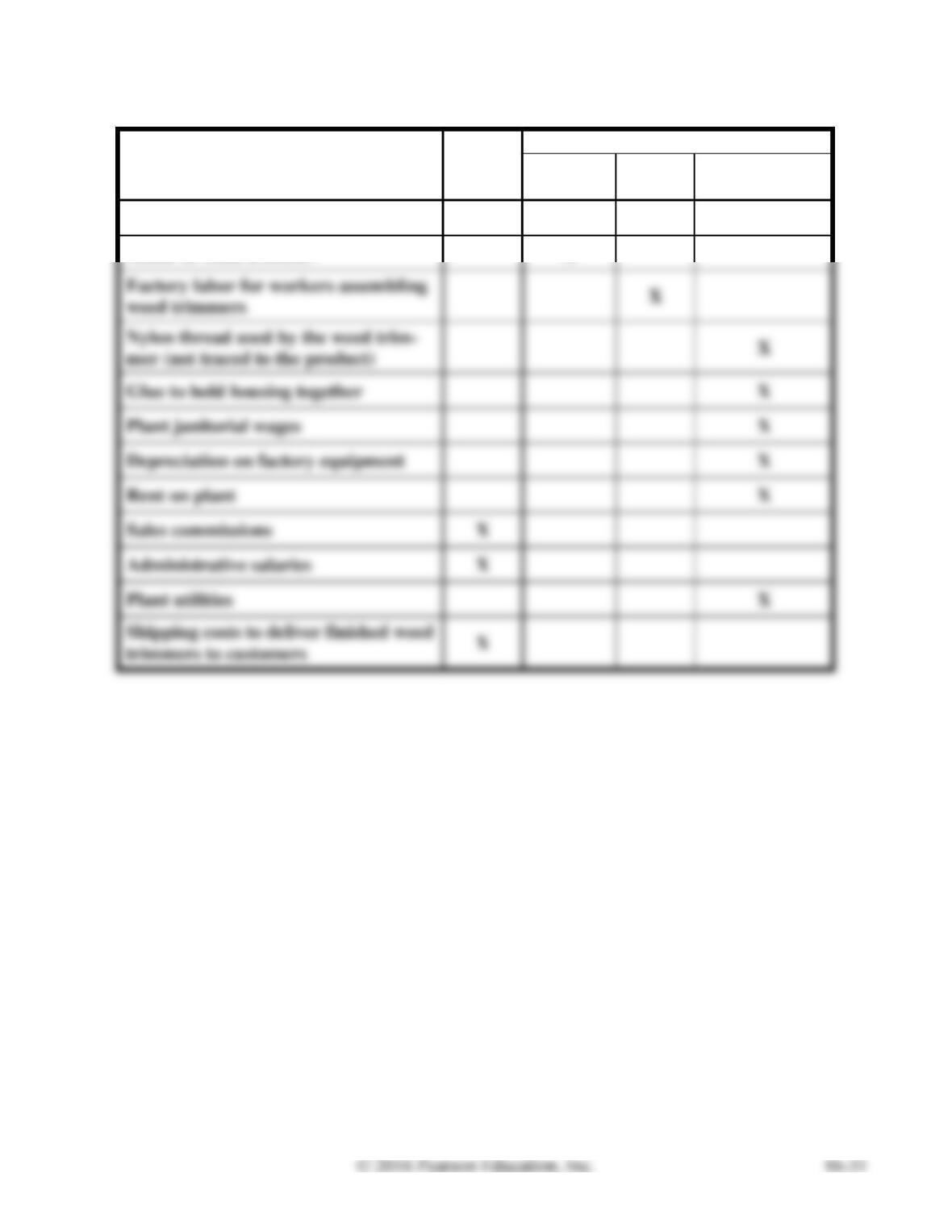
Cost:
Period
Cost
Product Cost
Direct
Materials
Direct
Labor
Manufacturing
Overhead
Shaft and handle of weed trimmer
X
Motor of weed trimmer
X
Glue to hold housing together
Plant janitorial wages
Sales commissions
Administrative salaries
P16-28A Calculating cost of goods sold for merchandising and manufacturing companies
Learning Objectives 2, 4, 5
3. Company B: $218,600
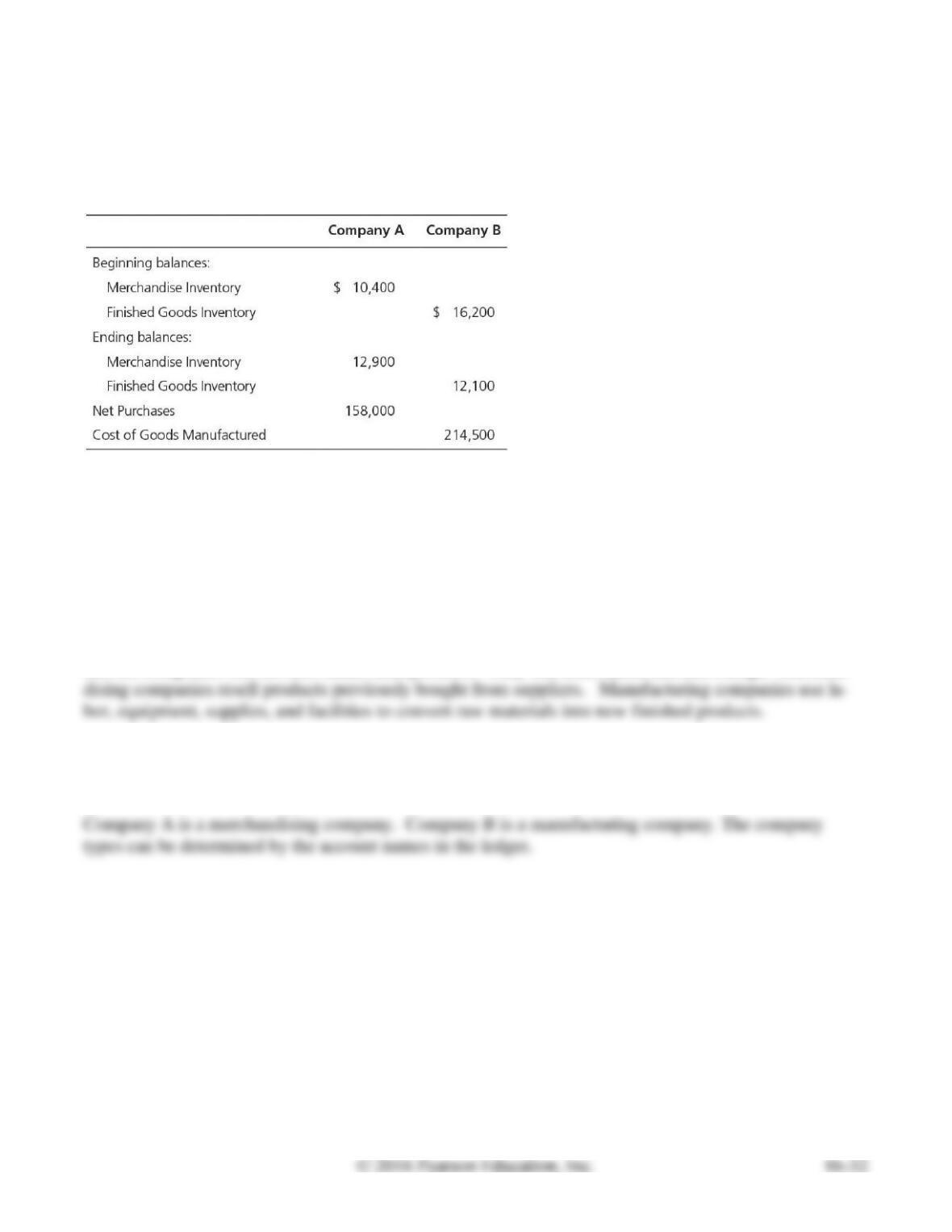
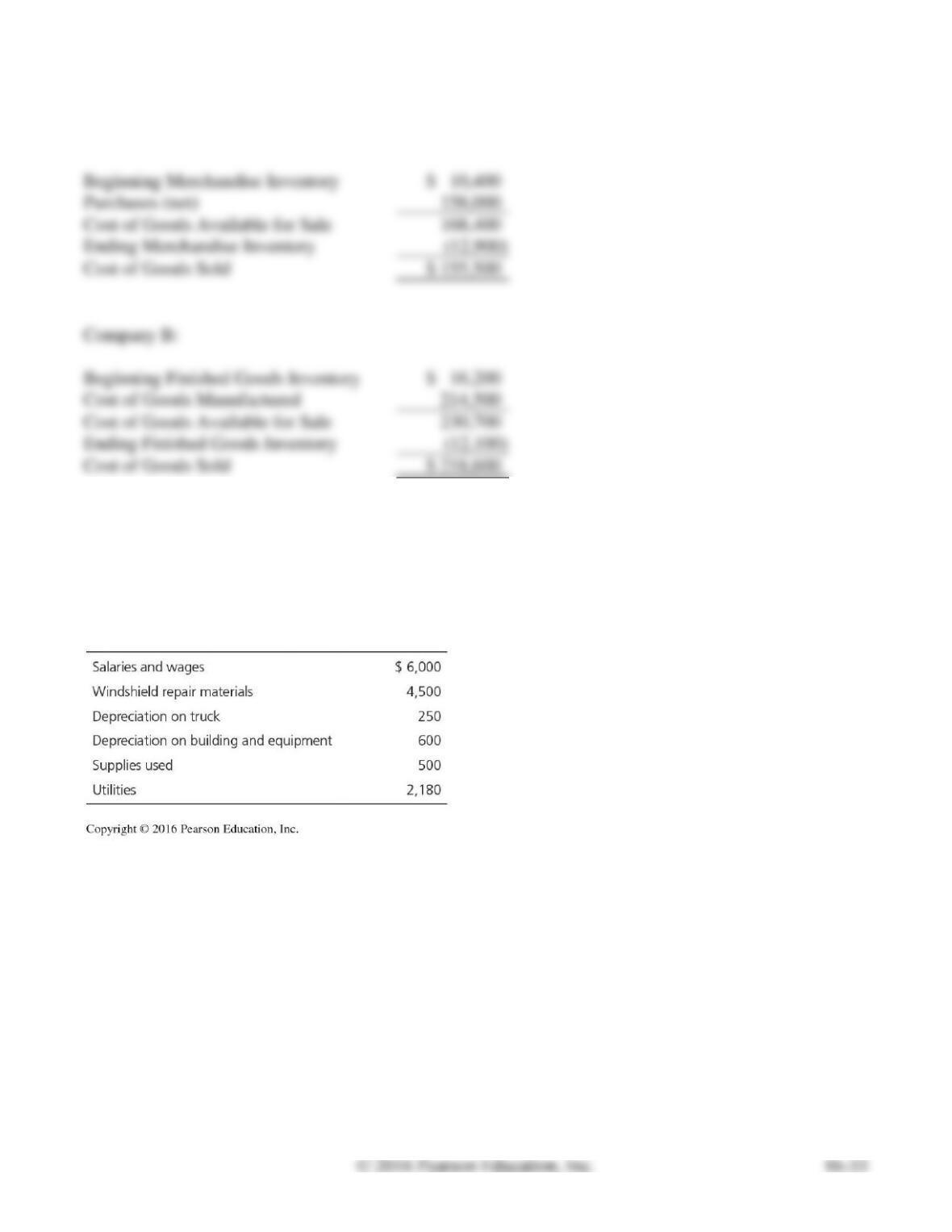
Below are data for two companies:
Requirements
1. Define the three business types: service, merchandising, and manufacturing.
2. Based on the data given for the two companies, determine the business type of each one.
3. Calculate the cost of goods sold for each company.
SOLUTION
Requirement 1
Service companies sell services rather than products. They sell time, skills, and knowledge. Merchan-
Requirement 2
Requirement 3
Company A:
P16-29A Preparing an income statement and calculating unit cost for a service company
Learning Objectives 2, 5
2. $70.15
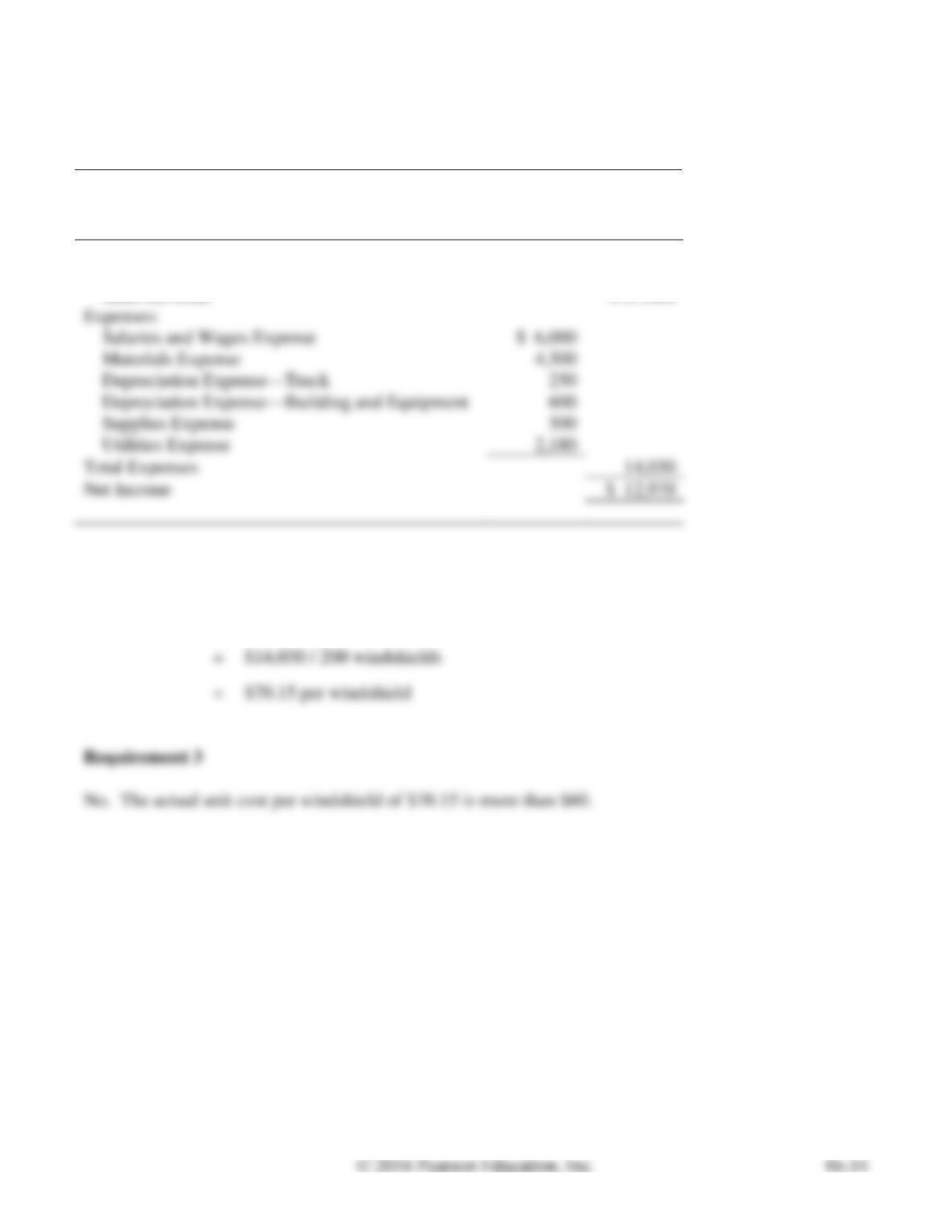
Sandman repairs chips in car windshields. The company incurred the following operating costs for the
month of February 2016:
Sandman earned $27,000 in revenues for the month of February by repairing 200 windshields. All costs
shown are considered to be directly related to the repair service.
Requirements
1. Prepare an income statement for the month of February.
2. Compute the cost per unit of repairing one windshield.
3. The manager of Sandman must keep unit operating cost below $60 per windshield in order to get his
bonus. Did he meet the goal?
SOLUTION
Requirement 1
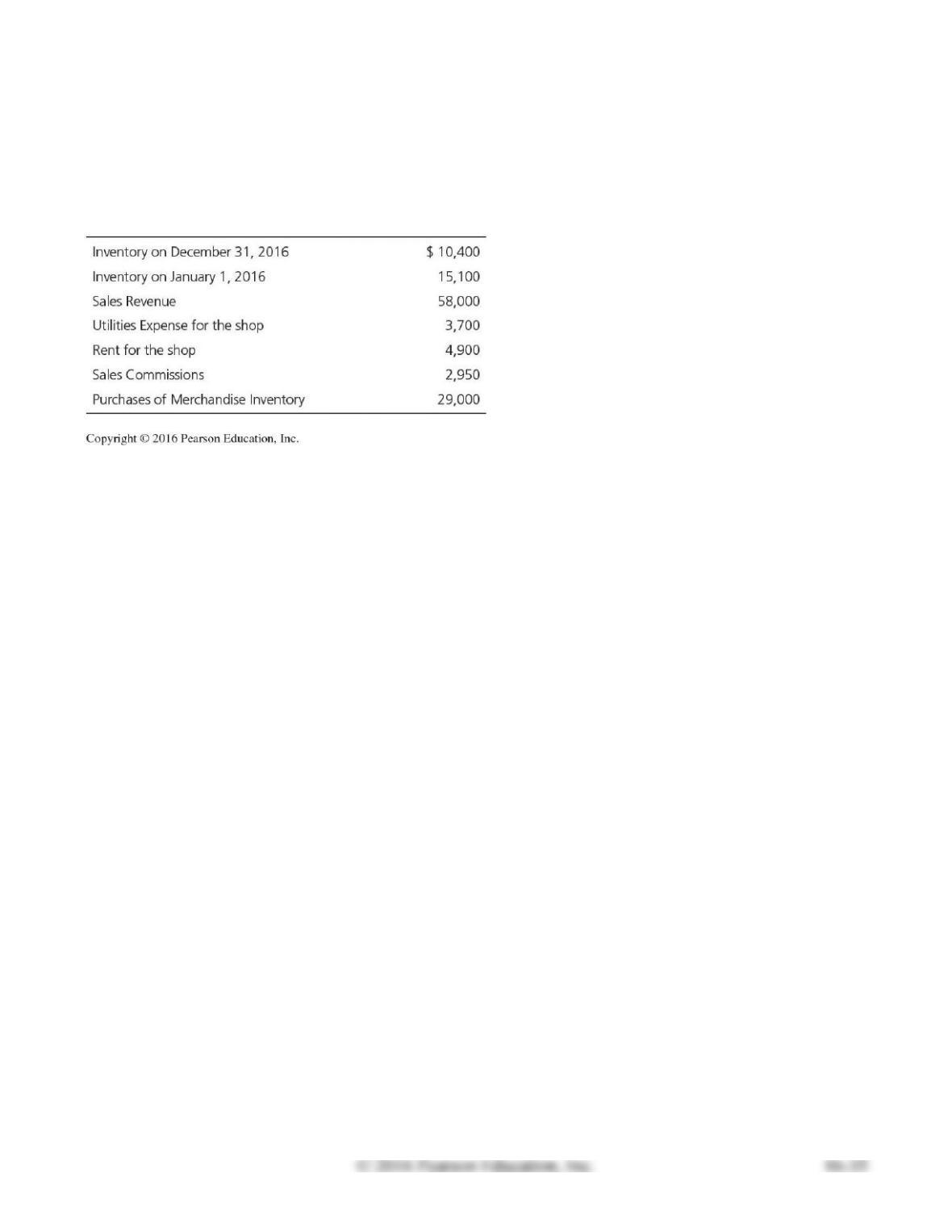
SANDMAN
Income Statement
Month Ended February 29, 2016
Revenues:
Sales Revenue
$ 27,000
Expenses:
Salaries and Wages Expense
Materials Expense
Depreciation Expense—Building and Equipment
Supplies Expense
Utilities Expense
Total Expenses
Net Income
Requirement 2
Unit cost
=
Total expenses / Total windshields repaired
=
$14,030 / 200 windshields
=
$70.15 per windshield
P16-30A Preparing an income statement and calculating unit cost for a merchandising company
Learning Objectives 2, 5
1. Net income: $12,750
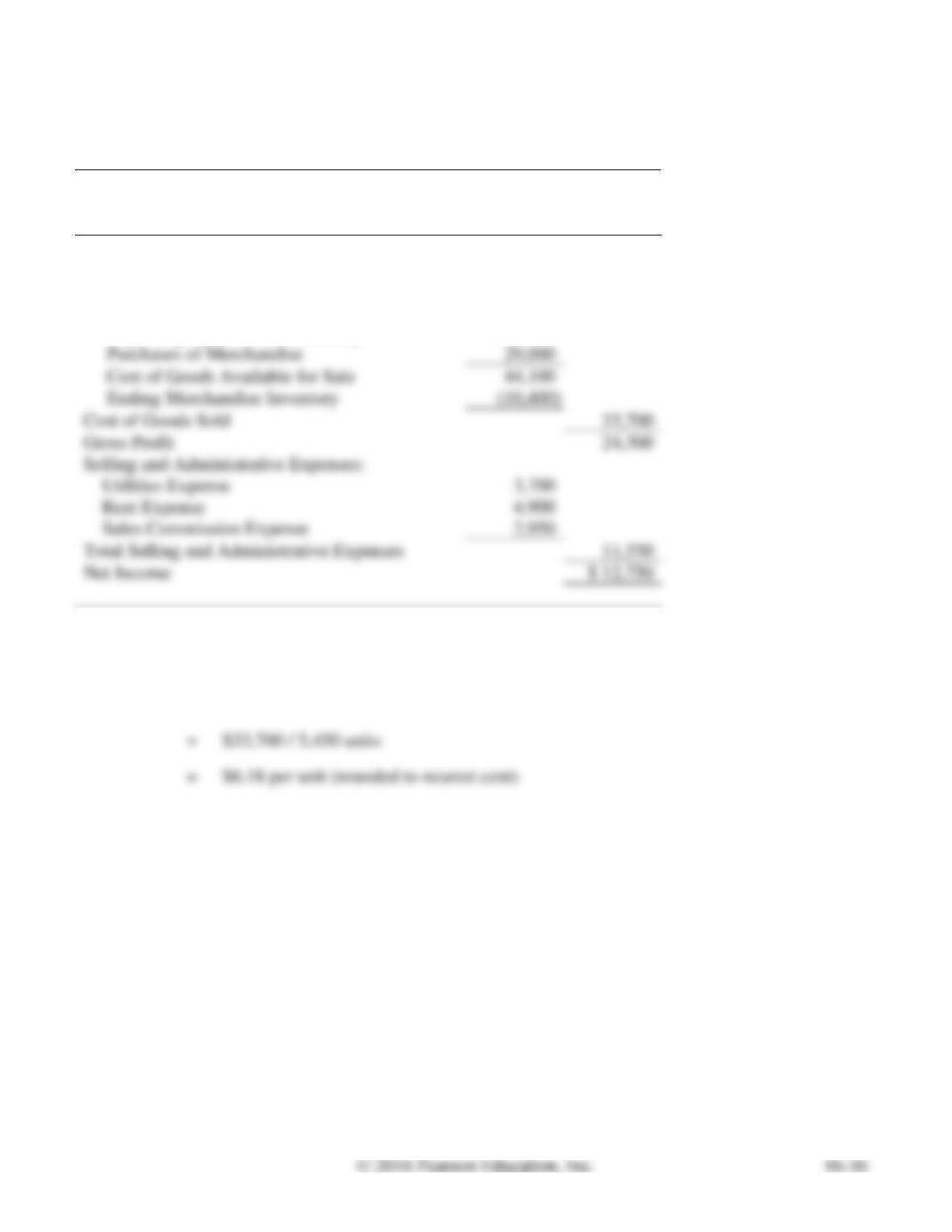
Cam Smith owns Cam’s Pets, a small retail shop selling pet supplies. On December 31, 2016, the ac-
counting records of Cam’s Pets showed the following:
Requirements
1. Prepare an income statement for Cam’s Pets for the year ended December 31, 2016.
2. Cam’s Pets sold 5,450 units. Determine the unit cost of the merchandise sold, rounded to the nearest
cent.
SOLUTION
Requirement 1
CAM’S PETS
Income Statement
Year Ended December 31, 2016
Revenues:
Sales Revenue
$ 58,000
Cost of Goods Sold:
Beginning Merchandise Inventory
$ 15,100
Purchases of Merchandise
Cost of Goods Available for Sale
Ending Merchandise Inventory
Cost of Goods Sold
33,700
Gross Profit
Selling and Administrative Expenses:
Utilities Expense
Rent Expense
Sales Commission Expense
Total Selling and Administrative Expenses
Net Income
$ 12,750
Requirement 2
Unit cost
=
Cost of goods sold / Total units sold
=
$33,700 / 5,450 units
=
$6.18 per unit (rounded to nearest cent)
P16-31A Preparing a schedule of cost of goods manufactured and an income statement for a man-
ufacturing company
Learning Objectives 2, 4
2. Net income: $34,900
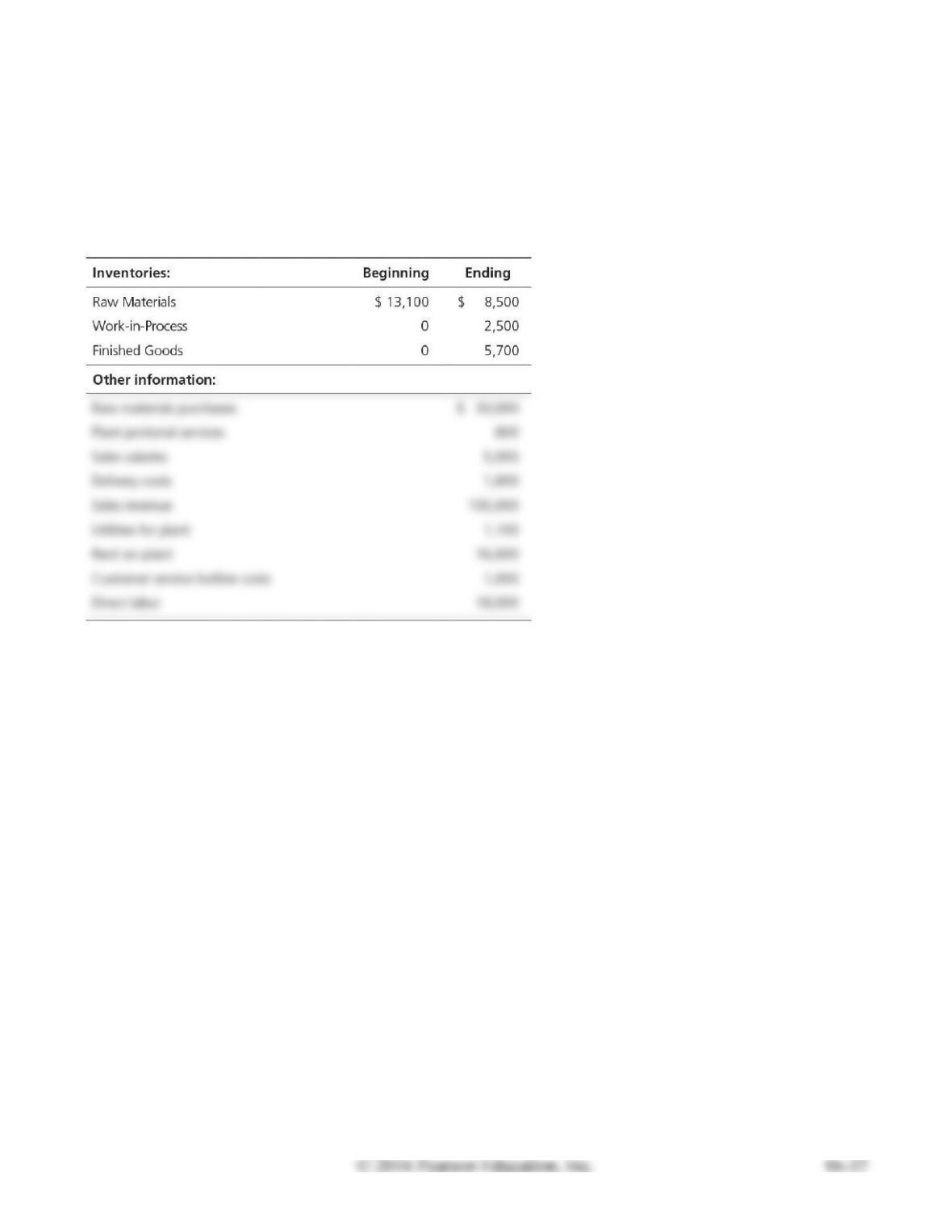
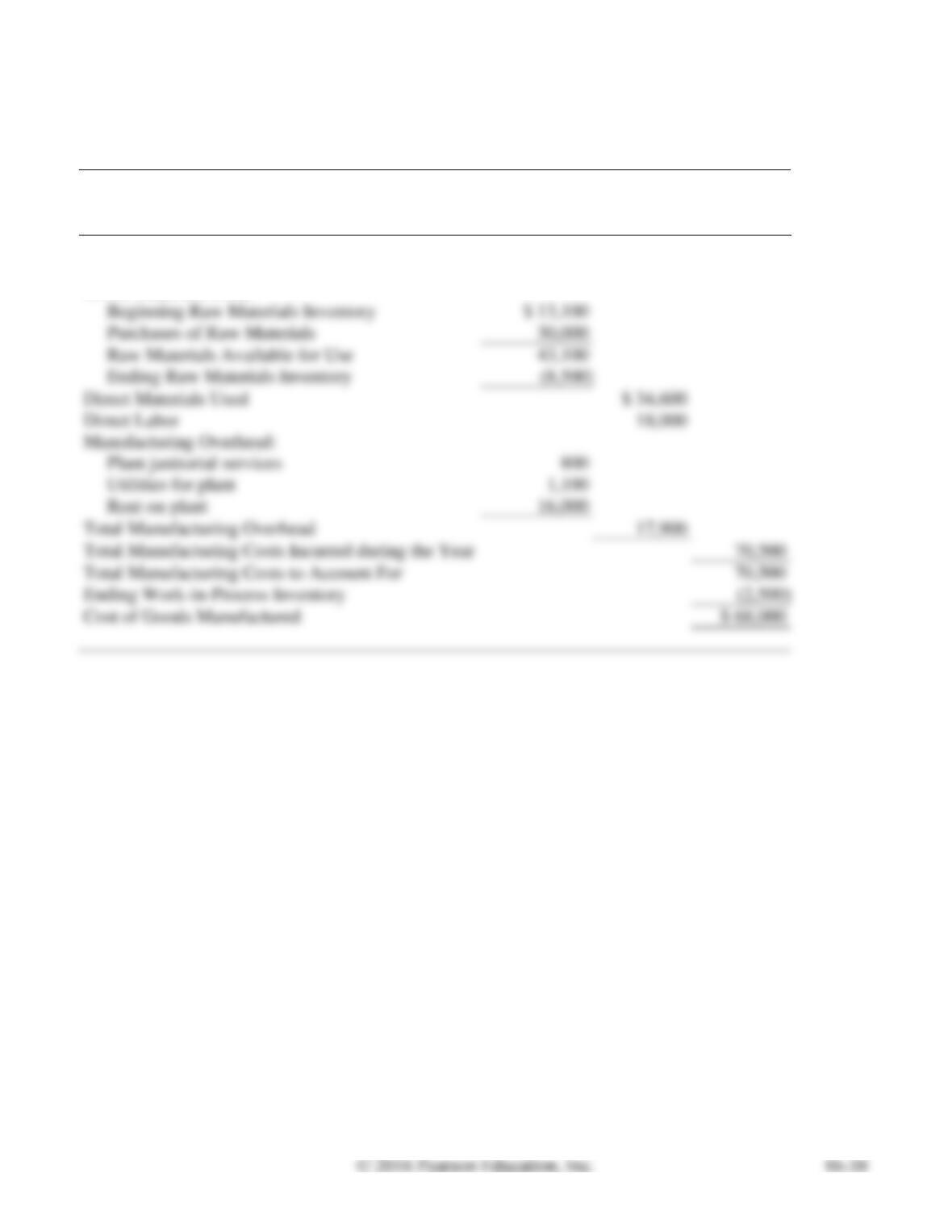
Yum Yum Treats manufactures its own brand of pet chew bones. At the end of December 2016, the ac-
counting records showed the following:
Requirements
1. Prepare a schedule of cost of goods manufactured for Yum Yum Treats for the year ended December
31, 2016.
2. Prepare an income statement for Yum Yum Treats for the year ended December 31, 2016.
3. How does the format of the income statement for Yum Yum Treats differ from the income statement
of a merchandiser?
4. Yum Yum Treats manufactured 17,600 units of its product in 2016. Compute the company’s unit
product cost for the year, rounded to the nearest cent.
SOLUTION
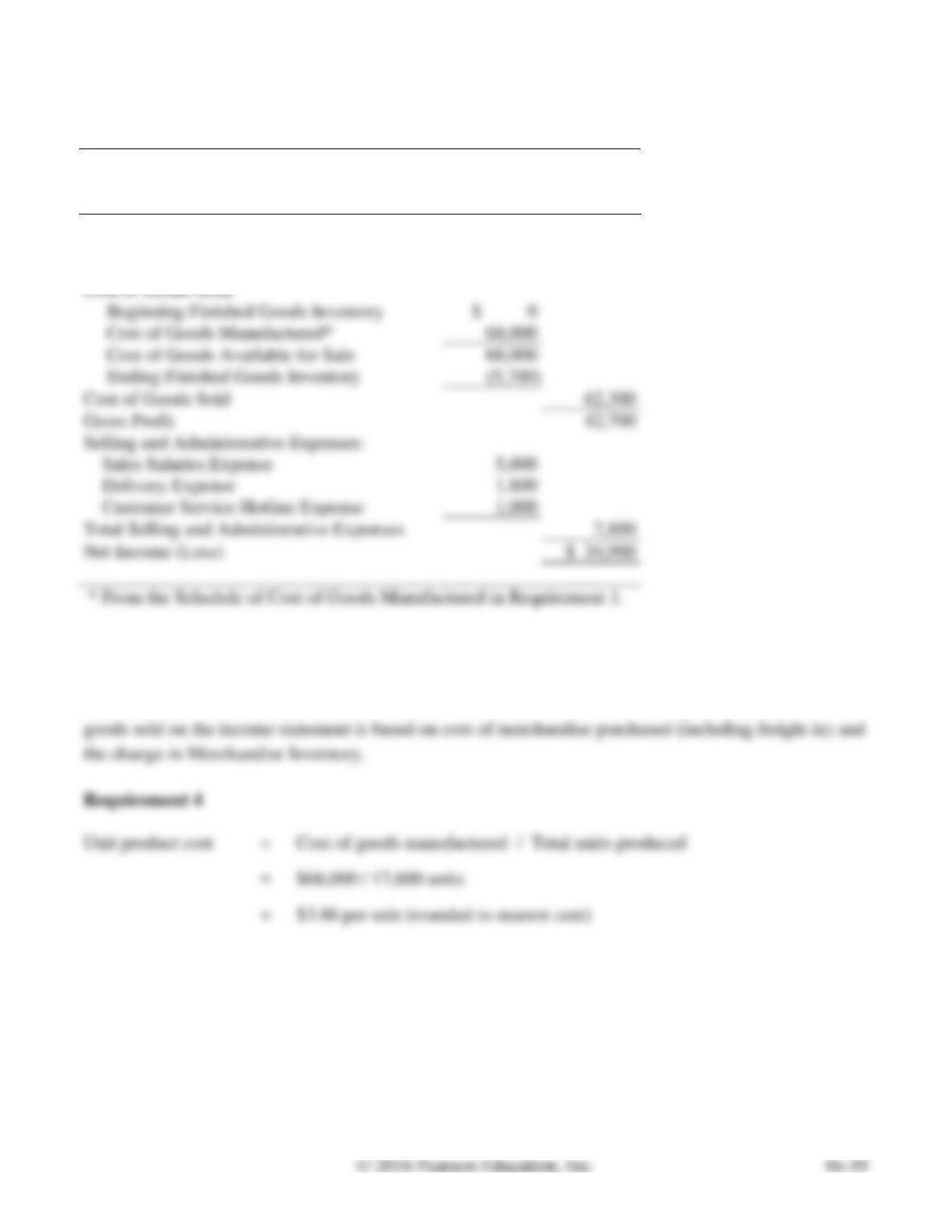
Requirement 1
YUM YUM TREATS
Schedule of Cost of Goods Manufactured
Year Ended December 31, 2016
Beginning Work-in-Process Inventory
$ 0
Direct Materials Used:
Beginning Raw Materials Inventory
Purchases of Raw Materials
Raw Materials Available for Use
Ending Raw Materials Inventory
Direct Materials Used
Direct Labor
Manufacturing Overhead:
Plant janitorial services
Utilities for plant
Rent on plant
Total Manufacturing Overhead
Total Manufacturing Costs Incurred during the Year
Total Manufacturing Costs to Account For
Ending Work-in-Process Inventory
Cost of Goods Manufactured
$ 68,000
P16-31A, cont.
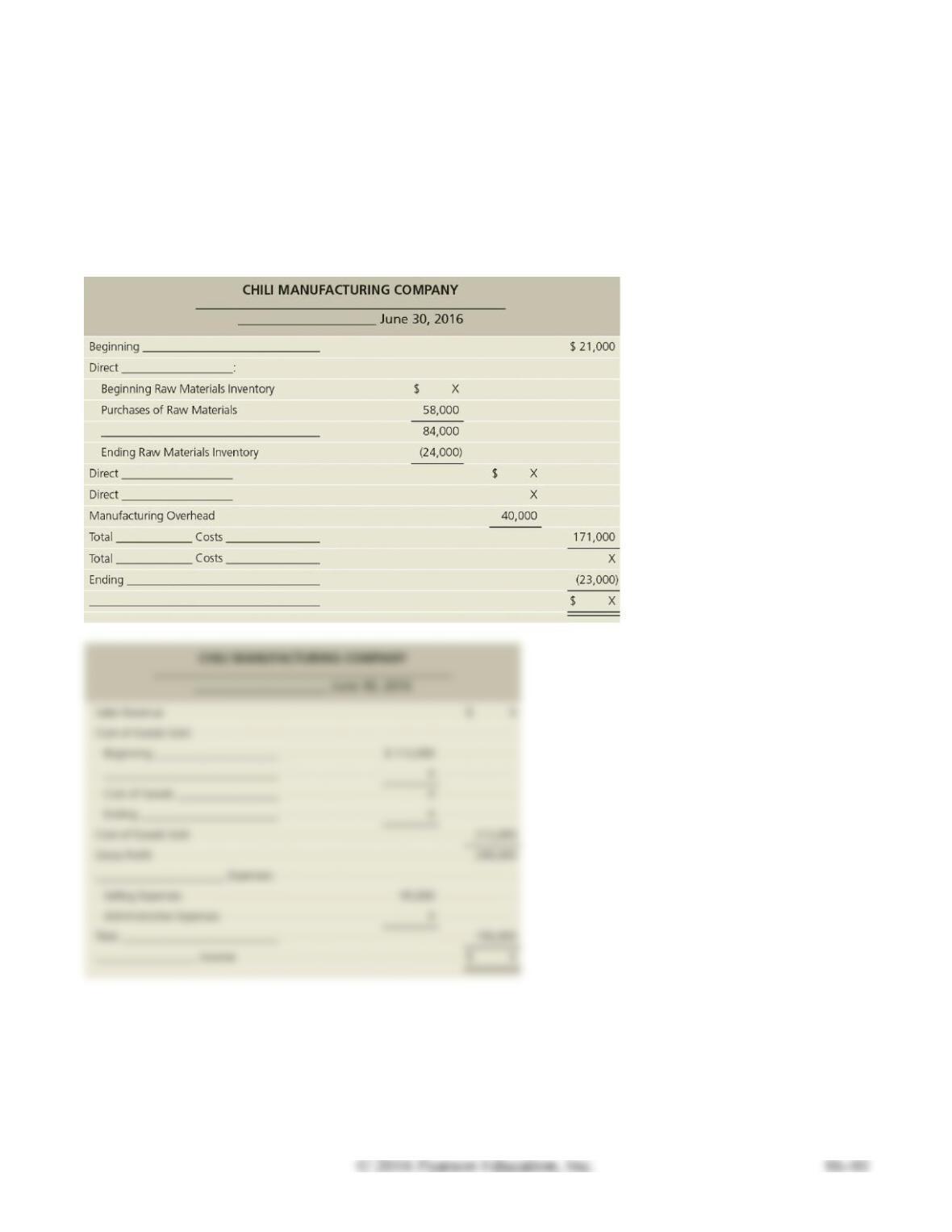
Requirement 2
YUM YUM TREATS
Income Statement
Year Ended December 31, 2016
Revenues:
Sales Revenue
$ 105,000
Cost of Goods Sold:
Beginning Finished Goods Inventory
Cost of Goods Manufactured*
Cost of Goods Available for Sale
Ending Finished Goods Inventory
Cost of Goods Sold
Gross Profit
Selling and Administrative Expenses:
Sales Salaries Expense
Delivery Expense
Customer Service Hotline Expense
Total Selling and Administrative Expenses
Net Income (Loss)
Requirement 3
For a manufacturing company, cost of goods sold on the income statement is based on cost of goods
manufactured and the change in Finished Goods Inventory. For a merchandising company, cost of
P16-32A Preparing a schedule of cost of goods manufactured and an income statement for a man-
ufacturing company
Learning Objectives 2, 4
COGM: $169,000
Certain item descriptions and amounts are missing from the monthly schedule of cost of goods manufac-
tured and income statement of Chili Manufacturing Company. Fill in the blanks with the missing words,
and replace the Xs with the correct amounts.