16–21
EXERCISE 16-8 (10–15 minutes)
September 1, 2012
Cash ($3,120,000 + $60,000 – $30,000) ……………….. 3,150,000
Unamortized Bond Issue Costs…………………………. 30,000
(To record the issuance of the bonds)
Schedule 1
Premium on Bonds Payable and Value of Stock Warrants
Sales price (3,000 X $1,040) ……………………………………………… $3,120,000
Face value of bonds ………………………………………………………… (3,000,000)
120,000
Deduct value assigned to stock warrants
(3,000 X 2 = 6,000; 6,000 X $3) ……………………………………….. 18,000
Premium on bonds payable …………………………………………….. $ 102,000
EXERCISE 16-9 (15–20 minutes)
(a) Cash ($3,000,000 X 1.02)……………………… 3,060,000
*$3,060,000 – ($3,000,000 X .98)
(b) Fair value of bonds without warrants
($3,000,000 X .98) …………………………... $2,940,000
Fair value of warrants (3,000 X $20) …….. 60,000
Total fair value …………………………………… $3,000,000
EXERCISE 16-10 (15–25 minutes)
1/2/12 No entry (total compensation cost is $600,000)
12/31/12 Compensation Expense ……………. 300,000
Paid-in Capital—
Stock Options ………………… 300,000
16–23
EXERCISE 16-10 (Continued)
1/3/14 Cash (30,000 X $40) ……………………………………. 1,200,000
Paid-in Capital—Stock Options
($600,000 X 30,000/40,000) ……………………….. 450,000
(Note to instructor: The market price of the stock has no relevance in the
prior entry and the following one.)
5/1/14 Cash (10,000 X $40) ……………………………………. 400,000
Paid-in Capital—Stock Options
EXERCISE 16-11 (15–25 minutes)
1/1/12 No entry (total compensation cost is $400,000)
12/31/12 Compensation Expense ……………………………… 200,000
EXERCISE 16-11 (Continued)
12/31/13 Compensation Expense ……………………….. 170,000
Paid-in Capital—Stock Options …. 170,000
($400,000 X 1/2 X 17/20) (To recognize
compensation expense for 2013)
Note: There are 5,000 options unexercised as of 3/31/14 (20,000 – 3,000 – 12,000).
EXERCISE 16-12 (15–25 minutes)
1/1/11 No entry (total compensation cost is $450,000)
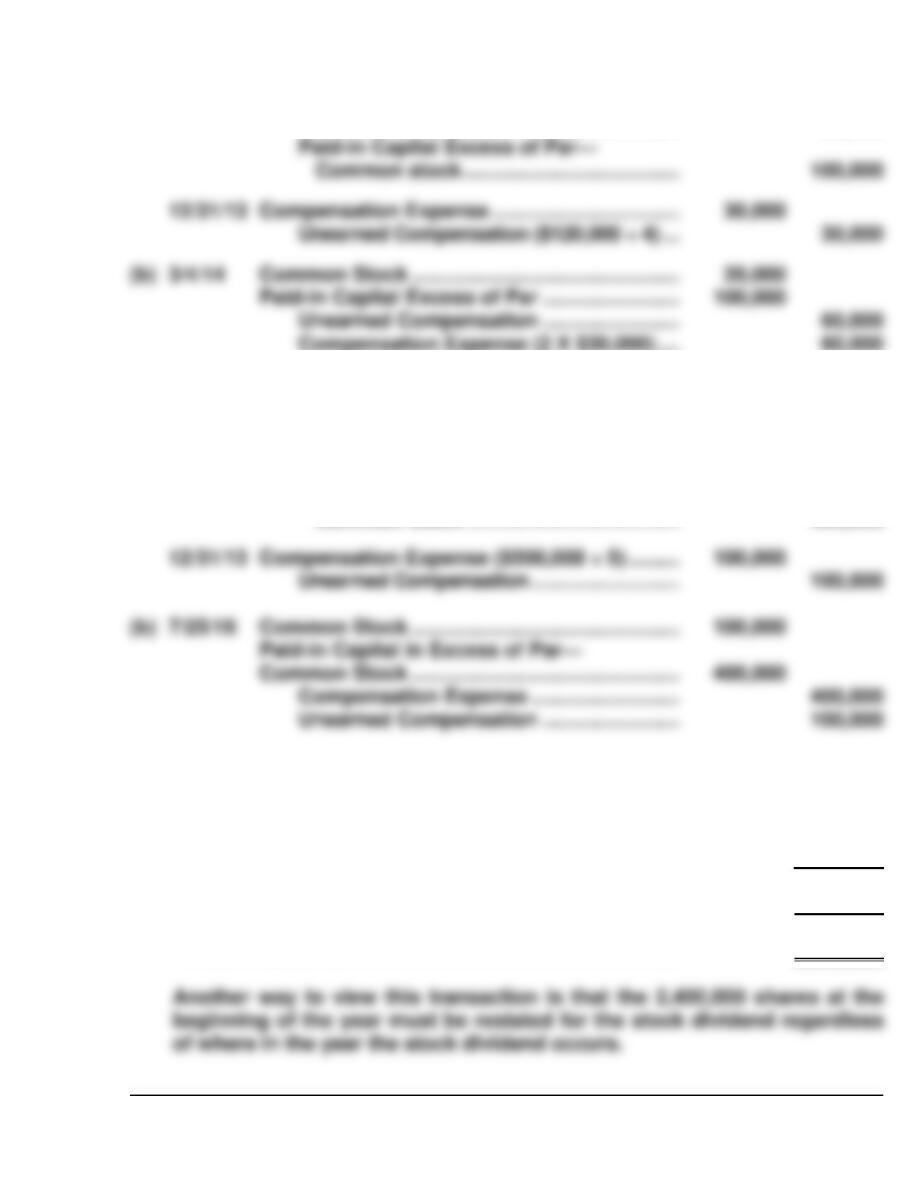
12/31/11 Compensation Expense ……………………….. 225,000
Paid-in Capital—Stock Options
($450,000 X 1/2) ………………………… 225,000
16–25
EXERCISE 16-13 (10–15 minutes)
(a) 1/1/12 Unearned Compensation …………………………. 120,000
Common Stock (4,000 X $5) ……………….. 20,000
EXERCISE 16-14 (10–15 minutes)
(a) 1/1/12 Unearned Compensation …………………………. 500,000
Common Stock ($10 X 10,000) ……………. 100,000
Paid-in Capital in Excess of Par—
Common Stock ………………………………. 400,000
EXERCISE 16-15 (15–25 minutes)
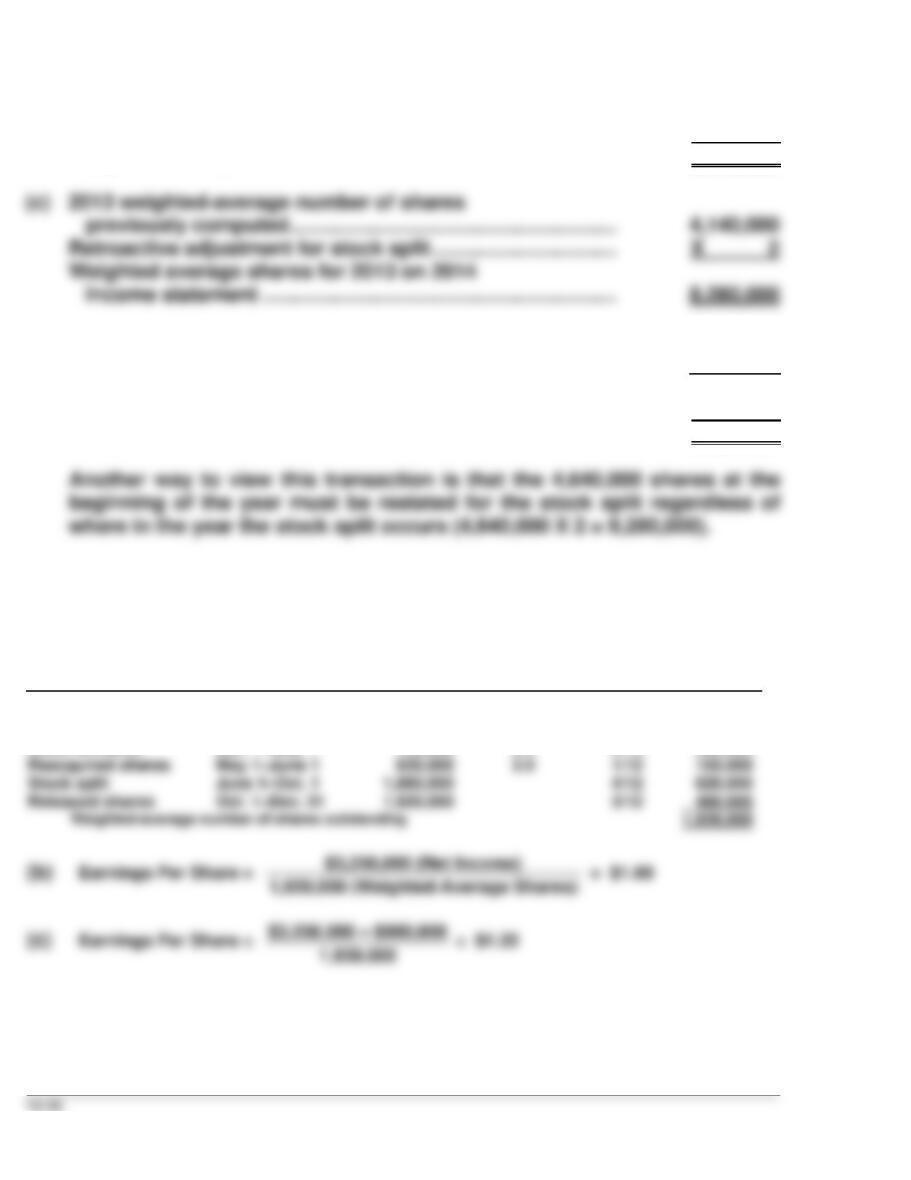
(a) Jan. 1, 2012–Sept. 30, 2012 (2,400,000 X 9/12)………….. 1,800,000
Retroactive adjustment for stock dividend ……………… X 1.10
Jan. 1, 2012–Sept. 30, 2012, as adjusted …………………. 1,980,000
Oct. 1, 2012–Dec. 31, 2012 (2,640,000 X 3/12) …………… 660,000
Weighted average shares for 2012 on 2013
income statement ……………………………………………….. 2,640,000
EXERCISE 16-15 (Continued)
(b) Jan. 1, 2013–Mar. 31, 2013 (2,640,000 X 3/12) ………………… 660,000
Apr. 1, 2013–Dec. 31, 2013 (4,640,000 X 9/12) ………………… 3,480,000
Weighted average shares—2013 ………………………………….. 4,140,000
(d) Jan. 1, 2014–Mar. 31, 2014 (4,640,000 X 3/12) ………………… 1,160,000
Retroactive adjustment for stock split ………………………….. X 2
Jan. 1, 2014–Mar. 31, 2014, as adjusted ………………………… 2,320,000
Apr. 1, 2014–Dec. 31, 2014 (9,280,000 X 9/12) ………………… 6,960,000
Weighted average share for 2014 …………………………………. 9,280,000
EXERCISE 16-16 (10–15 minutes)
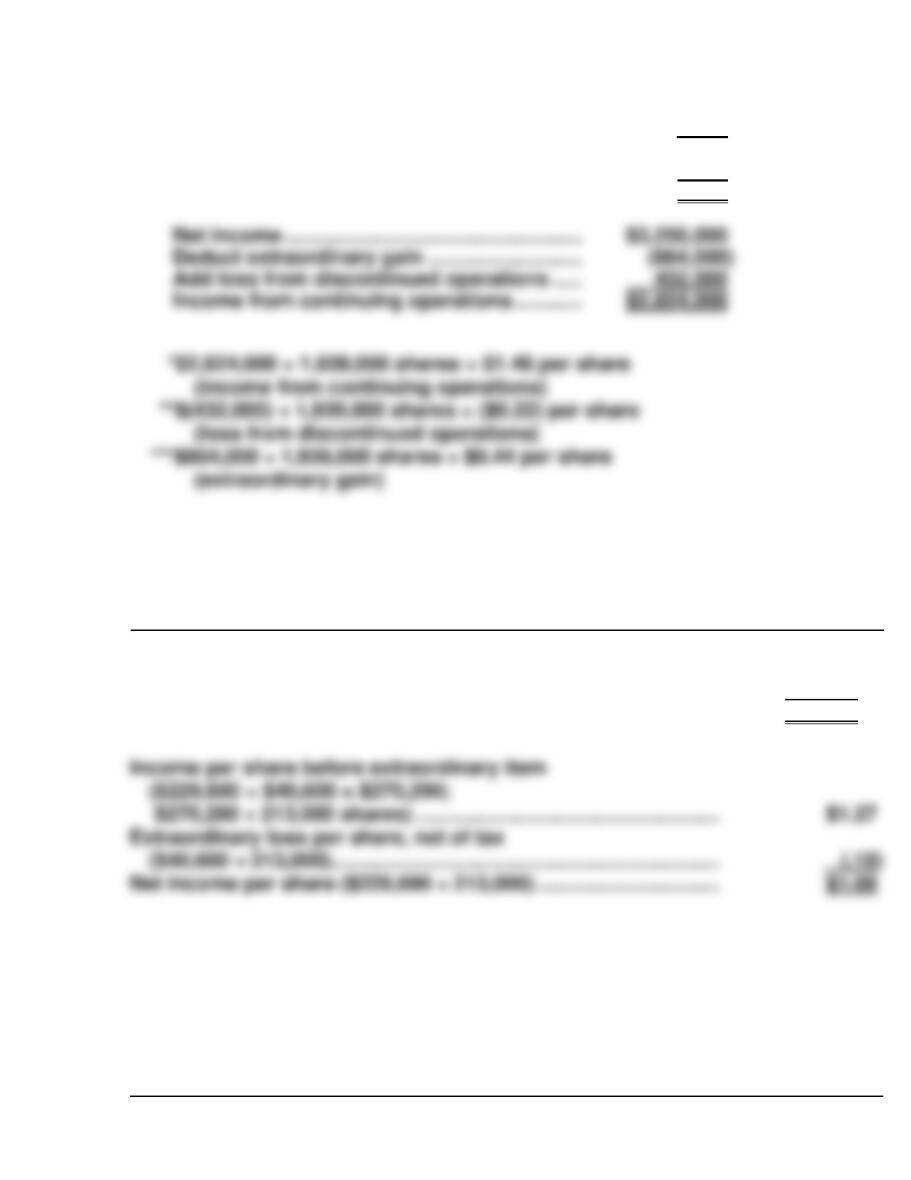
(a)
Event
Dates
Outstanding
Shares
Outstanding
Restatement
Fraction
of Year
Weighted
Shares
Beginning balance
Jan. 1–Feb. 1
480,000
1.2 X 3.0
1/12
144,000
Issued shares
Feb. 1–Mar. 1
600,000
1.2 X 3.0
1/12
180,000
Stock dividend
Mar. 1–May 1
720,000
3.0
2/12
360,000
Reacquired shares
May 1–June 1
620,000
1/12
155,000
Stock split
4/12
620,000
Reissued shares
Oct. 1–Dec. 31
3/12
16–27
EXERCISE 16-16 (Continued)
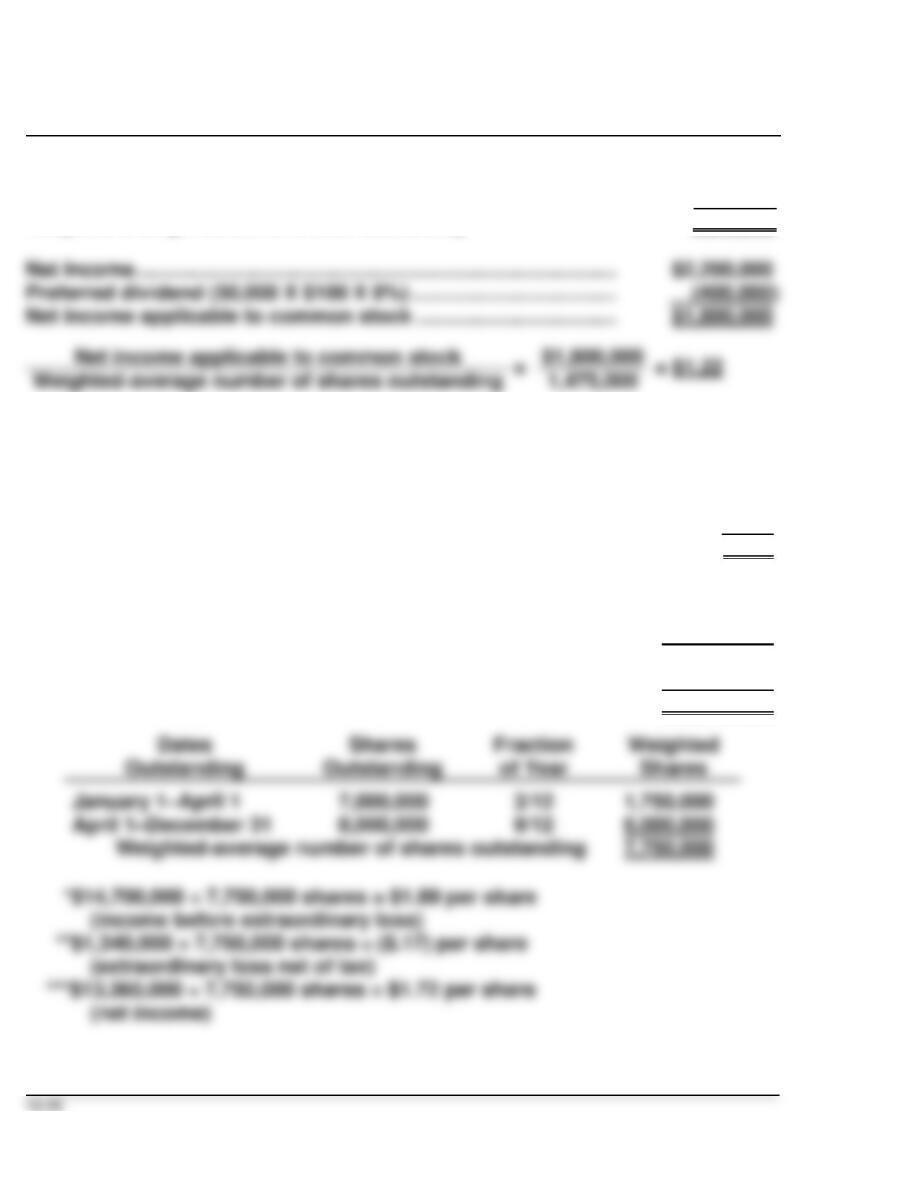
(d) Income from continuing operations*……….. $1.46
Loss from discontinued operations** ……… (.22)
Income before extraordinary item …………… 1.24
Extraordinary gain*** ……………………………… .44
Net income ……………………………………………. $1.68a
EXERCISE 16-17 (10–15 minutes)
Event
Dates
Outstanding
Shares
Outstanding
Fraction
of Year
Weighted
Shares
Beginning balance
Jan. 1–May 1
210,000
4/12
70,000
Issued shares
May 1–Oct. 31
218,000
6/12
109,000
Reacquired shares
Oct. 31–Dec. 31
204,000
2/12
34,000
Weighted-average number of shares outstanding
213,000
EXERCISE 16-18 (10–15 minutes)
Dates
Outstanding
Shares
Outstanding
Restatement
Fraction
of Year
Weighted
Shares
Beginning balance
Jan. 1–May 1
600,000
2
4/12
400,000
Issued shares
May 1–Aug. 1
900,000
2
3/12
450,000
Reacquired shares
Aug. 1–Dec. 31
750,000
2
5/12
625,000
Weighted-average number of shares outstanding
1,475,000
EXERCISE 16-19 (20–25 minutes)
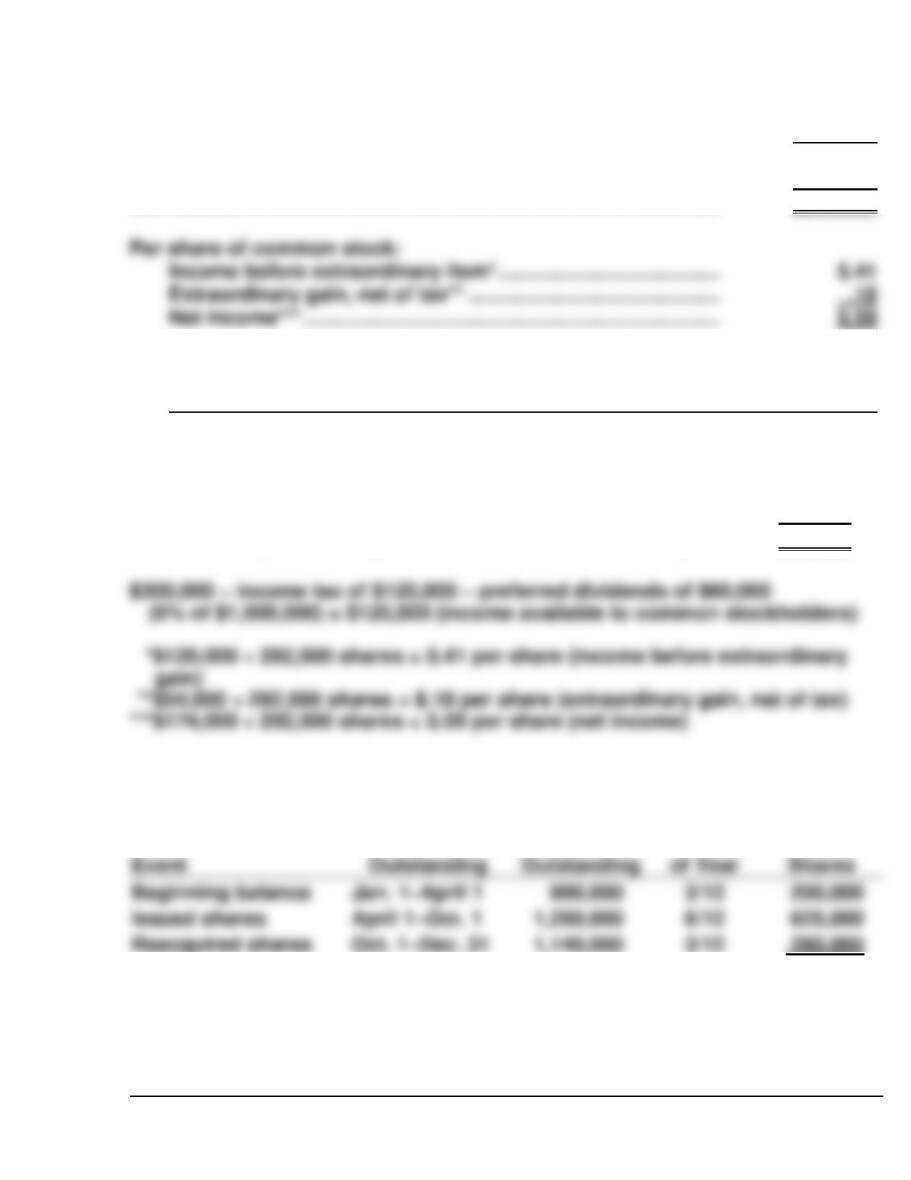
Earnings per share of common stock:
Income before extraordinary loss* ……………………………….. $1.89
Extraordinary loss, net of tax** …………………………………….. (.17)
Net income*** ……………………………………………………………… $1.72
Income data:
Income before extraordinary item ………………………………… $15,000,000
Deduct 6% dividend on preferred stock ………………………… 300,000
Common stock income before extraordinary item …………. 14,700,000
Deduct extraordinary loss, net of tax ……………………………. 1,340,000
Net income available for common stockholders ……………. $13,360,000
16–29
EXERCISE 16-20 (10–15 minutes)
Income before income tax and extraordinary items ……………… $300,000
Income taxes …………………………………………………………………….. 120,000
Income before extraordinary item ……………………………………….. 180,000
Extraordinary gain, net of applicable income tax of $36,000 …. 54,000
Net income ………………………………………………………………………… $234,000
Dates
Outstanding
Shares
Outstanding
Fraction
of Year
Weighted
Shares
January 1–April 1
200,000
3/12
50,000
April 1–July 1
260,000
3/12
65,000
July 1–Oct. 1
340,000
3/12
85,000
Oct. 1–Dec. 31
370,000
3/12
92,500
Weighted-average number of shares outstanding
292,500
EXERCISE 16-21 (10–15 minutes)
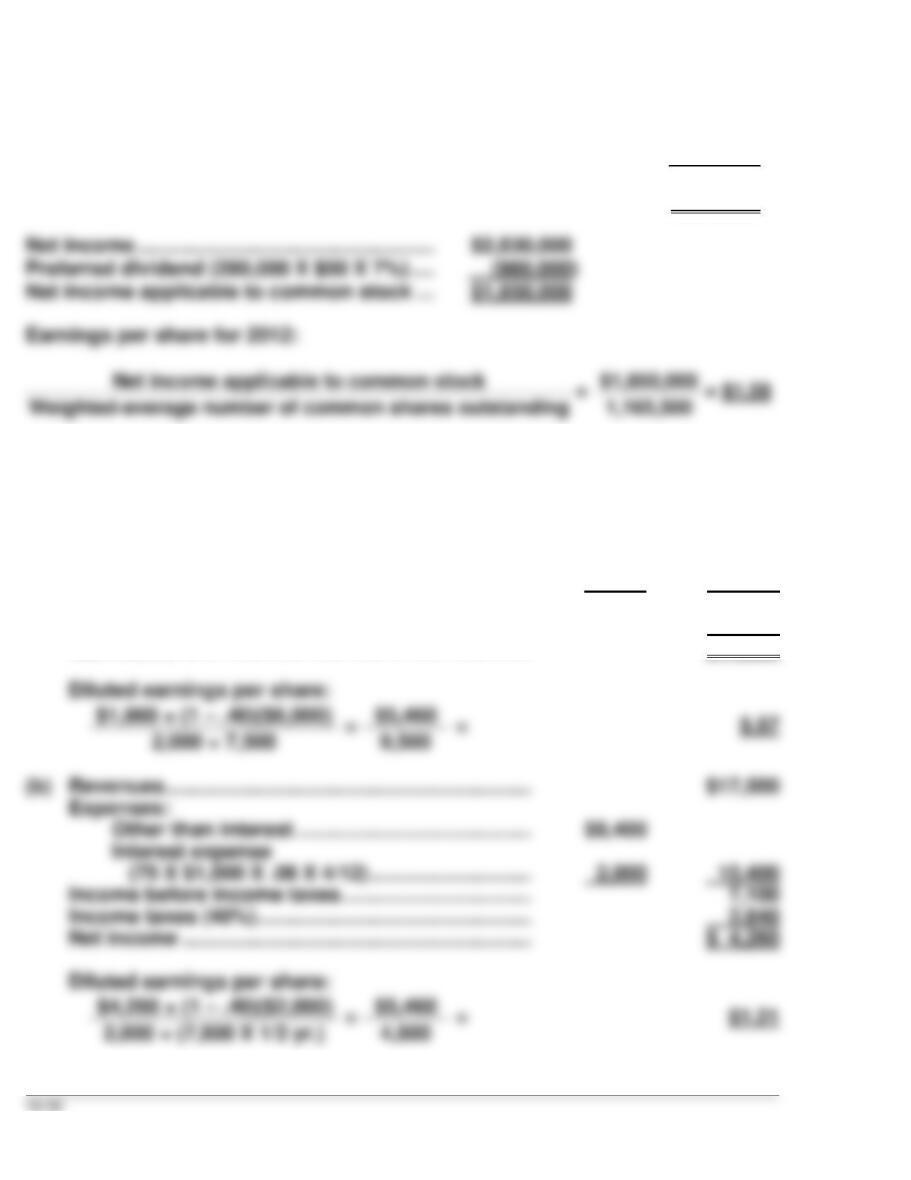
Outstanding
Jan. 1–April 1
April 1–Oct. 1
Oct. 1–Dec. 31
Dates
Shares
Fraction
Weighted
EXERCISE 16-21 (Continued)
Weighted-average number of shares outstanding—
unadjusted …………………………………………………………………. 1,110,000
Stock dividend, 2/15/11 …………………………………………… X 1.05
Weighted-average number of shares outstanding—
adjusted …………………………………………………………………….. 1,165,500
EXERCISE 16-22 (20–25 minutes)
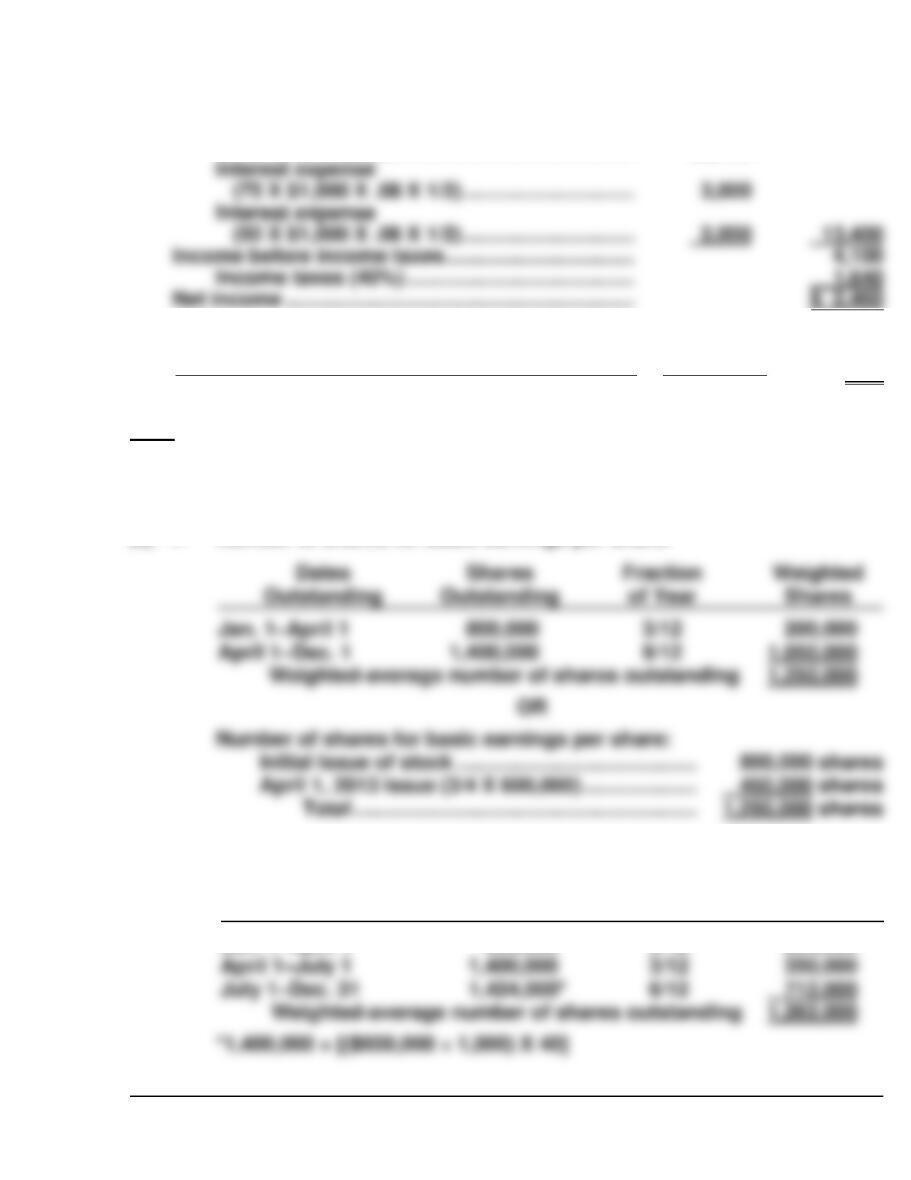
(a) Revenues $17,500
Expenses:
Other than interest ………………………………….. $8,400
Interest expense (75 X $1,000 X .08) …………. 6,000 14,400
Income before income taxes …………………………... 3,100
Income taxes (40%) …………………………………. 1,240
Net income ……………………………………………………. $ 1,860
16–31
EXERCISE 16-22 (Continued)
(c) Revenues………………………………………………………. $17,500
Expenses:
Other than interest ………………………………….. $8,400
Diluted earnings per share (see note):
$2,460 + (1 – .40)($5,000)
=
$5,460
= $.57
2,000 + (2,500 X 1/2 yr.) + 5,000 + (2,500 X 1/2)
9,500
Note: The answer is the same as (a). In both (a) and (c), the bonds are assumed
converted for the entire year.
EXERCISE 16-23 (15–20 minutes)
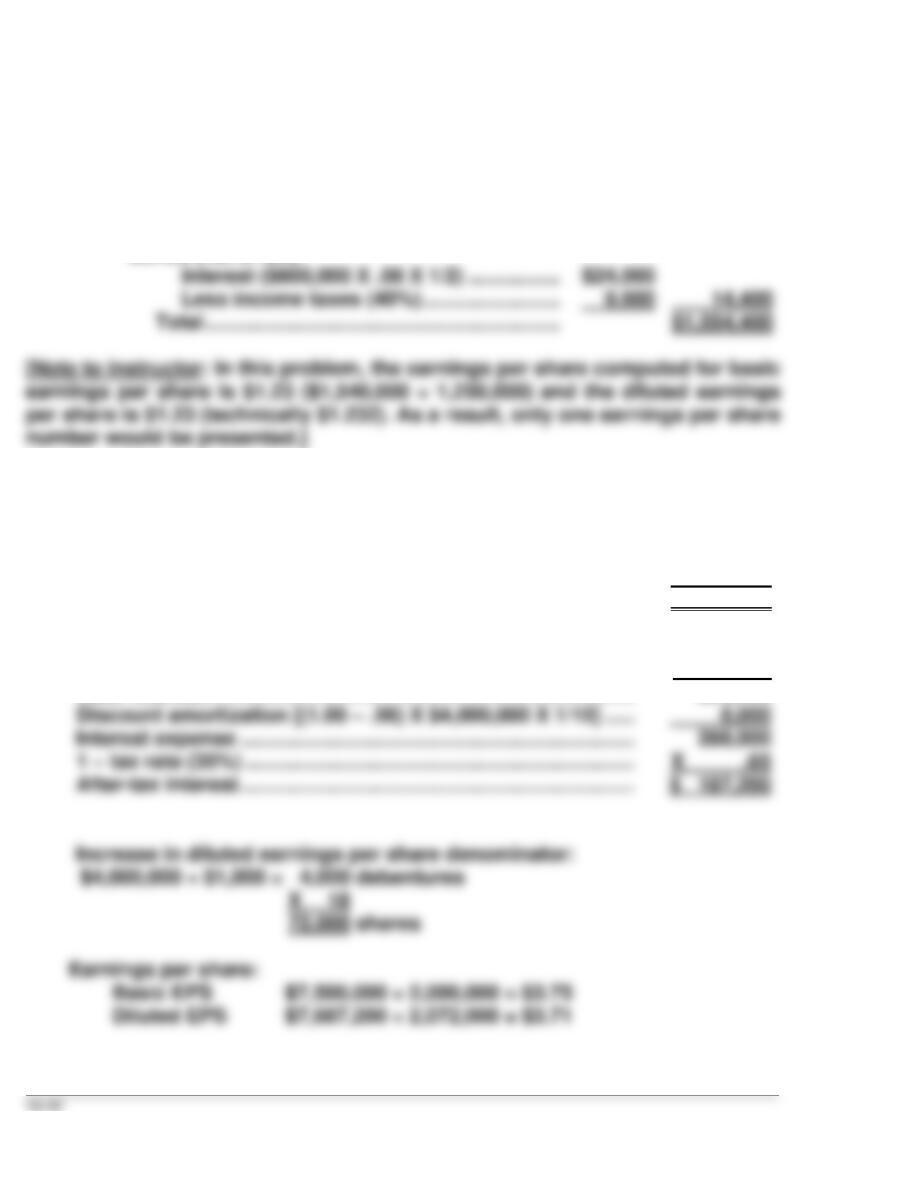
(a) 1. Number of shares for basic earnings per share.
Jan. 1–April 1
200,000
2. Number of shares for diluted earnings per share:
Dates
Outstanding
Shares
Outstanding
Fraction
of Year
Weighted
Shares
Jan. 1–April 1
800,000
3/12
200,000
April 1–July 1
3/12
350,000
EXERCISE 16-23 (Continued)
(b) 1. Earnings for basic earnings per share:
After-tax net income………………………….. $1,540,000
2. Earnings for diluted earnings per share:
After-tax net income………………………….. $1,540,000
Add back interest on convertible
bonds (net of tax):
EXERCISE 16-24 (20–25 minutes)
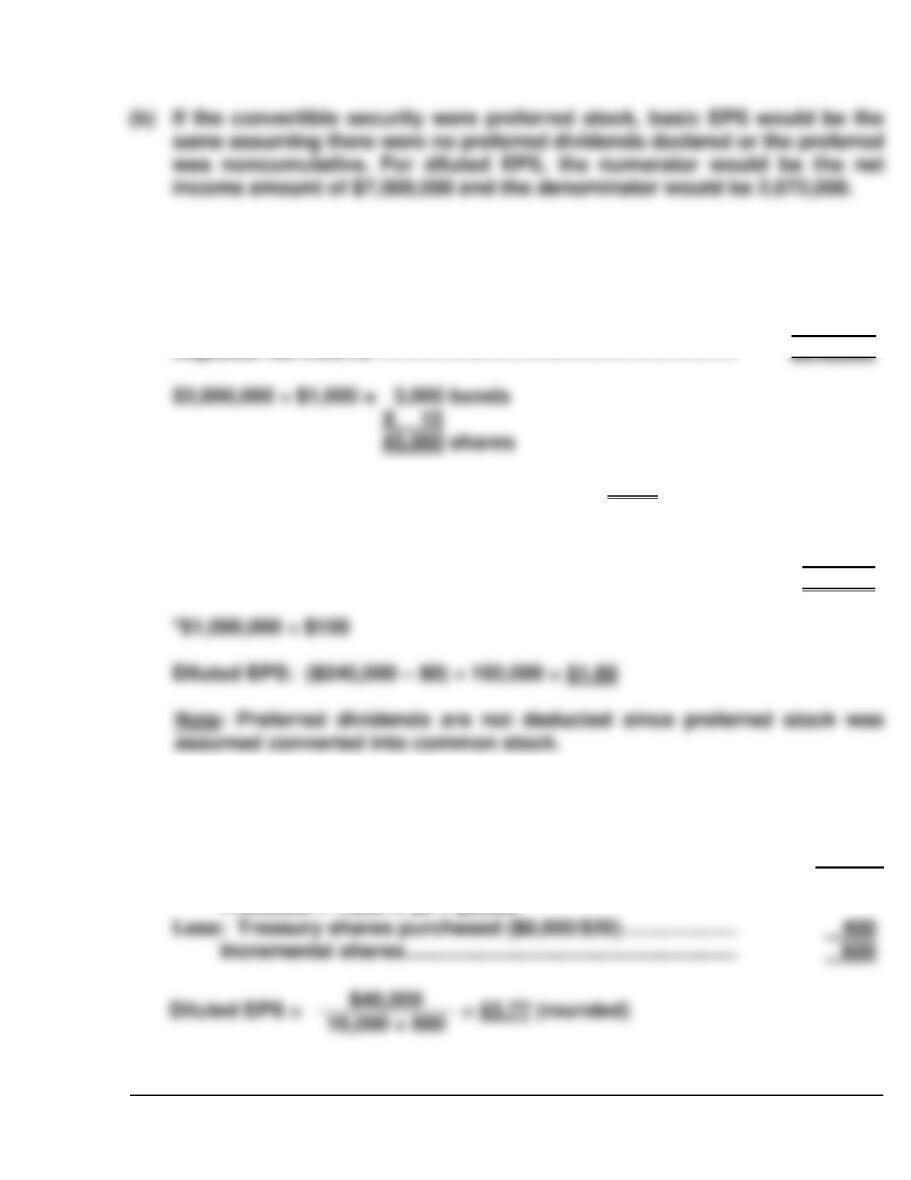
(a) Net income for year ……………………………………………………….. $7,500,000
Add: Adjustment for interest (net of tax) ………………………… 187,200*
$7,687,200
*Maturity value ………………………………………………………………. $4,000,000
Stated rate ……………………………………………………………………. X 7%
Cash interest ………………………………………………………………… 280,000
16–33
EXERCISE 16-24 (Continued)
EXERCISE 16-25 (10–15 minutes)
(a) Net income ……………………………………………………………………. $240,000
Add: Interest savings (net of tax) [$180,000 X (1 – .40)] ……. 108,000
Adjusted net income ……………………………………………………… $348,000
Diluted EPS: $348,000 ÷ (100,000 + 45,000) = $2.40
(b) Shares outstanding ……………………………………………………….. 100,000
Add: Shares assumed to be issued (10,000* X 5) …………….. 50,000
Shares outstanding adjusted for dilutive securities …………. 150,000
EXERCISE 16-26 (20–25 minutes)
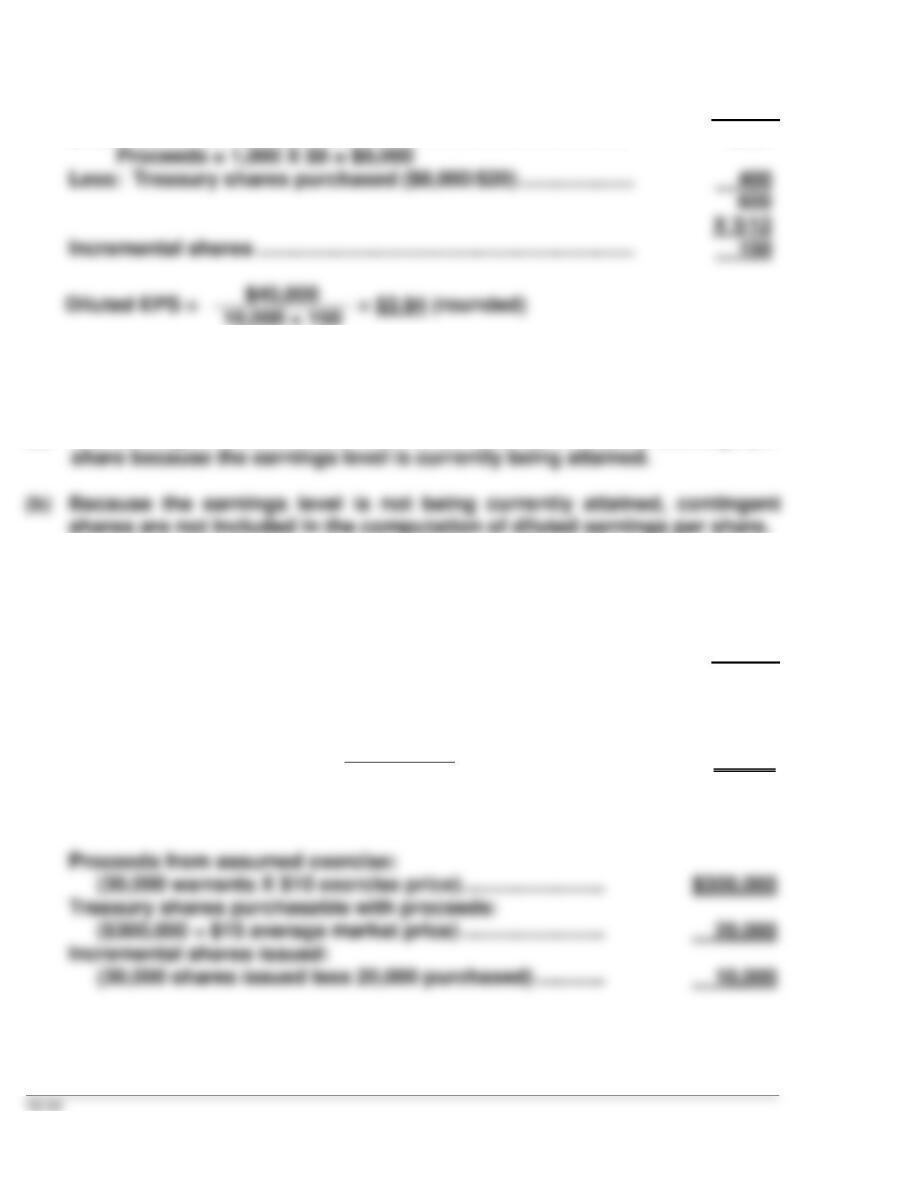
(a) Diluted
Shares assumed issued on exercise ………………………………. 1,000
Proceeds = 1,000 X $8 = $8,000
EXERCISE 16-26 (Continued)
(b) Diluted
Shares assumed issued on exercise ……………………………….. 1,000
Diluted EPS =
EXERCISE 16-27 (10–15 minutes)
(a) The contingent shares would have to be reflected in diluted earnings per
EXERCISE 16-28 (15–20 minutes)
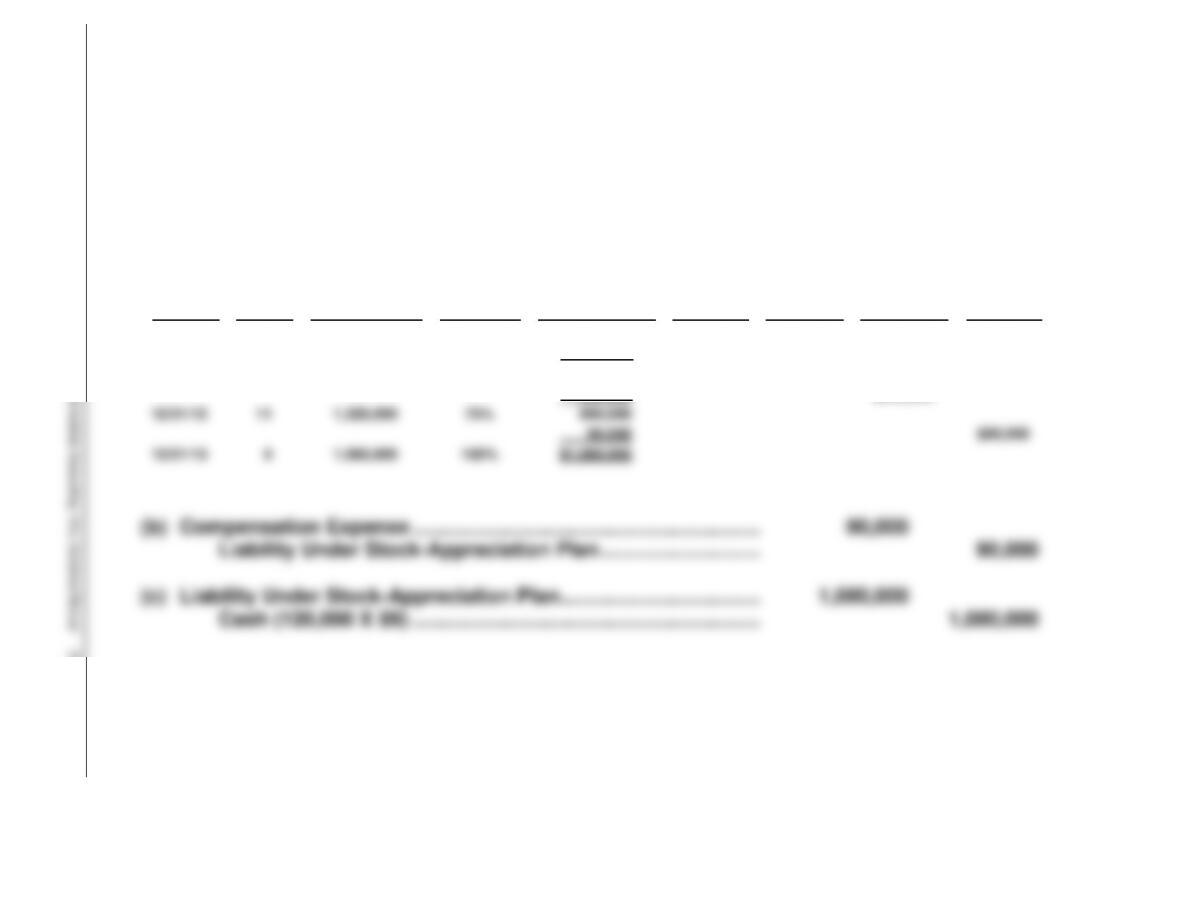
(a) Diluted
The warrants are dilutive because the option price
($10) is less than the average market price ($15).
Incremental shares =
$15 – $10
X 30,000 = 10,000
$15
OR

16–35
EXERCISE 16-28 (Continued)
(b) Basic EPS = $2.60
($260,000 ÷ 100,000 shares)
*EXERCISE 16-29 (15–25 Minutes)
16–36 Copyright © 2011 John Wiley & Sons, Inc. Kieso, Intermediate Accounting, 14/e, Solutions Manual (For Instructor Use Only)
(a) Schedule of Compensation Expense Stock Appreciation Rights
Date
Fair
Value
Cumulative
Compensation
Recognizable
Percentage
Accrued
Compensation
Accrued to Date
Expense
2010
Expense
2011
Expense
2012
Expense
2013
12/31/10
$4
$480,000
25%
$ 120,000
$120,000
(60,000)
$(60,000)
12/31/11
1
120,000
50%
60,000
930,000
$930,000
11
75%
990,000
90,000
*EXERCISE 16-30 (15–25 Minutes)
Copyright © 2011 John Wiley & Sons, Inc. Kieso, Intermediate Accounting, 14/e, Solutions Manual (For Instructor Use Only) 16–37
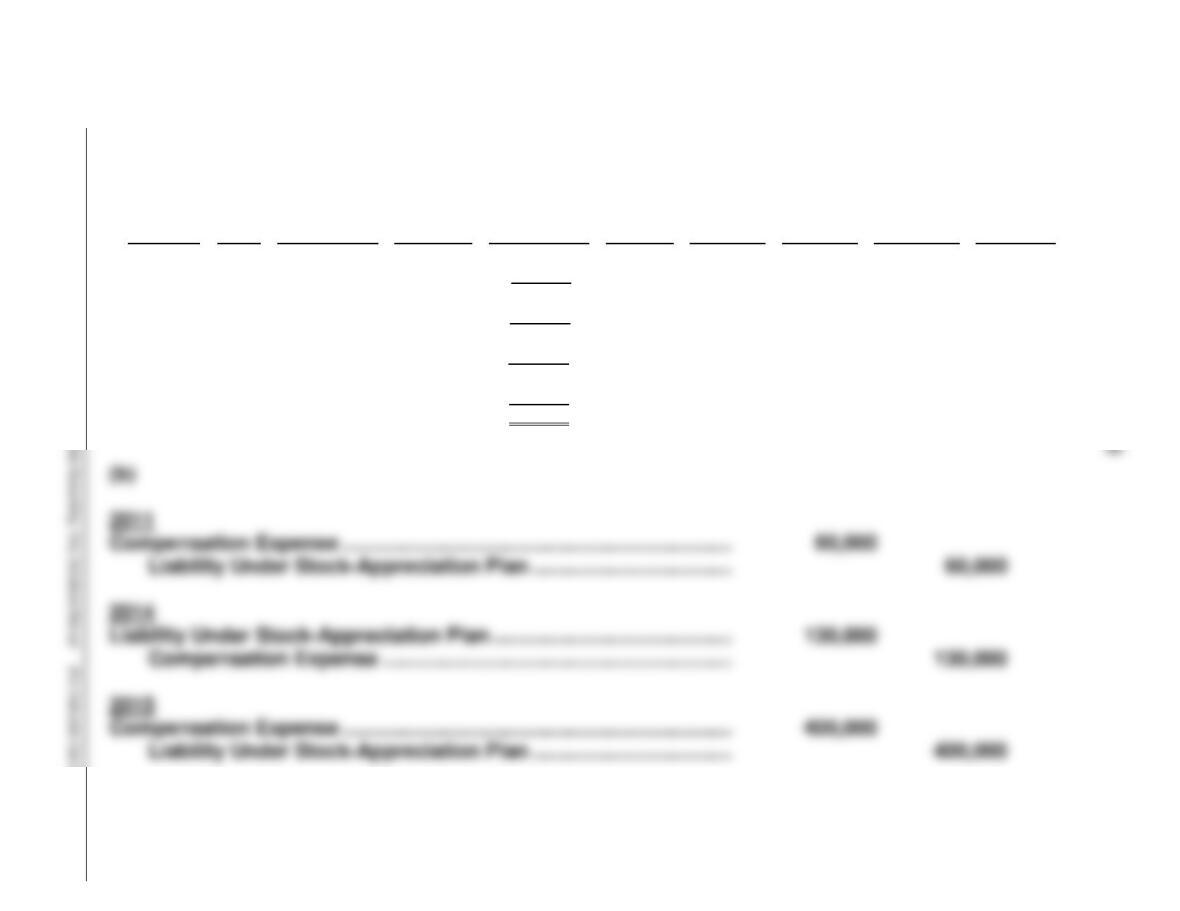
(a) Schedule of Compensation Expense Stock Appreciation Rights
Date
Fair
Value
Cumulative
Compensation
Recognizable
Percentage
Accrued
Compensation
Accrued
to Date
Expense
2011
Expense
2012
Expense
2013
Expense
2014
Expense
2015
12/31/11
$ 6
$240,000
25%
$ 60,000
$60,000
120,000
$120,000
12/31/12
9
360,000
50%
180,000
270,000
$270,000
12/31/13
15
600,000
75%
450,000
(130,000)
$(130,000)
12/31/14
8
320,000
100%
320,000
400,000
$400,000
12/31/15
18
720,000
—
$720,000

TIME AND PURPOSE OF PROBLEMS
Problem 16-1 (Time 35–40 minutes)
Purpose—to provide the student with an opportunity to prepare entries to properly account for a series of
transactions involving the issuance and exercise of common stock rights and detachable stock warrants,
plus the granting and exercise of stock options. The student is required to prepare the necessary journal
entries to record these transactions and the stockholders’ equity section of the balance sheet as of the end
of the year.
Problem 16-2 (Time 45–50 minutes)
Purpose—to provide the student with an understanding of the entries to properly account for convertible
debt. The student is required to prepare the journal entries to record the conversion, amortization, and
interest in connection with these bonds on specified dates.
Problem 16-3 (Time 30–35 minutes)
Purpose—to provide the student with an understanding of the entries to properly account for a stock-option
plan over a period of years. The student is required to prepare the journal entries when the stock-option
plan was adopted, when the options were granted, when the options were exercised, and when the options
expired.
Problem 16-4 (Time 25–30 minutes)
Purpose—to provide the student with an understanding of the entries to properly account for a stock option
and restricted stock plan. The student is asked to identify the important features of an employee stock–
purchase plan.
Problem 16-5 (Time 30–35 minutes)
Purpose—to provide the student with an understanding of the effect options and convertible bonds have on
the computation of the weighted-average number of shares outstanding with regard to basic EPS and
diluted EPS. Preferred stock dividends must also be computed.
Problem 16-6 (Time 30–35 minutes)
Purpose—to provide the student with an understanding of the proper computation of the weighted-average
number of shares outstanding for two consecutive years. The student is also asked to determine whether
the capital structure presented is simple or complex. A two-year comparative income statement with
appropriate EPS presentation is also required.
Problem 16-7 (Time 35–45 minutes)
Purpose—to provide the student with an opportunity to calculate the number of shares used to compute
basic and diluted earnings per share which is complicated by a stock dividend, a stock split, and several
issues of common stock during the year. To be determined are the number of shares to compute basic
EPS, the number of shares to compute diluted EPS, and the numerator for computing basic EPS.
Problem 16-8 (Time 25–35 minutes)
Purpose—to provide the student with a problem with multiple dilutive securities which must be analyzed to
compute basic and diluted EPS.
Problem 16-9 (Time 30–40 minutes)
Purpose—to provide the student with an opportunity to calculate the weighted-average number of common
shares for computing earnings per share and to prepare a comparative income statement including
earnings per share data. In addition, the student explains a simple capital structure and the earnings per
share presentation for a complex capital structure.
SOLUTIONS TO PROBLEMS
PROBLEM 16-1
(a) 1. Memo Entry (memo entry made to indicate the number of rights
issued).
2. Cash ………………………………………………………… 208,000
Discount on Bonds Payable* …………………….. 8,000
Bonds Payable ………………………………….. 200,000
Paid-in Capital—Stock Warrants** ………. 16,000
3. Cash* ………………………………………………………. 304,000
Common Stock (9,500 X $10) ……………… 95,000
Paid-in Capital in Excess of Par—
Common Stock …………………………... 209,000
*[(100,000 – 5,000) rights exercised] ÷
*[(10 rights/share) X $32 = $304,000
4. Cash* ………………………………………………………. 48,000
Paid-in Capital—Stock Warrants
PROBLEM 16-1 (Continued)
5. Compensation Expense* ………………………….. 100,000
6. For options exercised:
Cash (9,000 X $30)……………………………………. 270,000
Paid-in Capital—Stock Options
(90% X $100,000) …………………………………… 90,000
Common Stock (9,000 X $10) ……………… 90,000
Paid-in Capital in Excess of Par—
Common Stock ………………………………. 270,000
(b) Stockholders’ Equity:
Paid-in Capital:
Common Stock, $10 par value, authorized
1,000,000 shares, 320,100 shares
issued and outstanding ……………………. $3,201,000
Paid-in Capital in Excess of Par—