FINANCIAL REPORTING PROBLEM
(a) (1) Under P&G’s stock-based compensation plan (Note 7), 37,623,000
options were granted during 2009.
(4) The options granted since September 2002 will expire 10 years from
the date of grant.
at an average exercise price of $48.83.
(b)
(In millions—except per share)
2009
2008
2007
Weighted average common shares
3,154.1
3,316.8
3,398.8
Diluted earnings per share
$4.26
$3.64
$3.04
COMPARATIVE ANALYSIS CASE
(b)
Coca-Cola
PepsiCo
Options outstanding at year-end 2009
189,000,000
106,011,000
(c)
Coca-Cola
PepsiCo
Options granted during 2009
34,000,000
15.466,000
(d)
Coca-Cola
PepsiCo
Options exercised during 2009
15,000,000
10,546,000
(e)
(g)
FINANCIAL STATEMENT ANALYSIS CASE 1
(a) By adopting the disclosure option of SFAS No. 123, Kellogg was not
recognizing expense for the cost of stock options. When it adopted SFAS
No. 123(R), Kellogg took the disclosed expense out of the notes and
recorded it as an expense. Based on 2004 data, this will result in a $30.4
FINANCIAL STATEMENT ANALYSIS CASE 2
(a) Account 2007 (,000)
(1) Return on Assets 4.15% = Net Income/Total Assets
(2) Return on Stockholders’ Equity 33.07% = Net Income/Stockholders’
Equity
(3) Debt to Assets Ratio 87.44% = Total Debt/Total Assets
(b) Sepracor is doing very well. Its ROA and ROSE are above the industry
average. However, its debt level is quite high, compared to the industry.
This may suggest it is a riskier investment and may require a higher rate
of return than the 5% coupon. Investors likely were attracted to the con–
vertible bonds due to the possibility that Sepracor’s stock price will increase,
and they can cash in on these gains when they convert to common stock.
Reclassified:
Account 2007 (,000)
Current Liabilities 554,114
Convertible Debt 498,020
Total Liabilities 1,078,313
Stockholders’ Equity 326,413
Net Income 58,333

FINANCIAL STATEMENT ANALYSIS CASE 2 (Continued)
ACCOUNTING, ANALYSIS, AND PRINCIPLES
Accounting
(a) Under U.S. GAAP, proceeds from the issuance of convertible debt are
recorded entirely as debt.
(b)
2012
2011
Basic EPS
Net income (a)
$30,000
$27,000
Outstanding shares (b)
10,000
10,000
Basic EPS (a ÷ b)
$3.00
$2.70
Net income
$30,000
$27,000
Add: Interest savings ($200,000 X 6%)
Adjusted net income (a)
$42,000
$39,000
Outstanding shares
10,000
10,000
Shares upon conversion (200 X 30)
6,000
6,000
Total shares for diluted EPS (b)
16,000
16,000
ACCOUNTING, ANALYSIS, AND PRINCIPLES (Continued)
(c)
Bond Conversion Expense** ……………………….
7,500
Bonds Payable …………………………………………..
150,000
Common Stock* ………………………………..
9,000
Paid-in-capital in Excess of Par—
Common Stock* …………………………...
141,000
Cash …………………………………………………
7,500
Analysis
EPS Presentation:
2012 2011
Net income $30,000 $27,000
Basic EPS $3.00 $2.70
Diluted EPS $2.63 $2.44
ACCOUNTING, ANALYSIS, AND PRINCIPLES (Continued)
Principles
IFRS for convertible debt primarily differs from U.S. GAAP on convertible debt
in that IFRS requires that companies split the proceeds from issuance into a
debt component and an equity component. For example, in part (a) we
$70,000 Garner would make an entry like this:
Cash …………………………………………………………
200,000
Discount on Bonds Payable ……………………….
70,000
Bonds Payable …………………………………..
200,000
Share Premium-Convertible Equity……..
70,000
PROFESSIONAL RESEARCH
(a) The accounting for stock compensation is addressed in the FASB
Codification at FASB ASC 718-10 (Compensation-Stock Compensation).
10-1 The objective of accounting for transactions under share-based
payment arrangements with employees is to recognize in the
financial statements the employee services received in exchange for
10–2 This Topic requires that the cost resulting from all share-based
payment transactions be recognized in the financial statements. This
Topic establishes fair value as the measurement objective in account-
PROFESSIONAL RESEARCH (Continued)
(c) See FASB ASC 718-50–25.
25-1 An employee share-purchase plan that satisfies all of the following
1. The plan satisfies either of the following conditions:
(a) The terms of the plan are no more favorable than those
available to all holders of the same class of shares. Note that a
transaction subject to an employee share-purchase plan that
involves a class of equity shares designed exclusively for and
2. Substantially all employees that meet limited employment
qualifications may participate on an equitable basis.
3. The plan incorporates no option features, other than the following:
(a) Employees are permitted a short period of time—not
exceeding 31 days—after the purchase price has been fixed to
PROFESSIONAL SIMULATION
Explanation
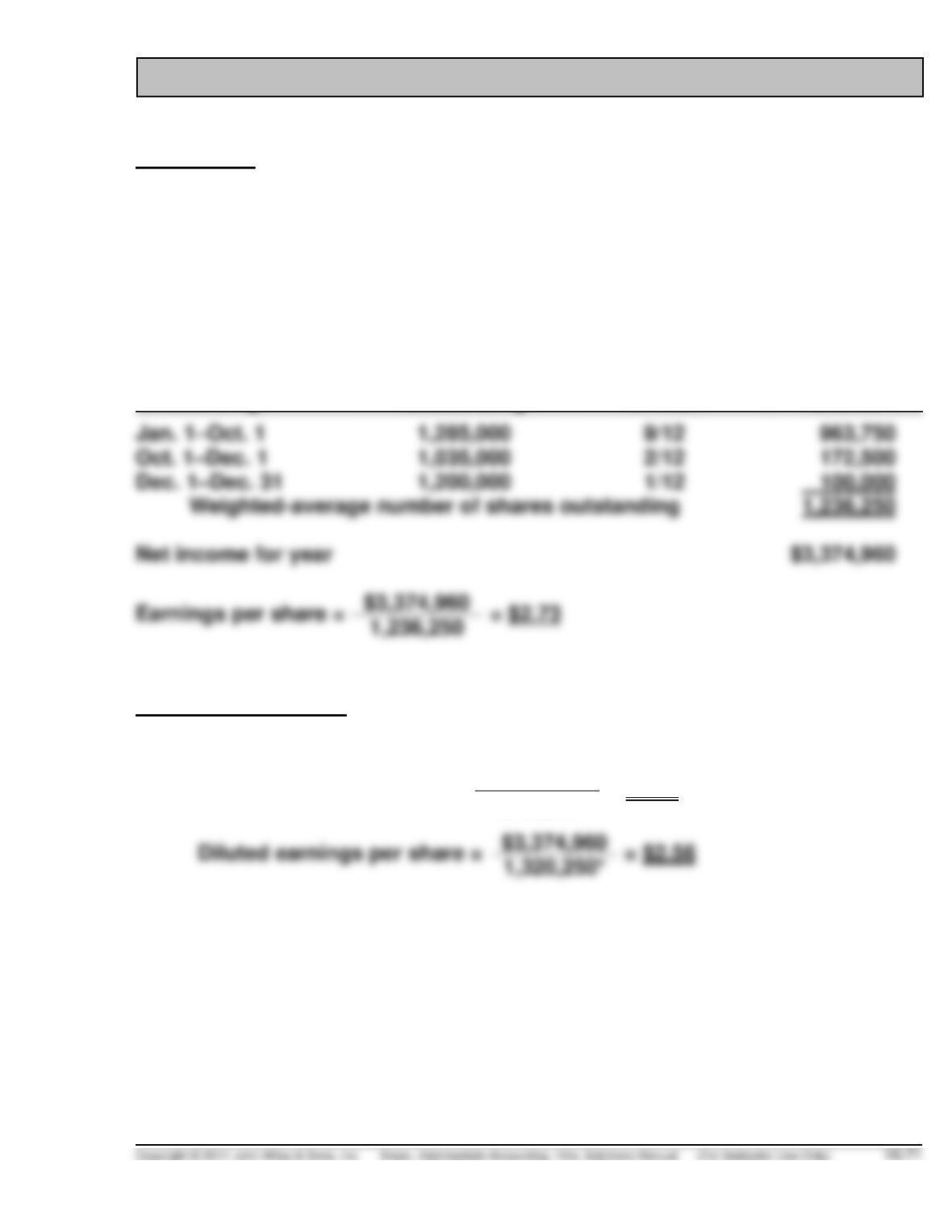
(a) The controller’s computations were not correct in that the straight
arithmetic average of the common shares outstanding at the beginning
and end of the year was used.
The weighted-average number of shares outstanding may be computed
as follows:
Dates
Outstanding
Shares
Outstanding
Fraction
of Year
Weighted
Shares
Financial Statements
(b)
Basic earnings per share =
$3,374,960
= $2.73
1,236,250
Diluted earnings per share =
= $2.56