Chapter 16
Carbohydrates
SUMMARY
Section 16.1
Biochemically important sugars usually contain five or six carbon atoms; their
structure includes a carbonyl group (either the aldehyde or the ketone form) and
several hydroxyl groups.
Section 16.2
Sugars can and do undergo oxidation reactions, as well as forming esters.
Glycosidic linkages are responsible for the bonding of monosaccharides to form
Section 16.3
The disaccharide sucrose is common table sugar. It consists of glucose and
Section 16.4
Polysaccharides are formed by linking monomeric sugars through glycosidic
linkages.
Section 16.5
Sugars can be found in specific bonding arrangements in some proteins.
2 Chapter 16
LECTURE NOTES
The two major topics of this chapter, the stereochemistry of monosaccharides
and the nature of polysaccharides, will each take one lecture. The discussion of
LECTURE OUTLINE
I. Monosaccharide structures
A. Aldoses and ketoses
B. Optical isomers
4. Epimers
C. Cyclic structures
1. Hemiacetals and hemiketals
II. Monosaccharide reactions
A. Oxidation-reductions
B. Esterification reactions
IV. Polysaccharides
A. Cellulose and starch
B. Forms of starch
1. Amylose
2. Amylopectin
Carbohydrates 3
ANSWERS TO PROBLEMS
16.1 Sugars: Their Structures and Stereochemistry
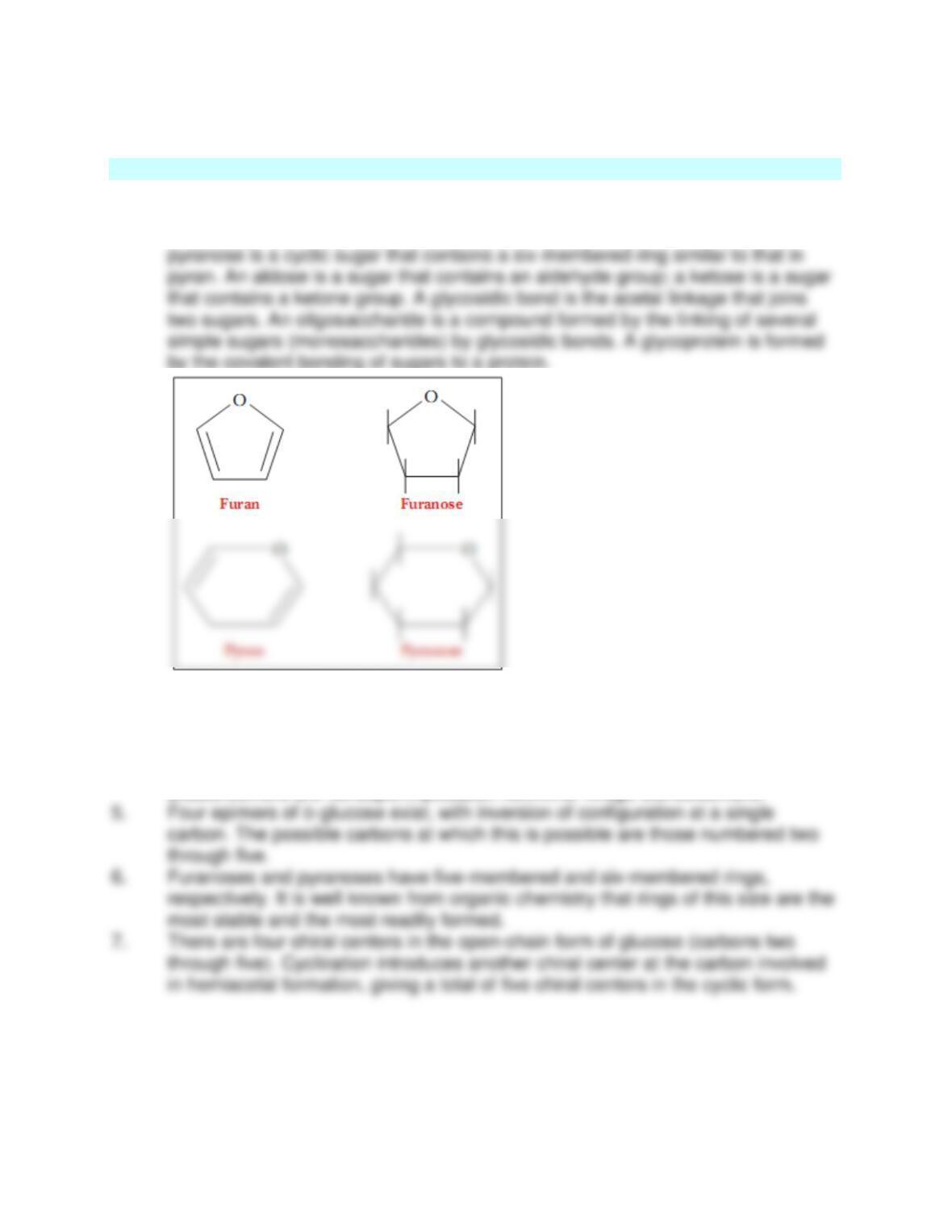
1. A polysaccharide is a polymer of simple sugars, which are compounds that
contain a single carbonyl group and several hydroxyl groups. A furanose is a
cyclic sugar that contains a five-membered ring similar to that in furan. A
2. D-Mannose and D-galactose are both epimers of D-glucose, with inversion of
configuration around carbon atoms 2 and 4, respectively; D-ribose has only five
carbons, but the rest of the sugars named in this question have six.
3. All groups are aldose–ketose pairs.
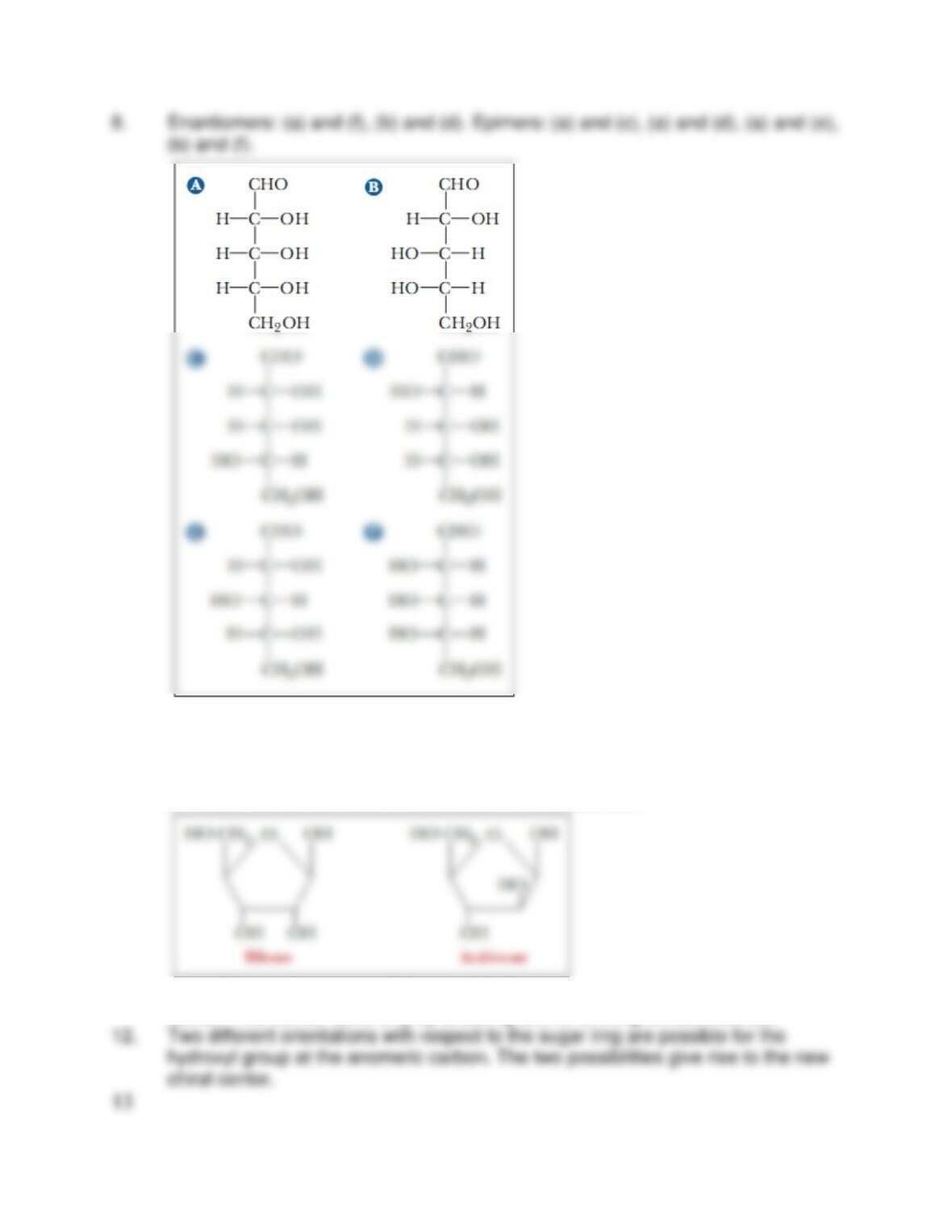
4. Enantiomers are nonsuperimposable, mirror-image stereoisomers.
Diastereomers are nonsuperimposable, nonmirror-image stereoisomers.
4 Chapter 16
9. L-Sorbitol was named early in biochemical history as a derivative of L-sorbose.
Reduction of D-glucose gives a hydroxy sugar that could easily be named D–
glucitol, but it was originally named L-sorbitol and the name stuck.
10. Arabinose is an epimer of ribose. Nucleosides in which arabinose is substituted
for ribose act as inhibitors in reactions of ribonucleosides.
11. Converting a sugar to an epimer requires inversion of configuration at a chiral
center. This can be done only by breaking and re-forming covalent bonds.
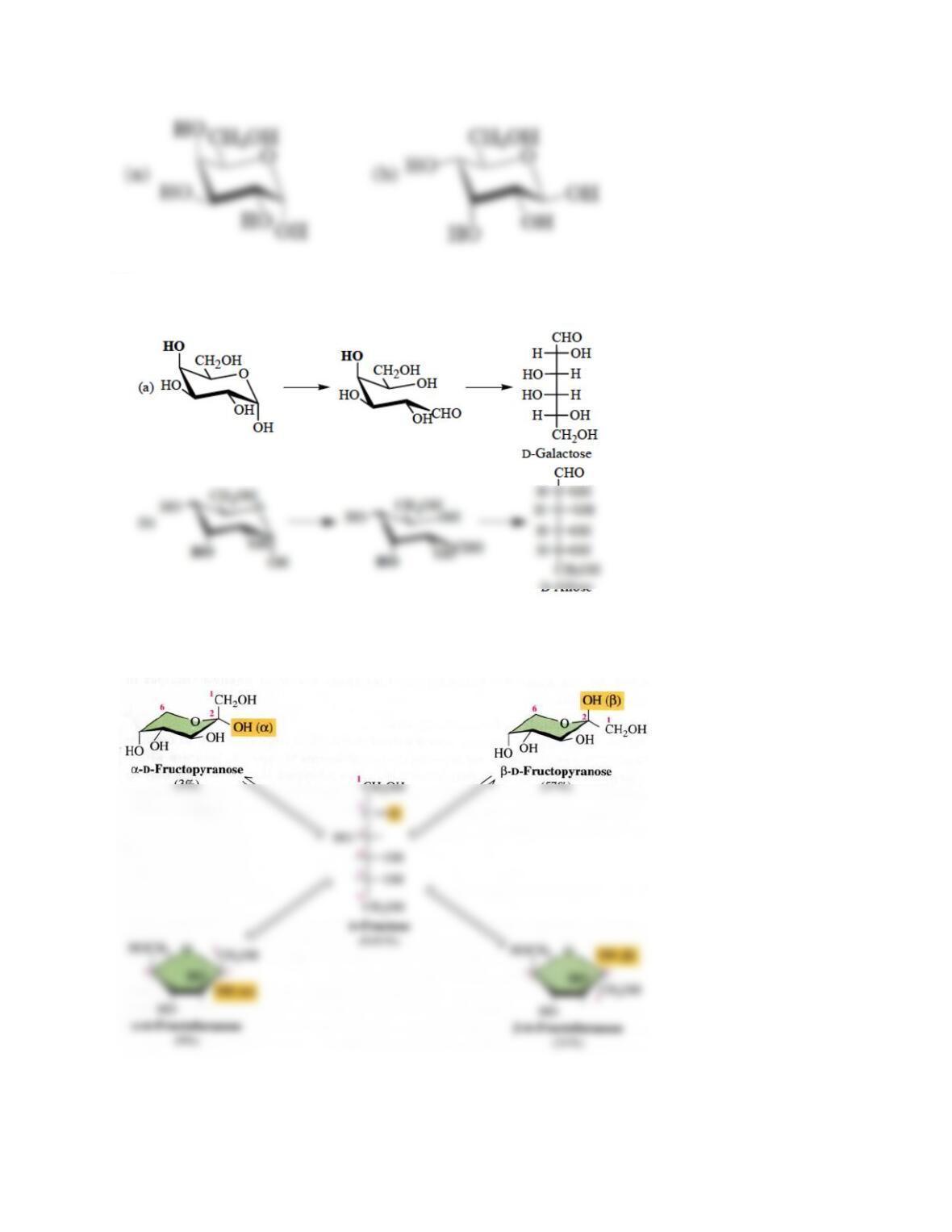
Carbohydrates 5
14
15.
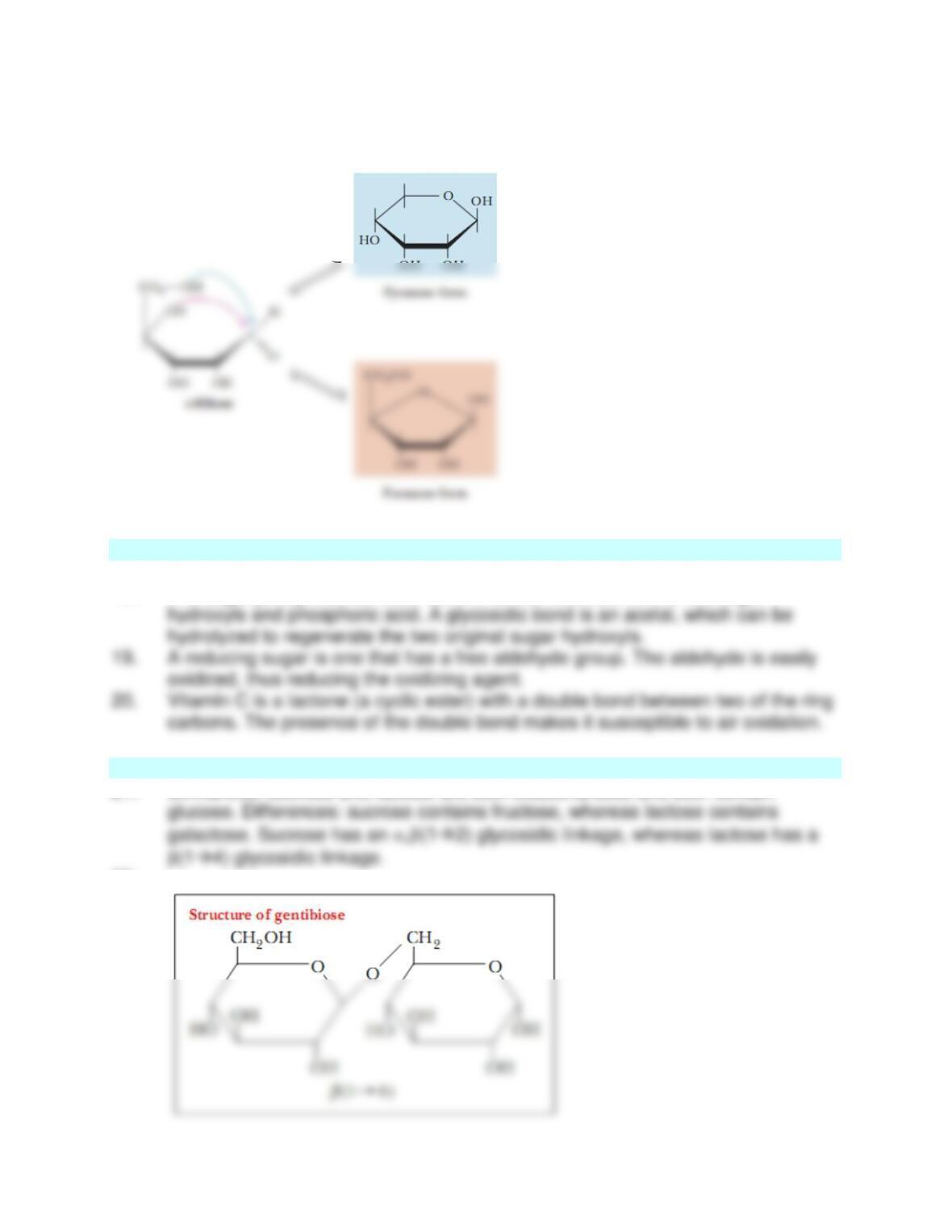
6 Chapter 16
16
16.2 Reactions of Monosaccharides
17. This compound contains a lactic acid side chain.
18. In a sugar phosphate, an ester bond is formed between one of the sugar
16.3 Some Important Oligosaccharides
21. Similarities: sucrose and lactose are both disaccharides, and both contain
22.
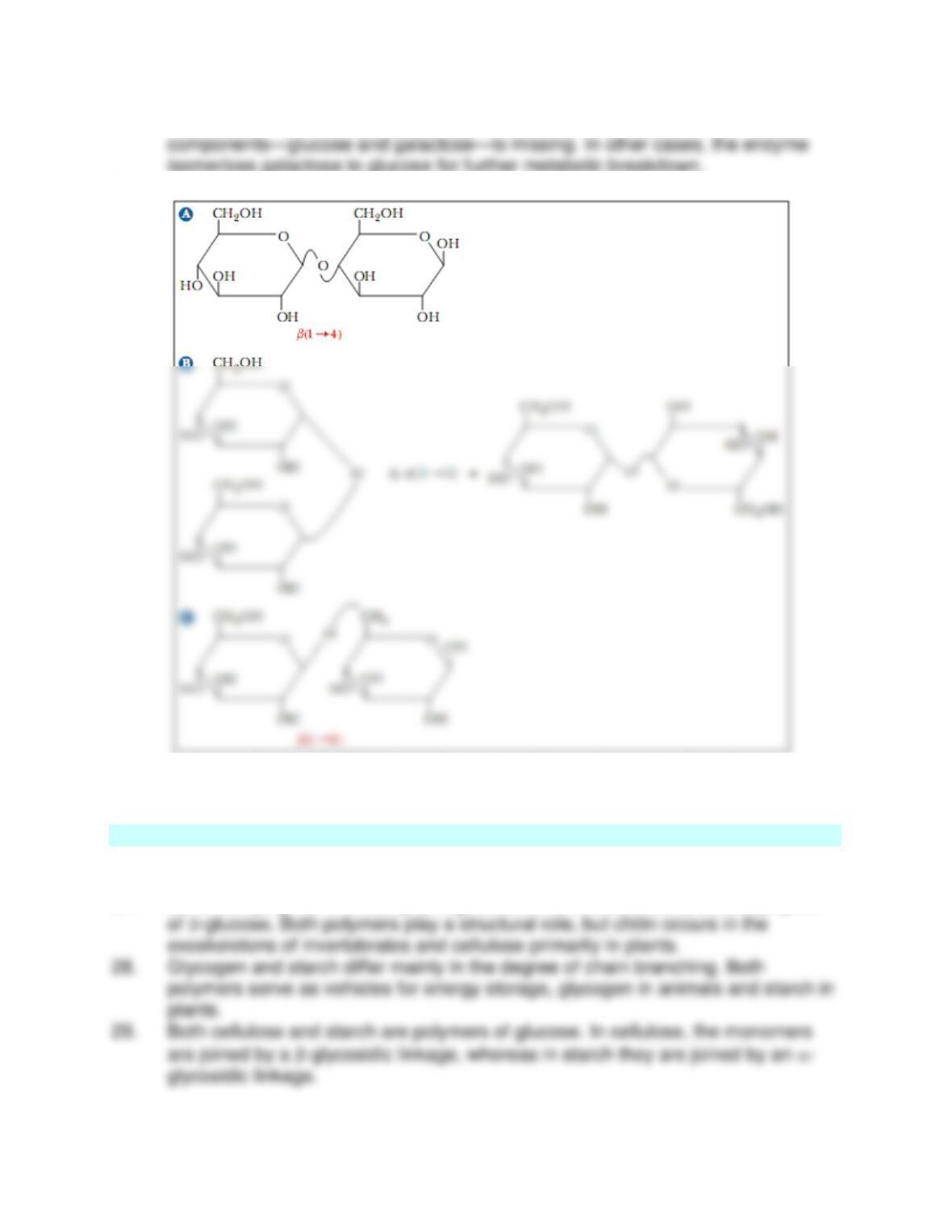
Carbohydrates 7
23. In some cases, the enzyme that degrades lactose (milk sugar) to its
24.
25. Milk contains lactose. Many people are sensitive to lactose and require an
alternative beverage.
16.4 Structures and Functions of Polysaccharides
26. The cell walls of plants consist mainly of cellulose, whereas those of bacteria
consist mainly of polysaccharides with peptide crosslinks.
27. Chitin is a polymer of N-acetyl-–D-glucosamine, whereas cellulose is a polymer
8 Chapter 16
30. Glycogen exists as a highly branched polymer. Starch can have both a linear and
a branched form, which is not as highly branched as that of glycogen.
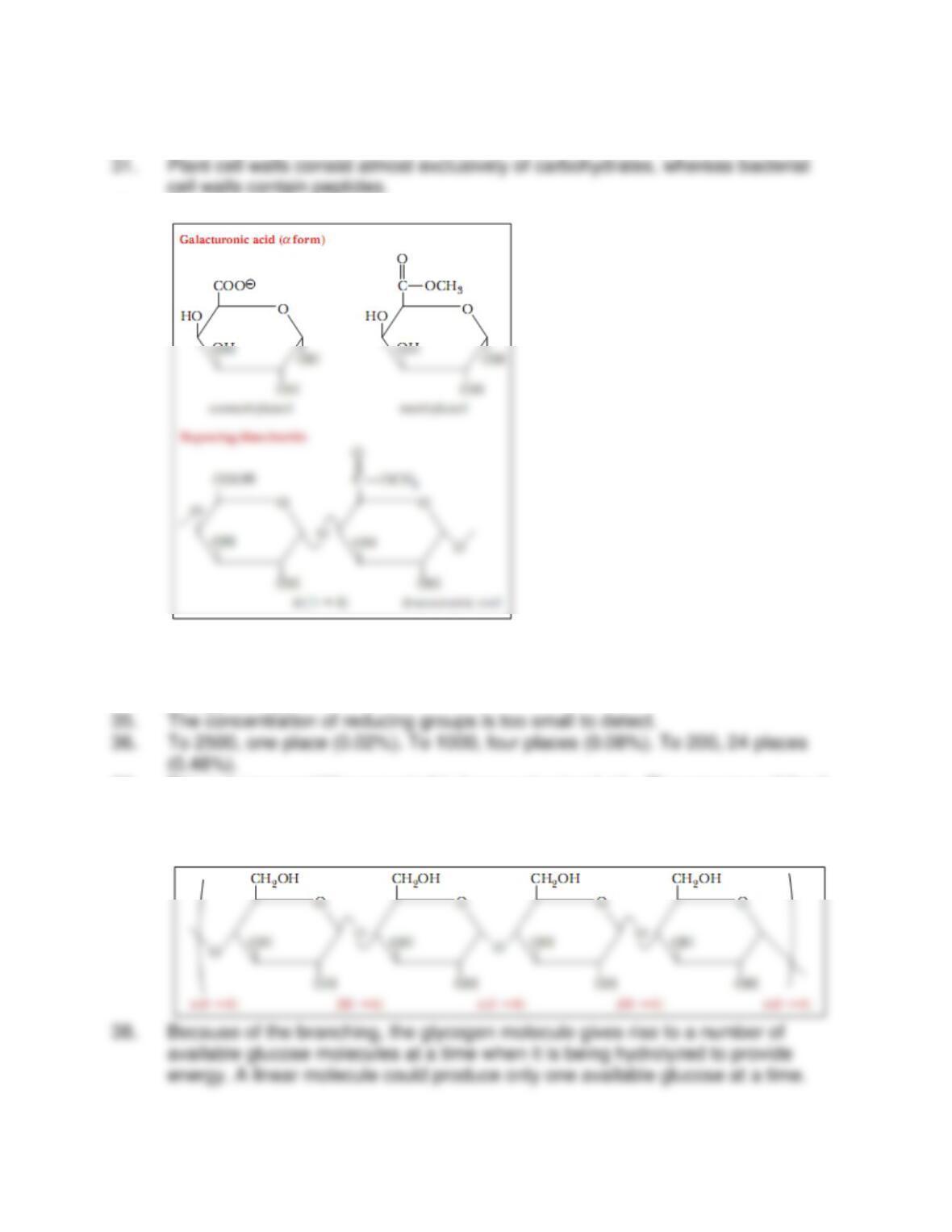
32. Repeating disaccharide of pectin:
33. Glucose and fructose.
34. Differences in structure: cellulose consists of linear fibers, but starch has a coil
form. Differences in function: cellulose has a structural role, but starch is used for
energy storage.
37. This polymer would be expected to have a structural role. The presence of the –
glycosidic linkage makes it useful as food only to termites or to ruminants, such
as cows and horses; these animals harbor bacteria capable of attacking the –
linkage in their digestive tracts.
Carbohydrates 9
39. The digestive tract of these animals contains bacteria that have the enzyme to
hydrolyze cellulose.
glycosidic bonds.
42. Fiber binds many toxic substances in the gut and decreases the transit time of
ingested food in the digestive tract, so that harmful compounds such as
carcinogens are removed from the body more quickly than would be the case
with a low-fiber diet.
43. A cellulase (an enzyme that degrades cellulose) needs an active site that can
45. The sequence of monomers in a polysaccharide is not genetically coded, and, in
this sense, it does not contain information.
46. It can be useful for polysaccharides to have a number of ends, characteristic of a
branched polymer, rather than the two ends of a linear polymer. This would be
the case when it is necessary to release residues from the ends as quickly as
possible. Polysaccharides achieve this by having 14 and 16 glycosidic
When the end point is reached, the next drop of iodine will produce a
characteristic blue color in the presence of the indicator.
51. Heparin is an anticoagulant. Its presence prevents blood clotting.
52. Glycosidic bonds can be formed between the side-chain hydroxyls of serine or
threonine residues and the sugar hydroxyls. In addition, there is the possibility of
10 Chapter 16
16.5 Glycoproteins
53. Glycoproteins are ones in which carbohydrates are covalently bonded to