CA 16-6 (Continued)
36,000 [(30,000 X $30) ÷ $25] shares of treasury stock at $25 with the proceeds. Therefore, if you add
the 30,000 exercised warrants to the common stock outstanding and then subtract the 36,000 shares
presumably purchased, the number of shares outstanding would be reduced to 94,000 (100,000 +
FINANCIAL REPORTING PROBLEM
(a) (1) Under P&G’s stock-based compensation plan (Note 7), 29,141,000
options were granted during 2011.
(2) At June 30, 2011, 271,096,000 options were exercisable by eligible
managers.
(b)
(In millions—except per share)
2011
2010
2009
Weighted-average common shares
3,001.9
3,099.3
3,154.1
Diluted earnings per share
$3.93
$4.11
$4.26
COMPARATIVE ANALYSIS CASE
(a) Coca–Cola sponsors restricted stock award plans, and stock option
plans.
(b)
Coca-Cola
PepsiCo
Options outstanding at year-end 2011
(c)
Coca-Cola
PepsiCo
Options granted during 2011
26,000,000
7,150,000
(d)
Coca-Cola
PepsiCo
Options exercised during 2011
32,000,000
19,980,000
(e)
Coca-Cola
PepsiCo
Average exercise price during 2011
$47.96
$47.74
(f)
Weighted-Average Number of Shares
(in millions)
Coca-Cola
PepsiCo
2011
2,323
1,597
2010
2009
(g)
Diluted Earnings Per Share
(in millions)
Coca-Cola
PepsiCo
2011
$3.69
$4.03
2010
$5.06
2009
FINANCIAL STATEMENT ANALYSIS CASE
(a) Account 2014 (,000)
Current Liabilities 554,114
Convertible Debt 648,020
(b) Ragatz is doing very well. Its ROA and ROE are above the industry
average. However, its debt level is quite high, compared to the
(c) Under GAAP, the debt and equity components of a convertible bond
are not separately recorded as liabilities and stockholders’ equity. If
Merck had non-convertible bonds with detachable warrants, Merck
would allocate the bond amount between debt and equity. Therefore,
(1) Rate of return on Assets 4.15% = Net Income/Total Assets
(2) Rate of return on Common Stock 17.9% = Net Income/Stockholders’
Equity Equity
(3) Debt to Total Assets 76.8% = Total Debt/Total Assets

FINANCIAL STATEMENT ANALYSIS CASE (Continued)
The adjustment results in Ragatz reporting a higher level of
stockholders’ equity and less debt. Although Ragatz reports the same
ACCOUNTING, ANALYSIS, AND PRINCIPLES
Accounting
(a) Under U.S. GAAP, proceeds from the issuance of convertible debt are
recorded entirely as debt.
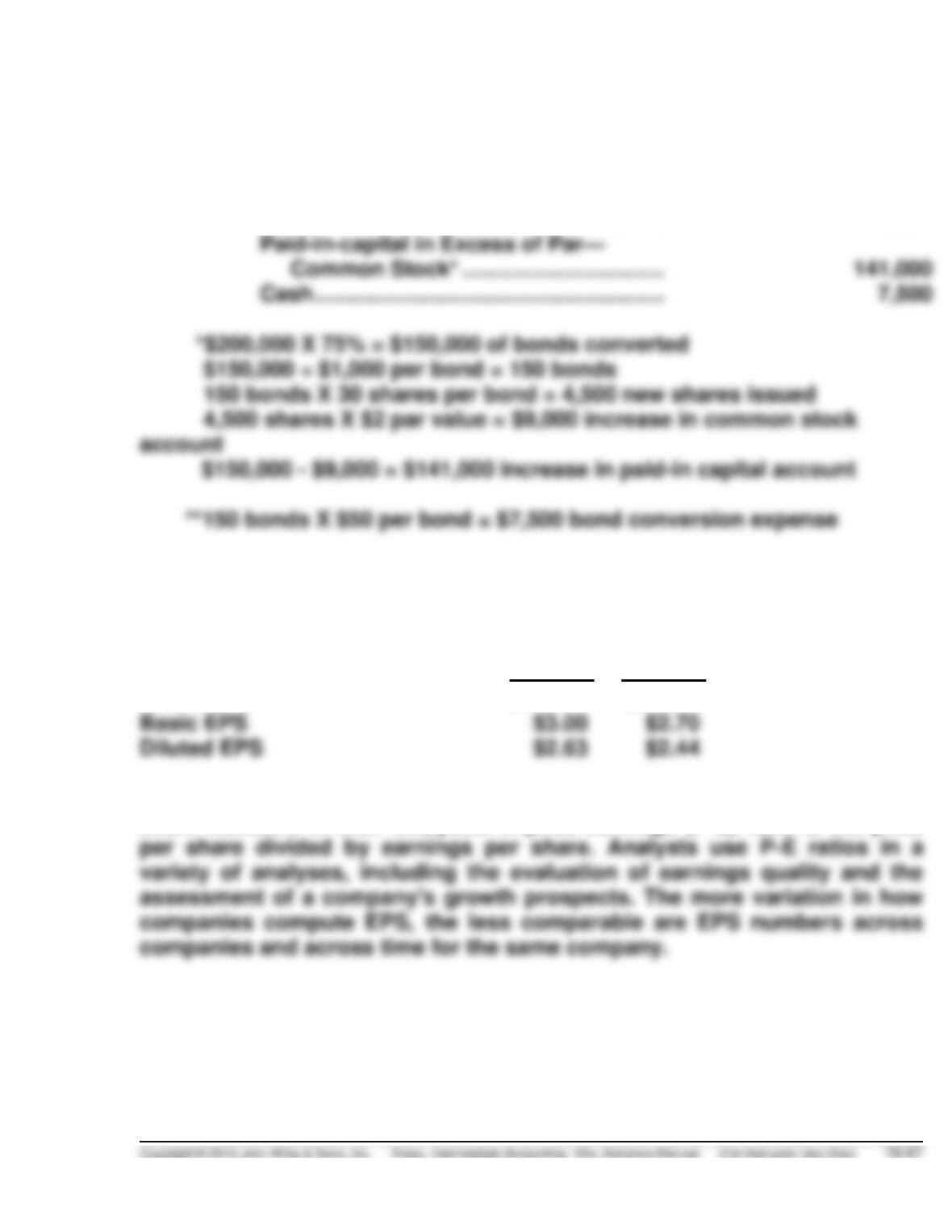
(b)
2014
2013
Basic EPS
Net income (a)
$30,000
$27,000
Basic EPS (a ÷ b)
Diluted EPS
Net income
$30,000
$27,000
Add: Interest savings ($200,000 X 6%)
12,000
12,000
Adjusted net income (a)
$42,000
$39,000
Outstanding shares
Shares upon conversion (200 X 30)
Total shares for diluted EPS (b)
ACCOUNTING, ANALYSIS, AND PRINCIPLES (Continued)
(c)
Bond Conversion Expense** ……………………….
7,500
Bonds Payable …………………………………………..
150,000
Common Stock* ………………………………..
9,000
Cash …………………………………………………
7,500
Analysis
EPS Presentation:
2014 2013
Net income $30,000 $27,000
EPS standards are important to analysts who rely on reported earnings per
share numbers in their analyses. A price-earnings (P-E) ratio is the price
ACCOUNTING, ANALYSIS, AND PRINCIPLES (Continued)
Principles
IFRS for convertible debt primarily differs from U.S. GAAP on convertible
debt in that IFRS requires that companies split the proceeds from issuance
into a debt component and an equity component. For example, in part (a)
Cash …………………………………………………………
200,000
Discount on Bonds Payable ……………………….
70,000
Bonds Payable …………………………………..
200,000
Share Premium-Conversion Equity……..
70,000
Supporters of the IFRS treatment would argue that separating the bond
issue into liability and equity components provides more representational
faithful information into the financial statements. That is, the resulting
PROFESSIONAL RESEARCH
(a) The accounting for stock compensation is addressed in the FASB
Codification at FASB ASC 718-10 (Compensation-Stock
Compensation).
(b) See FASB ASC 718-10-10 (Compensation—Stock Compensation,
Overall, Objectives).
10-1 The objective of accounting for transactions under share-based
payment arrangements with employees is to recognize in the
Currently Viewing:
718 Compensation—Stock Compensation
10–2 This Topic requires that the cost resulting from all share-based
payment transactions be recognized in the financial statements.
This Topic establishes fair value as the measurement objective in
PROFESSIONAL RESEARCH (Continued)
(c) See FASB ASC 718-50–25.
25-1 An employee share-purchase plan that satisfies all of the
1. The plan satisfies either of the following conditions:
(a) The terms of the plan are no more favorable than those
available to all holders of the same class of shares. Note
(b) Any purchase discount from the market price does not
exceed the per-share amount of share issuance costs that
would have been incurred to raise a significant amount of
capital by a public offering. A purchase discount of 5
2. Substantially all employees that meet limited employment
qualifications may participate on an equitable basis.
3. The plan incorporates no option features, other than the
following:
(a) Employees are permitted a short period of time—not
PROFESSIONAL SIMULATION
Note: This assignment is available on the Kieso website.
Explanation
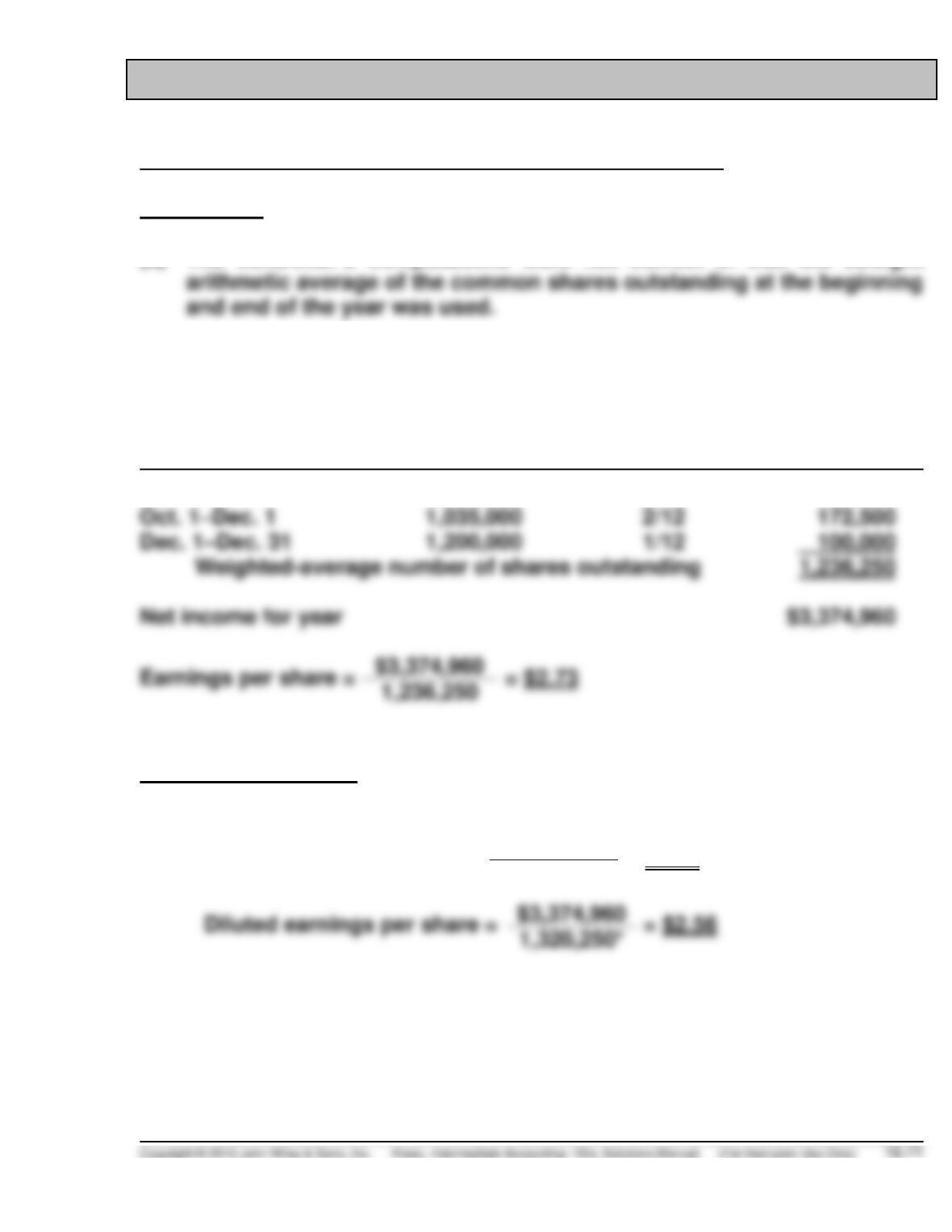
(a) The controller’s computations were not correct in that the straight
The weighted-average number of shares outstanding may be
computed as follows:
Dates
Outstanding
Shares
Outstanding
Fraction
of Year
Weighted
Shares
Jan. 1–Oct. 1
1,285,000
9/12
963,750
Oct. 1–Dec. 1
1,035,000
2/12
172,500
Financial Statements
(b)
Basic earnings per share =
$3,374,960
= $2.73
1,236,250
Diluted earnings per share =