
Continuing Case Solution
Chapter 16
Memorandum
To: Eric Conner and Phil Martin, CM2
From: L. Harbach
Re: Basic and Diluted Earnings Per Share
Date: January 28, 2013
If CM2 decided to issue 5% cumulative, convertible preferred stock and
According to GAAP, a company with a complex capital structure must make two
calculations of earnings per share (EPS): basic and diluted earnings per share. If
diluted earnings per share (DEPS) is lower than basic (BEPS), then both
DR CR
June 1 Cash 5,000,000
Bonds Payable
5,000,000
July 15
Cash 900,000
Common Stock ( $2 par)
600,000
Additional Paid-in Capital Common
Stock
300,000

Continuing Case Solution
4
Additional Paid-in Capital Common
Stock
100,000
Date Number of
outstanding
common shares
issued
Number of
months
outstanding/
12 months
Weighted-
average shares
outstanding
Beginning
balance
440,000
12/12
440,000
Basic Earnings Per Share (BEPS)
Formula: (Net income Preferred dividends) / Weighted-average common
shares outstanding
Diluted Earnings Per Share (DEPS)
-of-
calculation of DEPS.

Continuing Case Solution
5
Order-of-Entry Calculation
Convertible bonds:
Numerator effect of bonds: $5,000,000 x 6% x (1 35%) x 7/12* = $113,750
Convertible, cumulative preferred stock:
Numerator effect of preferred stock:
20,000 shares x $150 par value x 5% x 5/12* = $62,500
Result of order-of-entry calculation:
Since the bonds are more dilutive than the preferred stock (as shown by $0.3899
versus $0.3947), they will be used in the DEPS calculation first, as follows:
Continuing Case Solution
6
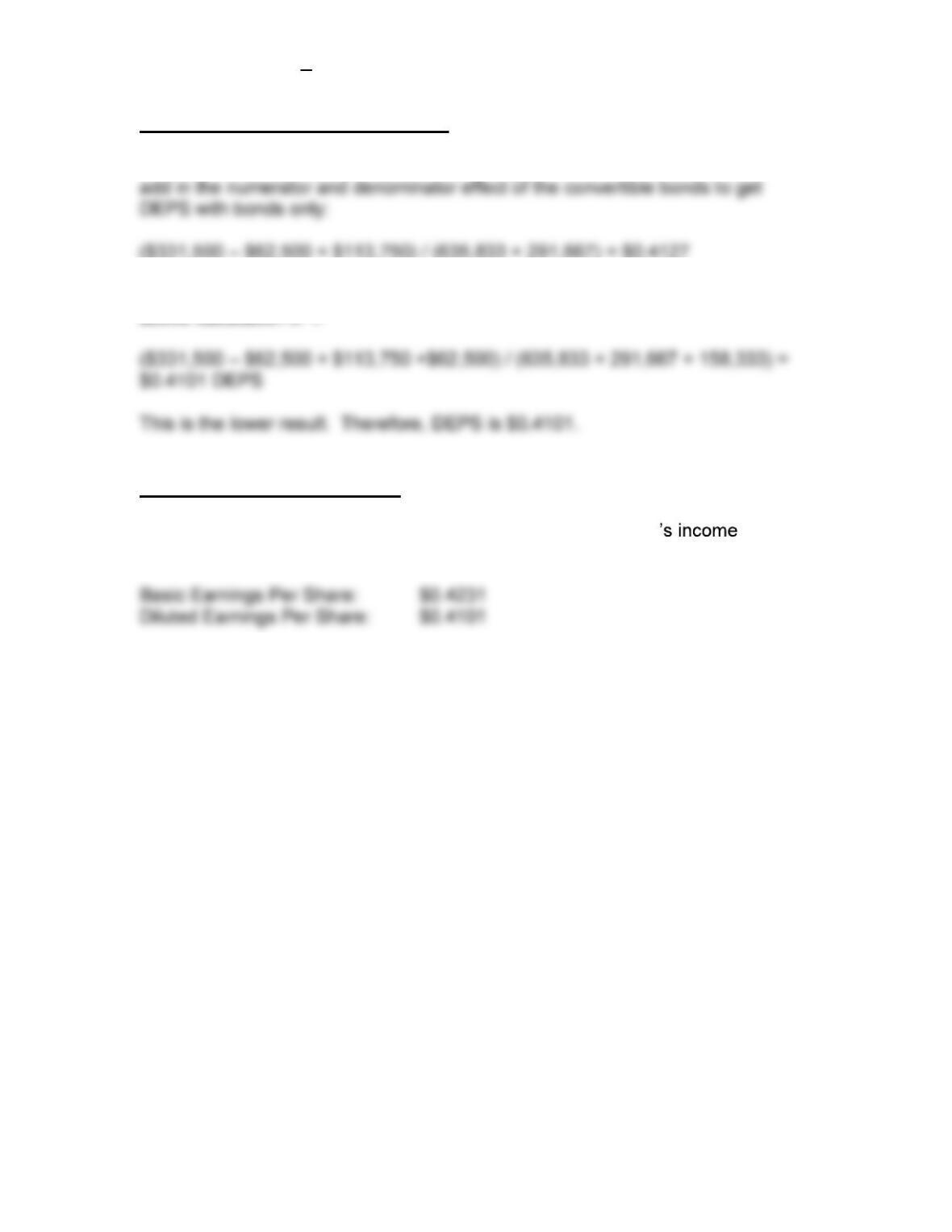
Diluted Earnings Per Share (DEPS)
1. With convertible bonds only: We must begin with the BEPS calculation and
2. Next add in the preferred stock numerator and denominator effects to the
above calculation in 1:
Income Statement Disclosure
Dual disclosures for EPS would be required on the face of CM2
statement as follows: