3-1
Ajax Petroleum
Teaching Commentary
OVERVIEW
This short but very rich case is based on an actual capital expenditure decision in one of the major oil companies in
1980. There are three major themes in the case:
1. Sorting out the managerial insights in a “joint costing” product context.
ANSWERS TO ASSIGNMENT QUESTIONS
Question 1
The economic return calculations for the project under the various combinations of prices for resid and fuel
Question 2
This question should be easy for students if they focus on the incremental flows for the refinery as a whole.
Only the “opportunity cost” is relevant for the capital investment analysis. For both resid and fuel gas, this is the
current market price of resid, which is $25. This is the foregone revenue if resid is used as feedstock instead of
Question 3
Based on the information in the case, the project looks like a winner for the Middletown refinery on an
3-2
Based on this uncertainty, some students will conclude that the project really hinges on the spread between
gasoline and resid prices rather than the absolute level for either one. It is then possible to calculate the break-even
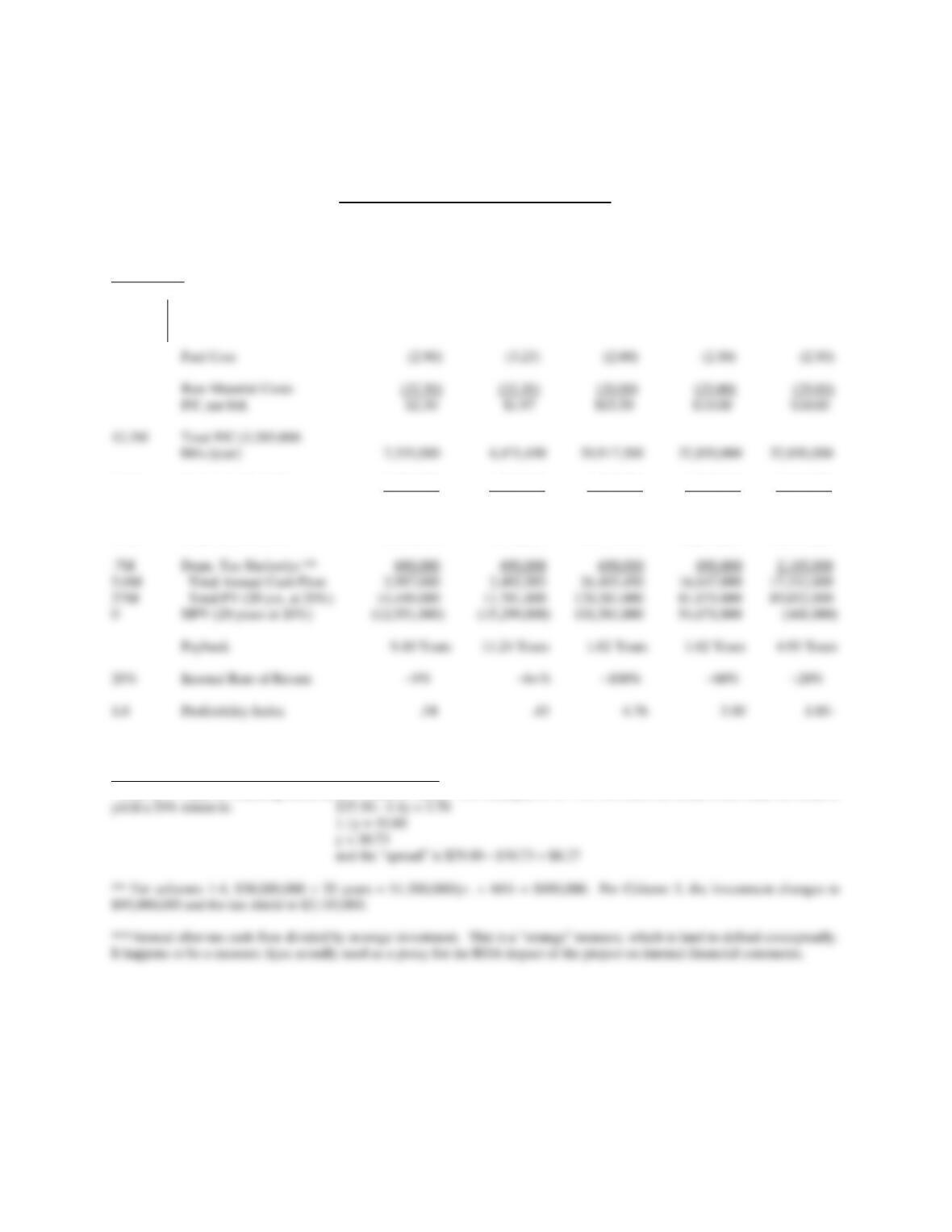
spread to yield the desired 20% economic return. This is shown in the far-left column of Exhibit A. When the
Question 4
In fact, Mr. MacGregor did recommend the project and it was approved. It was built in 1981, within the
budgeted cost of $30 million. And it never made even one dollar of profit for Ajax! What happened?
At about the time of the case, gasoline demand peaked in the United States as a result of a lagged price
elasticity response to the steady run-up in prices between 1972 and 1981 (from about $.15/gallon to about
Was this result foreseeable? Did it catch all the major oil companies by surprise? In fact, Ajax was not the
only major oil company caught with an amazing total flop of an investment project. But many of the major oil
companies did not invest. The following table illustrates the split:
Yes No
Ajax (Gulf) $ 30 M Exxon
Since the incremental cash flows for the project should look the same to any oil company with a mix of heavy
oil (resid) and light oil (gasoline) sales, why did Exxon and Mobil walk away from such an apparently lucrative
Exxon
• Refineries geared to process heavy Venezuelan crude. A mix of outputs heavy in resid is expected and
planned for.
CONCLUSION: NOT REALLY INTERESTED IN GETTING RID OF RESID AT A HEAVY
INCREMENTAL CAPITAL COST.
3-3
Gulf
• Refineries geared to process light Kuwait crude. But this supply was lost when their Kuwaiti reserves were
nationalized.
CONCLUSION: A PROJECT TO CONVERT RESID INTO GASOLINE LOOKS GREAT.
We don’t believe it is luck or contrarian judgment that explains why Gulf, Arco, and Chevron went for an
SDU while Exxon, Mobil, and Sohio/BP did not. Some finance/economics theoreticians who see capital
TEACHING STRATEGY
I use this case in a second-year MBA elective in Strategic Cost Management to review capital expenditure analysis
techniques while emphasizing a blending of calculations with strategic assessment. The case can also be used at or
near the end of a segment on capital expenditure analysis in an MBA core course.
3-4
Exhibit A
AJAX PETROLEUM
Cash Flows Analysis for the SDU Project
B/E Spread
For The
Incremental
Cash Flows*
X – 1.1y Value of Cracking
= $3.70 Stock Produced $37.50 $37.50 $37.50 $37.50 $37.50
3.3M Operating Costs/Yr. 3,300,000 3,300,000 3,300,000 3,300,000 4,800,000
9.0M Operating Cash Flow/Yr. 4,255,000 3,171,450 47,617,500 29,550,000 28,050,000
4.9M After Taxes (46%) 2,297,700 1,712,583 25,713,450 15,957,000 15,147,000
Return on Capital Employed 19.8%*** 16% 176% 111% 36.5%
*With X = Value of Cracking Stock & y = Value of Resid. For example, if X = $37.50, then the break even value for resid to
3-5
Exhibit B
AJAX PETROLEUM
A Joint Costing Example
• Assume 100,000 bbl. of crude are processed daily in the refinery at an average purchase price of $29 per barrel
(total cost – 2,900,000).
The question is how to apportion the $3,068,000 to the 95,000 bbl.
I. Volumetric Basis (Gulf)—Simply charge each bbl. for a proportionate share of cost ($3,068,000 ÷ 95,000 =
II. Market Value Basis (Exxon)—Assume gasoline feedstock costs $2.50/bbl. to convert to gasoline, which sells
for $39/bbl. Assume M/D costs $.60/bbl. to convert to fuel oils (jet fuel, diesel fuel, heating oil), which sell for
The overall cost ratio is 93% ($3,068,000/$3,309,000). Charging cost so that each product earns the same
overall gross margin (7%) yields the following figures:
III. Heat Value Basis (DOE)—It is a fact that the heavier the concentration of carbon in the oil, the greater its heat
3-6
Relative Total Relative
Volume Heat Value Heat Value
Gasoline 45,000 90% 40,500 (44%)
Share of
Operating Costs Per bbl.
Gasoline $1,350,000 (44%) $30.00
These three approaches serve to illustrate the three general possibilities over the three product categories, equal
cost, increasing cost, or decreasing cost.
Gulf Exxon DOE
Volumetrics Market Values Heat Value (BTUs)
Exhibit C
AJAX PETROLEUM
Final Observations
1. “Herd mentality” is hard to fight, but you have to try.
2. What the “economic analysis” missed was future trend in gasoline consumption. How could we know?