16.1: PROBLEM DEFINITION
Which of the following could be considered a model? Why? (select all that apply).
a. The ideal-gas law.
b. A set of instructions for using a Pitot-static tube to measure velocity.
c. An airplane built from a kit.
d. A computer program to predict the force on a pipe bend.
SOLUTION
A model is an idealization of something real (as a map is an idealization of a city)
a. The ideal-gas law: Yes, the equation is an idealization of the behavior of a gas.
1
16.2: PROBLEM DEFINITION
Apply the modeling building process to the Balloon Payload problem.
The Balloon Payload Problem. Your team is designing a helium-filled balloon
that will travel to at least 80,000 feet elevation in the atmosphere. The balloon will
transport a payload comprised of a camera and a data acquisition system. Right now,
you choose to solve a simpler problem which is to develop a model that predicts the
weight on the earth’s surface (at your location) such that a helium-filled balloon is
neutrally buoyant. This simpler problem can be easily tested with an experiment in
your classroom.
•What are the relevant variables?
•How are the variables related? What are the relevant equations? How can you
apply these equations to develop a single algebraic equation to solve for your
goal.
•What is a simple and low cost way to test your math model using experimental
data?
SOLUTION
•Relevant variables. Size of balloon (diameter), shape of balloon, volume of
balloon, temperature, local atmospheric pressure, weight of balloon skin, weight
2
16.3: PROBLEM DEFINITION
Apply the modeling building process to the Rocket Problem.
The Rocket Problem. Your team is designing a 2-stage solid-fuel rocket that
intended to travel to 15,000 feet and take photos. Right now, you choose to solve a
simpler problem which is to develop a model that predicts the height that a small,
low-cost rocket will fly because a small rocket can be purchased from Estes or Pitsco
and it is relatively easy to measure elevation.
•What are the relevant variables?
•How are the variables related? What are the relevant equations?
•What is a simple and low cost way to test your math model using experimental
data?
SOLUTION
•Relevant variables. Dimensions of rocket. Mass of rocket. Number of fins. Type
3
16.4: PROBLEM DEFINITION
Whydoyouthinkthatengineersmaketheeffort to learn partial differential equa-
tions? What are the benefits to them?
SOLUTION
Some answers are listed below (others are possible).
4
16.5: PROBLEM DEFINITION
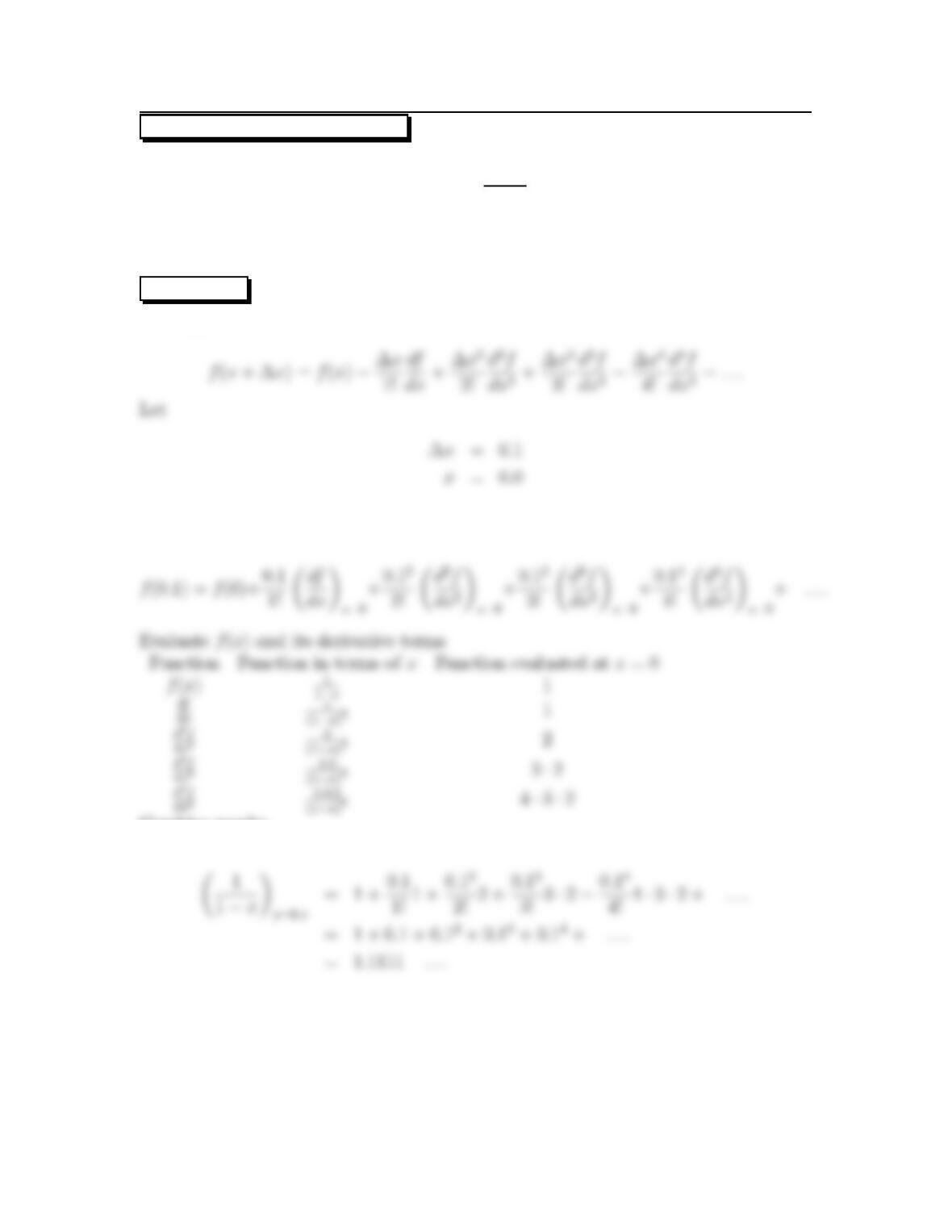
Consider the function .
f(x)= 1
1−x
Find the Taylor series expansion for the function f(x)about the point x=0.Evaluate
thenumericalvalueoftheTaylorseriesforx=0.1using 5 terms.
SOLUTION
UseTaylorsseriesinthisform.
The Taylor series becomes
Combine results
5
16.6: PROBLEM DEFINITION
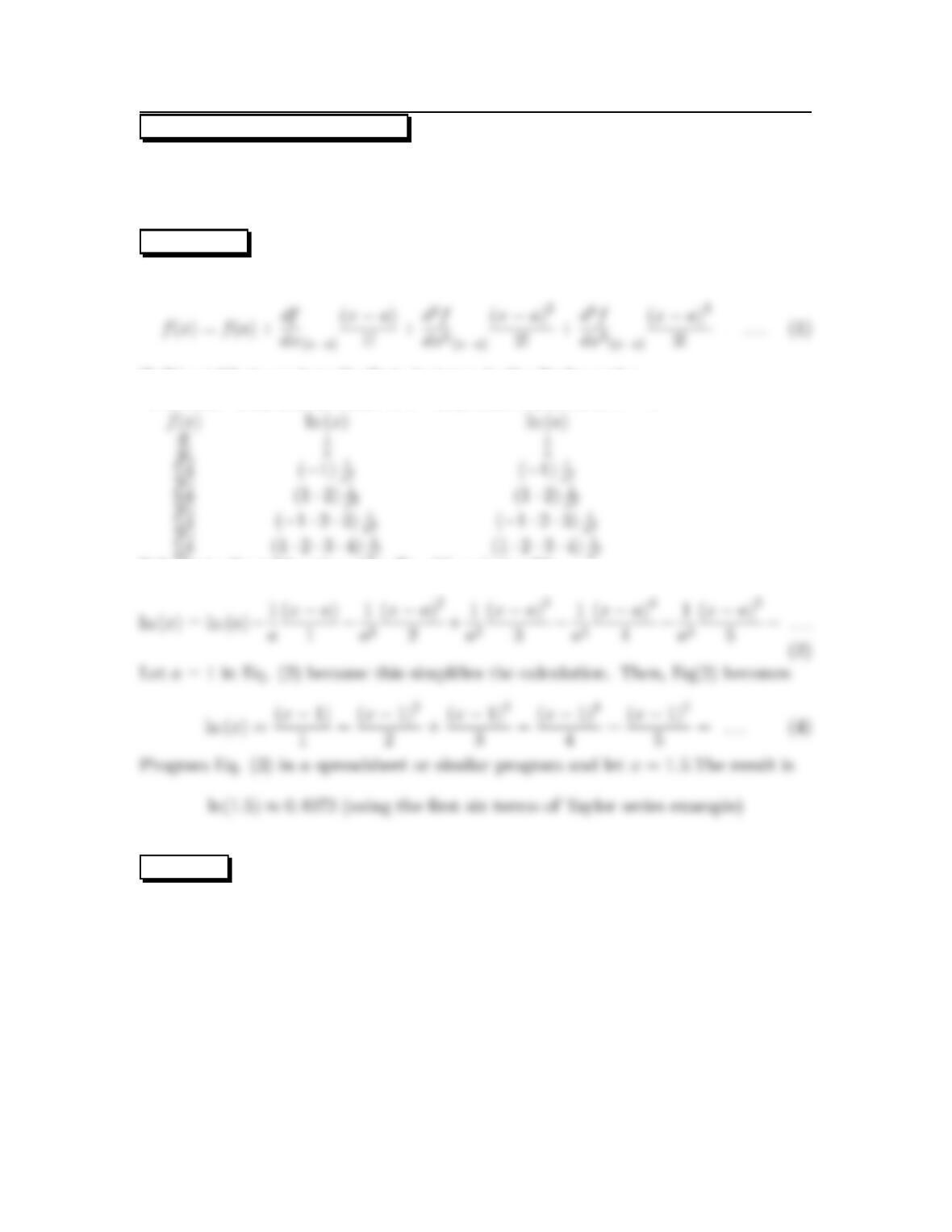
Consider the function f(x) = ln(x). Show how to find the Taylor series expansion for
the function f(x) about the point x = a. Then, find the numerical value for x = 1.5
and six terms
SOLUTION
Taylor Series (general form)
Build a table to analyze the first six terms in the Taylor series
Function Function in terms of xFunction evaluated at x=a
Substitute the table values into Eq. (1) and simplify
REVIEW
The exact solution (calculator) is ln(1.5) = 0.4055, so the 6-term approximation
overpredicts the true value by 0.45%. Pretty close indeed!
6
16.7: PROBLEM DEFINITION
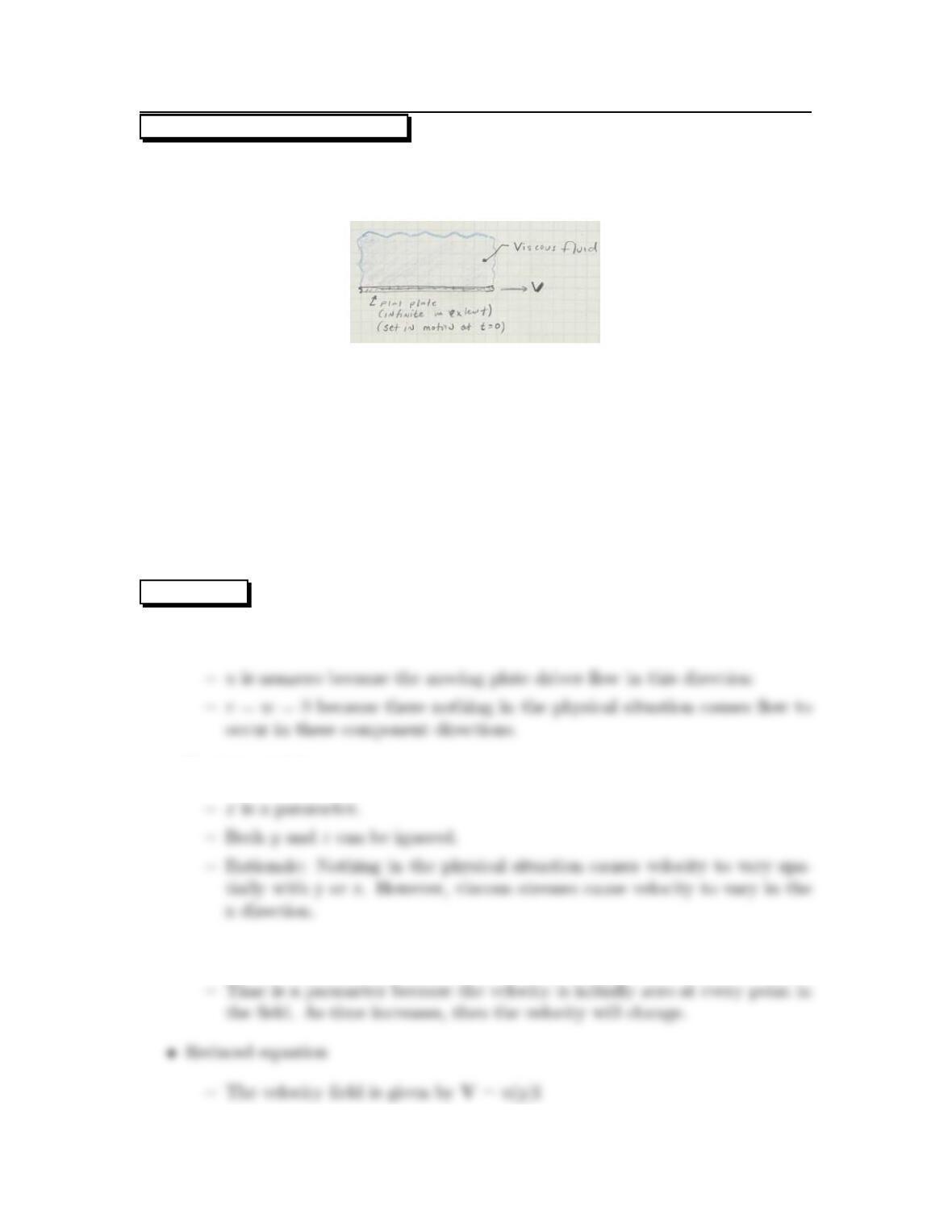
Aflat horizontal plate is infinite in size in both dimensions.
The plate is at rest at t=0,then sent into motion to the right.
Answer the following questions.
•Which velocity components (u, v, w) are zero? Which are non-zero? Why?
•Which spatial variables (x, y, z) are parameters? Which can be ignored? Why?
•Is time a parameter? Or, can time be ignored? Why?
•What is the reduced equation that represents the velocity field?
SOLUTION
•Velocity components
•Spatial variables
•Time
7
16.8: PROBLEM DEFINITION
Compare and contrast the integral-form of the continuity equation (Chapter 5 in
EFM10e) with the PDE-form of the continuity equations (Chapter 16 in EFM10e).
Address the following questions.
•Are the units and dimensions the same? Or different?
•How do the physics compare? What is the same? What is different?
•How do the derivations compare? What is the same? What is different?
•When would you want to apply the integral-form of the continuity equation
(Chapter 5)? When would you want to apply the PDE-form of the continuity
equation (Chapter 16)?
SOLUTION
•Units/Dimensions.
•Physics
•Derivations
•Application (Purpose)
8
16.9: PROBLEM DEFINITION
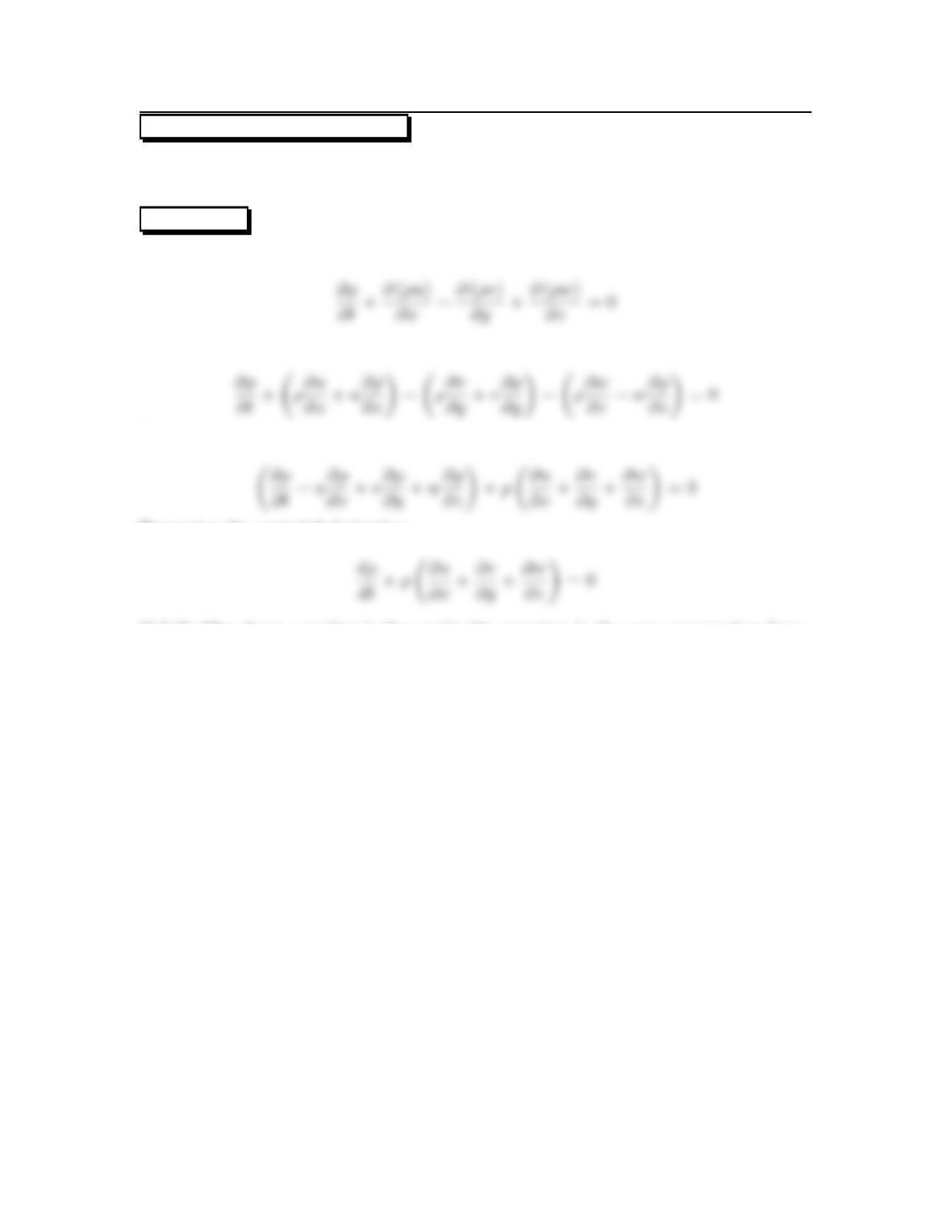
Start with the conservation form of the continuity equation in Cartesian coordinates
and derive the non-conservation form.
SOLUTION
Conservation form
Apply the product rule (from calculus)
Rearrange terms
Recognize the material derivative.
Q.E.D. The above equation is the continuity equation in the non-conservation form.
9
16.10: PROBLEM DEFINITION
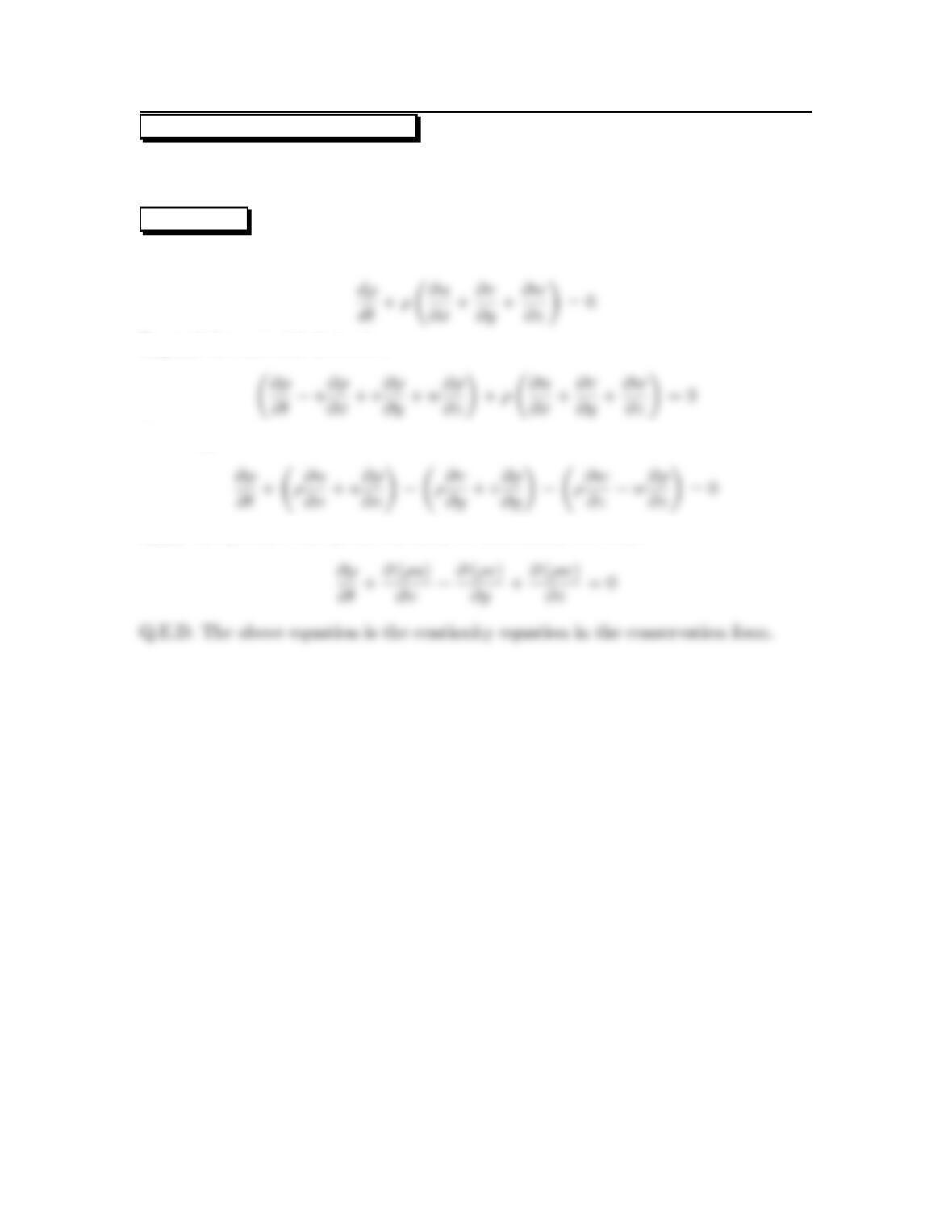
Start with the non-conservation form of the continuity equation in Cartesian coordi-
nates and derive the conservation form.
SOLUTION
Non-conservation form
Expand the material derivative
Rearrange terms
Apply the product rule (from calculus) to each bracketed term
10
16.11: PROBLEM DEFINITION
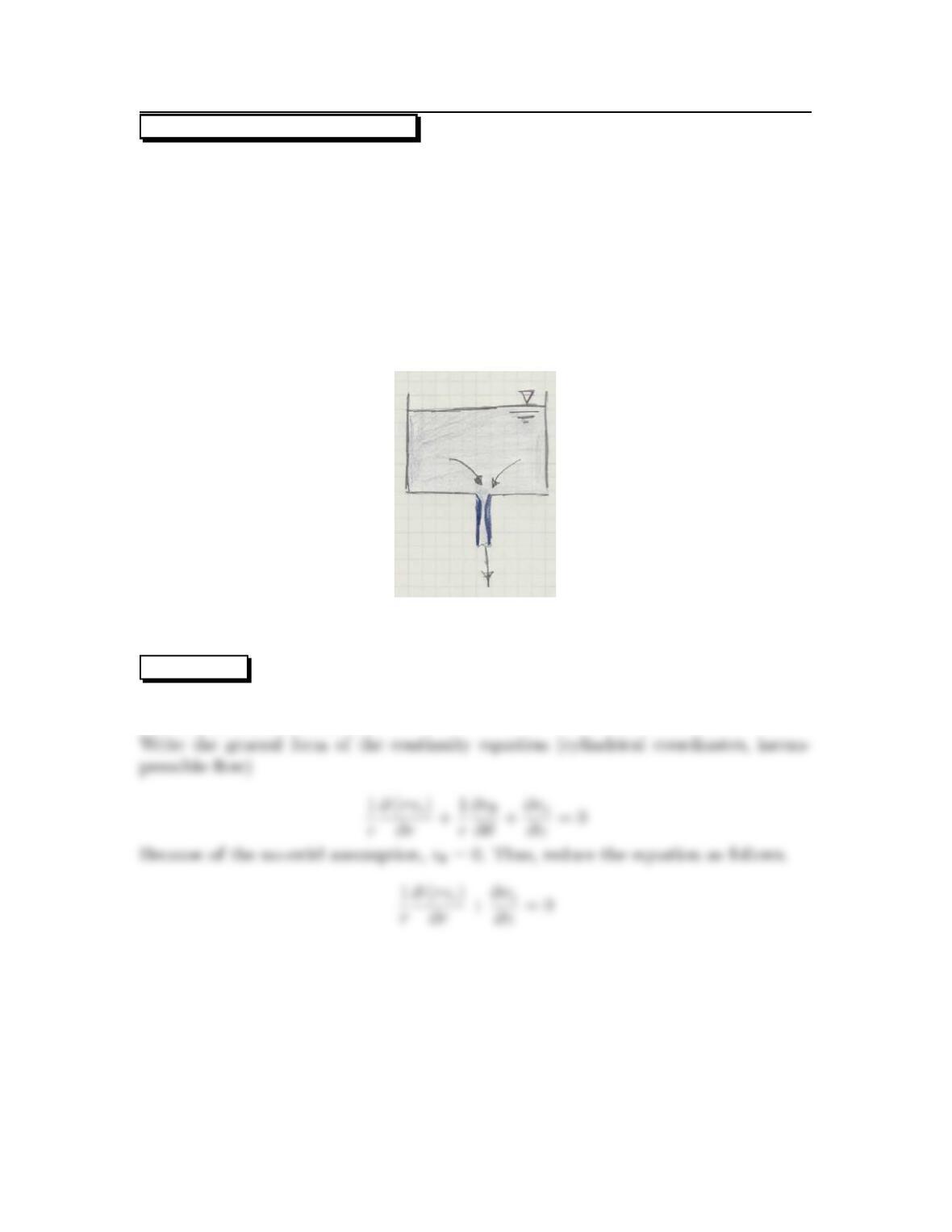
Consider water draining out of round hole in the bottom of a tank. Assume constant
density. Assume the water does not swirl. Then:
•Select the general form of the continuity equation that best applies to this
problem.
•Show how to simplify the general equation from part a to develop the reduced
form.
SOLUTION
Idealize water as incompressible.
Select cylindrical coordinates.
11
16.12: PROBLEM DEFINITION
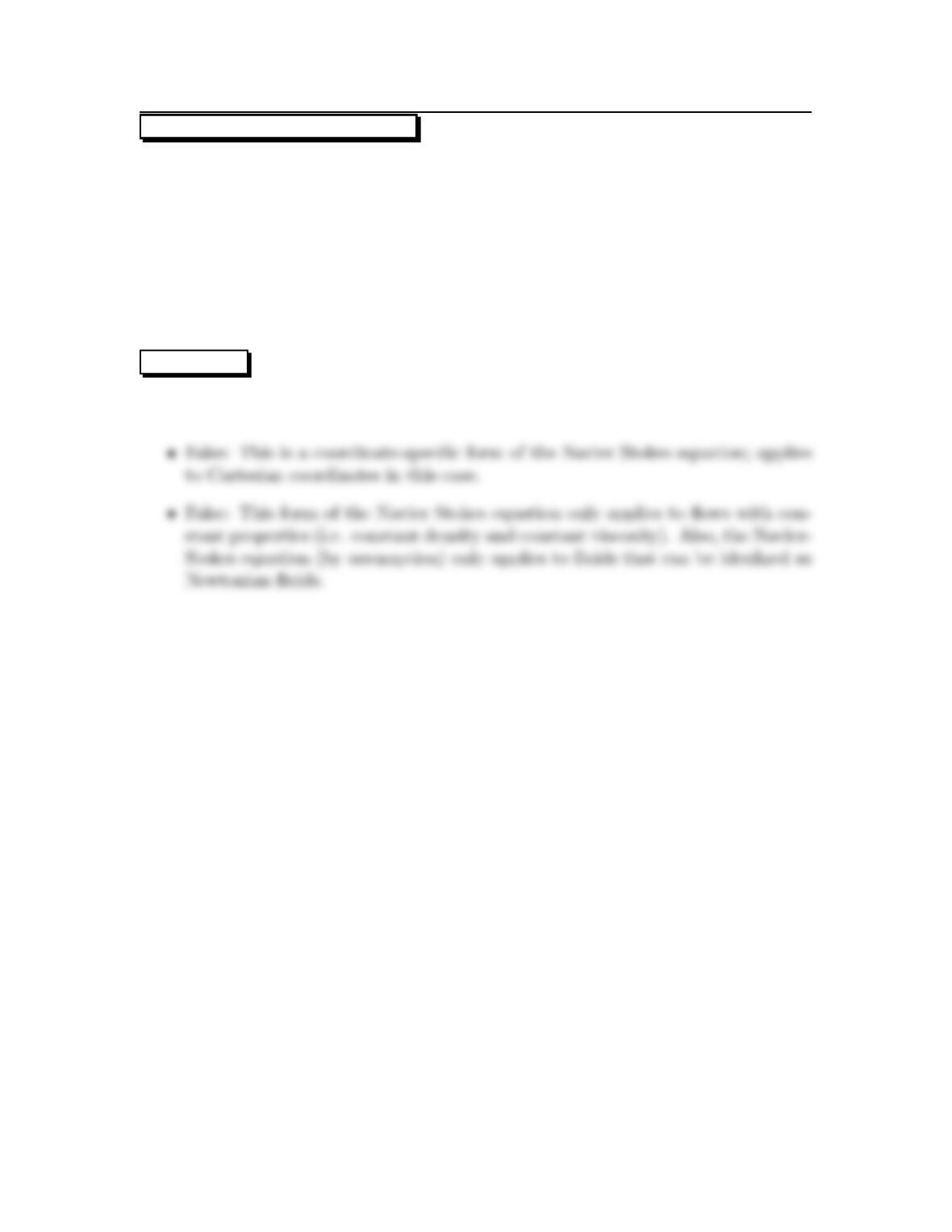
Regarding the Navier-Stokes equation as described in Eq. (16.24) in EFM10e, which
statements are true?
•The terms on the right side are linear.
•Theequationisinvariant.
•The equation applies to all fluids (all liquids and all gases).
SOLUTION
•True: The nonlinear terms are in the acceleration term.
12