15.1: PROBLEM DEFINITION
Situation:
Comparison of full pipes versus open channels.
Find:
Why is the Reynolds number for open channels different than the one for pipes?
PLAN
Consider the different definitions for Re for the two cases.
SOLUTION
For fully flowing pipes, Re = VD
ν.
1
15.2: PROBLEM DEFINITION
Situation:
A rectangular open channel has a base of length 2b, and the water is flowing with
adepthofb.
Find:
a. Sketch of channel.
b. Hydraulic radius of channel
PLAN
a. Sketch not shown
b. Use equation for hydraulic radius.
SOLUTION
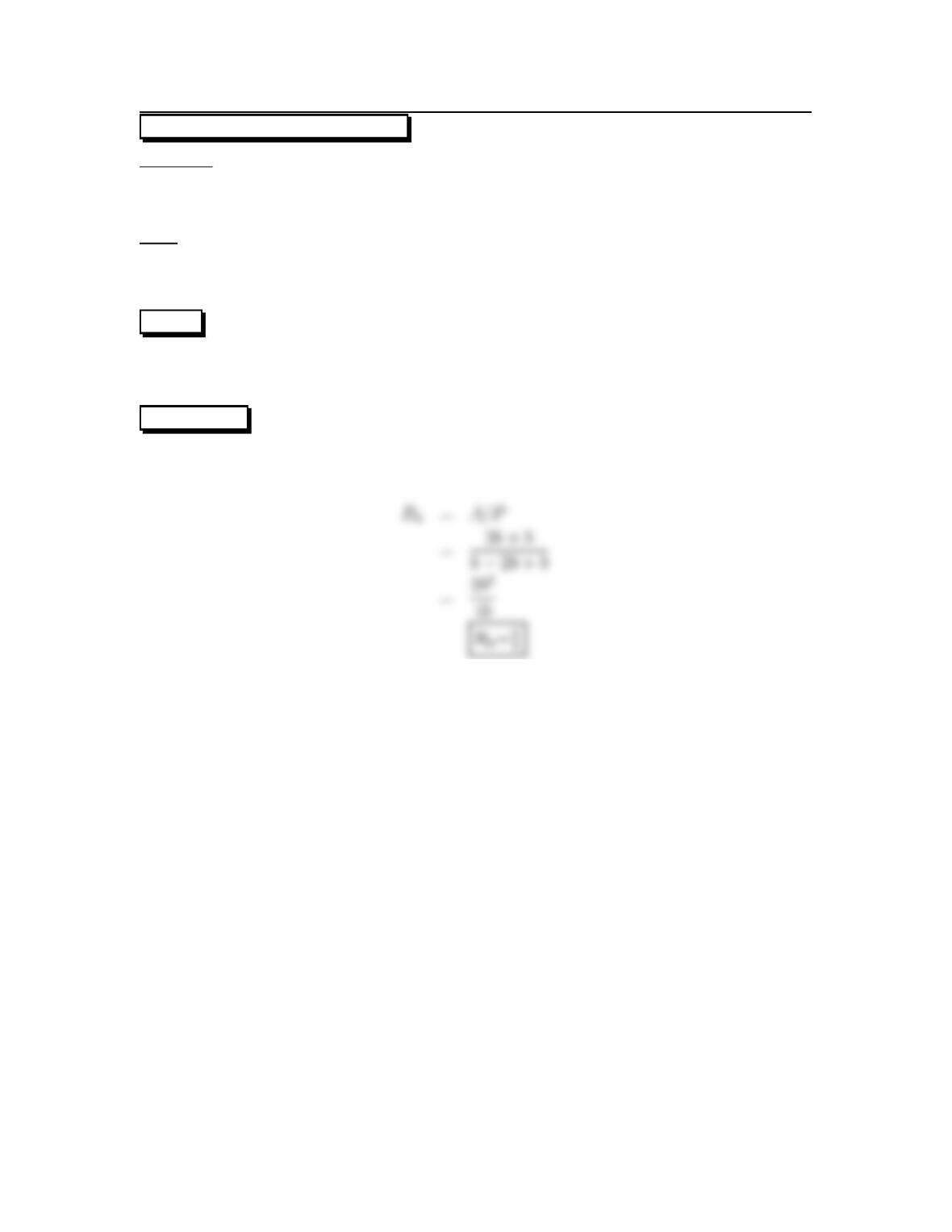
Hydraulic radius
2
15.3: PROBLEM DEFINITION
Situation:
Two channels have the same cross-sectional area, but different geometry, as shown
in problem statement.
Find:
a. Which channel has the largest wetted perimeter?
b. Which channel has more contact between water and channel-wall?
c. Which channel will have more energy loss to friction?
SOLUTION
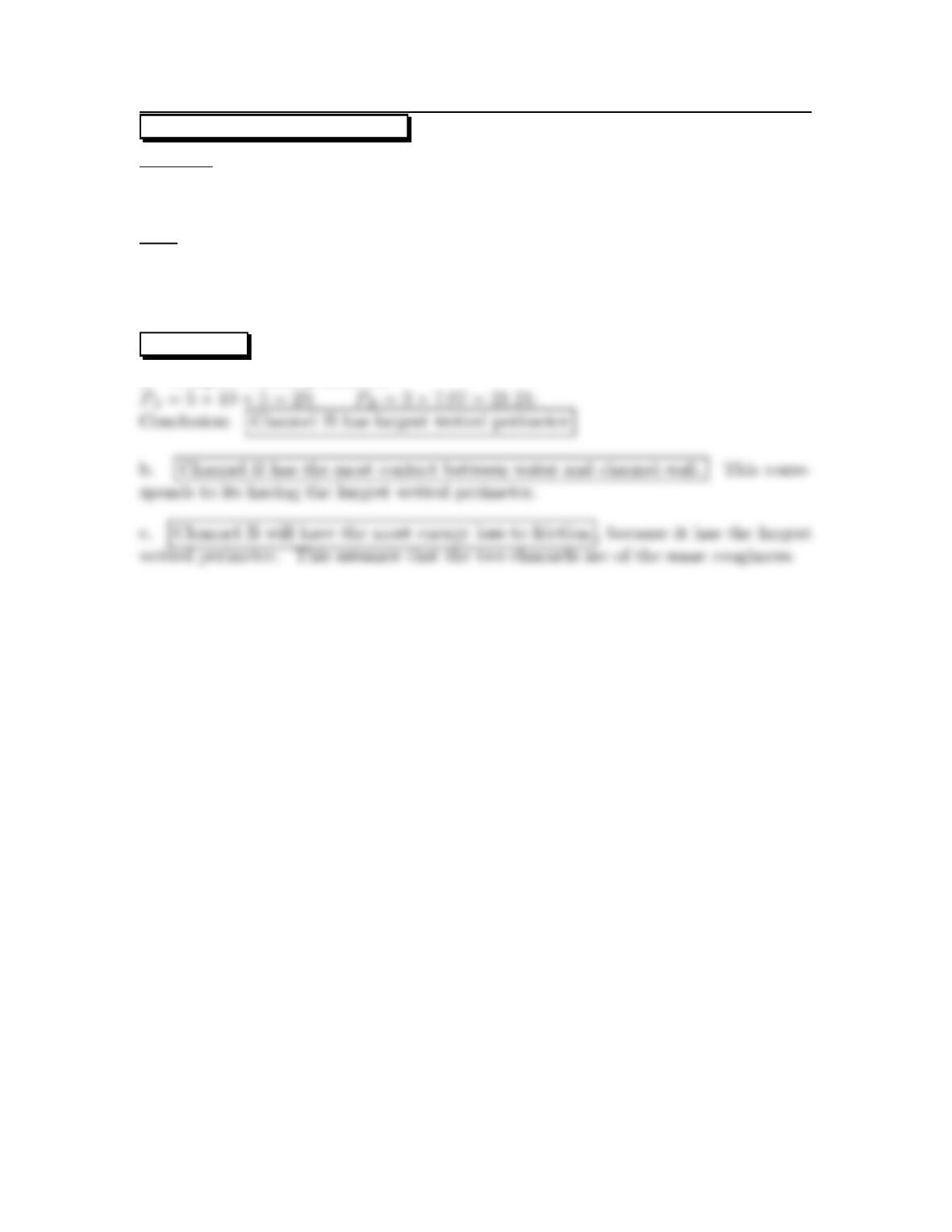
a. Compare wetted perimeters
3
15.4: PROBLEM DEFINITION
Situation:
Uniform flow of water in two channels.
Same slope, same wall roughness, same cross-sectional area.
Find:
Relate flow rates of two channels.
PLAN
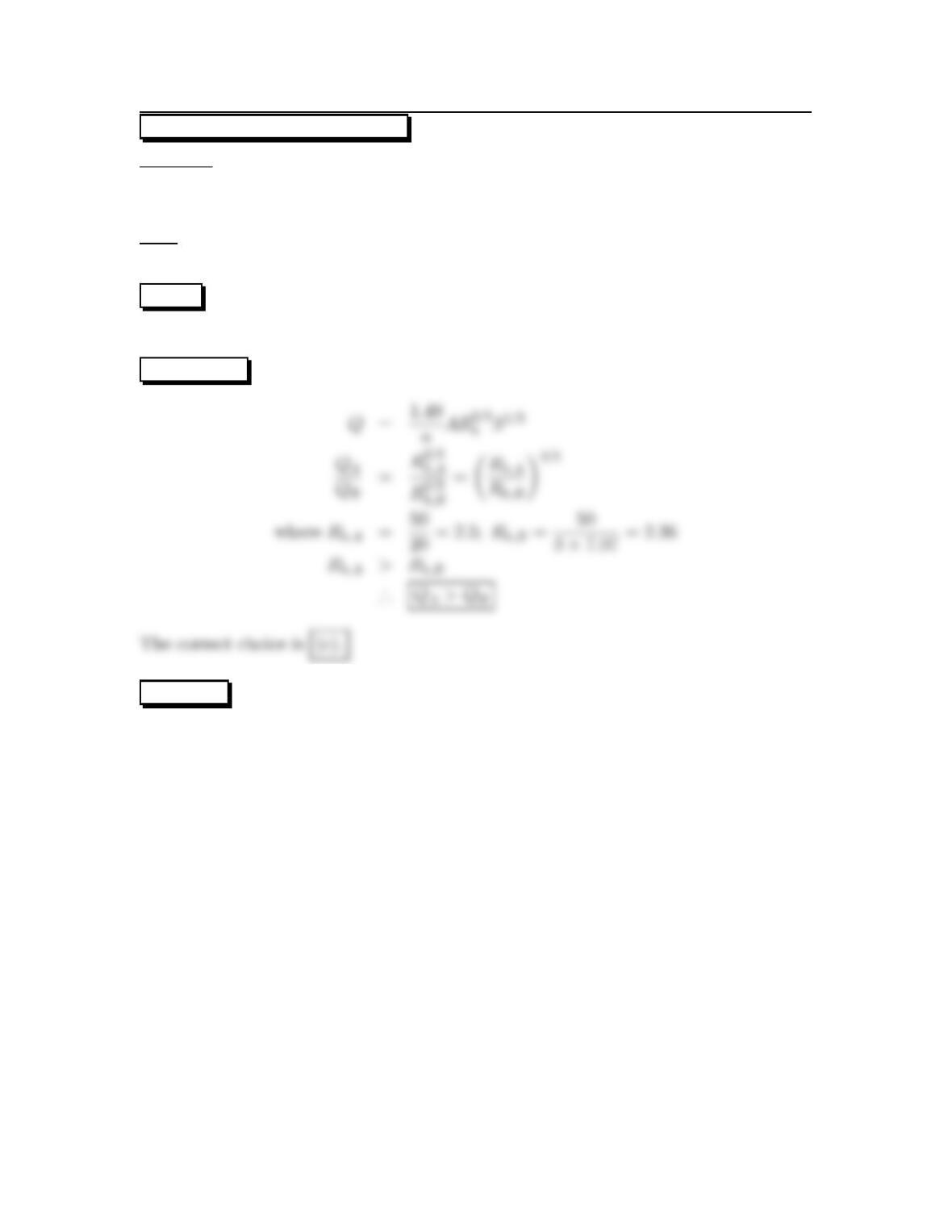
Use Manning Equation for steady uniform open channel flow.
SOLUTION
REVIEW
Note that it doesn’t matter whether you use the Manning Equation for Traditional
or SI units, because all of the constants cancel when you make a ratio of the two flow
rates.
4
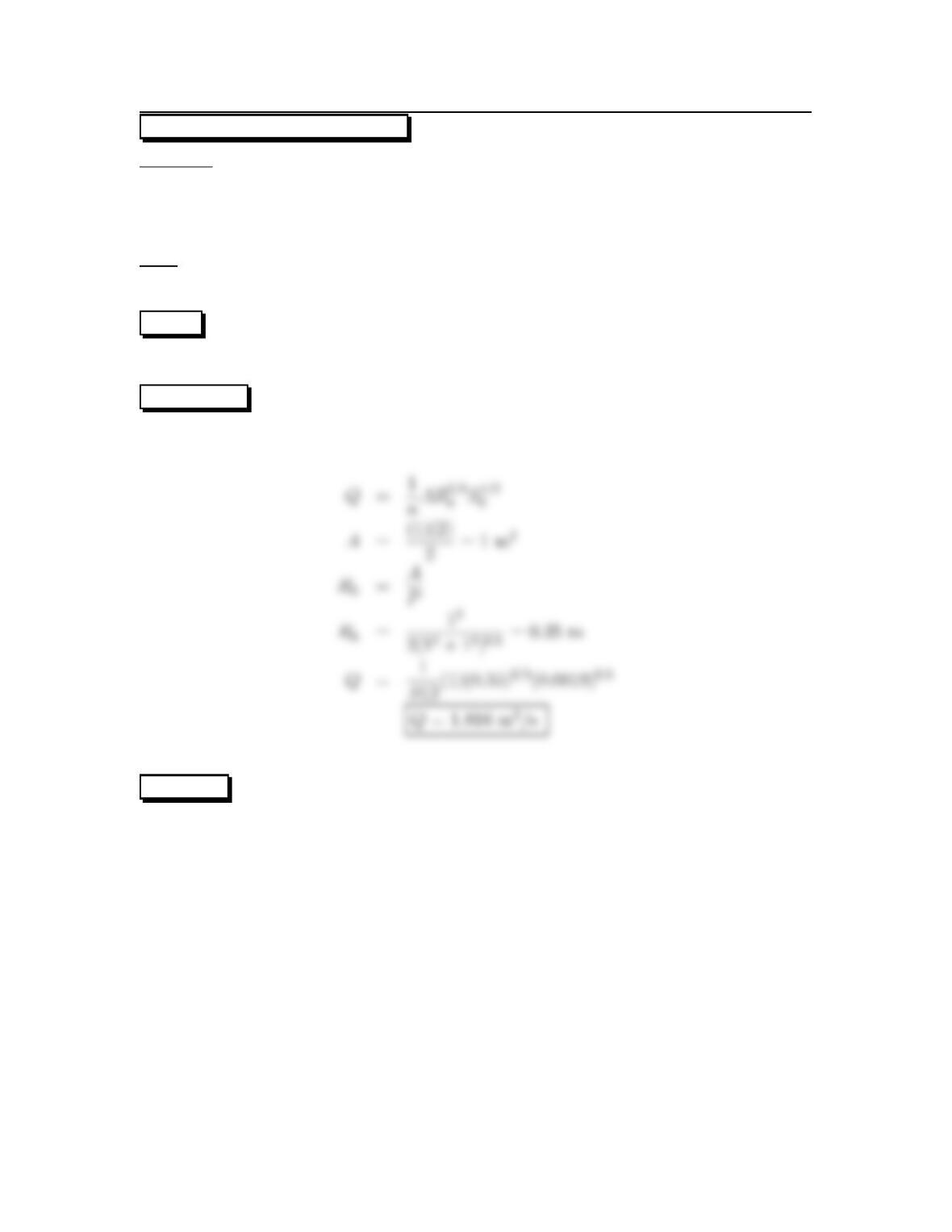
15.5: PROBLEM DEFINITION
Situation:
A wood flume of triangular cross-section (90ointerior angle).
Depth is 1m, S=.0019
Wood, assumed to be planed, n=0.012
Find:
Discharge of water (m
3/s).
PLAN
Apply Manning’s equation.
SOLUTION
Manning’s equation
REVIEW
Make sure to use the Manning Equation for SI units when your data are in SI units.
5
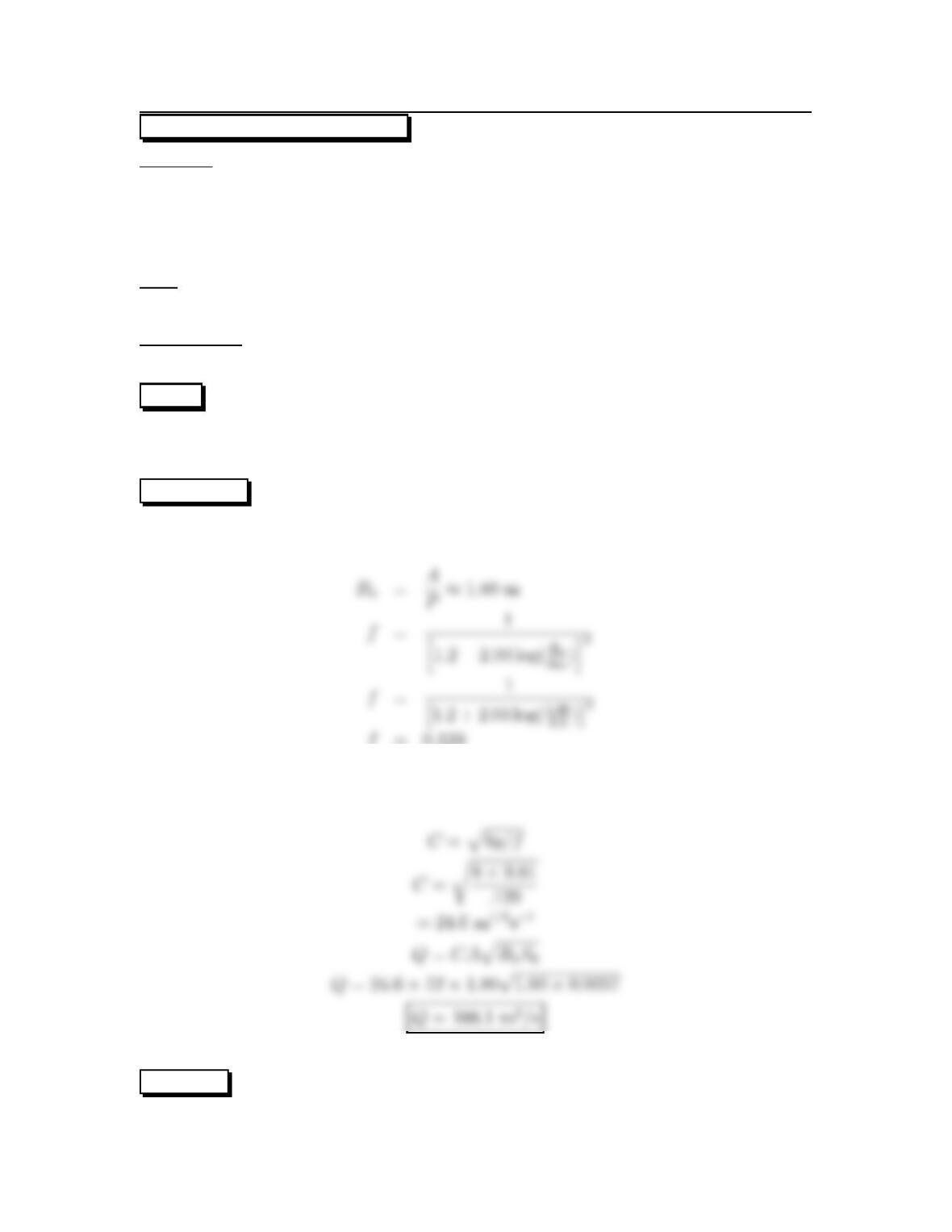
15.6: PROBLEM DEFINITION
Situation:
A rock-bedded stream, d84 =30cm
Average depth = 1.80 m.
Channel slope of 0.0037.
Width = 52 m.
Find:
Discharge (m
3/s) .
Assumptions:
ks=d84 =30cm =0.3m.
PLAN
1. Use the form of fdeveloped by Limerinos for a rocky stream bed.
2. Calculate Q using the Chezy Equation.
SOLUTION
1. Calculate ffor rocky stream bed
f=0.129
2. Calculate Cand Qusing Chezy equation
REVIEW
Remember: for a wide channel, Rh≈depth.
6
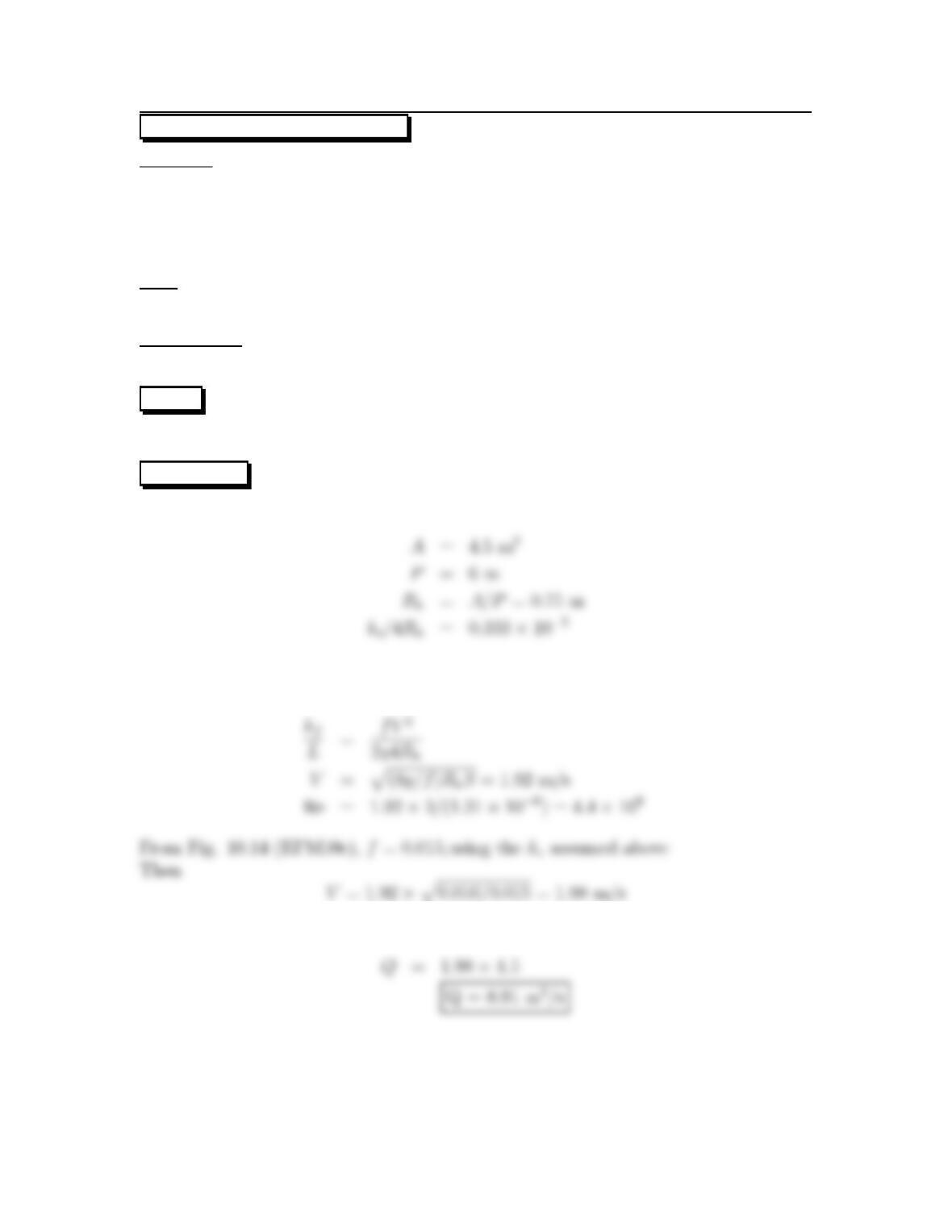
15.7: PROBLEM DEFINITION
Situation:
Rectangular concrete channel
Water at 10 ◦C
Depth 1.5 m
S=.001
Find:
Discharge (m
3/s) .
Assumptions:
ν=;ks=10
−3m
PLAN
Solve for Q with Darcy-Weisbach equation (note: could also use Manning equation).
SOLUTION
From Fig. 10.14 (EFM10e), f=0.016
Finally,
7
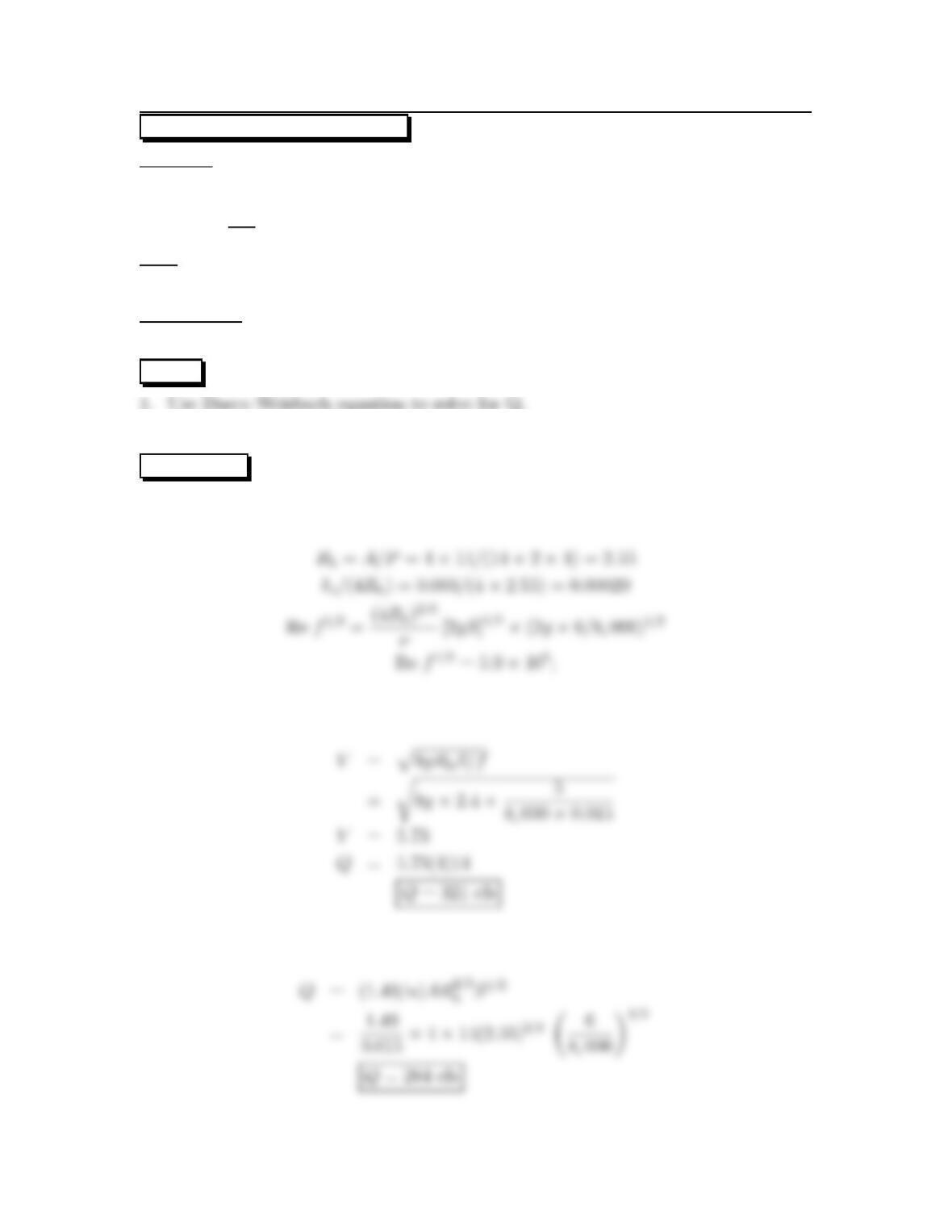
15.8: PROBLEM DEFINITION
Situation:
Concrete channel 14 ft wide, uniform flow
Depth is 4 ft.
Slope is 6
8000 =0.00075.
Find:
Discharge ¡ft3/s¢.
Assumptions:
ks=0.003
PLAN
2. Alternate Solution: use Manning equation.
SOLUTION
1. Darcy-Weisbach equation
From Fig. 10.14 (EFM10e), f=0.015
2. Alternate solution: Manning equation
Assume n=0.015
8
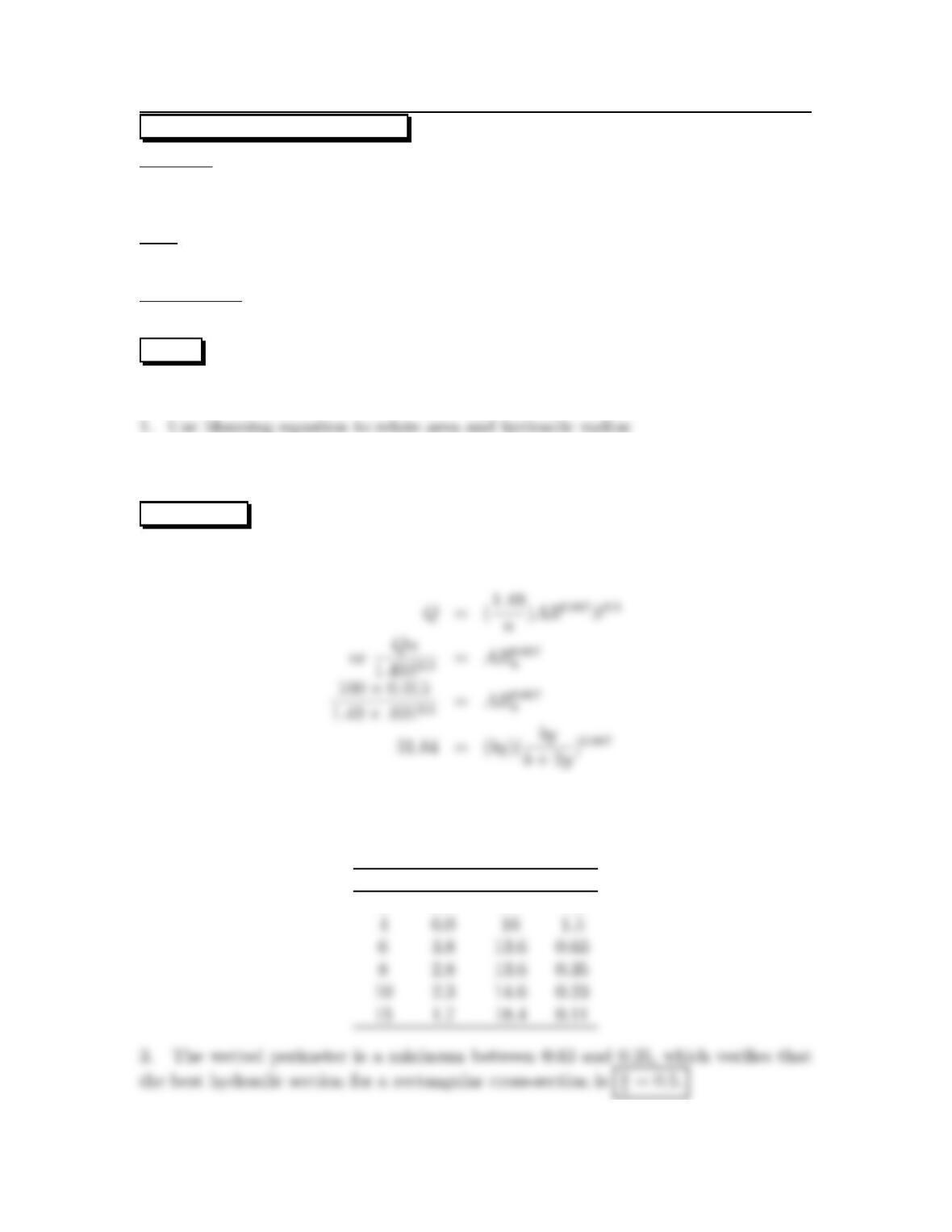
15.9: PROBLEM DEFINITION
Situation:
Channels of rectangular cross section
For each channel, the following applies: Q=100ft
3/sS=0.001
Find:
Cross-sectional areas for widths of 2, 4, 6, 8, 10 and 15 ft.
Assumptions:
n=0.015 for unfinished concrete
PLAN
Explore best hydraulic section for a rectangular channel.
Best hydraulic section is minimum wetted perimeter for a given cross-sectional area.
2. Solve to find different values of y as a function of b
3. Find when wetted perimeter is a minimum
SOLUTION
1. Mannings equation in form of yand b
2. For different values of bone can compute yand the wetted perimeter, P. The
following table results.
b(ft) y(ft) P(ft2)y/b
216.5 358.2
9
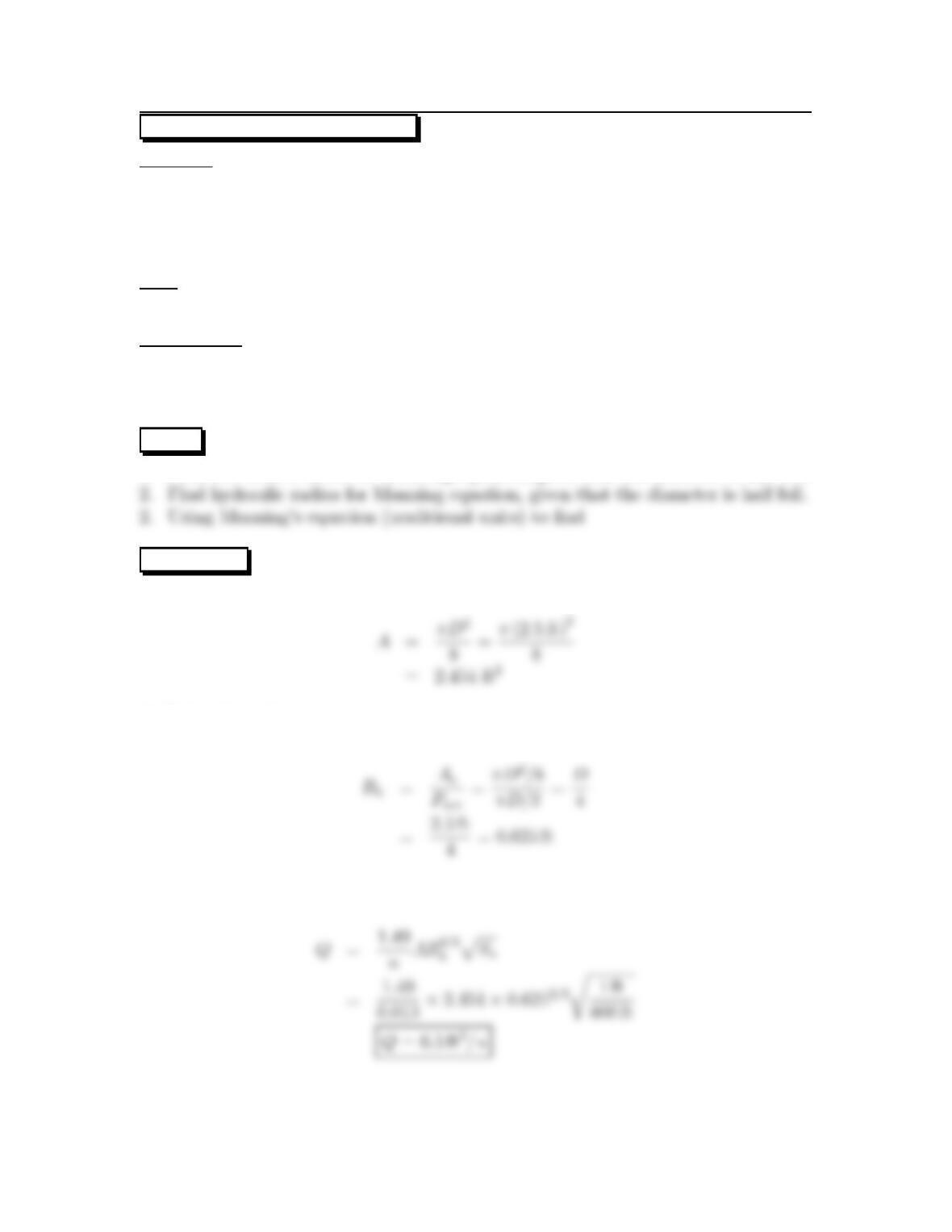
15.10: PROBLEM DEFINITION
Situation:
Sewer partially fills a concrete pipe.
The slope is 1 foot of drop per 800 feet of length.
Pipe diameter is D=2.5ft.
Depth of sewer is y=1.25 ft.
Find:
The discharge ¡ft3/s¢.
Assumptions:
1. The properties of the sewer are those of clean water.
2. Assume concrete pipe; Manning’s n-value of n=0.013 is a middle value for
concrete.
PLAN
1. Find flow area of sewer for Manning equation, given that the diameter is half full.
SOLUTION
1. Flow area
2. Hydraulic radius
.
3. Manning’s equation (traditional units)
10
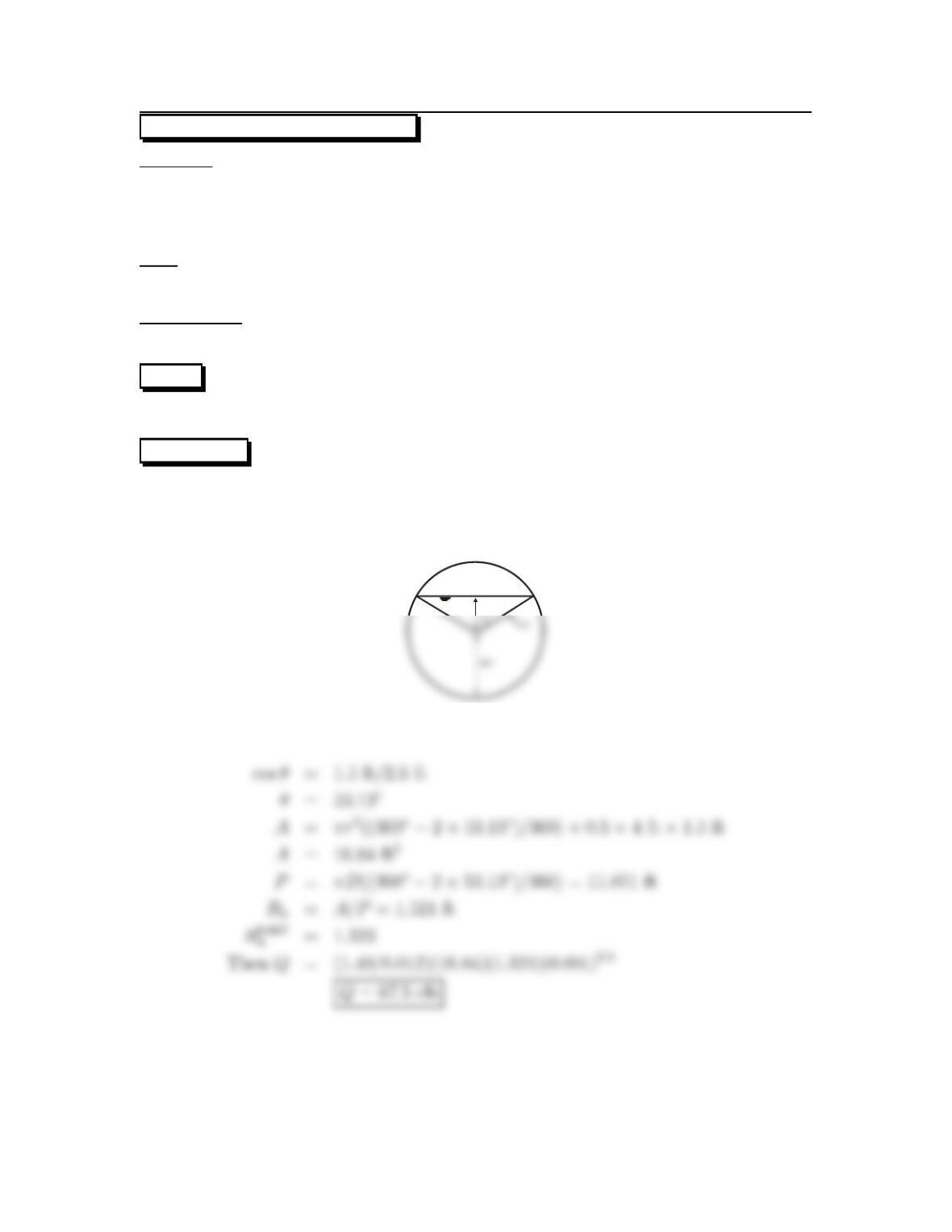
15.11: PROBLEM DEFINITION
Situation:
Concrete sewer pipe
D=5ft,S=0.001
Depth, y=4ft
Find:
The discharge ¡ft3/s¢.
Assumptions:
Smooth concrete, n=0.012
PLAN
Use Manning’s equation for a case where the depth is 4/5 of the diameter.
SOLUTION
Q=(1.49/n)AR0.667
hS0.5
0
2’ 2’
1.5’
11
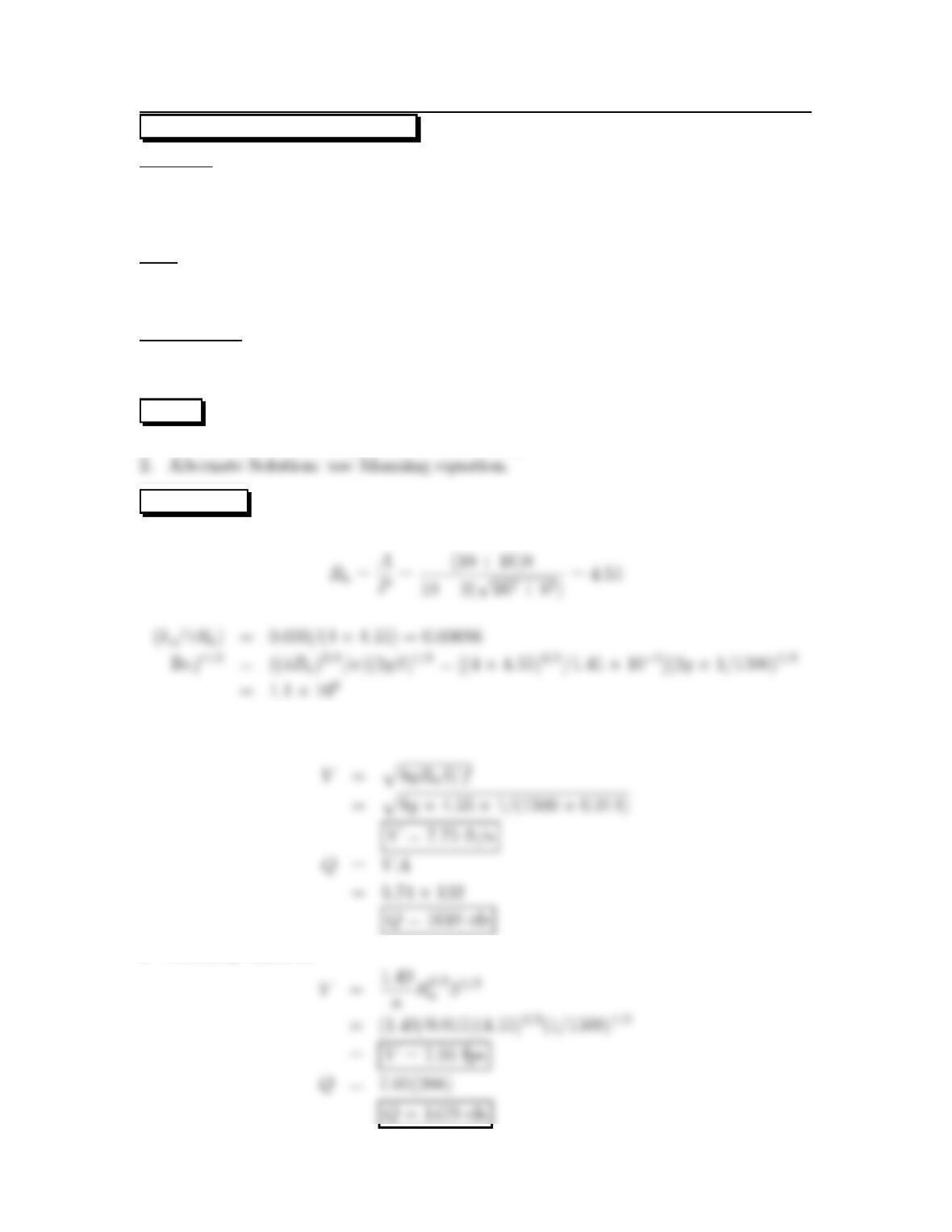
15.12: PROBLEM DEFINITION
Situation:
Trapezoidal, concrete-lined channel – figure in the problem statement
Depth = 8 ft
S=1ftin1500ft
Find:
Average velocity (ft/s) .
Discharge ¡ft3/s¢.
Assumptions:
ks=0.003 ft or n=0.015
ν=1.41 ×10⁻⁵ft2/s
PLAN
1. Use Darcy-Weisbach equation to solve for Q.
SOLUTION
1. Darcy-Weisbach equation
From Fig. 10.14 (EFM10e), f=0.013.Then
2. Manning equation
12

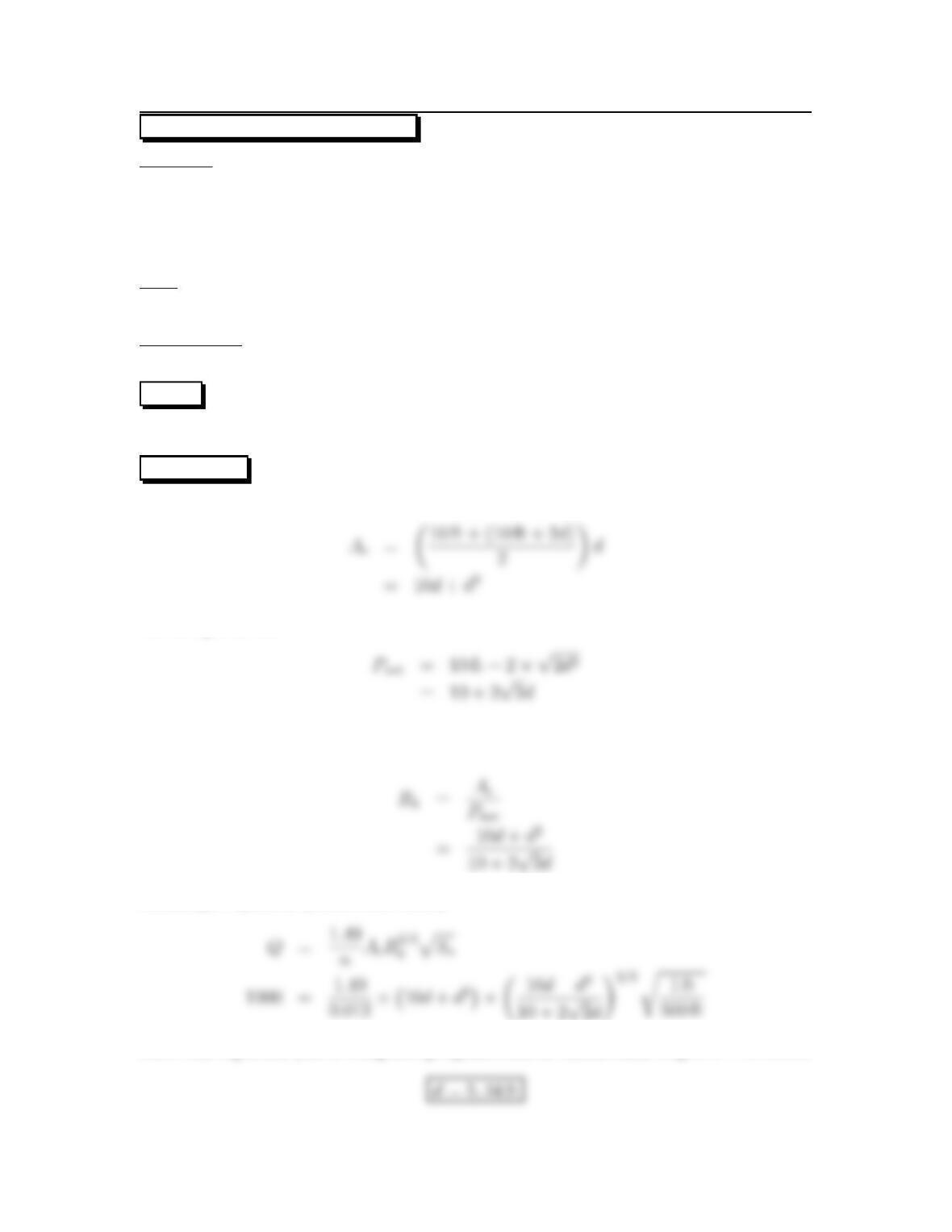
15.13: PROBLEM DEFINITION
Situation:
Trapezoidal, concrete-lined channel
Q=1000cfs
Slope is 1 ft. in 500 ft
Bottom width = 10ft, and side slopes are 1:1
Find:
Depth of flow (ft).
Assumptions:
n=0.012
PLAN
Use Manning’s equation (traditional units).
SOLUTION
Flow area
Wetted perimeter
Hydraulic radius
Manning’s equation (traditional units)
Solve this equation (use a computer program such as MathCAD) to give d=5.338 ft.
14
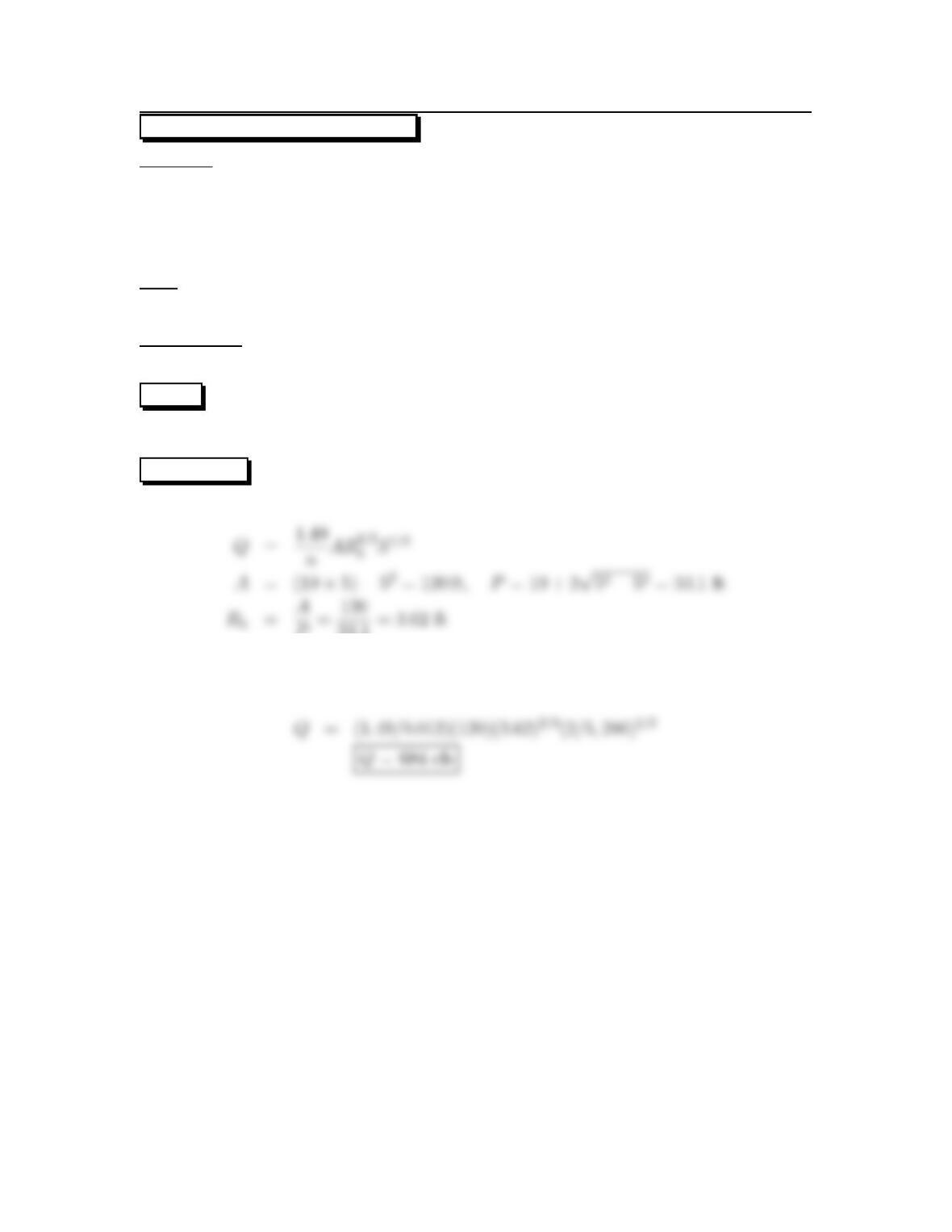
15.14: PROBLEM DEFINITION
Situation:
Trapezoidal, concrete-lined channel
Slope is 2 ft/mile
Bottom width = 19ft, and side slopes are 1:1
d=5ft
Find:
Discharge ¡ft3/s¢.
Assumptions:
n=0.012
PLAN
Use Manning’s equation (traditional units).
SOLUTION
P=120
33.1=3.62 ft
Then
15

15.15: PROBLEM DEFINITION
Situation:
Rectangular, concrete-lined channel
Width is 4m
Slope is .004
Q=25m
3/s
Find:
The uniform flow depth (m).
Assumptions:
n=0.015
PLAN
Use the Manning equation to solve for d,giventhatA=d×4m
SOLUTION
16
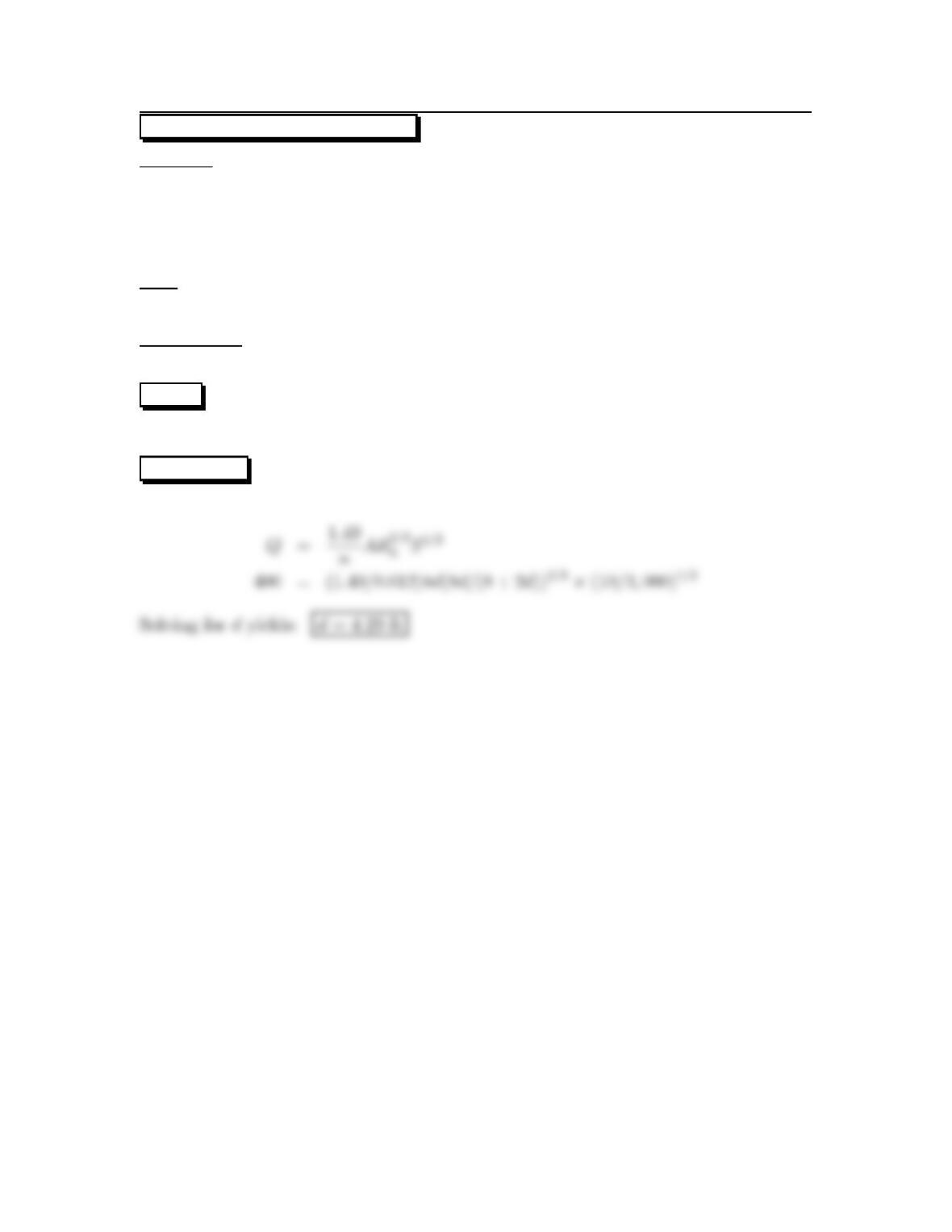
15.16: PROBLEM DEFINITION
Situation:
Rectangular, troweled concrete channel
Width is 8 ft
Slope is 10ft in 3000 ft
Q=400cfs
Find:
The depth of flow (ft).
Assumptions:
n=0.012
PLAN
Use the Manning equation
SOLUTION
17
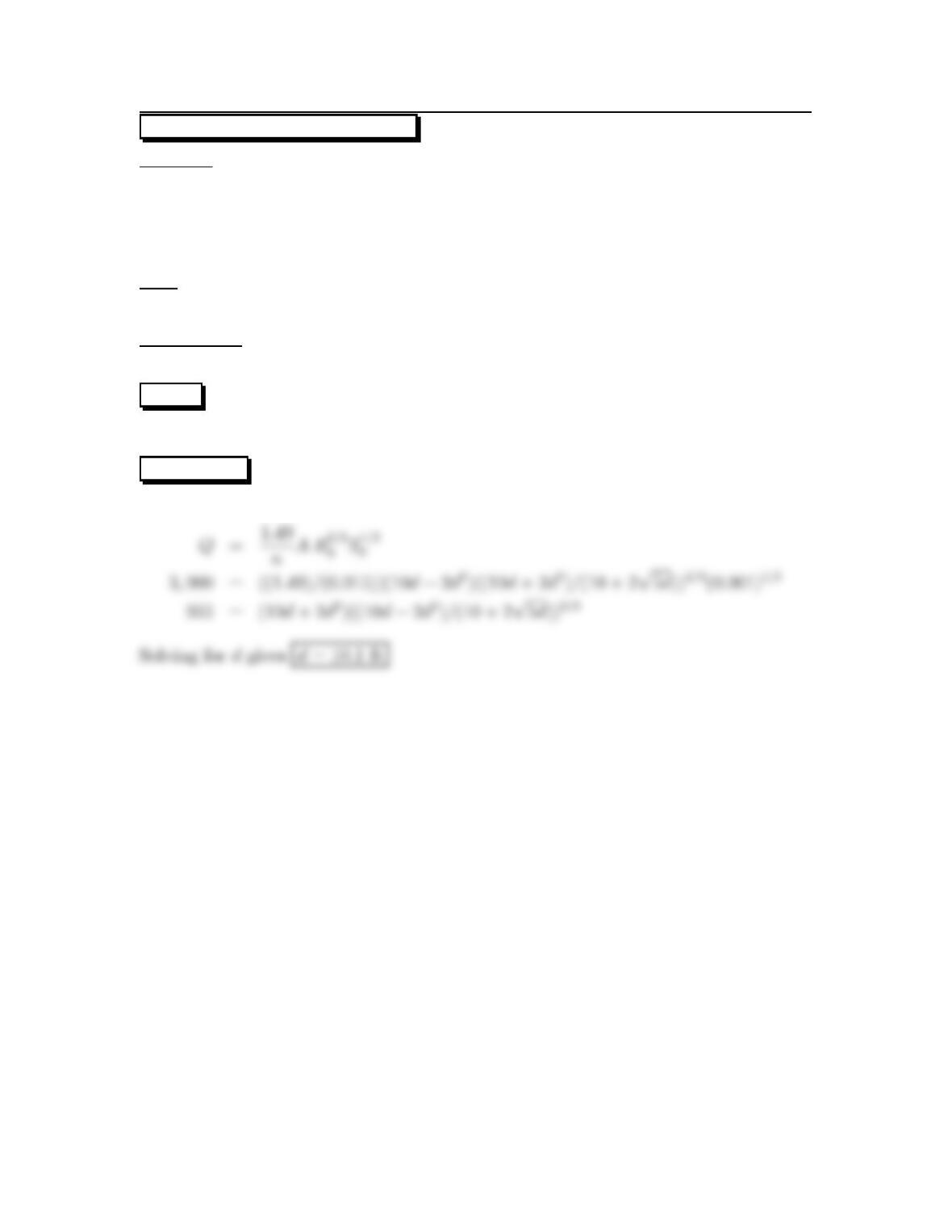
15.17: PROBLEM DEFINITION
Situation:
Trapezoidal, concrete-lined channel
Slope is .001
Bottom width = 10ft, and side slopes are 1:2
Q=3000cfs
Find:
Depth of flow in channel (ft).
Assumptions:
n=0.015
PLAN
Use the Manning equation
SOLUTION
18
15.18: PROBLEM DEFINITION
Situation:
Canal, trapezoidal.
Design Q=900cfs
S=0.002
Find:
Design with the best hydraulic section (ft).
Assumptions:
n=0.015 (concrete, wood forms unfinished – Table 15.1, EFM10e)
PLAN
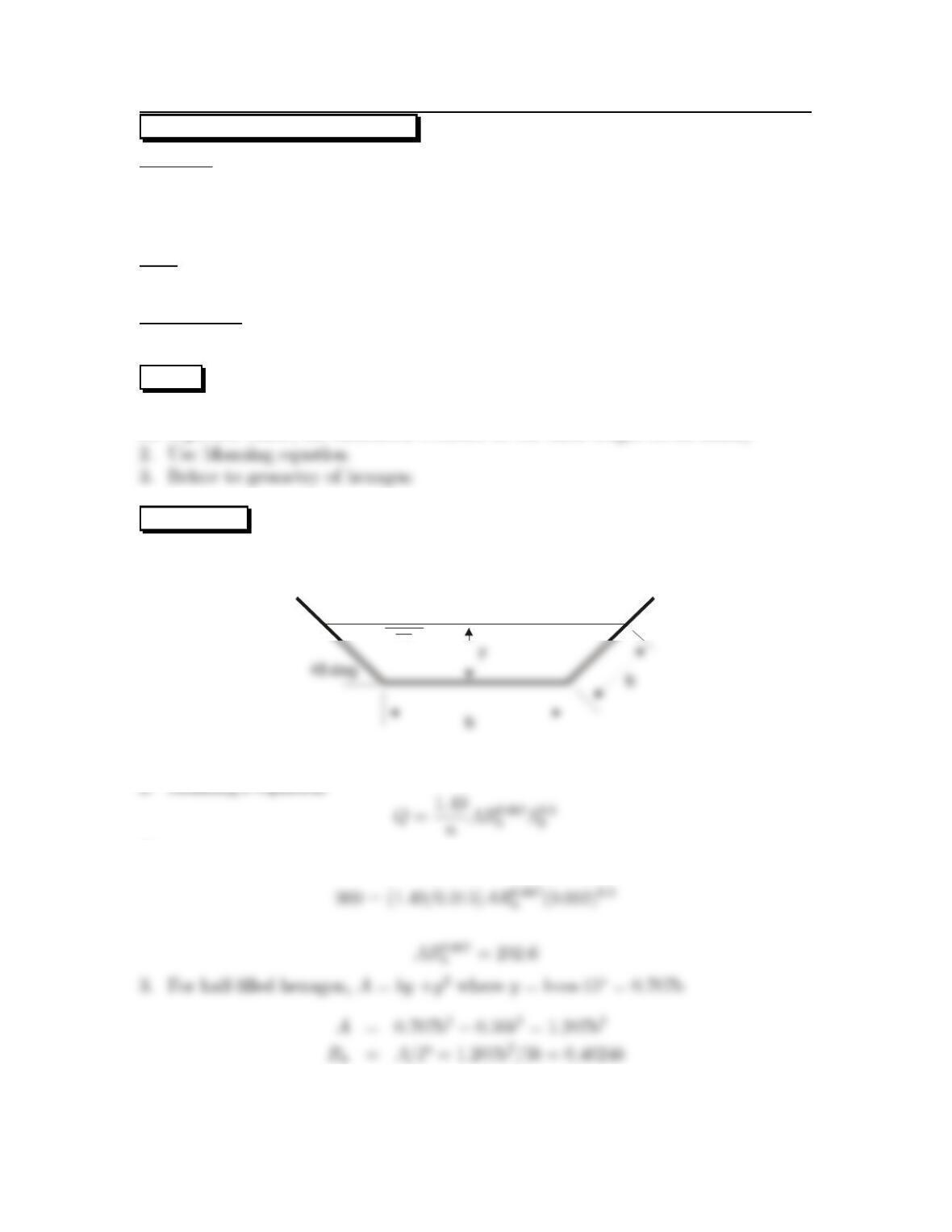
1. Best hydraulic section for a trapezoidal cross-section is a half-filled hexagon (note,
for depiction below, the dimension bshould be the same length on all limbs).
SOLUTION
1. Sketch of best cross-section, noting the necessary angles for a hexagon.
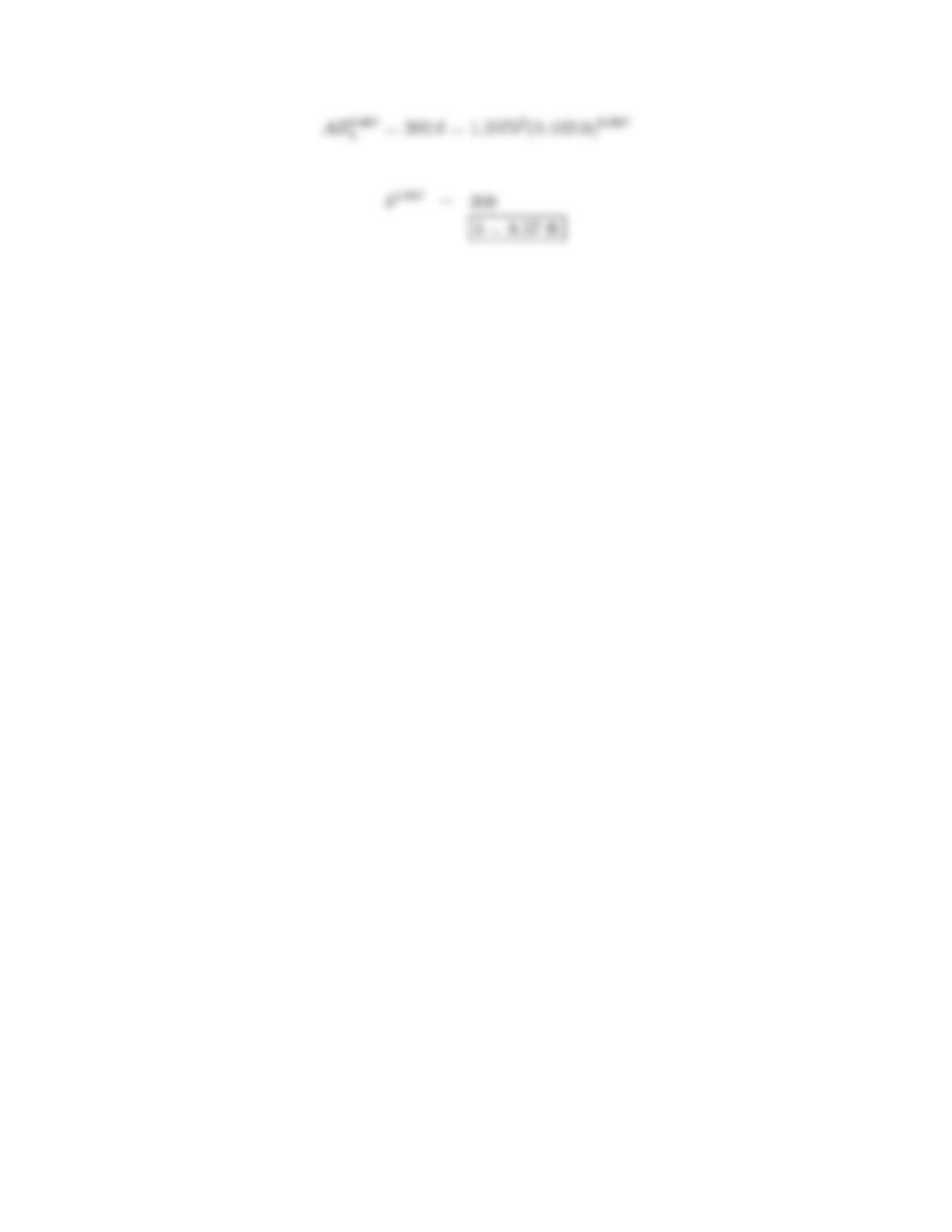
Then
Thus
19
20