15-1
CHAPTER 15
Spread Footing Design
QUESTIONS AND PRACTICE PROBLEMS
Section 15.1 Bearing Stress
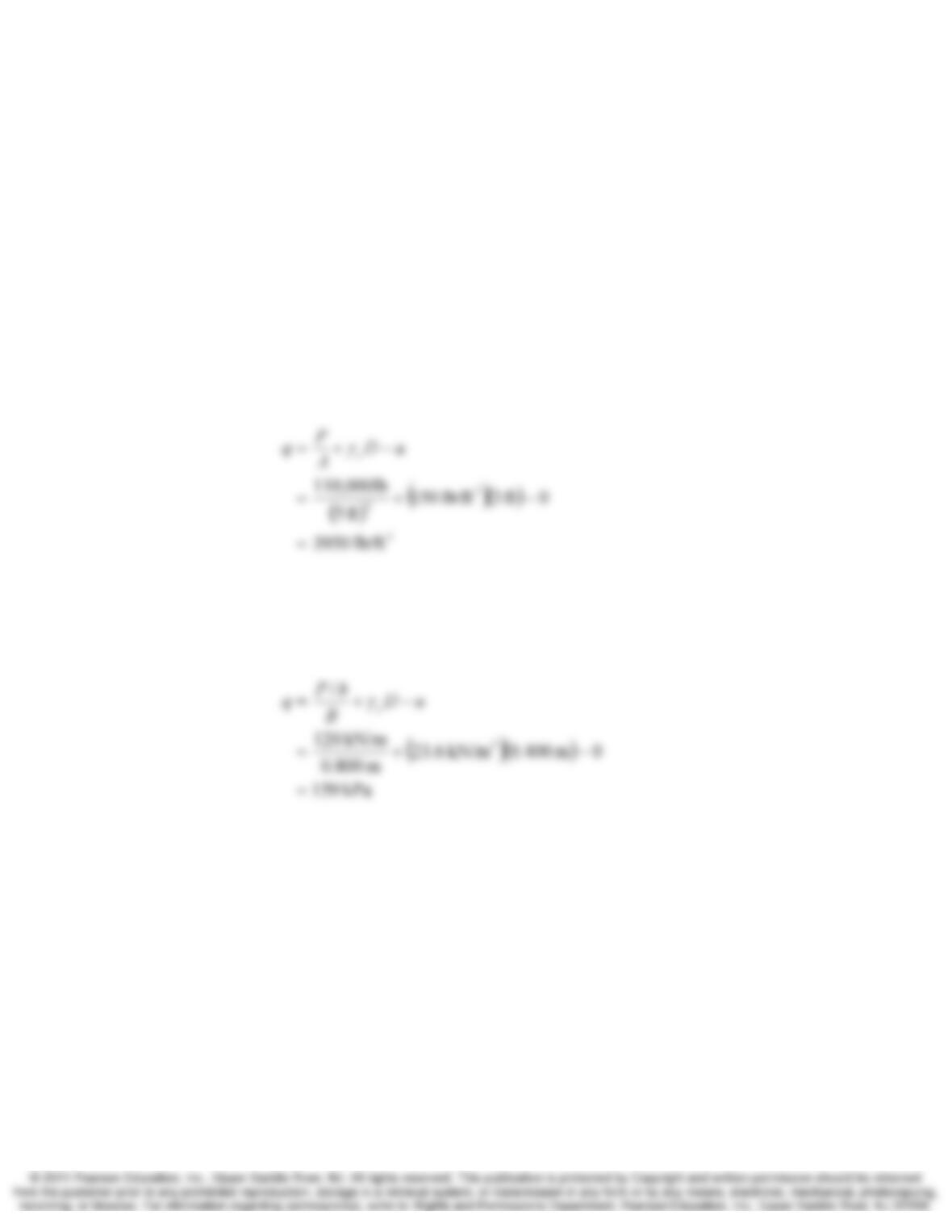
15.1 A 5 ft square, 3 ft deep footing supports a column load of 110 k. The groundwater table
is at a depth greater than 3 ft. Compute the bearing pressure.
Solution
15.2 An 800 mm wide, 400 mm deep continuous footing supports a wall load of 120 kN/m.
The groundwater table is at a great depth. Compute the bearing pressure.
Solution
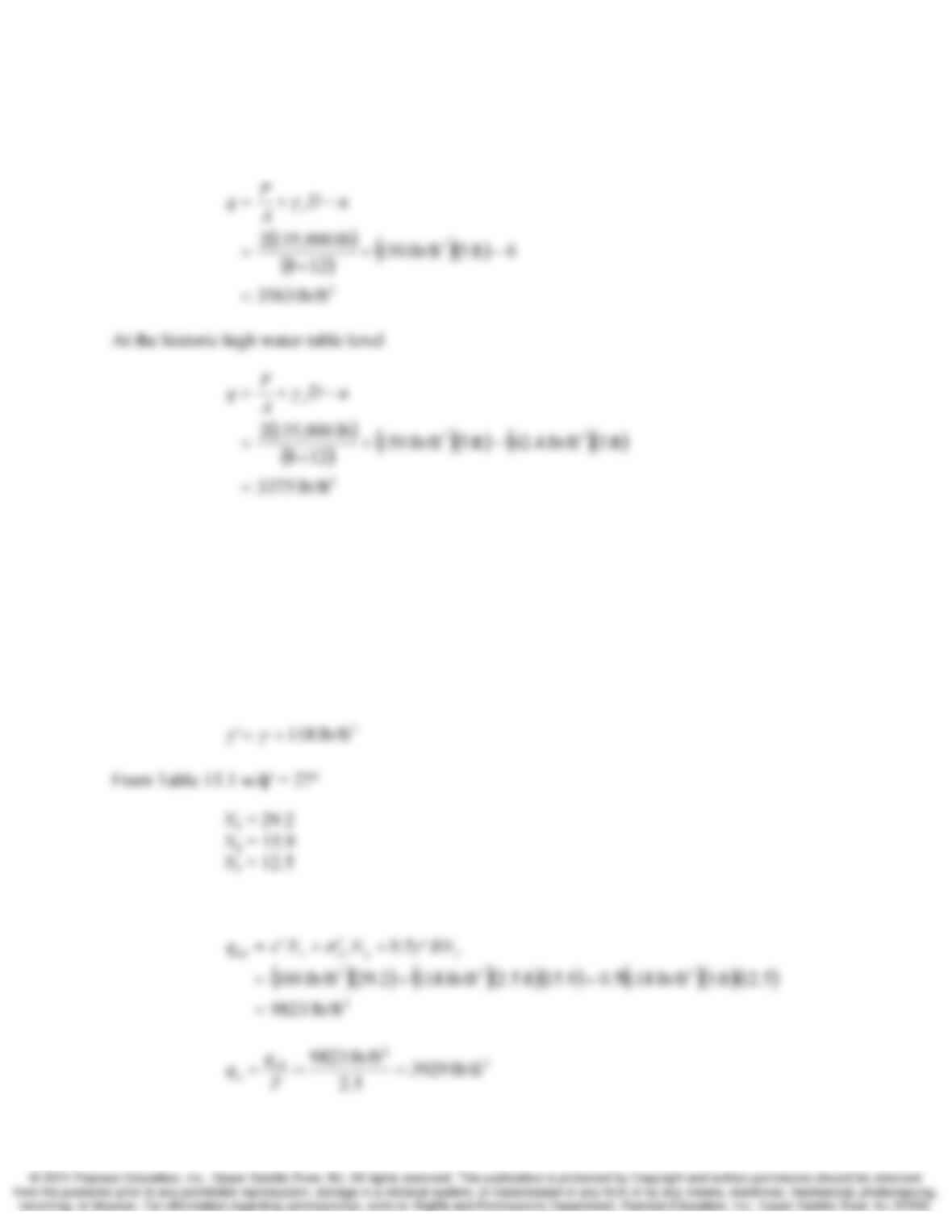
15.3 A rectangular footing 8 ft by 12 ft founded at a depth of 5 feet supports two columns each
bearing a load of 135 k. The groundwater is currently at a depth of 7 feet, but the historic
high water table is at a depth of 2 feet. Compute the bearing pressure under the current
groundwater conditions and if the groundwater reaches its historic high level.
15-2 Spread Footing Design Chap. 15
Solution
At current water table level
Section 15.2 Bearing Capacity
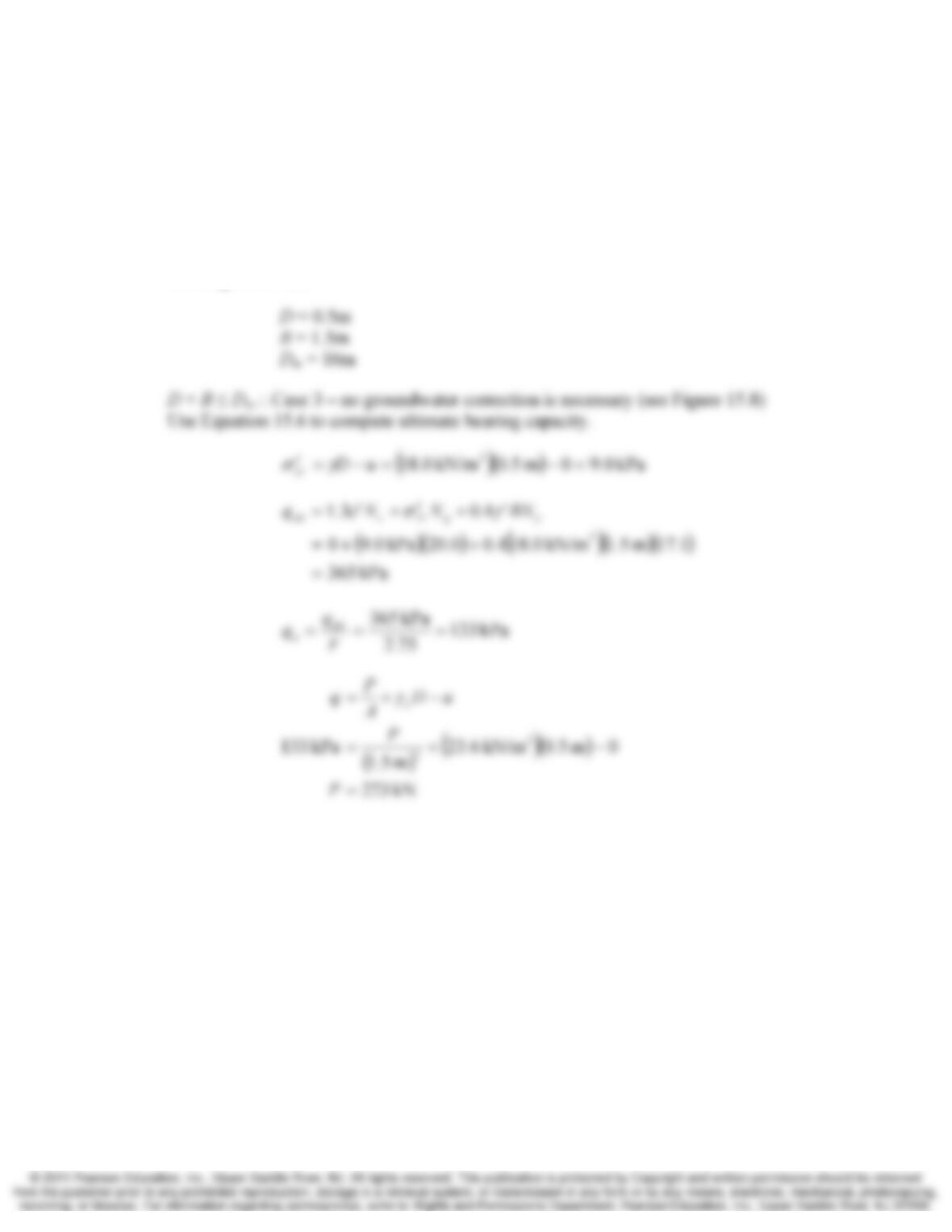
15.4 The bearing wall of a structure is to be supported on a 3-ft wide continuous footing
founded at a depth of 2.5 ft in a clayey sand with c′ = 100 lb/ft2, φ′ = 27°, and
γ = 118 lb/ft3. Compute allowable wall load if a factor of safety of 2.5 is required.
Solution
Assume groundwater table is very deep.
Using Equation 15.5
Chap. 15 Spread Footing Design 15-3
15.5 A proposed column is to be supported by a 1.5 m wide, 0.5 m deep square footing. The
soil beneath this footing is a silty sand with c′ = 0, φ′ = 29°, and γ = 18.0 kN/m3. The
groundwater table is at a depth of 10 m below the ground surface. The factor of safety
against a bearing capacity failure must be at least 2.75. Compute the maximum allowable
column load.
Solution
Check groundwater
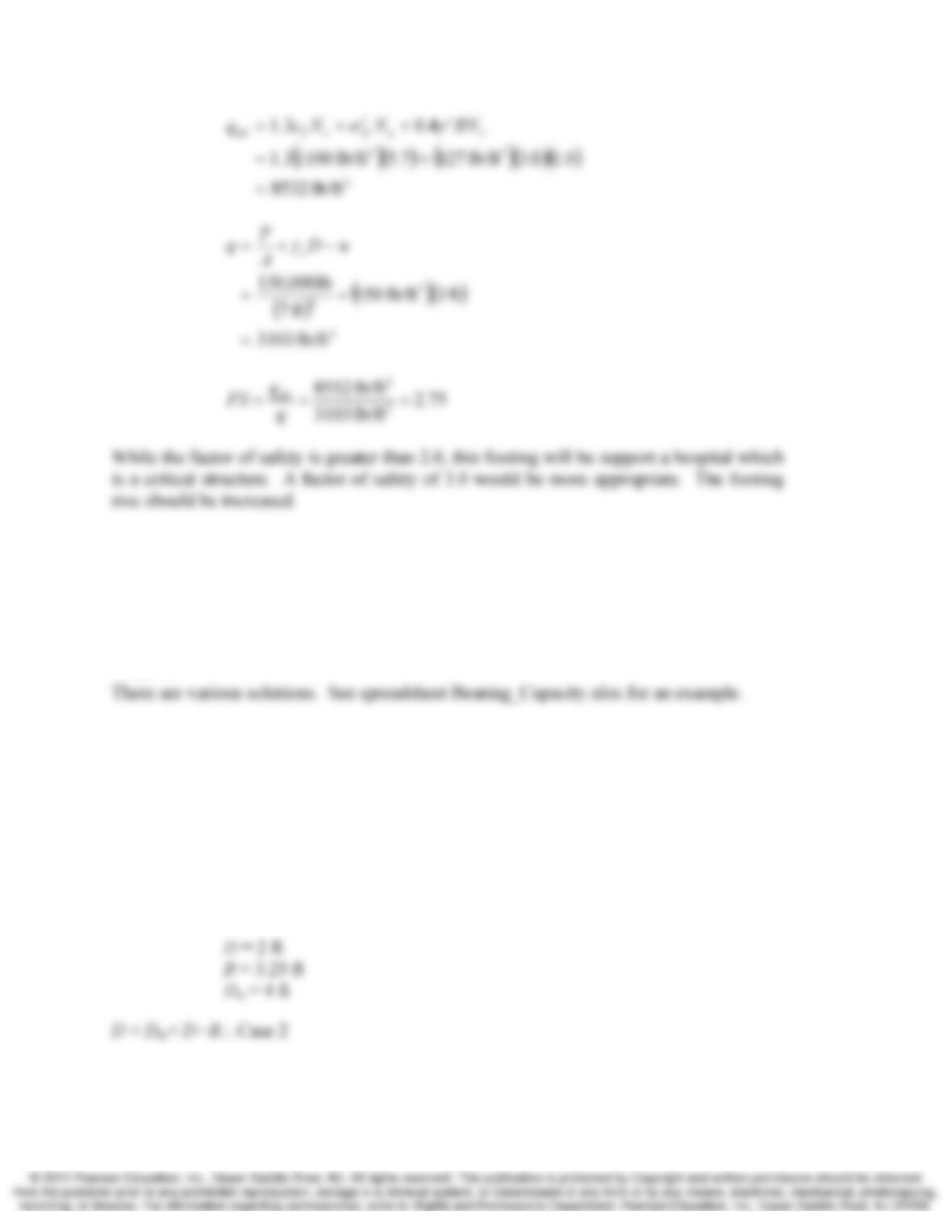
15.6 You are reviewing the footing design for a hospital founded on clay soils. The
controlling column load is 130 k. The proposed footing is square with a width of 7 ft. It
is founded at a depth of 3 ft in a medium to stiff clay with su = 1100 lb/ft2 and
γ = 127 lb/ft3. The groundwater table is at a depth of 2 ft. Is this design acceptable?
Explain.
Solution
This is case where a total stress analysis with φ = 0 is appropriate
15-4 Spread Footing Design Chap. 15
15.7 Write a spreadsheet program that will compute the ultimate and allowable bearing
capacity for both continuous and square footings using Terzaghi’s bearing capacity
theory. The program must allow users to input column or wall load, footing dimensions,
footing depth, depth to groundwater table, factor of safety, and the cohesion, friction
angle, and unit weight of the soil. It should accept either SI or English units.
Solution
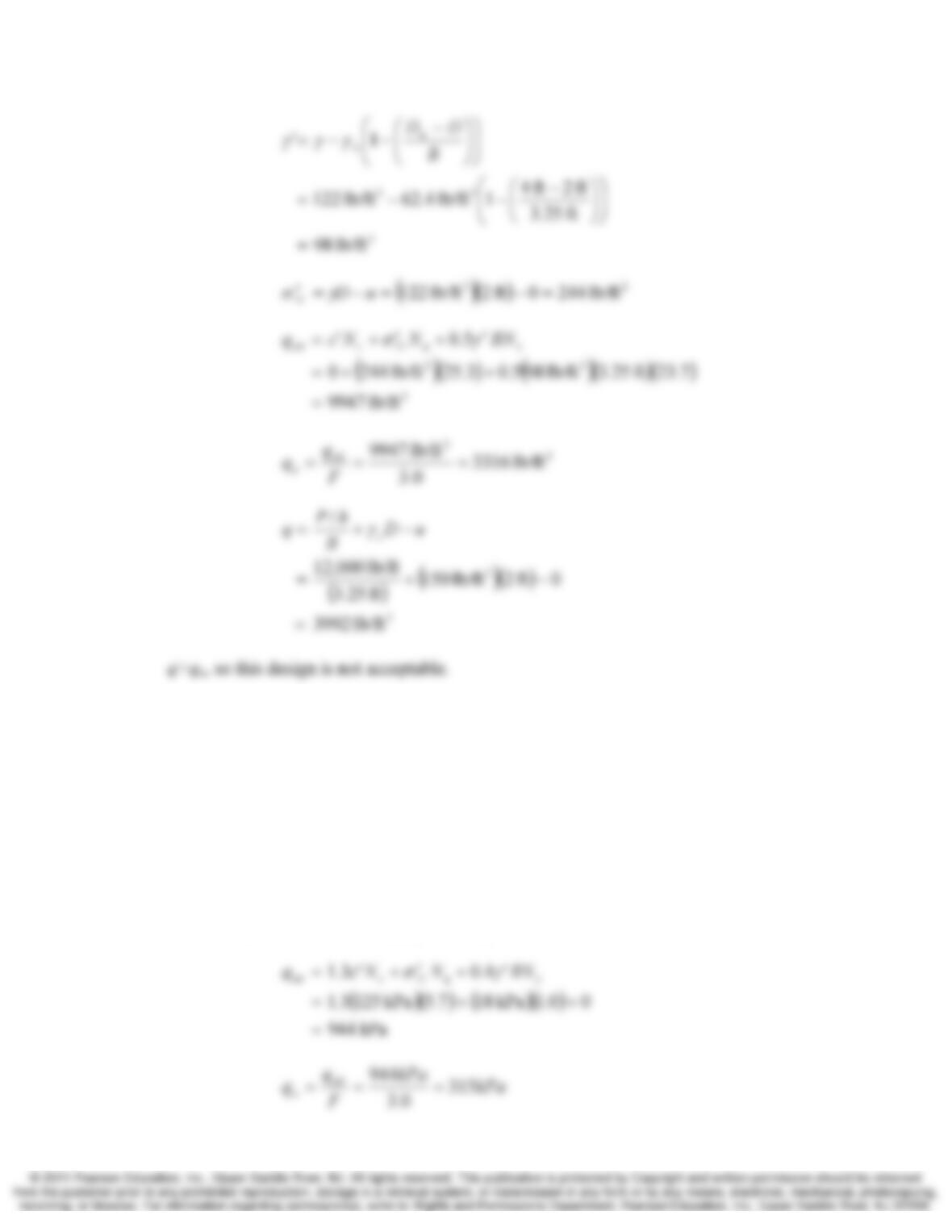
15.8 A 39 inch wide, 24 inch deep continuous footing supports a wall load of 12 k/ft. This
footing is underlain by a fine-to-medium sand with c′ = 0, φ′ = 31°, and γ = 122 lb/ft3.
The groundwater table is currently at a depth of 10 ft below the ground surface, but could
rise to 4 ft below the ground surface during the life of the project. The factor of safety
against a bearing capacity failure must be at least 3.0. Is the design acceptable? Provide
computations to justify your answer. Comment on any special considerations.
Solution
Check groundwater
Chap. 15 Spread Footing Design 15-5
Comment
The analysis must be based on a groundwater depth of 4 ft, because this is the worst-case
condition. The design can be made acceptable by increasing B.
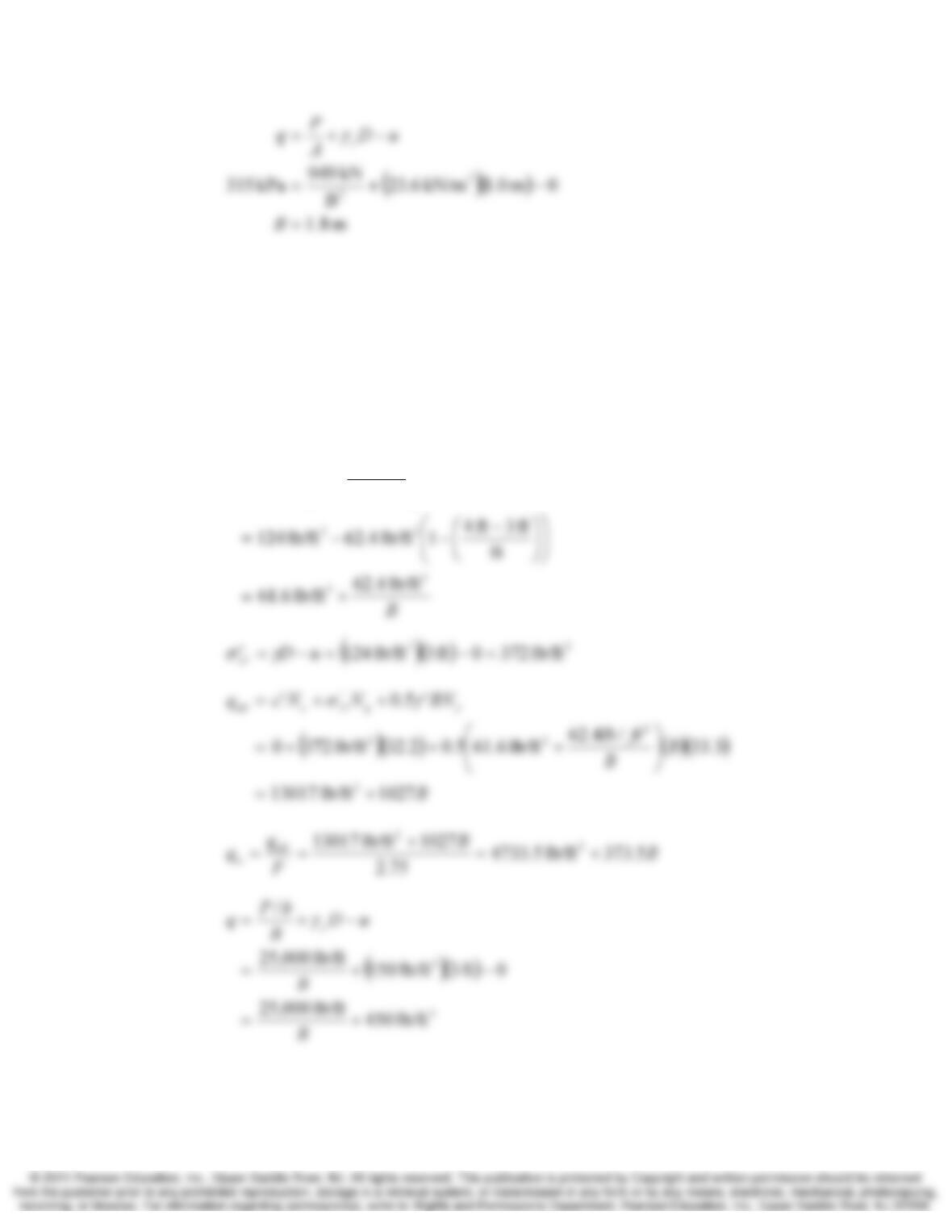
15.9 A 949-kN column load is to be supported on a square spread footing that will be
underlain by a clayey silt with su = 125 kPa. The bottom of this footing will be 1.0 m
below the ground surface, and the groundwater table is more than 30 m below the ground
surface. Using a factor of safety of 3.0, compute the required footing width.
Solution
This is a case for total stress analysis with φ = 0
15-6 Spread Footing Design Chap. 15
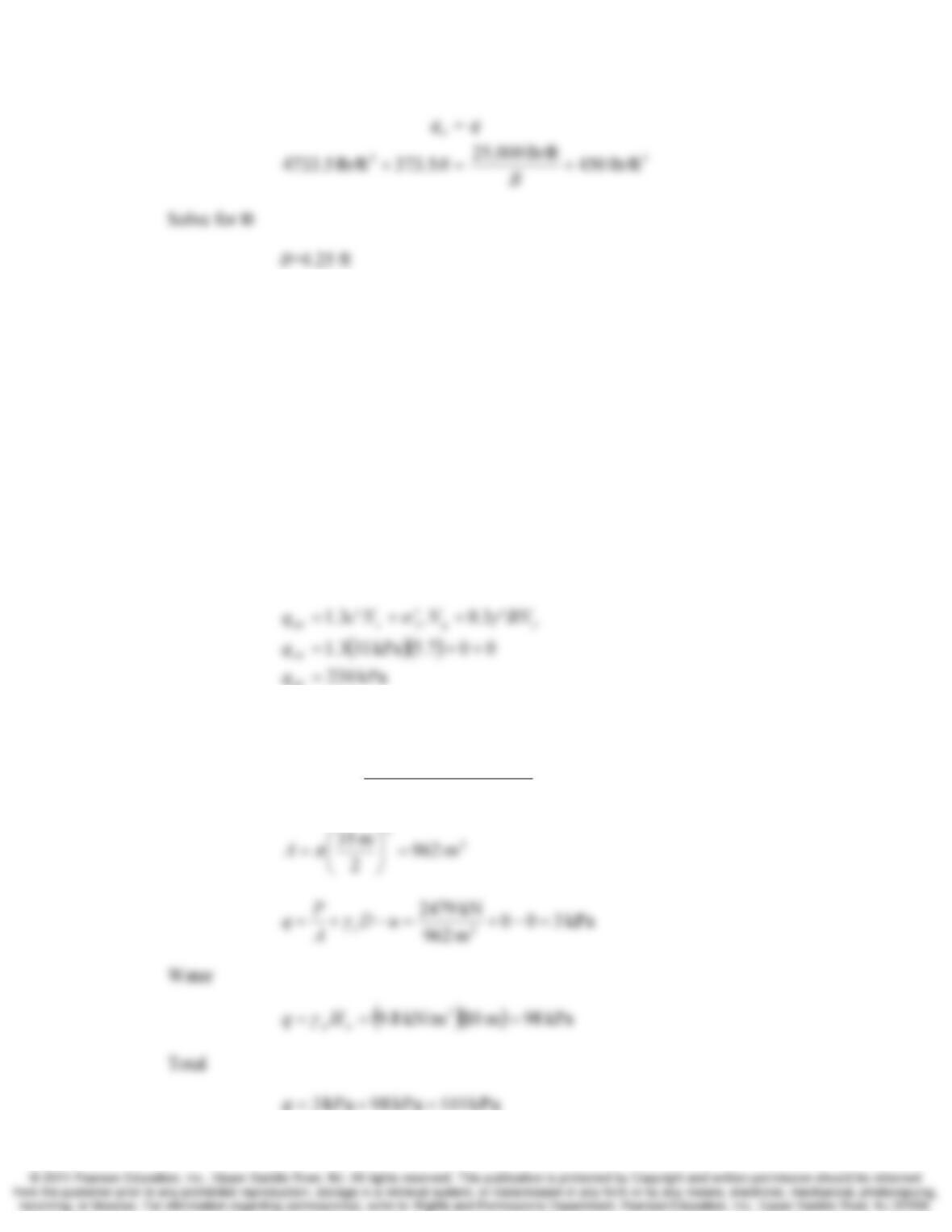
15.10 You are designing a continuous footing to support the walls of a tilt up structure. The
wall loads will be 25 k/ft. The footing will be founded at a depth of 3 ft on a medium
dense sand with c′ = 0, φ′ = 33°, and γ = 124 lb/ft3. The groundwater is at a depth of 4 ft.
Using a factor of safety of 2.75, compute the required footing width.
Solution
Check groundwater
Assume D < Dw< D+B
∴
Case 2
B
DDw
w
1‘
⎟
⎟
⎠
⎞
⎜
⎜
⎝
⎛⎟
⎠
⎞
⎜
⎝
⎛−
−−=
γγγ
Chap. 15 Spread Footing Design 15-7
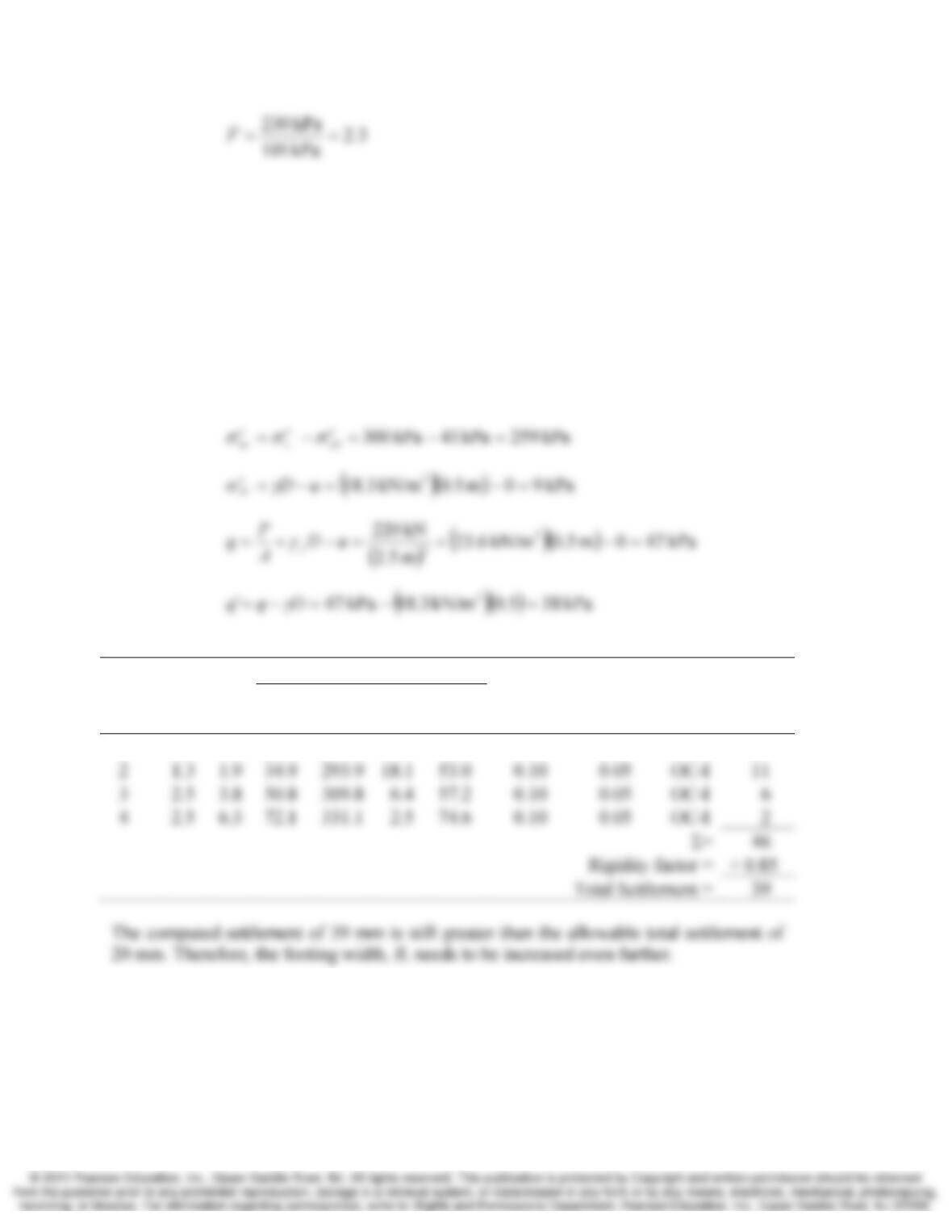
15.11 A proposed cylindrical steel water tank is to be built on a medium clay that has an
undrained shear strength, su, of 31 kPa. The tank diameter will be 35.0 m, and it will
contain 10.0 m of water. Its empty mass will be 253,000 kg. Assuming both the weight
of the empty tank and that of the water are spread evenly along the bottom, compute the
factor of safety against a bearing capacity failure. Is this factor of safety acceptable? If
not, how could the design be modified to provide an acceptable F?
Note: Although a ring footing would be present along the perimeter of this tank
to support the weight of the walls, the live load (i.e., the weight of the water) is spread
evenly across the bottom of the tank. This live load is a large fraction of the total load, so
the bearing capacity analysis should be based on a circular load with a diameter equal to
the diameter of the tank.
Solution
ult
Empty tank
()
(
)
kN 2479
N/kN1000
m/s 9.8kg 253,000 2
=== MgW
15-8 Spread Footing Design Chap. 15
Section 15.3 Settlement
15.12 The footing described in Example 15.6 has been redesigned so B now equals 2.50 m.
The column load and depth of embedment remain the same. Compute the new settlement,
δ. Does this new design satisfy the allowable settlement criteria described in Example
15.6?
Solution
(
)
(
)
(
)
(
)
kPa 41m 0.5kN/m 9.8m 2.5kN/m 18.3 33
,0 =−=−=
′∑uH
samplez
γσ
Layer
H
(m)
zf
(m)
At Midpoint of Layer
Cc/(1+e0)C
r
/(1+e0) Case
δc,ult
(mm)
σ‘z0
(kPa)
σ‘c
(kPa)
Δσz
(kPa)
σ‘zf
(kPa)
1 1.3 0.6 20.6 279.6 35.7 56.3 0.10 0.05 OC-I 27
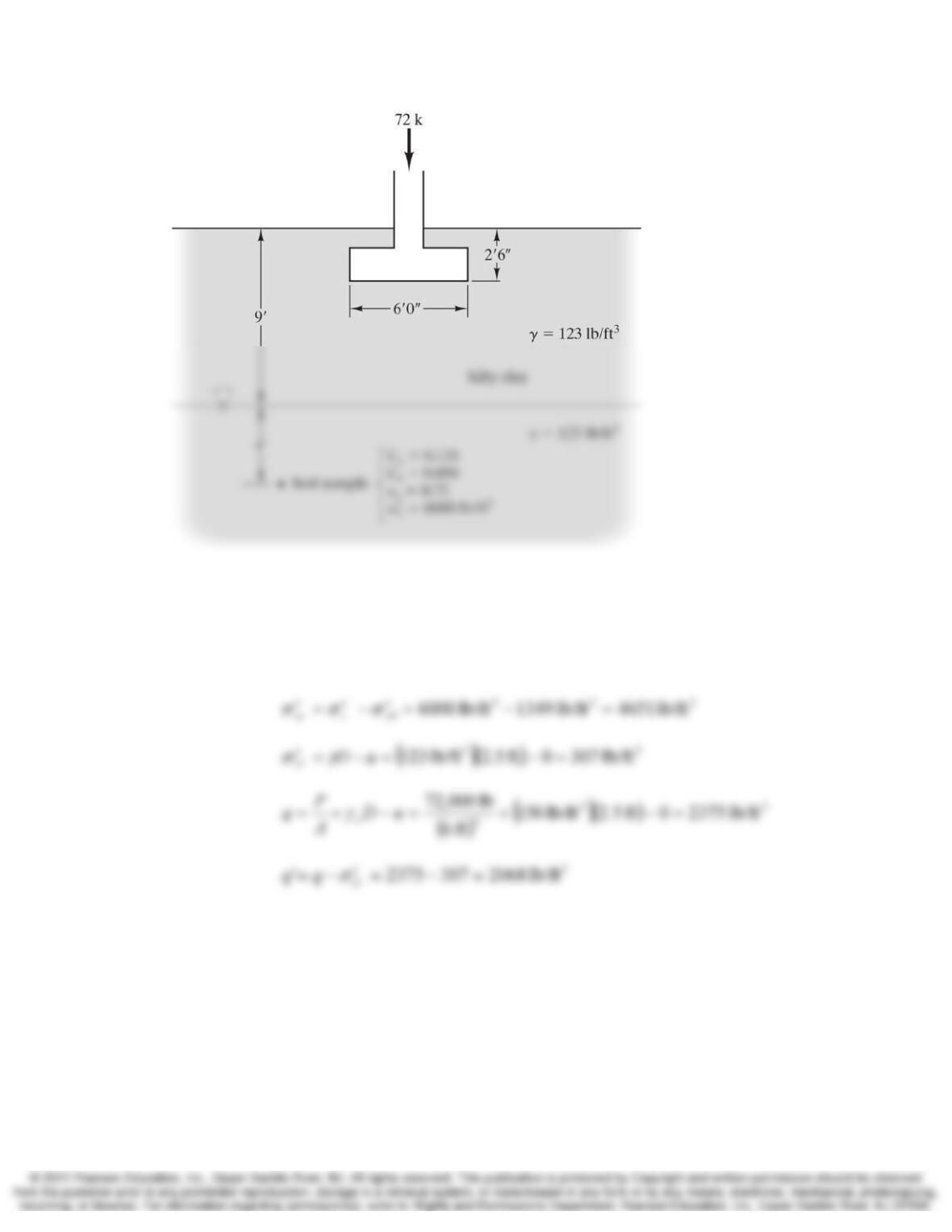
15.13 The proposed footing shown in Figure 15.20 has an allowable total settlement of 1.0 in.
Compute the settlement and determine if it meets this criterion.
Chap. 15 Spread Footing Design 15-9
Figure 15.20 Proposed square footing for Problem 15.13.
Solution
(
)
(
)
(
)
()
233
,0 lb/ft 13494ftlb/ft 62.4ft 13lb/ft 123 =−=−=
′∑uH
samplez
γσ
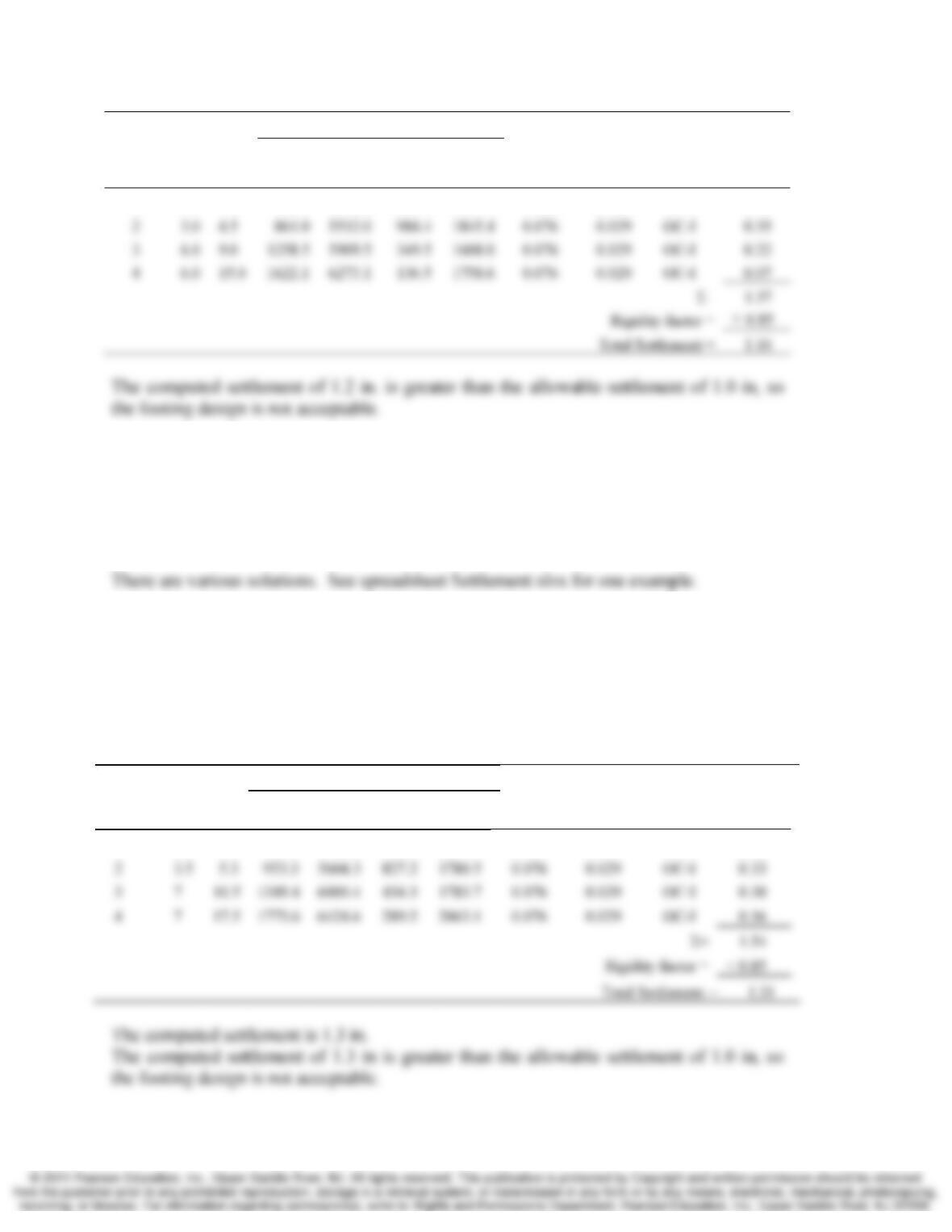
15-10 Spread Footing Design Chap. 15
Layer
H
(ft)
zf
(ft)
At Midpoint of Layer
Cc/(1+e0)C
r
/(1+e0)Case
δc,ult
(in)
σz0
(psf)
σ‘c
(psf)
Δσz
(psf)
σ‘zf
(psf)
1 3.0 1.5 492.0 5143.0 1943.9 2435.9 0.076 0.029 OC-I 0.73
15.14 Write a spreadsheet program that will compute the settlement of square or continuous
footings founded on clay soil. The program must allow users to input column or wall
load, footing dimensions, footing depth, Cc, Cr, σ′c, and unit weight of the soil. It should
divide the soil into at least 30 layers and should accept either SI or English units.
Solution
15.15 A proposed 3’6″ wide continuous footing is to be built at the site described in Problem
15.12. The depth, D, the bearing pressure, q, and the allowable settlement, δa, are the
same as before. Compute the predicted settlement and determine if it meets the
settlement criteria.
Solution
Layer
H
(ft)
zf
(ft)
At Midpoint of Layer
σz0
(psf)
σ‘c
(psf)
Δ
σz
(psf)
σ
‘zf
(psf) Cc/(1+e0)C
r
/(1+e0) Case δc
,
ul
t
(in)
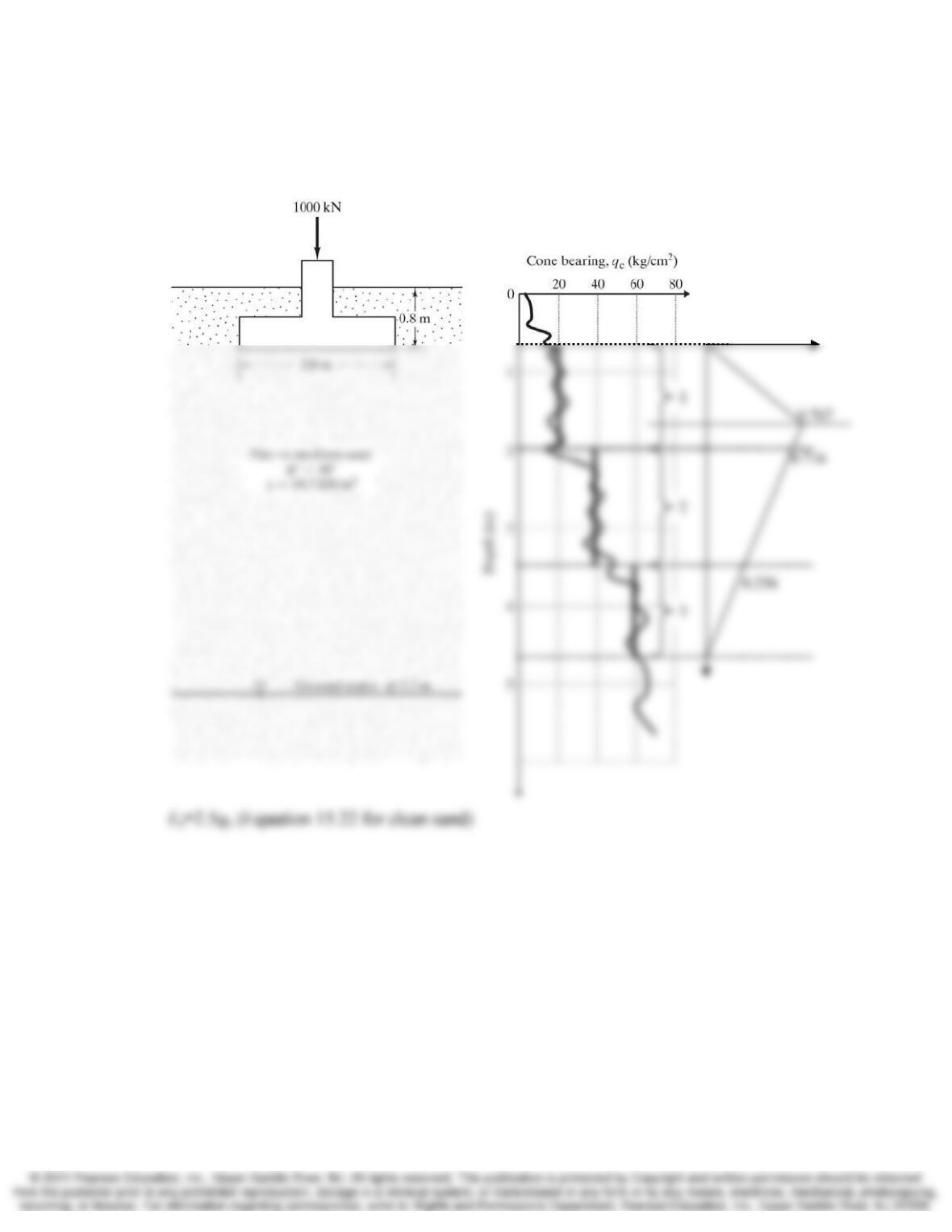
1 3.5 1.8 522.8 5173.8 1654.4 2177.2 0.076 0.029 OC-I 0.76
Chap. 15 Spread Footing Design 15-11
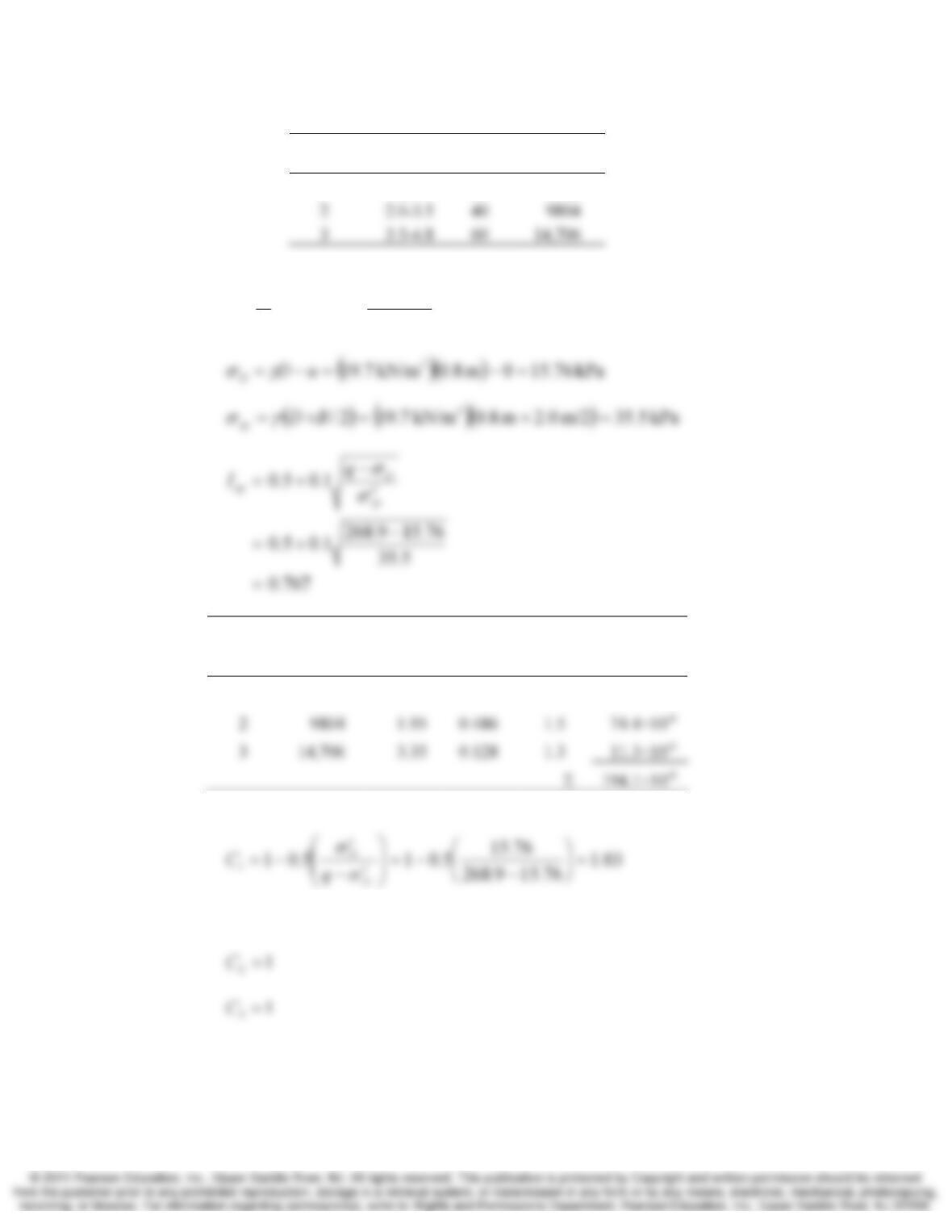
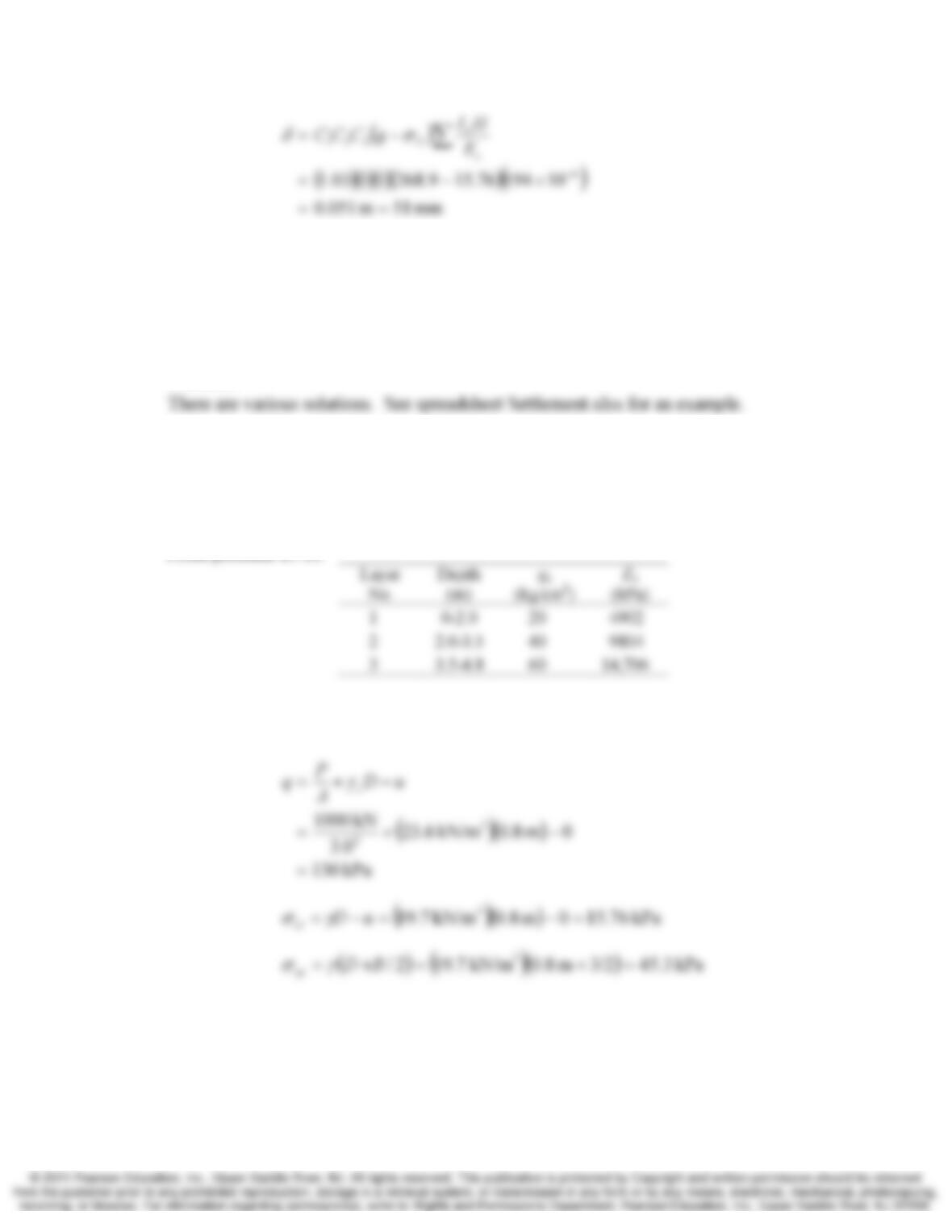
15.16 Compute the settlement of the proposed footing shown in Figure 15.21 using the CPT log
shown.
Solution
15-12 Spread Footing Design Chap. 15
Layer
No.
Depth
(m)
qc
(kg/cm2)
Es
(kPa)
1 0-2.0 20 4902
()
(
)
()
kPa 268.90m 0.8kN/m 23.6
2.0m
kN 1000 3
2=−+=−+= uD
A
P
qc
γ
Layer
No.
Es
(kPa)
zf
at center
(m) I
ε
H
(m) I
ε
(H)/Es
1 4902 0.6 0.443 1.2 108.4 ×10⁻⁶
Assume settlement is computed immediately after footing placement.
Chap. 15 Spread Footing Design 15-13
15.17 Write a spreadsheet program that will compute the settlement of square or continuous
footings founded on sand using Schmertmann’s method. The program must allow users
to input column or wall load, footing dimensions, footing depth, Es and unit weight of the
soil and time after construction. It should divide the soil into at least 30 layers and should
accept either SI or English units.
Solution
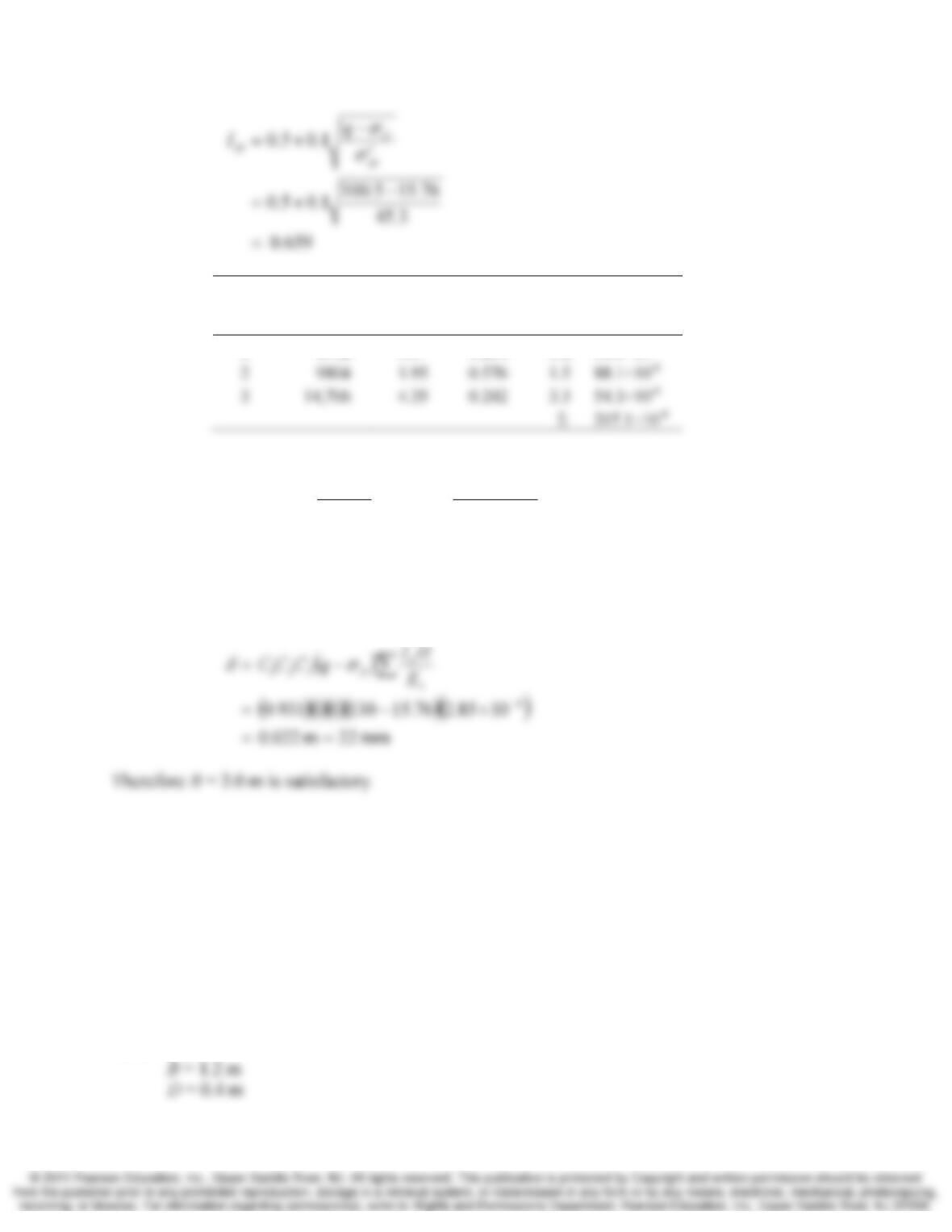
15.18 According to the structural engineer, the footing described in Problem 15.16 must not
settle more than 25 mm. Determine the required B that produces the most economical
design.
Solution
From problem 15.16
Through trial and error, try B=3.0 m
15-14 Spread Footing Design Chap. 15
Layer
No.
Es
(kPa)
zf
at center
(m) I
ε
H
(m) I
ε
H/Es
1 4902 0.6 0.264 1.2 64.6×10⁻⁶
931.0
76.15130
76.15
5.015.01
1=
⎟
⎠
⎞
⎜
⎝
⎛
−
−=
⎟
⎟
⎠
⎞
⎜
⎜
⎝
⎛
′
−
′
−=
D
D
q
C
σ
σ
1
2=C
1
3=C
Comprehensive
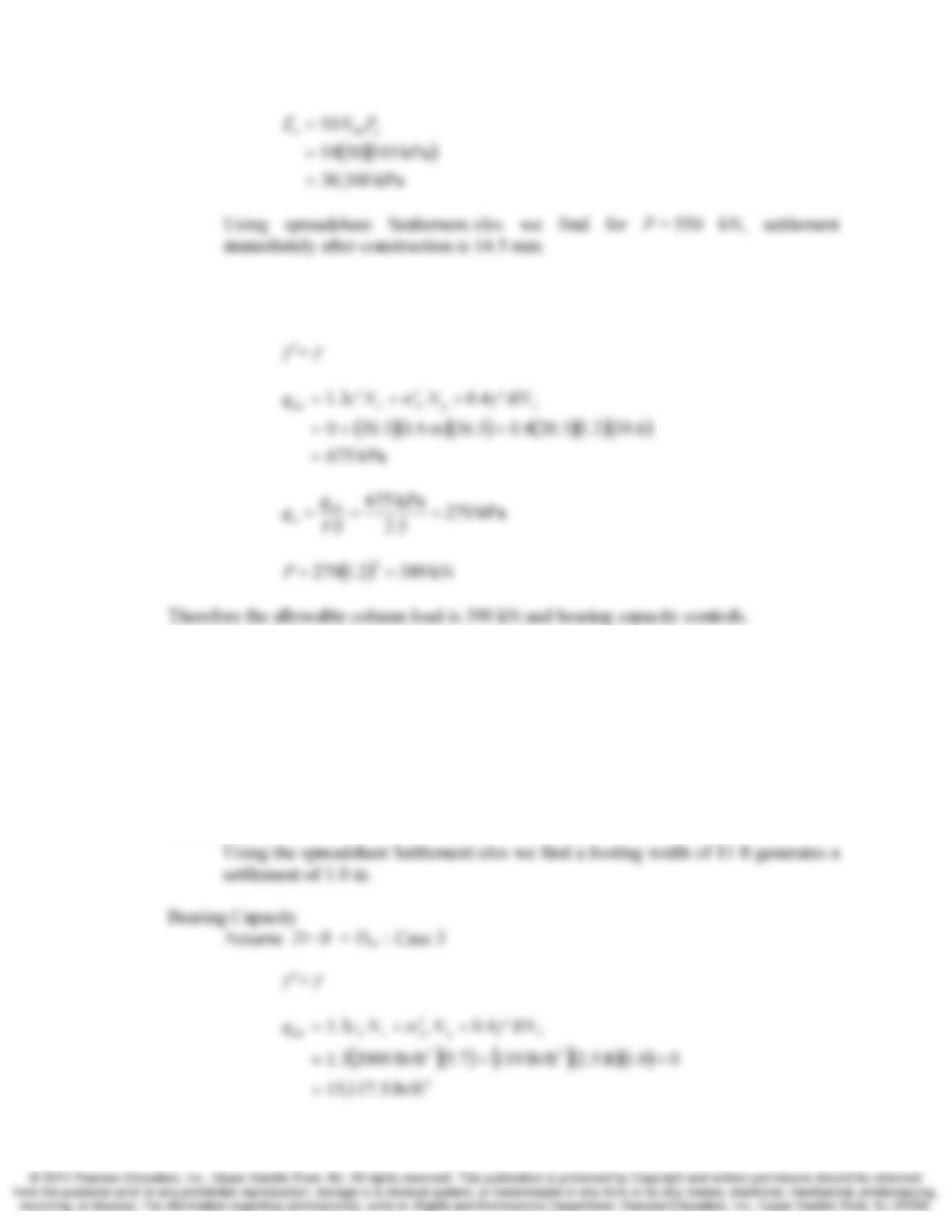
15.19 A proposed 1200 mm wide, 400 mm deep footing will be built on a sandy soil with c′ = 0,
φ
′ = 34°, γ = 20.1 kN/m3 and N60 = 30. The groundwater table is at a depth of 2 m below
the ground surface. Determine the maximum allowable column load that may be placed
on this footing while maintaining a factor of safety of at least 2.5 against a bearing
capacity failure and a total settlement of no more than 15 mm. Which controls this
design, bearing capacity or settlement?
Solution
Settlement
Chap. 15 Spread Footing Design 15-15
Check bearing capacity
D+B <
∴
Case 3
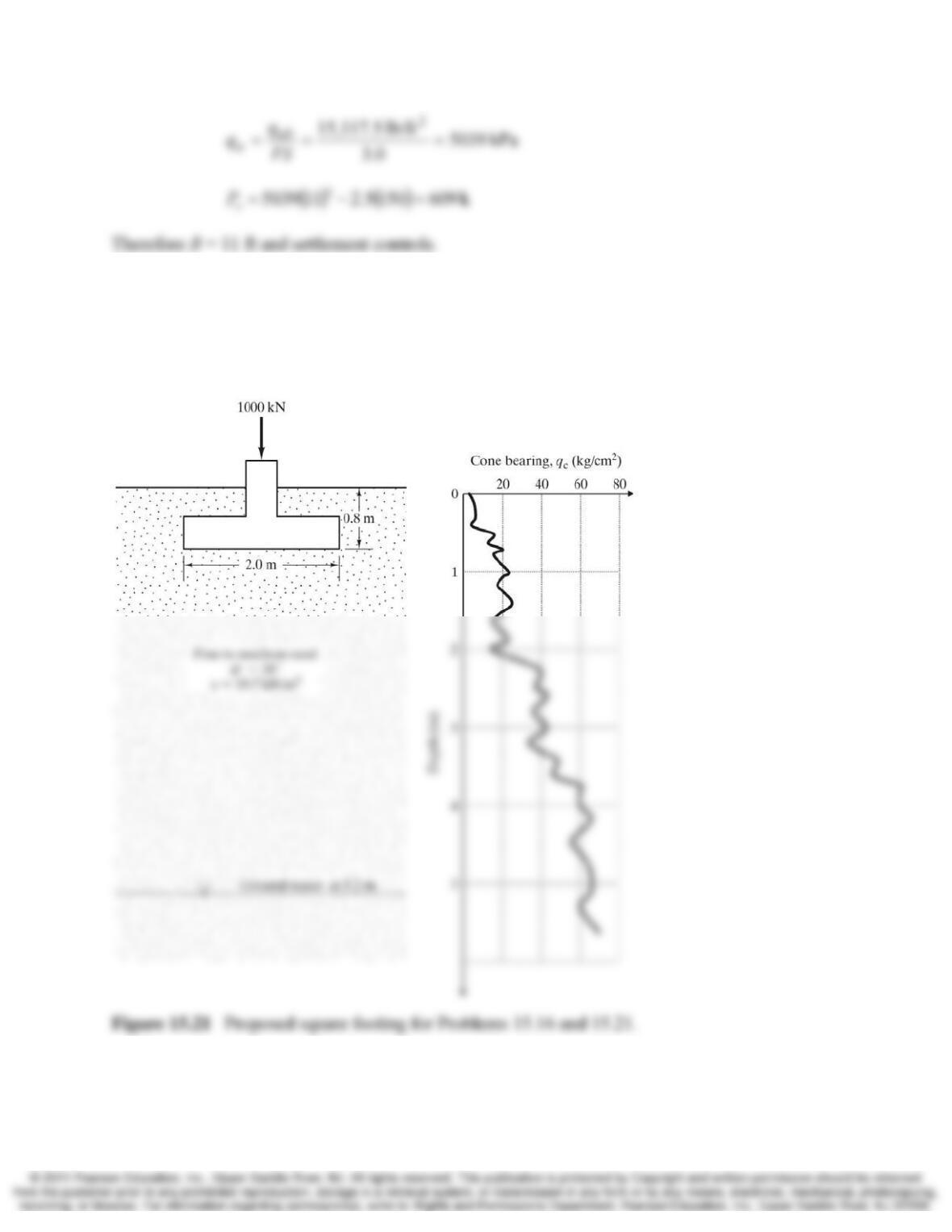
15.20 A 103-k column load is to be supported on a square footing embedded 2.5 ft into the
ground. The underlying soil is a silty clay with Cc/(1+e0) = 0.11, Cr/(1+e0) = 0.03,
σm′ = 5000 lb/ft2, γ = 119 lb/ft3, and su = 2000 lb/ft2. The groundwater table is at a depth
of 40 ft below the ground surface. The factor of safety against a bearing capacity failure
must be at least 3, and the total settlement must not exceed 1 inch. Find the design
footing width, B.
Solution
Settlement
∴
15-16 Spread Footing Design Chap. 15
15.21 A proposed building is to be built on the soil profile shown in Figure 15.21. The column
loads are 1500 kN, and will be supported on a 0.8-m deep square footings. The allowable
total settlement is 25 mm, and the factor of safety against a bearing capacity failure must
be at least 2.0. Determine the design footing width, B. Is the design controlled by
settlement or bearing capacity?
Chap. 15 Spread Footing Design 15-17
Solution
Settlement
Bearing Capacity
15.22 A proposed bent for a bridge will impart a vertical load of 3100 k onto a spread footing
foundation that will be embedded 6 ft into the ground. The underlying soils are dense
well-graded sands with c′ = 0,
φ
′ = 37°, γ = 128 lb/ft3, and N60 = 36. The groundwater
table is at a depth of 12 ft below the ground surface. This footing must have a factor of
safety of at least 2.75 against a bearing capacity failure and a total settlement of no more
than 1.5 inches. Determine the design footing width, B. Is the design controlled by
settlement or bearing capacity?
Solution
Settlement
15-18 Spread Footing Design Chap. 15
15.23 A proposed building is to be supported on a series of spread footing foundations resting
on the underlying sandy clay. These foundations will be embedded to a depth of 500 mm
below the ground surface. The column loads are 900 kN. The allowable total settlement
is 25 mm, and the factor of safety against a bearing capacity failure must be at least 3.0.
The sandy clay has the following engineering properties: Cc/(1+e0) = 0.12,
Cr/(1+e0) = 0.03, γ = 19.5 kN/m3, σm′ = 300 kPa, and su = 200 kPa. The groundwater
table is at a depth of 5 m. Determine the design footing width, B. Is the design
controlled by settlement or bearing capacity?
Solution
Settlement
Check Bearing Capacity
This is a case for φ = 0° undrained total stress analysis