15-1
CHAPTER 15
INVESTMENTS
CONTENT ANALYSIS OF EXERCISES AND PROBLEMS
Number
Content
Time Range
(minutes)
E15-1
Trading Securities. (Easy) Journal entries. Unrealized holding
gain. Balance sheet disclosure.
10-15
E15-5
Available-for-Sale Securities. (Easy) Journal entries. Balance
sheet disclosure.
15-20
E15-6
Held-to-Maturity Bond Investment. (Easy) Premium, straight-line
amortization, journal entries. Error in recording interest at
acquisition.
10-15
E15-10
Bond Investment. (Moderate) Premium, semiannual interest
receipts, amortization schedule using effective interest method,
journal entries.
10-20
15-2
Number
Content
Time Range
(minutes)
E15-13
Impairment of Investment in Bonds. (Moderate) Journal entries
for impairment. IFRS differences.
15-25
E15-14
Equity Method. (Easy) Stock investment. No goodwill. Journal
entries, balance sheet presentation.
10-20
E15-18
Stock Dividends. (Easy) Journal entries for stock acquisition,
stock dividend, and sale of a 1% interest.
5-15
E15-19
Life Insurance Policies. (Easy) Journal entries to record
purchase, premium payments, change in cash surrender value.
10-15
P15-2
Trading Securities. (Moderate) Journal entries. Income
statement and balance sheet disclosures.
15-20
P15-3
Available-for-Sale Securities. (Moderate) Journal entries.
Income statement and balance sheet disclosures (current and
noncurrent). Effect of including unrealized holding gains and
losses in income.
20-30
15-3
Number
Content
Time Range
(minutes)
P15-7
Investments in Available-for-Sale Bonds and Equity Securities.
(Challenging) Fair value method. Record various transactions.
Income/loss determination. Determine carrying value of
Temporary Investment account.
30-45
P15-11
Bond Investment. (Moderate) Between interest dates.
Discount. Straight-line method. Journal entries to record
purchase, interest, retirement. Error in recording interest at
acquisition.
20-30
P15-12
Bond Investment. (Challenging) Premium. Straight-line
method, effective interest method. Amortization schedules.
Journal entries.
30-45
P15-13
Bond Investment. (Challenging) Discount. Effective interest
method. Partial sale. Journal entries.
30-40
P15-17
Equity Method. (Moderate) Stock investments. Journal entries
to record purchase, income, dividends, sale.
30-40
P15-18
Change from Fair Value to Equity Method. (Challenging)
Change from 10% to 40% ownership. Calculate dividend
25-40
Number
Content
Time Range
(minutes)
P15-20
(Appendix). Derivatives. (Moderate) Loan and derivative
20-45
ANSWERS TO QUESTIONS
Q15-1 Companies purchase securities of other corporations for a number of different
Q15-3 (a) A debt security represents a creditor relationship with another company.
Q15-4 When an investor owns between 20% and 50% of the voting common stock of the
investee, the investor is presumed to have significant influence over the investee.
Q15-5 To account for an investment in trading securities, the investment is initially recorded
Q15-6 To account for an investment in available-for-sale securities, the investment is initially
recorded at cost. It is subsequently reported at fair value, and the total unrealized
Q15-7 To account for an investment in held-to-maturity debt securities, the investment is
15-5
Q15-8 An investment in available-for-sale securities is reported at fair value, as determined
by the year-end selling prices on a securities exchange, and any changes in
Q15-9 Gains and losses on sales of securities are reported in the income statement. They
are measured as the difference between the selling price and the cost (in the case
Q15-10 Bonds carrying a stated interest rate above the prevailing yield for securities with a
similar amount of risk are purchased at a premium. Premium amortizations result in an
effective interest rate that is lower than the stated rate. Thus, interest revenue is
lower.
Q15-11 Bonds carrying a stated interest rate below the prevailing market rate for securities
with a similar amount of risk are purchased at a discount. Discount amortizations
result in an effective interest rate that is higher than the stated rate. Thus, interest
revenue is higher.
Q15-12 The two methods available to recognize interest revenue and account for premiums
and discounts on investments in held-to-maturity bonds are the straight-line and
Q15-13 (a) When an investment in a debt security is transferred from the “held to maturity”
(b) When an investment in a debt security is transferred from the “available for sale”
Q15-14 Current asset
Temporary investment (at cost) $XXXX
Q15-15 IFRS allow the reversal of an impairment loss. The reversal of this impairment loss is
Q15-16 When an investor corporation owns a sufficiently large percentage of common stock,
it is able to exert significant influence over the operating and financial policies of the
investee corporation. In particular, the investor may be able to influence the
Q15-17 When the equity method is used, an investment in common stock is initially recorded
at its acquisition cost. However, in contrast to the fair value method, income is
recorded by the investor as an increase to the Investment account and as
investment income (based on the investor‘s percentage ownership) when it is
Q15-18 The facts and circumstances that preclude an investor who owns more than a 20%
investment of an investee from using the equity method include: (1) the investee
challenges the investor’s ability to exercise significant influence through litigation or
Q15-19 (a) When an investor acquires enough additional common stock during a year to
change from the fair value method to the equity method, the investor is required to

15-7
Q15-19 (continued)
(b) When an investor using the equity method sells a portion of the investment such
Q15-20 Under IFRS, Morgan and Parker could account for the joint venture arrangement
using either the equity method or proportionate consolidation. Under the equity
method, Morgan and Parker would report their investment in the associate (equity
Q15-21 Many insurance policies allow a portion of accumulated premiums to build up as a
savings plan; and, if the policy is canceled, this savings plan, or cash surrender value
of the policy, is returned to the company purchasing the life insurance policy. When
Q15-22 A fund involves setting aside cash and other assets to accomplish specific objectives;
whereas, an appropriation of retained earnings only reduces retained earnings
ANSWERS TO MULTIPLE CHOICE
SOLUTIONS TO REVIEW EXERCISES
RE15-1
RE15-2
Interest:
RE15-3
Unrealized Increase/Decrease in Value of
RE15-4
Cash 6,400
RE15-5
RE15-6
RE15-7
Investment in Trading Securities 12,500
RE15-8
RE15-9
Investment in Stock: Eagle Corporation
Investment in Stock: Eagle Corporation 14,400
RE15-10
Note: No journal entry is required, only a memorandum entry is made for a
15-10
RE15-11
Cash (750 x $28) 21,000
RE15-12
Prepaid Insurance 12,000
SOLUTIONS TO EXERCISES
E15-1
1. 2010
Dec. 10 Investment in Trading Securities 38,000
Cash (500 x $76) 38,000
Cumulative
12/31/10 Change in
*Security Cost Fair Value Fair Value
500 shares of C Company common stock $38,000 $39,500 $1,500
E15-2
1. 2010
Oct. 26 Investment in Trading Securities 10,500
Cash (300 x $35) 10,500
E15-2 (continued)
1. (continued)
Cumulative
12/31/10 Change in
*Security Cost Fair Value Fair Value
300 shares of F Company common stock $10,500 $11,400 $ 900
E15-3
2010
During Investment in Available-for-Sale
the Securities 16,200
Cumulative
12/31/10 Change in
*Security Cost Fair Value Fair Value
X Company common stock $15,000 $14,000 $(1,000)
E15-3 (continued)
Noncurrent assets:
E15-4
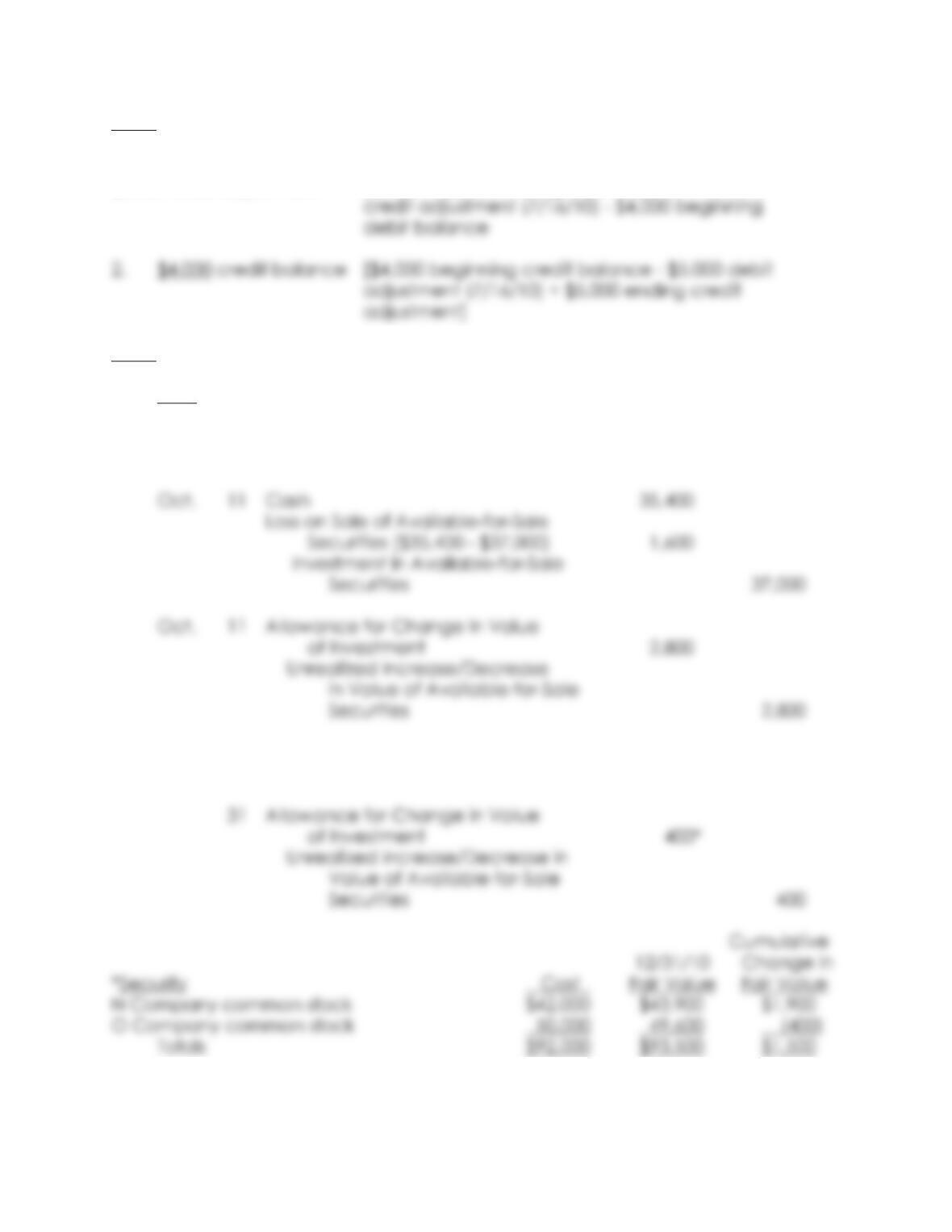
1. 2010
May 3 Investment in Available-for-Sale
Securities 13,500
Cash 13,500
Dec. 31 Cash 800
Dividend Revenue 800
15-14
E15-4 (continued)
1. (continued)
$5,000 debit adjustment = $4,000 required ending debit balance + $5,000
E15-5
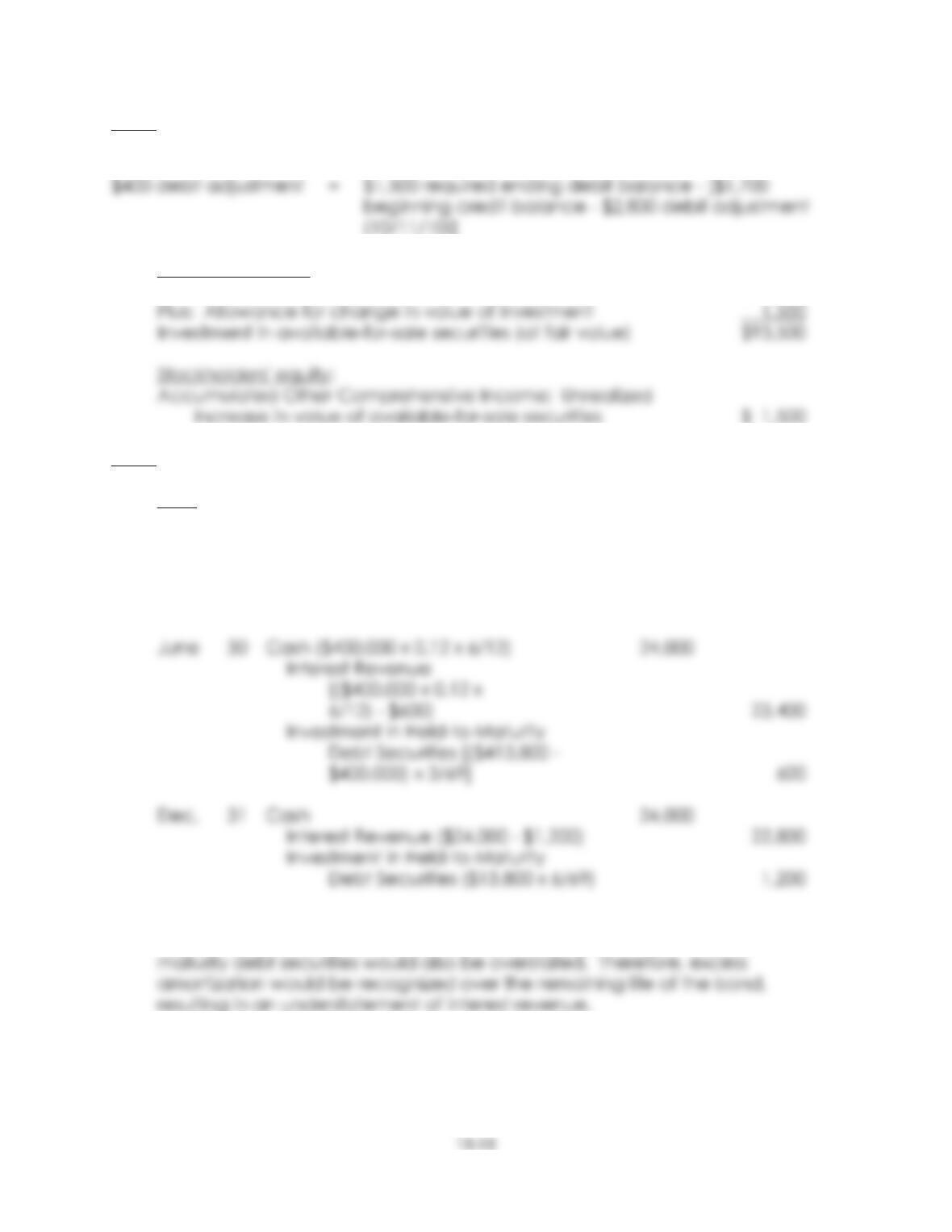
1. 2010
June 8 Investment in Available-for-Sale
Securities 50,000
Cash 50,000
Dec. 31 Cash 900
Dividend Revenue 900
E15-5 (continued)
1. (continued)
2. Noncurrent assets:
Investment in available-for-sale securities (at cost) $92,000
E15-6
1. 2010
Mar. 31 Investment in Held-to-Maturity
Debt Securities 413,800
Interest Revenue
($400,000 x 0.12 x 3/12) 12,000
Cash 425,800
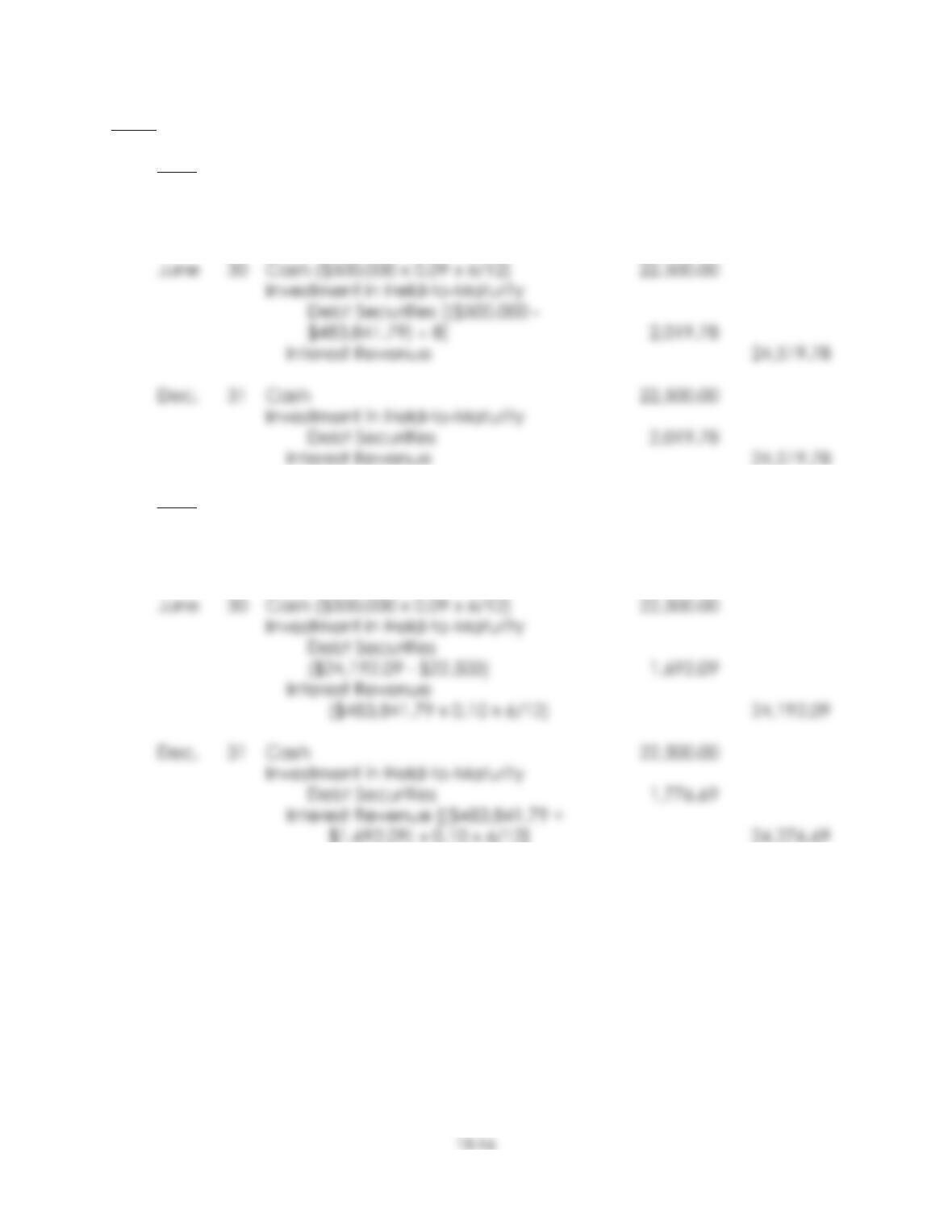
2. If the company failed to separately record the interest at acquisition, the
interest revenue for 2010 would be overstated and the value of the held-to-
E15-7
1. 2010
Jan. 1 Investment in Held-to-Maturity
Debt Securities 483,841.79
Cash 483,841.79
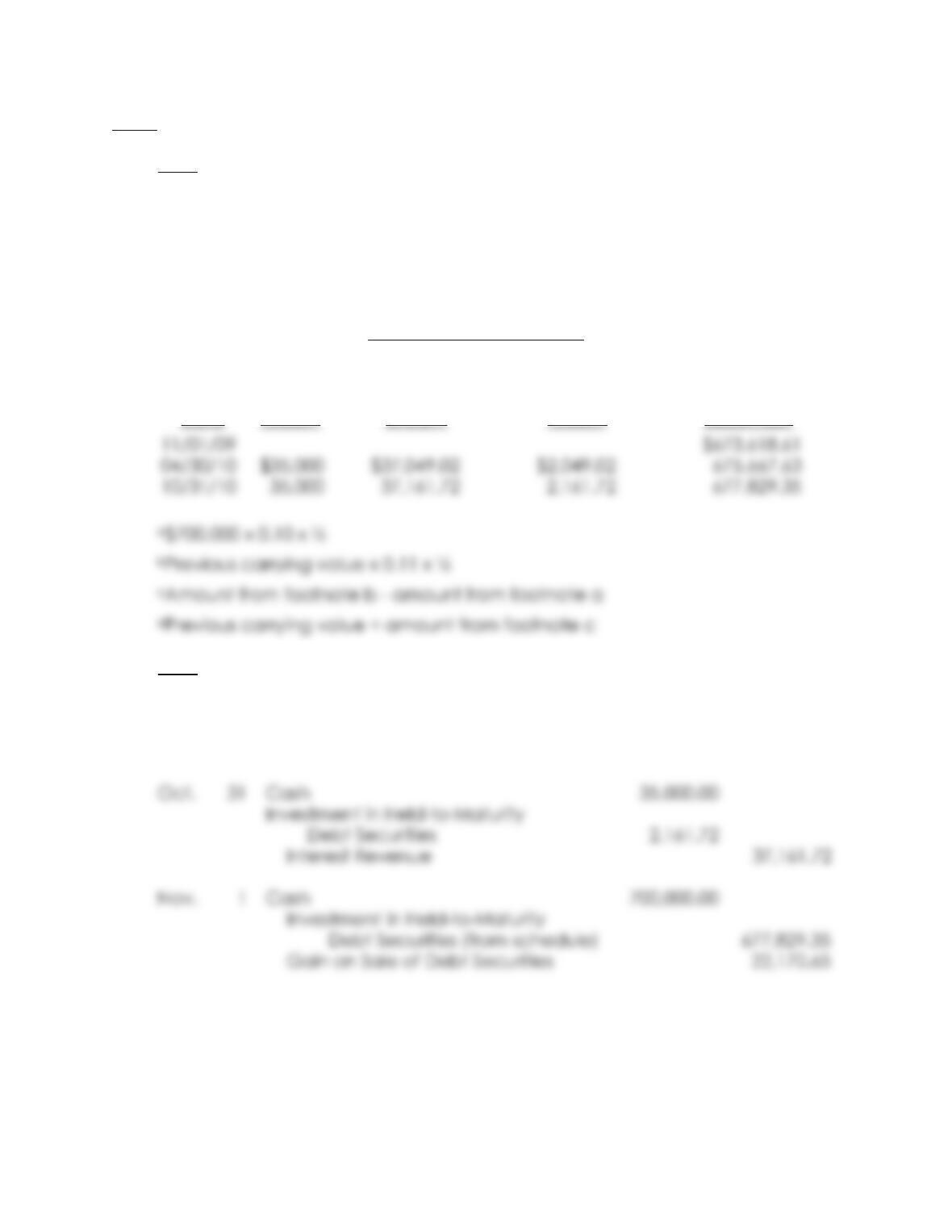
2. 2010
Jan. 1 Investment in Held-to-Maturity
Debt Securities 483,841.79
Cash 483,841.79
15-17
E15-8
2009
Nov. 1 Investment in Held-to-Maturity
Debt Securities 673,618.61
Cash 673,618.61
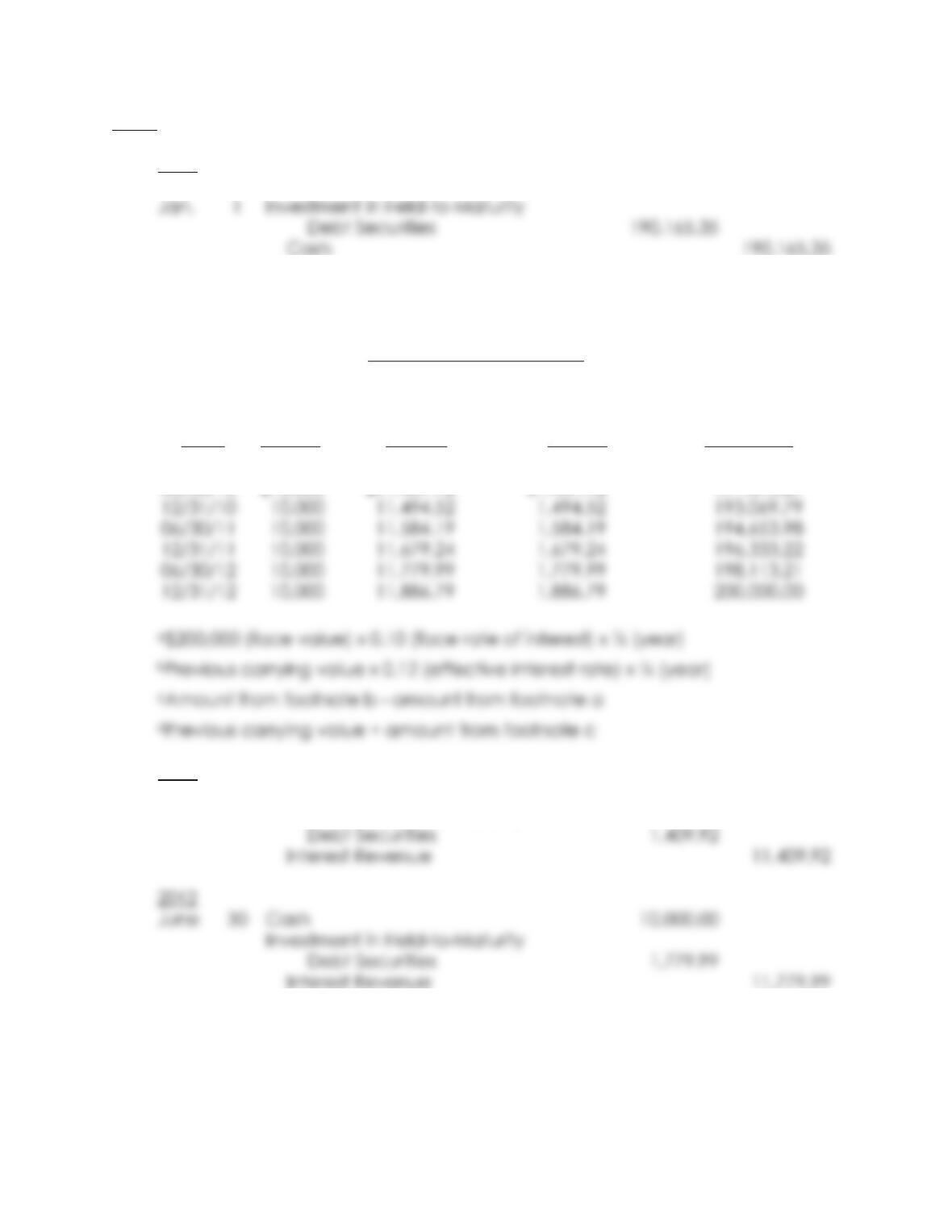
REID CORPORATION
Bond Investment Interest Revenue
and Discount Amortization Schedule (Partial)
Effective Interest Method
Date
Cash
Debita
Interest Revenue
Creditb
Investment in
Debt Securities
Debitc
Carrying Value
of Debt
Securitiesd
2010
Apr. 30 Cash 35,000.00
Investment in Held-to-Maturity
Debt Securities 2,049.02
Interest Revenue 37,049.02
15-18
E15-9
1. 2010
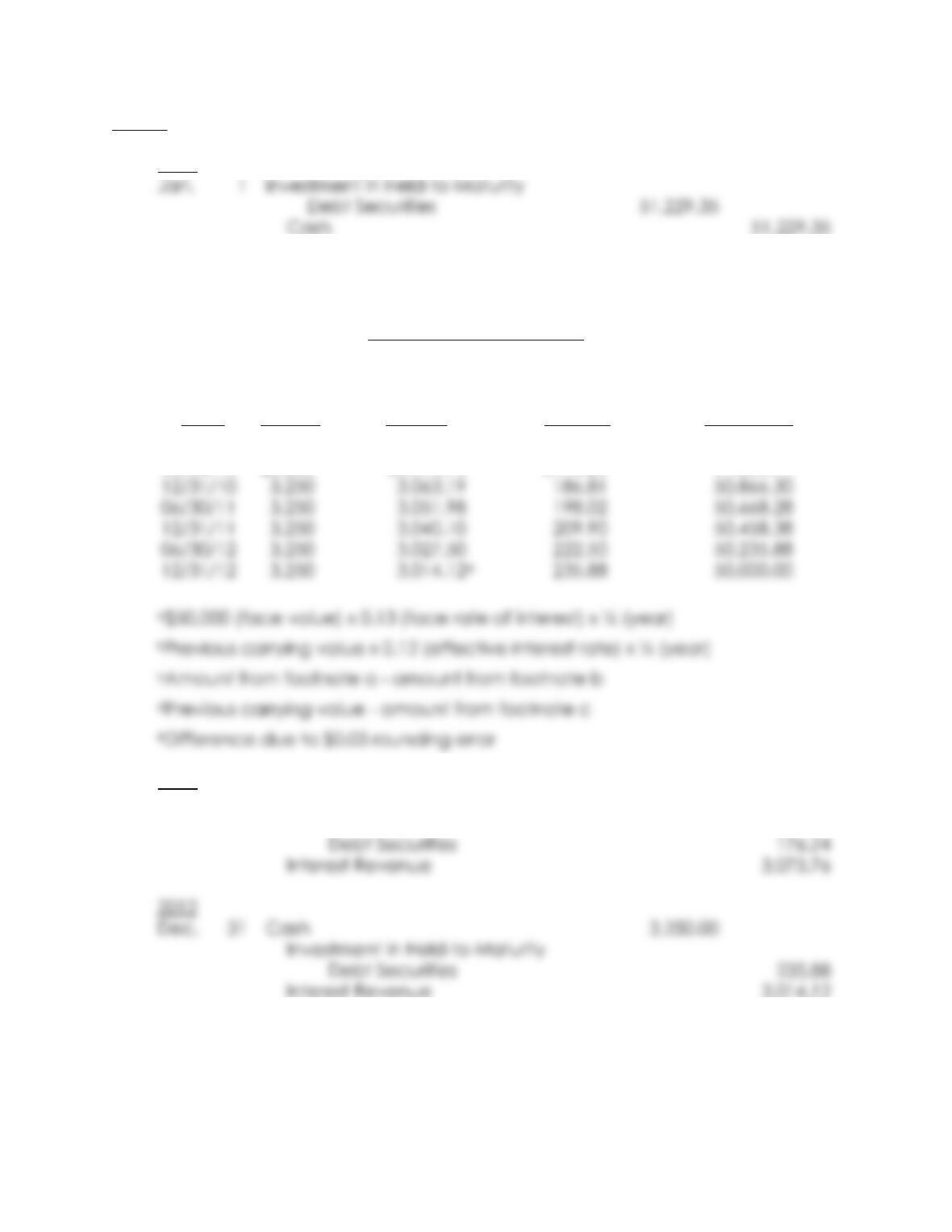
2. RODGERS COMPANY
Bond Investment Interest Revenue
and Discount Amortization Schedule
Effective Interest Method
Date
Cash
Debita
Interest Revenue
Creditb
Investment in
Debt Securities
Debitc
Carrying Value
of Debt
Securitiesd
01/01/10
06/30/10
$10,000
$11,409.92
$1,409.92
$190,165.35
191,575.27
3. 2010
June 30 Cash 10,000.00
Investment in Held-to-Maturity
15-19
E15-10
1. 2010
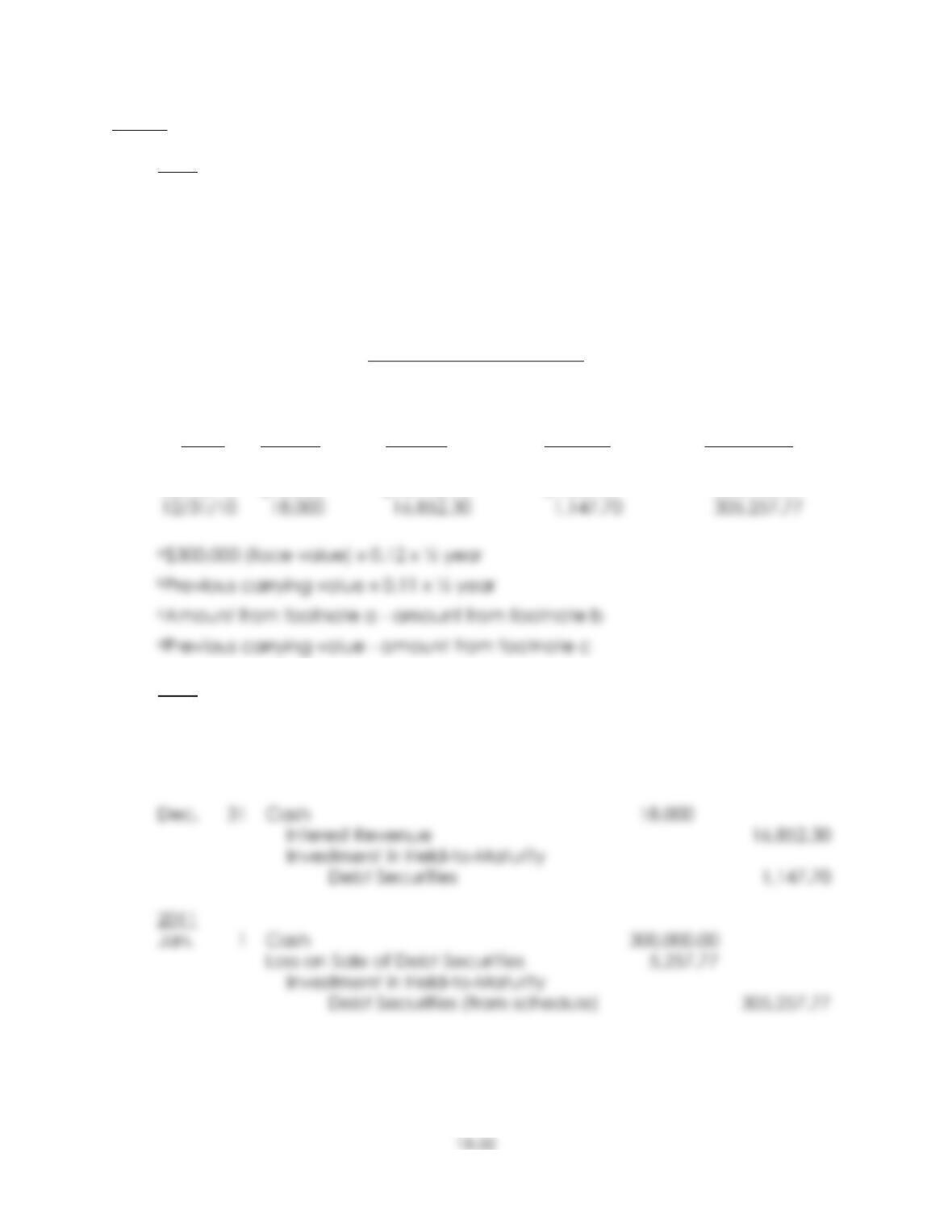
2. LYNCH COMPANY
Bond Investment Interest Revenue
and Premium Amortization Schedule
Effective Interest Method
Date
Cash
Debita
Interest Revenue
Creditb
Investment in
Debt Securities
Creditc
Carrying Value
of Debt
Securitiesd
01/01/10
06/30/10
$3,250
$3,073.76
$176.24
$51,229.35
51,053.11
3. 2010
June 30 Cash 3,250.00
Investment in Held-to-Maturity
E15-11
2010
Jan. 1 Investment in Held-to-Maturity
Debt Securities 307,493.34
Cash 307,493.34
GLOVER CORPORATION
Bond Investment Interest Revenue
and Premium Amortization Schedule (Partial)
Effective Interest Method
Date
Cash
Debita
Interest Revenue
Creditb
Investment in
Debt Securities
Creditc
Carrying Value
of Debt
Securitiesd
01/01/10
06/30/10
$18,000
$16,912.13
$1,087.87
$307,493.34
306,405.47
2010
June 30 Cash 18,000
Interest Revenue 16,912.13
Investment in Held-to-Maturity
Debt Securities 1,087.87