CHAPTER 15
Pricing
CHAPTER SUMMARY AND TEACHING OBJECTIVES
Pricing is an extremely important part of business strategy, yet too few firms know anything about
pricing. Why? In this chapter various pricing strategies are discussed. How price can be customized or
personalized to ensure the customer is satisfied and the business increases profit are also explored.
The most important aspect of this material is that students understand that every pricing strategy is
essentially MR = MC.
IMPORTANT TERMS
Consumer surplus it is the difference between what a consumer is willing to pay (seen by the demand
curve) and what they must pay (the market price)
personalized pricing each customer pays a different price
second or third degree price discrimination the different “degrees” of price discrimination refer to
how the customers are segregated or divided; they are cases different from perfect discrimination
wherein each customer pays a different price
price discrimination each customer pays a different price based on that customer’s price elasticity of
demand
product line extension changing a characteristic on a product and offering that product at a different
price
peak load pricing price varies according to demand
cost plus pricing price is set as average cost plus a markup
tying selling one product at a discounted price when another product is purchased
cannibalization sales of one product by a firm reduce sales of another of its products
most favored customer, MFC customer receives the lowest price offered by the firm
meet the competition clause, MCC customers receive lowest price offered by any firm
Chapter 15: Pricing 69
TOPICS AND TEACHING SUGGESTIONS
1. What Price?
2. More Complexities
Discuss the issues of bundling and how multiple product firms price each product relative to the
others
Teaching Strategy: Use the local cable company to frame your students reference. Did they buy
the telephone-cable-internet package?
3. Interdependences Among Firms
Discuss the role of the prisoner’s dilemma as part of a pricing strategy. Show how this problem
can extend to other non-price areas of competition.
ANSWERS TO EXERCISES
1. Explain why marginal revenue is less than or equal to price. How does the difference between
price and marginal revenue depend on the price elasticity of demand?
Marginal revenue is the additional revenue that comes from producing and selling an additional
as if demand is more inelastic.
2. Why would a firm not want to price at where marginal revenue is greater than marginal cost?
3. Many supermarkets sell both branded and private label goods. Suppose that a supermarket
estimates that the demand for its private label cola is less elastic than the demand for Coca-Cola.
How should it price its private label cola?
4. An engineer has discovered a way to improve the production of a microchip to reduce its marginal
cost from $1.00 to $.80. Should the firm reduce the selling price of the microchip by $.20?
5. Magazines are sold both through newsstands and subscriptions. Advertising accounts for up to
one-half of the revenues of magazines like Time and Sports Illustrated. How should a publisher
determine the price of subscriptions relative to newsstands?
6. Some personal computer software is sold at special discounts to students. Other software is
provided in a less powerful version for students. Why do publishers offer discounts to students?
What is the purpose of developing less powerful editions?
7. Using the kinked demand model, explain why a decrease in costs might not lead to a change in
8. At one time a major U.S. airline proposed that all airlines adopt a uniform fare schedule based on
mileage. The proposal would eliminate the many different fares that were available at that time.
Most major airlines applauded the suggestion and began to adopt the plan. Soon, however, various
airlines began cutting fares. Explain this using the prisoner’s dilemma.
The prisoner’s dilemma is that the firms do not want to lower fares but each ends up lowering
9. When one airline announced a substantial reduction in domestic airfares, within a day, other airlines
announced similar price cuts. What would you expect the outcome of this “price war” would be?
10. Stargazer Recordings sells compact discs in two markets. The marginal cost of each disc is $2.
Demand in each market is given by Q1 = 40 – 10P1 and Q2 = 40 – 2P2 where Q is thousands of
compact discs.
a. If the firm uses price discrimination how much output should it produce and what price should
it charge? What is its profit? What type of price discrimination is it using.
In each market the answer is found by setting MR = MC. The MR is obtained by using the
Chapter 15: Pricing 71
For the second market, the procedure is the same: Rewrite the demand equation
b. If the firm cannot prevent resale of compact discs, what will its profit be?
11. A major airline estimates that the demand and marginal revenue functions for first class and
excursion fares from New York to Paris are:
First Class: P = 4,200 – 2Q MR = 4,200 – 4Q
Excursion: P = 2,200 – .25Q MR = 2,200 – .5Q
If the marginal cost of production is $200 per passenger, what fare and what number of passengers
will maximize profit? Show that profit is greater than if the airline used a single or uniform price.
12. Explain what peak-load pricing is. What is its intended purpose?
13. Explain and demonstrate why cost–plus pricing is probably not the same as profit-maximizing pricing.
Cost-plus pricing is a process whereby the per-unit cost of a product is estimated and then a
14. What is framing? How could you alter the price elasticity of demand by framing?
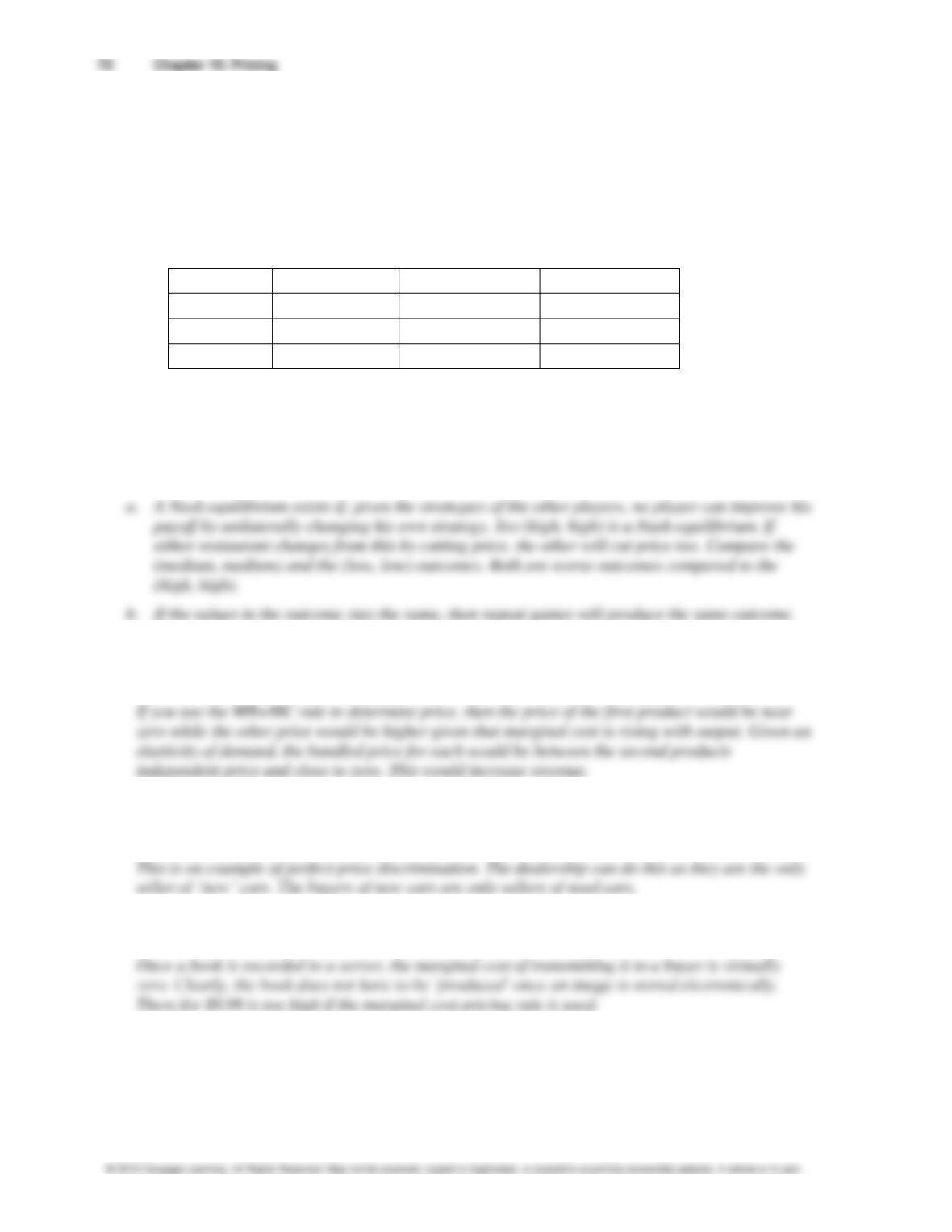
15. Two pizza shops have just opened on campus: Giuseppe’s Pizza and Capri’s Pizza. The “pricing
game” these competitors fact can be described in simple terms as follows: Each of them has to
choose a price (high, medium, or low) for its “double cheese pizza,” and the profitability of each
choice depends on the price that the rival chooses. The situation is depicted in the accompanying
table, where Giuseppe’s Pizza is the row player and Capri’s pizza the column player. Profits are
expressed in hundreds of dollars.
Capri’s Pizza
High
Medium
low
High
60,60
36,70
36,35
Medium
70,36
50,50
30,35
low
35,36
35,30
25,25
a. What is the Nash equilibrium (or equilibria) of the game? Is (high,high) a Nash equillbrium?
Explain.
b. If these players play this game twice, what would be your prediction? What if they play it over
and over again? Explain.
16. A firm offers two products for sale. The marginal cost of one product is new zero once the first
unit has been produced. The marginal cost of the other product rises as output rises. What would
be the effect of bundling the two products? What price would the firm charge for the bundle?
17. A car dealership typically determines a distinct price for a car for each customer. This is an
example of what type of price discrimination? Why is the dealership able to carry out this type of
price discrimination?
18. Amazon.com and Apple have recently agreed to sell ebooks for $9.99. Do you think this price
reflects marginal cost? Is it too high or too low? Explain.