
Requirements
1. Compute the following ratios for 2016 and 2015:
a. Current ratio
b. Cash ratio
c. Times-interest-earned ratio
d. Inventory turnover
e. Gross profit percentage
f. Debt to equity ratio
g. Rate of return on common stockholders’ equity
h. Earnings per share of common stock
i. Price/earnings ratio
2. Decide (a) whether Canfield’s ability to pay debts and to sell inventory improved or deteriorated
during 2016 and (b) whether the investment attractiveness of its common stock appears to have
increased or decreased.
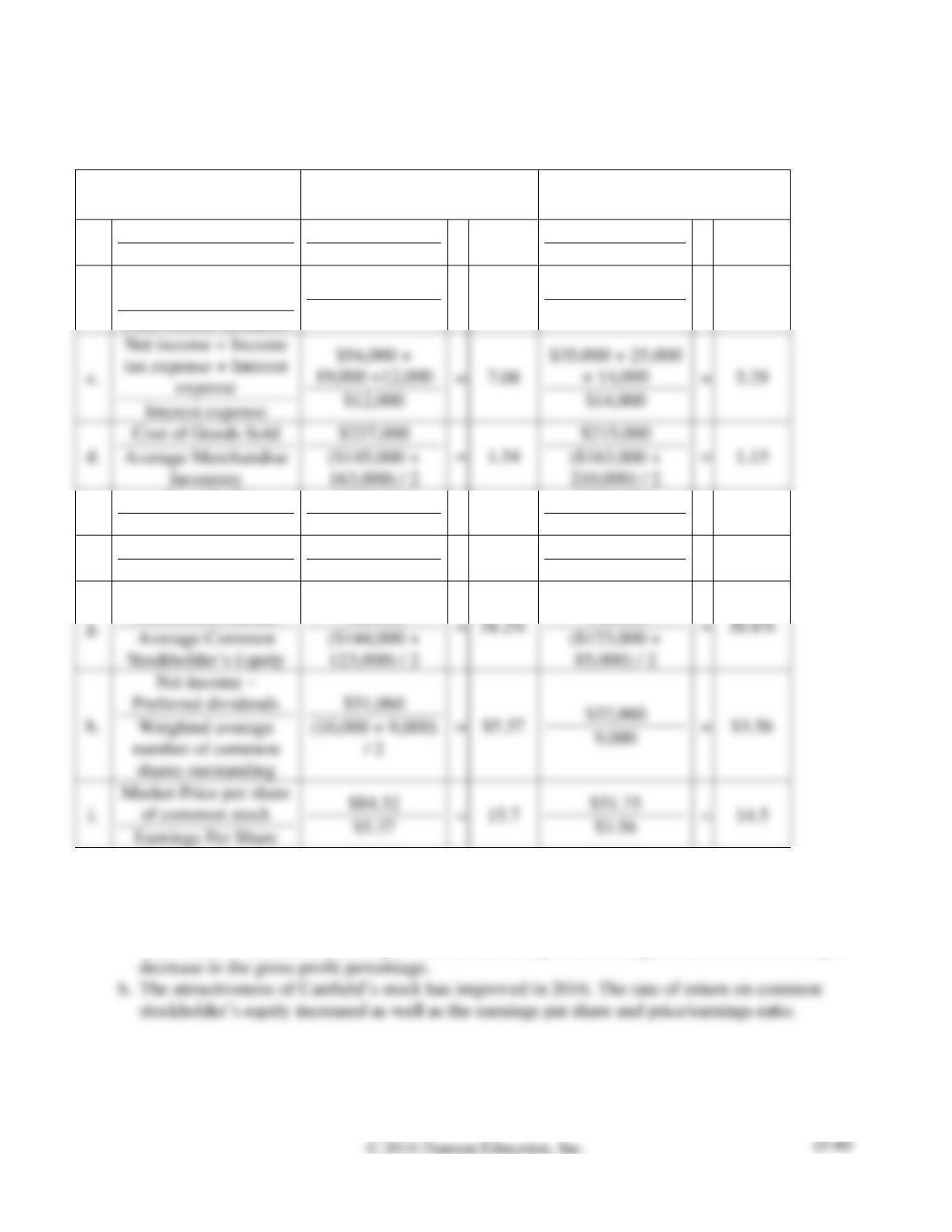
SOLUTION
Requirement 1
2016
2015
a.
Total current assets
Total current liabilities
$366,000
$223,000
=
1.64
$382,000
$246,000
=
1.55
b.
Cash + Cash
equivalents
Total current liabilities
$99,000 + 0
$223,000
=
.44
$96,000 + 0
$246,000
=
.39
e.
Gross Profit
Net Sales
$222,000
$459,000
=
48.4%
$209,000
$424,000
=
49.3%
f.
Total Liabilities
Total Equity
$343,000
$242,000
=
1.42
$341,000
$221,000
=
1.54
Net income –
Preferred dividends
$54,000 – (3% ×
98,000)
$35,000 – (3% ×
98,000)
Requirement 2
a. Canfield is in a better position to pay debt in 2016 than in 2015. The current ratio, cash ratio, and
times-interest-earned ratio all improved. The inventory turnover improved, but was offset by a
P15-39B Using ratios to decide between two stock investments
Learning Objective 4
1c. Red Zone 36 days
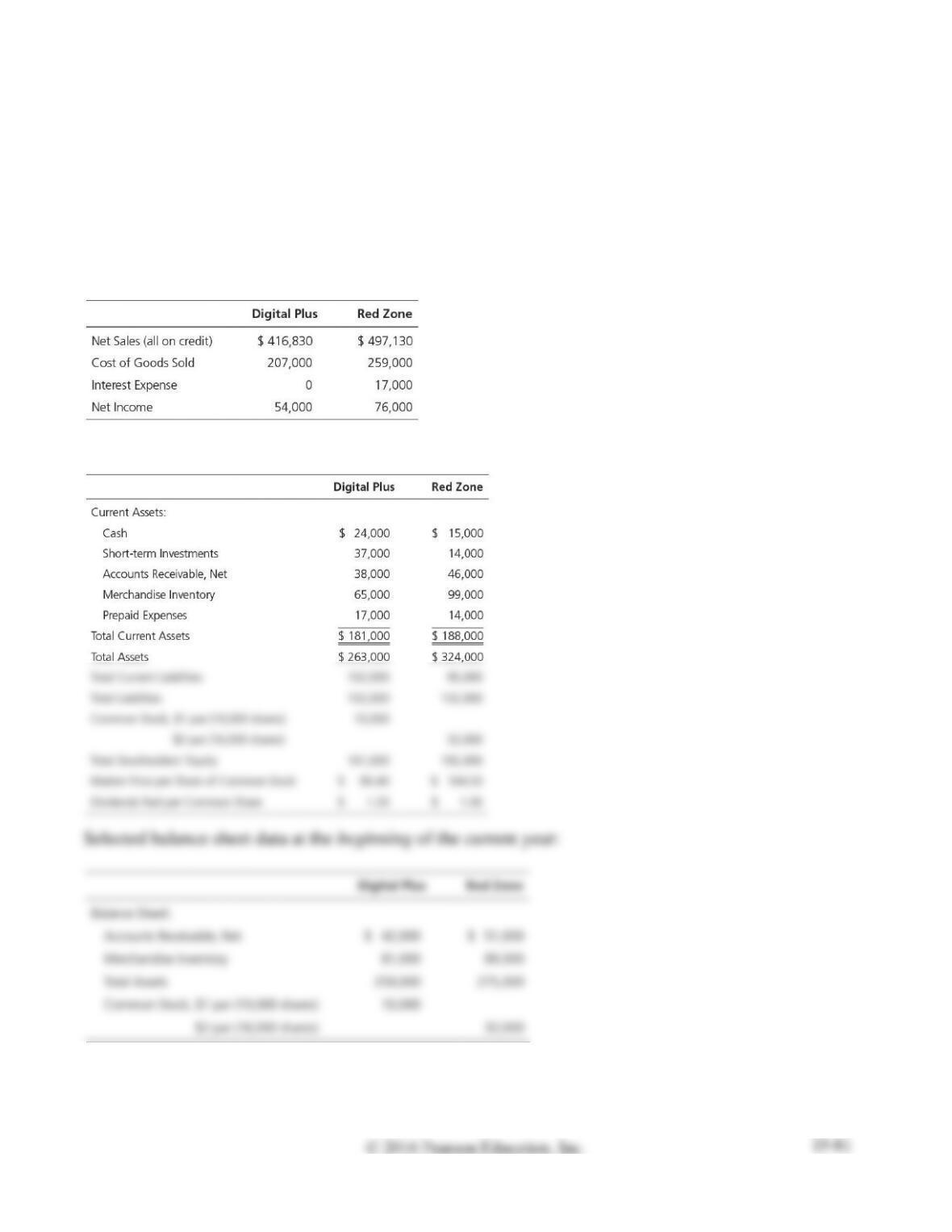
Assume that you are purchasing an investment and have decided to invest in a company in the digital
phone business. You have narrowed the choice to Digital Plus Corp. and Red Zone, Inc. and have
assembled the following data.
Selected income statement data for the current year:
Selected balance sheet and market price data at the end of the current year:
Your strategy is to invest in companies that have low price/earnings ratios but appear to be in good
shape financially. Assume that you have analyzed all other factors and that your decision depends on the
results of ratio analysis.
Requirements
1. Compute the following ratios for both companies for the current year:
a. Acid-test ratio
b. Inventory turnover
c. Days’ sales in receivables
d. Debt ratio
e. Earnings per share of common stock
f. Price/earnings ratio
g. Dividend payout
2. Decide which company’s stock better fits your investment strategy.
SOLUTION
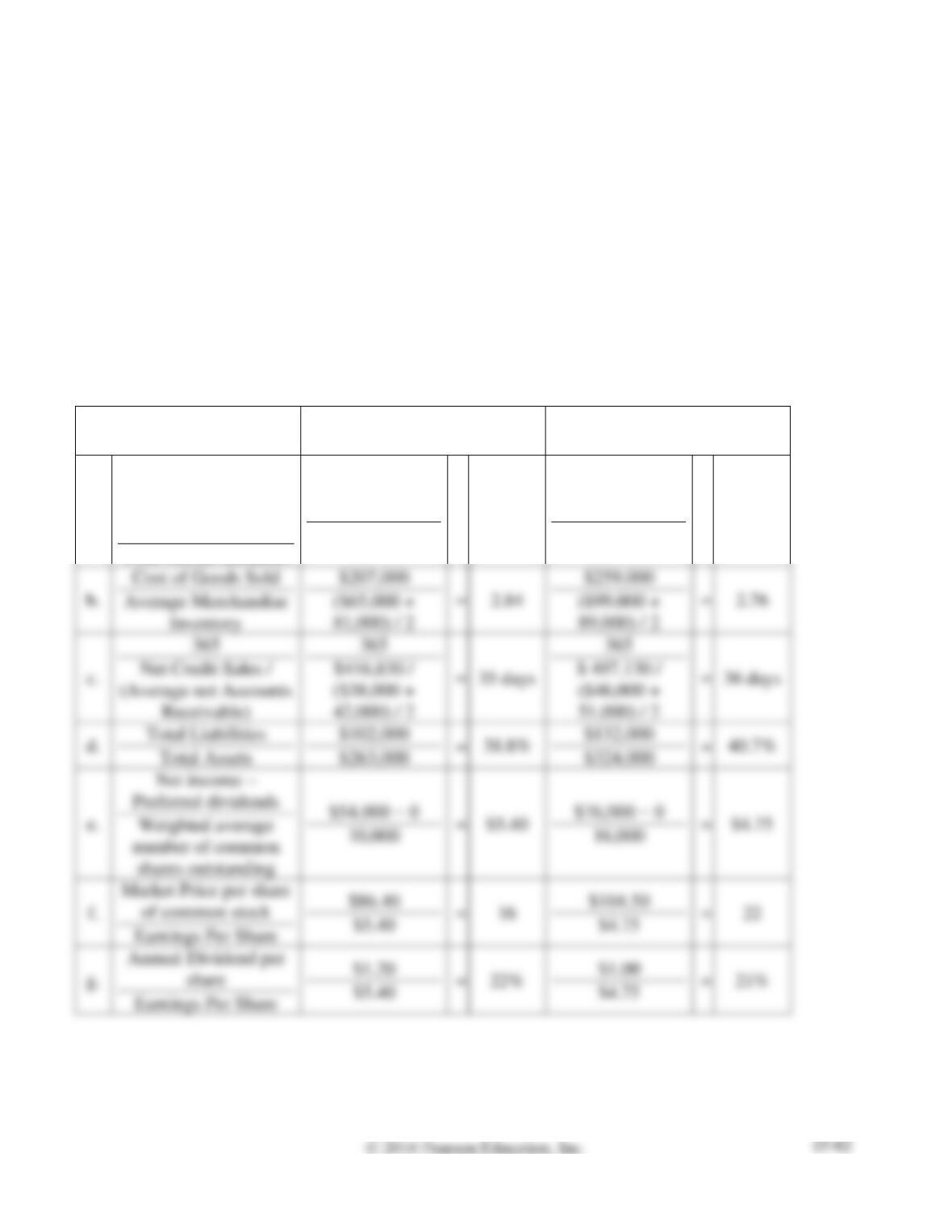
Requirement 1
Digital Plus
Red Zone
a.
Cash + Cash
equivalents + Short-
term Investments +
Accounts Receivable
Total current liabilities
($24,000 + 0 +
37,000 + 38,000)
$102,000
=
.97
($15,000 + 0 +
14,000 + 46,000)
$95,000
=
0.79
e.
=
=
P15-39B, Cont.
Requirement 2
Digital Plus would be the better investment based on the strategy of a low price earnings ratio, with
P15A-40B Preparing an income statement
Learning Objective 5
Appendix 15A
Net Income $149,800
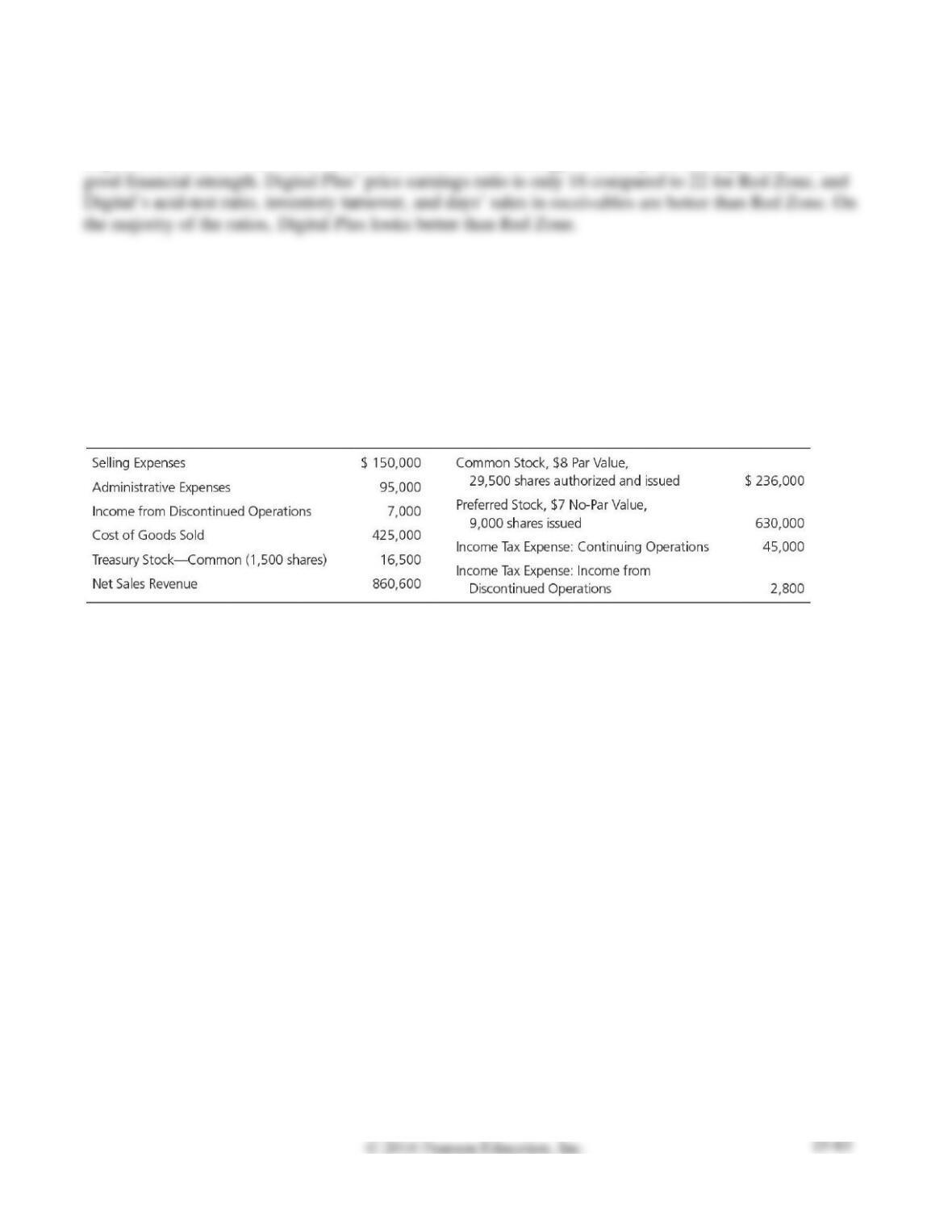
The following information was taken from the records of Shepard Motorsports, Inc. at November 30,
2016:
Prepare a multi-step income statement for Shepard Motorsports for the fiscal year ended November 30,
2016. Include earnings per share.
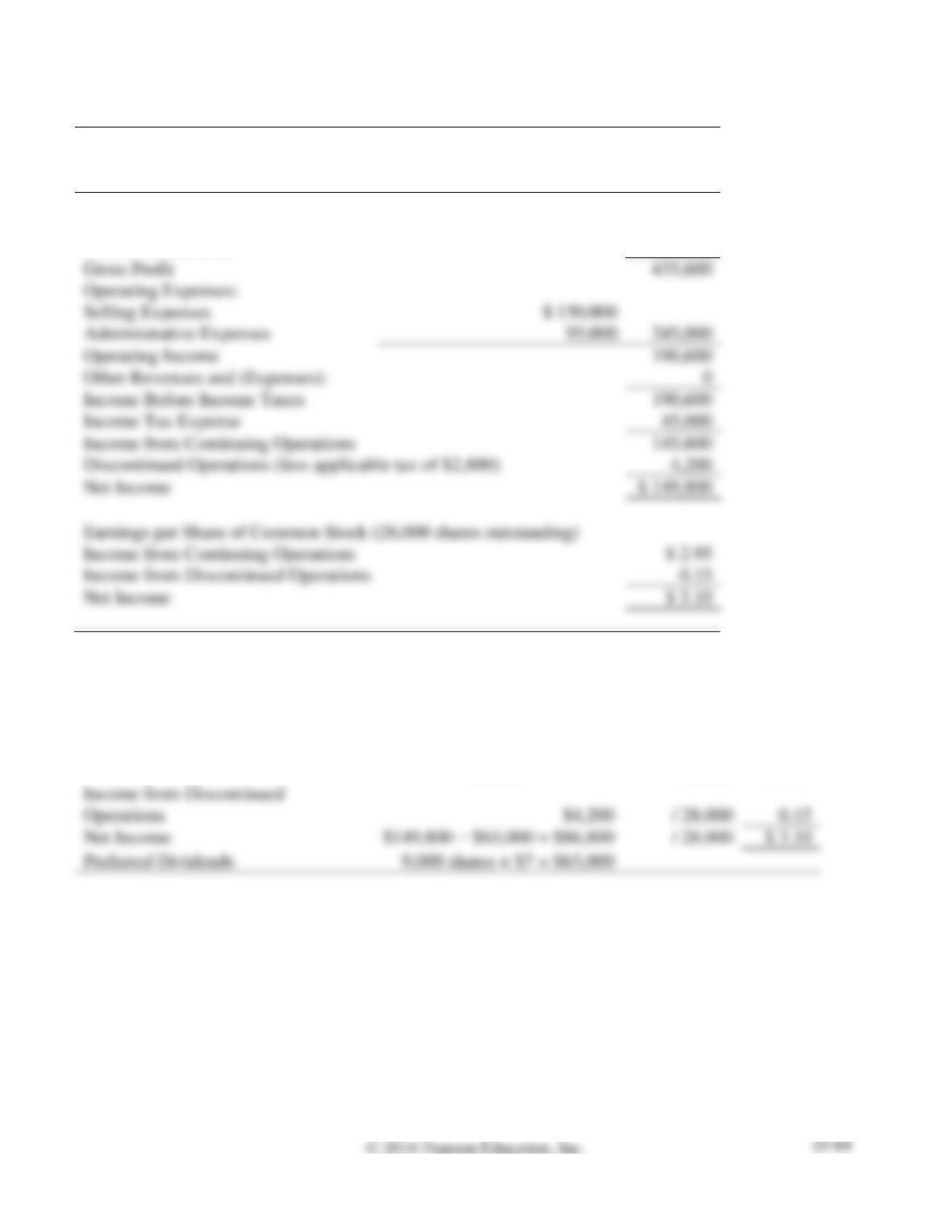
SOLUTION
SHEPARD MOTORSPORTS, INC.
Income Statement
Year Ended November 30, 2016
Net Sales Revenue
$ 860,600
Cost of Goods Sold
425,000
Gross Profit
435,600
Operating Expenses:
Selling Expenses
Administrative Expenses
245,000
Operating Income
190,600
Other Revenues and (Expenses):
Income Before Income Taxes
190,600
Income Tax Expense
Income from Continuing Operations
145,600
Discontinued Operations (less applicable tax of $2,800)
Net Income
$ 149,800
Earnings per Share of Common Stock (28,000 shares outstanding)
Income from Continuing Operations
Income from Discontinued Operations
Net Income
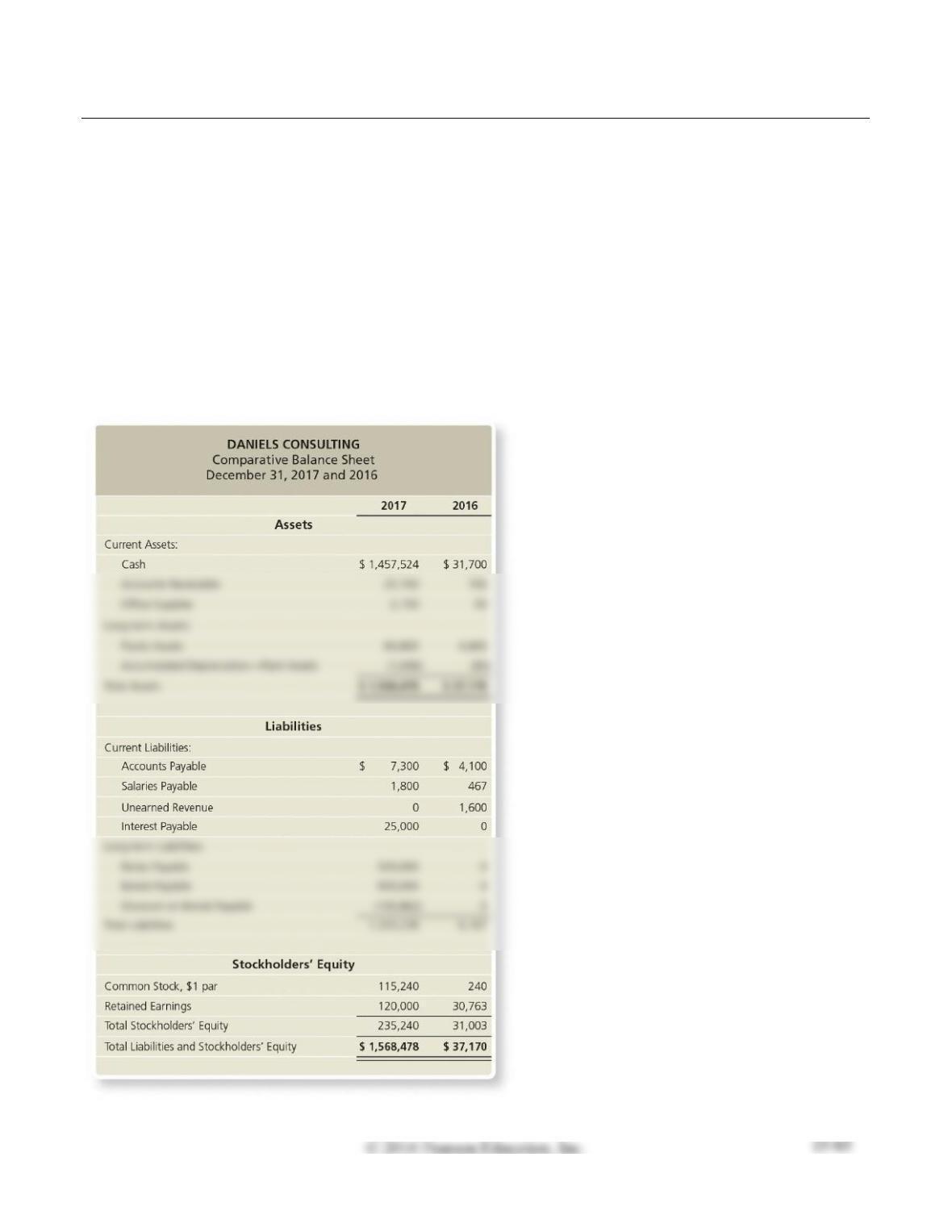
Common
Shares
Outstanding
Earnings per Share of Common Stock
Income from Continuing Operations
$145,600 − $63,000 =
$82,600
/ 28,000
$ 2.95
Income from Discontinued
Operations
/ 28,000
Net Income
/ 28,000
$ 3.10
Preferred Dividends
Continuing Problem
P15-41 Using ratios to evaluate a stock investment
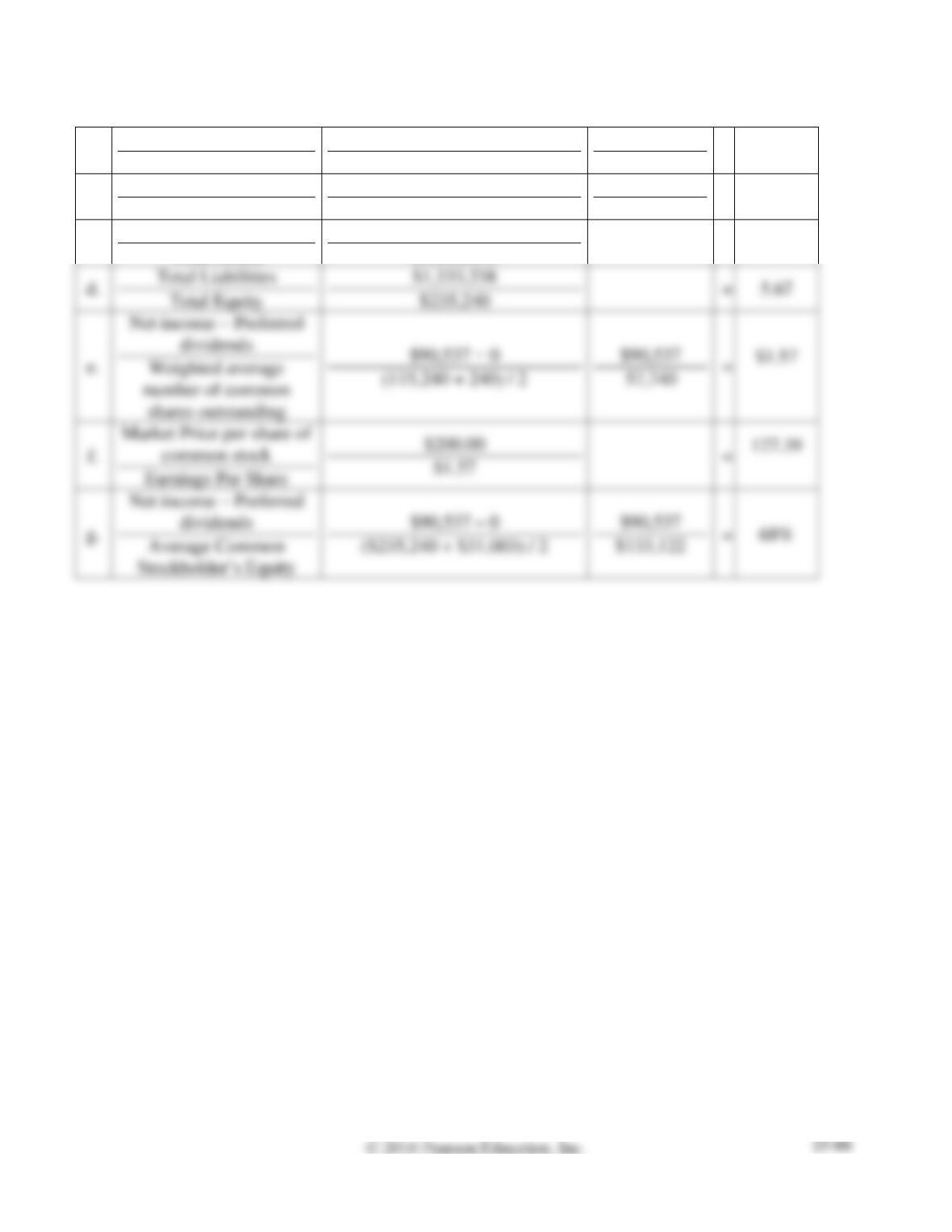
This problem continues the Daniels Consulting situation from Problem P14-46 of Chapter 14. Assuming
Daniels Consulting’s net income for the year was $90,537 and knowing that the current market price of
Daniels’s stock is $200 per share, calculate the following ratios for 2017 for the company:
a. Current ratio
b. Cash ratio
c. Debt ratio
d. Debt to equity ratio
e. Earnings per share
f. Price/earnings ratio
g. Rate of return on common stockholders’ equity
SOLUTION
a.
Total current assets
Total current liabilities
$1,457,524 + $25,700 + $2,150
$7,300 + $1,800 + $25,000
$1,485,374
$34,100
=
43.56
b.
Cash + Cash equivalents
Total current liabilities
$1,457,524 + $0
$7,300 + $1,800 + $25,000
$1,457,524
$34,100
=
42.74
c.
Total Liabilities
Total Assets
$1,333,238
$1,568,478
=
85%
Total Liabilities
Total Equity
$1,333,238
=
5.67
Comprehensive Problem for Chapter 15
Analyzing a company for its investment potential
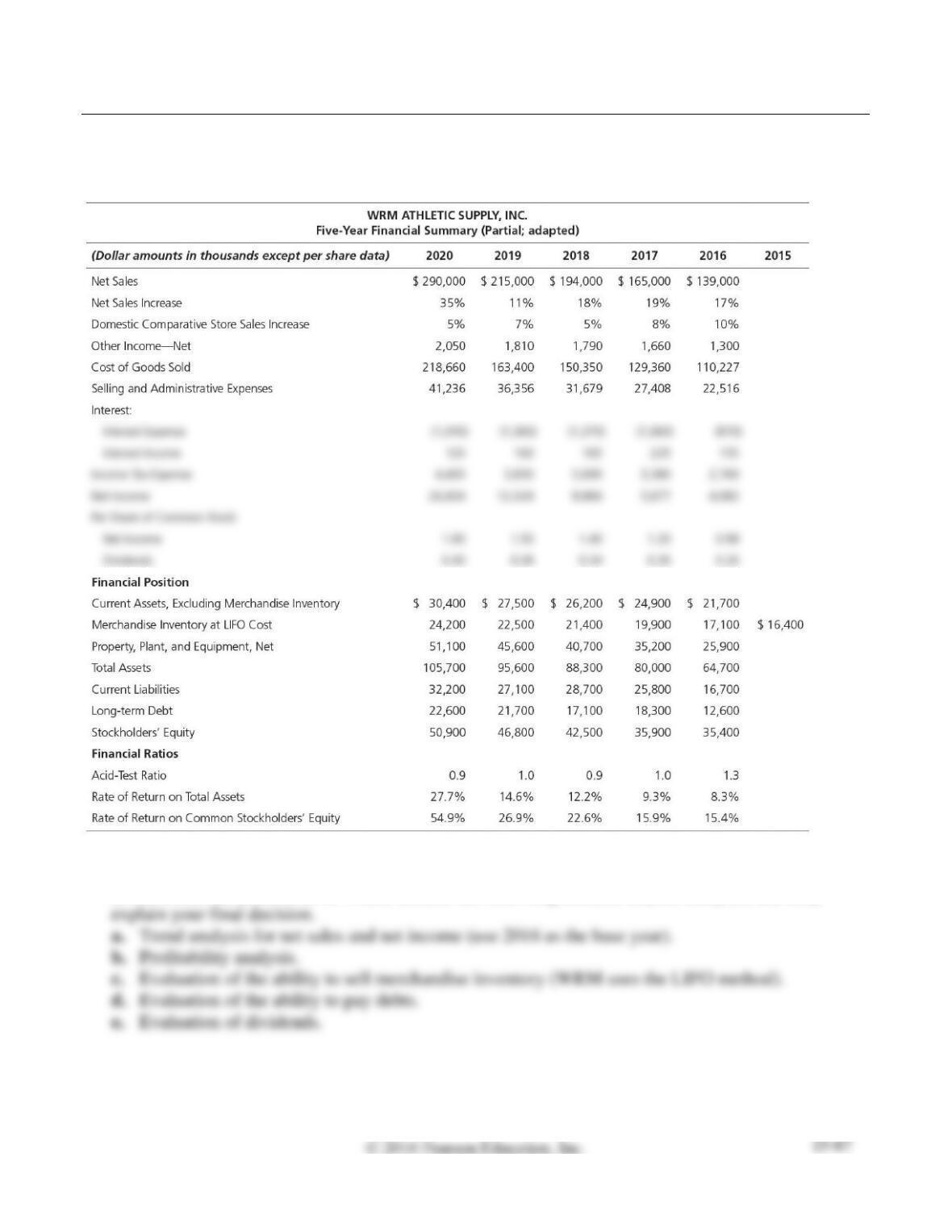
In its annual report, WRM Athletic Supply, Inc. includes the following five-year financial summary:
Requirements
1. Analyze the company’s financial summary for the fiscal years 2016–2020 to decide whether to
invest in the common stock of WRM. Include the following sections in your analysis, and fully
SOLUTION
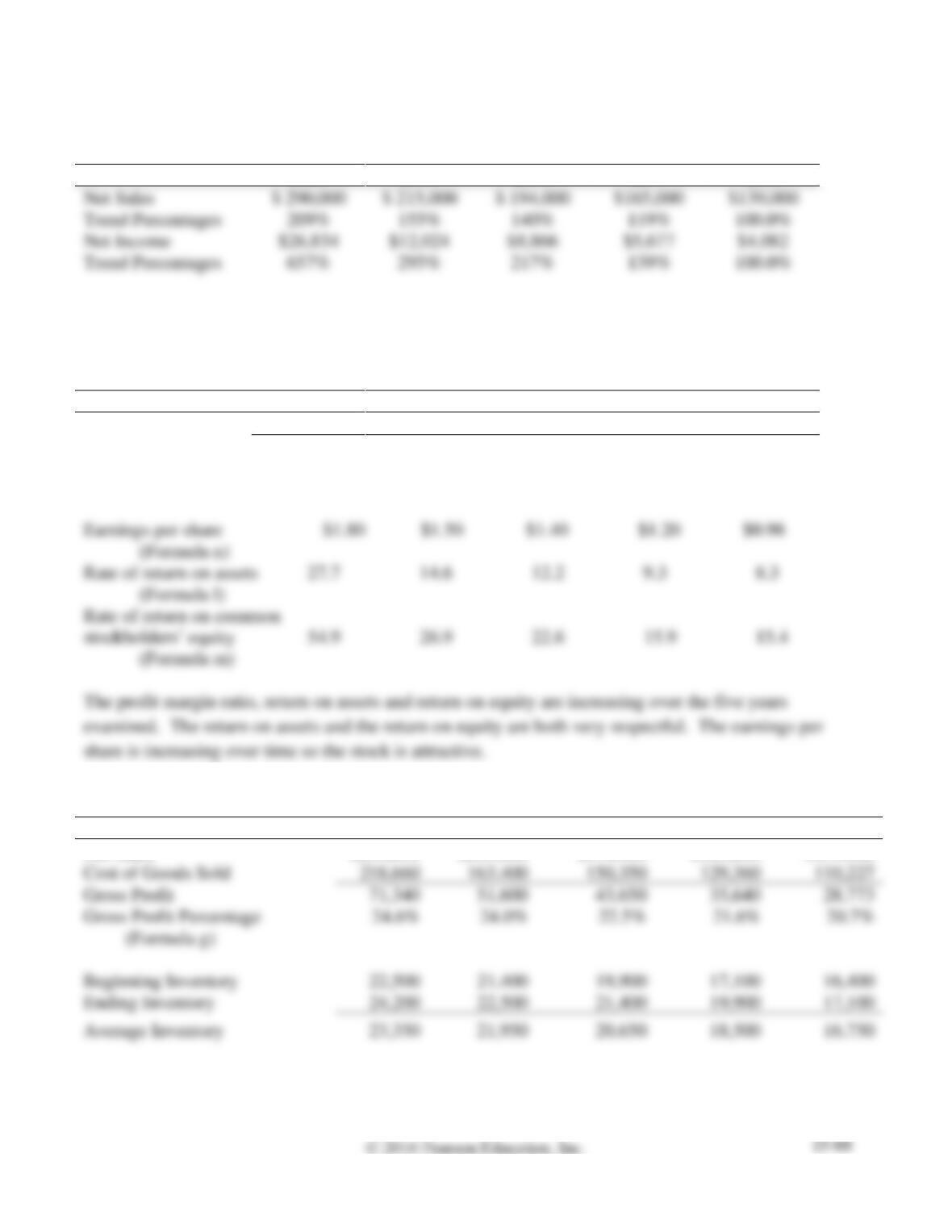
Requirement 1
2020
2019
2018
2017
2016
Net Sales
$ 194,000
$165,000
$139,000
Trend Percentages
209%
155%
140%
119%
100.0%
Net Income
$12,024
$5,677
$4,082
Trend Percentages
657%
295%
217%
139%
100.0%
Trends in net sales and net income are both upward, which is positive.
Requirement 2
2020
2019
2018
2017
2016
Net Income
$ 26,834
$12,024
$ 8,866
$5,677
$4,082
Net Sales
$290,000
$215,000
$194,000
$165,000
$139,000
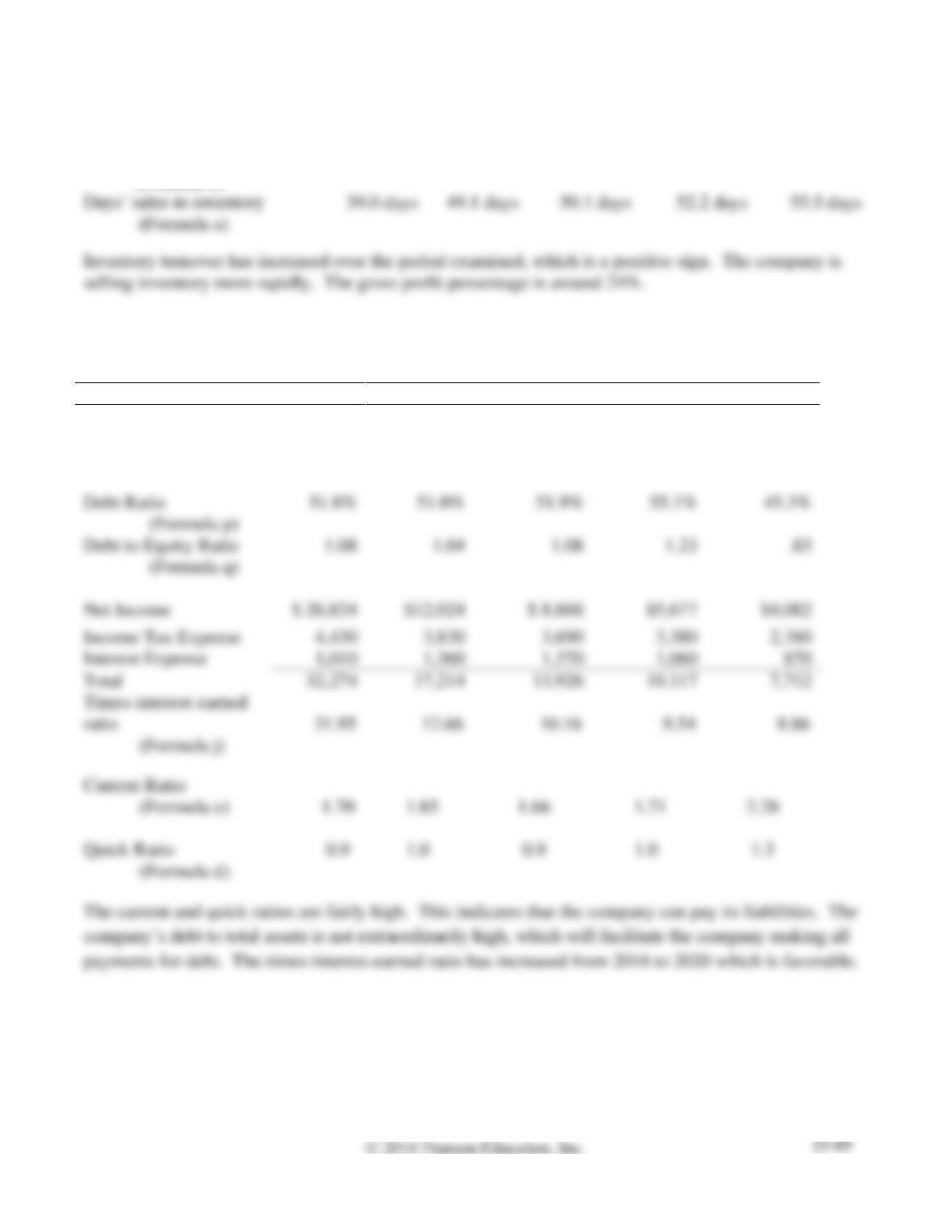
Profit Margin Ratio
9.3%
5.6%
4.6%
3.4%
2.9%
(Formula k)
Earnings per share
$1.80
$1.50
$1.40
$1.20
$0.98
Requirement 3
2020
2019
2018
2017
2016
Net Sales
$290,000
$215,000
$194,000
$165,000
$139,000
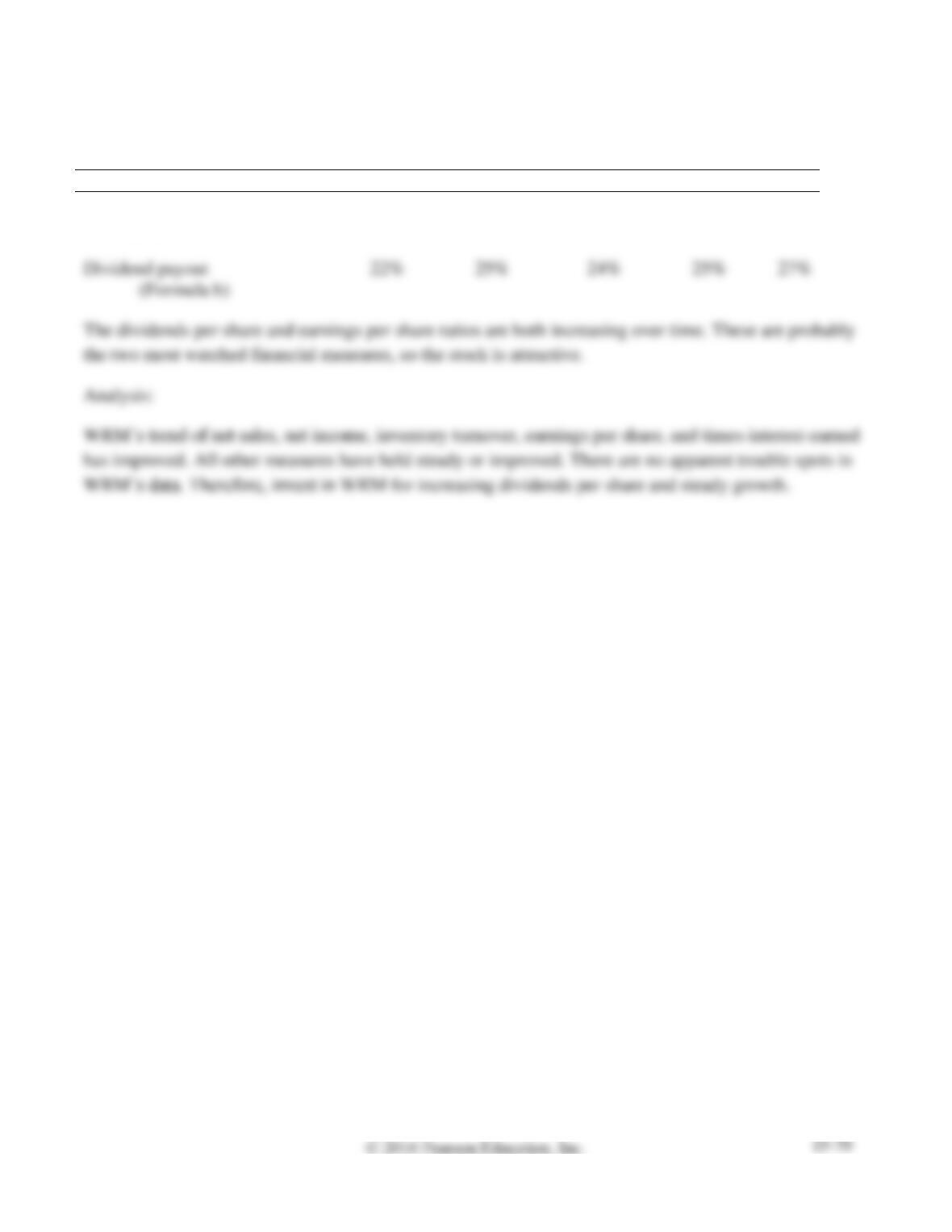
Cost of Goods Sold
218,660
Gross Profit
Gross Profit Percentage
Beginning Inventory
Ending Inventory
Average Inventory
Comprehensive Problem, cont.
Requirement 3, cont.
Inventory Turnover
9.36
7.44
7.28
6.99
6.58
(Formula e)
Requirement 4
2020
2019
2018
2017
2016
Total Assets
$105,700
$95,600
$88,300
$80,000
$64,700
Total Equity
50,900
46,800
42,500
35,900
35,400
Total Liabilities
55,800
48,800
45,800
44,100
29,300
Debt Ratio
(Formula p)
Debt to Equity Ratio
(Formula q)
Net Income
$12,024
$ 8,866
$5,677
$4,082
Income Tax Expense
4,430
Interest Expense
1,010
Total
32,274
17,214
13,926
10,117
Times-interest-earned
ratio
31.95
Comprehensive Problem, cont.
Requirement 5
2020
2019
2018
2017
2016
Annual Dividend per share
$0.40
$0.38
$0.34
$0.30
$0.26
Earnings per share
$1.80
$1.50
$1.40
$1.20
$0.98
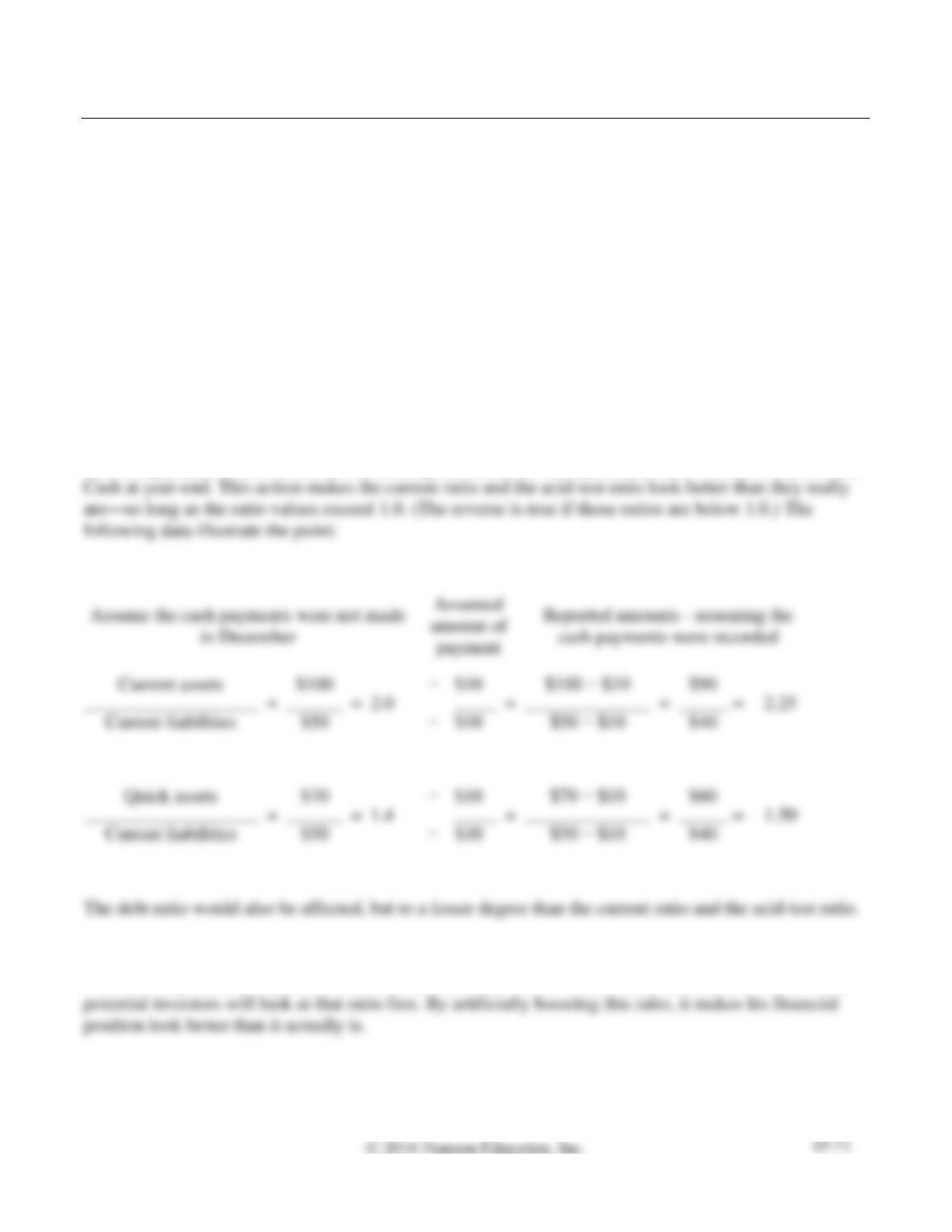
Dividend payout
25%
25%
Critical Thinking
Decision Case 15-1
Lance Berkman is the controller of Saturn, a dance club whose year-end is December 31. Berkman
prepares checks for suppliers in December, makes the proper journal entries, and posts them to the
appropriate accounts in that month. However, he holds on to the checks and mails them to the suppliers
in January.
Requirements
1. What financial ratio(s) is(are) most affected by the action?
2. What is Berkman’s purpose in undertaking this activity?
SOLUTION
Requirement 1
Recording payments in December, but mailing the checks in January, understates Accounts Payable and
Requirement 2
Berkman may want to improve the current ratio because it is the most widely used ratio. Creditors and
Ethical Issue 15-1
Ross’s Lipstick Company’s long-term debt agreements make certain demands on the business. For
example, Ross may not purchase treasury stock in excess of the balance of retained earnings. Also, long-
term debt may not exceed stockholders’ equity, and the current ratio may not fall below 1.50. If Ross
fails to meet any of these requirements, the company’s lenders have the authority to take over
management of the company.
Changes in consumer demand have made it hard for Ross to attract customers. Current liabilities have
mounted faster than current assets, causing the current ratio to fall to 1.47. Before releasing financial
statements, Ross’s management is scrambling to improve the current ratio. The controller points out that
an investment can be classified as either long-term or short-term, depending on management’s intention.
By deciding to convert an investment to cash within one year, Ross can classify the investment as short-
term—a current asset. On the controller’s recommendation, Ross’s board of directors votes to reclassify
long-term investments as short-term.
Requirements
1. What effect will reclassifying the investments have on the current ratio? Is Ross’s true financial
position stronger as a result of reclassifying the investments?
2. Shortly after the financial statements are released, sales improve; so, too, does the current ratio. As a
result, Ross’s management decides not to sell the investments it had reclassified as short-term.
Accordingly, the company reclassifies the investments as long-term. Has management behaved
unethically? Give the reasoning underlying your answer.
SOLUTION
Requirement 1
Reclassifying the long-term investments as short-term will increase current assets and, therefore,
Requirement 2
Reclassifying a long-term investment as current to meet a debt agreement does not necessarily brand
Financial Statement Case 15-1
Use Starbucks Corporation’s Fiscal 2013 Annual Report to answer the following questions. Visit
Requirements
1. Compute trend analyses for total net revenues and net earnings. Use October 2, 2011, as the base
year. What is the most notable aspect of these data?
2. Perform a vertical analysis for Starbucks Corporation’s asset section of the balance sheet as of
September 29, 2013, and September 30, 2012.
SOLUTION
Requirement 1
2013
2012
2011
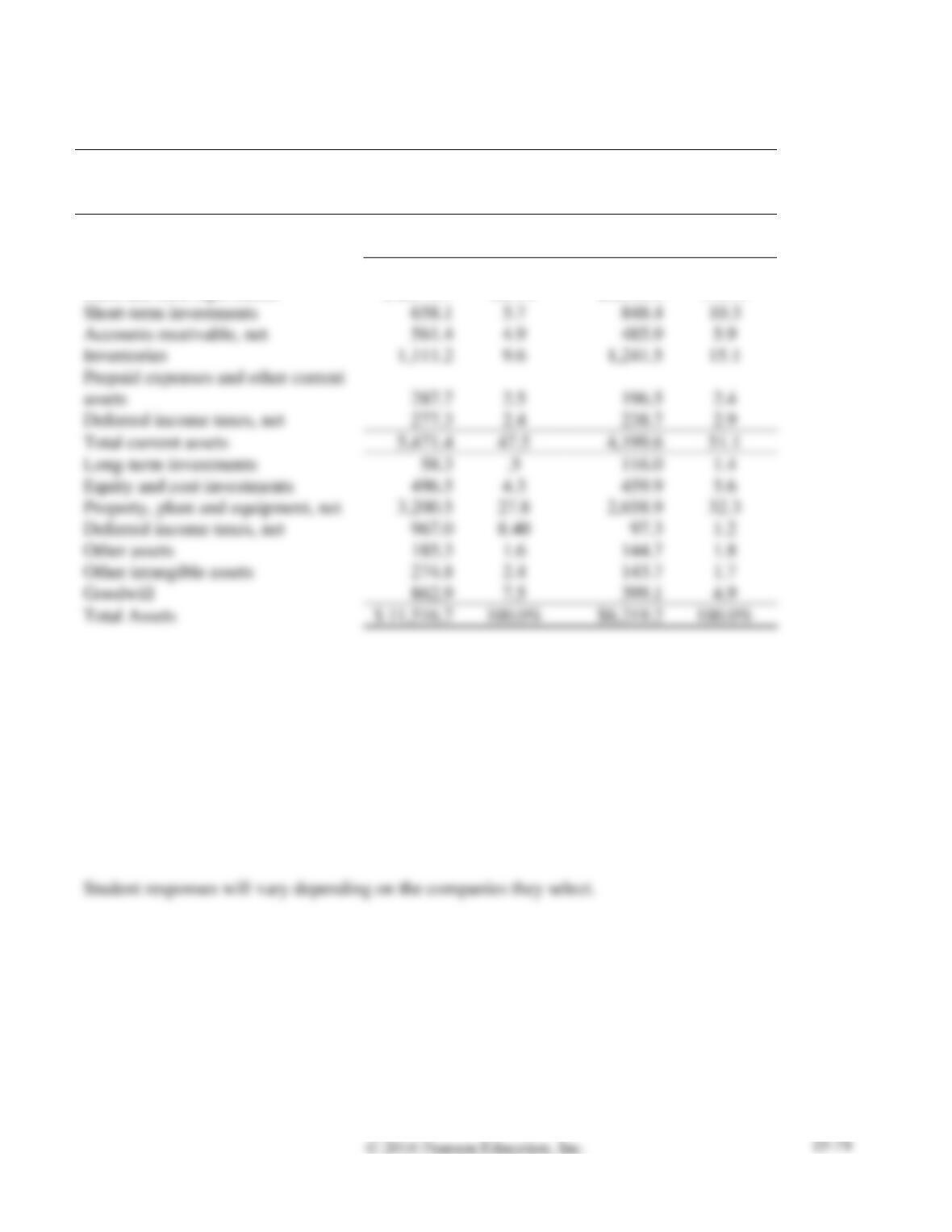
Total net revenues
Trend Percentages
127%
Net earnings
Trend Percentages
Financial Statement Case 15-1, cont.
Requirement 2
STARBUCKS CORPORATION
Consolidated Balance Sheet
(In millions)
Sep 29,
Percent of
Total
Sep 30,
Percent of
Total
2013
2012
Current Assets
Cash and cash equivalents
$ 2,575.7
22.4%
$1,188.6
14.5%
Short-term investments
Accounts receivable, net
Inventories
1,111.2
Deferred income taxes, net
Total current assets
5,471.4
Long-term investments
Equity and cost investments
Property, plant and equipment, net
3,200.5
Deferred income taxes, net
Other assets
Other intangible assets
Goodwill
862.9
Total Assets
100.0%
$8,219.2
100.0%
Team Project 15-1
Select an industry you are interested in, and pick any company in that industry to use as the benchmark.
Then select two other companies in the same industry. For each category of ratios, compute all the ratios
for the three companies. Write a two-page report that compares the two companies with the benchmark
company.
SOLUTION
Team Project 15-2
Select a company and obtain its financial statements. Convert the income statement and the balance
sheet to common size, and compare the company you selected to the industry average. The Risk
Management Association’s Annual Statement Studies and Dun & Bradstreet’s Industry Norms & Key
Business Ratios publish common-size statements for most industries.
SOLUTION