Chapter 15 – Section A – Mathcad Solutions
15.1 Initial state: Liquid water at 70 degF.
H138.05 BTU
lbm
⋅:= S10.0745 BTU
lbmrankine⋅
⋅:= (Table F.3)
Final state: Ice at 32 degF.
H20.02−143.3−()
BTU
lbm
⋅:= S20.0 143.3
491.67
−
⎛
⎜
⎝
⎞
⎠
BTU
lbmrankine⋅
⋅:=
Tσ70 459.67+( ) rankine⋅:=
(a)
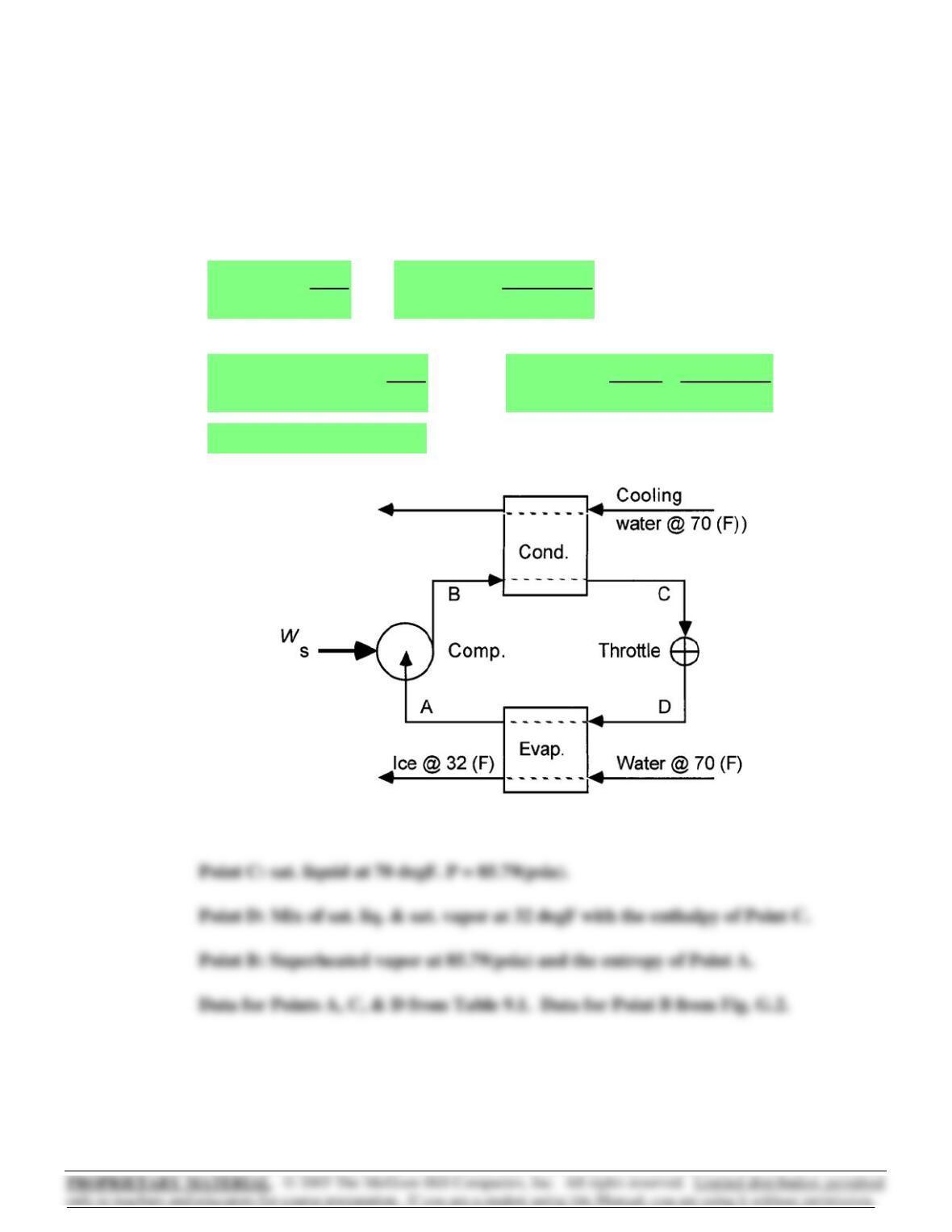
Point A: sat. vapor at 32 degF.
595
For sat. liquid at 70 degF:
SA0.2223 BTU
lbmrankine⋅
⋅:=HA107.60 BTU
lbm
⋅:=
For sat. liquid and vapor at 32 degF, by interpolation in the table:
Conventional refrigeration cycle under ideal conditions of operation:
Isentropic compression, infinite flow rate of cooling water, &
minimum temp. difference for heat transfer = 0.
(c)
(b) For the Carnot heat pump, heat equal to the enthalpy change of the
water is extracted from a cold reservoir at 32 degF, with heat
rejection to the surroundings at 70 degF.
TC491.67 rankine⋅:= THTσ
:= QCH2H1
−:= QC181.37−BTU
lbm
=
596
HAHvap
:=Hvap 106.48 BTU
lbm
⋅:=Hliq 19.58 BTU
lbm
⋅:=
For sat. liquid and vapor at 24 degF:
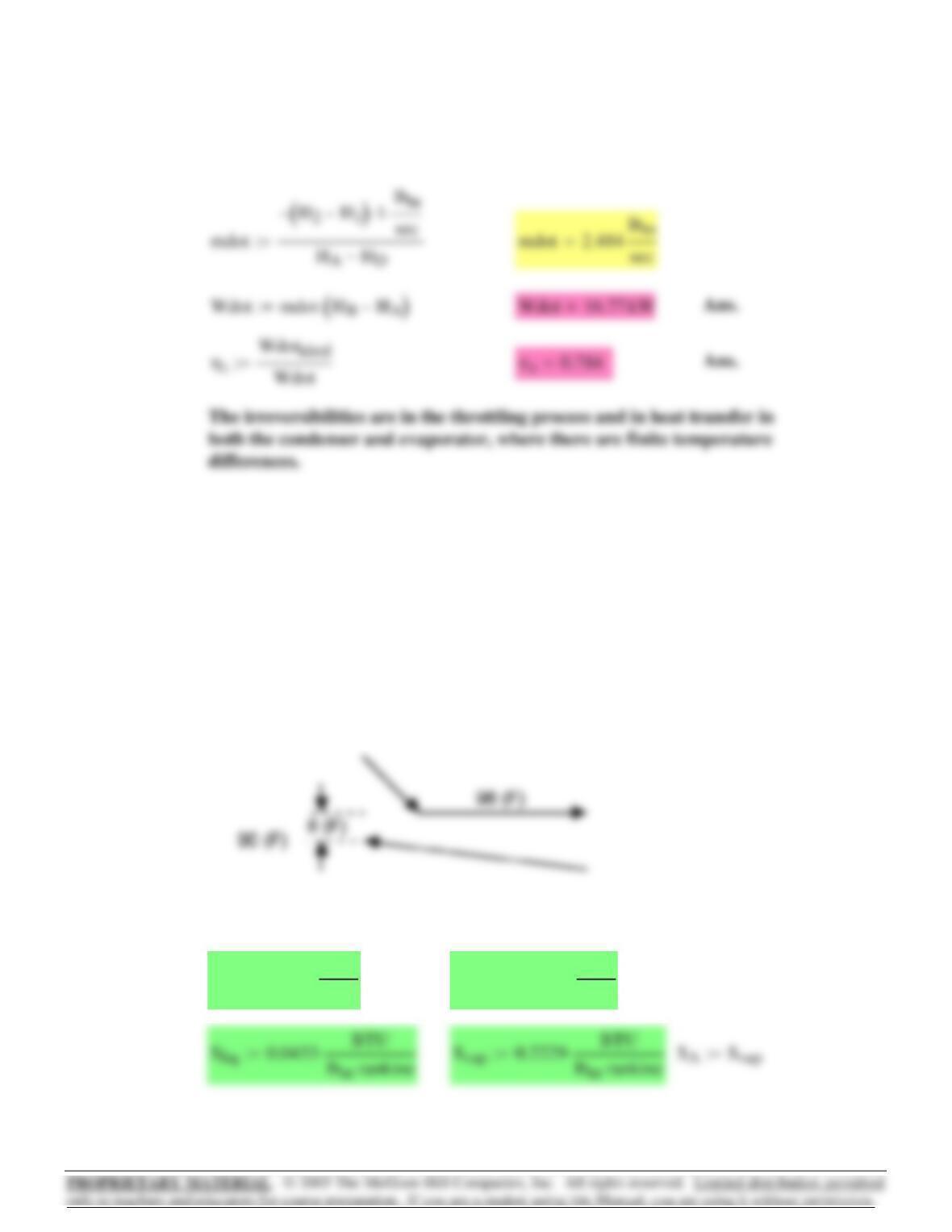
(Note that minimum temp. diff. is not at end of condenser, but it is not
practical to base design on 8-degF temp. diff. at pinch. See sketch.)
Point C: Sat. Liquid at 98 degF.
Point D: Mix of sat. liq. and sat. vapor at 24 degF with H of point C,
Point B: Superheated vapor at 134.75(psia).
Point A: Sat. vapor at 24 degF.
η0.75:=
Practical cycle.(d)
Refrigerent circulation rate:
597
Wdotlost.compressor mdot Tσ
⋅SBSA
−
()
⋅:=
Tσ70 459.67+( ) rankine⋅:=
THERMODYNAMIC ANALYSIS
mdot 2.914 lbm
sec
=mdot
H2H1
−
()
−1⋅lbm
sec
⋅
HAHD
−
:=
Refrigerent circulation rate:
HBHA
H’BHA
−
η
+:=H’B118 BTU
lbm
⋅:=
For isentropic compression, the entropy of Point B is 0.2229 at
P=134.75(psia). From Fig. G.2,
For sat. liquid at 98 degF, P=134.75(psia):
598
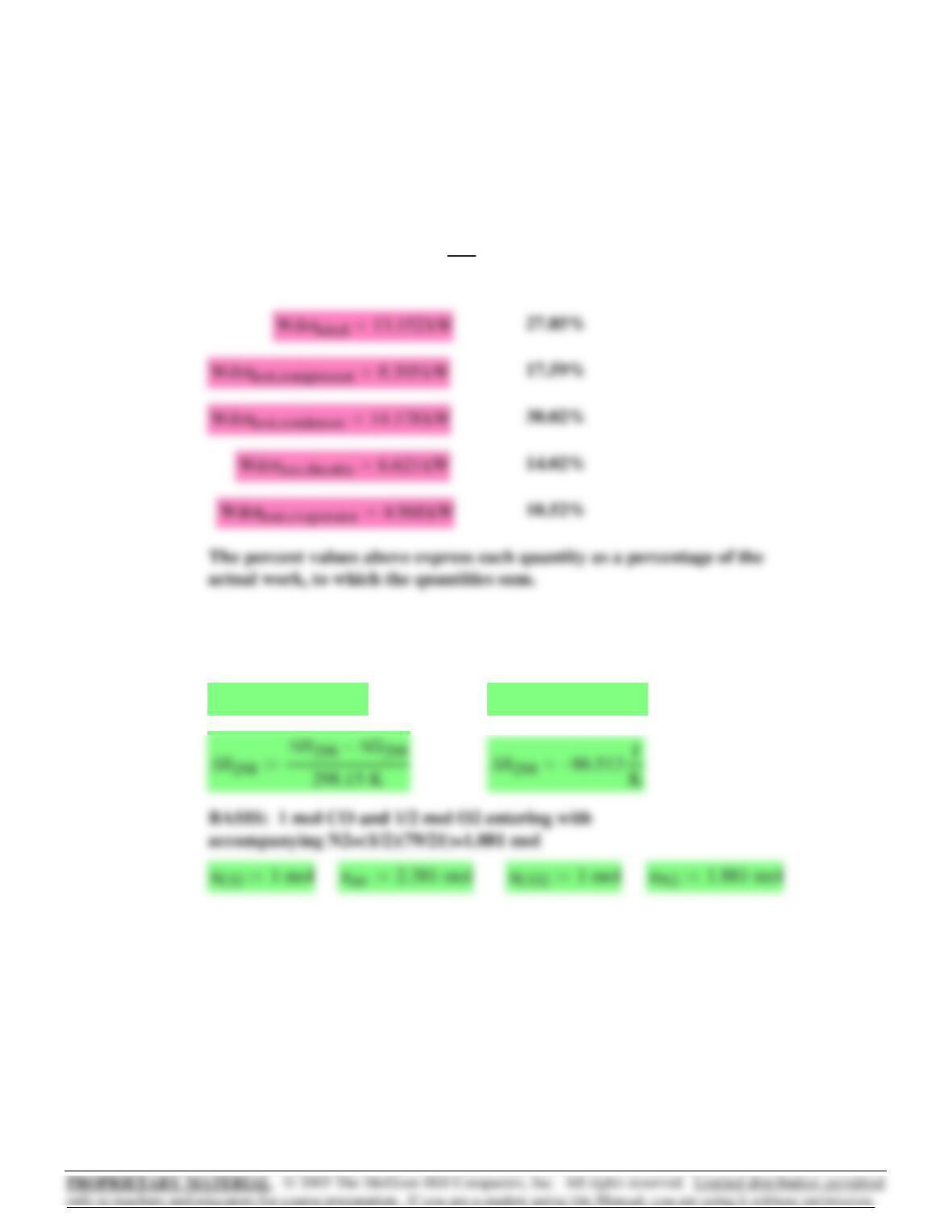
∆G298 257190−J⋅:=∆H298 282984−J⋅:=
Assume ideal gases. Data from Table C.415.2
Wdotlost.evaporator Tσmdot SASD
−
()
⋅
1lbm
sec
⋅S2S1
−
()
⋅+
…
⎡
⎢
⎢
⎣
⎤
⎥
⎥
⎦
⋅:=
Wdotlost.throttle mdot Tσ
⋅SDSC
−
()
⋅:=
599
∆Smixing 15.465 J
K
=∆Smixing nCO2 nN2
+
()
−R⋅y1ln y1
()
⋅y2ln y2
()
⋅+
()
⋅:=
y21y
1
−:=y10.347=y1
nCO2
nN2 nCO2
+
:=
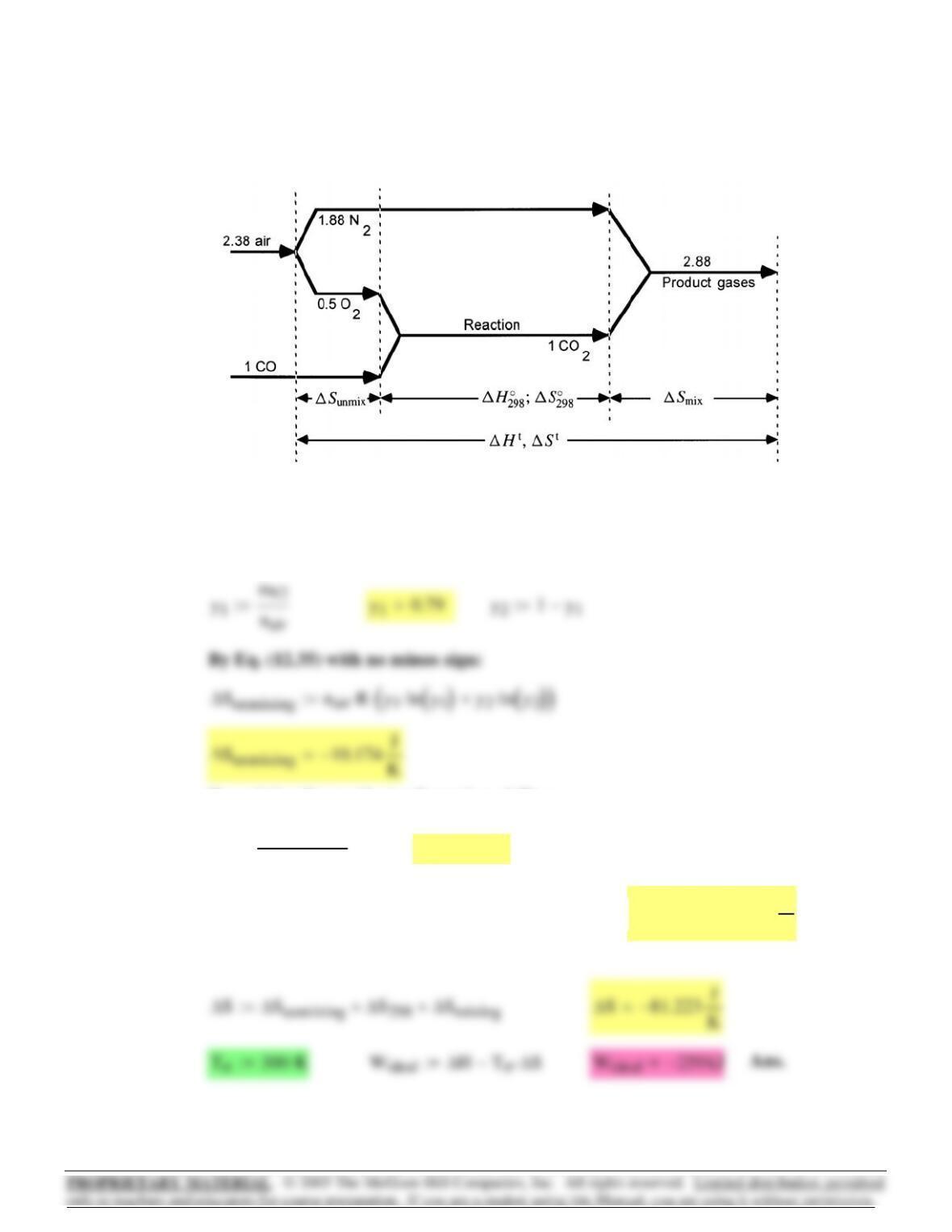
For mixing the products of reaction, define
For unmixing the air, define
∆H∆H298
:=
Since the enthalpy change of mixing for ideal gases is zero, the overall
enthalpy change for the process is
(a) Isothermal process at 298.15 K:
600
D 1.082−105
⋅K2
⋅:=B2.160 10 3−
⋅
K
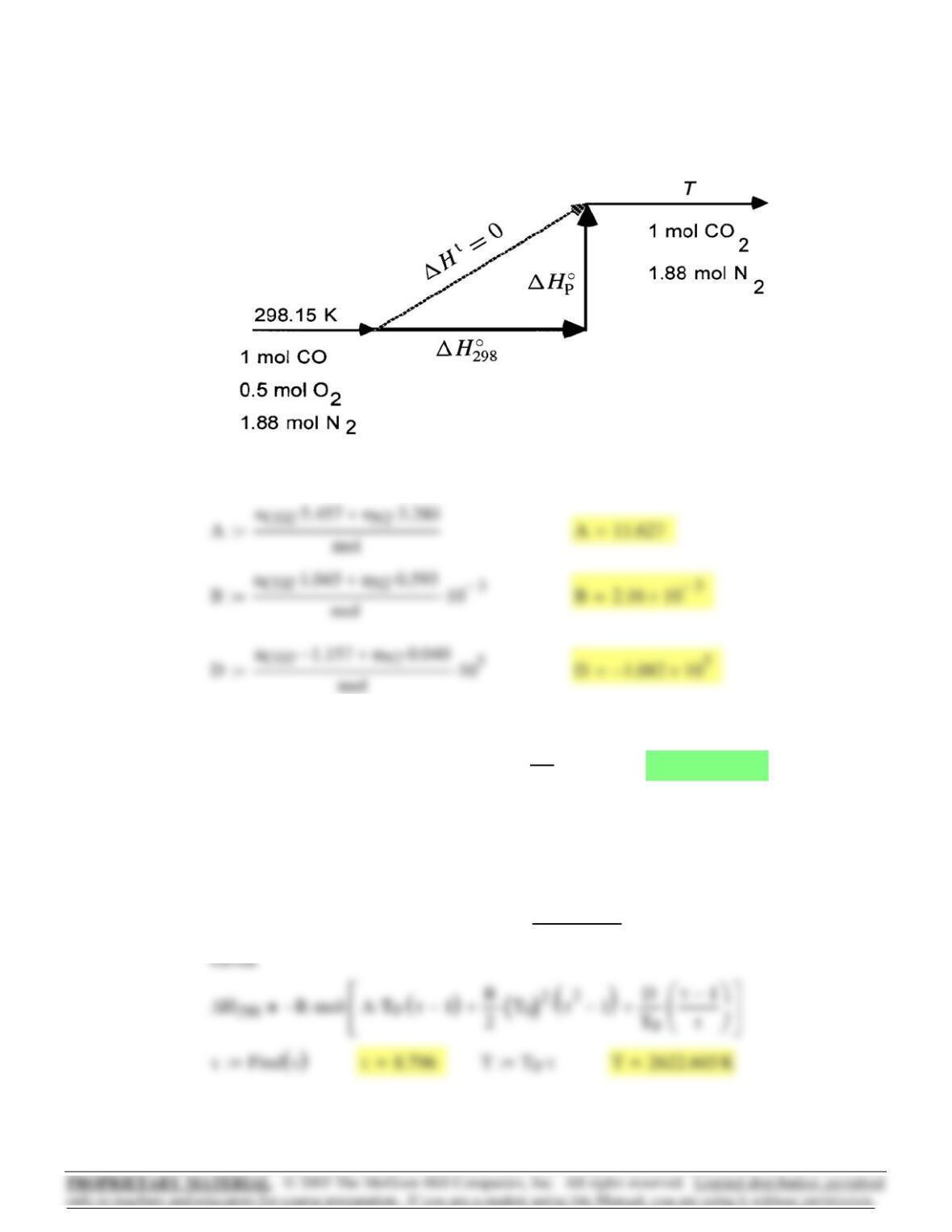
:=A 11.627:=τ 2:=
Guess
.∆H298 ∆HP
+0=
The integral is given by Eq. (4.7). Moreover, by an energy balance,
T0298.15 K⋅:=∆HPR
T0
T
T
CP
R
⌠
⎮
⎮
⌡
d⋅=
For the products,
Heat-capacity data for the product gases from Table C.1:
(b) Adiabatic combustion:
601
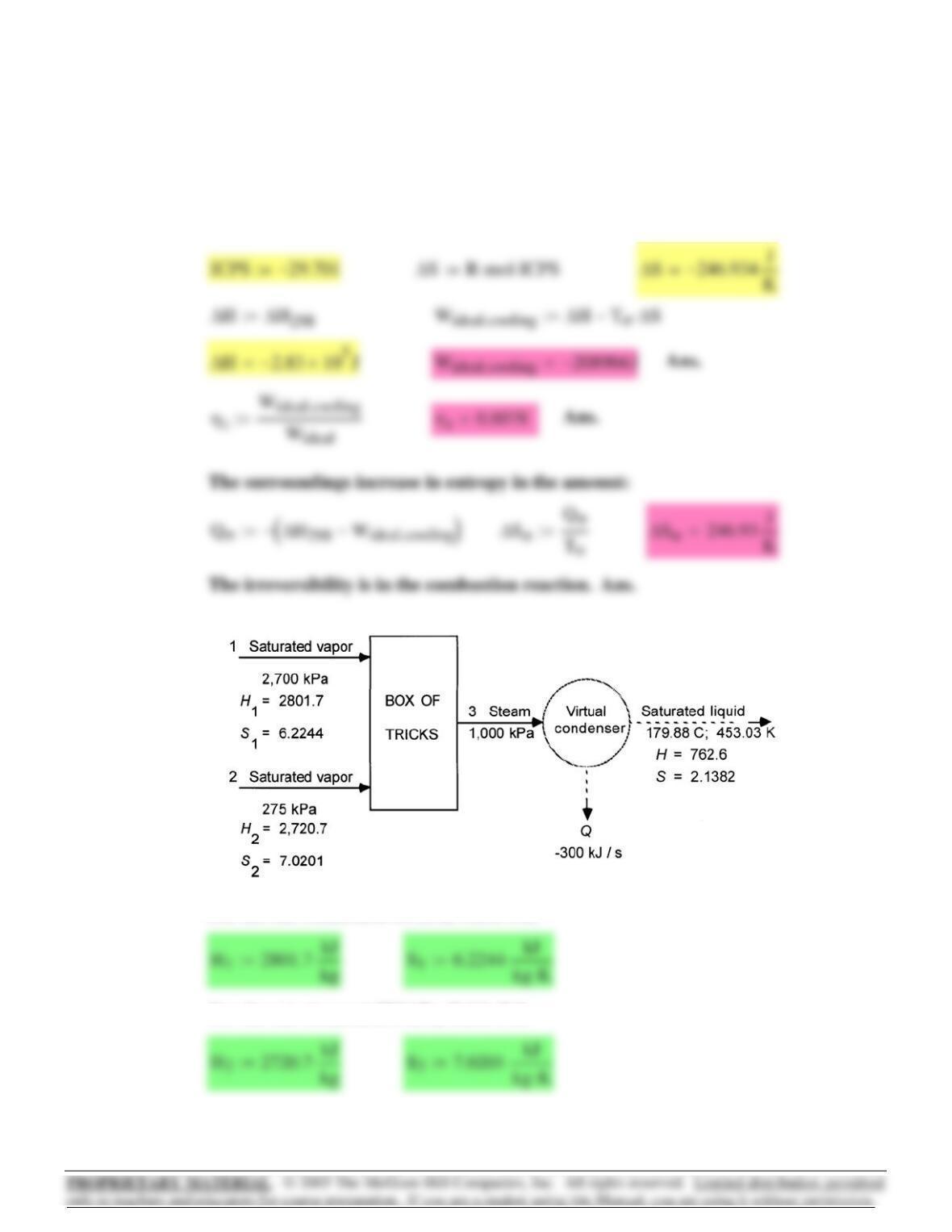
For the sat. steam at 275 kPa, Table F.2:
For the sat. steam at 2700 kPa, Table F.2:
15.3
ICPS 2622.6 298.15,11.627,2.160 10 3−
⋅, 0.0,1.082−105
⋅,
()
29.701−=
For the cooling process from this temperature to the final temperature of
298.15 K, the entropy change is calculated by
602
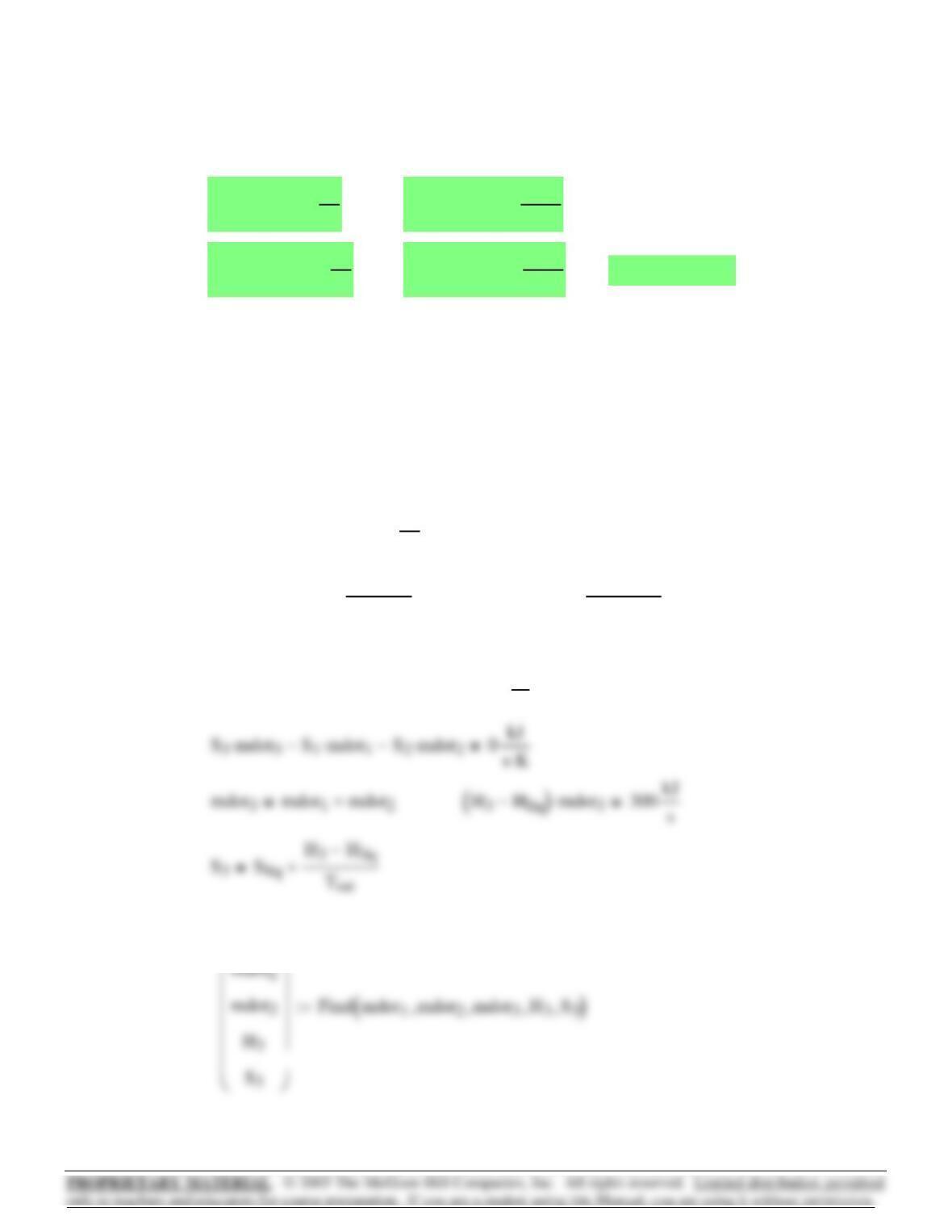
mdot1
⎛
⎜
⎞
H3mdot3
⋅H1mdot1
⋅− H2mdot2
⋅− 0kJ
s
=
Given
S3Sliq
H3Hliq
−
Tsat
+:=H3
H1H2
+
2
:=
mdot3mdot1mdot2
+:=mdot2mdot1
:=mdot10.1 kg
s
⋅:=
Guesses:
We can also write a material balance, a quantity requirement, and relation
between H3 and S3 which assumes wet steam at point 3.
The five equations (in 5 unknowns) are as follows:
∆fs S mdot⋅()0=∆fs H mdot⋅()0=
Assume no heat losses, no shaft work, and negligible changes in kinetic
and potential energy. Then by Eqs. (2.30) and (5.22) for a completely
reversible process:
(a)
Tsat 453.03K:=Svap 6.5828 kJ
kg K⋅
:=Hvap 2776.2 kJ
kg
:=
Sliq 2.1382 kJ
kg K⋅
⋅:=Hliq 762.6 kJ
kg
⋅:=
For sat. liquid and vapor at 1000 kPa, Table F.2:
603
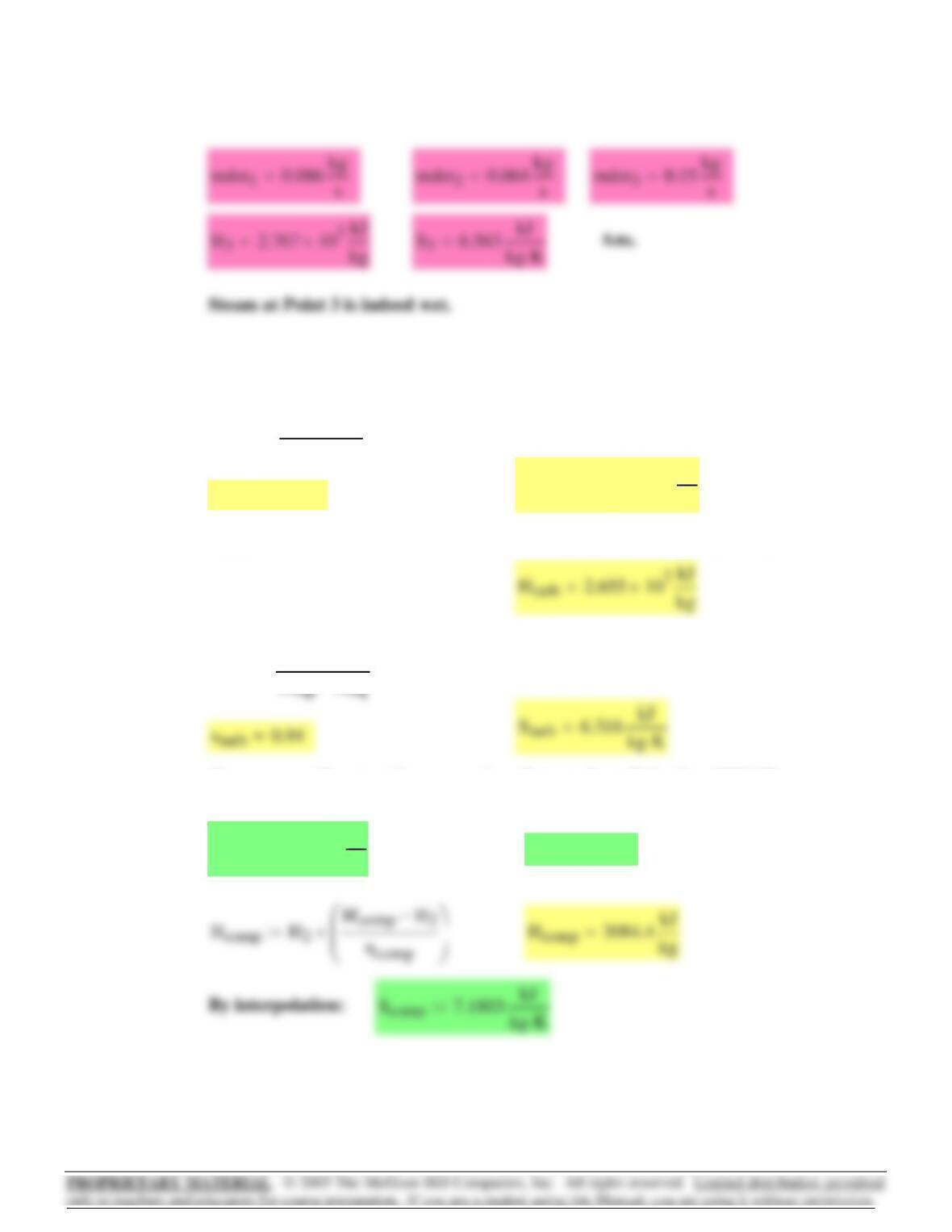
ηcomp 0.75:=H’comp 2993.5 kJ
kg
:=
Compressor: Constant-S compression of steam from Point 2 to 1000 kPa
results in superheated steam. Interpolation in Table F.2 yields
Sturb Sliq xturb Svap Sliq
−
()
⋅+:=xturb
Hturb Hliq
−
Hvap Hliq
−
:=
Hturb H1ηturb H’turb H1
−
()
⋅+:=ηturb 0.78:=
x’turb 0.919=H’turb 2.614 103
×kJ
kg
=
H’turb Hliq x’turb Hvap Hliq
−
()
⋅+:=x’turb
S1Sliq
−
Svap Sliq
−
:=
Turbine: Constant-S expansion of steam from Point 1 to 1000 kPa
results in wet steam of quality
(b)
604
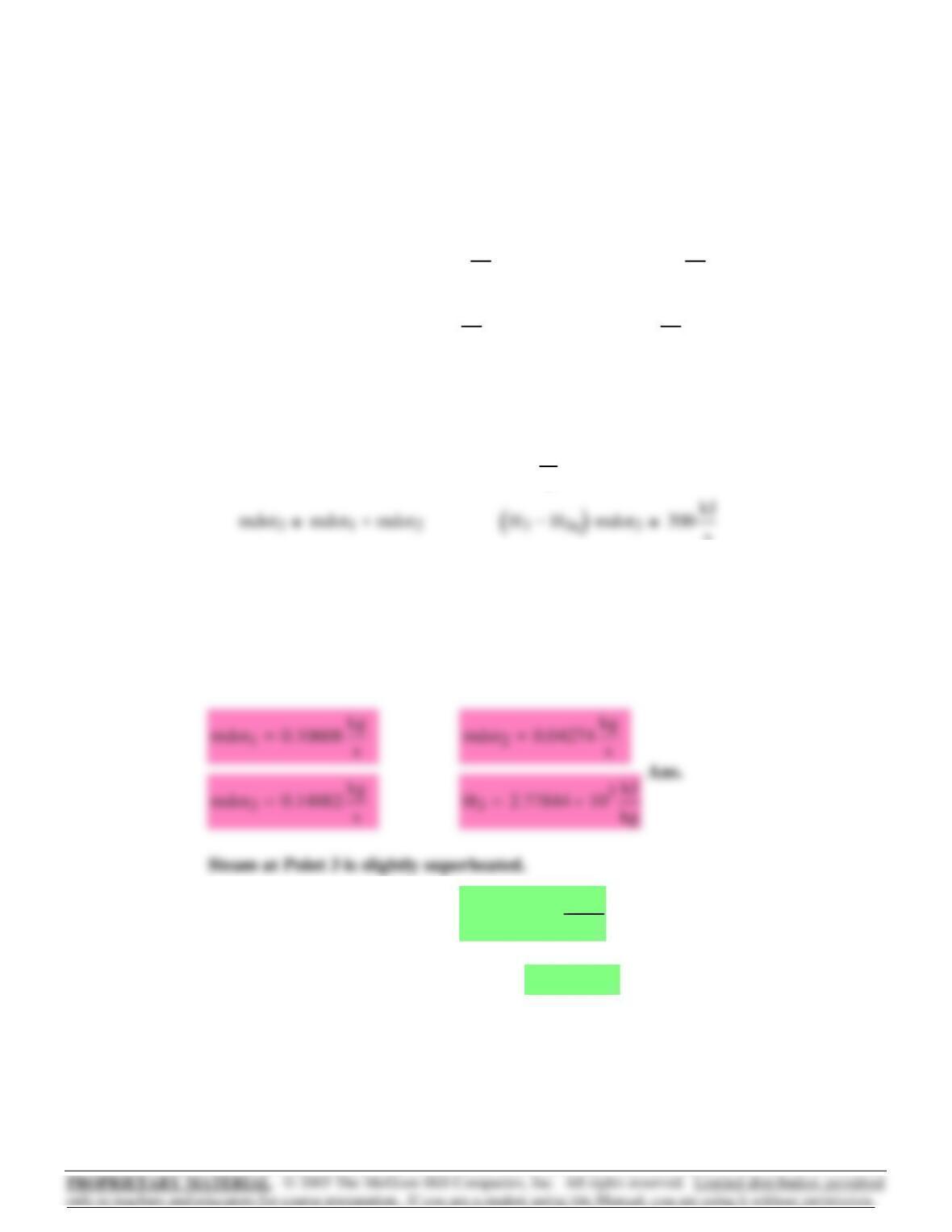
Wdotideal Tσmdot3S3
⋅mdot1S1
⋅− mdot2S2
⋅−
()
⋅:=
By Eq. (5.25), with the enthalpy term equal to zero:
(assumed)
Tσ300K:=
THERMODYNAMIC ANALYSIS
S36.5876 kJ
kg K⋅
:=
By interpolation,
mdot1
mdot2
mdot3
H3
⎛
⎜
⎜
⎜
⎜
⎜
⎝
⎞
⎟
⎟
⎟
⎠
Find mdot1mdot2
,mdot3
,H3
,
()
:=
s
H3mdot3
⋅H1mdot1
⋅− H2mdot2
⋅− 0kJ
s
=
Hcomp H2
−
()
mdot2
⋅Hturb H1
−
()
−mdot1
⋅=
Given
H32770. kJ
kg
:=mdot30.15 kg
s
:=
mdot20.064 kg
s
:=mdot10.086 kg
s
:=
Guesses:
The energy balance, mass balance, and quantity requirement equations of
Part (a) are still valid. In addition, The work output of the turbine equals
the work input of the compressor. Thus we have 4 equations (in 4
unknowns):
605
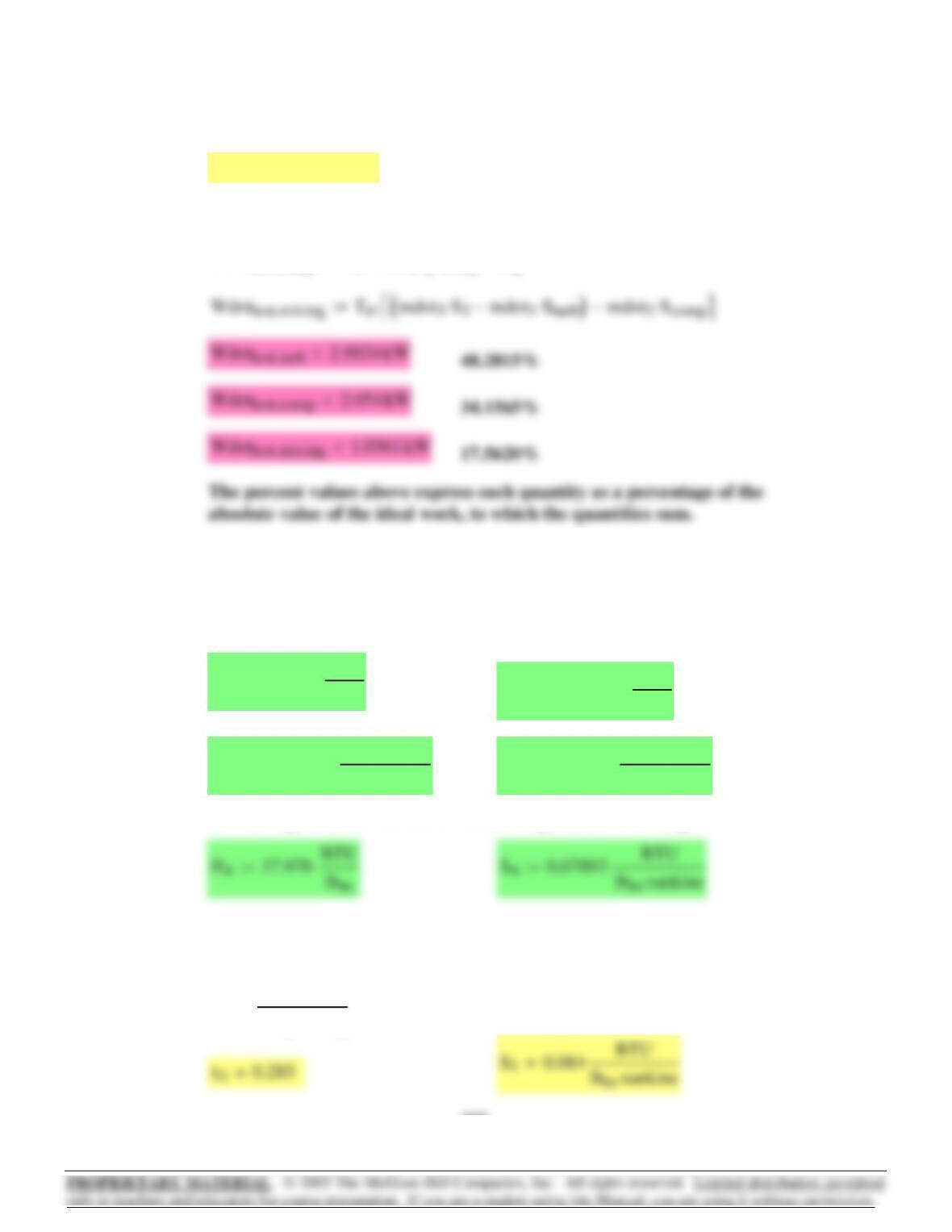
S1Sliq x1Svap Sliq
−
()
⋅+:=x1
H1Hliq
−
Hvap Hliq
−
:=
H1H4
:=S2Svap
:=H2Hvap
:=
For sat. liquid at the condenser outlet temperature of 80 degF:
Sliq 0.02744 BTU
lbmrankine⋅
:=Svap 0.22525 BTU
lbmrankine⋅
⋅:=
Hvap 103.015 BTU
lbm
⋅:=
Hliq 12.090 BTU
lbm
:=
For sat. liquid and vapor at the evaporator temperature of 0 degF:
Some property values with reference to Fig. 9.1 are given in Example 9.1.
Others come from Table 9.1 or Fig. G.2.
15.4
Wdotlost.comp Tσmdot2
⋅Scomp S2
−
()
⋅:=
Wdotlost.turb Tσmdot1
⋅Sturb S1
−
()
⋅:=
Wdotideal 6.014 kW=
606
THTσ
:=Tσ70 459.67+( ) rankine⋅:=
The purpose of the condenser is to transfer heat to the surroundings. Thus
the heat transferred in the condenser is Q in the sense of Chapter 15; i.e.,
it is heat transfer to the SURROUNDINGS, taken here to be at a
temperature of 70 degF.
Internal heat transfer (within the system) is not Q. The heat transferred in
the evaporator comes from a space maintained at 10 degF, which is part of
the system, and is treated as an internal heat reservoir.
The ideal work of the process is that of a Carnot engine operating between
the temperature of the refrigerated space and the temperature of the
surroundings.
mdot 1845.1 lbm
hr
⋅:=
S30.231 BTU
lbmrankine⋅
⋅:=
From Fig. G.2 at H3 and P = 101.37(psia):
From Example 9.1(b) for the compression step:
607