15–41
SOLUTIONS TO PROBLEMS
PROBLEM 15-1
(a)
January 11
Cash (20,000 X $16) …………………………………………. 320,000
Common Stock (20,000 X $10) ………………….. 200,000
Paid-in Capital in Excess of Par—Common
Stock …………………………………………………….. 120,000
February 1
Equipment ………………………………………………………. 50,000
Buildings ………………………………………………………… 160,000
Land ……………………………………………………………….. 270,000
Preferred Stock (4,000 X $100) …………………… 400,000
Paid-in Capital in Excess of Par—Preferred
Stock …………………………………………………….. 80,000
August 10
Cash (1,800 X $14) …………………………………………… 25,200
Retained Earnings (1,800 X $3) …………………………. 5,400*
Treasury Stock …………………………………………. 30,600
*(The debit is made to Retained Earnings because no Paid-in Capital
*from Treasury Stock exists.)
15–42
PROBLEM 15-1 (Continued)
December 31
Retained Earnings …………………………………………… 37,000
Dividend Payable ………………………………………. 37,000*
*Common Stock Cash Dividend:
Common shares outstanding 20,000
Common cash dividend X $.25
$5,000
Preferred Stock Cash Dividend: 4,000 X 100 X 8% = $32,000
Total cash dividends: $5,000 + $32,000 = $ 37,000
Preferred stock—par value $100 per share,
8% cumulative and nonparticipating,
5,000 shares authorized,
4,000 shares issued and outstanding ……… $400,000
Common stock—par value $10 per share,
50,000 shares authorized,
20,000 shares issued and outstanding ……. 200,000
Retained earnings 133,300*
Total stockholders’ equity …………………. $933,300
*($175,700 – $5,400 – $37,000)
15–43
PROBLEM 15-2
(a) Feb. 1 Treasury Stock ($19 X 2,000) …………….. 38,000
Cash ……………………………………….. 38,000
Mar. 1 Cash ($17 X 800) ……………………………… 13,600
Retained Earnings ($2 X 800) ……………. 1,600
Treasury Stock ($19 X 800) ………. 15,200
Mar. 18 Cash ($14 X 500) ……………………………… 7,000
Retained Earnings ($5 X 500) ……………. 2,500
Treasury Stock ($19 X 500) ………. 9,500
Apr. 22 Cash ($20 X 600) ……………………………… 12,000
Treasury Stock ($19 X 600) ………. 11,400
Paid-in Capital from Treasury
Stock …………………………………… 600
Paid-in capital from treasury stock …………………… 600
Total paid-in capital ………………………………. 400,600
Retained earnings* ………………………………………….. 445,900
**Treasury stock (beginning balance) ………………. $ 0
February 1 purchase (2,000 shares) ………………. 38,000
March 1 sale (800 shares) ……………………………… (15,200)
March 18 sale (500 shares) ……………………………. (9,500)
April 12 sale (600 shares) ……………………………… (11,400)
Treasury stock (ending balance)……………………. $ 1,900
15–44
PROBLEM 15-3
HATCH COMPANY
Stockholders’ Equity
December 31, 2012
Capital Stock
Preferred stock, $20 par,
8%, 180,000 shares issued
and outstanding ………………………………… $ 3,600,000
Common stock, $2.50 par,
4,100,000 shares issued,
4,080,000 shares outstanding …………….. 10,250,000
Total capital stock …………………………. 13,850,000
From treasury stock …………………………….. 10,000 28,020,000
Total paid-in capital ……………………….. 41,870,000
Retained earnings ………………………………………. 4,272,000
Total paid-in capital and retained earnings …… 46,142,000
Less: Treasury stock
(20,000 shares common) …………………… (200,000)
Total stockholders’ equity ……………… $45,942,000
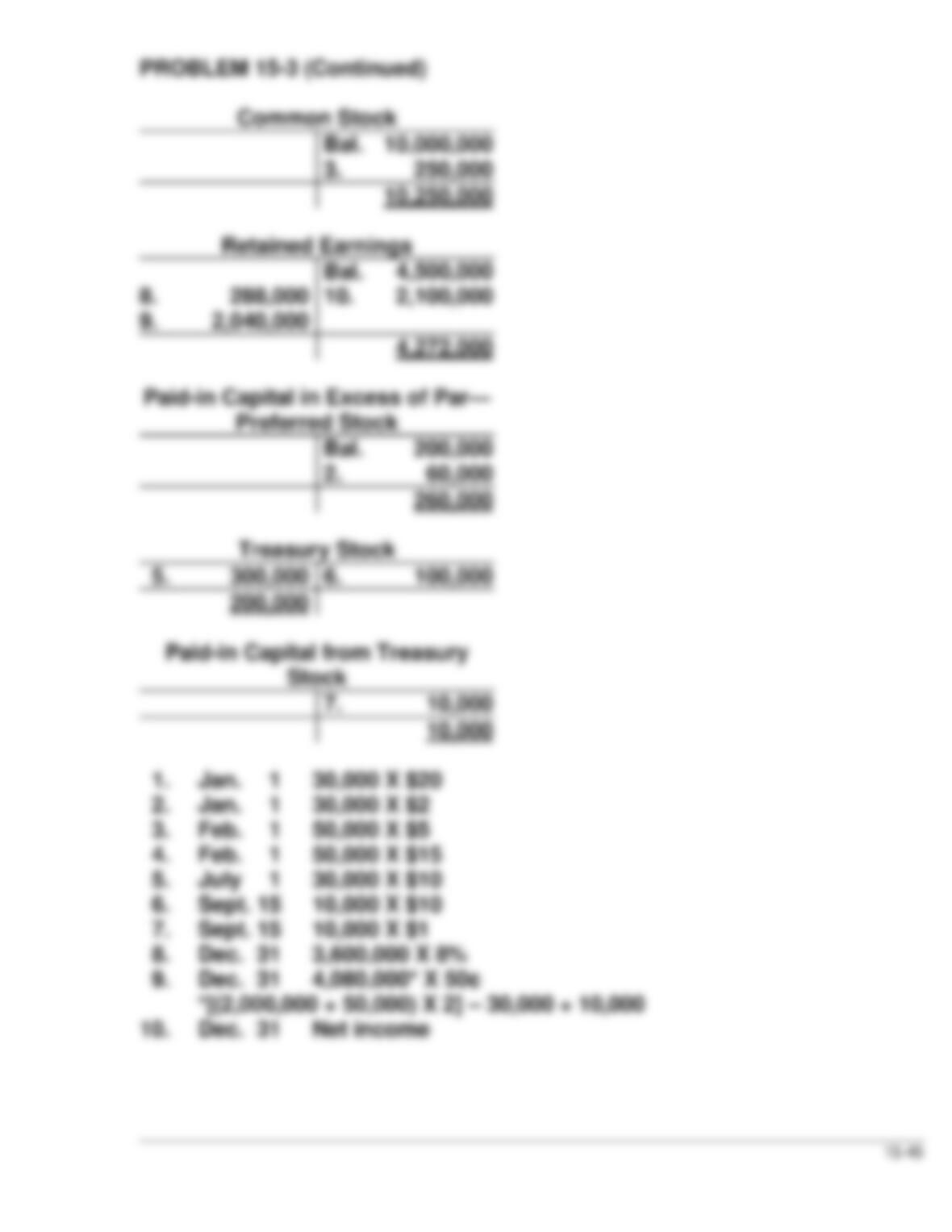
Bal. 3,000,000
1. 600,000
3,600,000
Paid-in Capital in Excess of Par—
Common Stock
Bal. 27,000,000
4. 750,000
27,750,000
15–45
PROBLEM 15-3 (Continued)
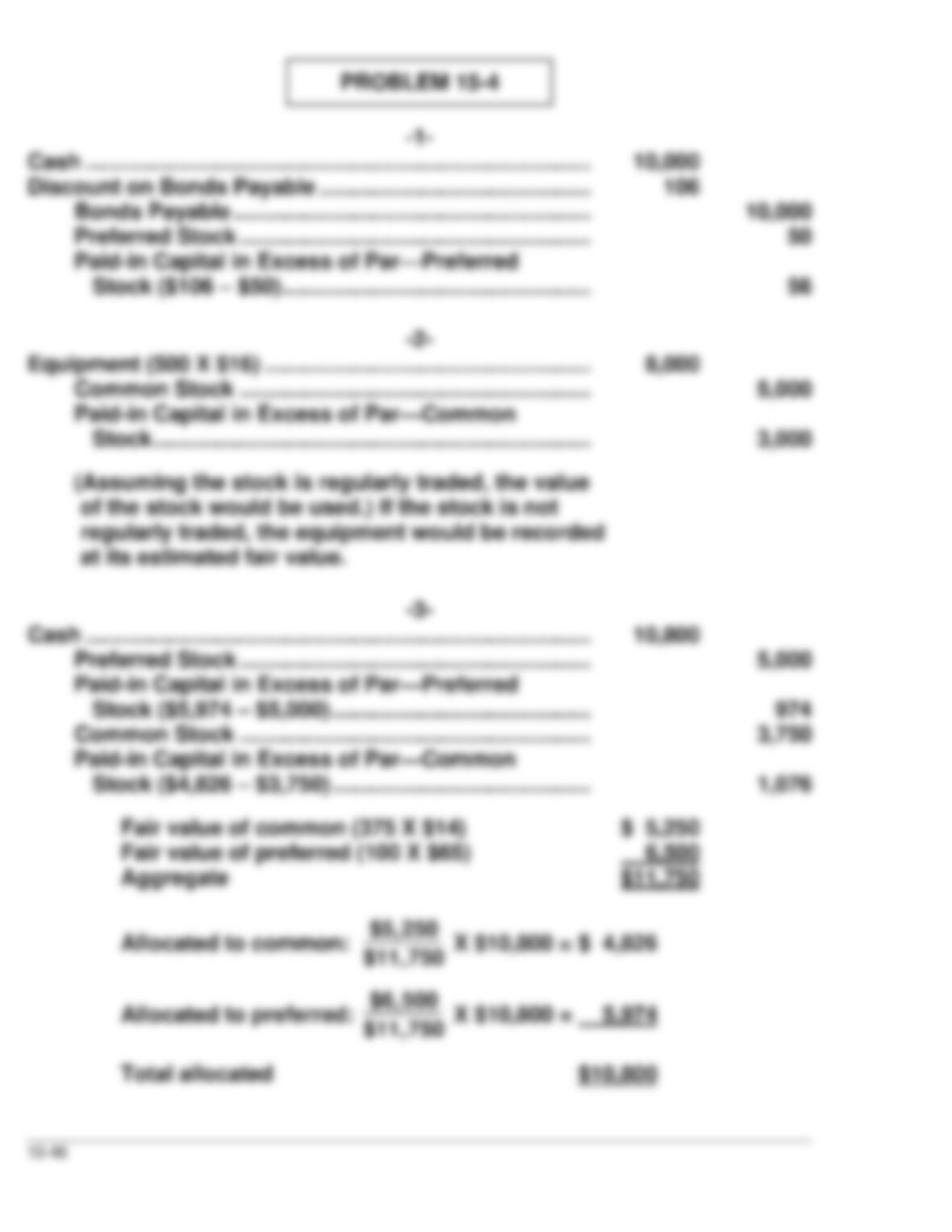
Common Stock
Bal. 10,000,000
3. 250,000
10,250,000
Retained Earnings
Bal. 4,500,000
8. 288,000
10. 2,100,000
9. 2,040,000
4,272,000
Paid-in Capital in Excess of Par—
Preferred Stock
Bal. 200,000
2. 60,000
260,000
3. Feb. 1 50,000 X $5
4. Feb. 1 50,000 X $15
5. July 1 30,000 X $10
6. Sept. 15 10,000 X $10
7. Sept. 15 10,000 X $1
8. Dec. 31 3,600,000 X 8%
9. Dec. 31 4,080,000* X 50¢
*[(2,000,000 + 50,000) X 2] – 30,000 + 10,000
10. Dec. 31 Net income
6. 100,000
200,000
10,000
15–46
PROBLEM 15-4
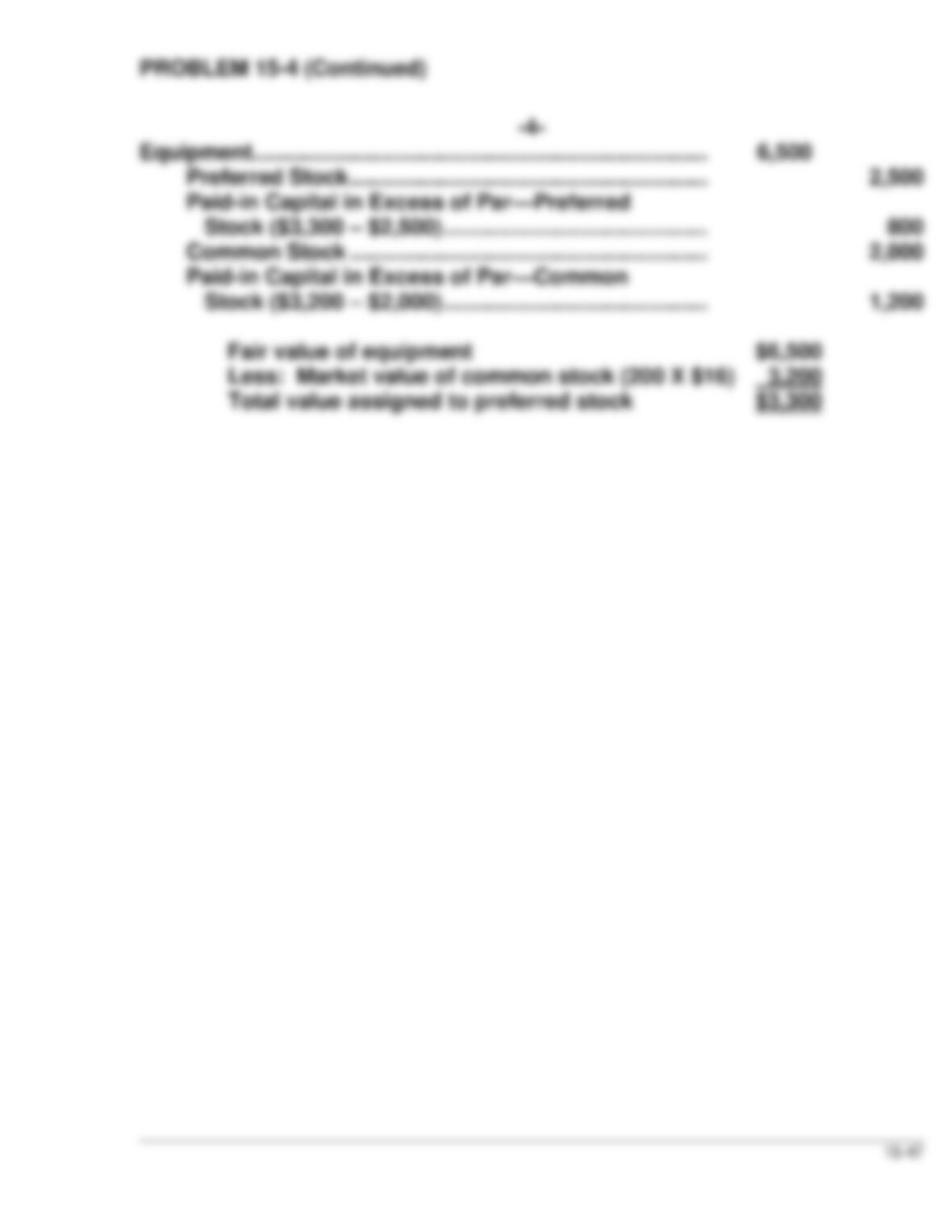
-1-
Cash ………………………………………………………………………. 10,000
Discount on Bonds Payable …………………………………….. 106
Bonds Payable …………………………………………………. 10,000
Preferred Stock ………………………………………………… 50
Paid-in Capital in Excess of Par—Preferred
Paid-in Capital in Excess of Par—Common
Stock …………………………………………………………….. 3,000
(Assuming the stock is regularly traded, the value
of the stock would be used.) If the stock is not
regularly traded, the equipment would be recorded
15–47
PROBLEM 15-4 (Continued)
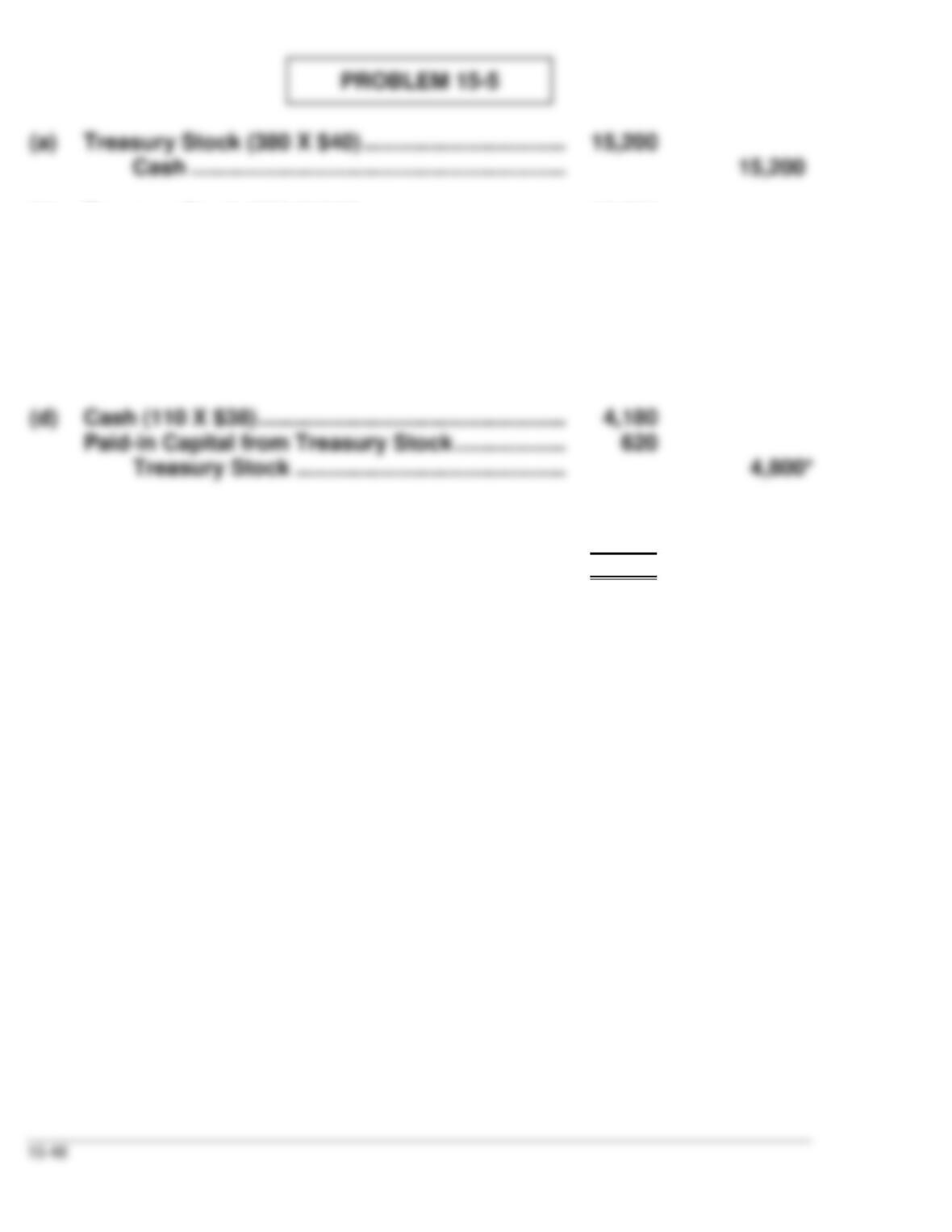
-4-
Equipment……………………………………………………………….. 6,500
Preferred Stock …………………………………………………. 2,500
Paid-in Capital in Excess of Par—Preferred
Stock ($3,300 – $2,500) ……………………………………. 800
Common Stock …………………………………………………. 2,000
Paid-in Capital in Excess of Par—Common
Stock ($3,200 – $2,000) ……………………………………. 1,200
Fair value of equipment $6,500
Less: Market value of common stock (200 X $16) 3,200
Total value assigned to preferred stock $3,300
15–48
PROBLEM 15-5
(a) Treasury Stock (380 X $40) …………………………... 15,200
Cash ……………………………………………………. 15,200
(b) Treasury Stock (300 X $45) …………………………... 13,500
Cash ……………………………………………………. 13,500
(c) Cash (350 X $42) ………………………………………….. 14,700
Treasury Stock (350 X $40) ……………………. 14,000
Paid-in Capital from Treasury Stock
(350 X $2) ………………………………………….. 700
*30 shares purchased at $40 = $1,200
80 shares purchased at $45 = 3,600
(Cost of treasury shares sold using FIFO = $4,800
15–49
PROBLEM 15-6
(a) -1-
Treasury Stock (280 X $97) ………………………………….. 27,160
Cash …………………………..……………………………….. 27,160
-2-
Retained Earnings ………………………………………………. 90,400
Cash (280 X $102) ……………………………………………….. 28,560
Treasury Stock …………………………………………….. 27,160
Treasury Stock (500 X $105) ………………………………… 52,500
Paid-in Capital from Treasury Stock …………………….. 1,400
Retained Earnings …………………………..………………….. 1,750
15–50
PROBLEM 15-6 (Continued)
(b) WASHINGTON COMPANY
Stockholders’ Equity
December 31, 2013
Common stock, $100 par value, authorized
8,000 shares; issued 4,800 shares,
4,650 shares outstanding …………………………. $480,000
Retained earnings (restricted in the
amount of $15,750* by the acquisition of
treasury stock) …………………………………………. 295,850**
Total paid-in capital and
retained earnings ………………………………. 775,850
Less: Treasury stock (150 shares) ……………….. 15,750
Total stockholders’ equity …………………….. $760,100
*($52,500 – $36,750)
**($294,000 – $90,400 – $1,750 + $94,000)
15–51
PROBLEM 15-7
(a)
For preferred dividends in arrears:
Retained Earnings …………………………………………………..
18,000
Treasury Stock …………………………..…………………..
18,000*
*1,500 shares of treasury stock issued
as dividend; 1,500 X $12 = $18,000
For $.30 per share common dividend:
Retained Earnings ………………………………………………..
89,610
Cash …………………………..……………………………….
89,610*
*Since all preferred dividends must be paid before the common
dividend, outstanding common shares include—
As of Dec. 31, 2012 (300,000 – 2,800) …………….
297,200
shares
Preferred distribution …………………………..………
1,500
shares
298,700
shares
Common dividend ……………………………………….
.30
/share
Amount of common cash dividend ……………….
$ 89,610
(b) The suggested cash dividend could be paid even if state law did restrict
the retained earnings balance in the amount of the cost of treasury
stock. Total dividends would be $125,160,* which is adequately covered
by the cash balance. The retained earnings balance, after adding the 2013
net income (estimated at $77,000), is sufficient to cover the dividends.**
For 6% preferred current year dividend:
Retained Earnings ………………………………………………..
18,000
Cash …………………………..……………………………….
18,000*
*(6% X $300,000)
15–52
PROBLEM 15-7 (Continued)
*Preferred dividends in arrears (6% X $300,000) …..
$ 18,000
Current preferred dividend (6% X $300,000) ……….
18,000
Common dividend ($.30 X 297,200) ……………………
89,160
Total cash dividend ………………………………………….
$125,160
**Beginning balance ……………………………………………
$105,000
Estimated net income ……………………………………….
77,000
Total balance available ……………………………………..
182,000
If restricted by cost of treasury shares ………………
(33,600)
Available to pay dividends ………………………………..
$148,400
15–53
PROBLEM 15-8
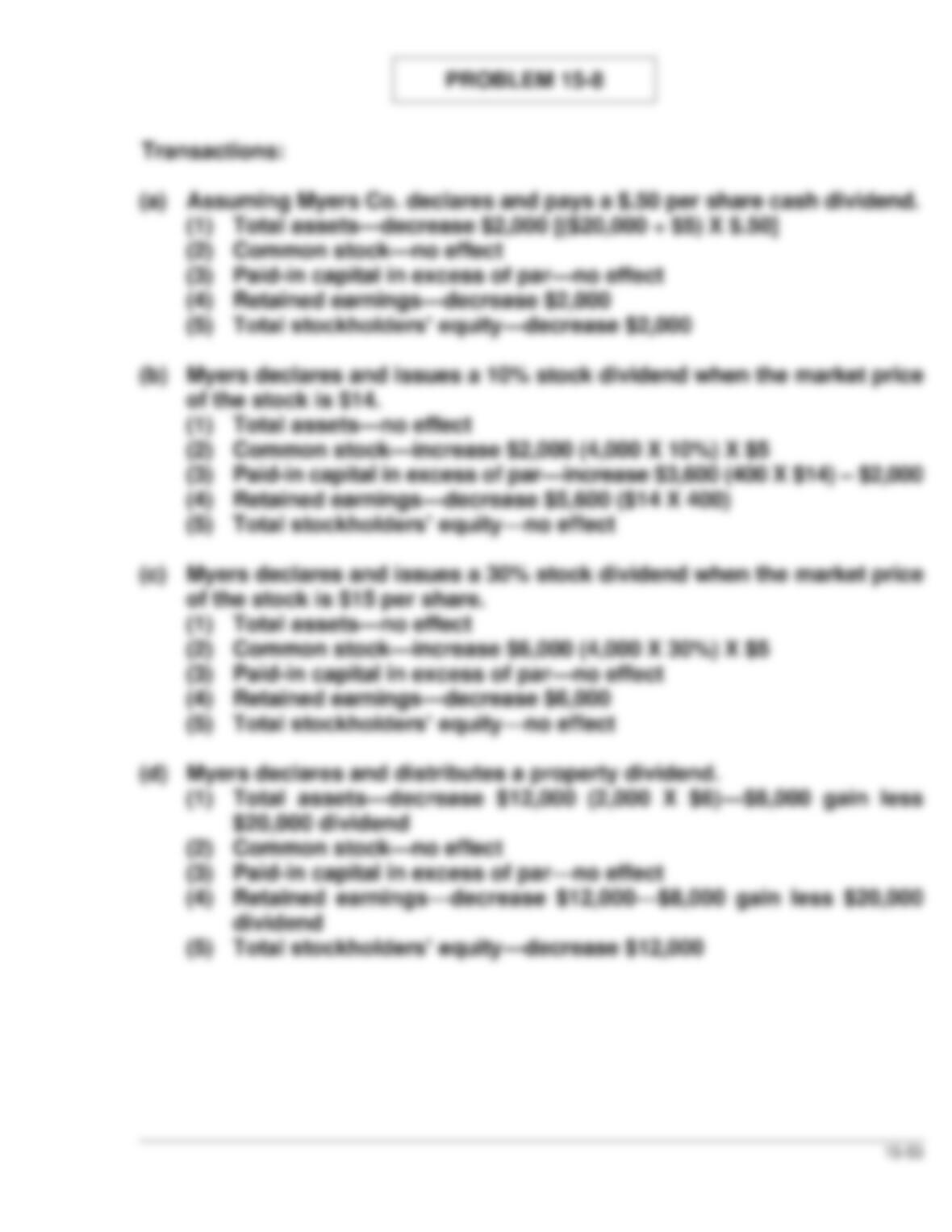
Transactions:
(a) Assuming Myers Co. declares and pays a $.50 per share cash dividend.
(1) Total assets—decrease $2,000 [($20,000 ÷ $5) X $.50]
(2) Common stock—no effect
(3) Paid-in capital in excess of par—no effect
(4) Retained earnings—decrease $2,000
(5) Total stockholders’ equity—decrease $2,000
(2) Common stock—increase $2,000 (4,000 X 10%) X $5
(3) Paid-in capital in excess of par—increase $3,600 (400 X $14) – $2,000
(4) Retained earnings—decrease $5,600 ($14 X 400)
(5) Total stockholders’ equity—no effect
(1) Total assets—no effect
(2) Common stock—increase $6,000 (4,000 X 30%) X $5
(3) Paid-in capital in excess of par—no effect
(4) Retained earnings—decrease $6,000
(5) Total stockholders’ equity—no effect
(3) Paid-in capital in excess of par—no effect
(4) Retained earnings—decrease $12,000—$8,000 gain less $20,000
dividend
(5) Total stockholders’ equity—decrease $12,000
15–54
PROBLEM 15-8 (Continued)
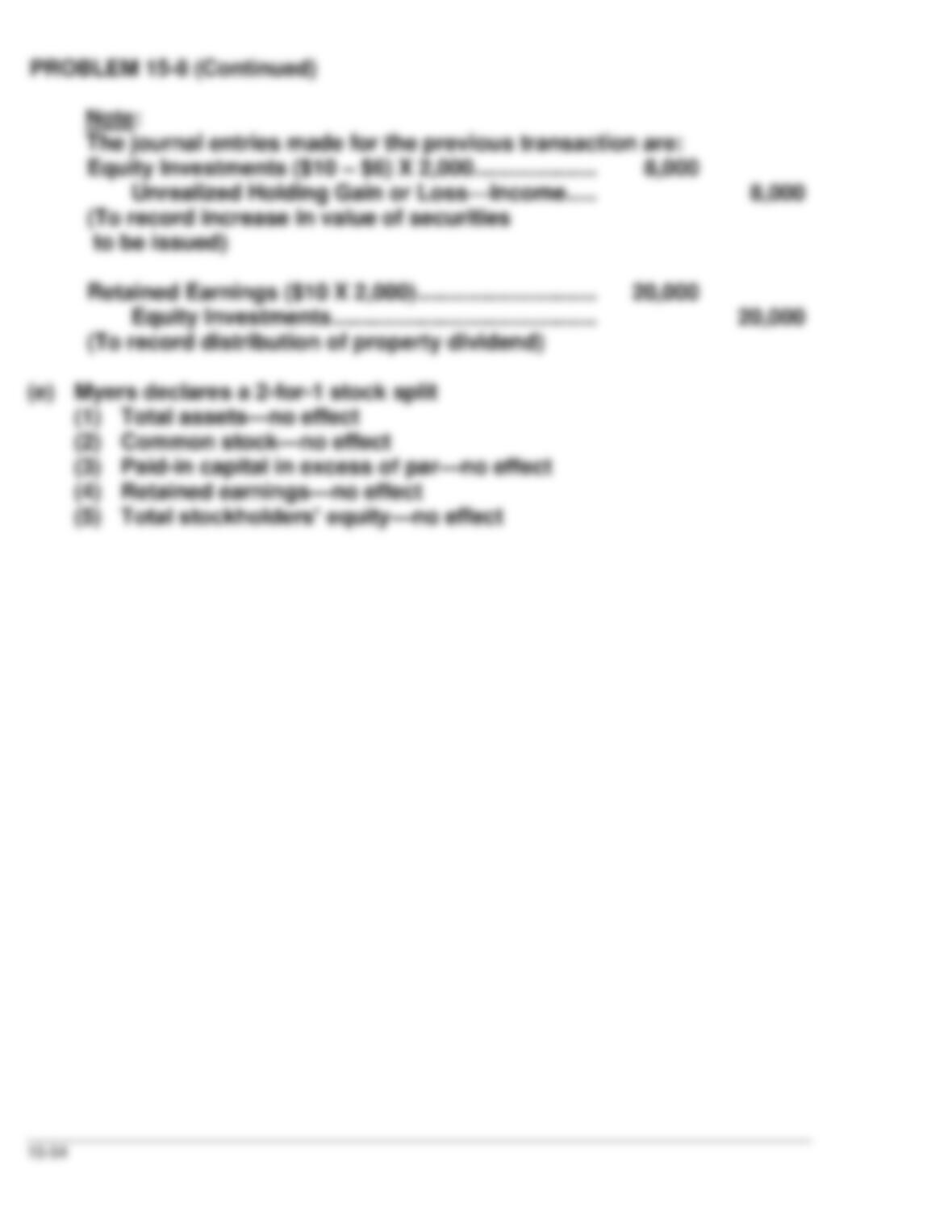
Note:
The journal entries made for the previous transaction are:
Equity Investments ($10 – $6) X 2,000 …………………….
8,000
Unrealized Holding Gain or Loss—Income ……….
8,000
(To record increase in value of securities
to be issued)
Retained Earnings ($10 X 2,000) …………………………..
20,000
Equity Investments …………………………………………
20,000
(To record distribution of property dividend)
(e) Myers declares a 2-for-1 stock split
(1) Total assets—no effect
(2) Common stock—no effect
(3) Paid-in capital in excess of par—no effect
(4) Retained earnings—no effect
(5) Total stockholders’ equity—no effect
15–55
PROBLEM 15-9
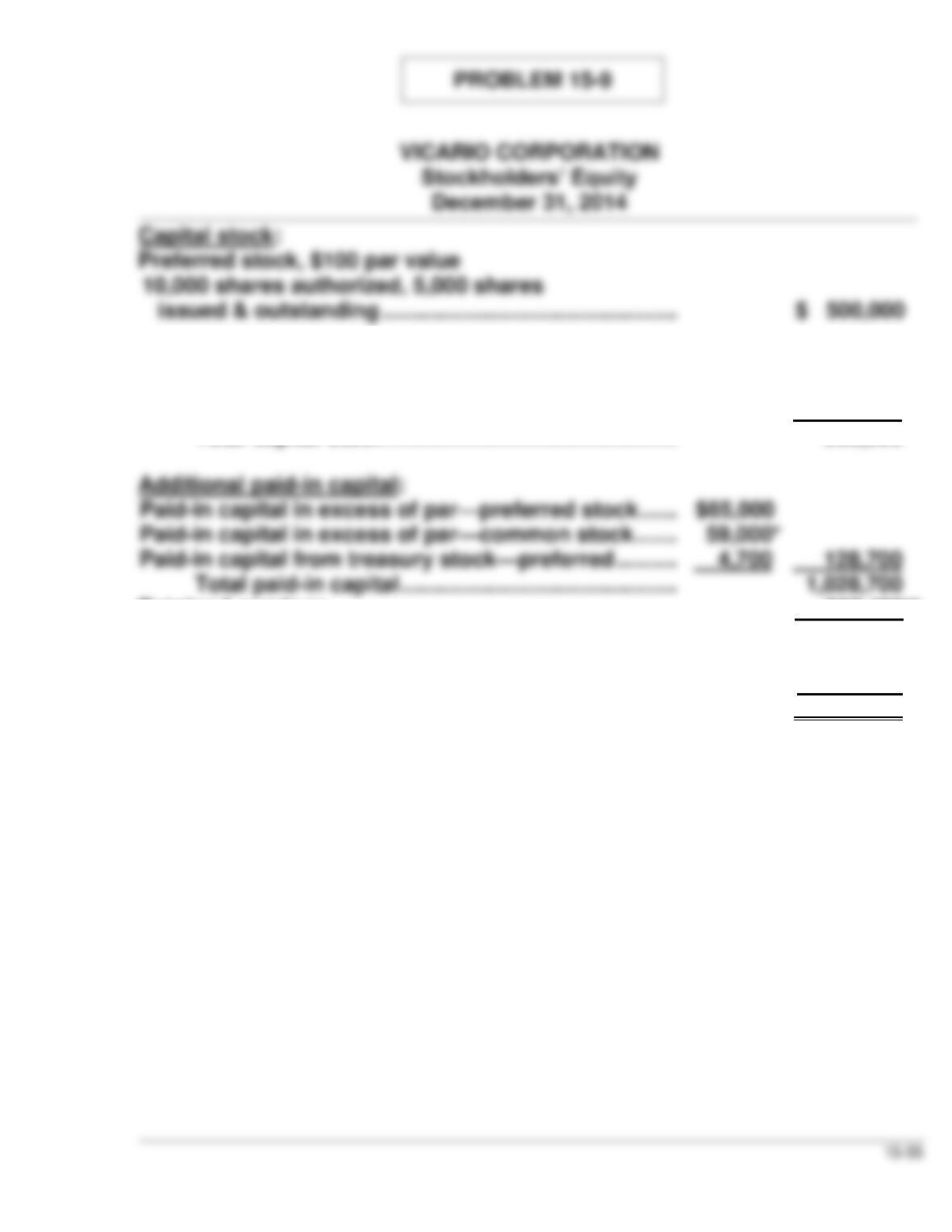
VICARIO CORPORATION
Stockholders’ Equity
December 31, 2014
Capital stock:
Preferred stock, $100 par value
10,000 shares authorized, 5,000 shares
issued & outstanding …………………………………………
$ 500,000
Common stock, $50 par value
15,000 shares authorized,
8,000 shares issued 7,700 shares outstanding ……….
400,000
Total capital stock ………………………………………..
900,000
Retained earnings
237,400**
Total paid-in capital and retained earnings …………….
1,266,100
Less: Cost of treasury stock
(300 shares—common) ……………………………….
19,200
Total stockholders’ equity …………………………….
$1,246,900
*[($57 – $50) X 7,000 + ($60 – $50) X 1,000]
**$610,000 – $312,600 – ($60 X 1,000 shares)
Additional paid-in capital:
Paid-in capital in excess of par—preferred stock ……
Paid-in capital in excess of par—common stock …….
Paid-in capital from treasury stock—preferred ……….
128,700
Total paid-in capital ………………………………………
15–56
PROBLEM 15-10
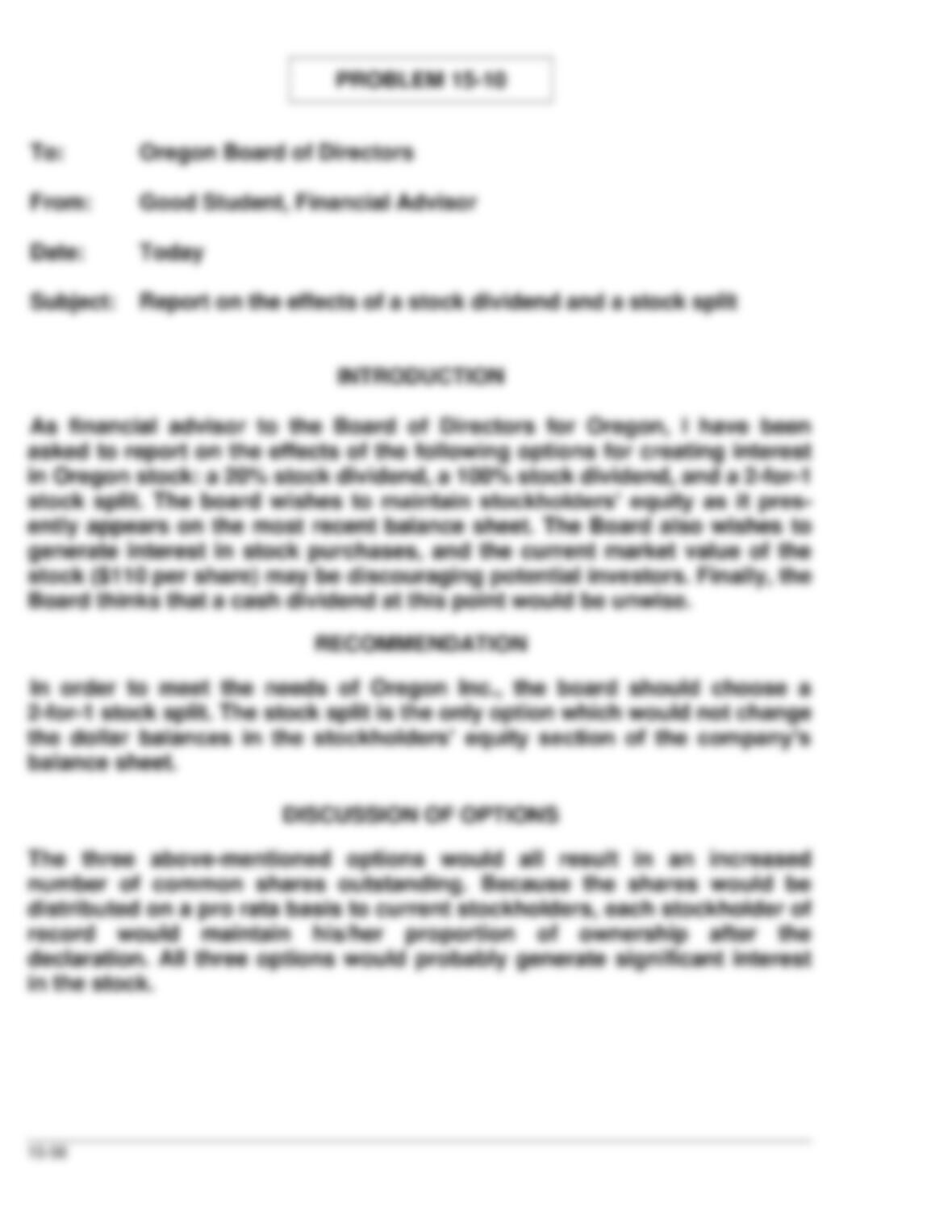
To: Oregon Board of Directors
From: Good Student, Financial Advisor
Date: Today
Subject: Report on the effects of a stock dividend and a stock split
INTRODUCTION
As financial advisor to the Board of Directors for Oregon, I have been
asked to report on the effects of the following options for creating interest
in Oregon stock: a 20% stock dividend, a 100% stock dividend, and a 2-for-1
stock split. The board wishes to maintain stockholders’ equity as it pres–
ently appears on the most recent balance sheet. The Board also wishes to
generate interest in stock purchases, and the current market value of the
stock ($110 per share) may be discouraging potential investors. Finally, the
Board thinks that a cash dividend at this point would be unwise.
DISCUSSION OF OPTIONS
The three above-mentioned options would all result in an increased
number of common shares outstanding. Because the shares would be
distributed on a pro rata basis to current stockholders, each stockholder of
record would maintain his/her proportion of ownership after the
declaration. All three options would probably generate significant interest
in the stock.
15–57
PROBLEM 15-10 (Continued)
A 20% STOCK DIVIDEND
This option would increase the shares outstanding by 20 percent, which
translates into 800,000 additional shares of $10 par value common stock.
The problem with this type of stock dividend is that GAAP requires these
shares to be accounted for at their current market value if it significantly
exceeds par.
The following journal entry must be made to record this dividend.
Retained Earnings ($110 X 800,000) …………………..
88,000,000
Common Stock Dividend Distributable ………..
8,000,000
Paid-in Capital in Excess of Par—
Common Stock ……………………………………….
80,000,000
This option would double the number of $10 par value common stock cur–
rently issued and outstanding. Because this type of dividend is considered,
in substance, a stock split, the shares do not have to be accounted for at
market value. Instead, Retained Earnings is reduced only by the par value
of the additional shares, while Common Stock Dividend Distributable and,
later, Common Stock are increased for that same amount. However, when
4,000,000 shares are already issued and outstanding, the reduction in
Retained Earnings reflecting the stock dividend is still great: $40,000,000.
In addition, no increase in any Paid-in Capital account occurs.
The following journal entry would be made to record the declaration of this
dividend:
Retained Earnings ($10 X 4,000,000) ………………….
40,000,000
Common Stock Dividend Distributable ………..
40,000,000
15–58
PROBLEM 15-10 (Continued)
A 2-FOR-1 STOCK SPLIT
This option doubles the number of shares issued and outstanding; however,
it also cuts the par value per share in half. No accounting treatment beyond
a memorandum entry is required for the split because the effect of splitting
the par value cancels out the effect of doubling the number of shares.
Therefore, Retained Earnings remains unchanged as does the Common
Stock and Paid-in Capital Accounts. In addition, the decreased market value
will encourage investors who might otherwise consider the stock too
expensive.
CONCLUSION
To generate the greatest interest in Oregon stock while maintaining the
present balances in the stockholders’ equity section of the balance sheet,
you should opt for the 2-for-1 stock split.
15–59
PROBLEM 15-11
(a)
May 5, 2012
Retained Earnings ………………………………………. 1,800,000
Dividends Payable …………………………………. 1,800,000
(Declaration of cash dividend of
$0.60 per share on 3,000,000 shares)
June 30, 2012
Dividends Payable ……………………………………… 1,800,000
Cash ……………………………………………………… 1,800,000
Distributable ……………………………………….. 1,800,000
Paid-in Capital in
Excess of Par—Common Stock ……………. 4,320,000
(Stock dividend of 6%, 180,000
shares, at $34 per share)
December 31, 2012
Common Stock Dividend Distributable ………….. 1,800,000
Common Stock ………………………………………….. 1,800,000
3,180,000 shares ………………………………………..
$31,800,000
Additional paid-in capital …………………………..……………..
9,320,000
Retained earnings …………………………………………………….
20,780,000
Total stockholders’ equity …………………………..
$61,900,000
15–60
PROBLEM 15-11 (Continued)
Statement of Retained Earnings
For the Year Ended December 31, 2012
Balance, January 1 …………………………….
$24,000,000
Add: Net income ………………………………
4,700,000
28,700,000
Less: Dividends on common stock:
Cash ………………………………………..
$1,800,000
Stock (see note) ……………………….
6,120,000
7,920,000
Balance December 31 …………………………
$20,780,000
Balance January 1 ……………………………..
$5,000,000
Excess of fair value over par value of
180,000 shares of common stock
distributed as a dividend (see note) ……
4,320,000
Balance December 31 …………………………
$9,320,000
Note: The 6% stock dividend (180,000 shares) was declared on November 30,
2012. For the purposes of the dividend, the stock was assigned a price of
$34 per share. The par value of $10 per share ($1,800,000) was credited to
Common Stock and the excess of $24 ($34 – $10) per share ($4,320,000) to