EXERCISE 15-6 (25–30 minutes)
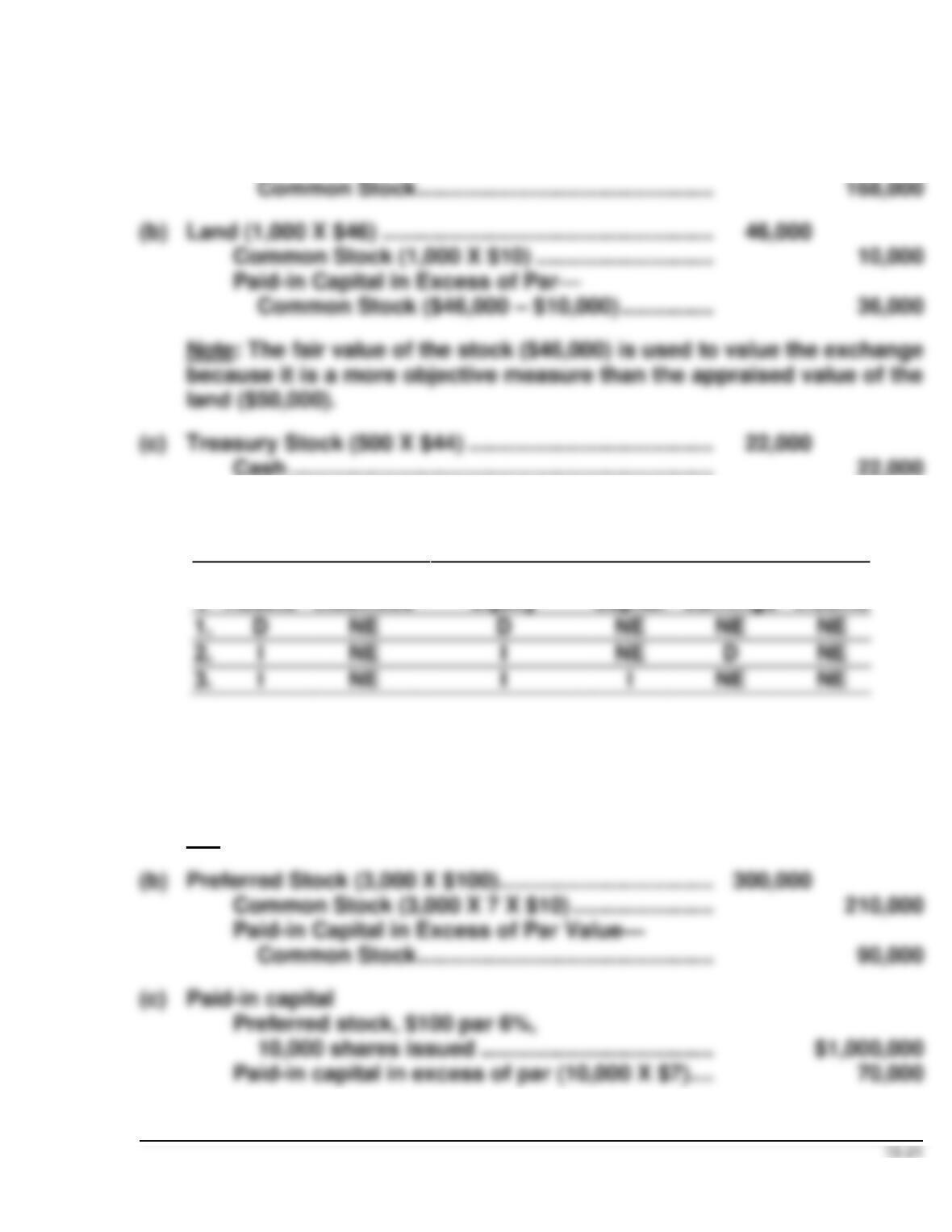
(a) Cash [(5,000 X $45) – $7,000] ………………………………. 218,000
Common Stock (5,000 X $10) ……………………….. 50,000
Paid-in Capital in Excess of Par—
EXERCISE 15-7 (15–20 minutes)
#
Assets
Liabilities
Stockholders’
Equity
Paid-in
Capital
Retained
Earnings
Net
Income
EXERCISE 15-8 (15–20 minutes)
(a) $1,000,000 X 6% = $60,000; $60,000 X 3 = $180,000. The cumulative
dividend is disclosed in a note to the stockholders’ equity section; it is
not reported as a liability.
15–22
EXERCISE 15-9 (15–20 minutes)
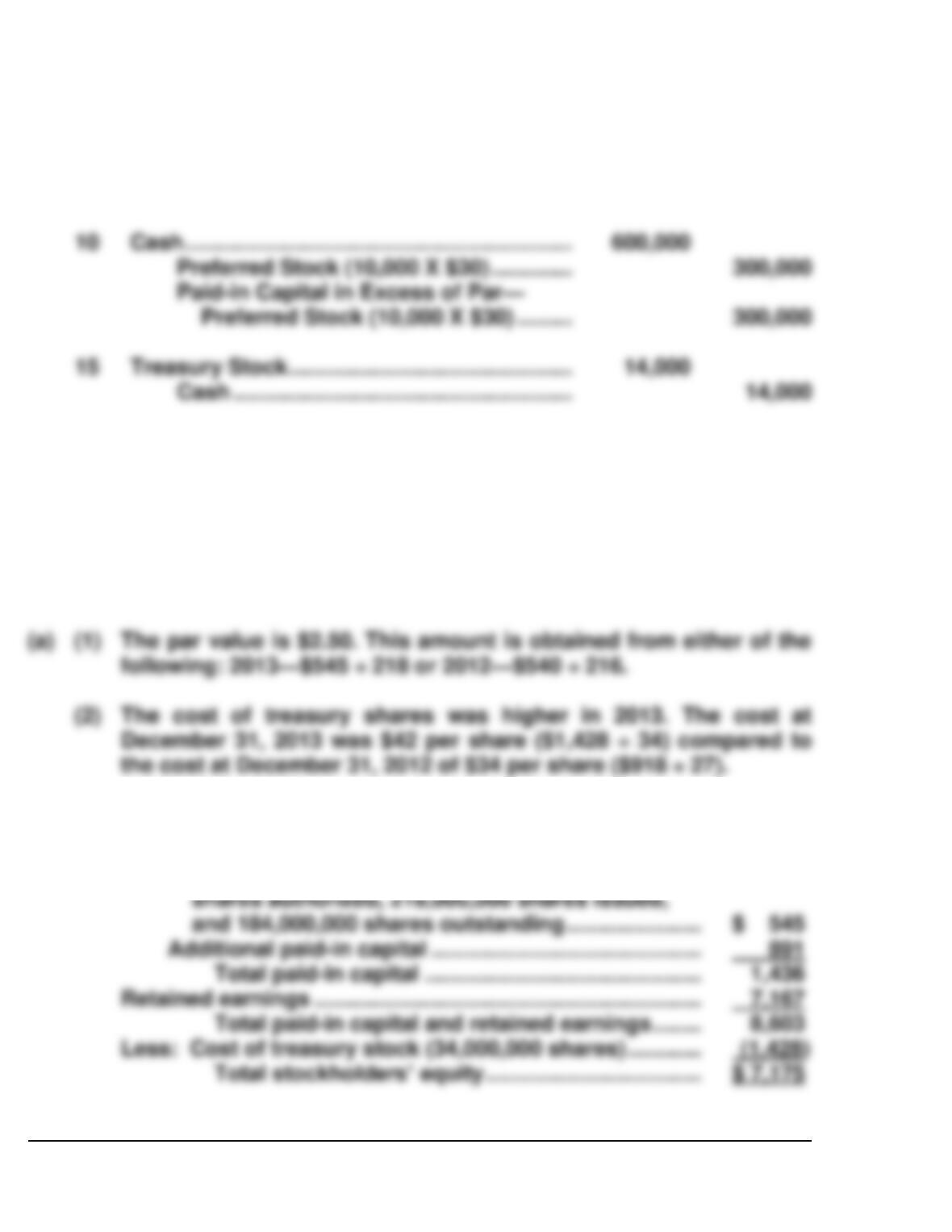
May 2 Cash …………………………..…………………………. 192,000
Common Stock (12,000 X $10) …………. 120,000
Paid-in Capital in Excess of Par—
Common Stock (12,000 X $6) ……….. 72,000
31 Cash …………………………..…………………………. 8,500
Treasury Stock (500 X $14) ………………. 7,000
Paid-in Capital from Treasury
Stock (500 X $3) …………………………... 1,500
EXERCISE 15-10 (20–25 minutes)
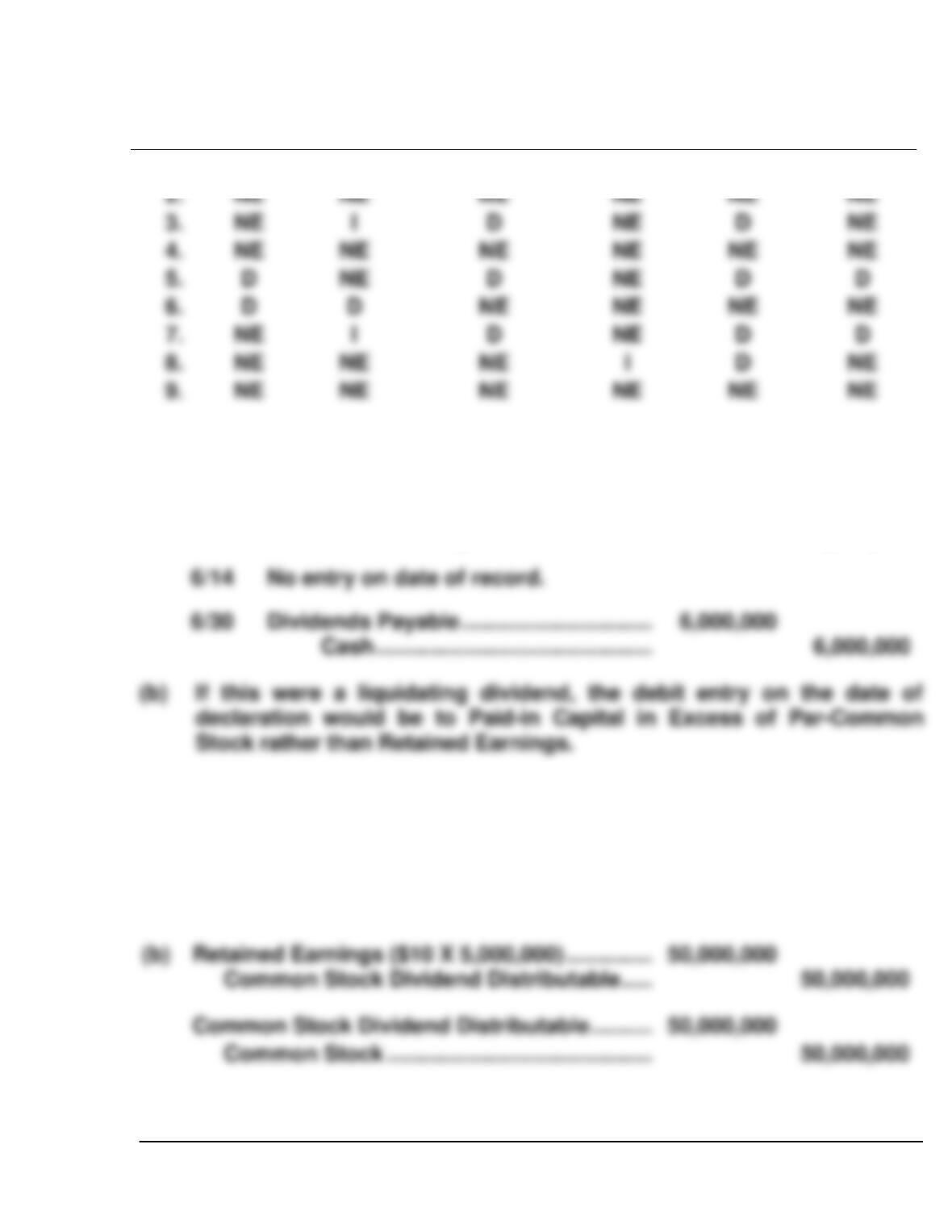
(b) Stockholders’ equity (in millions of dollars)
Paid-in capital
Common stock, $2.50 par value, 500,000,000
15–23
EXERCISE 15-11 (15–20 minutes)
Item
Assets
Liabilities
Stockholders’
Equity
Paid-in
Capital
Retained
Earnings
Net
Income
1.
I
NE
I
NE
I
I
EXERCISE 15-12 (10–15 minutes)
(a)
6/1
Retained Earnings …………………………..
6,000,000
Dividends Payable …………………………..
6,000,000
6/30
Dividends Payable …………………………..
6,000,000
Cash ……………………………………………………….
6,000,000
EXERCISE 15-13 (10–15 minutes)
(a) No entry—simply a memorandum note indicating the number of shares
has increased to 10 million and par value has been reduced from
$10 to $5 per share.
(b)
Retained Earnings ($10 X 5,000,000) ………………………..
2.
NE
NE
3.
NE
4.
NE
NE
5.
NE
NE
6.
NE
7.
NE
8.
NE
9.
NE
NE
EXERCISE 15-13 (Continued)
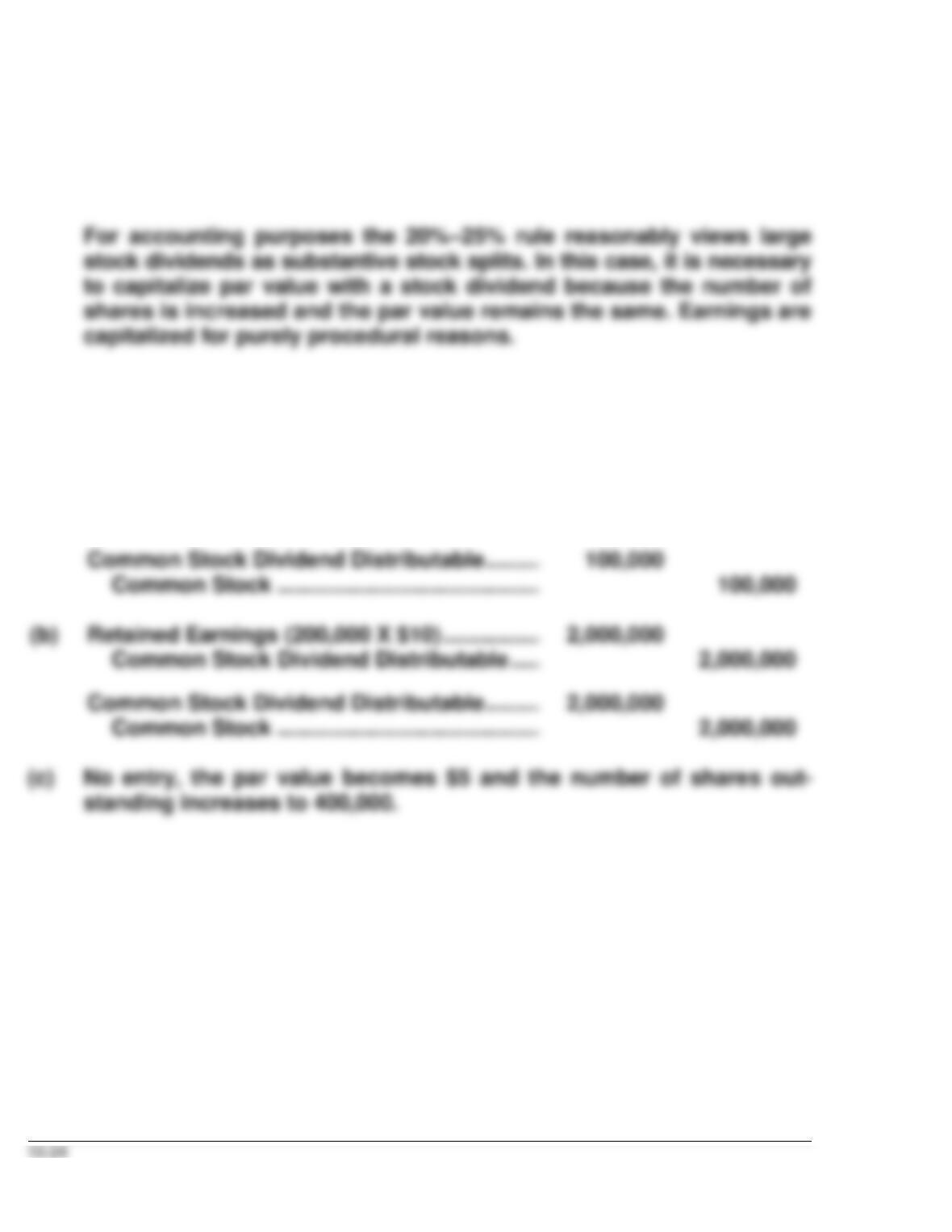
(c) Stock dividends and splits serve the same function with regard to the
securities markets. Both techniques allow the board of directors to
increase the quantity of shares and reduce share prices into a desired
“trading range.”
EXERCISE 15-14 (10–12 minutes)
(a)
Retained Earnings (10,000 X $37) …………………………..
370,000
Common Stock Dividend Distributable …………………
100,000
Paid-in Capital in Excess of Par—
Common Stock ………………………………………………..
270,000
Common Stock Dividend Distributable …………………….
Common Stock …………………………………………………..
(b)
Retained Earnings (200,000 X $10) …………………………..
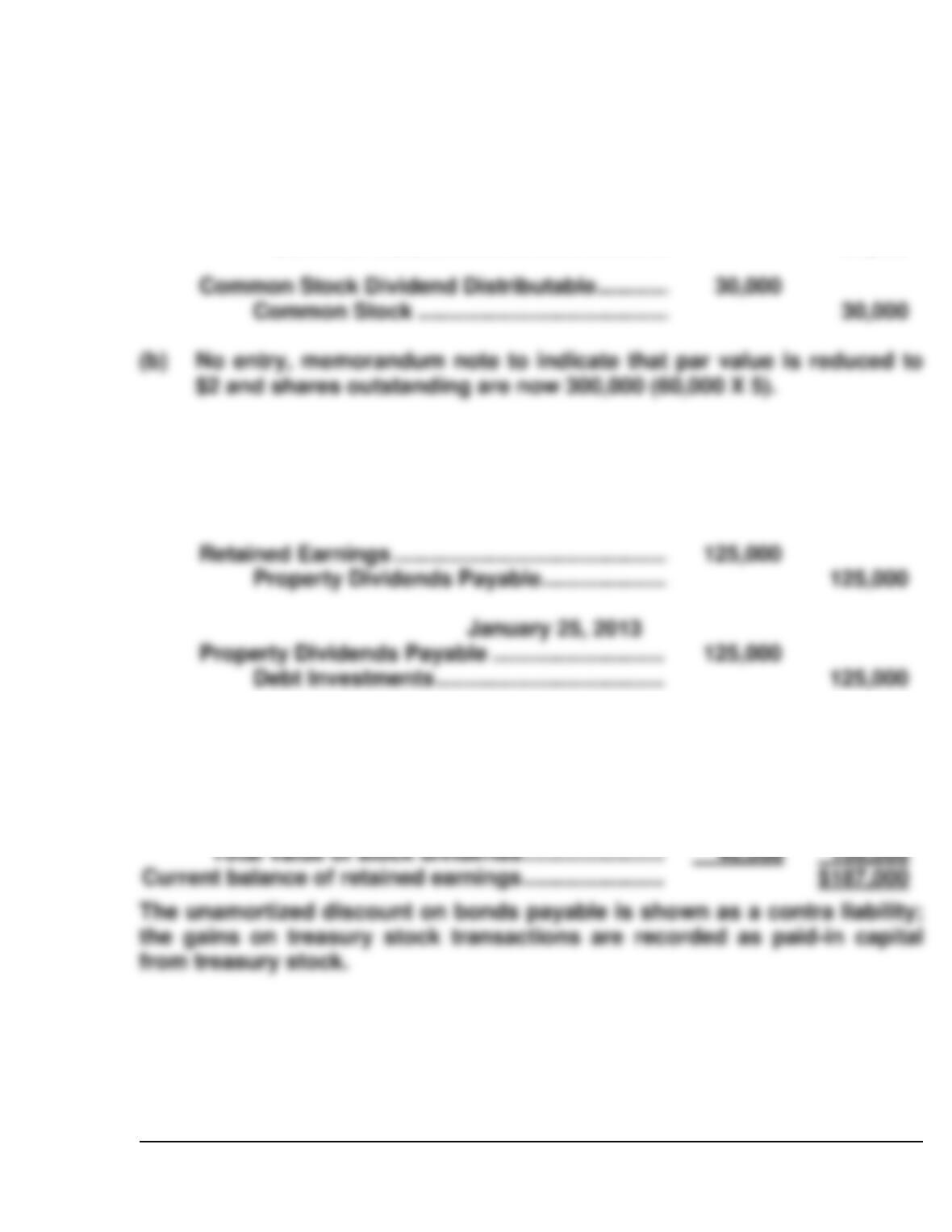
Common Stock Dividend Distributable …………………
Common Stock Dividend Distributable …………………….
Common Stock …………………………………………………..
15–25
EXERCISE 15-15 (10–15 minutes)
(a)
Retained Earnings
(60,000 shares X 5% X $39 = $117,000) ………………….
117,000
Common Stock Dividend
Distributable ………………………………………………..
30,000
Paid-in Capital in Excess of Par—
Common Stock…………………………………………….
87,000
(c)
January 5, 2013
Debt Investments ……………………………………………………
35,000
Unrealized Holding Gain or
Loss – Income ……………………………………………..
35,000
Retained Earnings …………………………..……………………..
Property Dividends Payable …………………………..
Property Dividends Payable …………………………..
Debt Investments ……………………………………………
EXERCISE 15-16 (5–10 minutes)
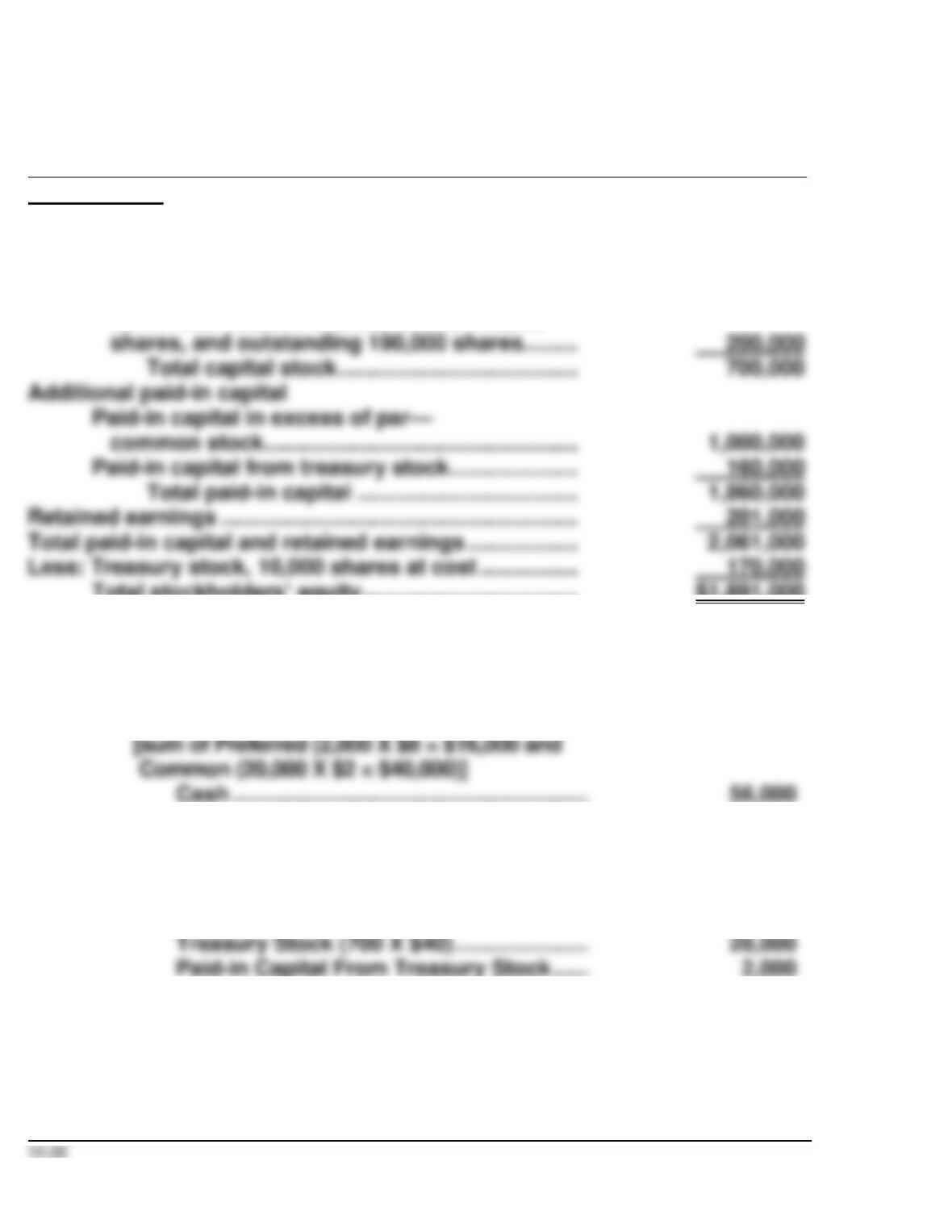
Total income since incorporation ………………………..
$287,000
Less: Total cash dividends paid …………………………
$ 60,000
Total value of stock dividends …………………..
Current balance of retained earnings …………………..
$187,000
Common Stock Dividend Distributable …………………….
Common Stock ………………………………………………
EXERCISE 15-17 (20–25 minutes)
Teller Corporation
Stockholders’ Equity
December 31, 2012
Capital stock
Preferred stock, $4 cumulative, par value $50
per share; authorized 60,000 shares, issued
and outstanding 10,000 shares ……………………
$ 500,000
Common stock, par value $1 per share;
authorized 600,000 shares, issued 200,000
shares, and outstanding 190,000 shares ………
200,000
Total capital stock …………………………………
Additional paid-in capital
Paid-in capital from treasury stock …………………
160,000
Total paid-in capital ………………………………
Retained earnings …………………………..……………………..
Total paid-in capital and retained earnings ………………
Less: Treasury stock, 10,000 shares at cost …………….
170,000
Total stockholders’ equity ……………………………..
$1,891,000
EXERCISE 15-18 (30–35 minutes)
(a)
1.
Dividends Payable ……………………………………………………
56,000
Cash ……………………………………………………….
2.
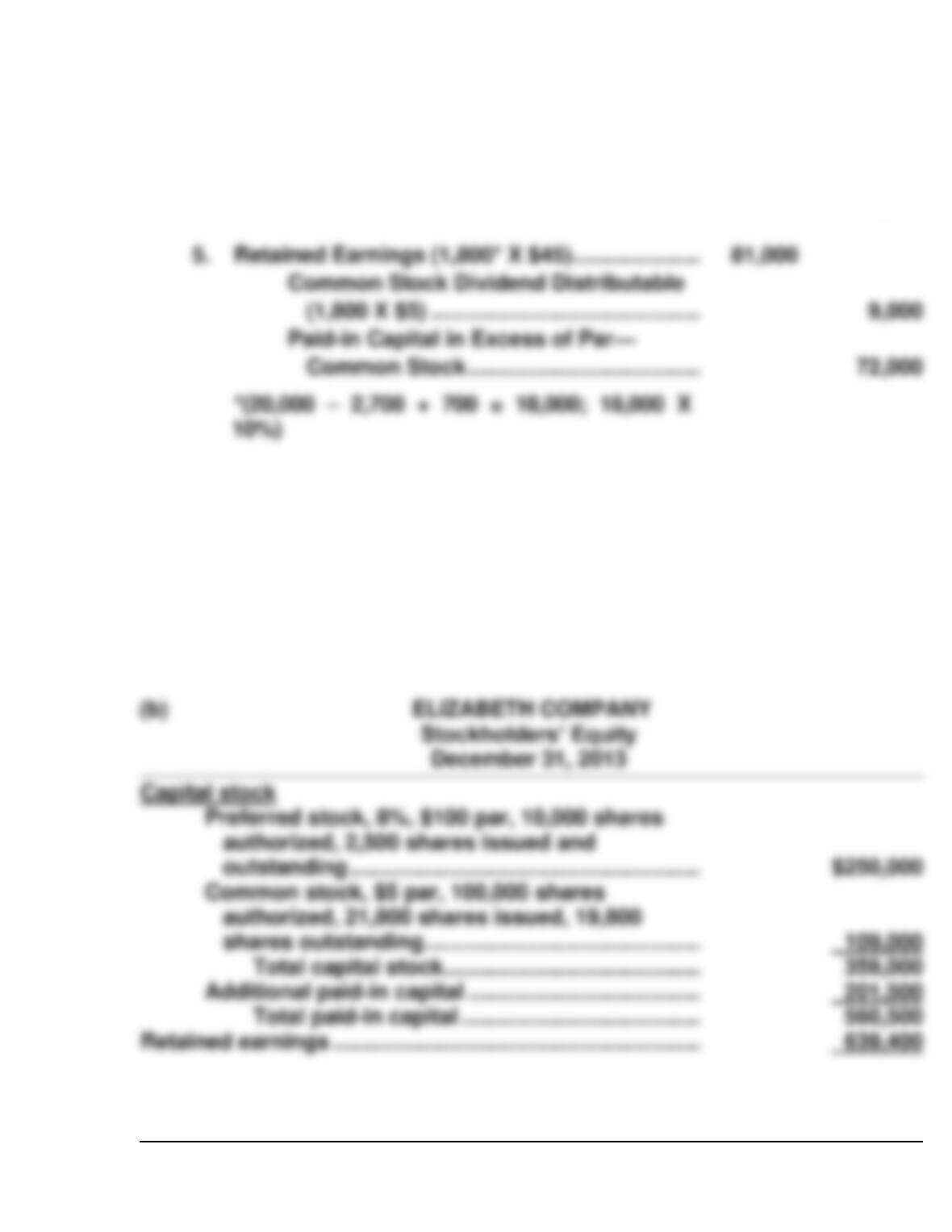
Treasury Stock ……………………………………………………….
108,000
Cash (2,700 X $40) …………………………………………..
108,000
3.
Land ………………………………………………………………………
30,000
Treasury Stock (700 X $40) …………………………..
Paid-in Capital From Treasury Stock ………………..
15–27
EXERCISE 15-18 (Continued)
4.
Cash (500 X $105) …………………………………………………..
52,500
Preferred Stock (500 X $100) …………………………..
50,000
Paid-in Capital in Excess of Par—
Preferred Stock ……………………………………………
2,500
6.
Common Stock Dividend Distributable …………………….
9,000
Common Stock ……………………………………………….
9,000
7.
Retained Earnings ………………………………………………….
59,600
Dividends Payable …………………………………………
59,600
[sum of Preferred (2,500 X $8 =
$20,000) and Common (19,800
(18,000 + 1,800) X $2 = $39,600)]
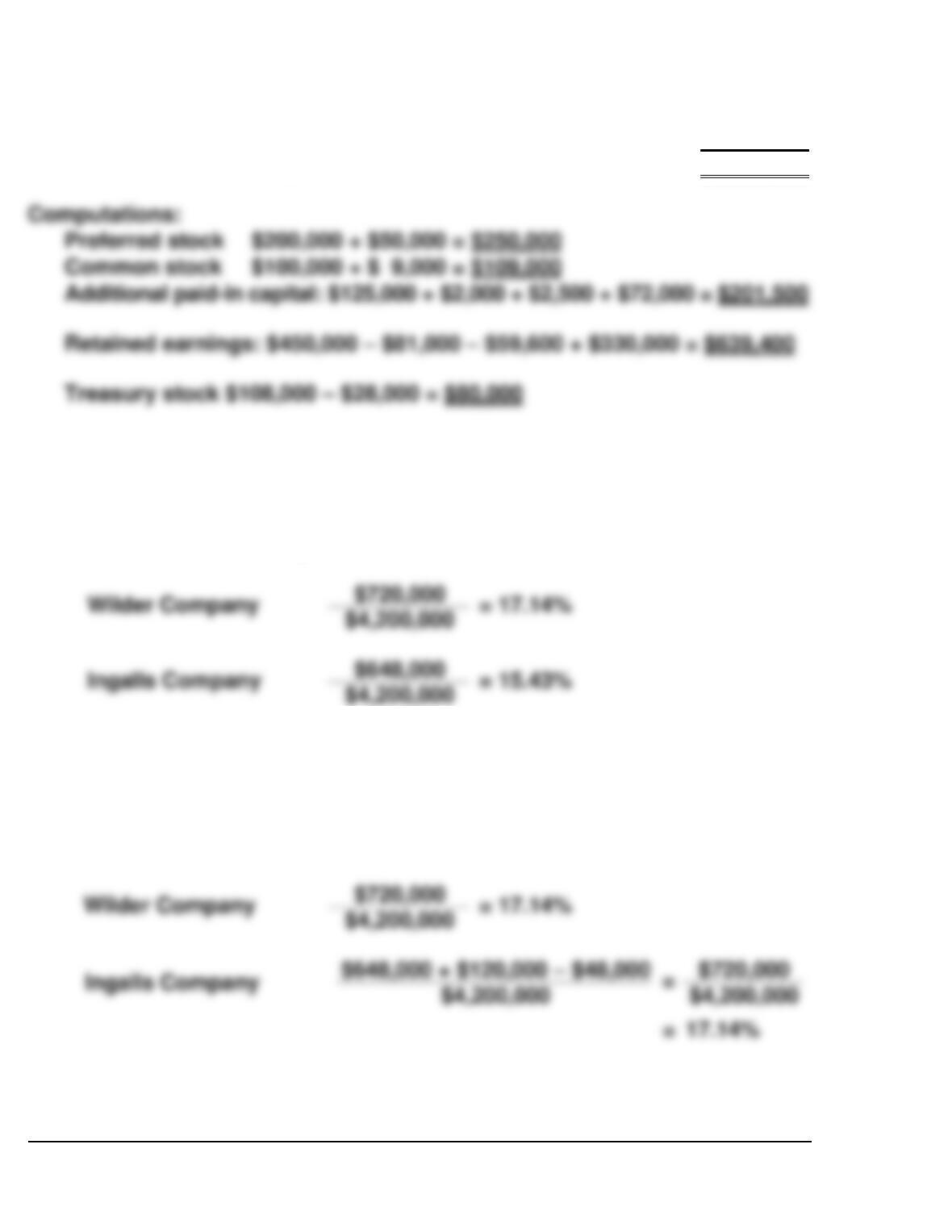
5.
Retained Earnings (1,800* X $45) …………………………..
81,000
Common Stock Dividend Distributable
(1,800 X $5) ………………………………………………….
9,000
Paid-in Capital in Excess of Par—
Common Stock …………………………………………….
72,000
15–28
EXERCISE 15-18 (Continued)
Total paid-in capital and retained earnings …………………..
1,199,900
Less: Cost of treasury stock (2,000 shares common) …….
80,000
Total stockholders’ equity …………………………………………..
$1,119,900
EXERCISE 15-19 (20–25 minutes)
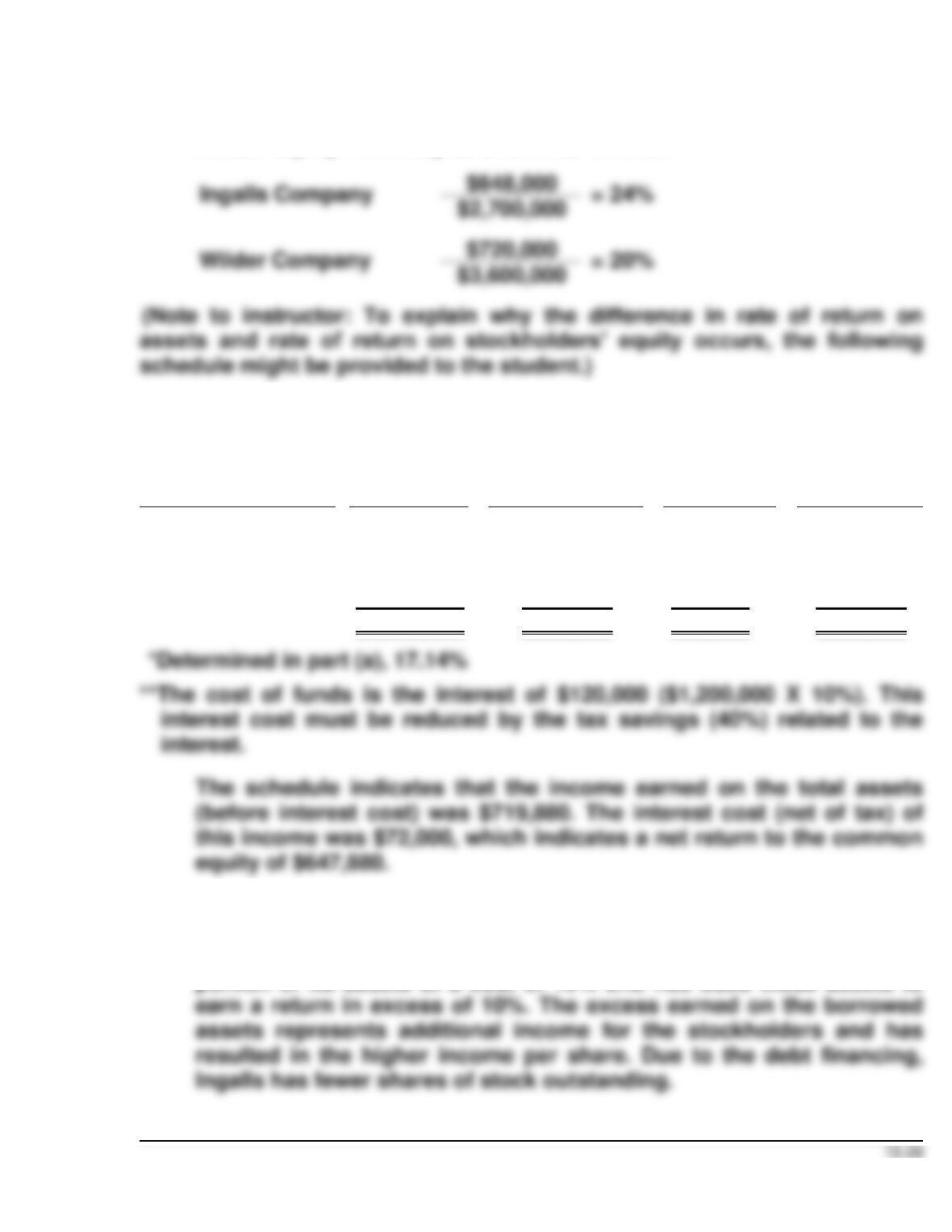
(a) Wilder Company is the more profitable in terms of rate of return on
total assets. This may be shown as follows:
It should be noted that these returns are based on net income related
to total assets, where the ending amount of total assets is considered
representative. If the rate of return on total assets uses net income
before interest but after taxes in the numerator, the rates of return on
total assets are the same as shown below:
EXERCISE 15-19 (Continued)
(b) Ingalls Company is the more profitable in terms of return on stock–
holder’ equity. This may be shown as follows:
Ingalls Company
Funds Supplied
Funds
Supplied
Rate of Return
on Funds at
17.14%*
Cost of
Funds
Accruing to
Common
Stock
Current liabilities
$ 300,000
$ 51,420
$ 0
$ 51,420
Long-term debt
1,200,000
205,680
72,000**
133,680
Common stock
2,000,000
342,800
0
342,800
Retained earnings
700,000
119,980
0
119,980
$4,200,000
$719,880
$72,000
$647,880
(c) The Ingalls Company earned a net income per share of $6.48 ($648,000 ÷
100,000) while Wilder Company had an income per share of $4.97
($720,000 ÷ 145,000). Ingalls Company has borrowed a substantial
portion of its assets at a cost of 10% and has used these assets to
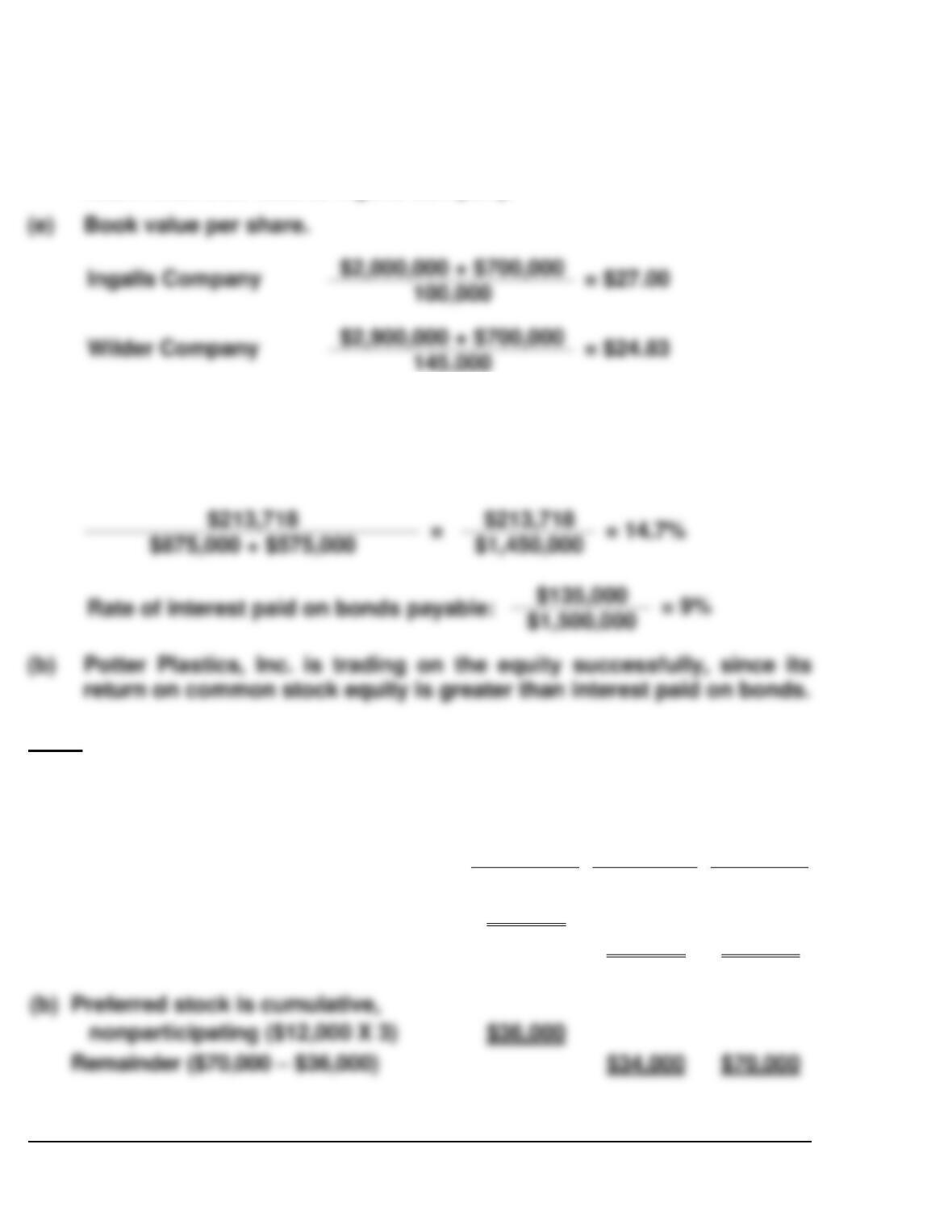
15–30
EXERCISE 15-19 (Continued)
(d) Yes, from the point of view of income it is advantageous for the stock–
holders of Ingalls Company to have long-term debt outstanding. The
assets obtained from incurrence of this debt are earning a higher
return than their cost to Ingalls Company.
EXERCISE 15-20 (15 minutes)
(a) Rate of return on common stock equity:
Note: Some analysts use after-tax interest expense to compute the bond rate.
*EXERCISE 15-21 (10–15 minutes)
Preferred
Common
Total
(a)
Preferred stock is noncumulative,
nonparticipating (2,000 X $100 X 6%)
$12,000
Remainder ($70,000 – $12,000)
$58,000
$70,000
(b)
Preferred stock is cumulative,
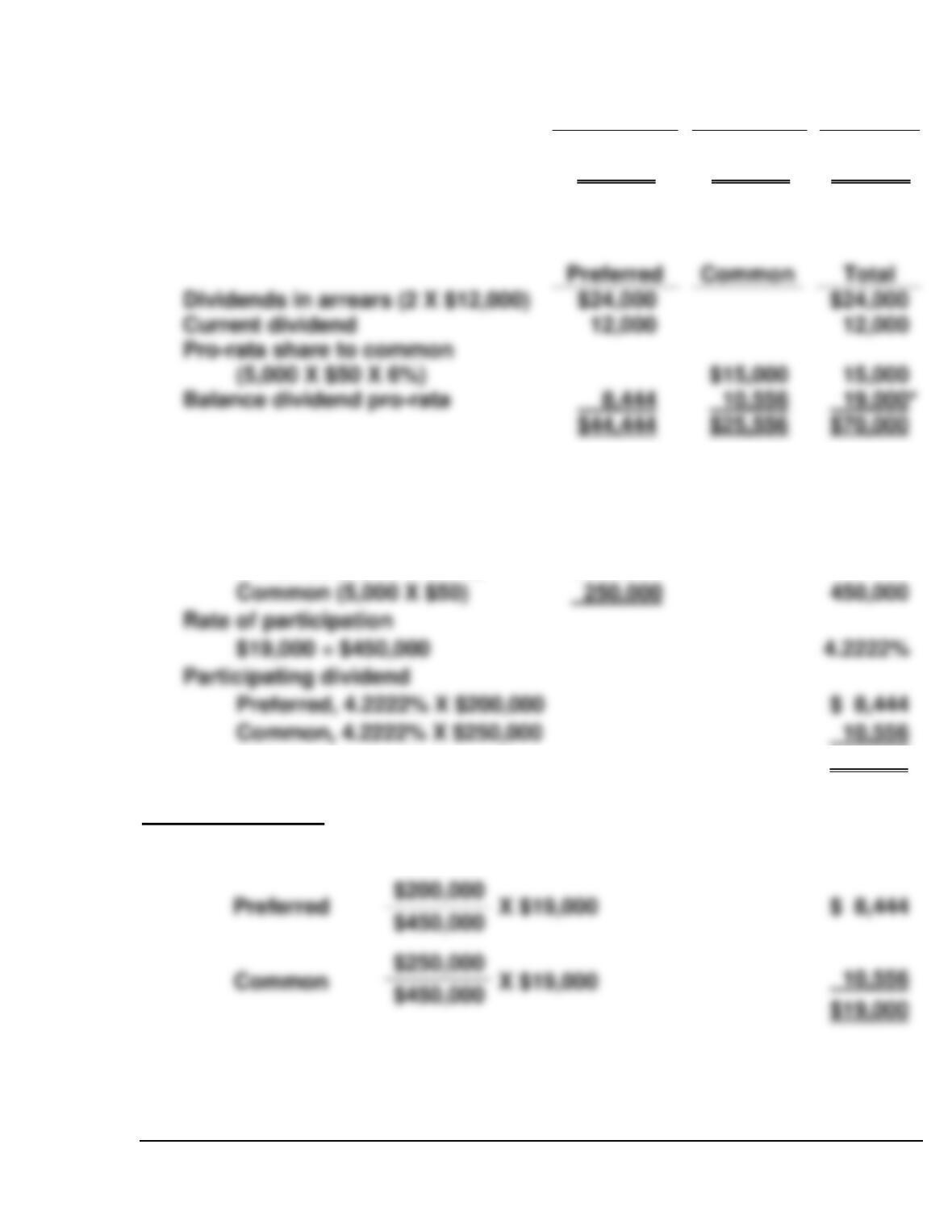
15–31
*EXERCISE 15-21 (Continued)
Preferred
Common
Total
(c)
Preferred stock is cumulative,
participating
$44,444
$25,556
$70,000
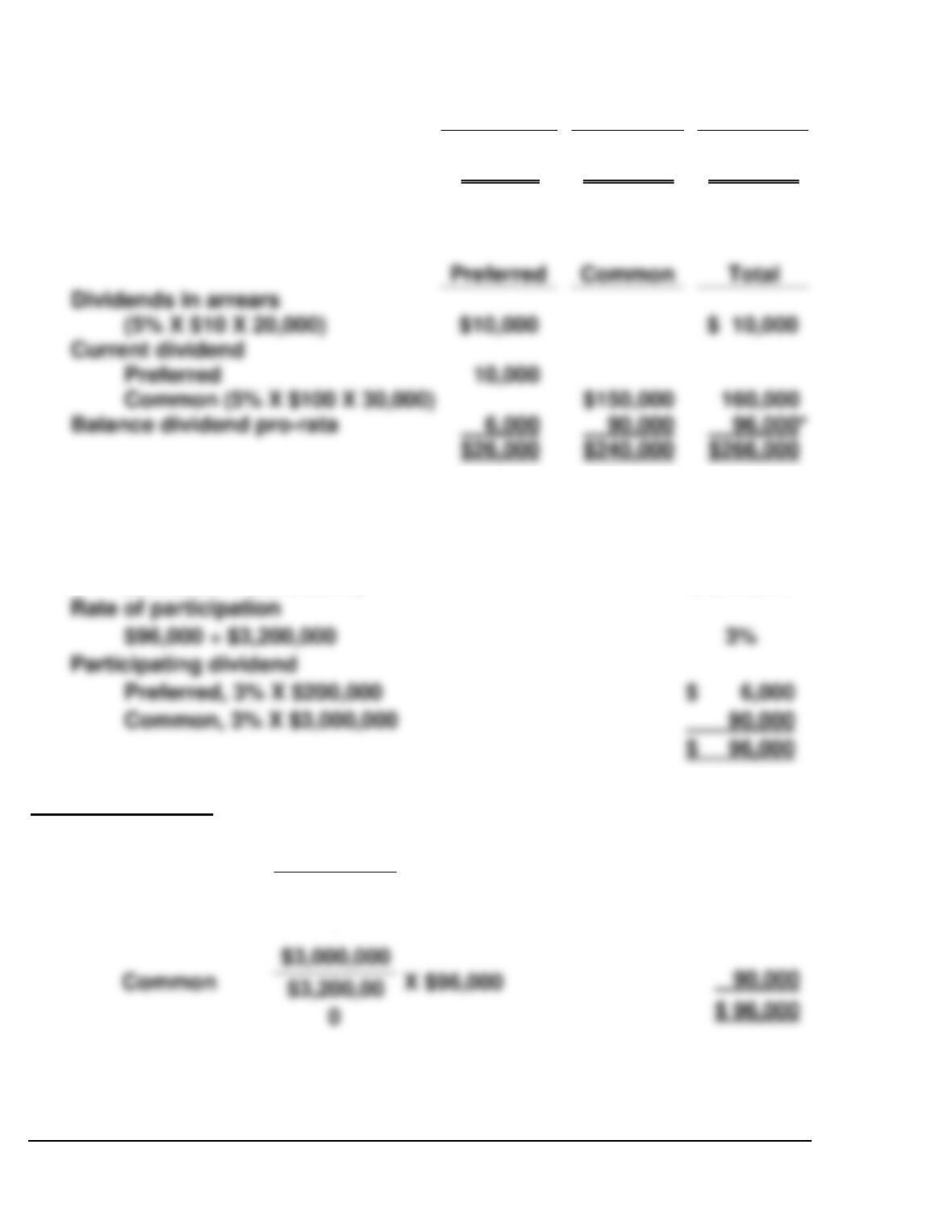
The computation for these amounts is as follows:
*Additional amount available for participation
($70,000 – $24,000 – $12,000 – $15,000)
19,000
Par value of stock that is to participate
Preferred (2,000 X $100)
$200,000
Common (5,000 X $50)
450,000
Rate of participation
$19,000 ÷ $450,000
4.2222%
Participating dividend
Preferred, 4.2222% X $200,000
$ 8,444
Common, 4.2222% X $250,000
10,556
$19,000
Note to instructor: Another way to compute the participating
amount is as follows:
Common
Pro-rata share to common
$44,444
$70,000
15–32
*EXERCISE 15-22 (15–20 minutes)
Preferred
Common
Total
(a)
Preferred stock is cumulative and
fully participating
$26,000
$240,000
$266,000
The computation for these amounts is as follows:
*Additional amount available for participation
($266,000 – $10,000 – $160,000)
$ 96,000
Par value of stock that is to participate
($200,000 + $3,000,000)
$3,200,000
Rate of participation
Participating dividend
Preferred, 3% X $200,000
$ 6,000
Common, 3% X $3,000,000
90,000
$ 96,000
Note to instructor: Another way to compute the participating
amount is as follows:
Preferred
$200,000
X $96,000
$ 6,000
$3,200,00
0
$3,000,000
Current dividend
Balance dividend pro-rata
$26,000
$240,000
$266,000
15–33
*EXERCISE 15-22 (Continued)
Preferred
Common
Total
(b)
Preferred stock is noncumulative
and nonparticipating
$10,000
$256,000
$266,000
The computation for these amounts is as follows:
Preferred
Common
Total
(c)
Preferred stock is noncumulative
and participating in distributions
in excess of 7%
$12,875
$253,125
$266,000
Preferred
Common
Total
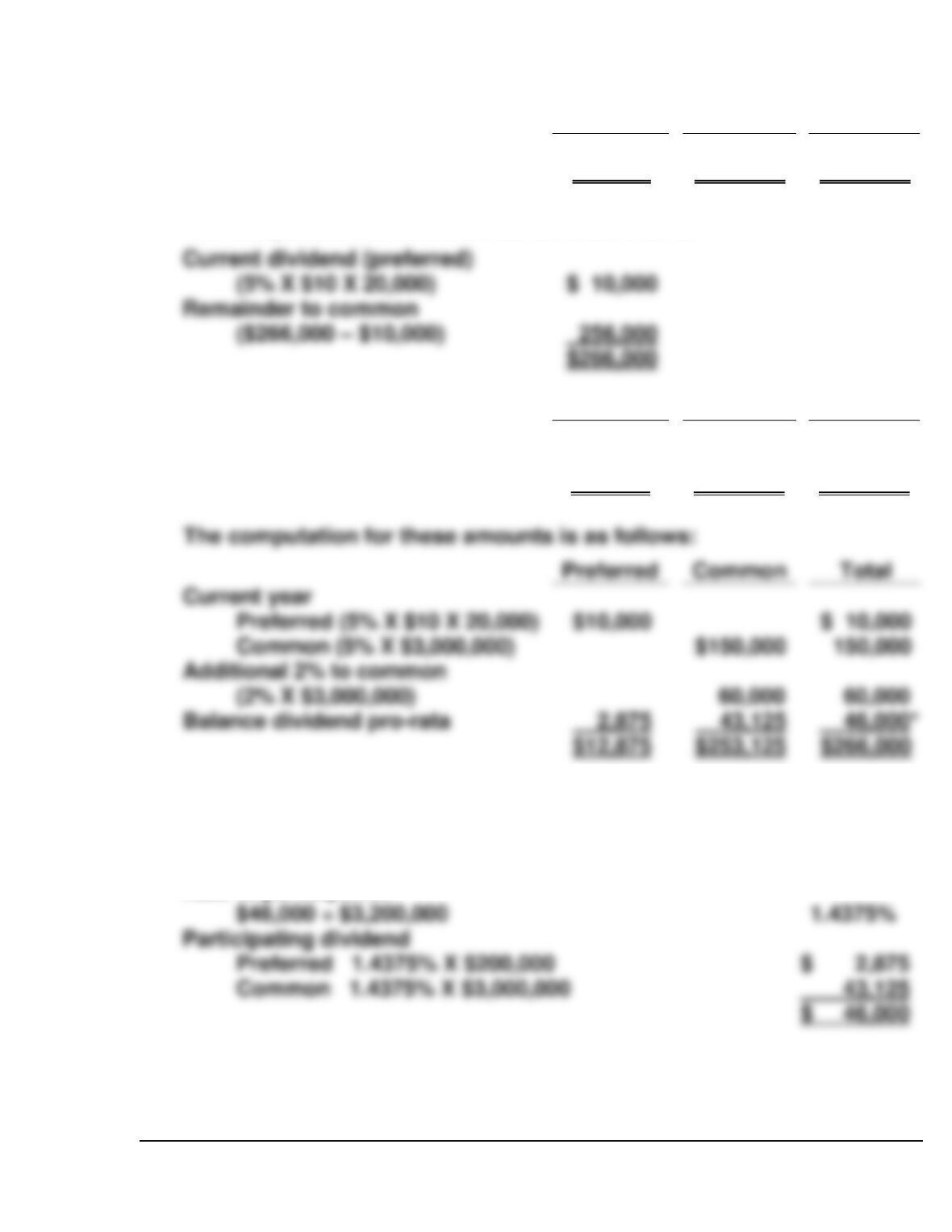
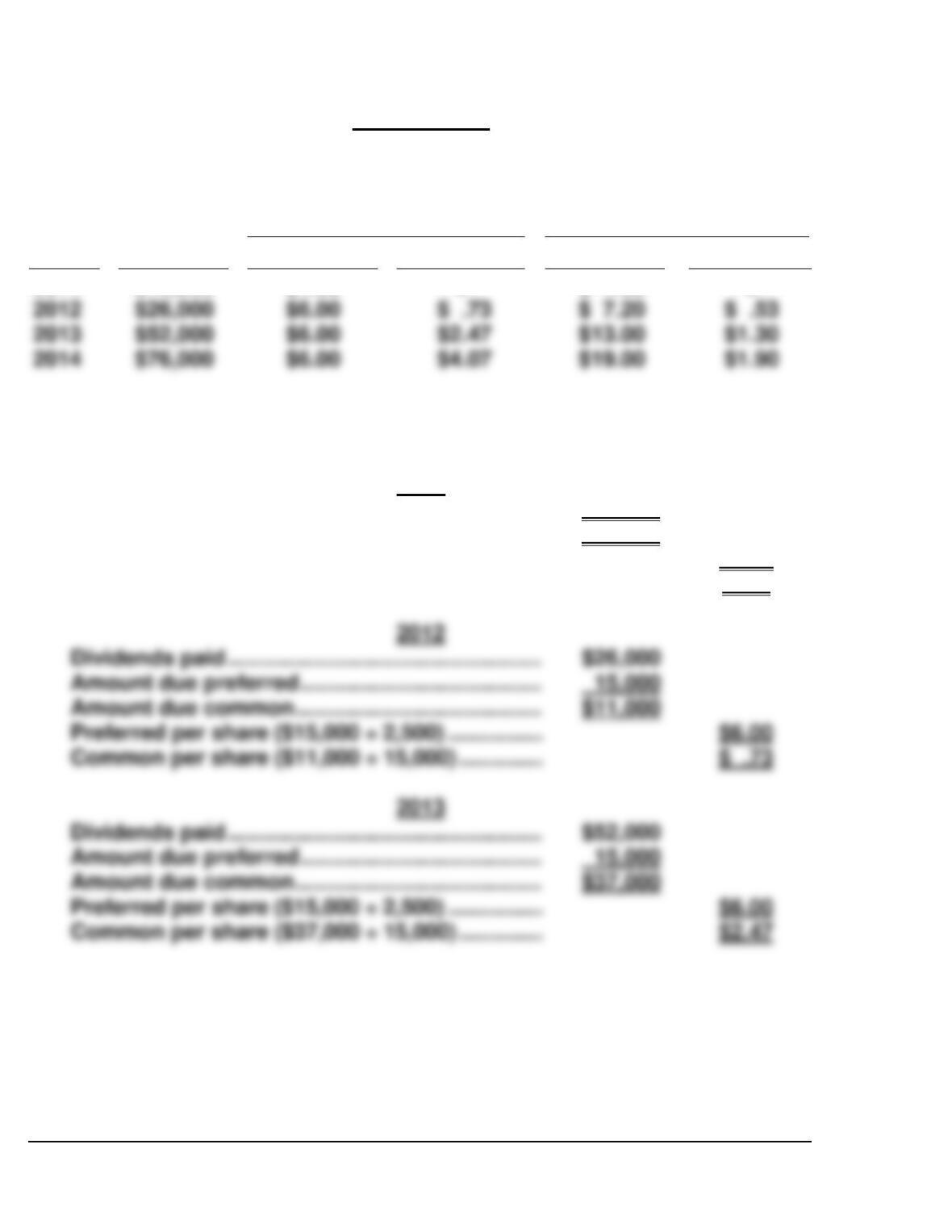
Current year
Preferred (5% X $10 X 20,000)
Common (5% X $3,000,000)
Balance dividend pro-rata
46,000*
$12,875
$253,125
$266,000
*Additional amount available for participation
($266,000 – $10,000 – $150,000 – $60,000)
$ 46,000
Par value of stock that is to participate
($200,000 + $3,000,000)
$3,200,000
Rate of participation
$46,000 ÷ $3,200,000
Participating dividend
Preferred 1.4375% X $200,000
Common 1.4375% X $3,000,000
Current dividend (preferred)
(5% X $10 X 20,000)
Remainder to common
($266,000 – $10,000)
15–34
*EXERCISE 15-23 (15–20 minutes)
Assumptions
(a)
(b)
Preferred, noncumulative,
and nonparticipating
Preferred, cumulative,
and fully participating
Year
Paid-out
Preferred
Common
Preferred
Common
2011
$12,000
$4.80
–0–
$ 4.80
–0–
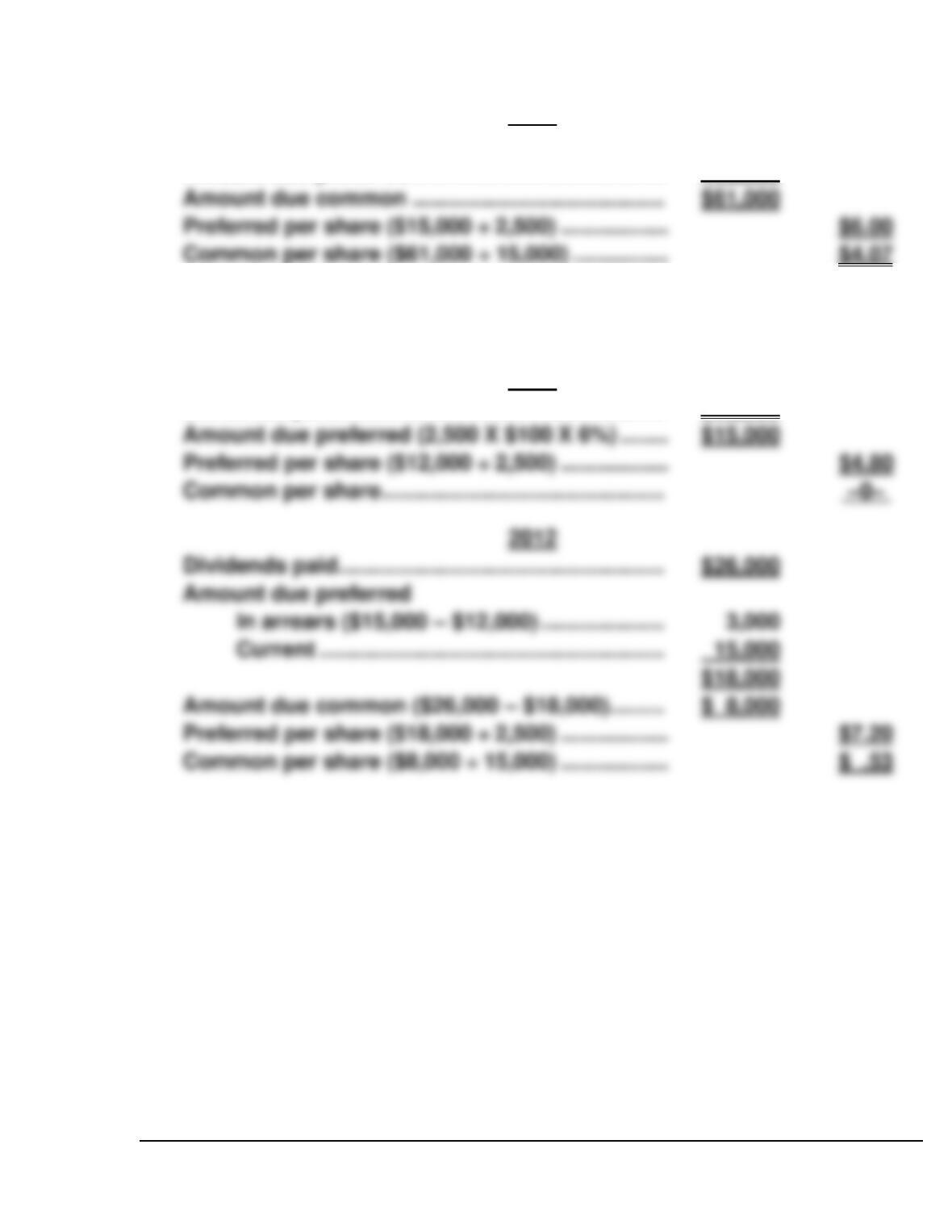
The computations for part (a) are as follows:
2011
Dividends paid ……………………………………………
$12,000
Amount due preferred (2,500 X $100 X 6%) ……
$15,000
Preferred per share ($12,000 ÷ 2,500) …………….
$4.80
Common per share ……………………………………..
–0–
Dividends paid ……………………………………………
$26,000
Amount due preferred …………………………………
Amount due common …………………………..……..
Preferred per share ($15,000 ÷ 2,500) …………….
Common per share ($11,000 ÷ 15,000) …………..
$ .73
Dividends paid ……………………………………………
Amount due preferred …………………………………
Amount due common …………………………..……..
$37,000
Preferred per share ($15,000 ÷ 2,500) …………….
$6.00
Common per share ($37,000 ÷ 15,000) …………..
$2.47
2014
$76,000
$6.00
$19.00
15–35
*EXERCISE 15-23 (Continued)
2014
Dividends paid ……………………………………………..
$76,000
Amount due preferred …………………………..………
15,000
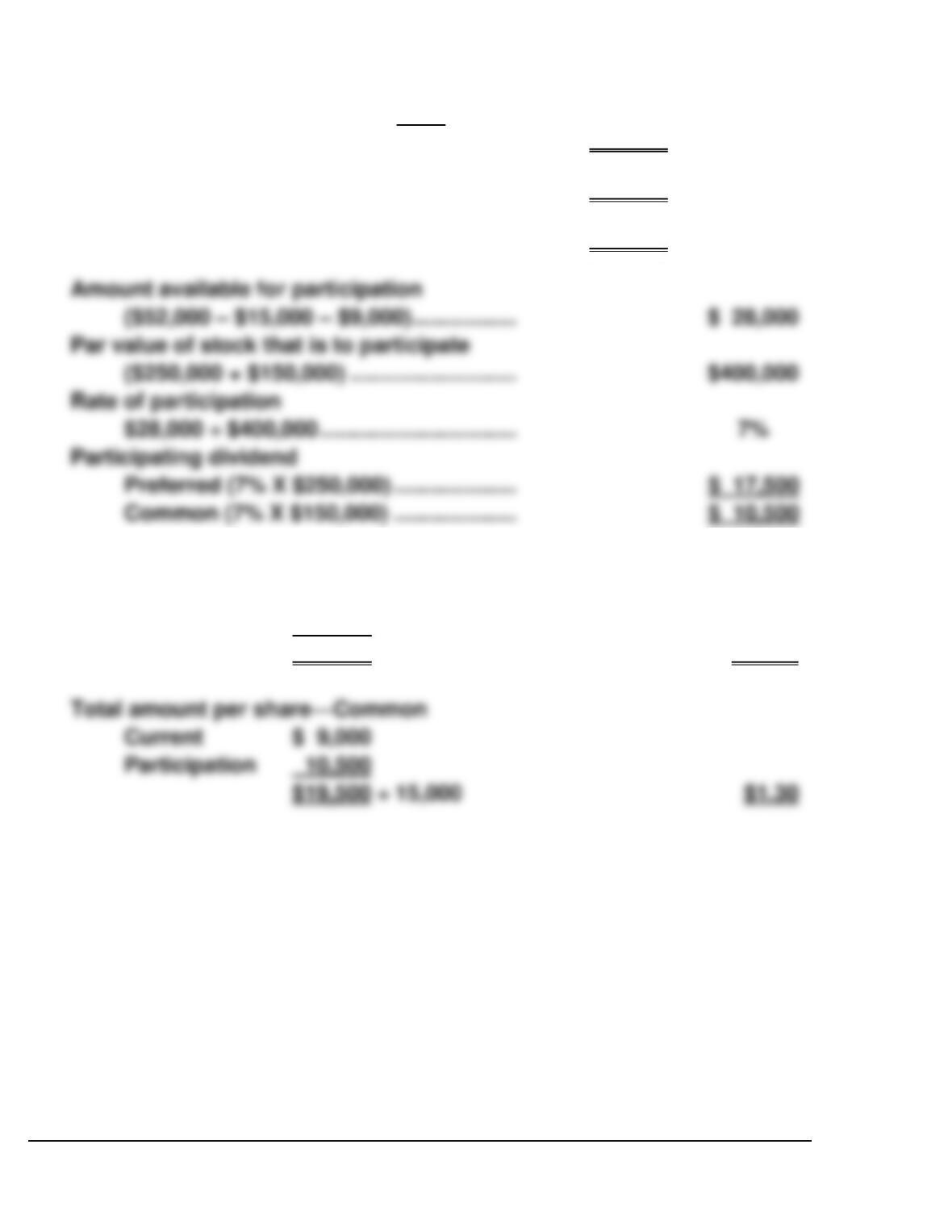
The computations for part (b) are as follows:
2011
Dividends paid ……………………………………………..
$12,000
Amount due preferred (2,500 X $100 X 6%) ……..
$15,000
Preferred per share ($12,000 ÷ 2,500) ………………
Common per share ……………………………………….
Dividends paid ……………………………………………..
$26,000
Amount due preferred
In arrears ($15,000 – $12,000) ………………..
3,000
Current ………………………………………………..
15,000
$18,000
Amount due common ($26,000 – $18,000) ………
$ 8,000
Preferred per share ($18,000 ÷ 2,500) ………………
Common per share ($8,000 ÷ 15,000) ………………
Amount due common …………………………………..
$61,000
Preferred per share ($15,000 ÷ 2,500) ………………
Common per share ($61,000 ÷ 15,000) …………….
15–36
*EXERCISE 15-23 (Continued)
2013
Dividends paid ………………………………………..
$52,000
Amount due preferred
Current (2,500 X $100 X 6%) ……………..
$15,000
Amount due common
Current (15,000 X $10 X 6%) ……………..
$ 9,000
Total amount per share—Preferred
Current $15,000
Participation 17,500
$32,500 ÷ 2,500
$13.00
Total amount per share—Common
Current $ 9,000
Participation 10,500
$19,500 ÷ 15,000
Amount available for participation
($52,000 – $15,000 – $9,000) ……………..
Par value of stock that is to participate
($250,000 + $150,000) ………………………
Rate of participation
$28,000 ÷ $400,000 …………………………..
Participating dividend
Preferred (7% X $250,000) ………………..
Common (7% X $150,000) ………………..
15–37
*EXERCISE 15-23 (Continued)
2014
Dividends paid ………………………………………..
$76,000
Amount due preferred
Current (2,500 X $100 X 6%)……………..
$15,000
Amount due common
Current (15,000 X $10 X 6%)……………..
$ 9,000
Common (13% X $150,000) ………………
$ 19,500
Total amount per share—Preferred
Current $15,000
Participation 32,500
$47,500 ÷ 2,500
$19.00
Total amount per share—Common
Current $ 9,000
Participation 19,500
$28,500 ÷ 15,000
Amount available for participation
($76,000 – $15,000 – $9,000)……………..
$ 52,000
Par value that is to participate
($250,000 + $150,000) ………………………
$400,000
Rate of participation
$52,000 ÷ $400,000 …………………………..
Participating dividend
Preferred (13% X $250,000) ………………
$ 32,500
15–38
*EXERCISE 15-24 (10–15 minutes)
(a)
Common
Preferred
Stockholders’ equity
Preferred stock …………………………………….
$500,000
Common stock ………………………………………
$ 750,000
Retained earnings
Dividends in arrears (3 years at 6%) ……….
90,000
Remainder to common* ……………………
310,000
$1,060,000
$590,000
(b)
Stockholders’ equity
Preferred stock ……………………………………..
$500,000
Liquidating premium……………………………..
30,000
Common stock …………………………………………..
$ 750,000
Retained earnings
Dividends in arrears (3 years at 6%) ……….
$ 90,000
Remainder to common* …………………..
280,000
$1,030,000
$620,000
Shares outstanding …………………………………….
750,000
$1.37
*Balance in retained earnings
($700,000 – $40,000 – $260,000) ………………..
Less: Liquidating premium to preferred………
Dividends to preferred ……………………..
Shares outstanding …………………………………….
750,000
*Balance in retained earnings
($700,000 – $40,000 – $260,000) ………………..
Less: Dividends to preferred …………………….
Available to common ………………………

TIME AND PURPOSE OF PROBLEMS
Problem 15-1 (Time 50–60 minutes)
Purpose—to provide the student with an understanding of the necessary entries to properly account for
a corporation’s stock transactions. This problem involves such concepts as stock sold for cash,
noncash stock transactions, and declaration and distribution of stock dividends. The student is required
to prepare the respective journal entries and the stockholders’ equity section of the balance sheet to
reflect these transactions.
Problem 15-2 (Time 25–35 minutes)
Purpose—to provide the student with an opportunity to record the acquisition of treasury stock and its
sale at three different prices. In addition, a stockholders’ equity section of the balance sheet must be
prepared.
Problem 15-3 (Time 25–30 minutes)
Purpose—to provide the student with an opportunity to record seven different transactions involving
stock issuances, reacquisitions, and dividend payments. Throughout the problem the student needs to
keep track of the shares outstanding.
Problem 15-4 (Time 20–30 minutes)
Purpose—to provide the student with an understanding of the necessary entries to properly account for
a corporation’s stock transactions. This problem involves such concepts as a capital stock assessment,
lump-sum sales of capital stock, and a noncash stock exchange. The student is required to prepare the
journal entries to reflect these transactions.
Problem 15-5 (Time 30–40 minutes)
Purpose—to provide the student with an understanding of the proper entries to reflect the reacquisition,
and reissuance of a corporation’s shares of stock. The student is required to record these treasury stock
transactions under the cost method, assuming the FIFO method for purchase and sale purposes.
Problem 15-6 (Time 30–40 minutes)
Purpose—to provide the student with an understanding of the necessary entries to properly account for
a corporation’s stock transactions. This problem involves such concepts as the reacquisition, and reis–
suance of shares of stock; plus a declaration and payment of a cash dividend. The student is required
to prepare the respective journal entries and the stockholders’ equity section of the balance sheet to
reflect these transactions.
Problem 15-7 (Time 15–20 minutes)
Purpose—to provide the student with an understanding of the proper accounting for the declaration and
payment of cash dividends on both preferred and common stock. This problem also involves a dividend
arrearage on preferred stock, which will be satisfied by the issuance of shares of treasury stock. The
student is required to prepare the necessary journal entries for the dividend declaration and payment,
assuming that they occur simultaneously.
Problem 15-8 (Time 20–25 minutes)
Purpose—to provide the student with an understanding of the accounting effects related to stock divi-
dends and stock splits. The student is required to analyze their effect on total assets, common stock,
paid-in capital, retained earnings, and total stockholders’ equity.
Problem 15-9 (Time 20–25 minutes)
Purpose—to provide the student with an understanding of the effect which a series of transactions
involving such items as the issuance and reacquisition of common and preferred stock, and a stock
dividend, have on the company’s equity accounts. The student is required to prepare the stockholders’
equity section of the balance sheet in proper form reflecting the above transactions.

15–40
Time and Purpose of Problems (Continued)
Problem 15-10 (Time 35–45 minutes)
Purpose—to provide the student with an understanding of the differences between a stock dividend and
a stock split. Acting as a financial advisor to the Board of Directors, the student must report on each
option and make a recommendation.
Problem 15-11 (Time 25–35 minutes)
Purpose—to provide the student with an understanding of the proper accounting for the declaration and
payment of both a cash and stock dividend. The student is required to prepare both the necessary
journal entries to record cash and stock dividends and the stockholders’ equity section of the balance
sheet, including a note to the financial statements setting forth the basis of the accounting for the stock
dividend.
Problem 15-12 (Time 35–45 minutes)
Purpose—to provide the student a comprehensive problem involving all facets of the stockholders’
equity section. The student must prepare the stockholders’ equity section of the balance sheet,
analyzing and classifying a dozen different transactions to come up with proper accounts and amounts.
A good review of Chapter 15.