15-1
CHAPTER 15
Stockholders’ Equity
ASSIGNMENT CLASSIFICATION TABLE (BY TOPIC)
Topics
Questions
Brief
Exercises
Exercises
Problems
Concepts
for Analysis
3. Issuance of shares.
7, 10
1, 2, 6
1, 2, 4,
6, 9
1, 3, 4
4. Noncash stock trans–
actions; lump sum sales.
8, 9
4, 5
3, 4, 5, 6
1, 4
2
5. Treasury stock trans-
actions, cost method.
11, 12, 17
7, 8
3, 6, 7, 9,
10, 18
1, 2, 3,
5, 6, 7
7
6. Preferred stock.
3, 13,
14, 15
9
8
1, 3
7. Stockholders’ equity
accounts; classifications;
terminology.
10, 11, 17
9, 11, 12
3
8. Dividend policy.
22, 25, 26
12, 15, 16
7, 10
dividends; liquidating
dividends.
13, 14
15, 18
10. Restrictions of retained
earnings.
27, 28
9
11. Analysis.
17, 19, 20
and book value.
21, 22,
23, 24
corporate form.
1, 2, 3
1
4, 5, 6, 16,
3
7, 10, 16,
1, 2, 3, 9
15-2
ASSIGNMENT CLASSIFICATION TABLE (BY LEARNING OBJECTIVE)
Learning Objectives
Brief
Exercises
Exercises
Problems
1. Discuss the characteristics of the corporate
form of organization.
4. Describe the accounting for treasury stock.
3, 7, 8
6, 7, 9, 10, 18
1, 2, 3, 5,
6, 7, 9, 12
5. Explain the accounting for and reporting
of preferred stock.
9
5, 8
4
6. Describe the policies used in distributing
dividends.
10, 11, 12
7. Identify the various forms of dividend
distributions.
11, 12
11, 12, 15,
16, 18
3, 6, 7, 8,
9, 11, 12
8. Explain the accounting for small and large
stock dividends, and for stock splits.
13, 14
11, 13, 14,
15, 16, 18
3, 8, 10,
11, 12
per share.
23, 24
equity.
3. Explain the accounting procedures for issuing
shares of stock.
1, 2, 4, 5, 6
1, 2, 3, 4, 5,
6, 8, 9, 10
1, 3, 4, 9, 12
ASSIGNMENT CHARACTERISTICS TABLE
Item
Description
Level of
Difficulty
Time
(minutes)
E15-1
Recording the issuances of common stock.
Simple
15–20
E15-2
Recording the issuance of common and preferred stock.
Simple
15–20
E15-3
Stock issued for land.
Simple
10–15
E15-4
Lump-sum sale of stock with bonds.
Moderate
20–25
E15-5
Lump-sum sales of stock with preferred stock.
Simple
10–15
E15-6
Stock issuances and repurchase.
Moderate
25–30
E15-7
Effect of treasury stock transactions on financials.
Moderate
15–20
E15-8
Preferred stock entries and dividends.
Moderate
15–20
E15-9
Correcting entries for equity transactions.
Moderate
15–20
E15-10
Analysis of equity data and equity section preparation.
Moderate
20–25
Equity items on the balance sheet.
Simple
15–20
E15-12
Cash dividend and liquidating dividend.
Simple
10–15
E15-13
Stock split and stock dividend.
Simple
10–15
E15-14
Entries for stock dividends and stock splits.
Simple
10–12
E15-15
Dividend entries.
Simple
10–15
E15-16
Computation of retained earnings.
Simple
05–10
E15-17
Stockholders’ equity section.
Moderate
20–25
E15-18
Moderate
30–35
E15-19
Comparison of alternative forms of financing.
Moderate
20–25
E15-20
Trading on the equity analysis.
Moderate
15–20
Preferred dividends.
Simple
10–15
Preferred dividends.
Moderate
15–20
Preferred stock dividends.
15–20
Computation of book value per share.
Moderate
10–15
P15-1
Equity transactions and statement preparation.
Moderate
50–60
P15-2
Treasury stock transactions and presentation.
Simple
25–35
P15-3
Equity transactions and statement preparation.
Moderate
25–30
P15-4
Stock transactions—lump sum.
Moderate
20–30
P15-5
Treasury stock—cost method.
Moderate
30–40
P15-6
Treasury stock—cost method—equity section preparation.
Moderate
30–40
P15-7
Cash dividend entries.
Moderate
15–20
P15-8
Dividends and splits.
Moderate
20–25
P15-9
Simple
20–25
P15-10
Stock dividends and stock split.
Moderate
35–45
P15-11
Stock and cash dividends.
Simple
25–35
P15-12
Analysis and classification of equity transactions.
35–45
CA15-1
Preemptive rights and dilution of ownership.
Moderate
10–20
CA15-2
Issuance of stock for land.
Moderate
15–20
CA15-3
Conceptual issues—equity.
Moderate
25–30
CA15-4
Stock dividends and splits.
Simple
25–30
CA15-5
Stock dividends.
Simple
15–20
CA15-6
Stock dividend, cash dividend, and treasury stock.
Moderate
20–25
CA15-7
Treasury stock, ethics.
Moderate
10–15
*This material is presented in an appendix to the chapter.
CE15-1
Master Glossary
(a) A security that is convertible into another security based on a conversion rate. For example,
convertible preferred stock that is convertible into common stock on a two-for-one basis (two
shares of common for each share of preferred).
CE15-2
According to FASB ASC 505-20–25-3 (Stock Dividends and Stock Splits):
25-3 The point at which the relative size of the additional shares issued becomes large enough to
materially influence the unit market price of the stock will vary with individual entities and under
CE15-3
According to FASB ASC 340-10-S99-1 (Deferred Costs and Other Assets—SEC Materials):
15-5
CE15-4
According to FASB ASC 505-30–25-7 (Treasury Stock—Recognition):
25-7 After an entity’s repurchase of its own outstanding common stock, sometimes it may either retire
the repurchased shares and issue additional common shares, or, as an alternative, resell the
repurchased shares. In either case, the price received may differ from the amount paid to
15-6
ANSWERS TO QUESTIONS
1. The basic rights of each stockholder (unless otherwise restricted) are to share proportionately:
(1) in profits, (2) in management (the right to vote for directors), (3) in corporate assets upon
liquidation, and (4) in any new issues of stock of the same class (preemptive right).
3. Preferred stock commonly has preference to dividends in the form of a fixed dividend rate and
a preference over common stock to remaining corporate assets in the event of liquidation.
4. The distinction between paid-in capital and retained earnings is important for both legal and
economic points of view. Legally, dividends can be declared out of retained earnings in all states,
5. Authorized capital stock—the total number of shares authorized by the state of incorporation for
issuance.
6. Par value is an arbitrary, fixed per share amount assigned to a stock by the incorporators. It is
7. The issuance for cash of no-par value common stock at a price in excess of the stated value of
the common stock is accounted for as follows:
(1) Cash is debited for the proceeds from the issuance of the common stock.
(2) Common Stock is credited for the stated value of the common stock.
(3) Paid-in Capital in Excess of Stated Value is credited for the excess of the proceeds from the
issuance of the common stock over its stated value.
8. The proportional method is used to allocate the lump sum received on sales of two or more
classes of securities when the fair market value or other sound basis for determining relative
9. The general rule to be applied when stock is issued for services or property other than cash is
15-7
Questions Chapter 15 (Continued)
10. The direct costs of issuing stock, such as underwriting costs, accounting and legal fees, printing
11. The major reasons for purchasing its own shares are: (1) to provide tax-efficient distributions of
excess cash to shareholders, (2) to increase earnings per share and return on equity, (3) to provide
12. (a) Treasury stock should not be classified as an asset since a corporation cannot own itself.
(b) The “gain” or “loss” on sale of treasury stock should not be treated as additions to or
deductions from income. If treasury stock is carried in the accounts at cost, these so-called
13. The character of preferred stock can be altered by being cumulative or noncumulative, partici-
pating or nonparticipating, convertible or nonconvertible, callable or noncallable, or redeemable.
14. Nonparticipating means the security holder is entitled to no more than the specified fixed dividend.
If the security is partially participating, it means that in addition to the specified fixed dividend the
security may participate with the common stock in dividends up to a certain stated rate or
15. Preferred stock is generally reported at par value as the first item in the stockholders’ equity
section of a company’s balance sheet. Any excess over par value is reported as part of additional
paid-in capital.
16. Additional paid-in capital results from: (1) premiums on stock issued, (2) sale of treasury stock
17. When treasury stock is purchased, the Treasury Stock account is debited and Cash is credited at
*
Questions Chapter 15 (Continued)
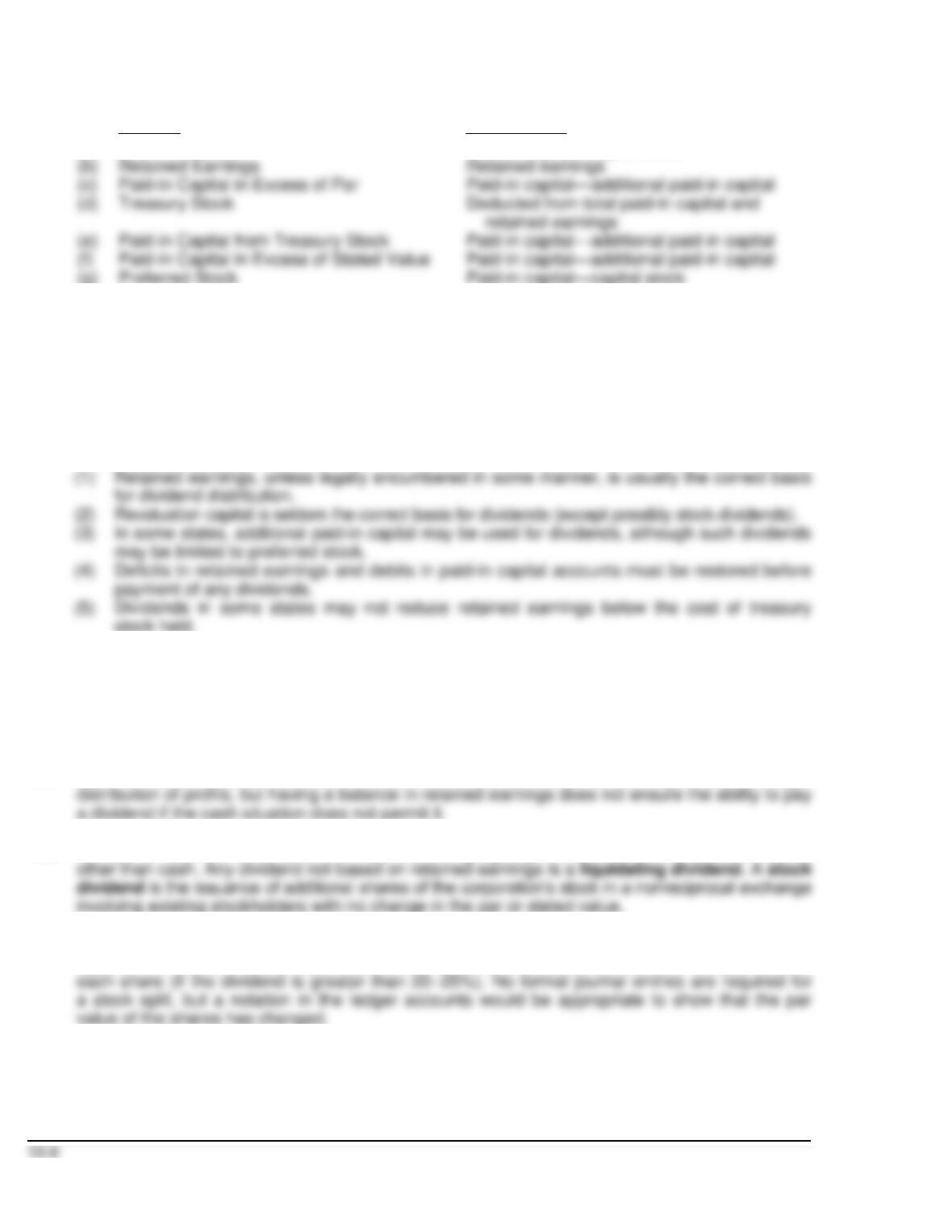
18. The answers are summarized in the table below:
Account Classification
(a) Common Stock Paid-in capital—capital stock
19. The dividend policy of a company is influenced by (1) the availability of cash, (2) the stability of
earnings, (3) current earnings, (4) prospective earnings, (5) the existence or absence of contractual
restrictions on working capital or retained earnings, and (6) a retained earnings balance.
20. In declaring a dividend, the board of directors must consider the condition of the corporation such
that a dividend is (1) legally permissible and (2) economically sound.
In general, directors should give consideration to the following factors in determining the legality
of a dividend declaration:
stock held.
In order that dividends be economically sound, the board of directors should consider: (1) the
availability (liquidity) of assets for distribution; (2) agreements with creditors; (3) the effect of
a dividend on investor perceptions (e.g. maintaining an expected “pay–out ratio”); and (4) the size
of the dividend with respect to the possibility of paying dividends in future bad years. In addition,
the ability to expand or replace existing facilities should be considered.
21. Cash dividends are paid out of cash. A balance must exist in retained earnings to permit a legal
22. A cash dividend is a distribution in cash while a property dividend is a distribution in assets
23. A stock dividend results in the transfer from retained earnings to paid-in capital of an amount
equal to the market value of each share (if the dividend is less than 20–25%) or the par value of
15-9
Questions Chapter 15 (Continued)
24. (a) A stock split effected in the form of a dividend is a distribution of corporate stock to present
stockholders in proportion to each stockholder’s current holdings and can be expected to
cause a material decrease in the market value per share of the stock. GAAP specifies that a
distribution in excess of 20% to 25% of the number of shares previously outstanding would
cause a material decrease in the market value. This is a characteristic of a stock split as
25. A partially liquidating dividend will be debited both to Retained Earnings and Paid-in Capital in
Excess of Par. The portion of dividends that is a return of capital should be debited to Paid-in
Capital in Excess of Par.
26. A property dividend is a nonreciprocal transfer of nonmonetary assets between an enterprise and
27. Retained earnings are restricted because of legal or contractual restrictions, or the necessity to
protect the working capital position.
15–10
Questions Chapter 15 (Continued)
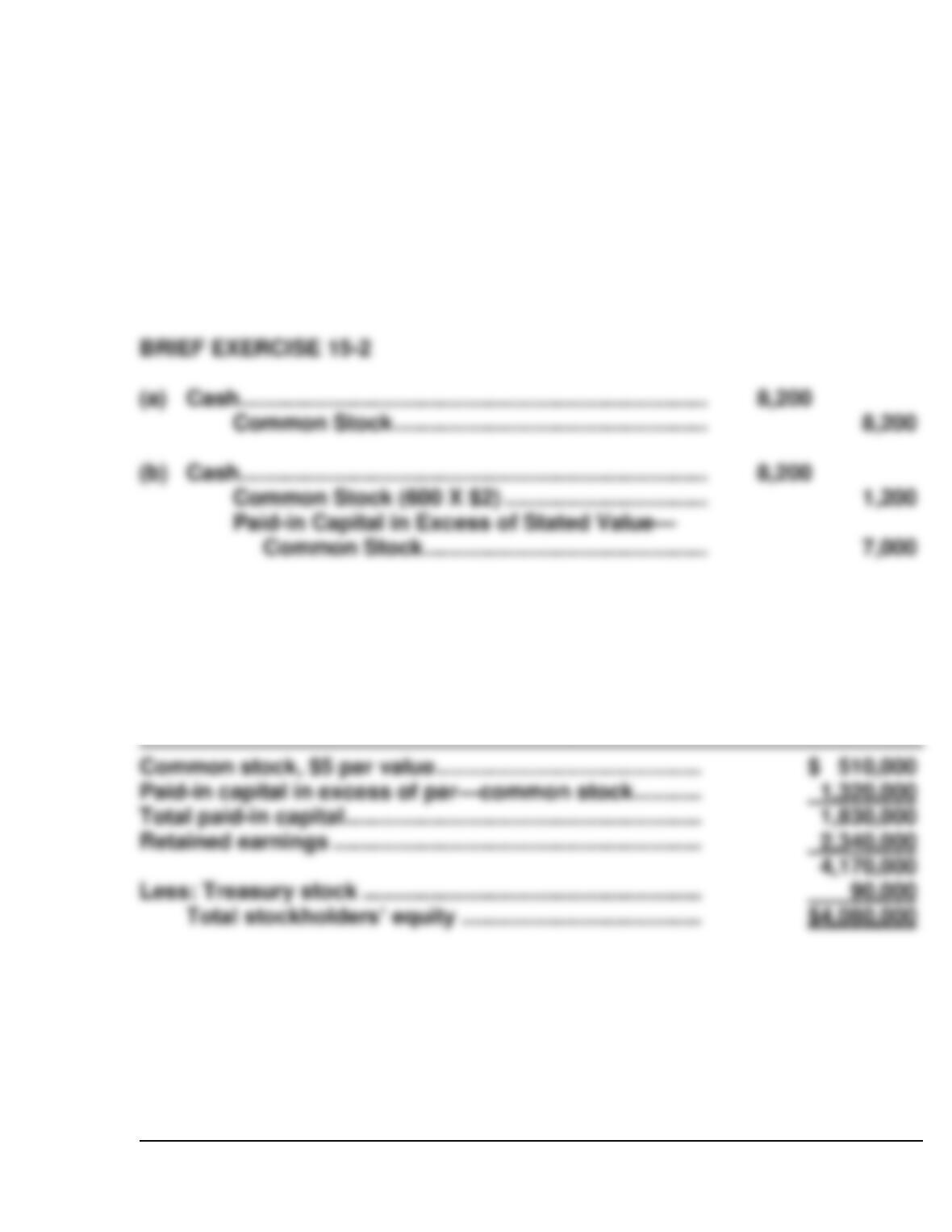
*29.
Preferred
Common
Total
(a)
Current year’s dividend, 7%
$ 7,000
$21,000a
$28,000
Participating dividend of 9%
9,000
27,000
36,000
Totals
$16,000
$48,000
$64,000
a(see schedule below for computation of amounts)
Participating dividend:
Preferred, 9% of $100,000 $ 9,000
Common, 9% of $300,000 27,000
Dividends $ 36,000
(b)
Preferred
Common
Total
Dividends in arrears, 7% of $100,000
$ 7,000
$ 7,000
Current year’s dividend, 7%
7,000
$21,000
28,000
Participating dividend 7.25% ($29,000 ÷ $400,000)*
7,250
$21,250
$64,000
$ 2,000
Remainder to common
$21,000
Totals
$21,000
$30,000
15–11
SOLUTIONS TO BRIEF EXERCISES
BRIEF EXERCISE 15-1
Cash ……………………………………………………………………….. 4,500
Common Stock (300 X $10) ………………………………… 3,000
Paid-in Capital in Excess of Par—
Common Stock …………………………………………….. 1,500
BRIEF EXERCISE 15-3
WILCO CORPORATION
Stockholders’ Equity
December 31, 2012
15–12
BRIEF EXERCISE 15-4
Cash ………………………………………………………………………. 13,500
Preferred Stock (100 X $50) ……………………………….. 5,000
Paid-in Capital in Excess of Par—
Preferred Stock ……………………………………………… 3,100
Common Stock (300 X $10) ……………………………….. 3,000
Paid-in Capital in Excess of Par—
Common Stock………………………………………………. 2,400
BRIEF EXERCISE 15-5
Land……………………………………………………………………….. 31,000
Common Stock (3,000 X $5) ………………………………. 15,000
Paid-in Capital in Excess of Par—
Common Stock………………………………………………. 16,000
15–13
BRIEF EXERCISE 15-7
7/1/12 Treasury Stock (100 X $87) ……………………. 8,700
Cash ……………………………………………… 8,700
BRIEF EXERCISE 15-8
8/1/12 Treasury Stock (200 X $80) ……………………. 16,000
Cash ……………………………………………… 16,000
BRIEF EXERCISE 15-9
Cash …………………………………………………………………… 61,500
Preferred Stock (500 X $100) …………………………. 50,000
Paid-in Capital in Excess of Par—
Preferred Stock ………………………………………….. 11,500
15–14
BRIEF EXERCISE 15-11
Sep. 21
Equity Investments …………………………………………………
325,000
Unrealized Holding Gain or Loss—
Income ($1,200,000 – $875,000) ……………………….
325,000
BRIEF EXERCISE 15-12
Apr. 20
Retained Earnings
($500,000 – $125,000) …………………………..
375,000
Paid-in Capital in Excess of Par—
Common Stock …………………………………………………….
125,000
Dividends Payable…………………………..
500,000
June 1
Dividends Payable ………………………………………………….
Cash ……………………………………………………….
500,000
BRIEF EXERCISE 15-13
Declaration Date.
Retained Earnings …………………………………………………..
1,300,000
Common Stock Dividend Distributable …………….
200,000
Distribution Date.
Common Stock Dividend Distributable……………………..
200,000
Common Stock ……………………………………………….
Retained Earnings ………………………………………………….
Property Dividends Payable …………………………..
1,200,000
Oct. 8
No entry.
Oct. 23
Property Dividends Payable …………………………..
Equity Investments …………………………..
BRIEF EXERCISE 15-14
Declaration Date.
Retained Earnings …………………………………………………..
4,000,000
Common Stock Dividend Distributable
(400,000 X $10) …………………………………………….
4,000,000
Distribution Date.
Common Stock Dividend Distributable …………………….
4,000,000
Common Stock ……………………………………………….
4,000,000
*BRIEF EXERCISE 15-15
(a) Preferred stockholders would receive $60,000 (6% X $1,000,000) and
the remainder of $240,000 ($300,000 – $60,000) would be distributed to
common stockholders.
15–16
SOLUTIONS TO EXERCISES
EXERCISE 15-1 (15–20 minutes)
(a) Jan. 10 Cash (80,000 X $6) …………………………. 480,000
Common Stock (80,000 X $3) …….. 240,000
Paid-in Capital in Excess of Par—
Common Stock………………………. 240,000
(b) Jan. 10 Cash (80,000 X $6) …………………………. 480,000
Common Stock (80,000 X $2) …….. 160,000
Paid-in Capital in Excess of
Stated Value—Common Stock
(80,000 X $4) ………………………….. 320,000
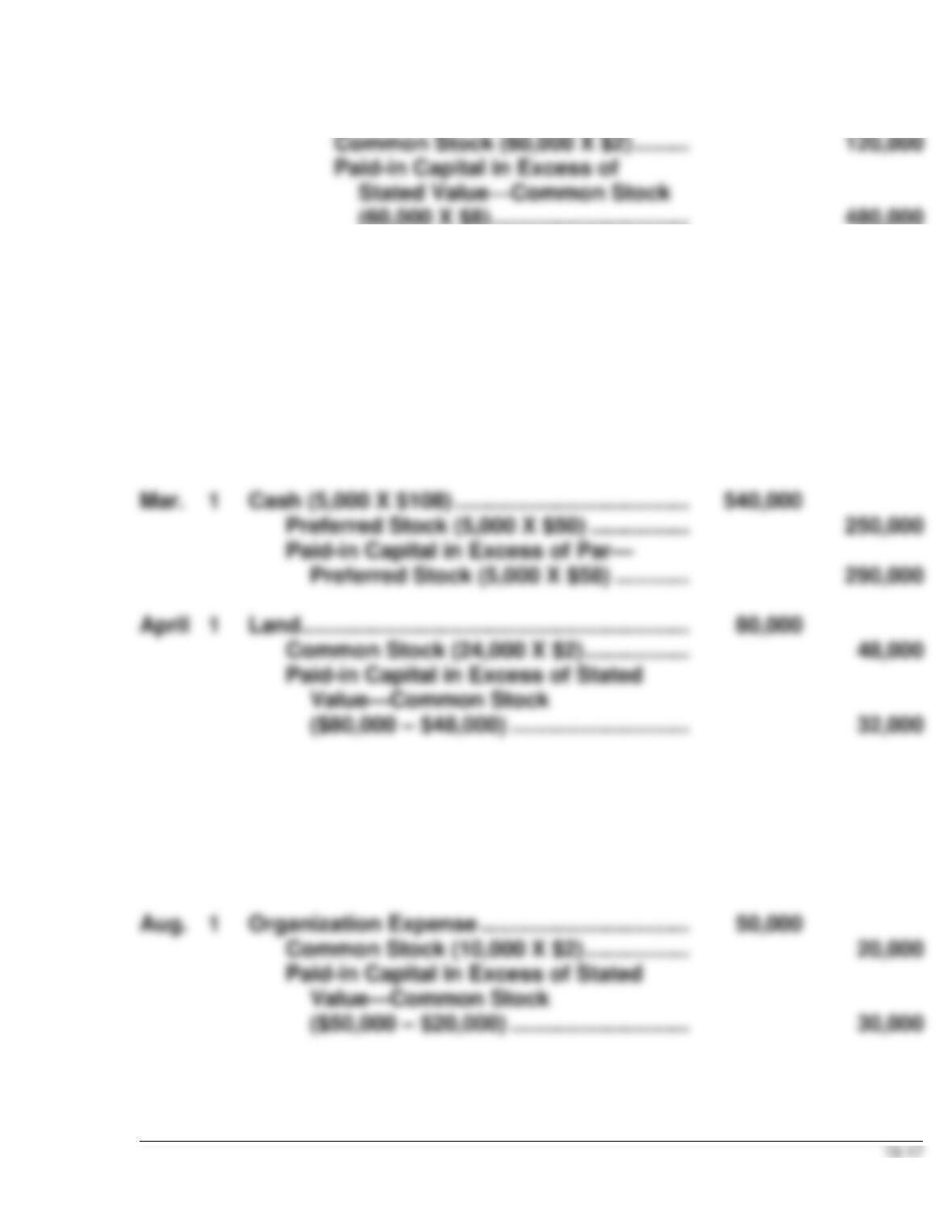
EXERCISE 15-1 (Continued)
Sept. 1 Cash (60,000 X $10) ………………………… 600,000
EXERCISE 15-2 (15–20 minutes)
Jan. 10 Cash (80,000 X $5) …………………………………. 400,000
Common Stock (80,000 X $2) …………….. 160,000
Paid-in Capital in Excess of Stated
Value—Common Stock
(80,000 X $3) …………………………………. 240,000
May 1 Cash (80,000 X $7) …………………………………. 560,000
Common Stock (80,000 X $2) …………….. 160,000
Paid-in Capital in Excess of Stated
Value—Common Stock
(80,000 X $5) …………………………………. 400,000
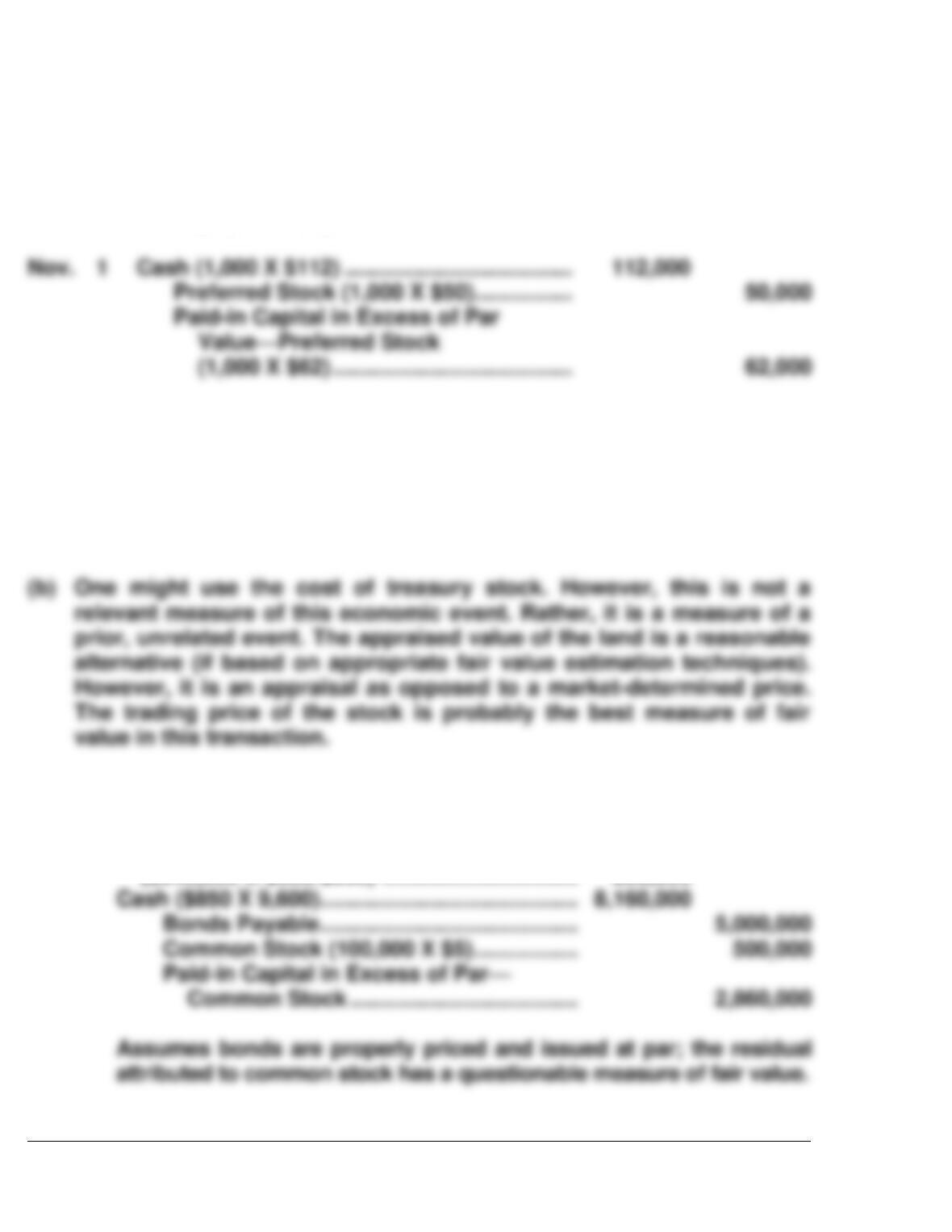
15–18
EXERCISE 15-2 (Continued)
Sept. 1 Cash (10,000 X $9) ………………………………… 90,000
Common Stock (10,000 X $2) ……………. 20,000
Paid-in Capital in Excess of Stated
Value—Common Stock
(10,000 X $7) ………………………………… 70,000
EXERCISE 15-3 (10–15 minutes)
(a) Land ($60 X 25,000) ………………………………………… 1,500,000
Treasury Stock ($48 X 25,000) ………………….. 1,200,000
Paid-in Capital from Treasury Stock …………. 300,000
EXERCISE 15-4 (20–25 minutes)
(a) (1) Unamortized Bond Issue Costs
($340,000 X $500/$850) ………………………….. 200,000
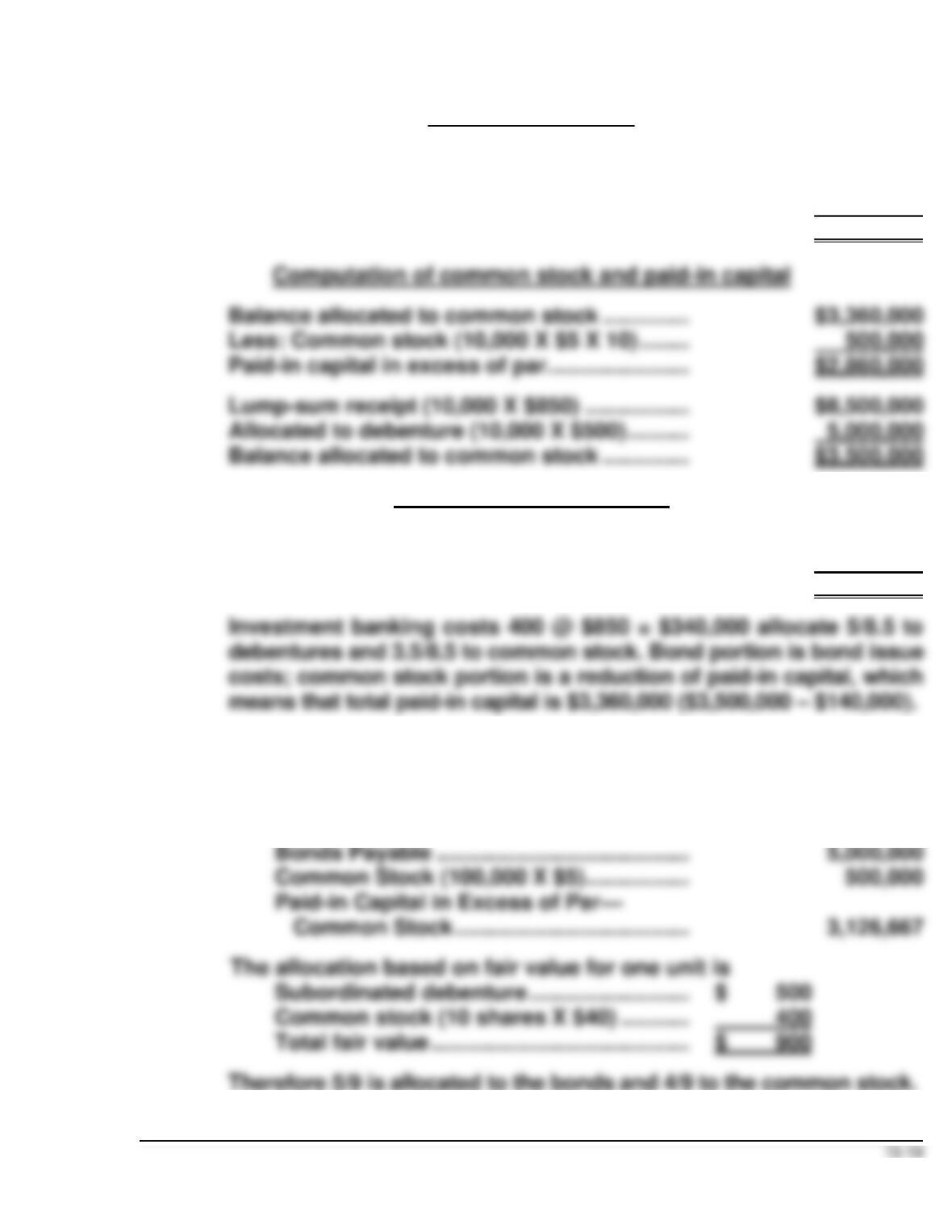
EXERCISE 15-4 (Continued)
Incremental method
Lump-sum receipt (9,600 X $850) ………………. $8,160,000
Allocated to subordinated debenture
(9,600 X $500) ……………………………………….. 4,800,000
Balance allocated to common stock ………….. $3,360,000
Bond issue cost allocation
Total issue cost (400 X $850) …………………….. $ 340,000
Less: Amount allocated to bonds ………………. 200,000
Amount allocated to common ……………………. $ 140,000
(2) Cash ………………………………………………………… 8,160,000
Unamortized Bond Issue Costs …………………. 188,889
Discount on Bonds Payable
($5,000,000 – $4,722,222) ……………………….. 277,778
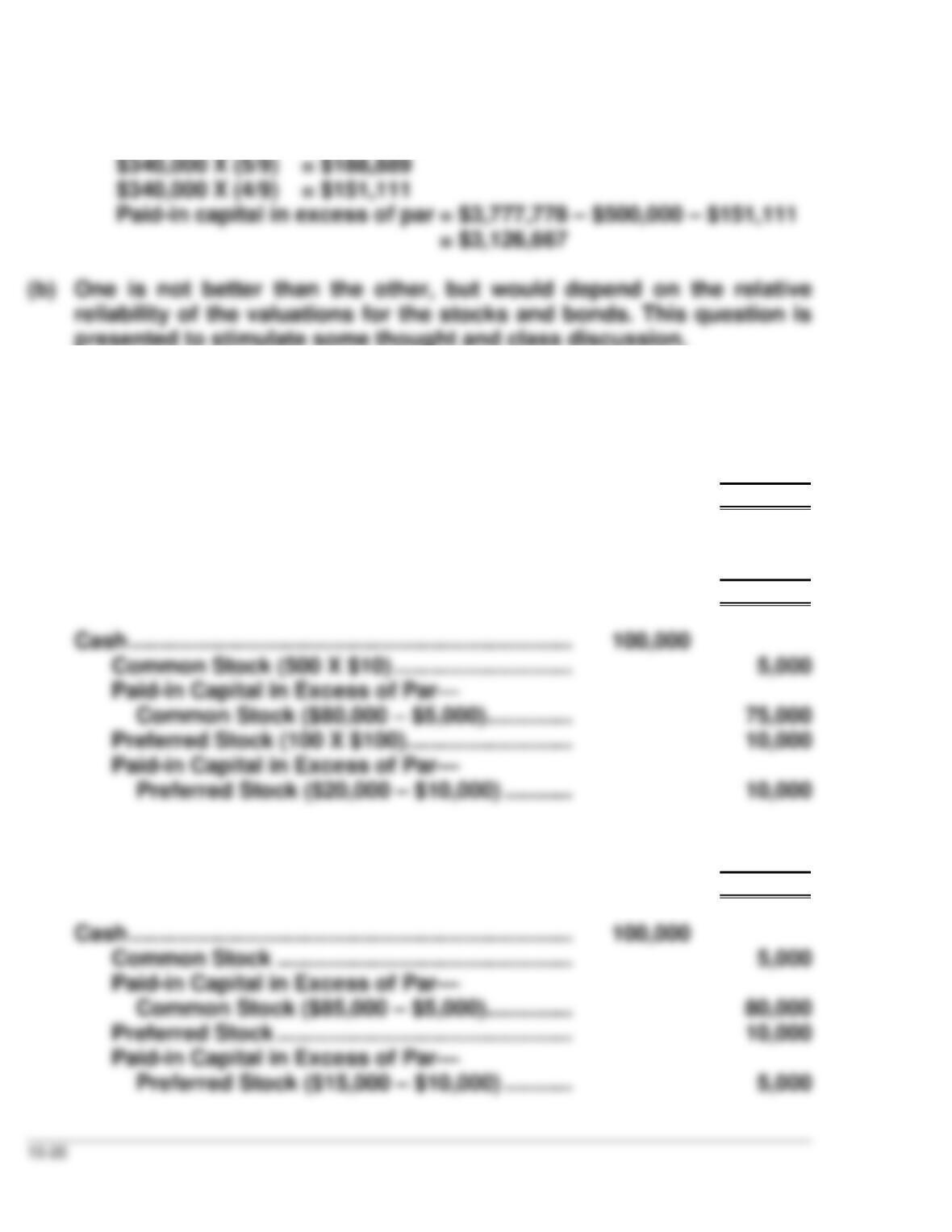
EXERCISE 15-4 (Continued)
$8,500,000 X (5/9) = $4,722,222 To Debentures
$8,500,000 X (4/9) = $3,777,778 To Common Stock
EXERCISE 15-5 (10–15 minutes)
(a) Fair value of Common (500 X $168) ……………………………… $ 84,000
Fair value of Preferred (100 X $210) …………………………….. 21,000
$105,000
Allocated to Common: $84,000/$105,000 X $100,000 ……. $ 80,000
Allocated to Preferred: $21,000/$105,000 X $100,000 ……. 20,000
Total allocation ………………………………………………………….. $100,000
(b) Lump-sum receipt ………………………………………….. $100,000
Allocated to common (500 X $170) ………………….. 85,000
Balance allocated to preferred ………………………… $ 15,000