Problem 15-12 (continued)
c. Financial leverage is positive in both years because the return on
3. We would recommend keeping the stock. The stock’s downside risk
seems small because it is selling for only 7.3 times current earnings as
compared to 9 times earnings for other companies in the industry. In
addition, its earnings are strong and trending upward, and its return on
common equity (16.6%) is extremely good. Its return on total assets
(10.4%) compares well with that of the industry. The risk, of course, is
whether the company can get its cash problem under control.
Conceivably, the cash problem could worsen, leading to an eventual
Problem 15-13 (30 minutes)
a. The market price is going down. The dividends paid per share over the
three-year period are unchanged, but the dividend yield is going up.
Therefore, the market price per share of stock must be decreasing.
b. The earnings per share is increasing. Again, the dividends paid per
equity exceeded the return on total assets employed.
e. It is becoming more difficult for the company to pay its bills as they
come due. Although the current ratio has improved over the three years,
the acid-test ratio is down. Also note that the accounts receivable and
inventory are both turning more slowly, indicating that an increasing
Problem 15-14 (30 minutes)
1. a. Computation of working capital:
Current assets:
Cash ………………………………….
$ 70,000
Marketable securities ……………..
12,000
Accounts receivable, net …………
Inventory …………………………...
Prepaid expenses ………………….
Total current assets (a) …………….
Current liabilities:
Accounts payable ………………….
Accrued liabilities ………………….
60,000
Notes due in one year ……………
Total current liabilities (b)………….
b. Computation of the current ratio:
Current assets $900,000
Current ratio= = =2.5
Current liabilities $360,000
Problem 15-14 (continued)
2.
The Effect on
Working
Current
Acid-Test
Transaction
Capital
Ratio
Ratio
(a)
Declared a cash dividend ……………..
Decrease
Decrease
Decrease
(b)
Paid accounts payable …………………
None
Increase
Increase
(c)
Collected accounts receivable ………..
None
None
None
(f)
Borrowed on a short-term note ……..
None
Decrease
Decrease
(g)
Sold inventory at a profit ……………..
Increase
Increase
Increase
(j)
Issued common stock for cash ………
Increase
Increase
Increase
(k)
Paid off short-term notes ……………..
None
Increase
Increase
Problem 15-15 (45 minutes)
Effect on
Ratio
Reason for Increase, Decrease, or No Effect
1.
Decrease
Sale of inventory at a profit will be reflected in an increase
in retained earnings, which is part of stockholders’ equity.
An increase in stockholders’ equity will result in a decrease
in the ratio of assets provided by creditors as compared to
assets provided by owners.
asset is exchanged for another.
4.
No effect
Payments on account reduce cash and accounts payable by
equal amounts; thus, the net amount of working capital is
not affected.
5.
Decrease
When a customer pays a bill, the accounts receivable
balance is reduced. This increases the accounts receivable
turnover, which in turn decreases the average collection
period.
6.
Decrease
Declaring a cash dividend will increase current liabilities,
but have no effect on current assets. Therefore, the current
ratio will decrease.
Problem 15-15 (continued)
Effect on
Ratio
Reason for Increase, Decrease, or No Effect
9.
Decrease
The dividend yield ratio is obtained by dividing the dividend
per share by the market price per share. If the dividend
per share remains unchanged and the market price goes
up, then the yield will decrease.
11.
Increase
A write-off of inventory will reduce the inventory balance,
thereby increasing the turnover in relation to a given level
12.
Increase
Since the company’s assets earn at a rate that is higher
than the rate paid on the bonds, leverage is positive,
increasing the return to the common stockholders.
13.
No effect
Changes in the market price of a stock have no direct
14.
Decrease
A decrease in net income would mean less income
available to cover interest payments. Therefore, the times-
15.
No effect
Write-off of an uncollectible account against the Allowance
for Bad Debts will have no effect on total current assets.
For this reason, the current ratio will remain unchanged.
16.
Decrease
A purchase of inventory on account will increase current
liabilities, but will not increase the quick assets (cash,
accounts receivable, marketable securities). Therefore, the
ratio of quick assets to current liabilities will decrease.
17.
Increase
The price-earnings ratio is obtained by dividing the market
up, then the price-earnings ratio will increase.
Problem 15-16 (90 minutes)
1.
a.
This Year
Last Year
Net income ……………………………………
$ 280,000
$ 168,000
Add after-tax cost of interest:
$120,000 × (1 – 0.30) …………………..
84,000
$100,000 × (1 – 0.30) …………………..
70,000
Total (a) ……………………………………….
$ 364,000
$ 238,000
Average total assets (b) ……………………
$5,330,000
$4,640,000
Return on total assets (a) ÷ (b) …………
6.8%
5.1%
Net income ……………………………………
$ 280,000
Less preferred dividends …………………..
48,000
Net income remaining for common (a) ..
Average total stockholders’ equity ………
$3,120,000
$3,028,000
Less average preferred stock …………….
Average common equity (b) ………………
$2,520,000
$2,428,000
(a) ÷ (b) …………………………………….
9.2%
4.9%
c.
Leverage is positive for this year because the return on common
equity (9.2%) is greater than the return on total assets (6.8%). For
last year, leverage is negative because the return on the common
equity (4.9%) is less than the return on total assets (5.1%).
2.
a.
Net income remaining for common [see
above] (a) …………………………………..
$232,000
$120,000
50,000
Earnings per share (a) ÷ (b) ……………..
Dividends per share (a) ……………………
Market price per share (b) ………………..
$36.00
Dividend yield ratio (a) ÷ (b) …………….
Average number of common shares
Problem 15-16 (continued)
This Year
Last Year
c.
Dividends per share (a) ……………………
$1.44
$0.72
Earnings per share (b) ……………………..
$4.64
$2.40
Dividend payout ratio (a) ÷ (b) ………….
31.0%
30.0%
d.
Market price per share (a) ………………….
$36.00
$20.00
Earnings per share (b) ……………………….
$4.64
$2.40
Price-earnings ratio (a) ÷ (b) ………………
7.8
8.3
e.
Stockholders’ equity ………………………..
$3,200,000
$3,040,000
Less preferred stock ………………………..
600,000
600,000
Common stockholders’ equity (a) ……….
$2,600,000
$2,440,000
Number of common shares outstanding
(b) …………………………………………….
50,000
50,000
Book value per share (a) ÷ (b) ………….
$52.00
$48.80
f.
Gross margin (a) …………………………….
$1,050,000
$860,000
Sales (b) ……………………………………….
$5,250,000
$4,160,000
Gross margin percentage (a) ÷ (b) ……..
20.0%
20.7%
Problem 15-16 (continued)
This Year
Last Year
3.
a.
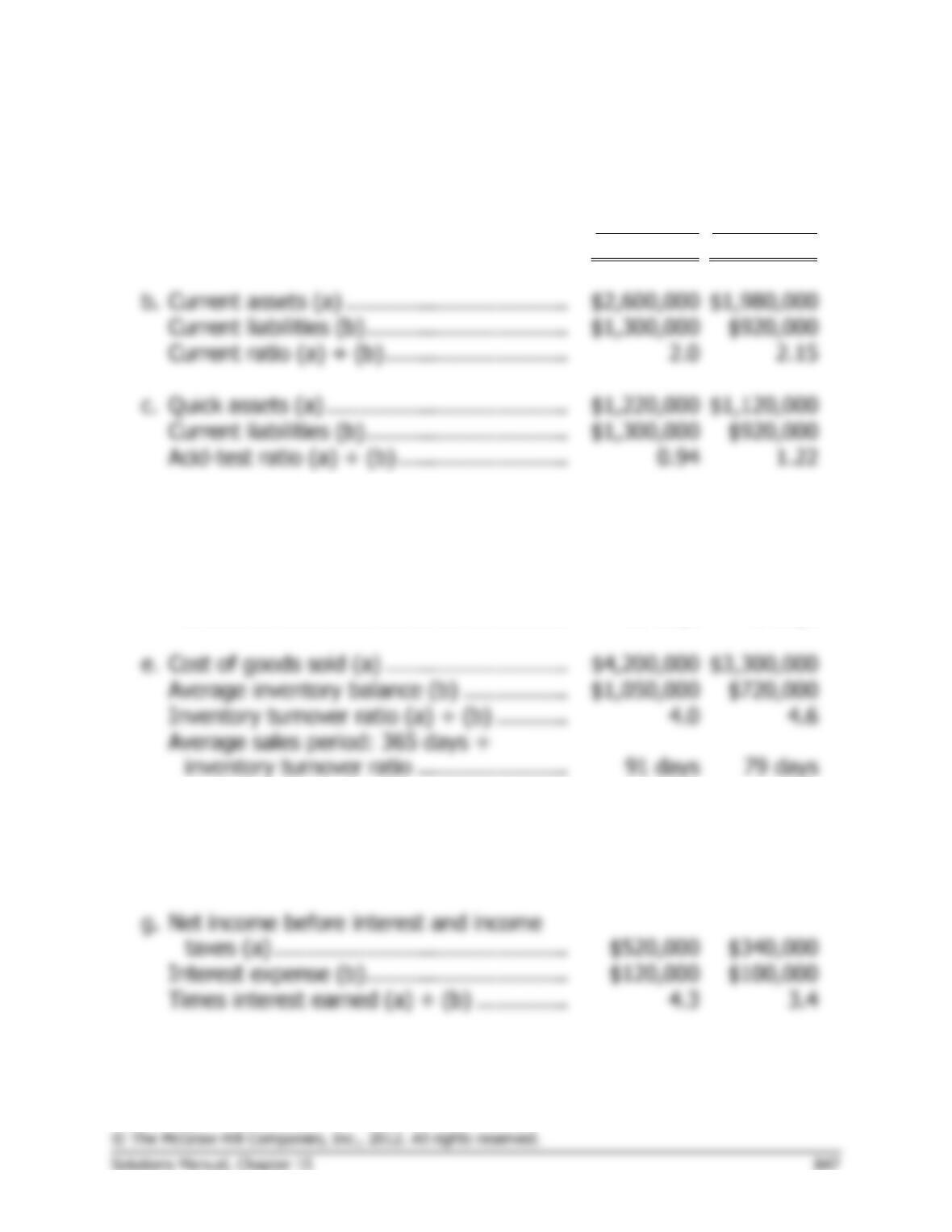
Current assets (a) …………………………....
$2,600,000
$1,980,000
Current liabilities (b) ………………………….
1,300,000
920,000
Working capital (a) − (b) ……………………
$1,300,000
$1,060,000
Current assets (a) …………………………....
$2,600,000
$1,980,000
Current liabilities (b) ………………………….
$1,300,000
Current ratio (a) ÷ (b) ……………………….
Quick assets (a) ……………………………….
$1,220,000
$1,120,000
Current liabilities (b) ………………………….
$1,300,000
Acid-test ratio (a) ÷ (b) ……………………..
0.94
1.22
d.
Sales on account (a) …………………………
$5,250,000
$4,160,000
Average receivables (b) ……………………..
$750,000
$560,000
Accounts receivable turnover (a) ÷ (b) ….
7.0
7.4
Average collection period: 365 days ÷
accounts receivable turnover …………….
52 days
49 days
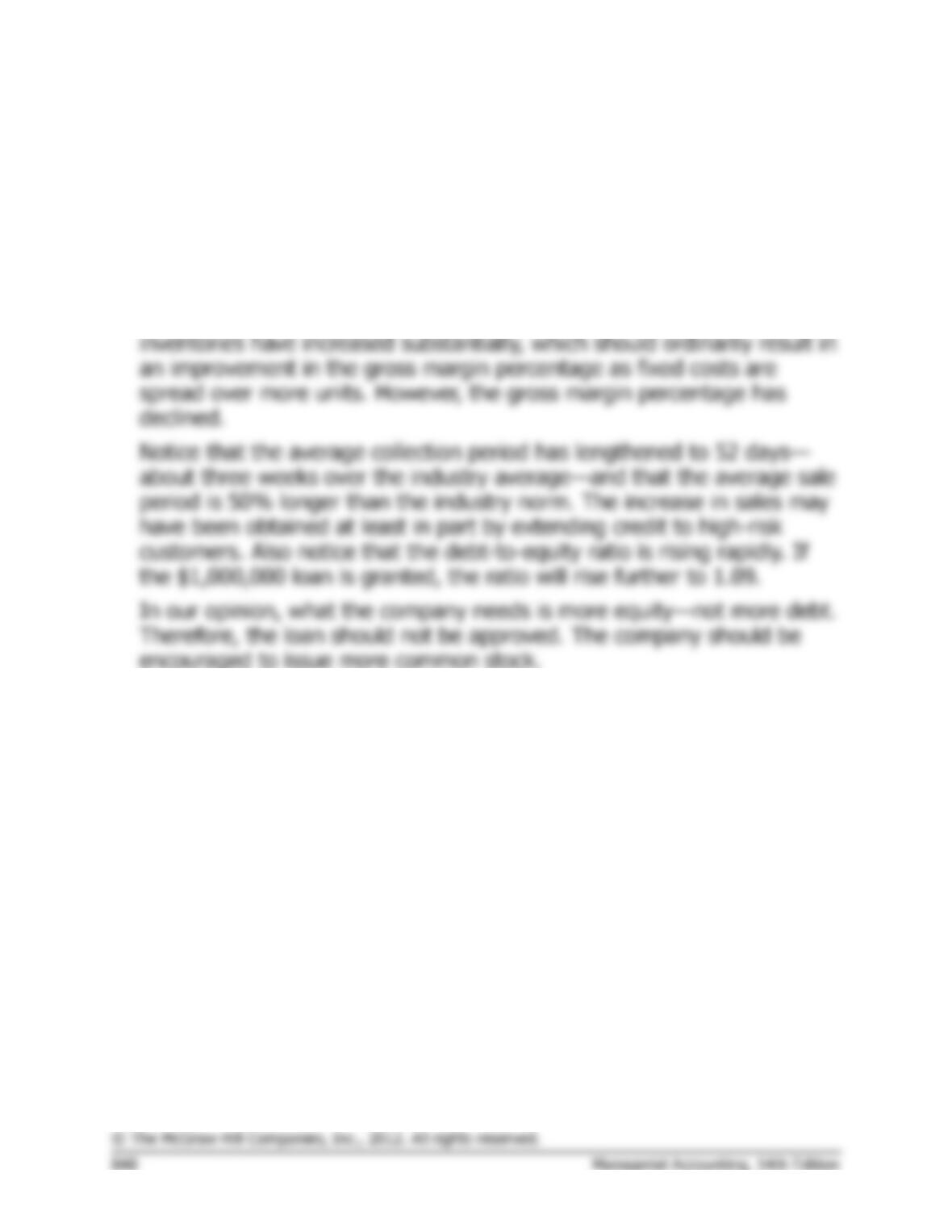
Cost of goods sold (a) ……………………….
$4,200,000
$3,300,000
Average inventory balance (b) …………….
$1,050,000
Inventory turnover ratio (a) ÷ (b) ………..
f.
Total liabilities (a) ……………………………..
$2,500,000
$1,920,000
Stockholders’ equity (b) ……………………..
$3,200,000
$3,040,000
Debt–to-equity ratio (a) ÷ (b) ………………
0.78
0.63
Interest expense (b) ………………………….
Times interest earned (a) ÷ (b) …………..
Problem 15-16 (continued)
4. As stated by Marva Rossen, both net income and sales are up from last
year. The return on total assets has improved from 5.1% last year to
6.8% this year, and the return on common equity is up to 9.2% from
4.9% the year before. But this appears to be the only bright spot.
Virtually all other ratios are below what is typical for the industry, and,
more important, they are trending downward. The deterioration in the
gross margin percentage, while not large, is worrisome. Sales and
Problem 15-17 (30 minutes)
1.
Hedrick Company
Comparative Balance Sheets
This Year
Last Year
Current assets:
Cash ………………………………………
5.6%
8.5%
Marketable securities ………………….
0.0%
2.0%
Accounts receivable, net ……………..
15.8%
12.1%
Inventory ………………………………..
22.8%
16.1%
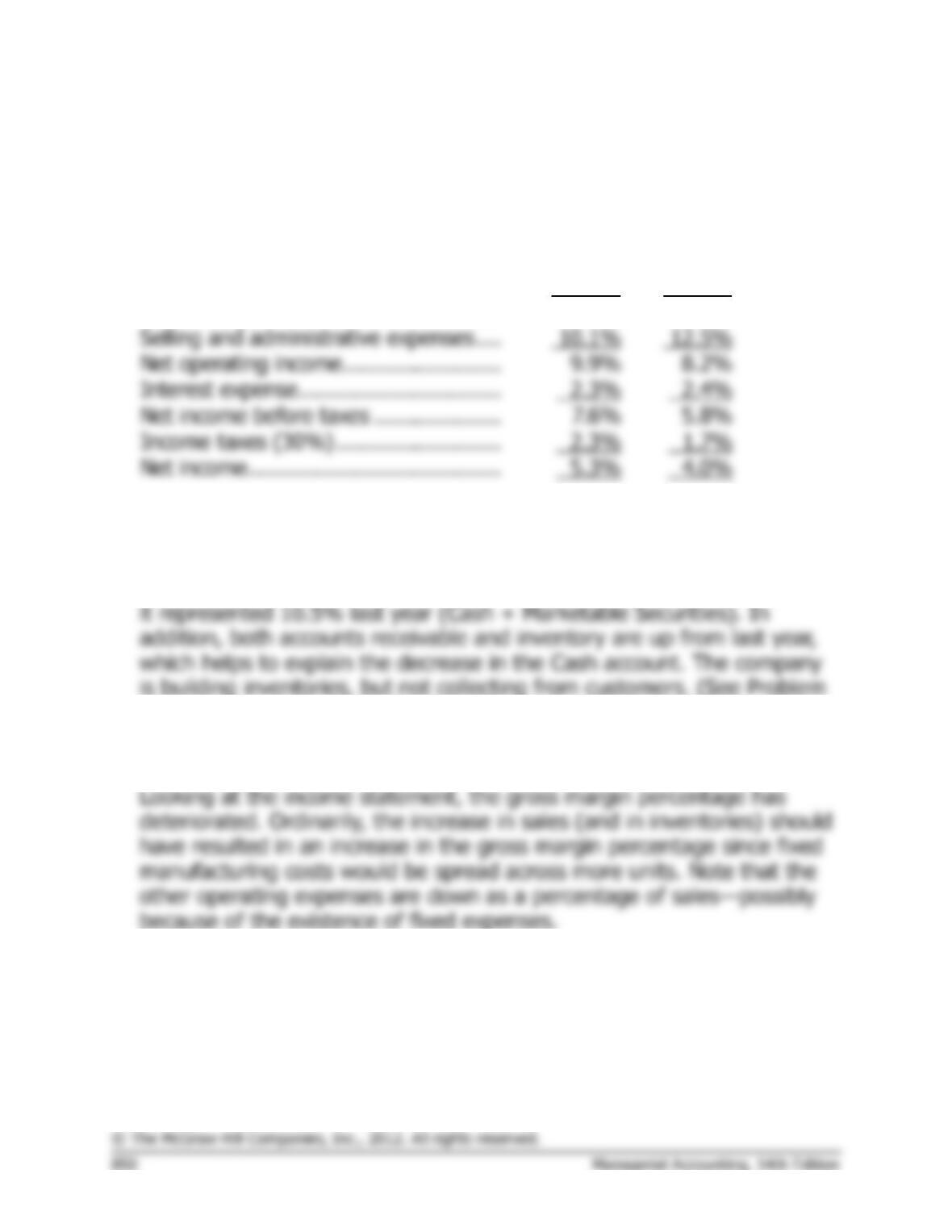
Prepaid expenses ………………………
1.4%
Total current assets ……………………..
45.6%
39.9%
Plant and equipment, net ………………
60.1%
Total assets ………………………………..
Current liabilities …………………………
22.8%
18.5%
Bonds payable, 10% …………………….
21.1%
20.2%
Total liabilities …………………………….
43.9%
38.7%
Stockholders’ equity:
Preferred stock, 8%, $30 par value .
10.5%
12.1%
Common stock, $40 par value ………
35.1%
40.3%
Retained earnings ……………………..
10.5%
56.1%
61.3%
Total liabilities and equity ………………
Problem 15-17 (continued)
2.
Hedrick Company
Comparative Income Statements
This Year
Last Year
Sales ………………………………………..
100.0%
100.0%
Cost of goods sold ………………………..
80.0%
79.3%
Gross margin ……………………………….
20.0%
20.7%
Selling and administrative expenses ….
10.1%
12.5%
Net operating income …………………….
Interest expense …………………………..
Net income before taxes ………………..
Income taxes (30%) ……………………..
Net income ………………………………….
*Due to rounding, figures may not fully reconcile down a column.
3. The company’s current position has declined substantially between the
two years. Cash this year represents only 5.6% of total assets, whereas
15-16 for a ratio analysis of the current assets.) Apparently, part of the
financing required to build inventories was supplied by short-term
creditors, as evidenced by the increase in current liabilities.
Problem 15-18 (45 minutes)
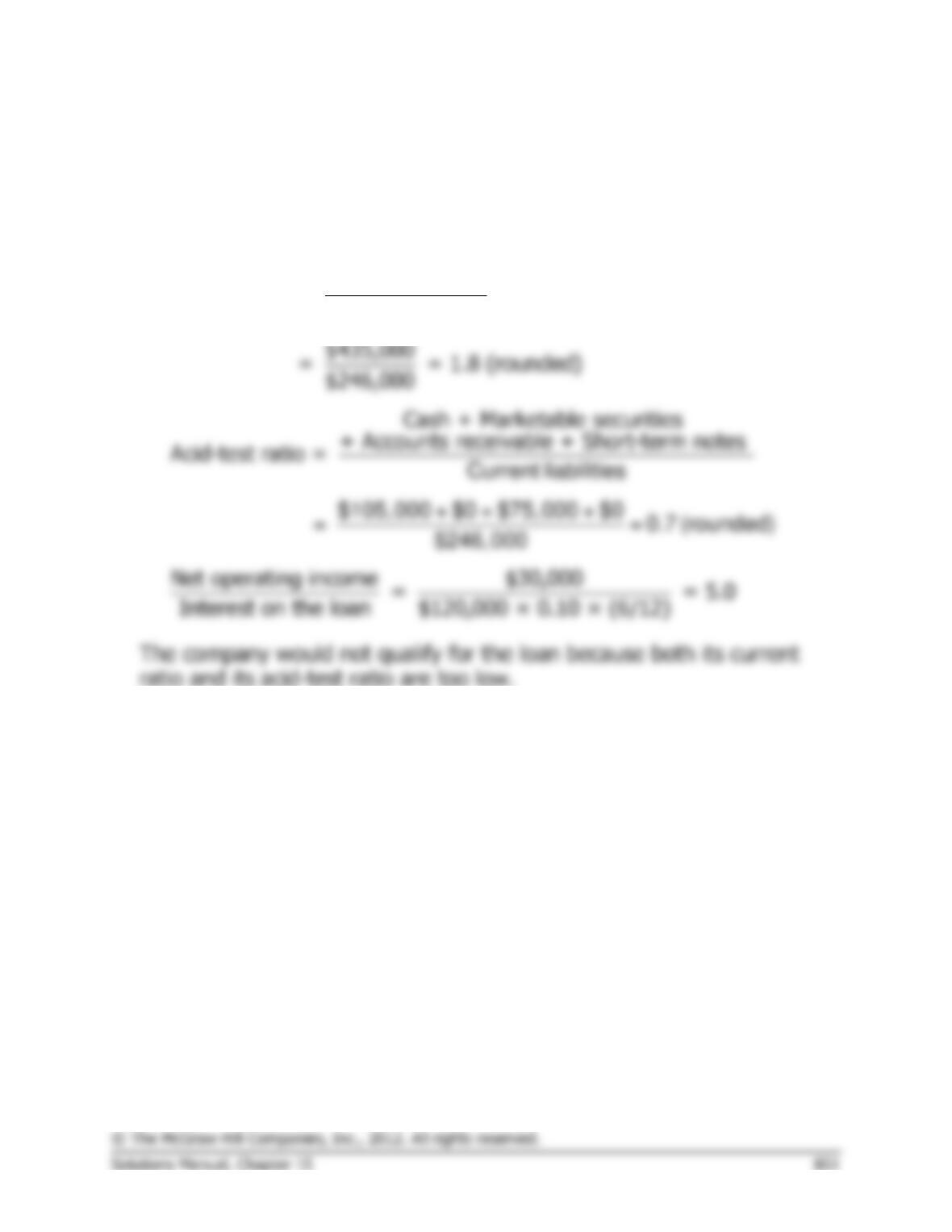
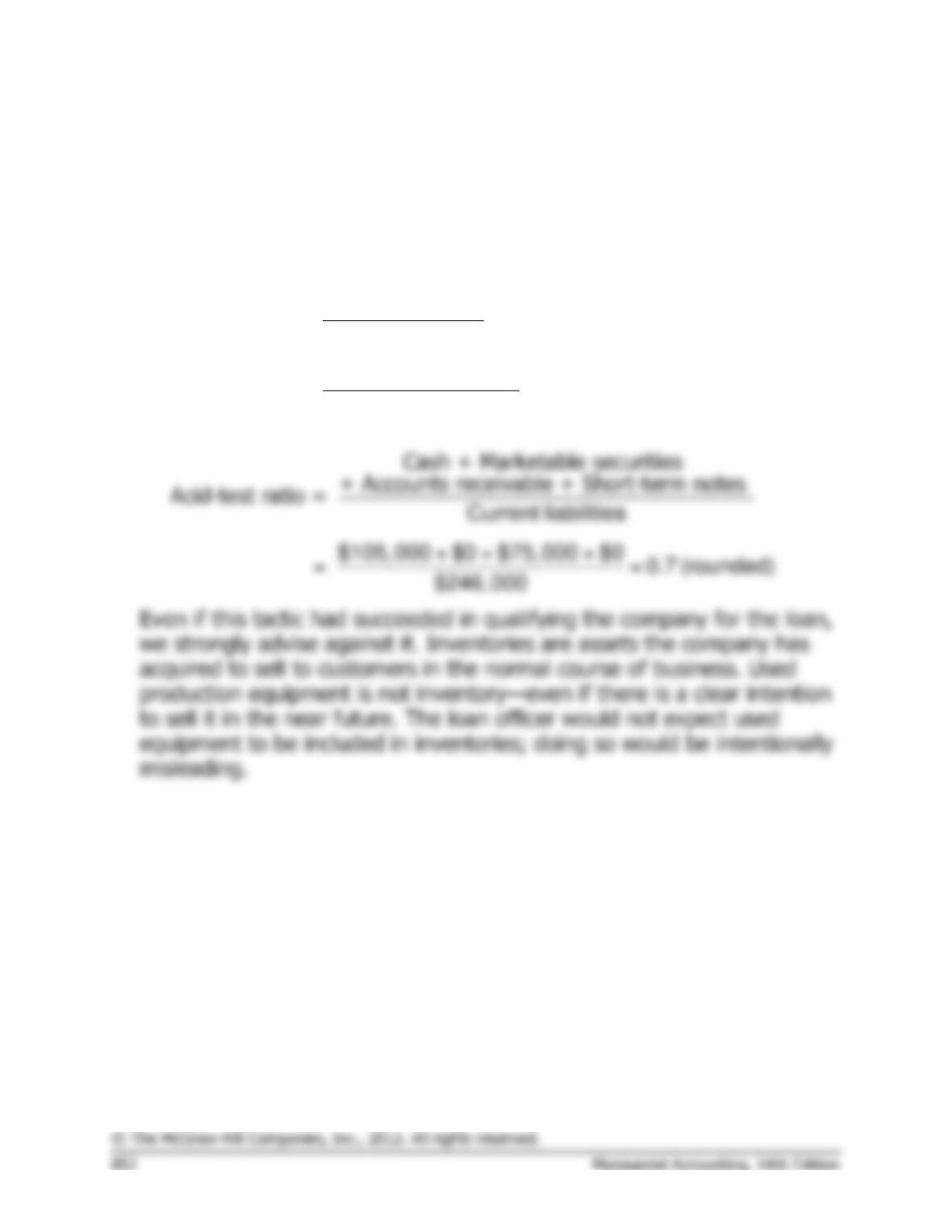
1. The loan officer stipulated that the current ratio prior to obtaining the
loan must be higher than 2.0, the acid-test ratio must be higher than
1.0, and the interest on the loan must be no more than one-fourth of
net operating income. These ratios are computed below:
Current assets
Current ratio =
Current liabilities
Problem 15-18 (continued)
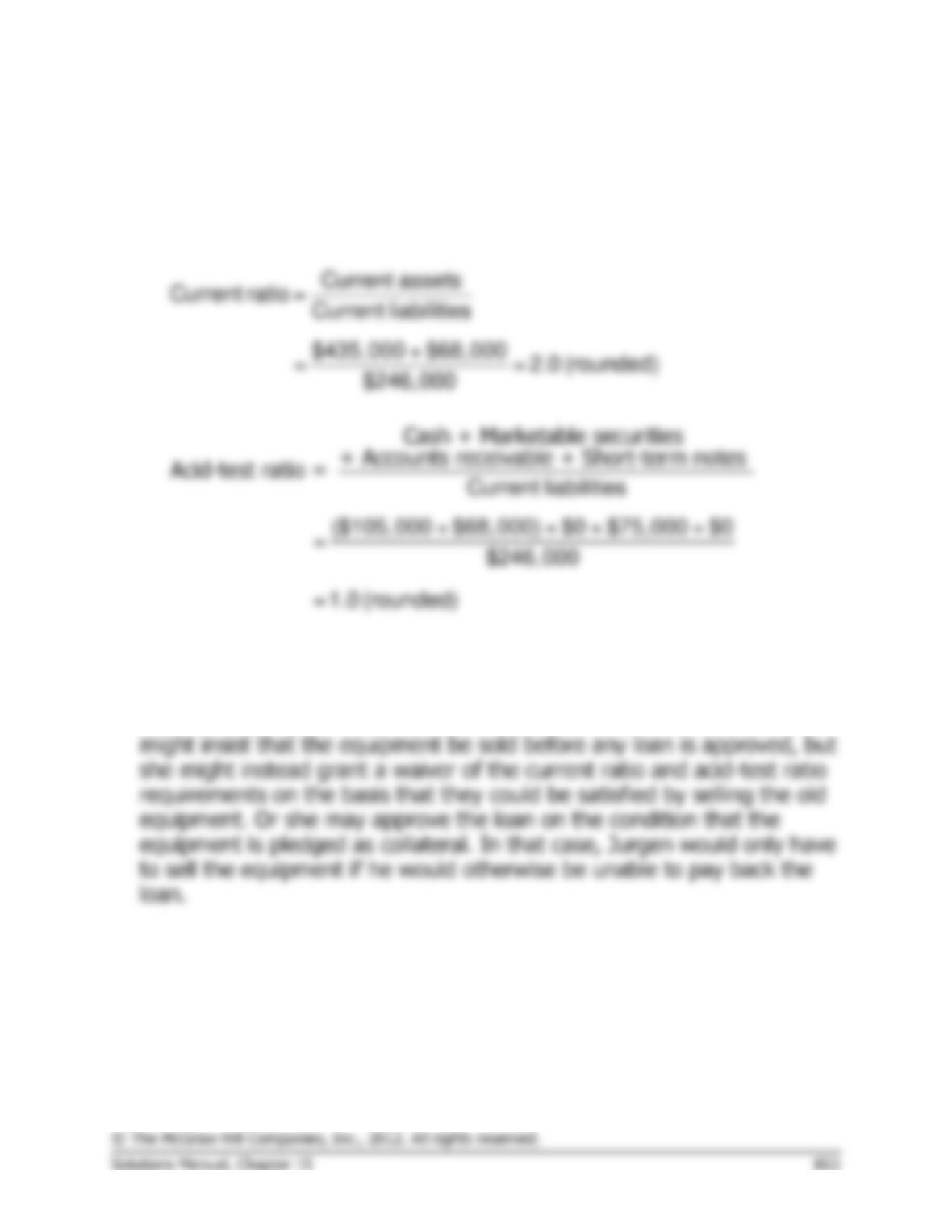
2. By reclassifying the $68 thousand net book value of the old equipment
as inventory, the current ratio would improve, but the acid-test ratio
would be unaffected. Inventory is considered a current asset for
purposes of computing the current ratio, but is not included in the
numerator when computing the acid-test ratio.
Current assets
Current ratio =
Current liabilities
$435,000 + $68,000
= = 2.0 (rounded)
$246,000
Problem 15-18 (continued)
Nevertheless, the old equipment is an asset that could be turned into
cash. If this were done, the company would immediately qualify for the
loan since the $68 thousand in cash would be included in the numerator
in both the current ratio and in the acid-test ratio.
However, other options may be available. The old equipment is being
used to relieve bottlenecks in the heat-treating process and it would be
desirable to keep this standby capacity. We would advise Jurgen to fully
and honestly explain the situation to the loan officer. The loan officer
Problem 15-19 (60 minutes or longer)
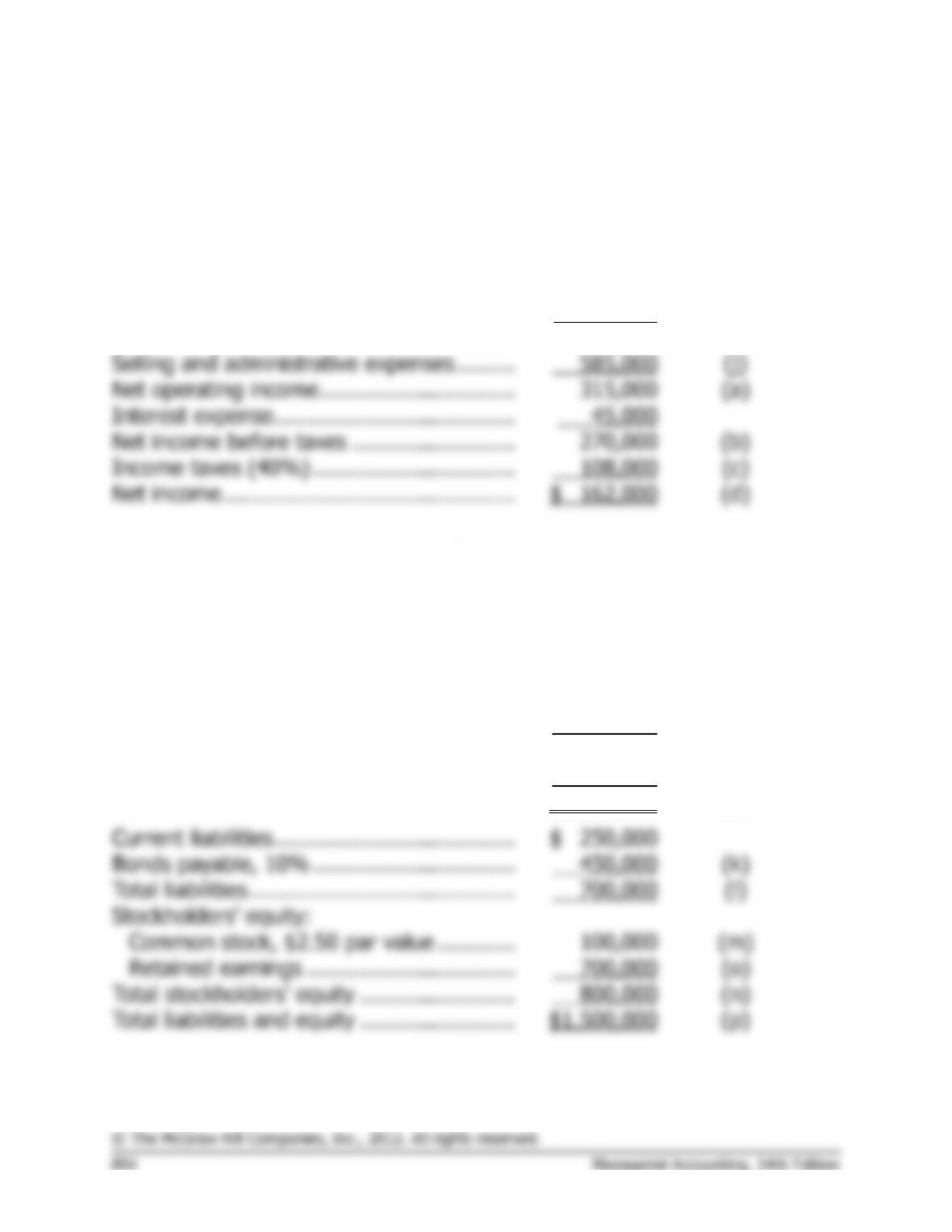
Tanner Company
Income Statement
For the Year Ended December 31
Key
Sales ………………………………………………
$2,700,000
Cost of goods sold …………………………….
1,800,000
(h)
Gross margin ……………………………………
900,000
(i)
Selling and administrative expenses ………
585,000
(j)
Net operating income …………………………
315,000
(a)
Interest expense ……………………………….
Net income before taxes …………………….
270,000
(b)
Income taxes (40%) ………………………….
108,000
Net income ………………………………………
$ 162,000
(d)
Tanner Company
Balance Sheet
December 31
Current assets:
Cash …………………………………………….
$ 80,000
(f)
Accounts receivable, net …………………..
200,000
(e)
Inventory ………………………………………
320,000
(g)
Total current assets …………………………...
600,000
(g)
Plant and equipment ………………………….
900,000
(q)
Total assets ……………………………………..
$1,500,000
(p)
Current liabilities ……………………………….
$ 250,000
Bonds payable, 10% ………………………….
450,000
(k)
Total liabilities …………………………………..
700,000
Common stock, $2.50 par value …………
100,000
Retained earnings …………………………..
700,000
(o)
800,000
(n)
Total liabilities and equity ……………………
(p)
Problem 15-19 (continued)
Computation of missing amounts:
a.
Earnings before interest and taxes
Times interest earned = Interest expense
Earnings before interest and taxes
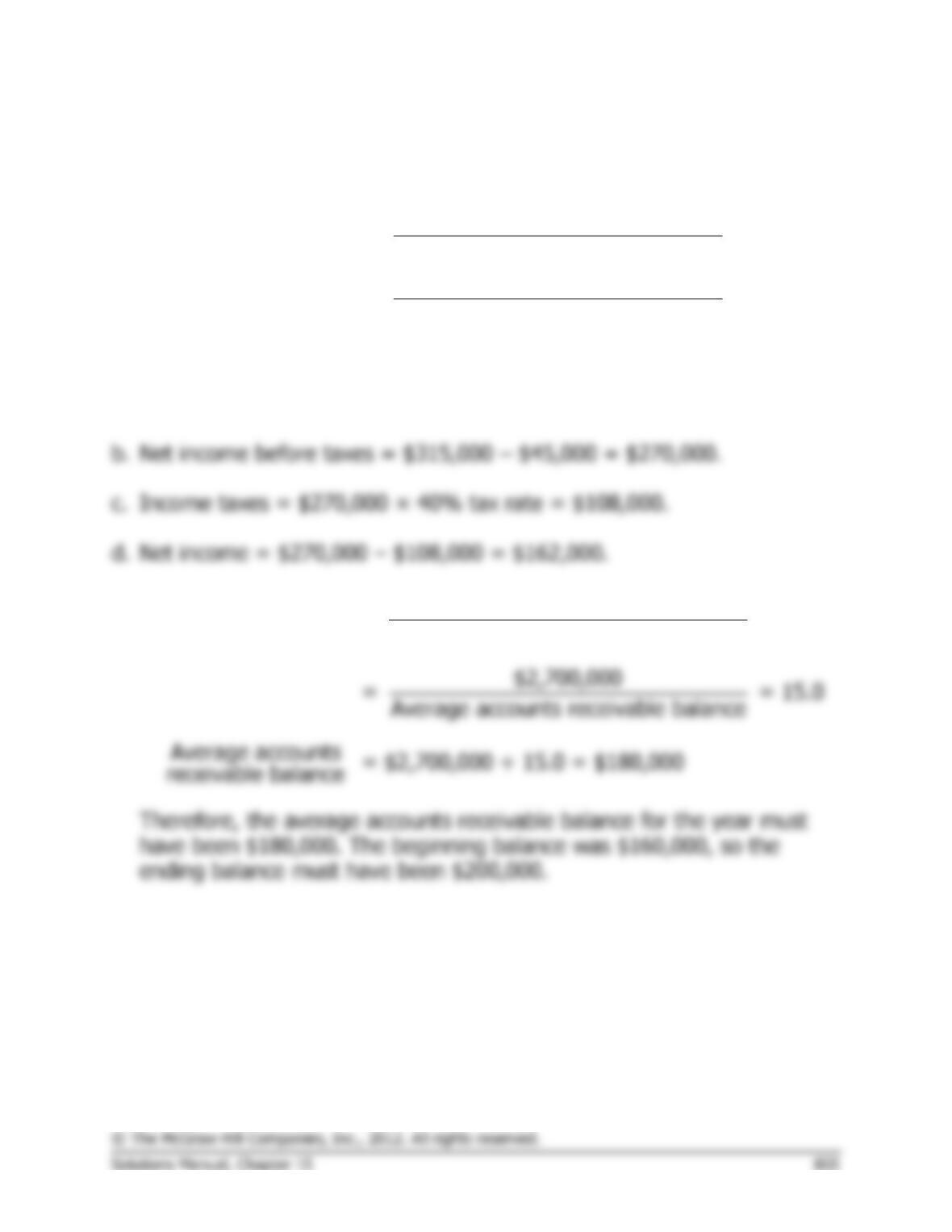
= $45,000
= 7.0
Therefore, the earnings before interest and taxes for the year must be
$315,000 (= $45,000 × 7.0).
e.
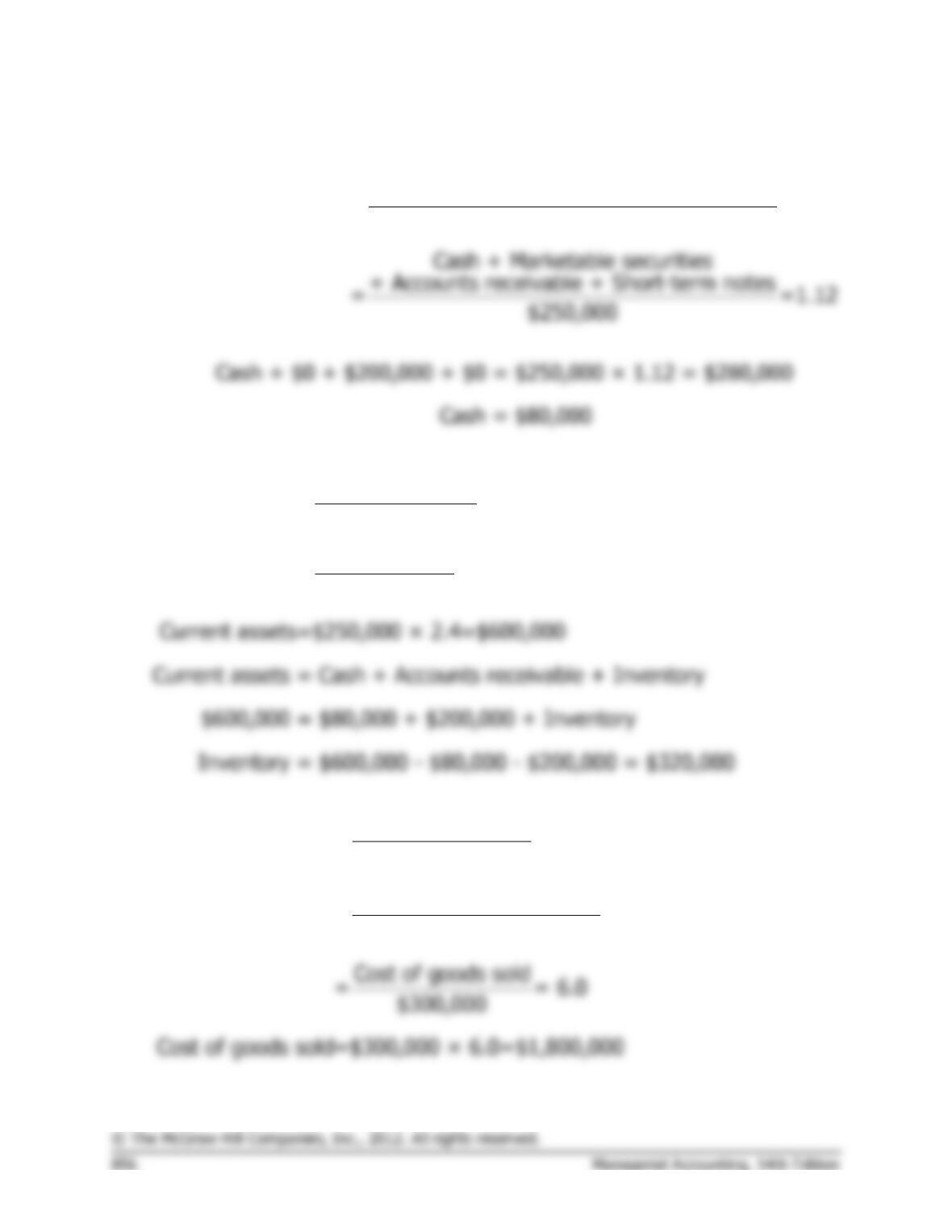
Sales on account
Accounts receivable =
turnover Average accounts receivable balance
Problem 15-19 (continued)
f.
Cash + Marketable securities
+ Accounts receivable + Short-term notes
Acid–test ratio= Current liabilities
g.
Current assets
Current ratio= Current liabilities
Current assets
= =2.4
$250,000
h.
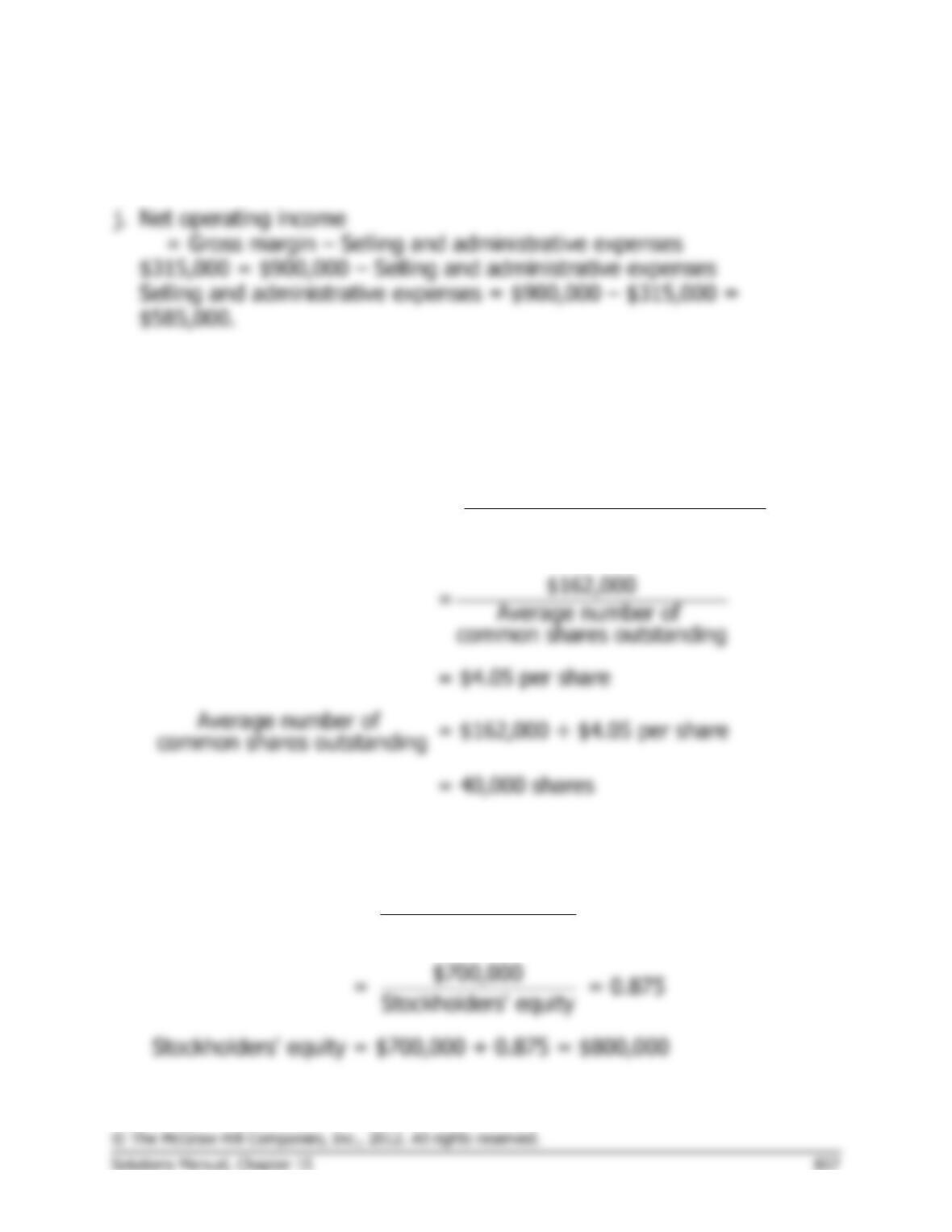
Cost of goods sold
Inventory turnover= Average inventory
Cost of goods sold
=($280,000 + $320,000)/2
Problem 15-19 (continued)
i. Gross margin = $2,700,000 – $1,800,000 = $900,000
k. The interest expense for the year was $45,000 and the interest rate was
10%, so the bonds payable must total $450,000.
l. Total liabilities = $250,000 + $450,000 = $700,000
m.
Net income-Preferred dividends
Earnings per share = Average number of
common shares outstanding
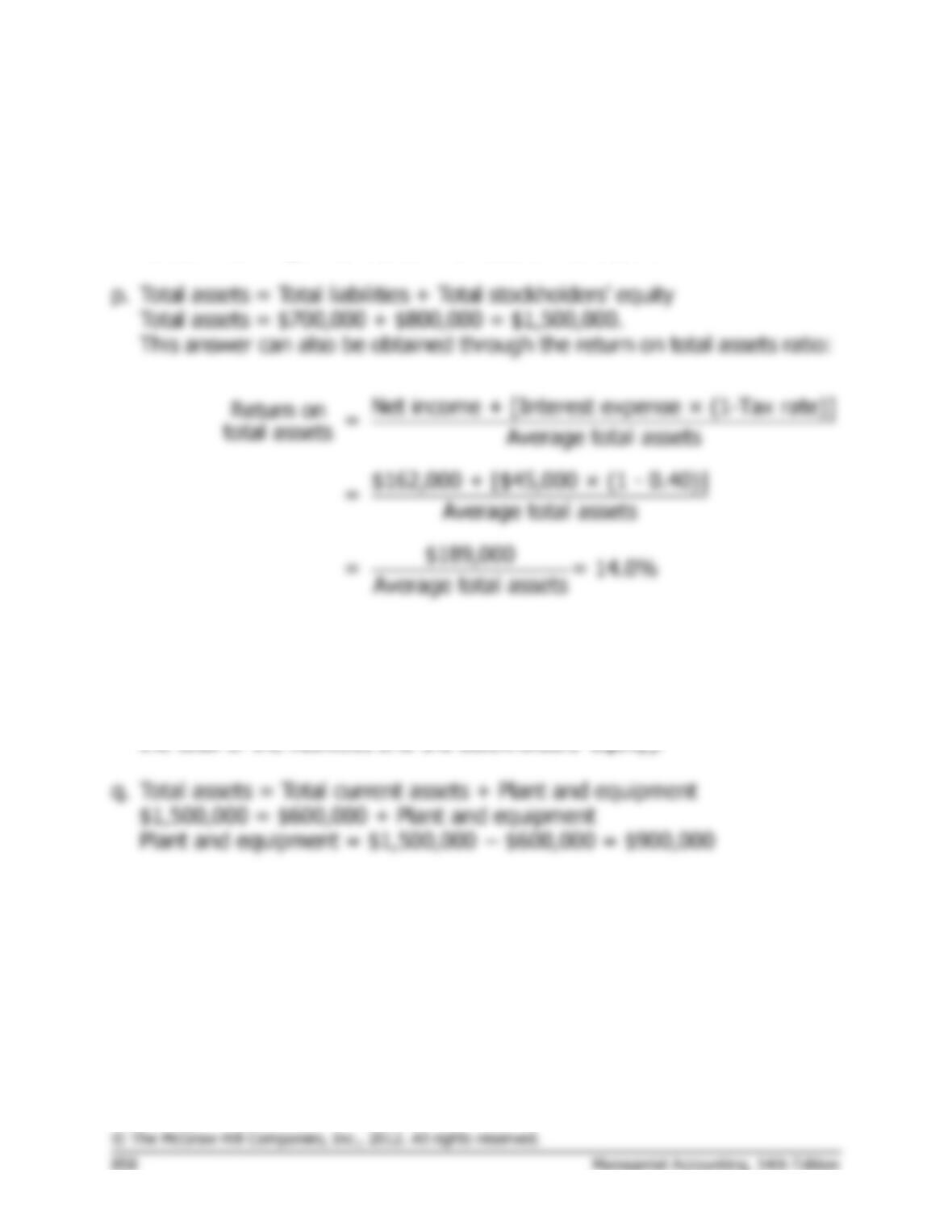
The stock is $2.50 par value per share, so the total common stock must
be $100,000.
n.
Total liabilities
Debt–to-equity ratio = Stockholders’ equity
Problem 15-19 (continued)
o. Total stockholders’ equity = Common stock + Retained earnings
$800,000 = $100,000 + Retained earnings
Retained earnings = $800,000 − $100,000 = $700,000
Average total assets = $189,000 ÷ 0.14 = $1,350,000
Therefore the average total assets must be $1,350,000. Since the total
assets at the beginning of the year were $1,200,000, the total assets at
the end of the year must have been $1,500,000 (which would also equal
the total of the liabilities and the stockholders’ equity).