CHAPTER 15
RASING CAPITAL
Answers to Concepts Review and Critical Thinking Questions
1. A company’s internally generated cash flow provides a source of equity financing. For a profitable
company, outside equity may never be needed. Debt issues are larger because large companies have
the greatest access to public debt markets (small companies tend to borrow more from private lenders).
Equity issuers are frequently small companies going public; such issues are often quite small.
3. They are riskier and harder to market from an investment bank’s perspective.
4. Yields on comparable bonds can usually be readily observed, so pricing a bond issue accurately is
much less difficult.
8. He could have done worse since his access to the oversubscribed and, presumably, underpriced issues
was restricted, while the bulk of his funds were allocated in stocks from the undersubscribed and, quite
possibly, overpriced issues.
Solutions to Questions and Problems
Basic
NOTE: All end-of-chapter problems were solved using a spreadsheet. Many problems require multiple
steps. Due to space and readability constraints, when these intermediate steps are included in this solutions
manual, rounding may appear to have occurred. However, the final answer for each problem is found
without rounding during any step in the problem.
1. If you receive 1,000 shares of each, the profit is:
Profit = 1,000($9.50) – 1,000($5.25)
Profit = $4,250
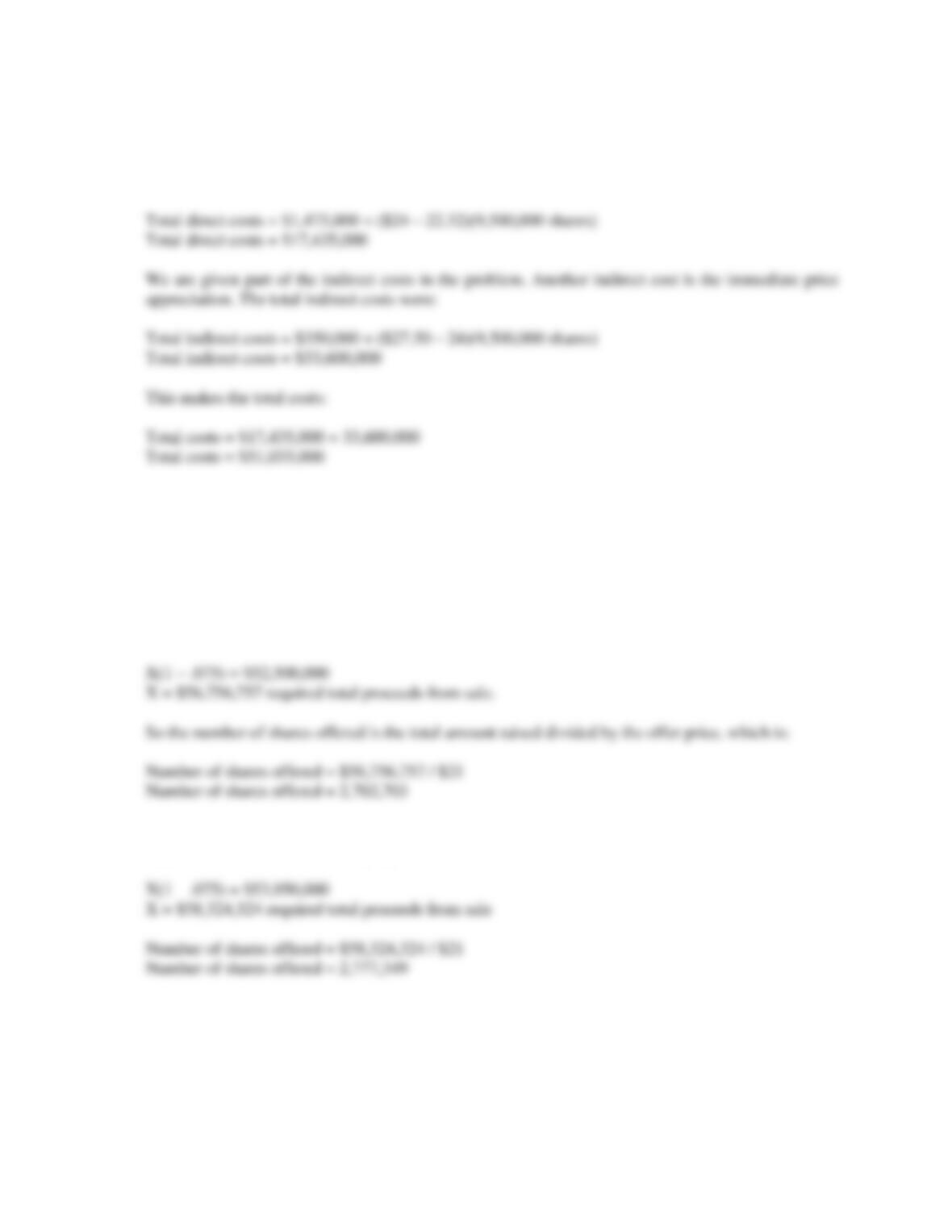
2. Using X to stand for the required sale proceeds, the equation to calculate the total sale proceeds,
including flotation costs, is:
3. This is basically the same as the previous problem, except that we need to include the $1,425,000 of
expenses in the amount the company needs to raise, so:
4. We need to calculate the net amount raised and the costs associated with the offer. The net amount
raised is the number of shares offered times the price received by the company, minus the costs
associated with the offer, so:
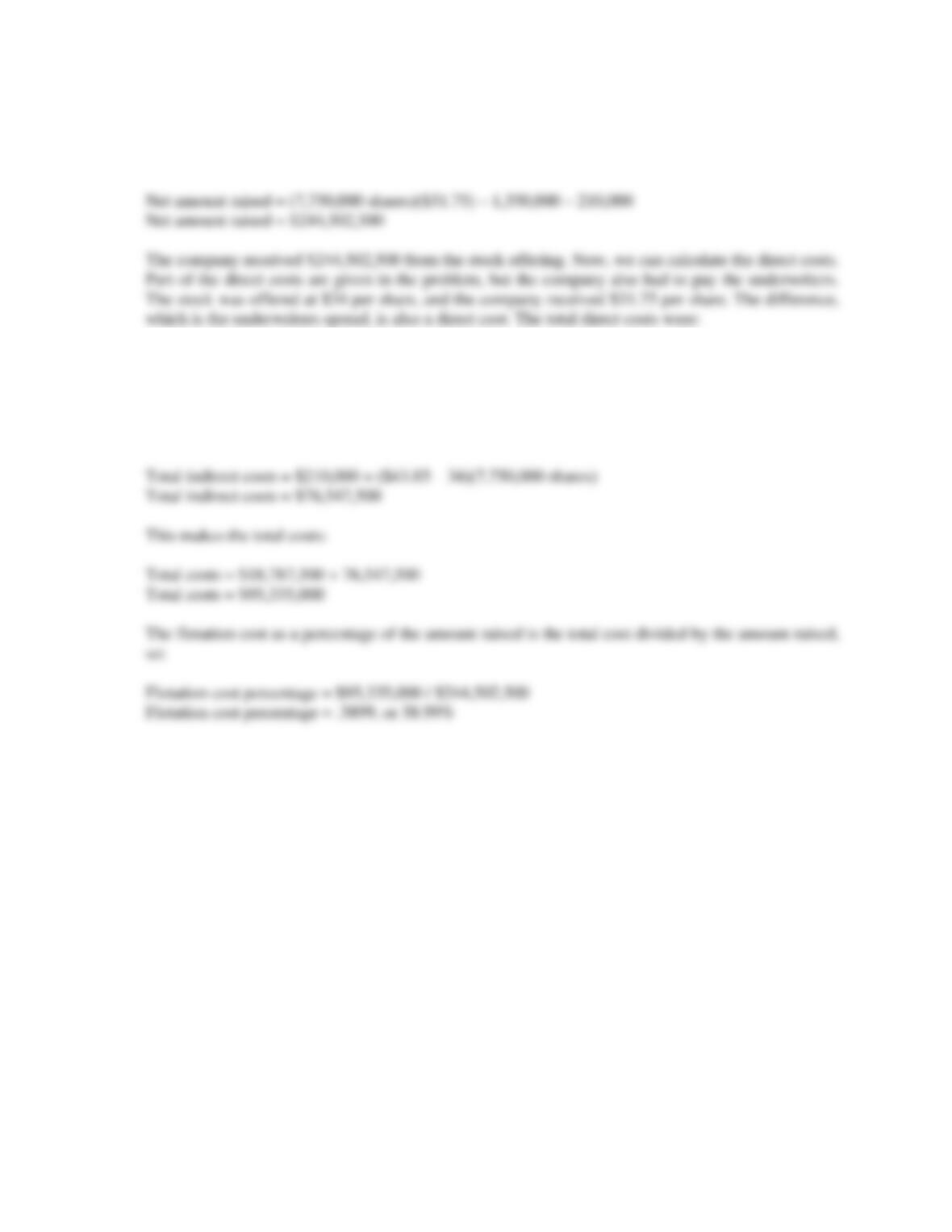
The company received $210,215,000 from the stock offering. Now, we can calculate the direct costs.
Part of the direct costs are given in the problem, but the company also had to pay the underwriters.
The stock was offered at $24 per share, and the company received $22.32 per share. The difference,
which is the underwriters spread, is also a direct cost. The total direct costs were:
The flotation costs as a percentage of the amount raised is the total cost divided by the amount raised,
so:
Flotation cost percentage = $51,035,000 / $210,215,000
Flotation cost percentage = .2428, or 24.28%
5. Using X to stand for the required sale proceeds, the equation to calculate the total sale proceeds,
including flotation costs, is:
6. This is basically the same as the previous problem, except that we need to include the $1,450,000 of
expenses in the amount the company needs to raise, so:
7. We need to calculate the net amount raised and the costs associated with the offer. The net amount
raised is the number of shares offered times the price received by the company, minus the costs
associated with the offer, so:
Total direct costs = $1,350,000 + ($34 – 31.75)(7,750,000 shares)
Total direct costs = $18,787,500
We are given part of the indirect costs in the problem. Another indirect cost is the immediate price
appreciation. The total indirect costs were: