Chapter 15
The Importance of Energy Changes and Electron Transfer
in Metabolism
1
SUMMARY
Section 15.1
Standard states are benchmark conditions chosen to have a basis of comparison
Section 15.2
The usual thermodynamic standard state implies that the system involved is at
pH = 0, which is seldom, if ever, found in living things. The modified standard
state explicitly states that the system is at pH = 7.
Section 15.3
Section 15.4
In catabolism, large molecules are broken down to smaller products, releasing
energy and transferring electrons to acceptor molecules of various sorts. The
Section 15.5
Two coenzymes, NADH and FADH2, play a crucial role in biological oxidation-
reduction reactions. Hydrogen ions are transferred in addition to electrons.
Section 15.6
Section 15.7
Metabolic pathways proceed in many stages, allowing for efficient use of energy.
2 Chapter 15
LECTURE NOTES
Thermodynamics is arguably the most difficult of topics discussed for students.
Even though this will have been covered in a general chemistry course, the concepts
LECTURE OUTLINE
I. Thermodynamics
A. Standard states
II. Metabolism
A. Catabolism and anabolism
B. Oxidation-reduction reactions
1. Oxidizing and reducing agents
2. Half-reactions
C. Coenzymes in biological oxidation-reduction reactions
III. Coupling of energy production and use
ANSWERS TO PROBLEMS
15.1 Standard States for Free-Energy Changes
1. There is a connection, and it is one of the most important points in this chapter. It
can be expressed in the equation G°′ = –RT ln Keq.
2. Reaction (a) would take place only if it is coupled to an exergonic reaction.
Reaction (b) would proceed only if coupled to an exergonic reaction. Reaction (c)
The Importance of Energy Changes and Electron Transfer
in Metabolism 3
15.2 A Modified Standard State for Biochemical Applications
6. The usual thermodynamic standard state refers to pH = 0. This is not very useful
in biochemistry.
7. Statement (a) is true, but statement (b) is not. The standard state of solutes is
normally defined as unit activity (1 M for all but the most careful work). In
9. No, there is no relationship between the thermodynamic quantity G° and the
speed. The G° reflects the thermodynamic possibility under standard states.
Speed is a kinetic quantity that is based on the ability of an enzyme to catalyze
the reaction and the real substrate concentrations in the cell.
10. Assuming one significant figure, 20 kJ mol–1, 0 kJ mol–1, +30 kJ mol–1.
13. The levels of substrates and products can affect the true G of a reaction,
changing it from zero to a high number as in part (a). G is negative when there
is a larger amount of substrate than product.
14. The overall G°′ = –260.4 kJ mol–1 or –62.3 kcal mol–1. The reaction is exergonic,
because it has a large, negative G°′.
15. Greater than 3333 to 1.
18. Two aspects are involved here. (a) Very rarely, if ever, are in vivo concentrations
standard concentrations; actual G (not G°) values are very dependent on local
concentrations, especially if the number of reactant molecules and product
4 Chapter 15
15.3 The Nature of Metabolism
19. Group 1: catabolism, oxidative, energy-yielding. Group 2: anabolism, reductive,
energy-requiring.
20. The local decrease in entropy associated with living organisms is balanced by
the increase in the entropy of the surroundings caused by their presence.
15.4 The Role of Oxidation and Reduction in Metabolism
24.
(a) NADH is oxidized, H+ + NADH NAD+ + 2e– + 2H+. The aldehyde is reduced,
15.5 Coenzymes in Biologically Important Oxidation–Reduction Reactions
26. NAD+, NADP+, and FAD all contain an ADP moiety.
27. In NADPH, the 2′ hydroxyl of the ribose attached to the adenine has a phosphate
attached.
28. There is little effect in the reactions. Both are coenzymes involved in oxidation–
reduction reactions. The presence of the phosphate distinguishes two separate
production of ATP.
31. None of these statements is true. Some coenzymes are involved in group-
transfer reactions (recall this from Chapter 7). Many coenzymes contain
phosphate groups, and CoA contains sulfur. ATP does not represent stored
The Importance of Energy Changes and Electron Transfer
in Metabolism 5
34. See Figures 15.4 and 15.5.
35. Glucose-6-phosphate is oxidized, and NADP+ is reduced. NADP+ is the oxidizing
agent, and glucose-6-phosphate is the reducing agent.
36. FAD is reduced, and succinate is oxidized. FAD is the oxidizing agent, and
succinate is the reducing agent.
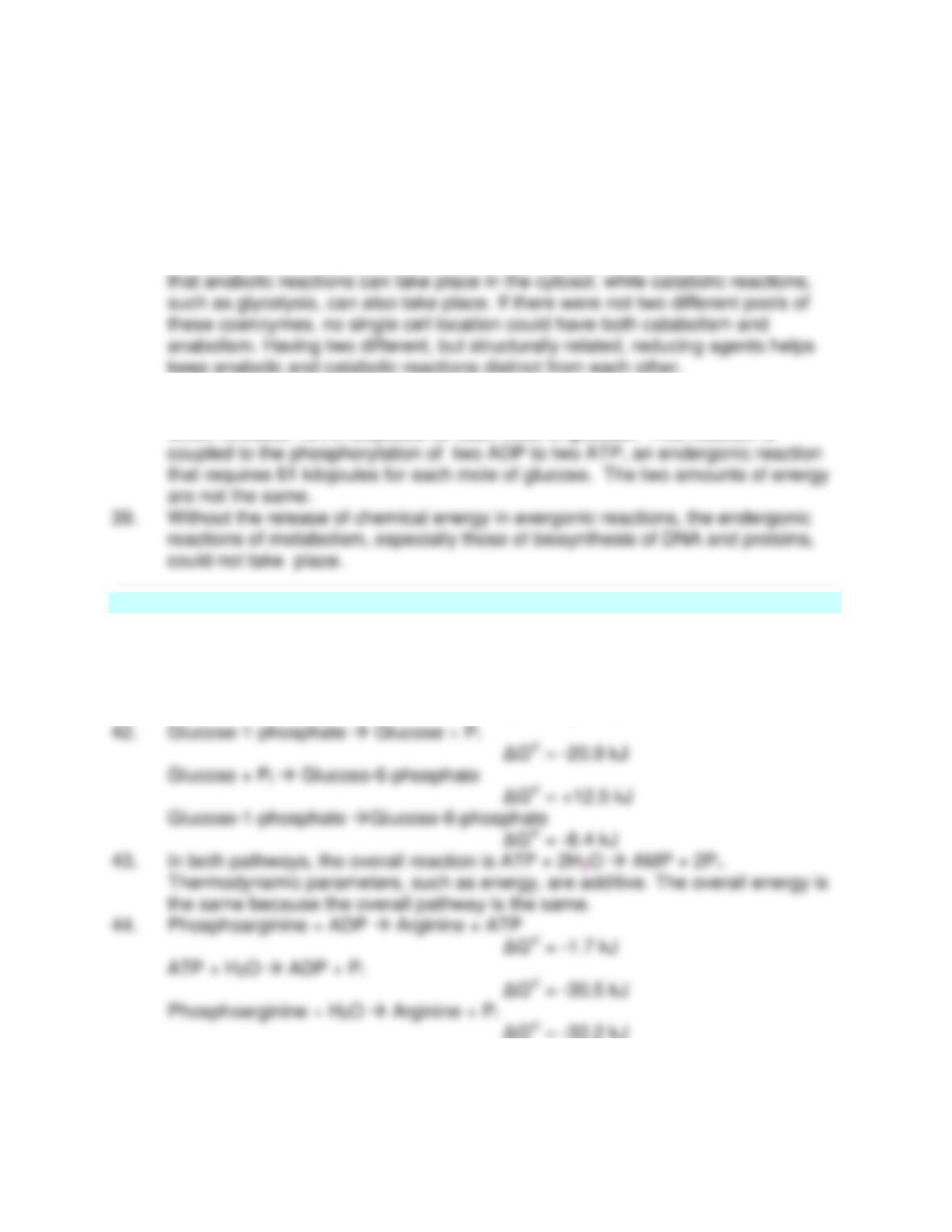
37. It is important to have two different pools of redox coenzymes. In the cytosol, the
NAD+/NADH ratio is high, but the NADPH/NADP+ ratio is also high. This means
38. Only a portion of the energy released by exergonic reactions drives endergonic
reactions. An example is the exergonic oxidation of glucose to two lactate ion),
which releases 184.5 kilojoules for each mole of glucose. This reaction is
15.6 Coupling of Production and Use of Energy
40. The ratio of substrates to products would have to be 321,258 to 1.
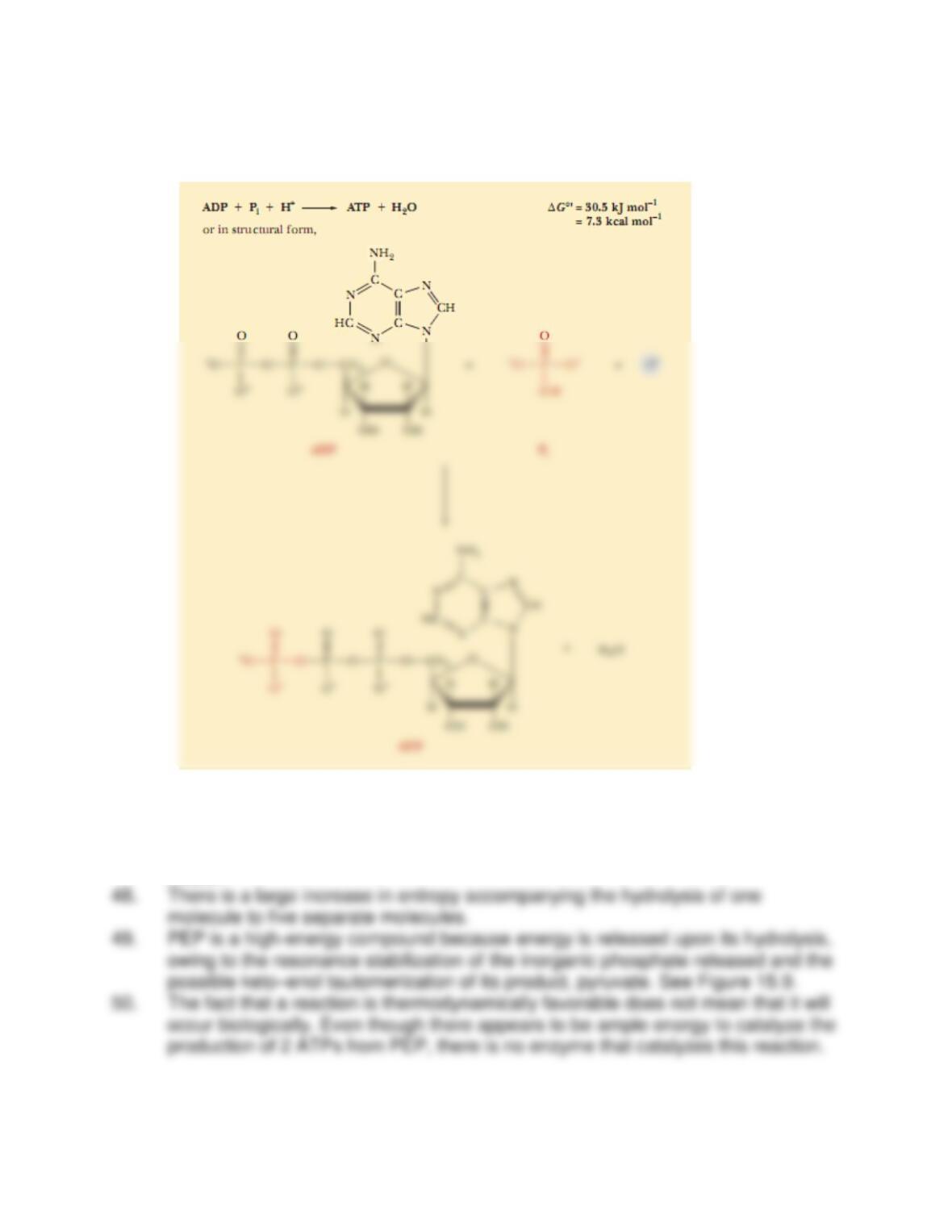
41. Creatine phosphate + ADO Creatine + ATP
ΔGo’ = -12.6 kJ
ATP + Glycerol ADP + Glycerol-3-phosphate
ΔGo’ = -20.8 kJ
6 Chapter 15
45. ATP is less stable than ADP and Pi because of the charge distribution and loss of
the resonance stabilization in the phosphate ion. There is stabilization (dispersal
of energy) when ATP is hydrolyzed, leading to a negative free-energy change.
46. It is intermediate; thus, ATP is ideally positioned to serve as a phosphate donor
or (as ADP) a phosphate acceptor, depending on local concentrations.
47. Creatine phosphate can phosphorylate ADP to ATP. There is a biochemical
“germ of truth” here, but the effectiveness of such a supplement is another
matter.
The Importance of Energy Changes and Electron Transfer
in Metabolism 7
51. Sprints and similar short periods of exercise rely on anaerobic metabolism as a
15.7 Coenzyme A in Activation of Metabolic Pathways
52. An activation step leads to an exergonic next step in a pathway. It is similar to the
way in which organic chemists want to attach a good leaving group for the next
step in a series of reactions.
reaction.
55. Coenzyme A serves several purposes. It is a high-energy compound, activating
the initial steps of the metabolic pathway. It is used as a tag to “earmark” a
molecule for a particular pathway. It is large and cannot cross membranes, so
compartmentalization of pathways can be affected by binding metabolites to
coenzyme A.