15.19: PROBLEM DEFINITION
How are head loss and slope related for non-uniform flow, as compared to uniform
flow? Consider both rapidly and gradually varying non-uniform flow.
SOLUTION
•In uniform flow, velocity is constant along a streamline. Practically speaking,
this requires a design of constant cross-section and slope.
For uniform flow, as shown in Figure 15.4 (EFM10e), the slope of the HGL will
•For non–uniform flow, one must consider whether the situation at hand is rapidly
varying, or gradually varying.
* For gradually varied flow, because of the long distance involved, the surface
21
15.20: PROBLEM DEFINITION
Situation:
Critical flow in general.
Find:
Is critical flow a desirable or undesirable flow condition? Why?
SOLUTION
Critical flow is undesirable because it is very unstable.
It is unstable because it occurs when specific energy is a minimum for a given dis-
22

15.21: PROBLEM DEFINITION
Situation:
Critical flow _____. (Select all of the following that are correct.)
a. occurs when specific energy is a minimum for a given discharge.
b. occurs when the discharge is maximum for a given specificenergy.
c. occurs when Fr <1.
d. occurs when Fr = 1.
SOLUTION
a. Yes
23
15.22: PROBLEM DEFINITION
Situation:
Water flows through a rectangular channel.
V=35ft/s,y=8in.
Find:
(a) Determine if the flow is subcritical or supercritical.
(b) Calculate the alternate depth (ft).
PLAN
Check the Froude number, then apply the specific energy equation to calculate the
alternative depth.
SOLUTION
Froude number
SpecificEnergyEquation
Let the alternate depth = y2,then
24
15.23: PROBLEM DEFINITION
Water flows through a rectangular channel.
Q=900ft
3/s,y=3ft
width = 16 ft.
Find:
Determine if the flow is subcritical or supercritical.
PLAN
Calculate average velocity by applying the flow rate equation. Then check the Froude
number.
SOLUTION
Flow rate equation
Froude number
25
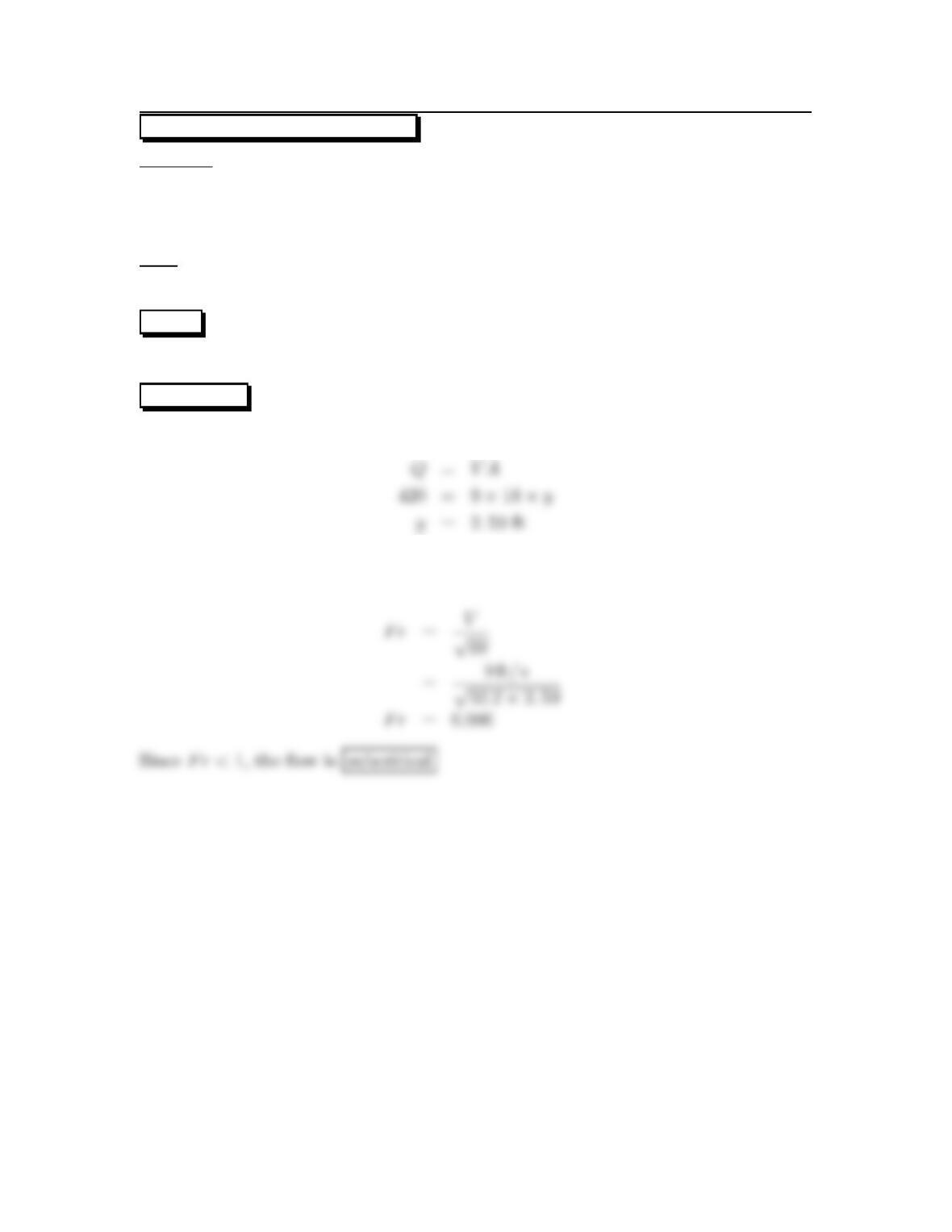
15.24: PROBLEM DEFINITION
Situation:
Water flows through a rectangular channel.
Q=420ft
3/s,V=9ft/s.
width = 18 ft.
Find:
Determine if the flow is subcritical or supercritical.
PLAN
Calculate yby applying the flow rate equation. Then check the Froude number.
SOLUTION
Flow rate equation
Froude number
26
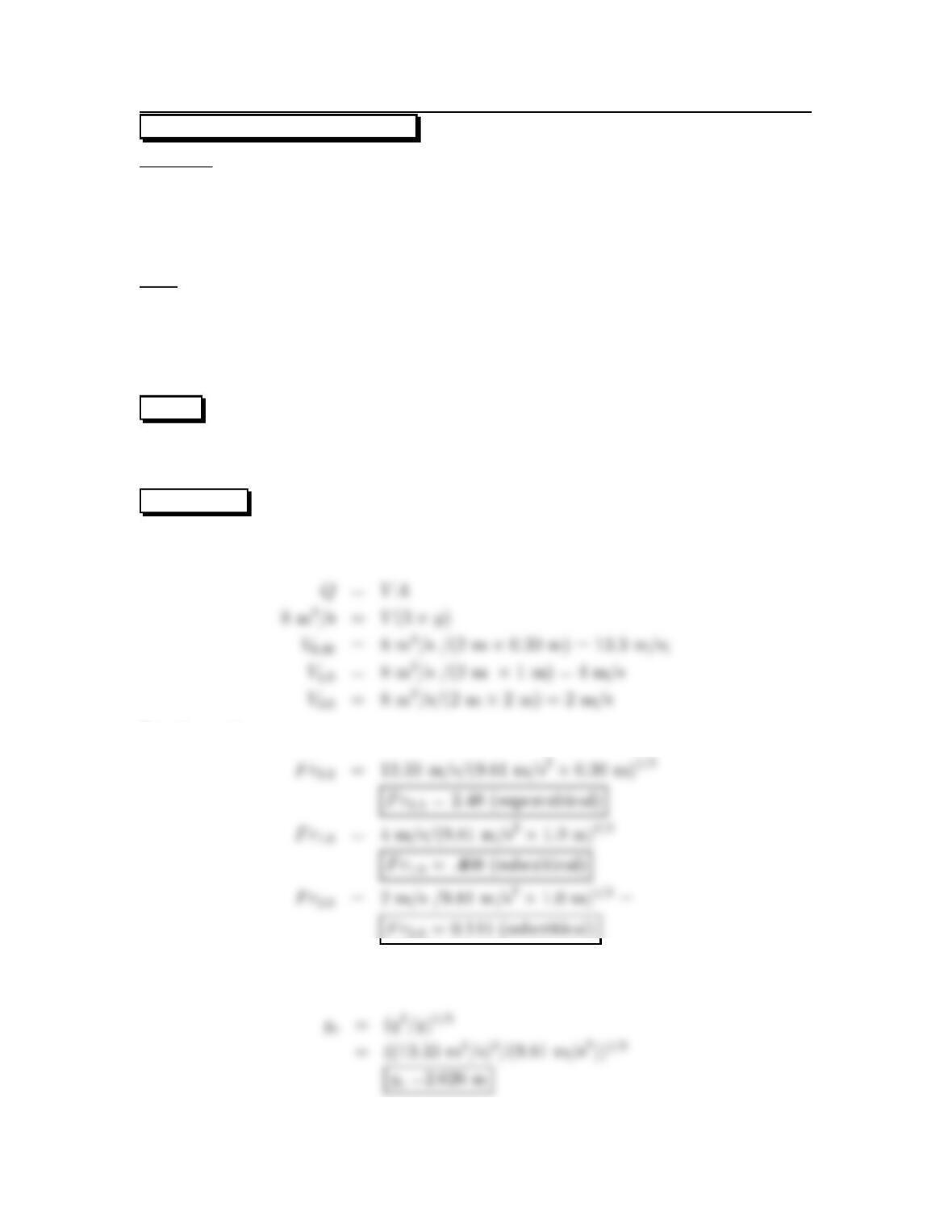
15.25: PROBLEM DEFINITION
Situation:
Water flows through a rectangular channel.
Q=8m
3/s.
width = 2m.
Three depths of flow are of interest: y=0.3,1.0,and 2.0m.
Find:
(a) For each specified depth:
(i) Calculate the Froude number.
(ii) Determine if the flow is subcritical or supercritical.
(b) Calculate the critical depth (m).
PLAN
Calculate average velocities by applying the flow rate equation. Then check the
Froude numbers. Then apply the critical depth equation.
SOLUTION
Flow rate equation
Froude numbers
Critical depth equation
27
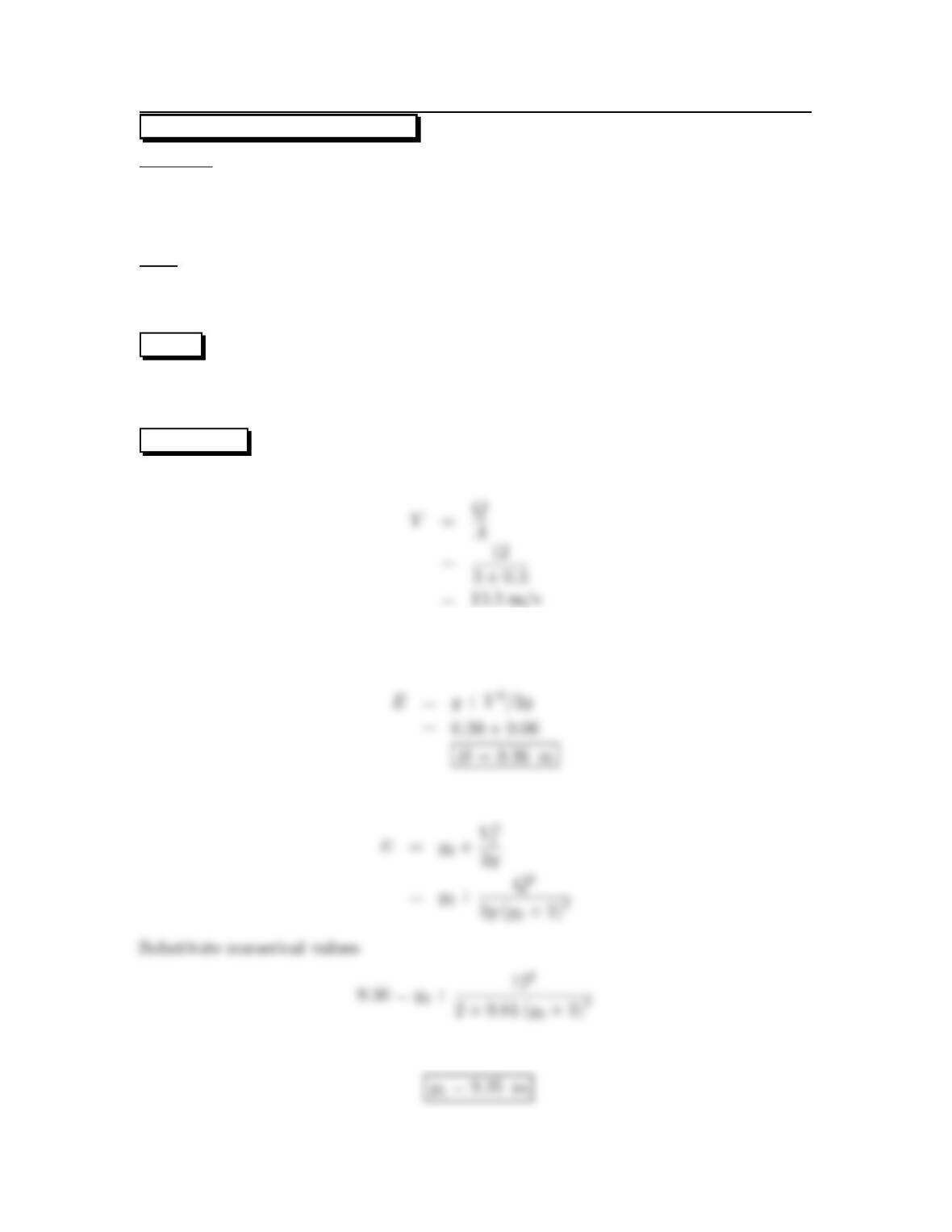
15.26: PROBLEM DEFINITION
Situation:
Water flows through a rectangular channel.
Q=12m
3/s,y=0.3m.
width = 3m.
Find:
(a) Alternate depth (m).
(b) Specificenergy(m).
PLAN
Apply the flow rate equation to find the average velocity. Then calculate specific
energy and alternate depth.
SOLUTION
Flow rate equation
SpecificEnergyEquation
Let the alternate depth = y2,then
Solving for y2gives the alternate depth.
28
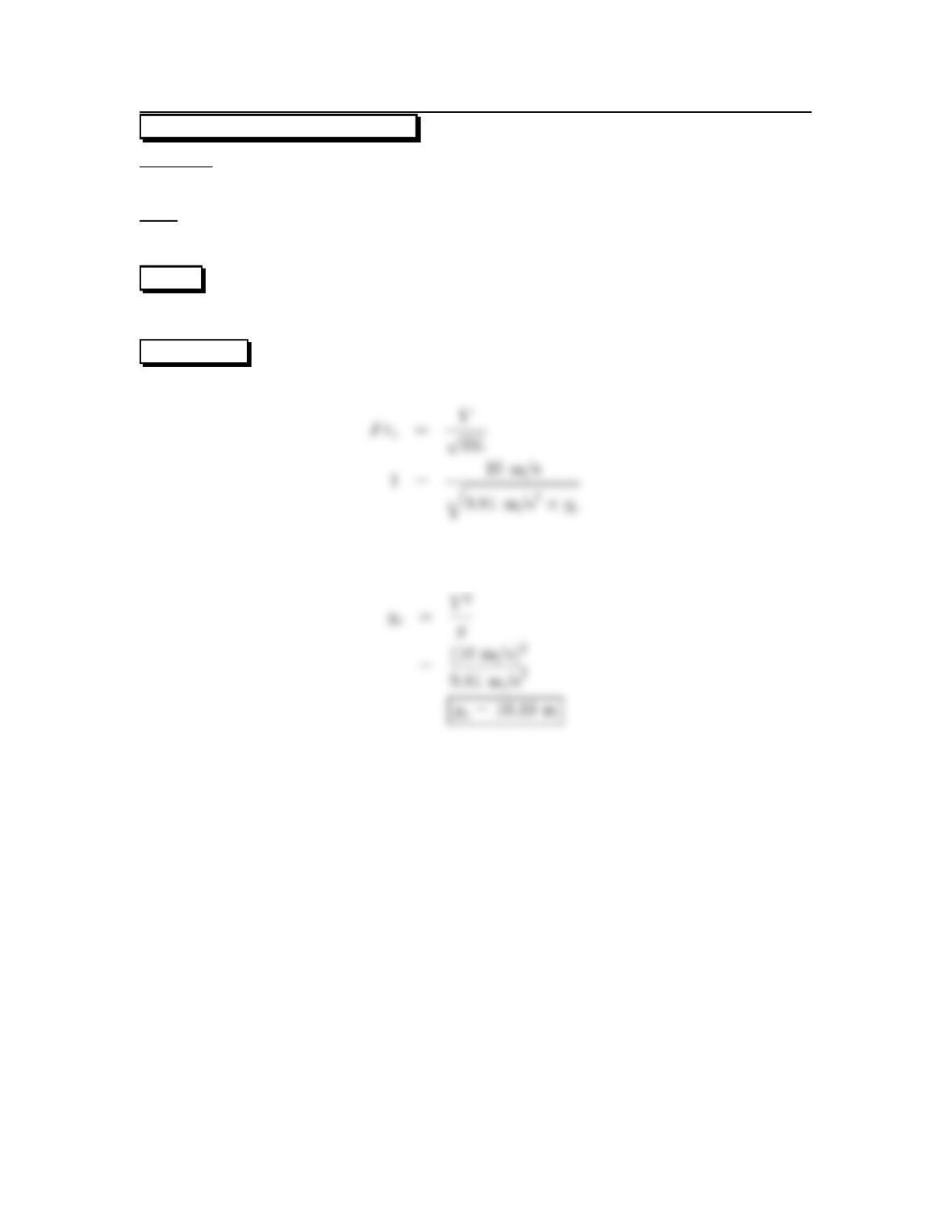
15.27: PROBLEM DEFINITION
Situation:
Water flows at the critical depth in a channel; V=10m/s.
Find:
Depth of flow (critical depth) (m).
PLAN
Calculate the critical depth by setting Froude number equal to 1.
SOLUTION
Froude number
Critical depth
29
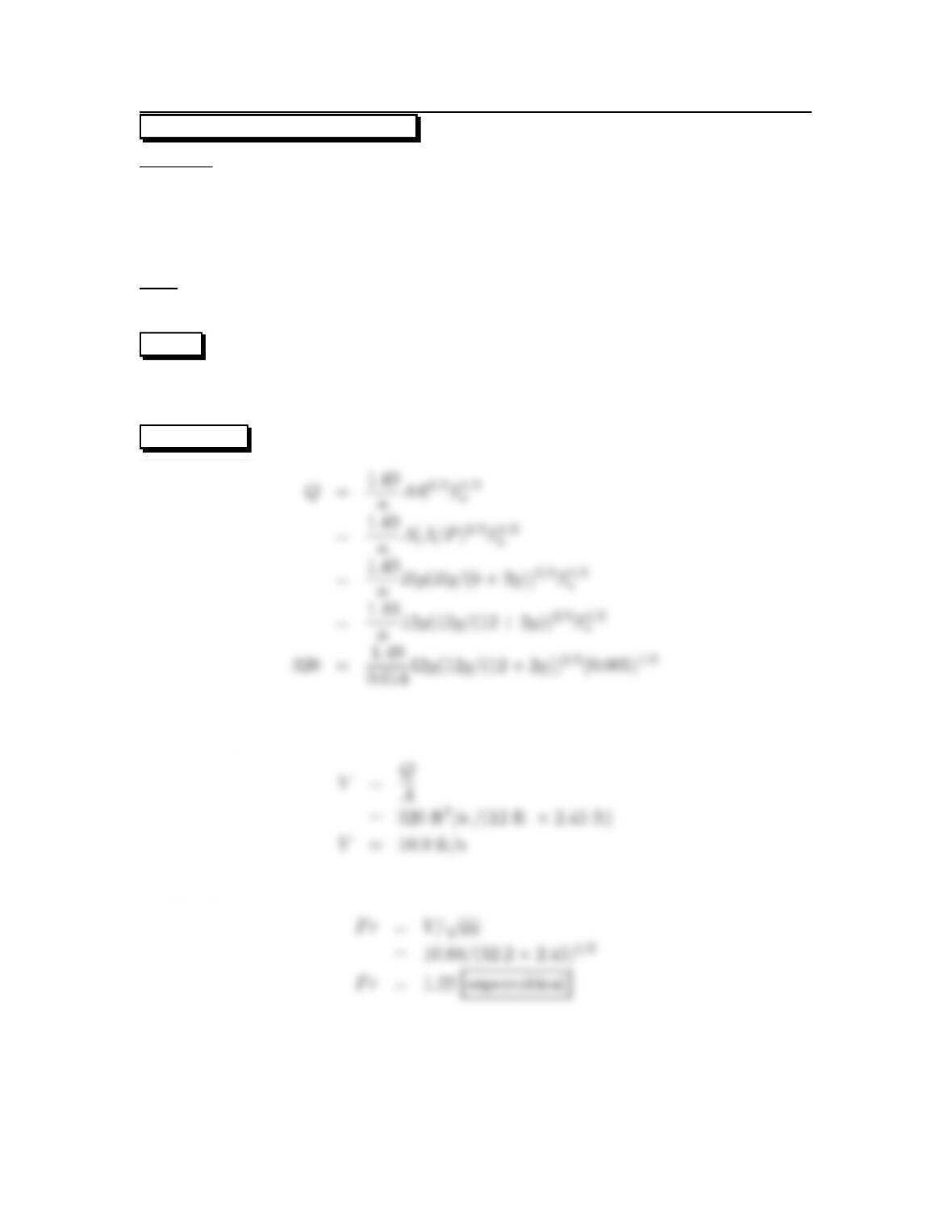
15.28: PROBLEM DEFINITION
Situation:
Water flows in a rectangular channel.
Bottom slope = 0.005.
n=0.014,Q=320cfs.
width = 12 ft.
Find:
Determine if the flow is subcritical or supercritical.
PLAN
Calculate y, then calculate the average velocity by applying the flow rate equation.
Then check the Froude number.
SOLUTION
Solving for yyields: y=2.45 ft.
Flow rate equation
Froude number
30
15.29: PROBLEM DEFINITION
Situation:
Water flows in a trapezoidal channel—additional details are provided in the problem
statement.
Find:
Determine if the flow is subcritical or supercritical.
PLAN
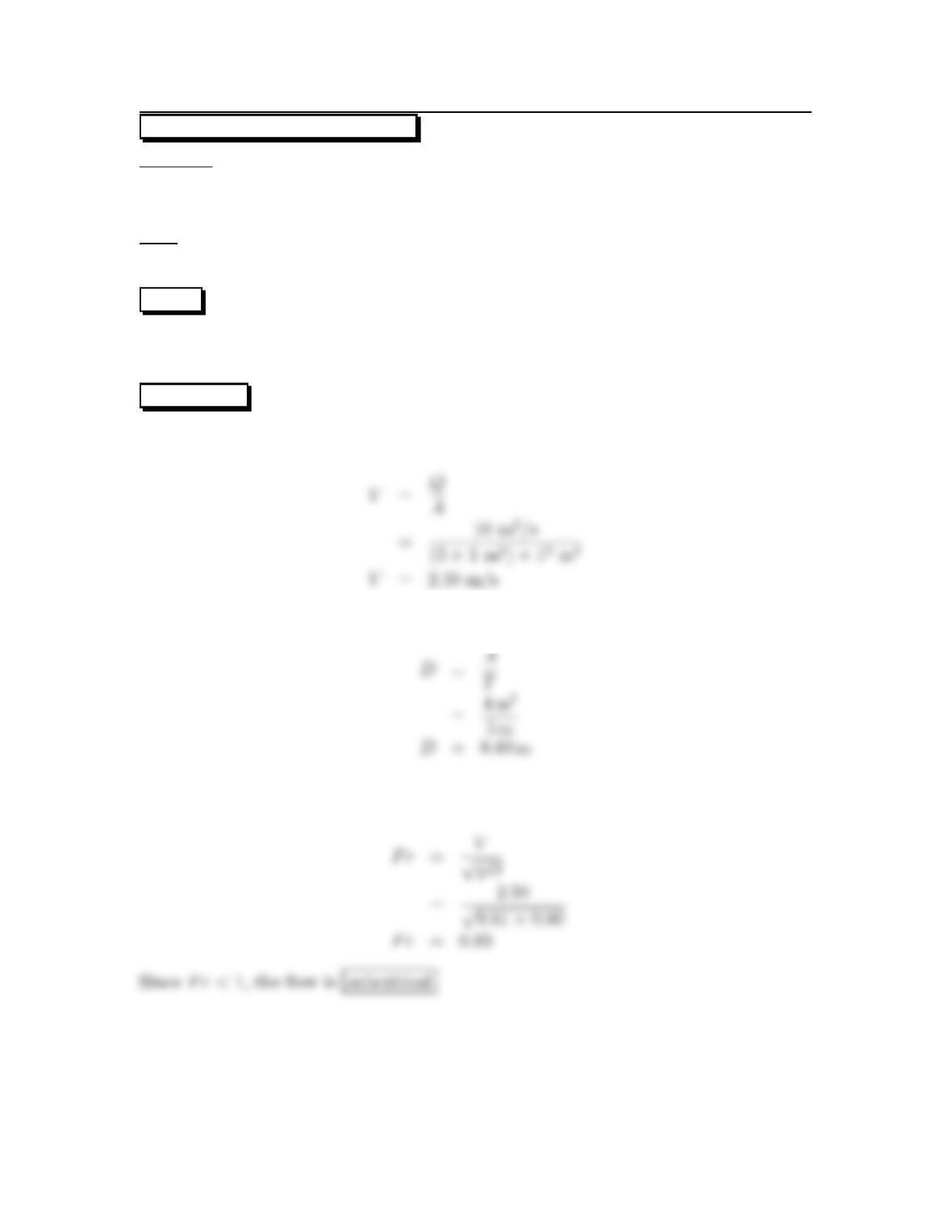
Calculate Froude number by first applying the flow rate equation to find average
velocity and the hydraulic depth equation to find the depth.
SOLUTION
Flow rate equation
Calculate hydraulic depth
Froude number
31
15.30: PROBLEM DEFINITION
Situation:
Water flows in a trapezoidal channel–additional details are provided in the problem
statement.
Find:
The critical depth (m).
PLAN
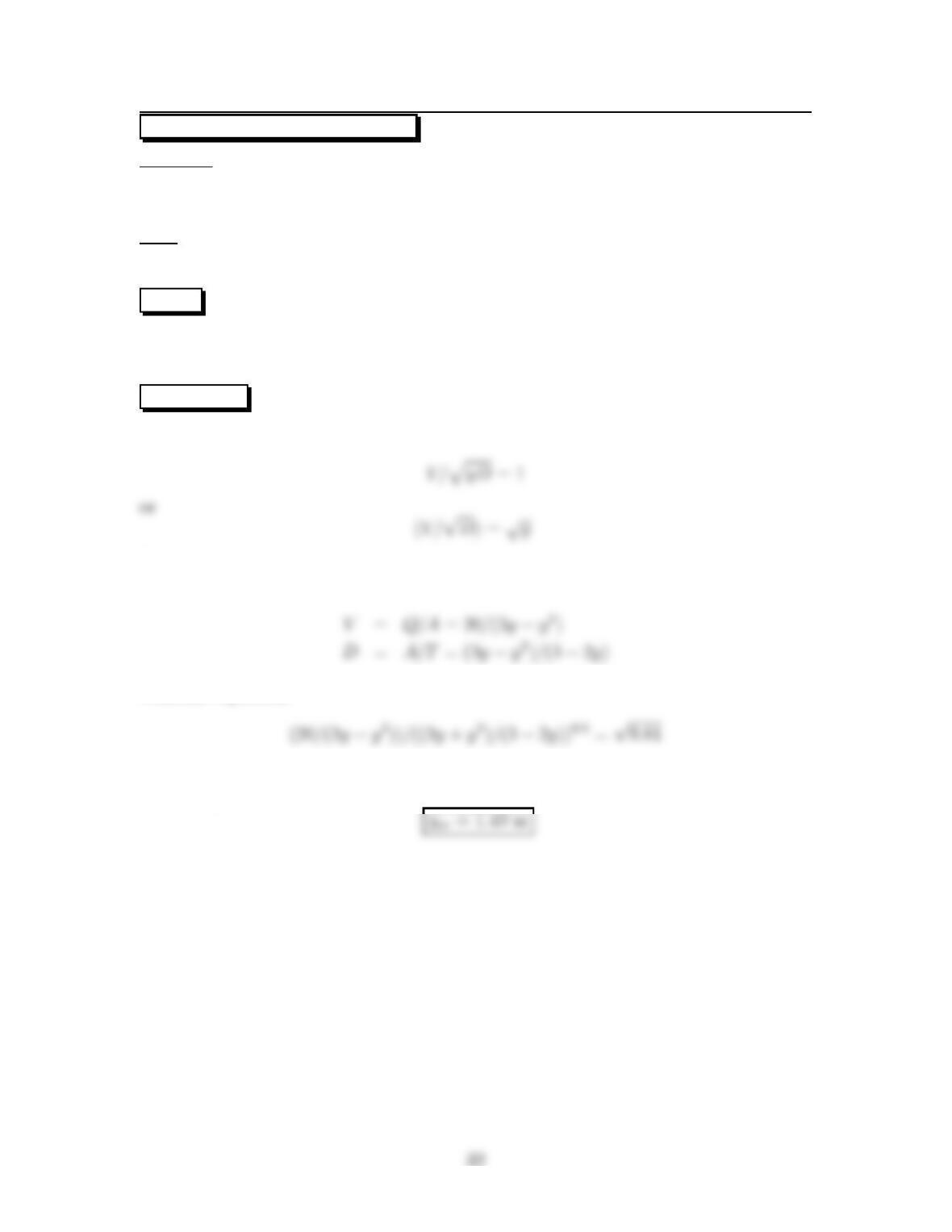
Calculate the critical depth by setting Froude number equal to 1, and simultaneously
solving it along with the flow rate equation and the hydraulic depth equation.
SOLUTION
For the critical flow condition, Froude number =1.
Flow rate equation
Combine equations
Solve for y
15.31: PROBLEM DEFINITION
Situation:
Water flows in a rectangular channel—additional details are provided in the problem
statement.
Find:
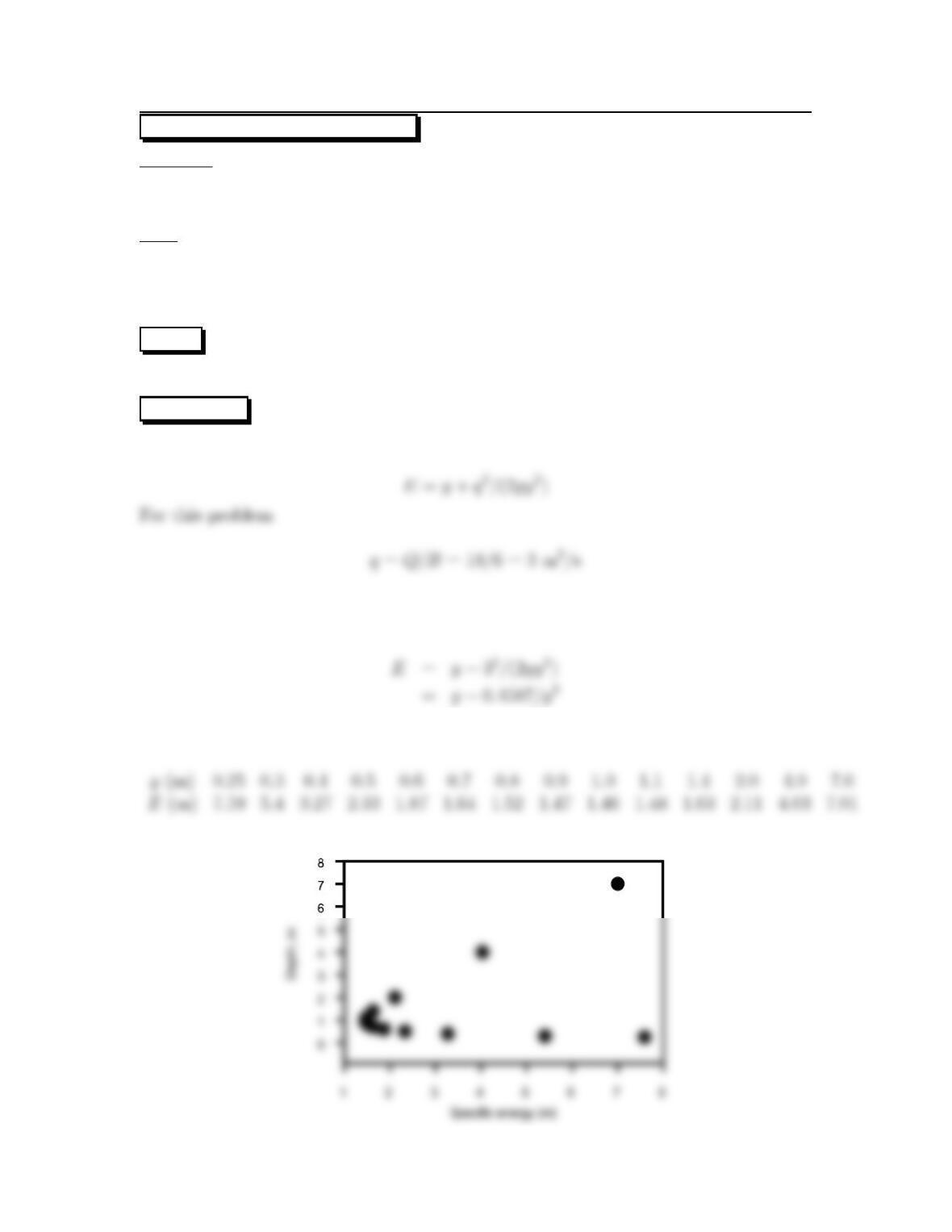
(a)Plotdepthversusspecificenergy.
(b) Calculate the alternate depth (m).
(c) Calculate the sequent depth (m).
PLAN
Apply the specific energy equation.
SOLUTION
Specific Energy Equation for a rectangular channel.
so
The calculated Eversus yis shown below
(a) The corresponding plot is
33
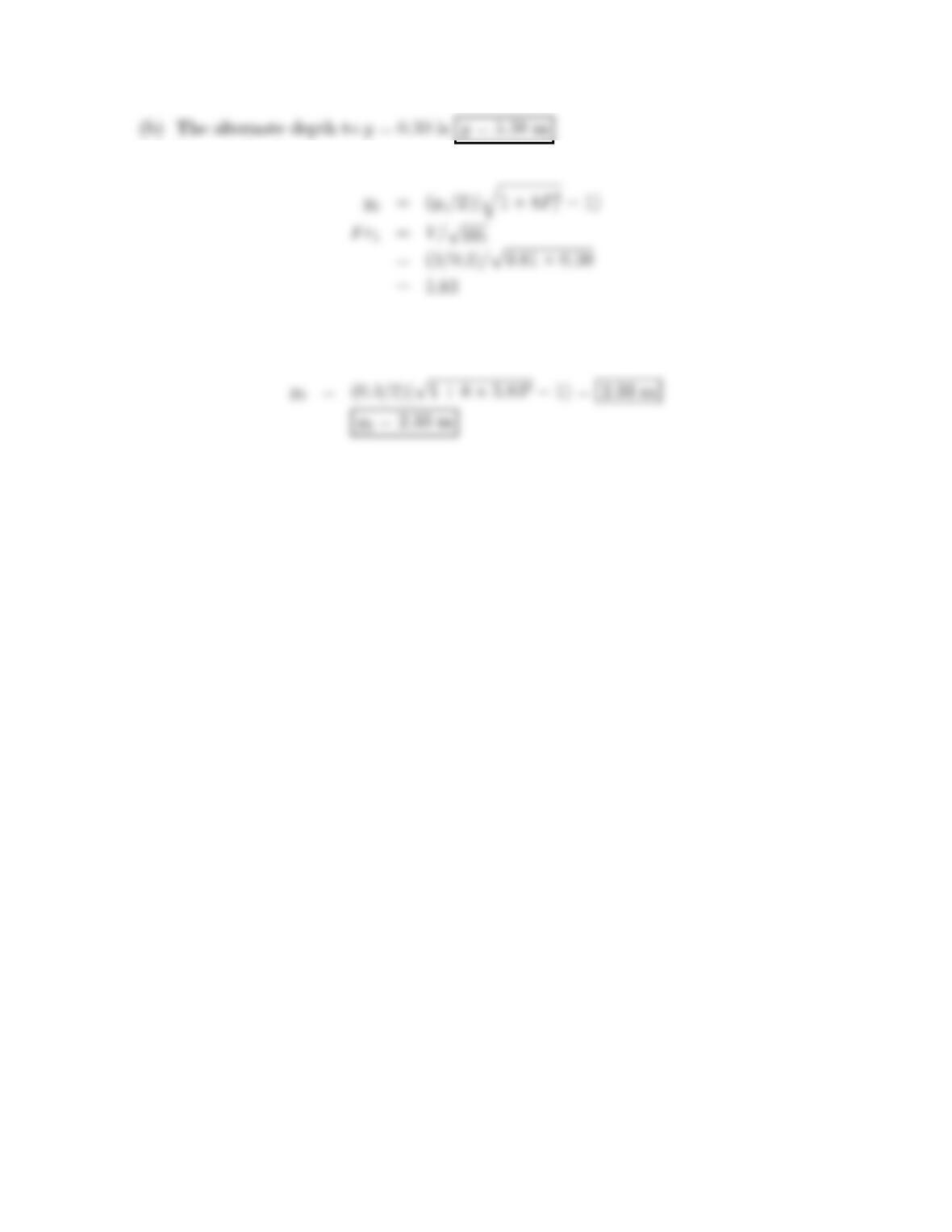
(c) Sequent depth:
Hydraulic jump equation
34
15.32: PROBLEM DEFINITION
Situation:
A rectangular channel ends in a free outfall
width = 8 m
depth at brink is 0.55 m
Find:
Discharge in the channel (m
3/s).
PLAN
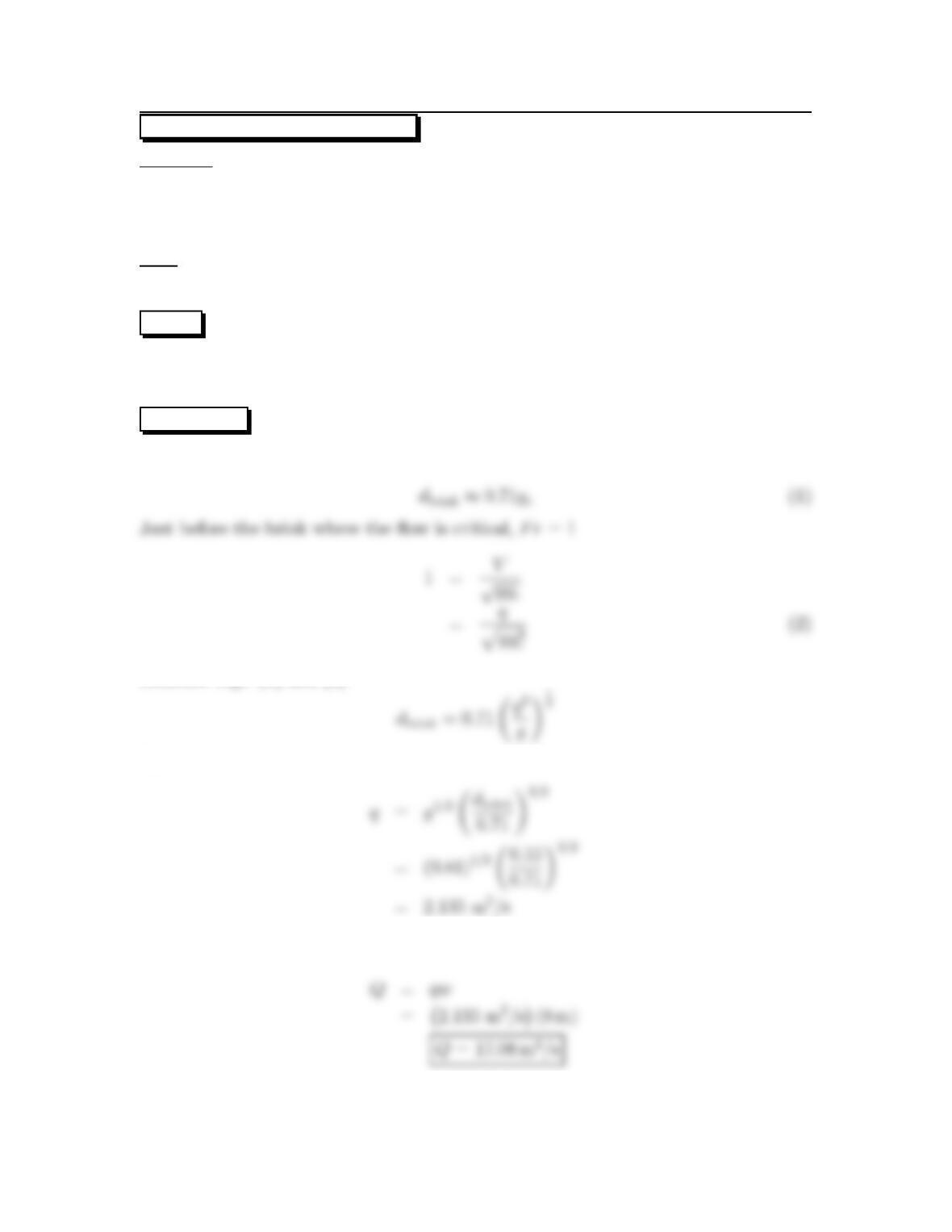
Calculate the critical depth by setting Froude number equal to 1, and simultaneously
solve it along with the brink depth equation. Then apply the flow rate equation.
SOLUTION
At the brink, the depth is 71% of the critical depth
Combine Eqs. (1) and (2)
Or
Discharge is
35
15.33: PROBLEM DEFINITION
Situation:
A rectangular channel ends in a free outfall–additional details are provided in the
problem statement.
Find:
Discharge in the channel ¡ft3/s¢.
PLAN
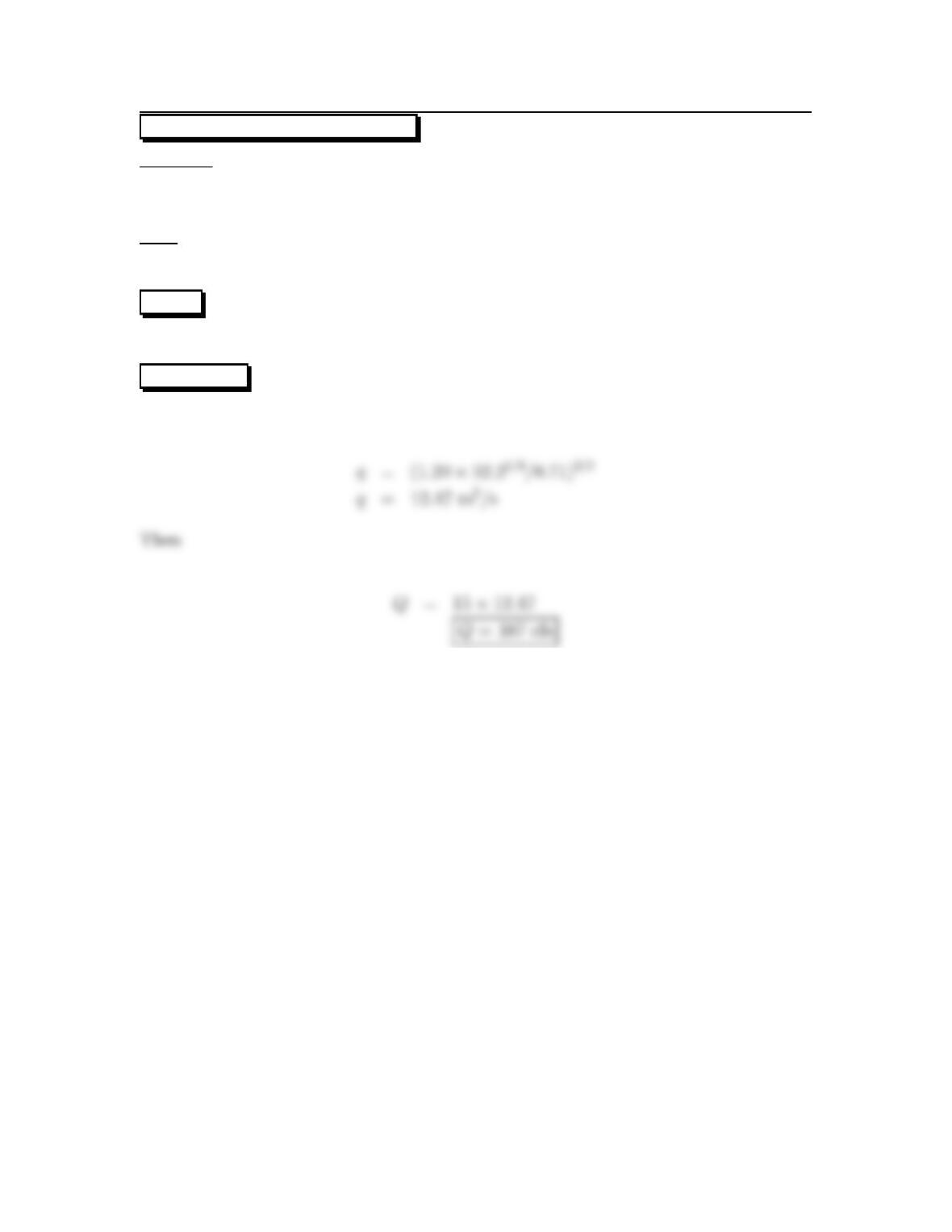
Same solution procedure applies as in Prob. 15.11.
SOLUTION
From the solution to Prob. 15.11, we have
36
15.34: PROBLEM DEFINITION
Situation:
A rectangular channel ends in a free outfall.
Q=500cfs.
Width = 14 ft.
Find:
Depth of water at the brink of the outfall (ft).
PLAN
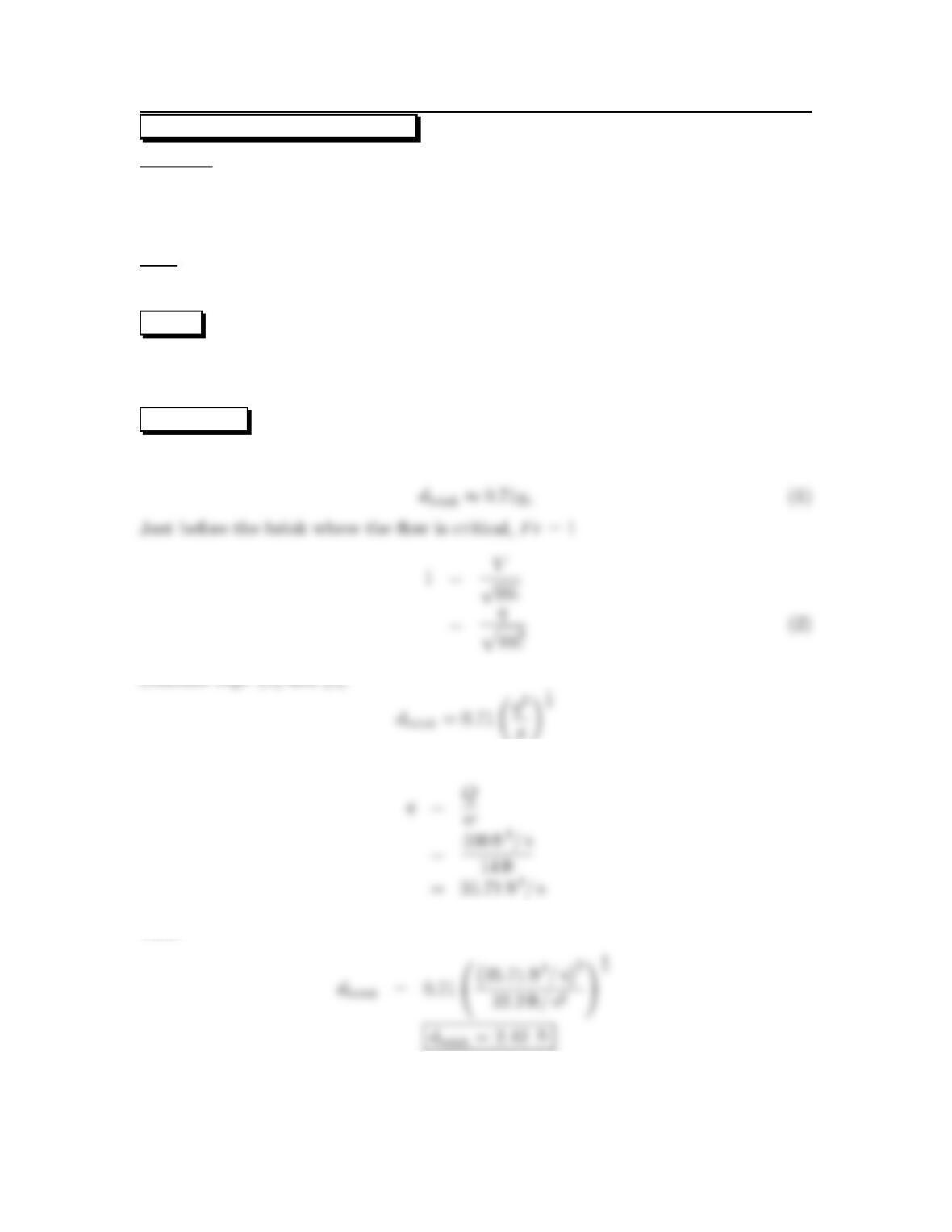
Calculate the depth at the brink by setting Froude number equal to 1, and simulta-
neously solve this equation along with the brink depth equation.
SOLUTION
At the brink, the depth is 71% of the critical depth
where
Thus
37
15.35: PROBLEM DEFINITION
Situation:
Water flows over a broad-crested weir
height = 3 ft
H=1.8 ft
Find:
Discharge of water ¡ft3/s¢.
PLAN
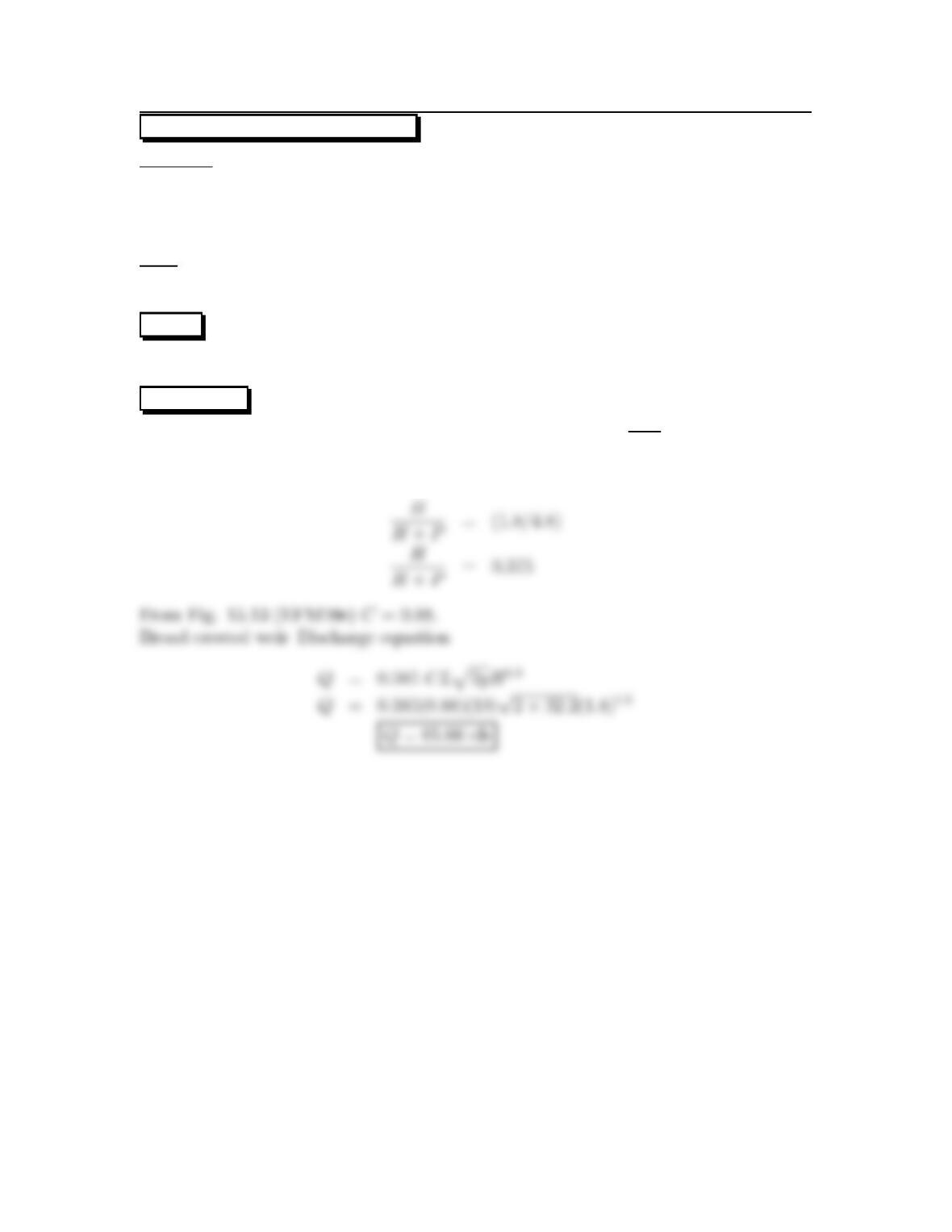
Apply the Broad crested weir—Discharge equation.
SOLUTION
To look up the discharge coefficient, we need the parameter H
H+P,where P=height
of weir, as in Fig. 15.13 (EFM10e).
38
15.36: PROBLEM DEFINITION
Situation:
Water flows over a broad-crested weir.
The weir height is P=2m.
The height of water above the weir is H=0.6m.
The length of the weir is L=5m.
Find:
Discharge (m
3/s).
PLAN
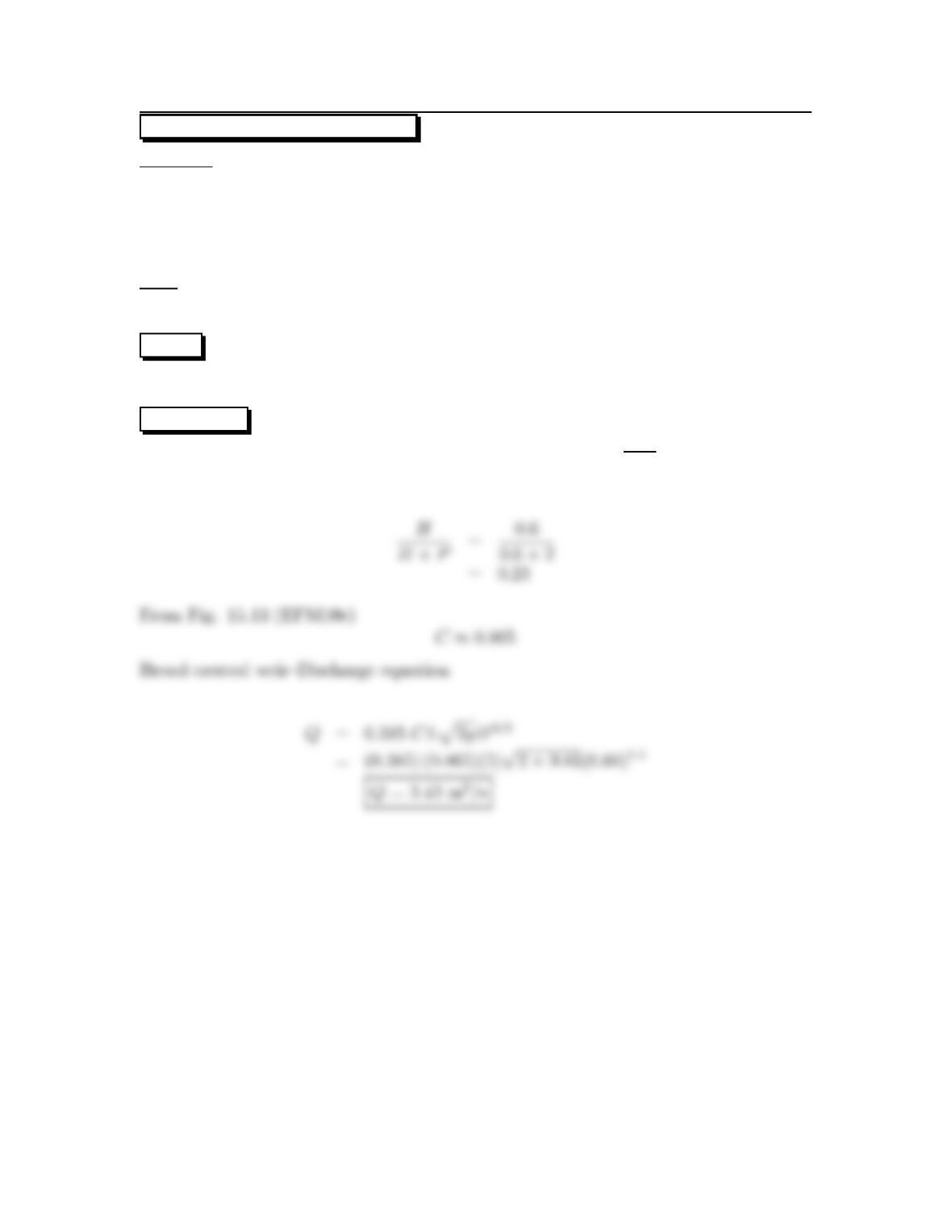
Apply the Broad crested weir—Discharge equation.
SOLUTION
To look up the discharge coefficient, we need the parameter H
H+P,where P=height
of weir, as in Fig. 15.13 (EFM10e).
39
15.37: PROBLEM DEFINITION
Situation:
Water flows over a broad-crested weir.
Additional details are given in the problem statement.
Find:
The water surface elevation in the reservoir upstream (m).
PLAN
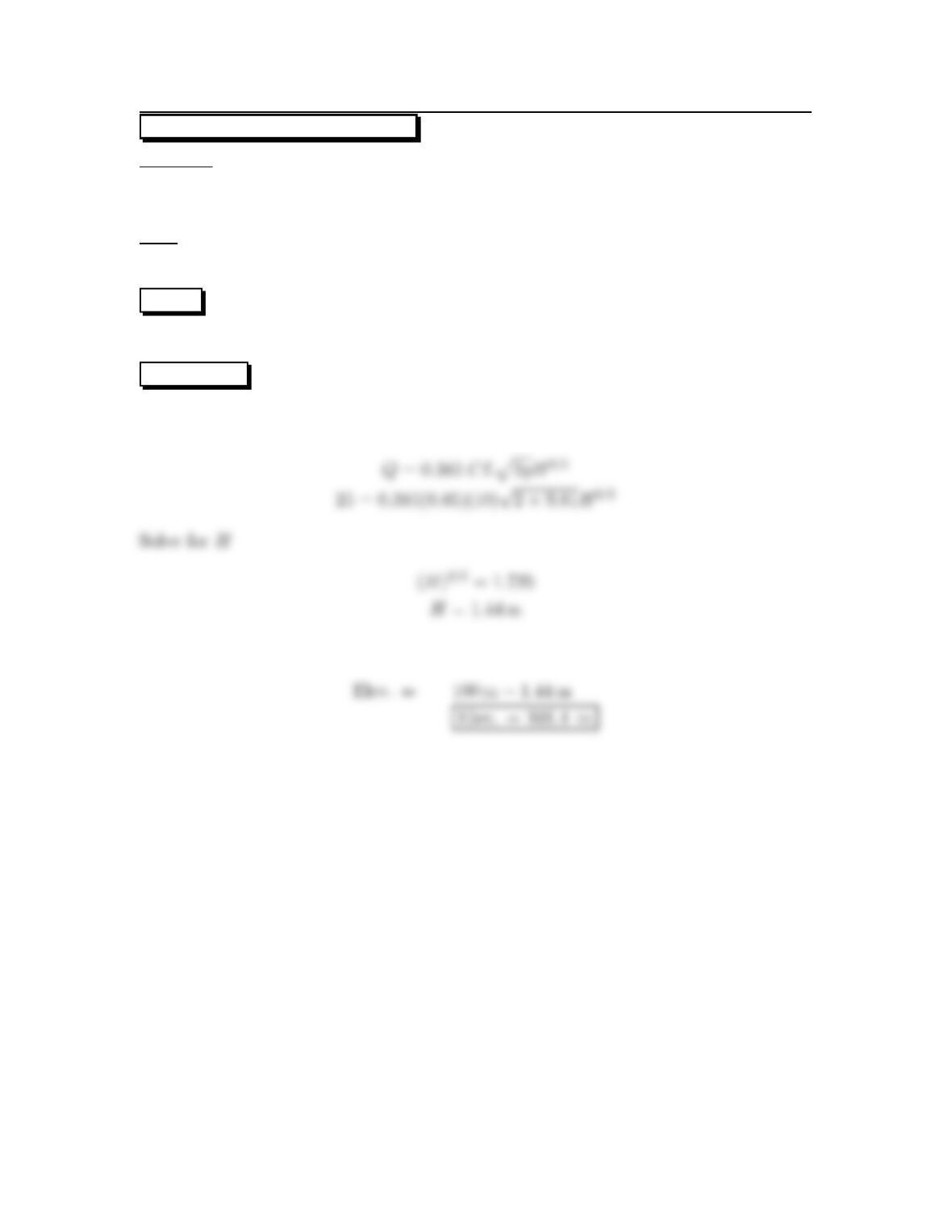
Apply the Broad crested weir—Discharge equation.
SOLUTION
From Fig. 15.13 (EFM10e), C≈0.85
Broad crested weir—Discharge equation
Water surface elevation
40