173
C H A P T E R 1 4
LEADING STRATEGIC CHANGE
Introduction
Chapter 14 now emphasises the importance of leaders of change by bringing upfront a
discussion of leadership roles and styles. It then goes on to discuss the importance of diagnosing
the context of change and different levers for change that can be employed. The discussion of
different types of strategic change programmes now also incorporates the topic of organisational
ambidexterity.
Illustration 14.1
Styles of leading change
1. How would you describe the styles of leadership illustrated here in terms of those explained
in Section 14.2.1?
Question 1 asks students to relate the quotes in the illustration to the styles explained in the text.
Presumably the centrality of the idea of a vision owned by a business leader, as espoused by
Jack Welch, places the onus for galvanising change squarely on that leader. It is likely that
students will see that as associated with a directive style of leading change. But they may also
see that a clear vision from the top can also aid all the other styles of leading change.
174
Moya Greene emphasises the importance of tuning in to the views and perceptions of different
stakeholders in the public sector. Participation of such stakeholders in strategic change is
inevitable in the public sector, therefore, the ability of the strategic leader to understand and
keep control of this is vital.
Illustration 14.2
Challenges of change in the UK Ministry of Defence
This illustration uses the change kaleidoscope to explain the context of change in the MOD. The
questions are designed to encourage students to see the importance of understanding context in
relation to leading strategic change.
1. In your view, what are the main barriers to change facing the MOD?
Johnson, Whittington, Scholes, Angwin and Regnér, Exploring Strategy, 10th edition,
Instructors Manual on the Web
What steps have been taken to ensure that those leading the change programme have long
(rather than short) time horizons with regard to the MOD?
Illustration 14.3
A forcefield analysis for developing strategy
1. What might the problems be in devolving strategy to a European division?
2. Undertake a forcefield analysis for an organisation of your choice.
Question 1 asks students to consider the problems of managing change surfaced by a forcefield
analysis. In theory, the answer is straightforward: build on pushing forces, add others and
reduce the resisting forces. But what are the practical problems here? They might include:
Hopefully, students will recognise the issue of power. Some of the resisting forces (e.g.
silos, non-sharing of information) are likely to be linked to the preservation of peoples or
groups power bases. Changing those is likely to be resented and resisted.

176
Illustration 14.4
Change levers to transform a business school
1. What change levers explained in Section 14.4 are evident in George Yips approach?
Question 1 requires students to consider which of the levers for change explained in the chapter
are evident in George Yips approach to change at Rotterdam School of Management (RSM).
He had a clear view of his strategy but chose not to focus on leading change through education
and argument so much as through an action approach. He introduced an incentive scheme for
Question 2 invites students to suggest other ways in which he might have led change to get
academics to focus on the needs of managers. Are there other ways in which he could have
involved practitioners for example, some universities have appointed them as visiting fellows?
Question 3, however, invites students to consider whether the overall approach adopted by Yip
(and advocated by Pascale) is appropriate in leading strategic change. The underlying premise is
that by getting people to do things differently, they change their beliefs and assumptions. The
177
Illustration 14.5
Traditions of successful evolutionary strategic transformation
1. How do the traditions relate to the explanations of evolutionary strategic change explained
in Section 14.5.4 and, in particular, the concept of organisational ambidexterity?
2. If the traditions took decades to develop, is it possible for executives to manage their
introduction into organisations? How?
This illustration is based on the research on which the book Strategic Transformation
(Hensmans, Johnson and Yip) is based. This examined some of the very few companies that,
over a long period of time, had made major strategic changes without having the trigger of
Although these organisations did not organise themselves such that they had different
structural parts of the business devoted to exploitation and exploration, they did have more
informal coalitions of managers that seemed to be doing this.
They certainly encouraged diversity rather than conformity, positively encouraging or
tolerating contradictory views and contestation.
Question 2, however, poses a problem. If, as the research found, it took these businesses
decades to build such traditions, how might it be possible for leaders of change to introduce
such traditions, or capabilities more quickly? The authors of the book acknowledge the
difficulties here but do make some suggestions which include:
178
But, all this within an overarching rationale about the nature and purpose of the business.
The emphasis is, then on building organisations that welcome and encourage differences and
diversity. In this respect there are some similarities to the lessons of the variety lens discussed in
the book.
Key Debate
Strategic change from top to bottom
The purpose of this key debate is to require students to discuss the question of whether change
in organisations comes about through top-down or bottom-up processes. Hopefully, they will
conclude that both processes are likely to be at work. The issue is to what extent is change
influenced by the processes and vice versa?
1. What are the problems associated with top-down or bottom-up views of change management?
It might be useful to get students to take extreme positions at least to start with. What are
the problems associated with the different explanations of change in the illustration? This
highlights the problems that are associated with each view.
179
There are two accounts here of a more bottom-up approach. Balogun argues that top
management can establish the context for change and shape it as it emerges. Are there not
dangers here too? For example:
Strategy might be formed on the basis of a localised understanding of and response to
strategic issues rather than any general picture of strategic issues.
And if the Tsoukas and Chia views are added to this, are there no further problems?
At the extreme, there might be little overall strategic direction there would be the
2. If you were a senior executive, which approach would you take and in what circumstances?
This takes the discussion back to the issue of context. Again it might be useful to pose some
extremes. For example:
If a senior executive were faced with a crisis and had to implement a turnaround
strategy, then top-down direction could well be appropriate.
However, suppose the context is a high-tech business at the cutting edge of scientific
3. Are the different views irreconcilable?
What could well emerge from this discussion is that the views are not irreconcilable. They
Video assignment
Wilmington
The video features Charles Brady who is the chief executive of the Wilmington Group.
Wilmington is a UK-based group of companies that has now expanded, via acquisitions, into an
180
1. Brady does not see his role in leading change as directive. He describes it as: …. really
providing a facilitation service, a catalyst. He accepts he is there to set priorities but wishes
to encourage people within Wilmington to take responsibility for change themselves, to
experiment and to improvise. He is really describing how he is trying to encourage the sort
2. Without using the term, Charles Brady seems to be describing what Section 14.5 calls
evolution. His description does not exactly match what is described as organisational
ambidexterity but it does describe what is sometimes termed a learning organisation
where there is continual adjustment to change driven by initiatives from within the
organisation not just from the top. The aim is to achieve strategic change through
continual adaptation to the changing world around the organisation.
Assignment 14.1
Styles of leading change
The aim of this assignment is to require students to distinguish between different leadership
styles that seem to have been successful in managing strategic change. In terms of the strategic
leaders named in the assignment, for example, Sergio Marchionne faced the need for major and
Assignment 14.2
Contextual dimensions influencing change programmes
The purpose of this assignment is to encourage students to see how a context of change should
influence the design of a change programme. It can be used either taking one context into
consideration (e.g. the case example on Sergio Marchionne or Barclays in Chapter 5) or by
taking a comparative approach by choosing change situations with different contextual features
(e.g. the need for rapid change versus more incremental change; or centralised power versus
devolved power). Such a contextual analysis might be carried out, but then the student needs to
be faced with the question as to how this would influence the design of a strategic change
programme.
The key point that students should grasp is that there is no one right way of leading change, but
rather that the approach needs to be tailored to the change context.
Assignment 14.3
Forcefield analysis
Students will need to draw on either a suitable case study such as Barclays, Fiat/Chrysler or
Babcock Rail (in the case section of the text and cases) or an organisation with which they are
familiar for this assignment. It may also be helpful to build the force field analysis on the basis
of a cultural web analysis of the chosen organisation.
The challenge for students is not only to identify blockages to change but also to ask the
question what can be managed to achieve the required change? So, in terms of the dimensions
in the cultural web:
Many organisational rituals are capable of being managed, changed, removed or added and
can signal significant changes to what is especially valued in the organisation. Arguably,
this is one of the main levers for change that George Yip employed at Rotterdam School of
Management.
Assignment 14.4
Pascales maxim
Pascales argument is that, traditionally, writers and managers have conceived a change
programme in terms of the primary need of convincing people of the need to change their
beliefs and values so that their behaviour will change. He argues, however, that attitudes and
beliefs are more likely to change following and because of behaviour change. These different
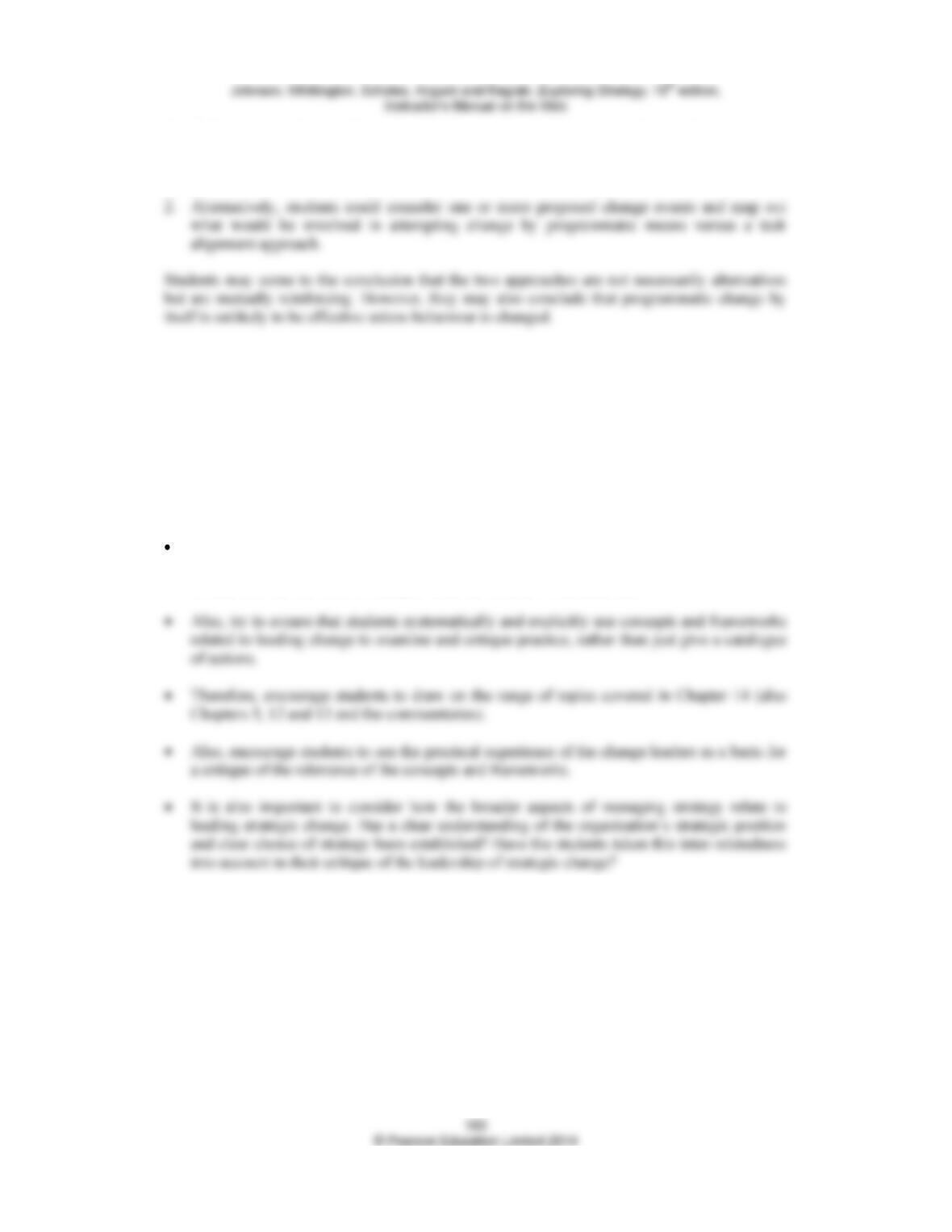
approaches closely relate to those made by Beer and his colleagues who refer to programmatic
and task alignment views of change as follows:
Programmatic Task alignment
Problems in behaviour are a function of
individual knowledge, attitudes and beliefs
Individual knowledge, attitudes and beliefs are
shaped by day-to-day patterns of behavioural
interactions (routines)
This assignment provides students with a basis for exploring these different approaches on the
basis of their own experience, what they have read, and also on the basis of their own views.
1. If they are part-time students, it might be possible for them to consider a change event in
their experience and identify (a) whether the orientation was one of programmatic or task
alignment change and (b) how successful this was.
Assignment 14.5
Change leadership
The purpose of this assignment is to assist students in linking concepts about strategic change to
the practice of management by considering the activities of leaders of change.
A number of points need emphasising:
Encourage students to distinguish between what the leaders decide to do and how they set
about doing it. Get the students to focus more on the latter for this exercise. Encourage them
to read between the lines to interpret what the executives actually did.
Integrative assignment 14.6
From diversified multi-domestic to a related conglomerate
In the past 15 years, a good many multinationals have gone through just the sort of change
outlined in this assignment. For example, Unilever has sought to do this; it has sought to retain
its global spread, but is much more focused and related. So what are the implications for change
here?
In the 1960s, Unilever was not only global but also highly diversified (from soaps and
detergents through to tea plantations and a chemicals business). It was at that time that the
corporate centre started to try and exert some influence over its highly diversified business
units. So, for much for the 1960s and 1970s the change efforts in Unilever took the form of
attempts at increased central control from the centre. This took several forms and gave rise
to a number of problems.
It was later, in the 1970s and 1980s that Unilever began to simplify its highly diverse
portfolio. The implication being, of course, that the executives at the corporate centre (not
just coordinators) needed to understand the businesses and that this was difficult to do with
such a hugely diversified portfolio. This should lead students to see that there is a
relationship between corporate control and diversity. The greater the diversity the more
complex the problems facing the corporate centre and, quite likely, the more costly they are
to address.
Such major changes have necessarily involved structural change as well as changes of systems
and controls and a replacement of senior levels of management. What is often more difficult is
to make such changes apparent at more junior levels. How would someone working within
one of the businesses within a restructured Unilever see significant change in their own jobs;
why would they behave differently than in the past? The need is to translate the intended
change into more operating levels of relevance for such people. So, many of the lessons
about the changes in routines and symbols discussed in this chapter are important.
Johnson, Whittington, Scholes, Angwin and Regnér, Exploring Strategy, 10th edition,
Instructors Manual on the Web
185
Case Example
Sergio Marchionne: leading change in Fiat and Chrysler
1. In relation to Section 14.5, what was the type of change pursued at Fiat and Chrysler? Was
this appropriate to the change context?
Questions 1 and 2 require the students to consider the change context in Fiat and Chrysler, so it
may be useful to start with that. Certainly, at Fiat on the engineering side (which was the
dominant function) there was a highly homogeneous (lack of diversity) mindset which
Question 1 then asks what type of change was pursued. Clearly, there is a need for major change
at both organisations, not just in terms of performance but also in terms of the product range and
Question 2 is about the change style of Marchionne himself. On the face of it, this is highly
directive and students may see this as appropriate given the poor performance of both
companies when he took over. However, the case suggests that there is another dimension to his
Question 3 asks students to review the change levers employed and suggest others that might
have been used. There were major structural changes made in both Fiat and Chrysler. In turn,
these involved, pruning large numbers of executives and identifying managers from below and
were attempts to introduce fresh blood and new ideas. In relation to these new managers and those
introduced from below, he also went out of his way to build personal relationships with them and
ensure that they were given his political backing. But there were many other levers employed:
He saw his role as the challenging of assumptions (the example of the speed of new product
development is given). The impression is, also, that he expected others to challenge each
other.
Of course, we do not know from the brief case study here just what else he did, so it may be
that other ideas that students come up with were, indeed, employed by him. Presumably, for
example, he may well have done away with and introduced new rituals into both organisations.
Question 4 is about the effectiveness of what he did. By 2006, Fiat was profitable but by 2013 it
was not. He had run into major problems in the European auto industry which he was lobbying
to change in terms of the structure of the industry itself. Chrysler had also returned to profits and