PROBLEM 14.46
KNOWN: Thick plate of pure iron at 1000°C subjected to a carburizing process with sudden
exposure to a carbon concentration CC,s at the surface.
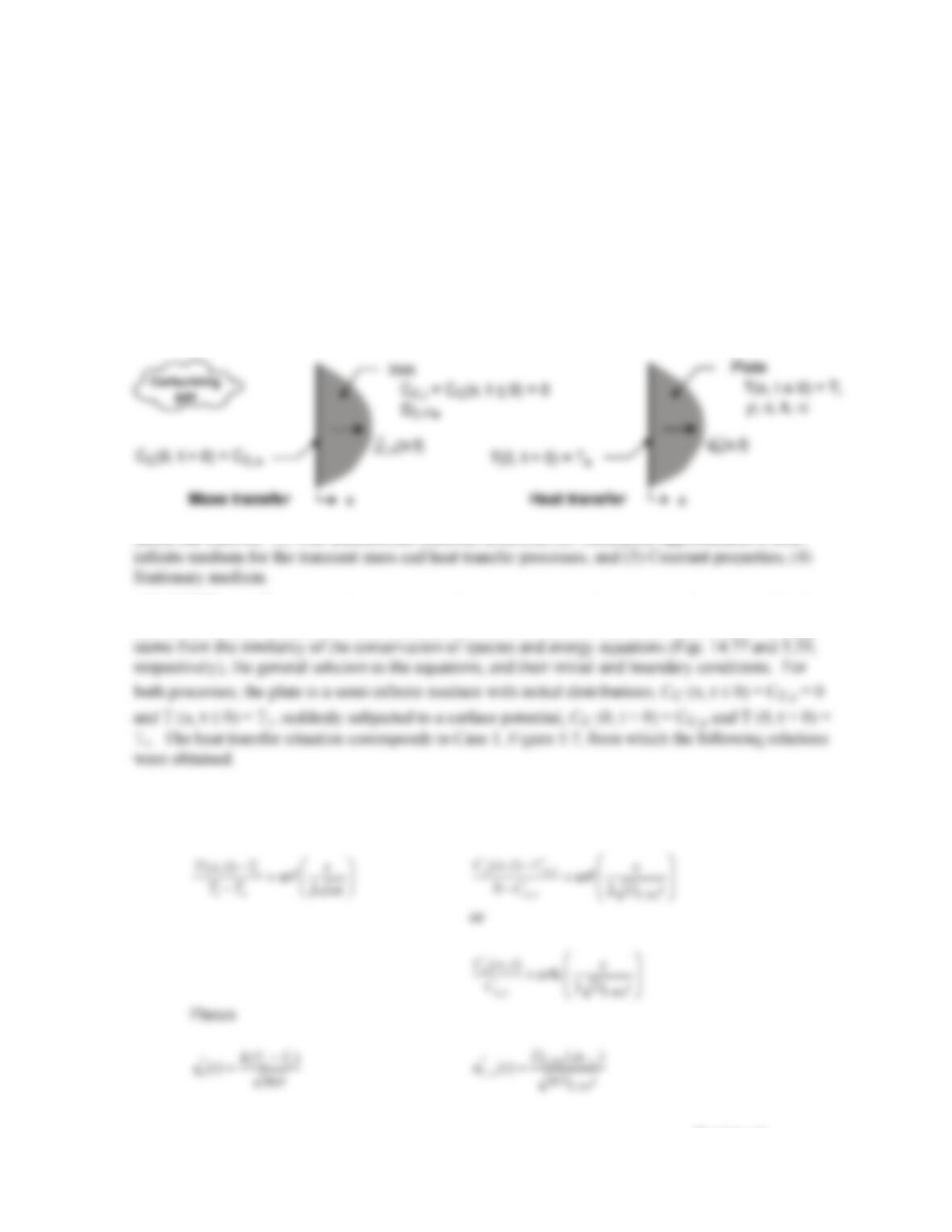
FIND: (a) Consider the heat transfer analog to the carburization process; sketch the mass and heat
transfer systems; explain correspondence between variables; provide analytical solutions to the mass
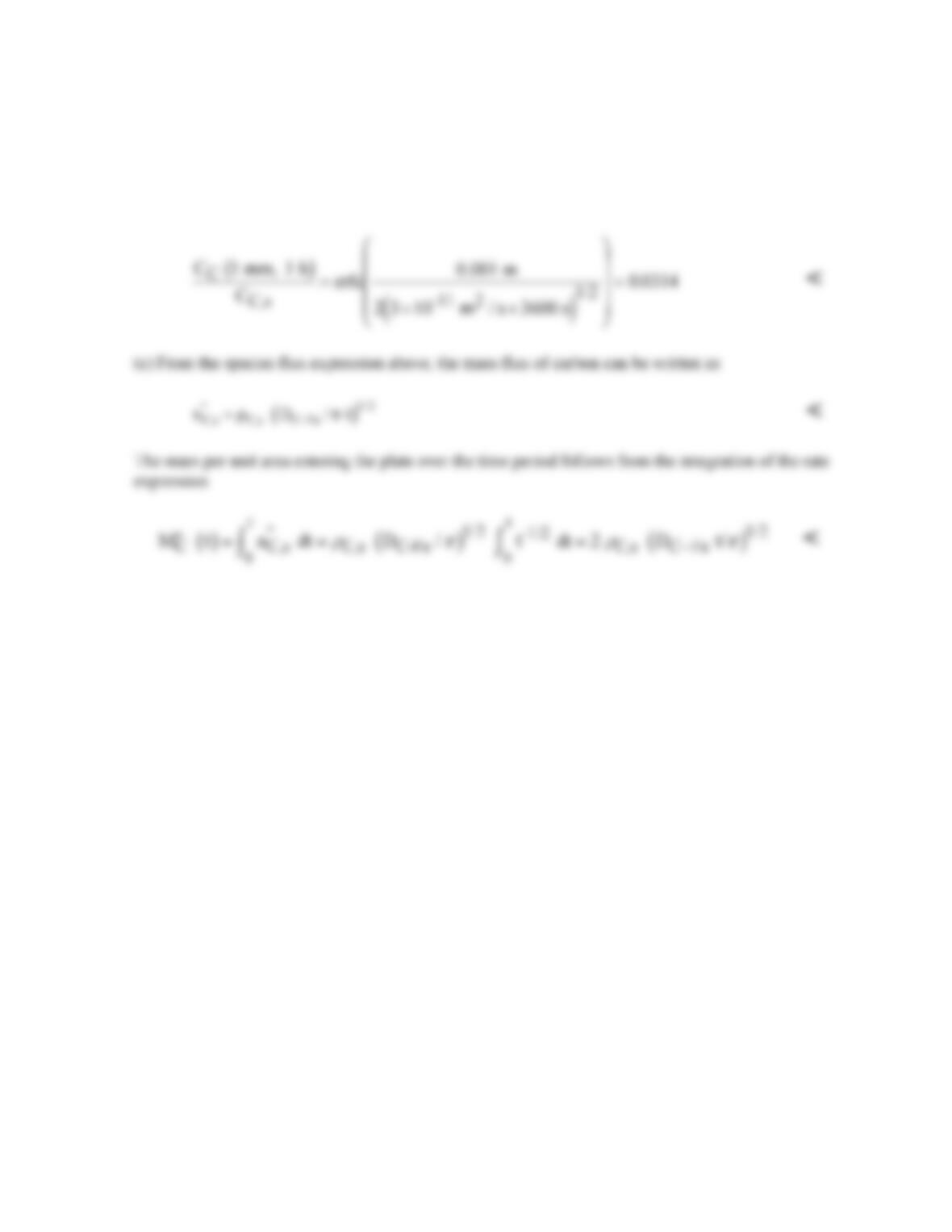
and heat transfer situation; (b) Determine the carbon concentration ratio, CC (x, t)/CC,s, at a depth of
1 mm after 1 hour of carburization; and (c) From the analogy, show that the time dependence of the
mass flux of carbon into the plate can be expressed as
′′ =−
n D t
CC,s C Fe
ρ π
/ ;
/
bg1 2
also, obtain an
expression for the mass of carbon per unit area entering the iron plate over the time period t.
SCHEMATIC:
ASSUMPTIONS: (1) One-dimensional transient diffusion, (2) Thick plate approximates a semi-
ANALYSIS: (a) The analogy between the carburizing mass transfer process in the plate and the heat
transfer process is illustrated in the schematic above. The basis for the mass – heat transfer analogy
Heat transfer Mass transfer
Distributions
Continued …
PROBLEM 14.46 (Cont.)
(b) Using the concentration distribution expression above, with L = 1 mm, t = 1 h and
DC-Fe = 3 × 10–11 m2/s, find the concentration ratio,
PROBLEM 14.47
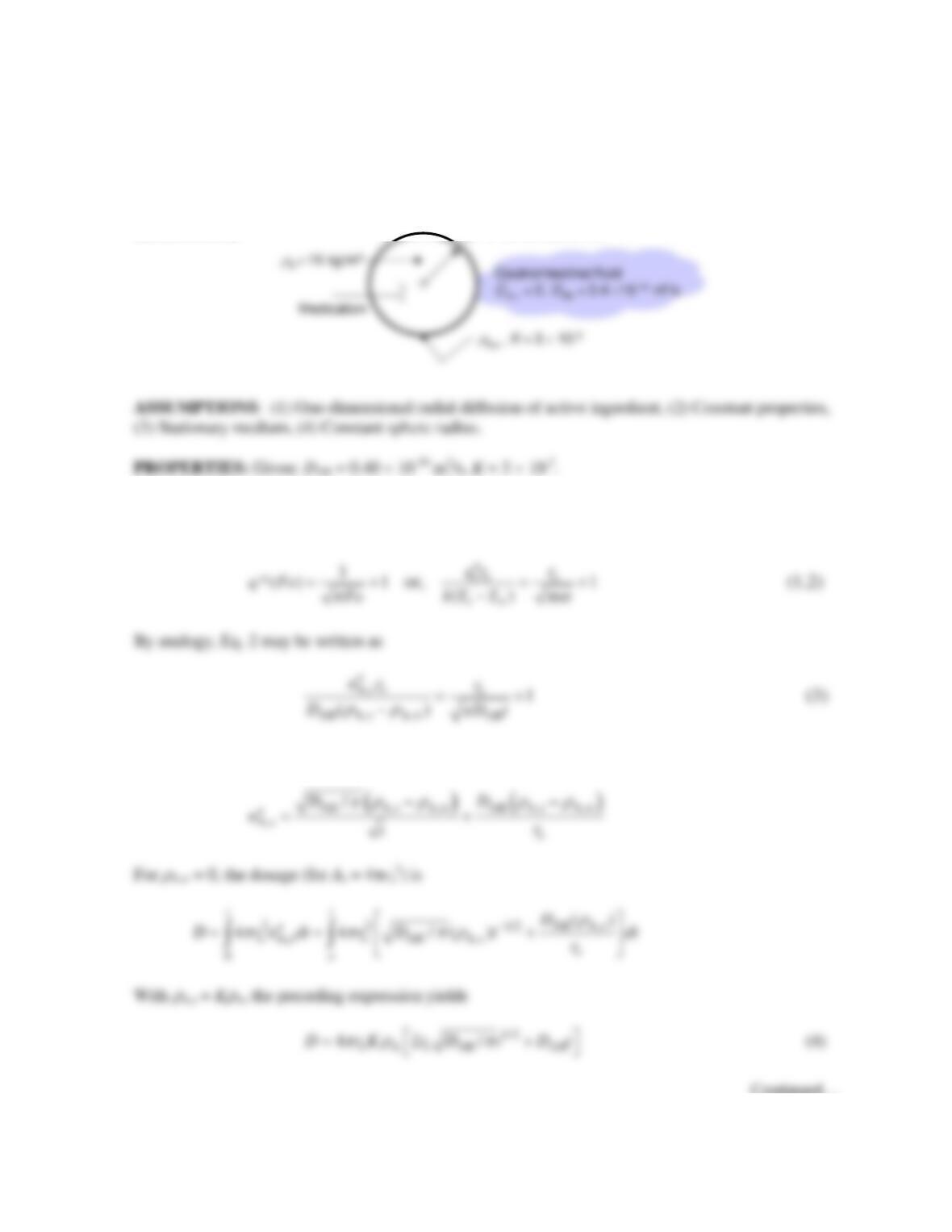
KNOWN: Radius of pharmaceutical product, density of the active ingredient, partition coefficient,
and binary diffusion coefficient of the active ingredient in the gastrointestinal tract.
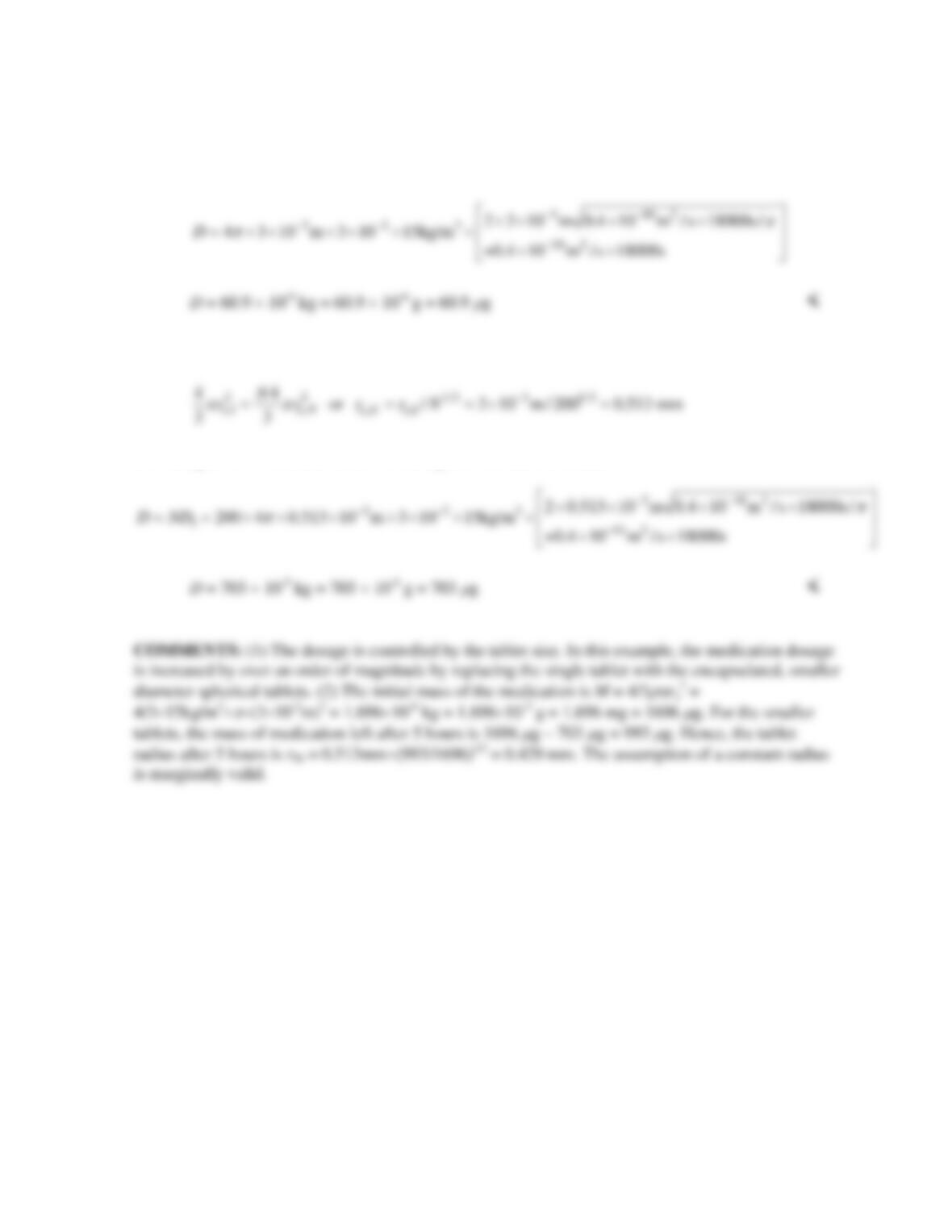
FIND: (a) Dosage delivered over 5 hours from a D = 6 mm diameter tablet, (b) Dosage delivered
over 5 hours from N = 200 small, spherical tablets of the same mass.
SCHEMATIC:
ANALYSIS: (a) The approximate solution of Chapter 5 for external conduction from an isothermal
sphere and the heat-mass transfer analogy will be used. From Table 5.2a,
Rearranging,
Continued…
r
o
= 3 mm or 0.513 mm
PROBLEM 14.47 (Cont.)
Substituting the appropriate values into Eq. 4 results in
(b) For the same initial mass and N = 200 tablets,
The dosage is D = ND1 where D1 is the dosage for one tablet. Hence,
PROBLEM 14.48
KNOWN: Thickness, initial condition and bottom surface condition of a water layer.
FIND: (a) Time to reach 25% of saturation at top, (b) Amount of salt transfer in that time, (c) Final
concentration of salt solution at top and bottom.
SCHEMATIC:
ANALYSIS: (a) With constant ρ and DAB and no homogeneous chemical reactions, Eq. 14.47b
reduces to
where the condition at
x1
∗
=
corresponds to Bim = ∞. Hence, the mass transfer problem is
analogous to the heat transfer problem governed by Eq. 5.38 through 5.40. Assuming applicability of
PROBLEM 14.48 (Cont.)
(b) The change in the salt mass within the water is
Hence,
( )
L
A A,s A A,s
0
M / dx
ρ ρρ
′′
∆=
∫
Substituting numerical values,
PROBLEM 14.49
KNOWN: Carbon dioxide concentration at water surface and reaction rate constant.
FIND: (a) Differential equation which governs variation with position and time of CO2
concentration in water, (b) Appropriate boundary conditions and solution for a deep body of water
with negligible chemical reactions.
SCHEMATIC:
ASSUMPTIONS: (1) One-dimensional diffusion in x, (2) Constant properties, including total
ANALYSIS: (a) From Eq. 14.47b, it follows that, for the prescribed conditions,
(b) For a deep body of water, appropriate boundary conditions are
With an initial condition, ρA(x,0) ≡ ρA,i = 0, the problem is analogous to that involving heat transfer
in a semi–infinite medium with constant surface temperature. By analogy to Eq. 5.60, the species
concentration is then
PROBLEM 14.50
KNOWN: Sheet material has high, uniform concentration of hydrogen at the end of a process, and is
then subjected to an air stream with a specified, low concentration of hydrogen. Mass transfer
parameters specified include: convection mass transfer coefficient, hm, and the mass diffusivity and
solubility of hydrogen (A) in the sheet material (B), DAB and SAB, respectively.
FIND: (a) The final mass density of hydrogen in the material if the sheet is exposed to the air stream
for a very long time,
ρ
A,f, (b) Identify and evaluate the parameter that can be used to determine
whether the transient mass diffusion process in the sheet can be characterized by a uniform
concentration at any time; Hint: this situation is analogous to the lumped capacitance method for a
transient heat transfer process; (c) Determine the time required to reduce the hydrogen concentration
to twice the limiting value calculated in part (a).
SCHEMATIC:
C (t), C (0) = C = 320 kmol/m
A A A,i 3
ANALYSIS: (a) The final content of H2 in the material will depend upon the solubility of H2 (A) in
the material (B) and its partial pressure in the free stream. From Eq. 14.62,
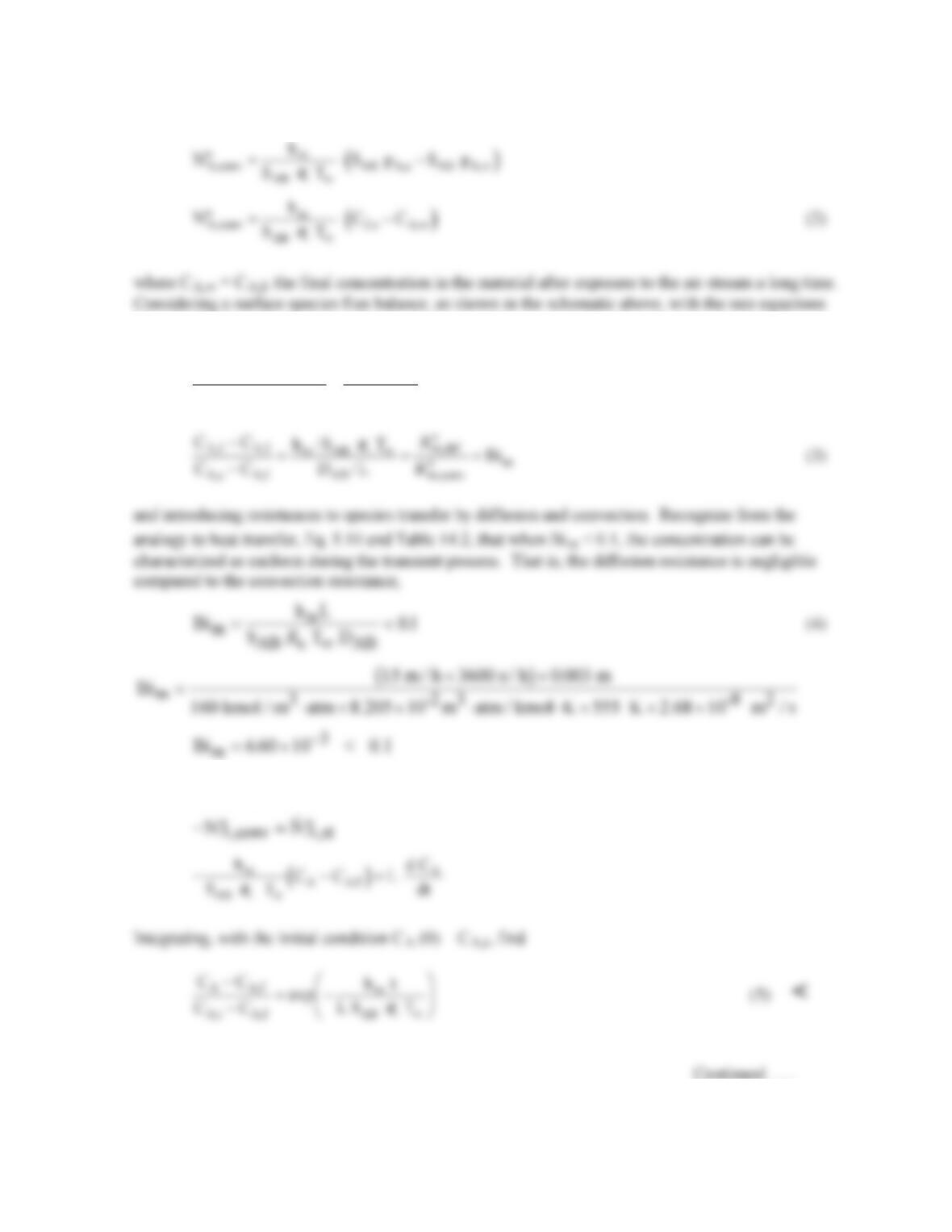
(b) The parameters associated with transient diffusion in the material follow from the analogous
treatment of Section 5.2 (Fig. 5.3) and are represented in the schematic.
PROBLEM 14.50 (Cont.)
and substituting the ideal gas law, Eq. 14.9, and introducing the solubility relation, Eq. 14.62,
(1) and (2),
( ) ( )
AB A,1 A,2 mA,s A,f
AB
D C C h CC
L S T
∞
−= −
R
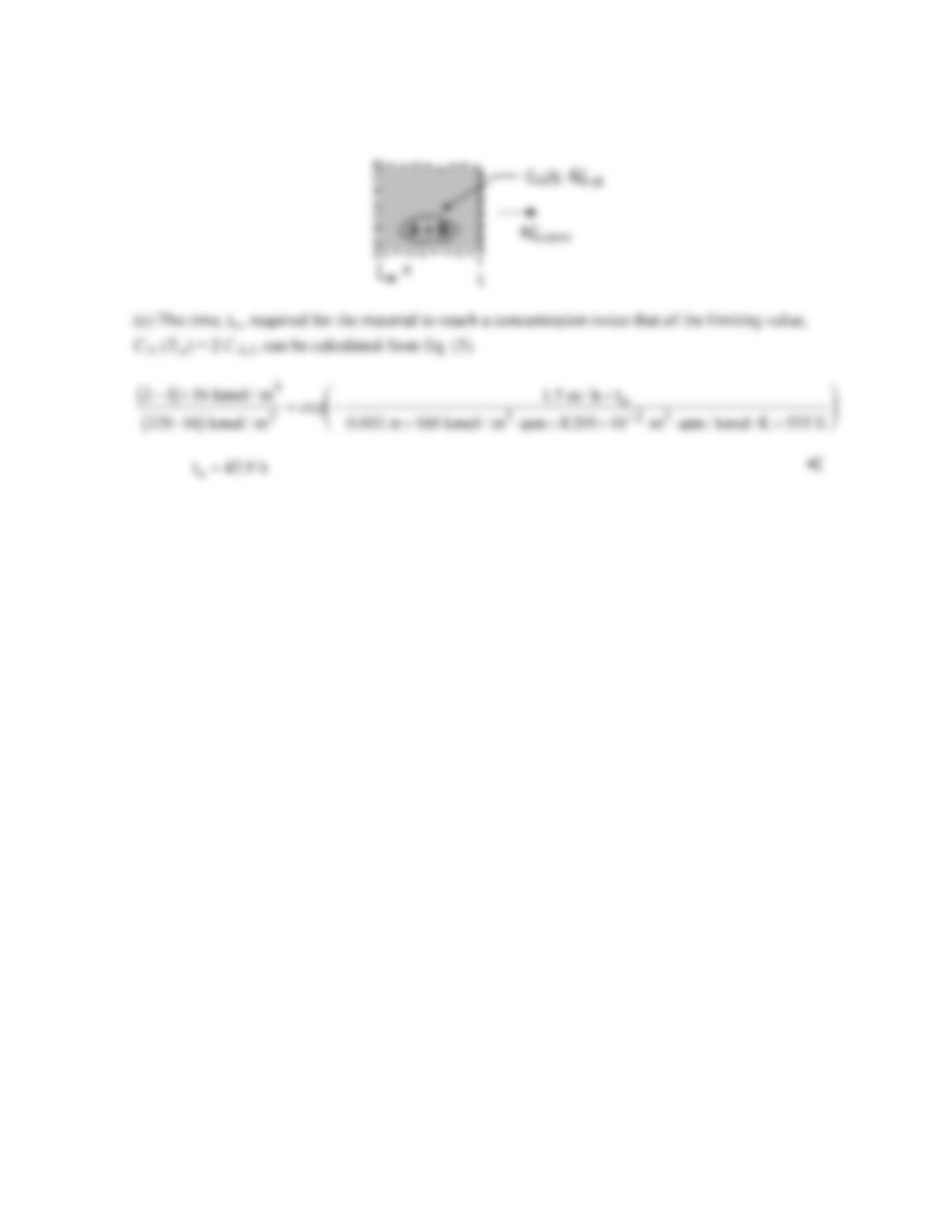
Hence, the mass transfer process can be treated as a nearly uniform concentration situation. From
conservation of species on the material with uniform concentration,
Continued …..
PROBLEM 14.50 (Cont.)
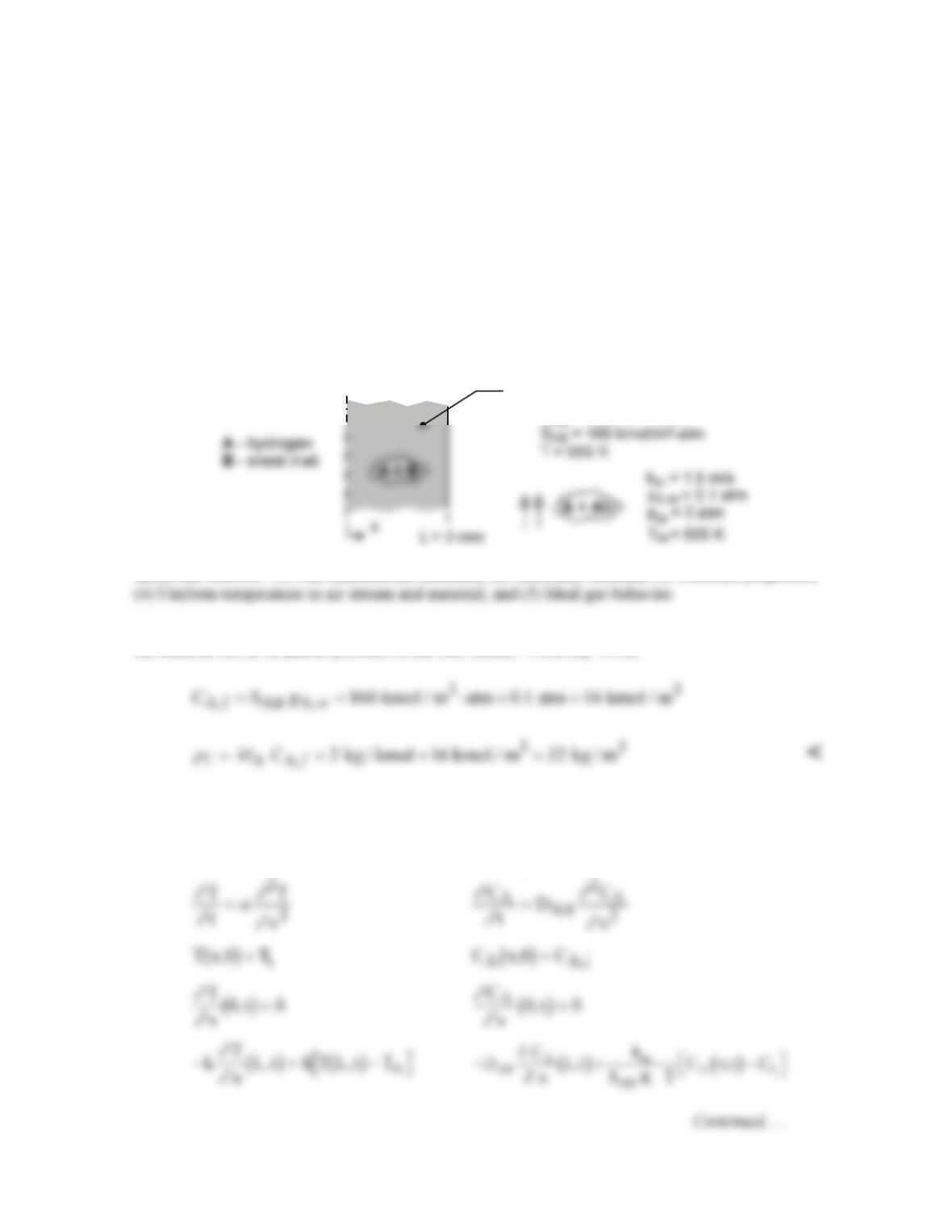
which is similar to the analogous heat transfer relation for the lumped capacitance analysis, Eq. 5.6.
PROBLEM 14.51
KNOWN: Hydrogen-removal process described in Problem 14.50, but under conditions for which
the mass diffusivity of hydrogen gas (A) in the sheet (B) is DAB = 1.8 × 10⁻¹¹ m2/s (instead of
2.6 × 10⁻⁸ m2/s). With a smaller DAB, a uniform concentration condition may no longer be assumed
to exist in the material during the removal process.
FIND: (a) The final mass density of hydrogen in the material if the sheet is exposed to the air stream
for a very long time,
ρ
A,f, (b) Identify and evaluate the parameters that describe the transient mass
transfer process in the sheet; Hint: this situation is analogous to that of transient heat conduction in a
plane wall; (c) Assuming a uniform concentration in the sheet at any time during the removal process,
determine the time required to reach twice the limiting mass density calculated in part (a); (d) Using
the analogy developed in part (b), determine the time required to reduce the hydrogen concentration to
twice the limiting value calculated in part (a); Compare the result with that from part (c).
SCHEMATIC:
C (t), C (0) = C = 320 kmol/m
A A A,i 3
D = 1.8×10 m /s
AB –11 2
ASSUMPTIONS: (1) One-dimensional diffusion, (2) Stationary medium, (3) Constant properties,
ANALYSIS: (a) The final content of H2 in the material will depend upon the solubility of H2 (A) in
the material (B) at its partial pressure in the free stream. From Eq. 14.62,
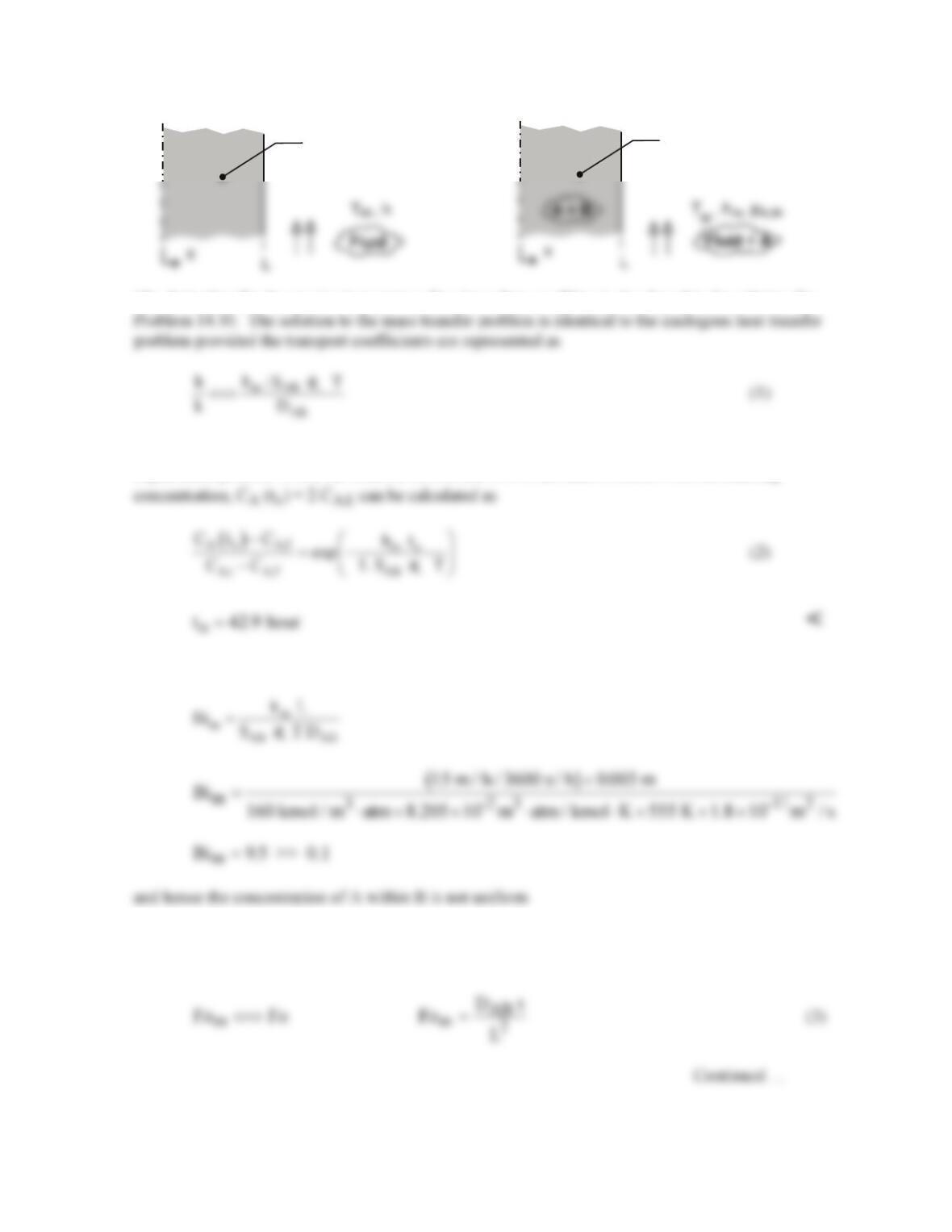
(b) For the plane wall shown in the schematic below, the heat and mass transfer conservation
equations and their initial and boundary conditions are
Heat transfer Mass (Species A) transfer
PROBLEM 14.51 (Cont.)
D , S
AB AB
T(x,t), T(x,0) = T
i
ρ
, c, k
(x,t), (x,0) = C
A,i
CC
AA
The derivation for the species transport surface boundary condition is developed in the solution for
(c) The uniform concentration transient diffusion process is analogous to the heat transfer lumped-
capacitance process. From the solution of Problem 14.50, the time to reach twice the limiting
For the present situation, the mass transfer Biot number is
(d) Invoking the analogy with the heat transfer situation, we can use the one-term series solution, Eq.
5.43, with
Bi Bi
m
<=>
and