PROBLEM 14.15
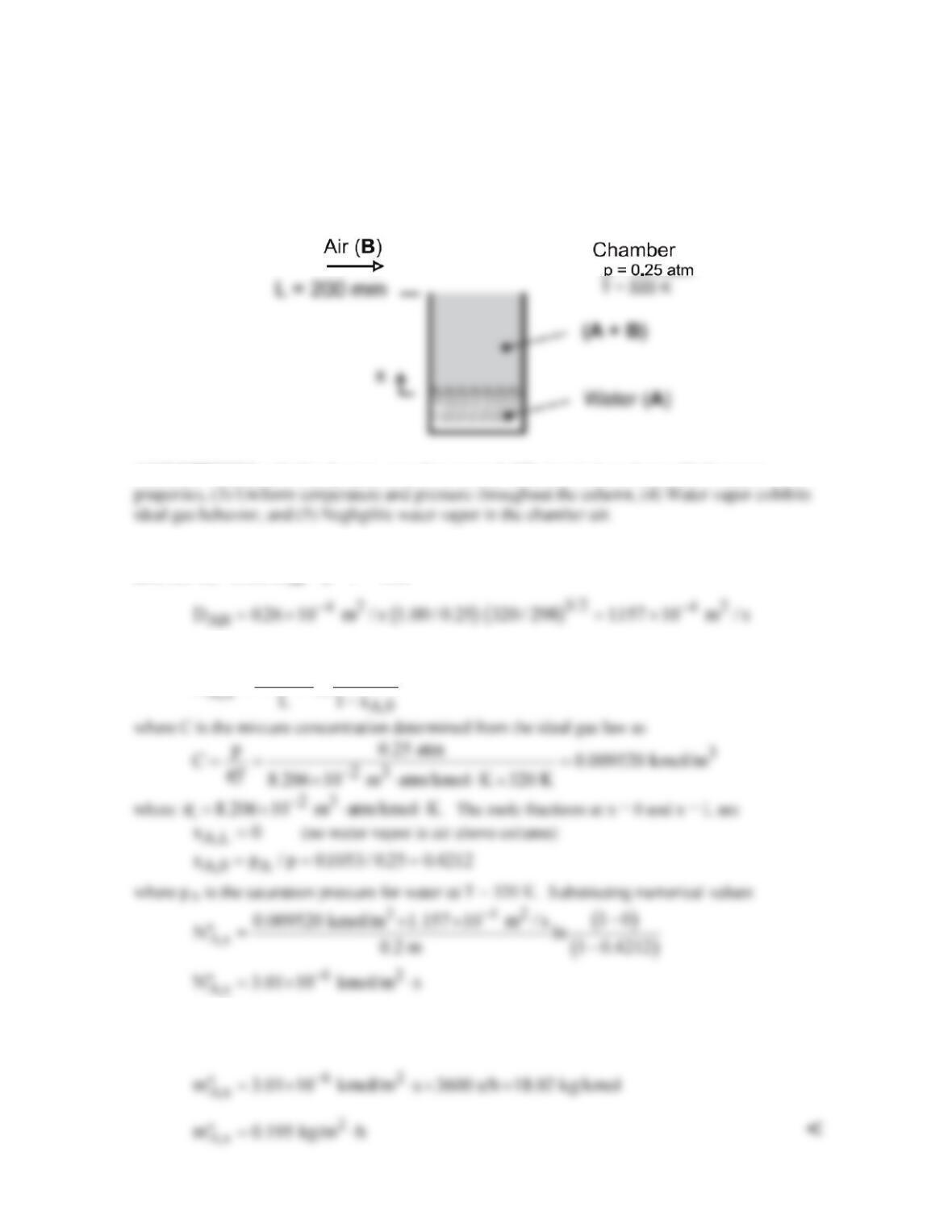
KNOWN: Column containing liquid phase of water (A) evaporates into the air (B) flowing over the
mouth of the column.
FIND: Evaporation rate of water (kg/h⋅m2) using the known value of the binary diffusion coefficient
for the water vapor – air mixture.
SCHEMATIC:
ASSUMPTIONS: (1) Steady-state, one-dimensional diffusion in the column, (2) Constant
PROPERTIES: Table A-6, water (T = 320 K): psat = 0.1053 bar; Table A-8, water vapor-air (0.25
atm, 320 K): Since DAB ~ p-1 T3/2 find
ANALYSIS: From Eq. 14.40, the molar flow rate per unit area is
′′
NC D
or, on a mass basis,
A,x A,x A
mN
′′ ′′
M
PROBLEM 14.16
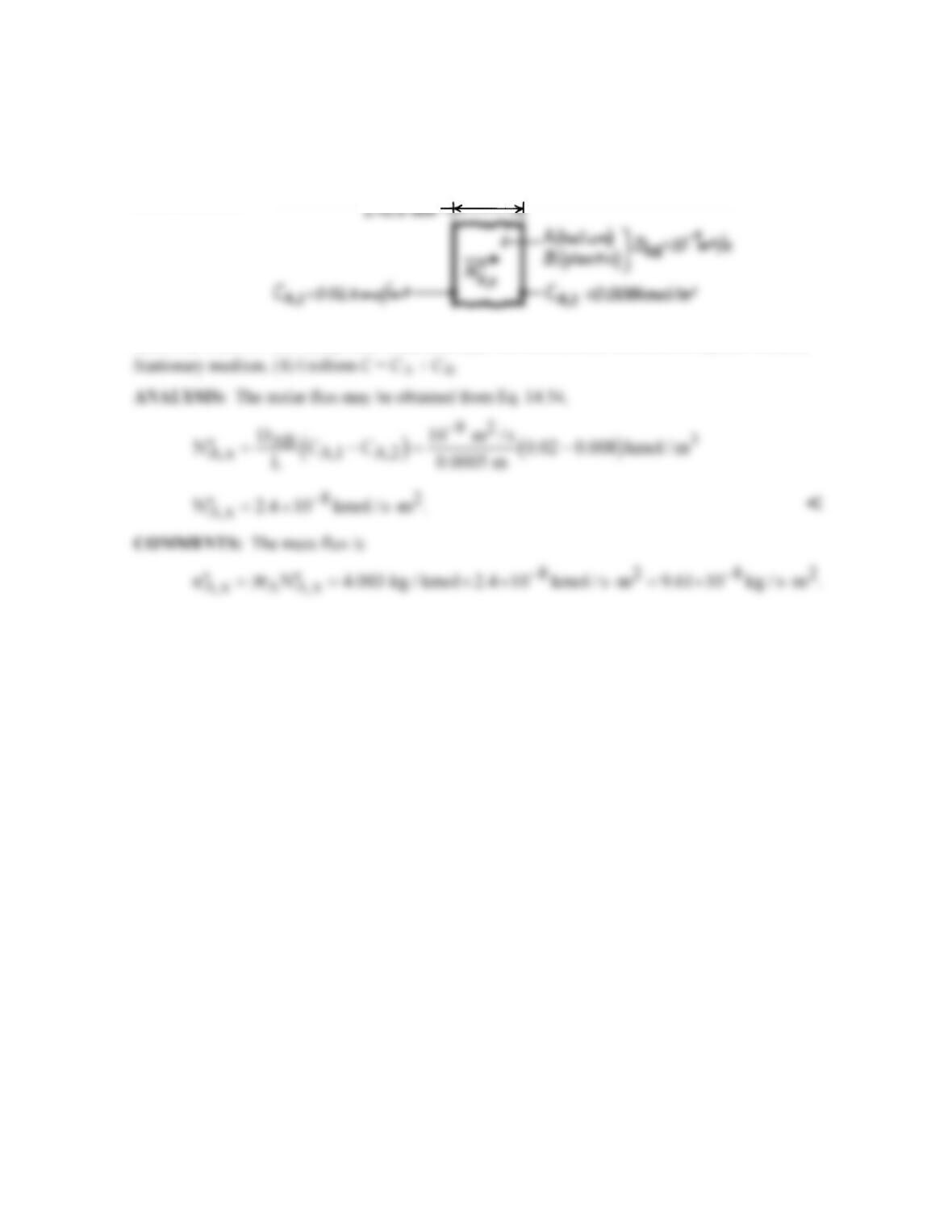
KNOWN: Molar concentrations of helium at the inner and outer surfaces of a plastic membrane.
Diffusion coefficient and membrane thickness.
FIND: Molar diffusion flux.
SCHEMATIC:
ASSUMPTIONS: (1) Steady-state conditions, (2) One-dimensional diffusion in a plane wall, (3)
PROBLEM 14.17
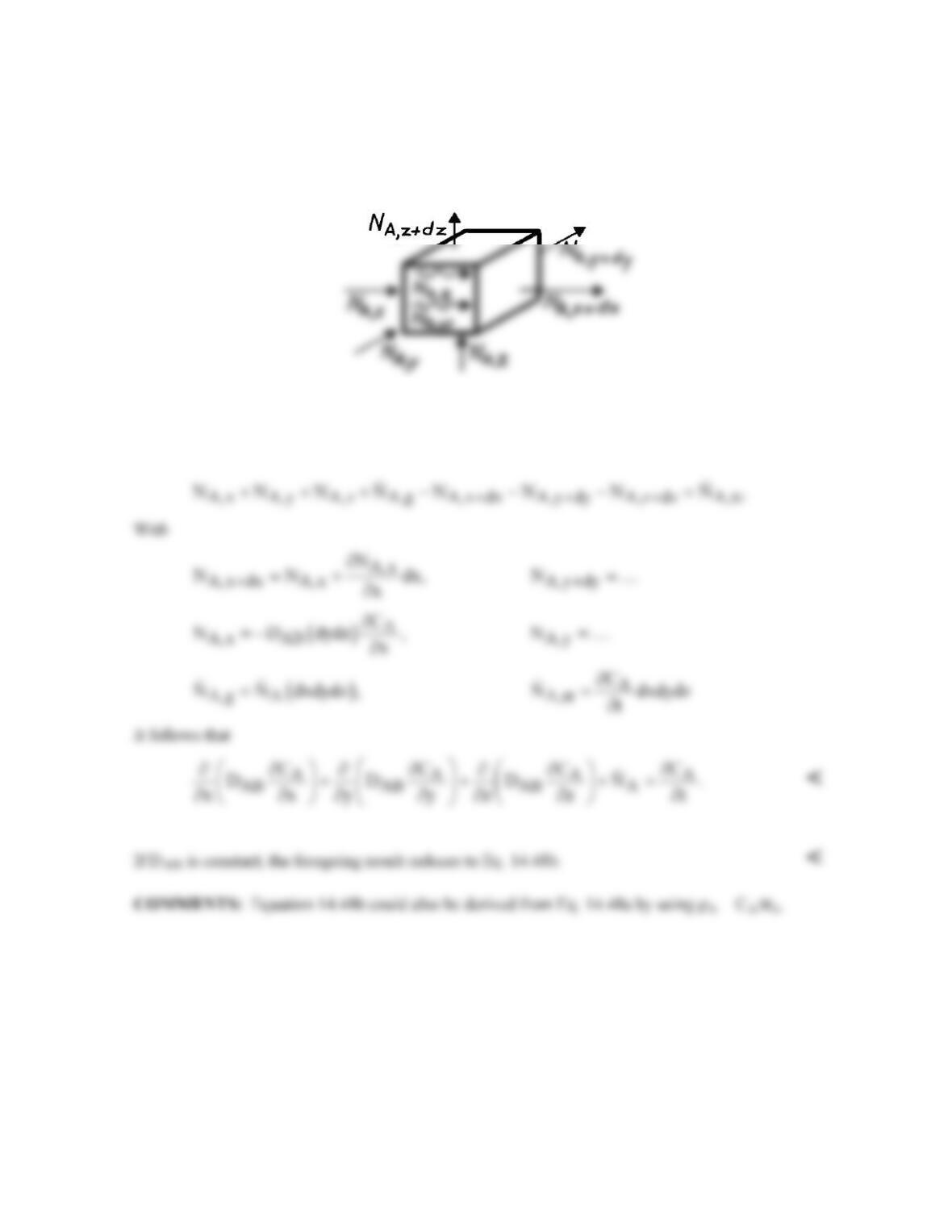
KNOWN: Three-dimensional diffusion of species A in a stationary medium with chemical reactions.
FIND: Derive molar form of diffusion equation. Compare with Eq.14.48b.
SCHEMATIC:
ASSUMPTIONS: (1) Uniform total molar concentration, (2) Stationary medium.
ANALYSIS: The derivation parallels that of Section 14.4.2, except that Eq. 14.43 is applied on a
molar basis. That is,
PROBLEM 14.18
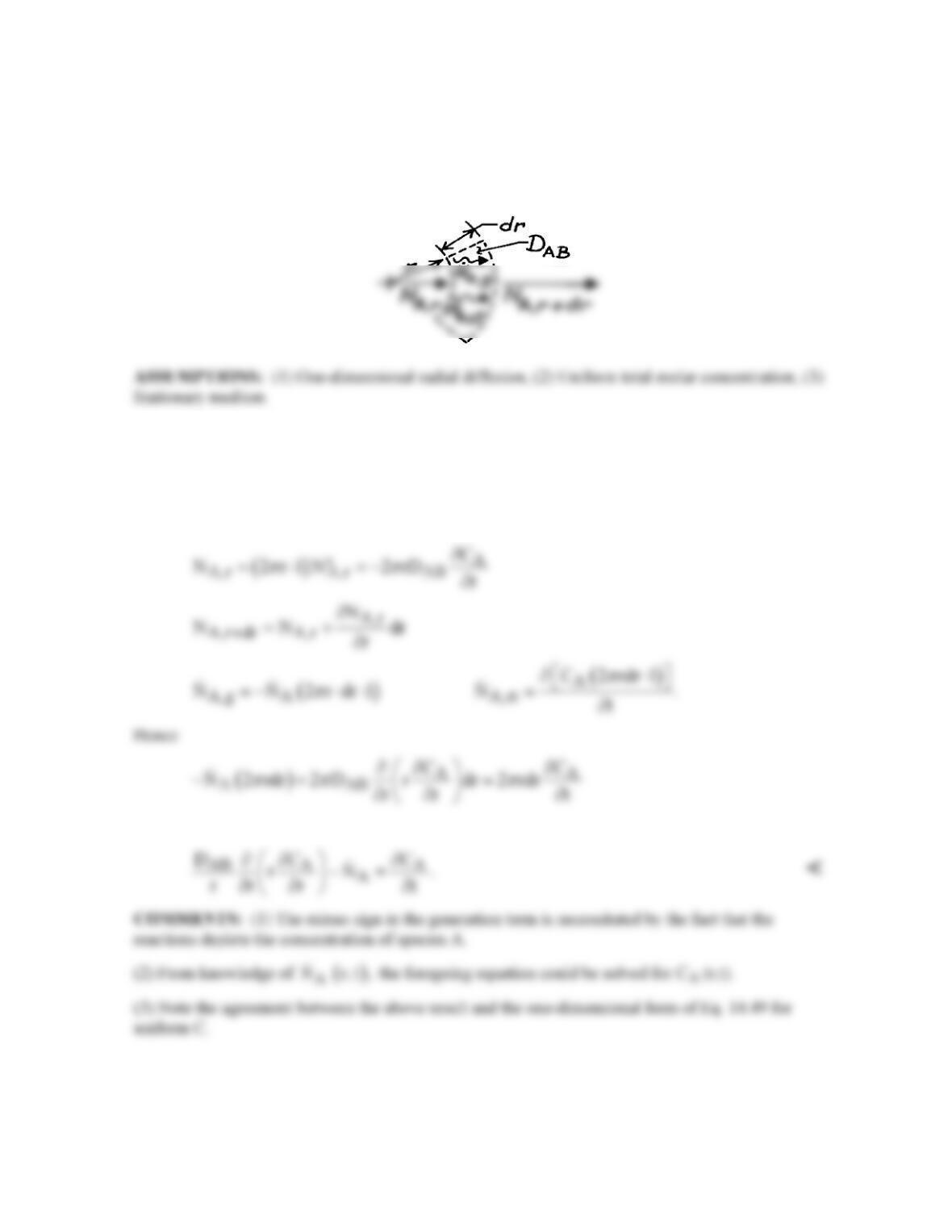
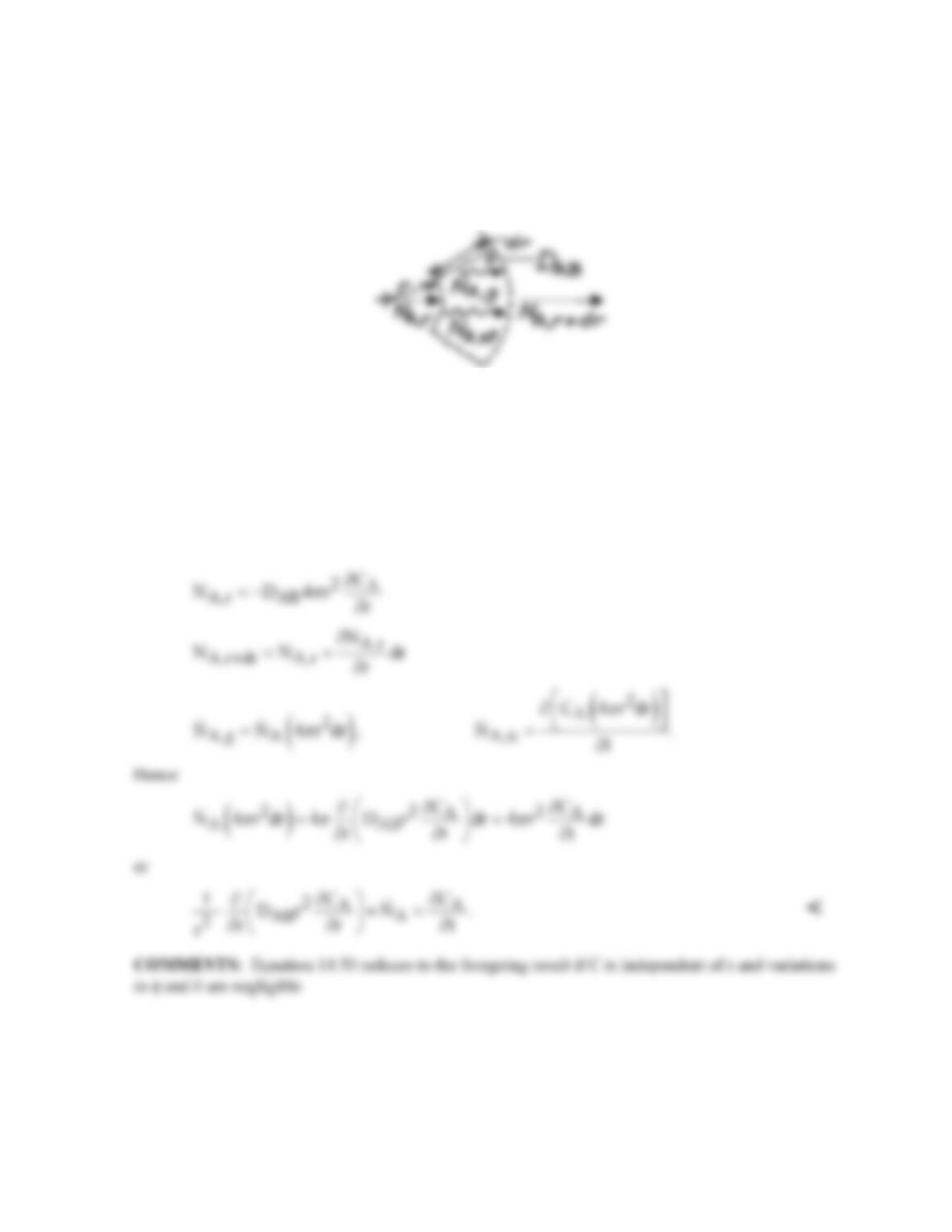
KNOWN: Gas (A) diffuses through a cylindrical tube wall (B) and experiences chemical reactions at
a volumetric rate,
A
N.
FIND: Differential equation which governs molar concentration of gas in plastic.
SCHEMATIC:
ANALYSIS: Dividing the species conservation requirement, Eq. 14.43, by the molecular weight,
MA, and applying it to a differential control volume of unit length normal to the page,
A,r A,g A,r dr A,st
NNN N
where
or
PROBLEM 14.19
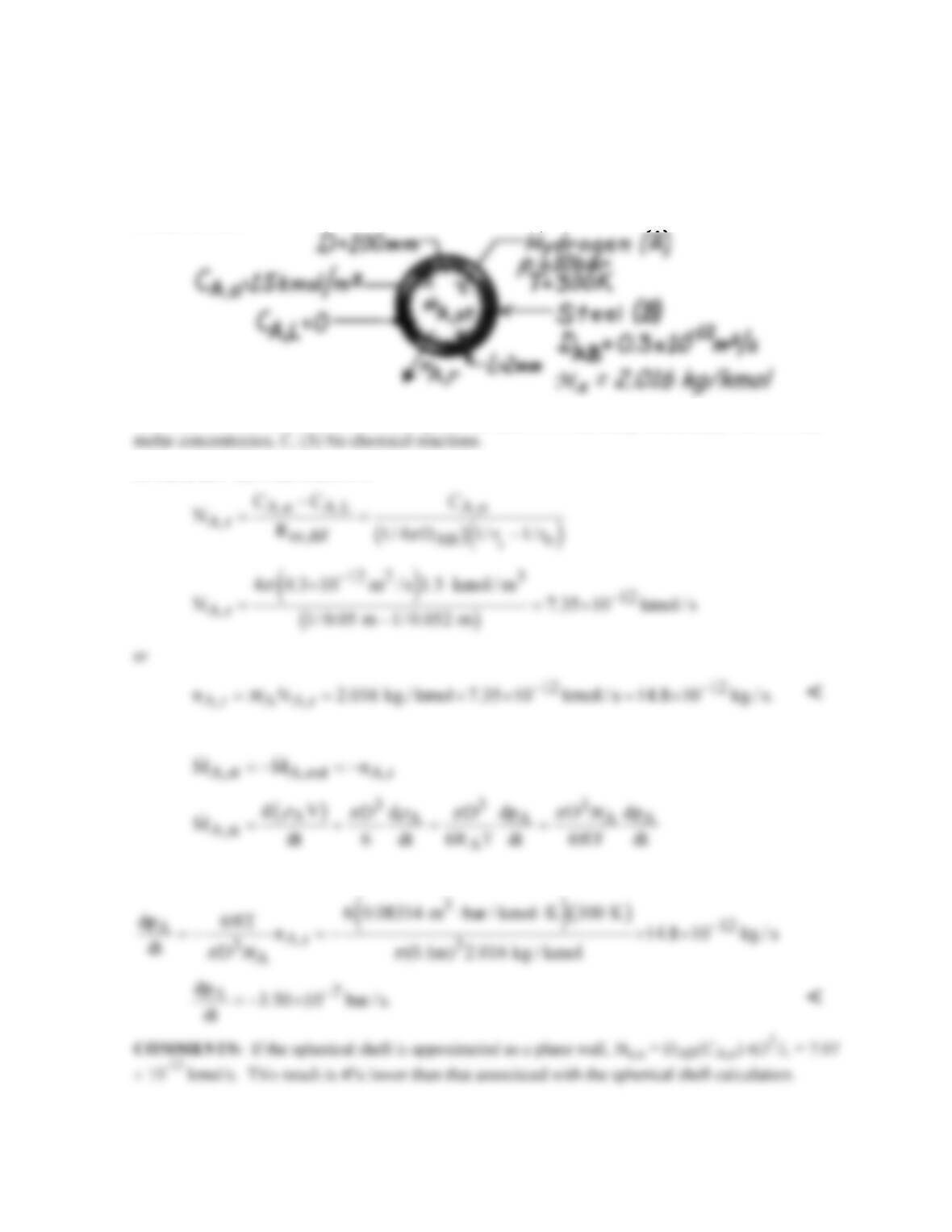
KNOWN: One-dimensional, radial diffusion of species A in a stationary, spherical medium with
chemical reactions.
FIND: Derive appropriate form of diffusion equation.
SCHEMATIC:
ASSUMPTIONS: (1) One-dimensional, radial diffusion, (2) Uniform total molar concentration, (3)
Stationary medium.
ANALYSIS: Dividing the species conservation requirement, Eq. 14.43, by the molecular weight,
MA, and applying it to the differential control volume, it follows that
A,r A,g A,r dr A,st
NNN N
where
PROBLEM 14.20
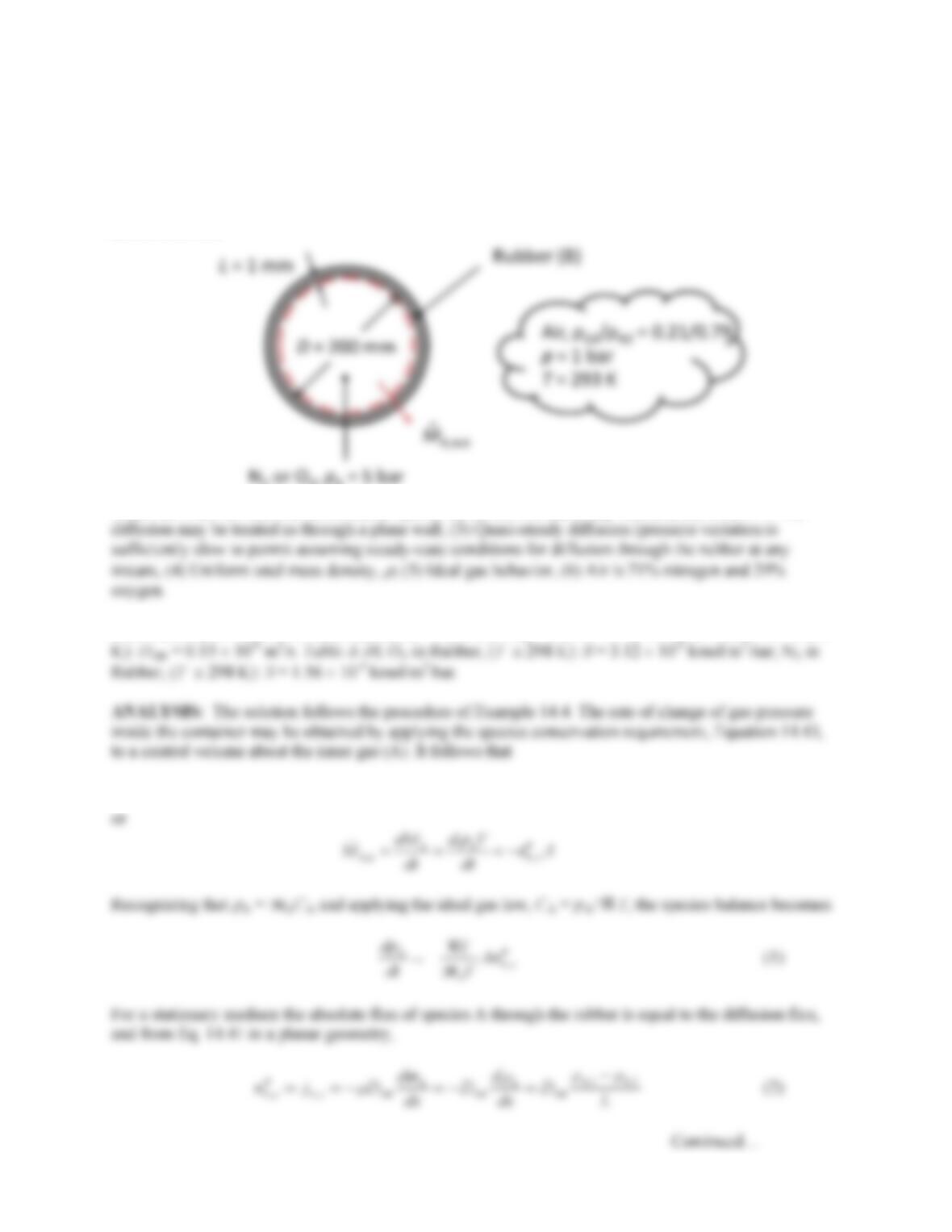
KNOWN: Pressure and temperature of hydrogen stored in a spherical steel tank of prescribed
diameter and thickness.
FIND: (a) Initial rate of hydrogen mass loss from the tank, (b) Initial rate of pressure drop in the
tank.
SCHEMATIC:
ASSUMPTIONS: (1) One-dimensional species diffusion in a stationary medium, (2) Uniform total
ANALYSIS: (a) From Table 14.1
(b) Applying a species balance to a control volume about the hydrogen,
Hence
PROBLEM 14.21
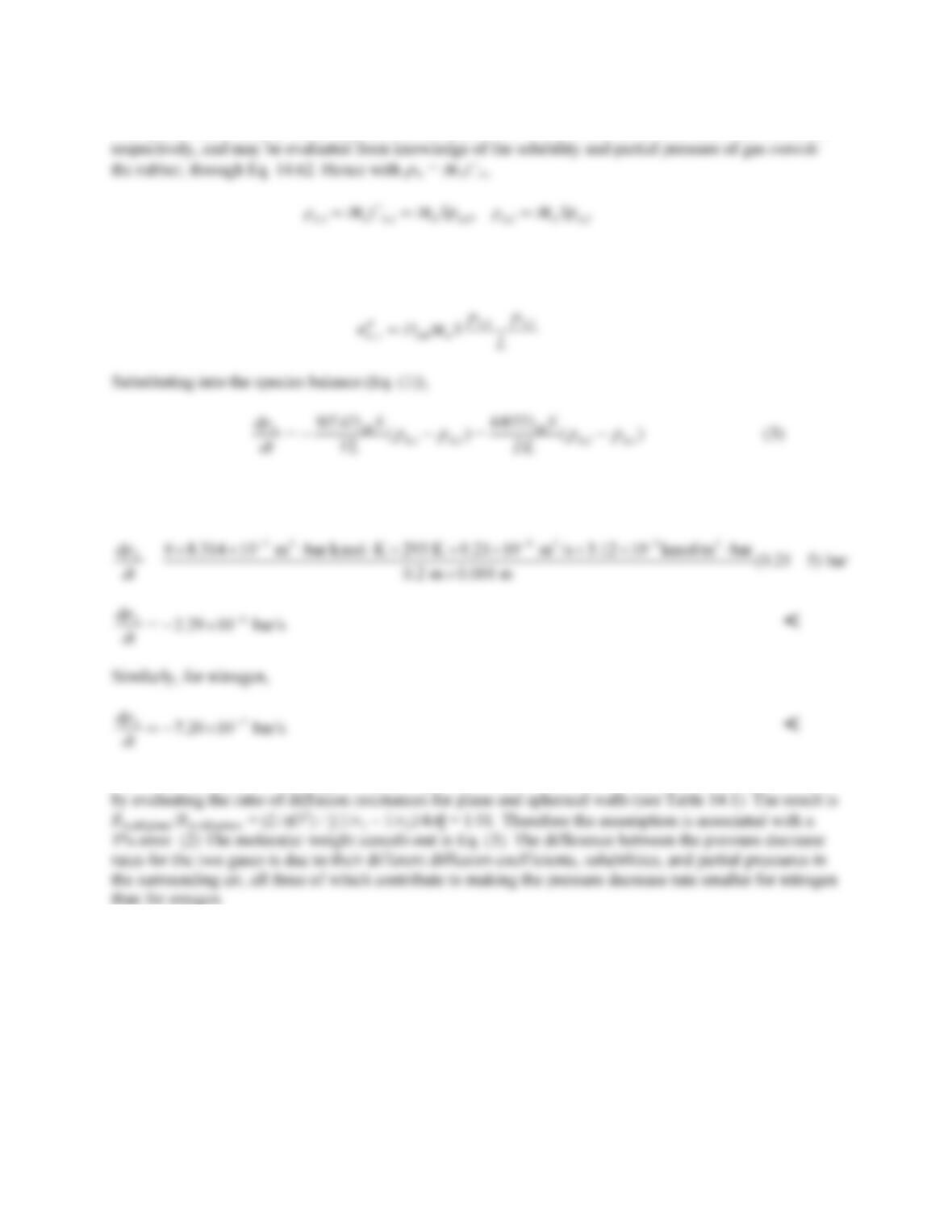
KNOWN: Diameter and wall thickness of spherical rubber container. Pressure, temperature and type of
gas inside. Pressure and temperature of air outside.
FIND: Initial rate of pressure change if the gas is pure nitrogen or pure oxygen.
SCHEMATIC:
2
2
A
ASSUMPTIONS: (1) One-dimensional species diffusion in a stationary medium, (2) Since L << D,
PROPERTIES: Table A-8, O2 in Rubber, (T ≅ 298 K): DAB = 0.21 10-9 m2/s; N2 in Rubber, (T ≅ 298
A,st A,out
MM
PROBLEM 14.21 (Cont.)
The species densities
ρ
A,1 and
ρ
A,2 pertain to conditions within the rubber at its inner and outer surfaces,
where pA,1 and pA,2 are the partial pressures of species A inside the container and in the air outside the
container, respectively. Hence Eq. (2) becomes
where pA,1 = 5 bar and pA,2 = 0.21 1 bar = 0.21 bar for O2 and pA,2 = 0.79 bar for N2. Evaluating Eq. (3)
for oxygen, the initial rate of pressure decrease is:
COMMENTS: (1) The assumption that the spherical wall can be treated as a plane wall can be assessed
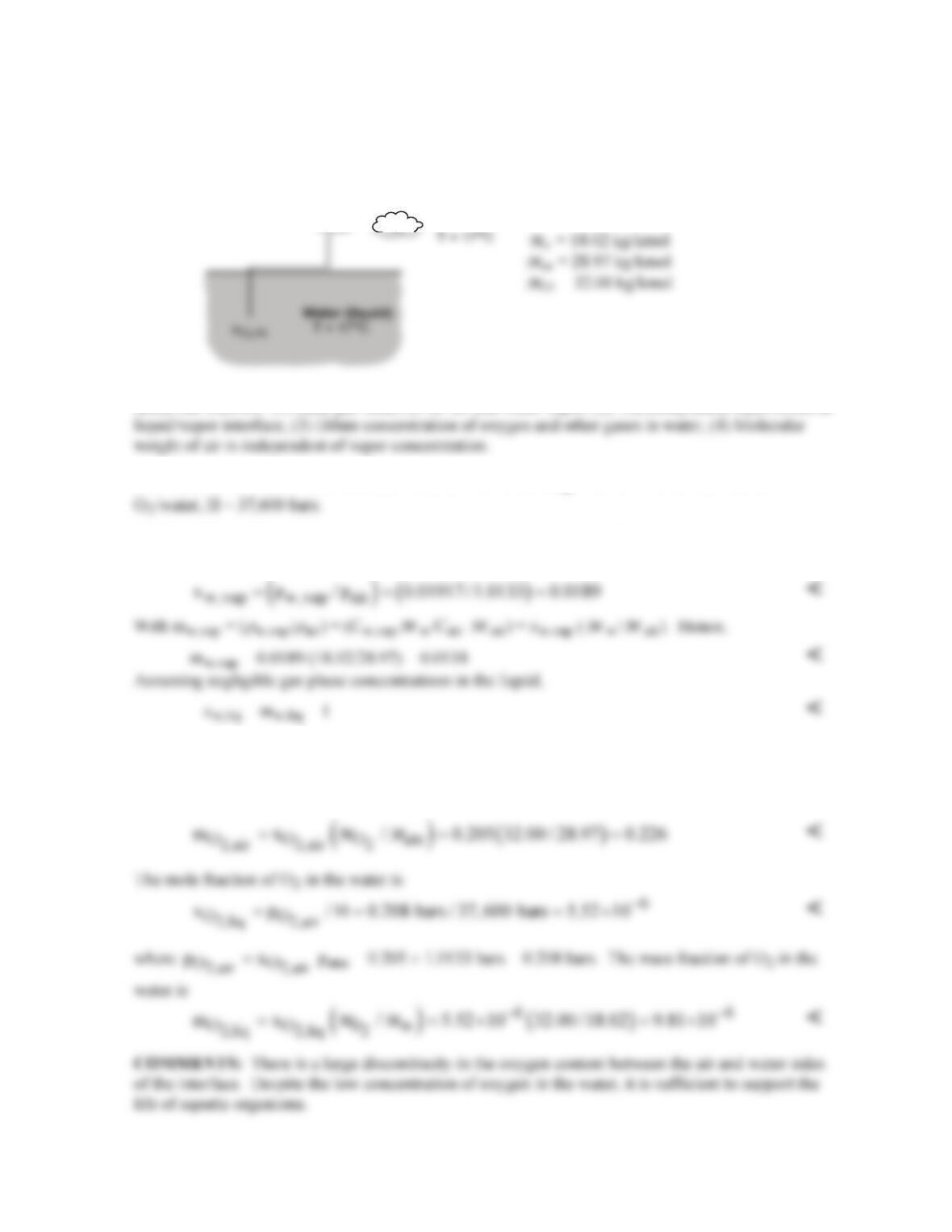
PROBLEM 14.22
KNOWN: Temperature of atmospheric air and water. Percentage by volume of oxygen in the air.
FIND: (a) Mole and mass fractions of water at the air and water sides of the interface, (b) Mole and
mass fractions of oxygen in the air and water.
SCHEMATIC:
ASSUMPTIONS: (1) Ideal gas behavior for air and water vapor, (2) Thermodynamic equilibrium at
PROPERTIES: Table A-6, Saturated water (T = 290 K): pvap = 0.01917 bars. Table A-9,
ANALYSIS: (a) Assuming ideal gas behavior, pw,vap = (Nw,vap /V) ℜT and p = (N/V) ℜT, in which
case
(b) Since the partial volume of a gaseous species is proportional to the number of moles of the
species, its mole fraction is equivalent to its volume fraction. Hence on the air side of the interface
O2,air
x 0.205
<
xO ,air
p = 1 atm
Air
PROBLEM 14.23
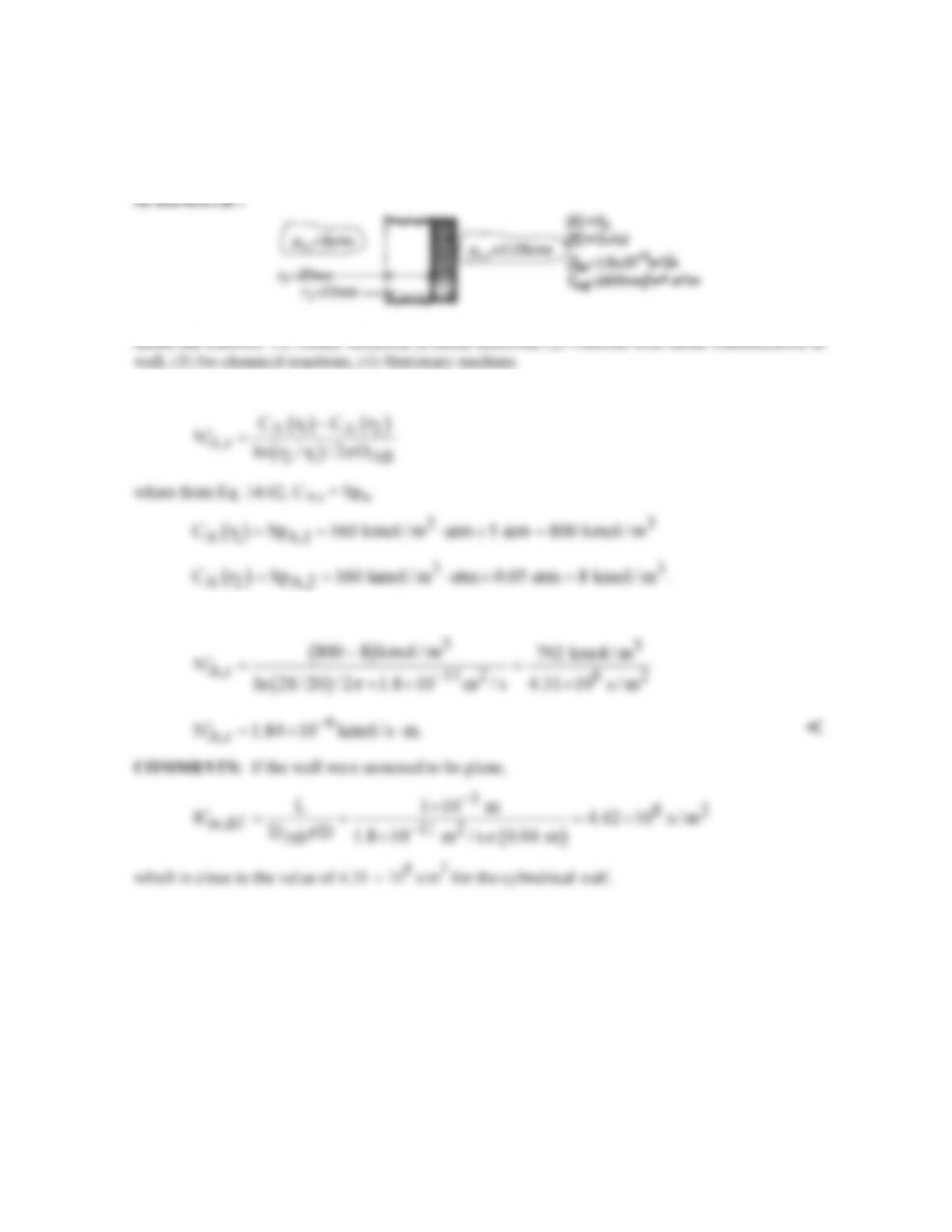
KNOWN: Pressure and temperature of hydrogen inside and outside of a circular tube. Diffusivity
and solubility of hydrogen in tube wall of prescribed thickness and diameter.
FIND: Rate of hydrogen transfer through tube per unit length.
ANALYSIS: The mass transfer rate per unit tube length is
Hence,
PROBLEM 14.24
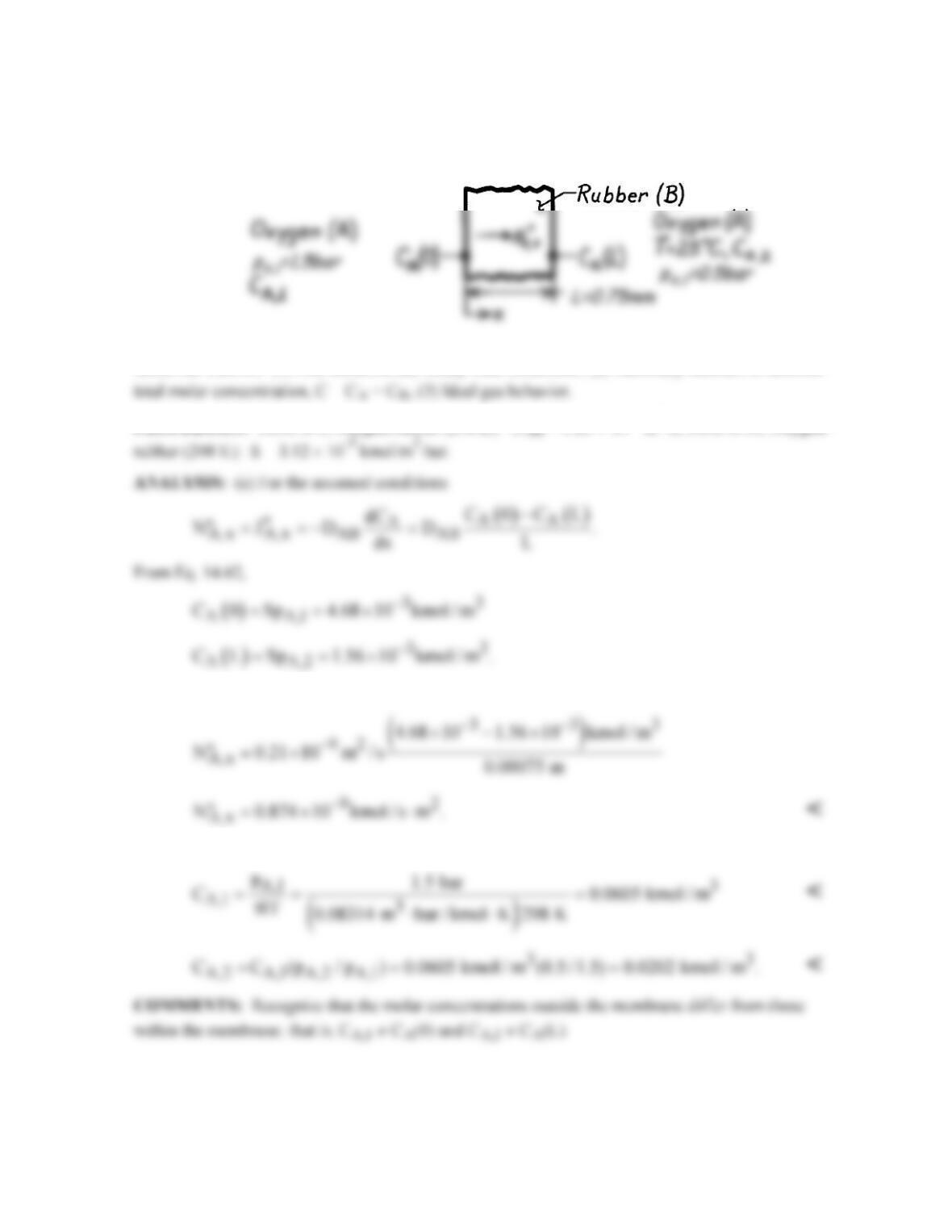
KNOWN: Oxygen pressures on opposite sides of a rubber membrane.
FIND: Molar diffusive flux of O2 and molar concentrations of O2 outside the rubber on both sides.
SCHEMATIC:
ASSUMPTIONS: (1) One-dimensional, steady-state conditions, (2) Stationary medium of uniform
PROPERTIES: Table A-8, Oxygen-rubber (298 K): DAB = 0.21 10-9 m2/s; Table A-10, Oxygen–
Hence
(b) From the ideal gas law
PROBLEM 14.25
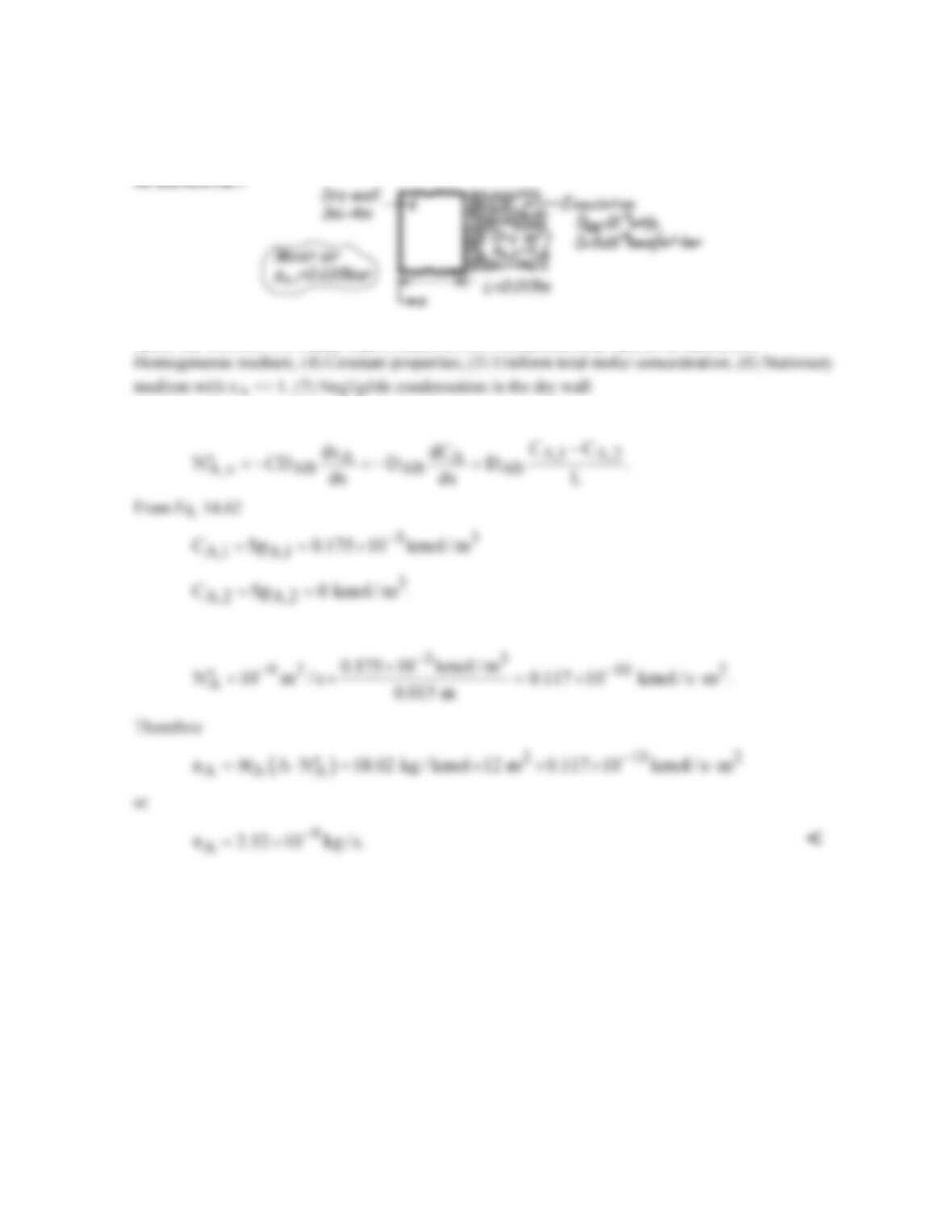
KNOWN: Water vapor is transferred through dry wall by diffusion.
FIND: The mass diffusion rate through a 0.015 3 4 m wall.
ASSUMPTIONS: (1) Steady-state conditions, (2) One-dimensional species diffusion, (3)
ANALYSIS: From Eq. 14.42,
Hence
PROBLEM 14.26
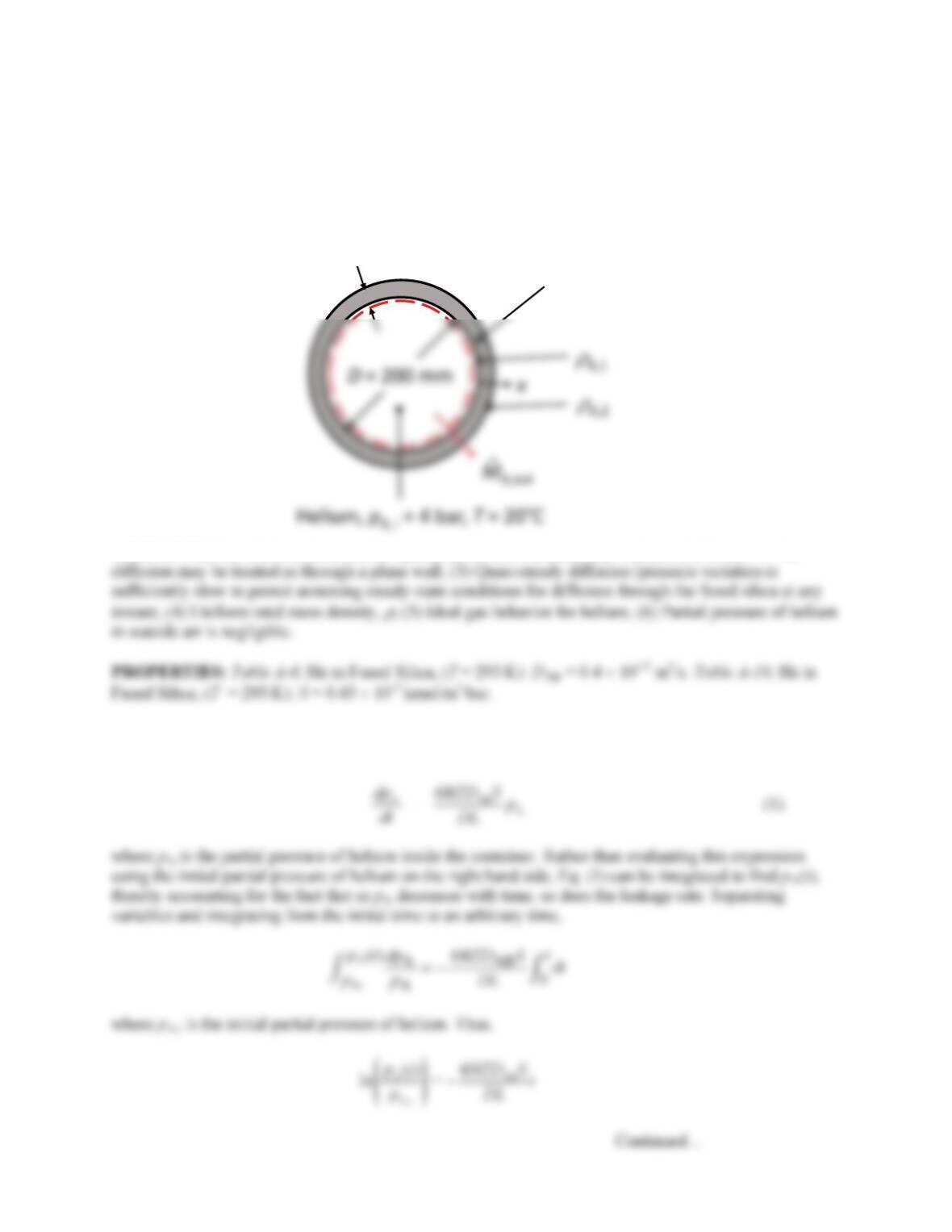
KNOWN: Diameter and wall thickness of spherical fused silica container. Temperature and initial
pressure of helium stored inside.
FIND: Time required for the pressure in the container to drop by 1% and 10%. Compare result with time
estimated using initial rate of pressure decrease.
SCHEMATIC:
Fused silica (B)
L= 2 mm
ASSUMPTIONS: (1) One-dimensional species diffusion in a stationary medium, (2) Since t << D,
ANALYSIS: The analysis is identical to Example 14.4 up until the final equation for the rate of change
of helium pressure, namely
PROBLEM 14.26 (Cont.)
Solving for time yields
The time for the pressure to drop by 1% is therefore,
Similarly, for a 10% drop in pressure,
COMMENTS: (1) The leakage rate is very low and the pressure remains nearly constant for many years.
Realistically, any opening created in the sphere in order to fill it would likely have a much higher leakage
PROBLEM 14.27
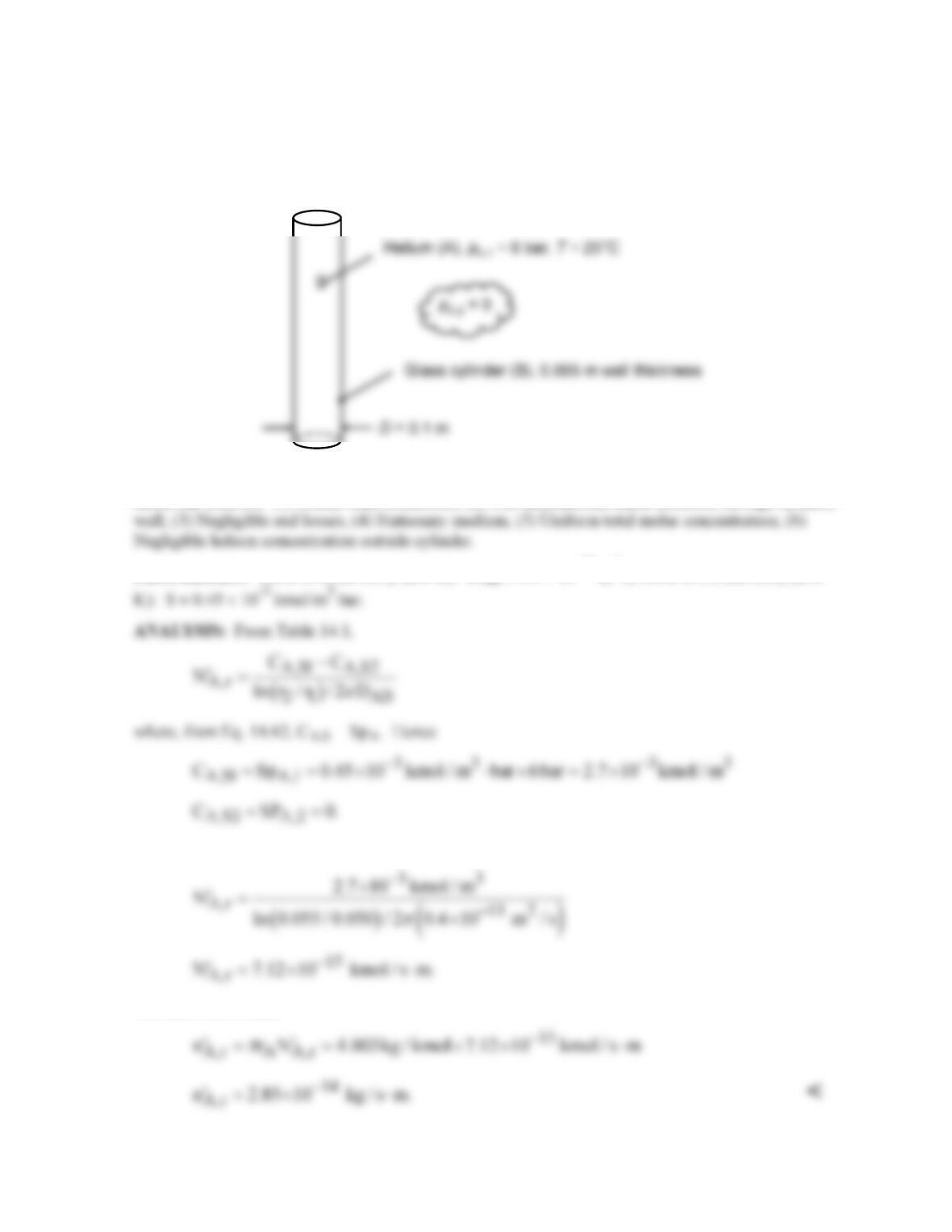
KNOWN: Pressure and temperature of helium in a glass cylinder of 100 mm inside diameter and 5
mm thickness.
FIND: Mass rate of helium loss per unit length.
SCHEMATIC:
ASSUMPTIONS: (1) Steady-state conditions, (2) One-dimensional radial diffusion through cylinder
PROPERTIES: Table A-8, He–SiO2 (298 K): DAB ≈ 0.4 10–13 m2/s; Table A-10, He–SiO2 (298
Hence
The mass loss is then
PROBLEM 14.28
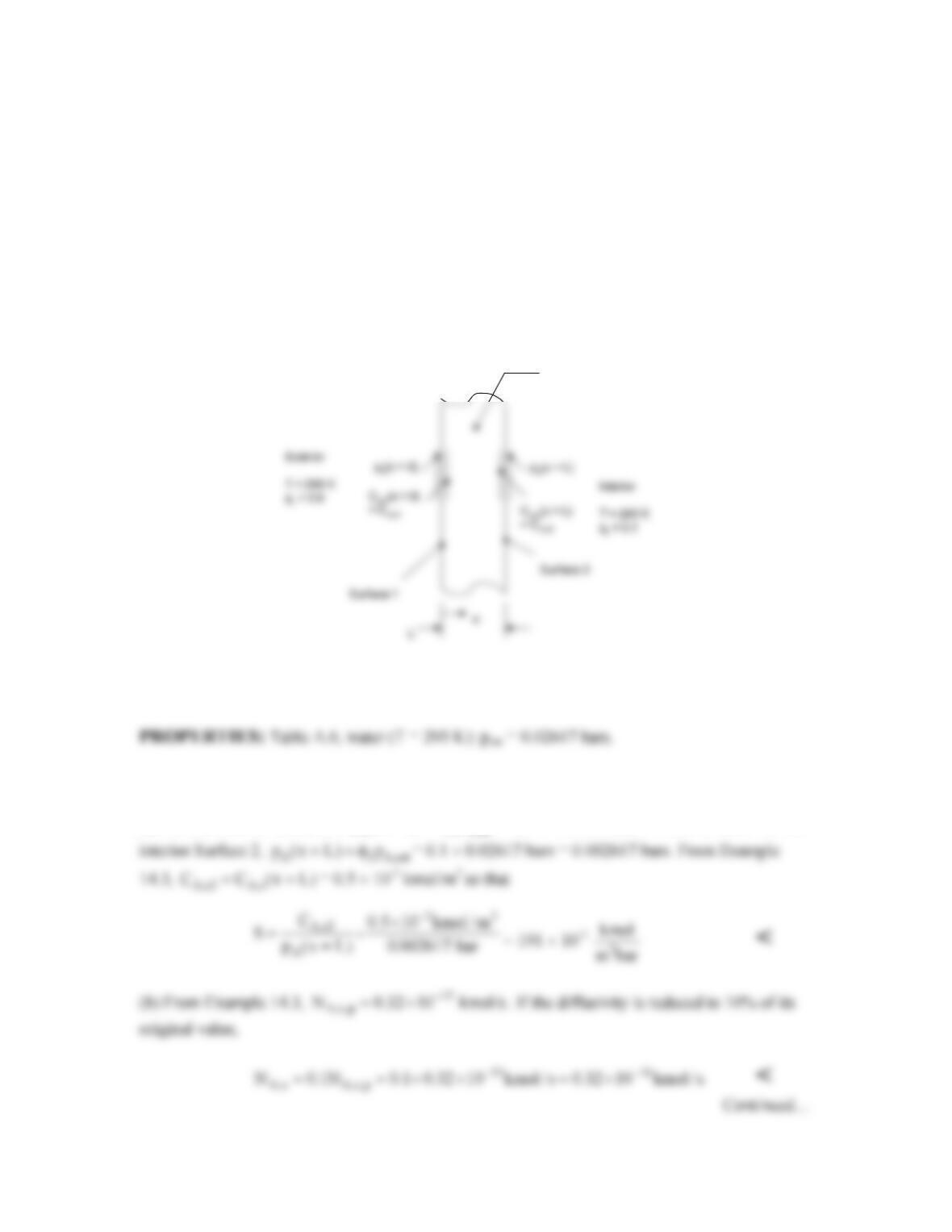
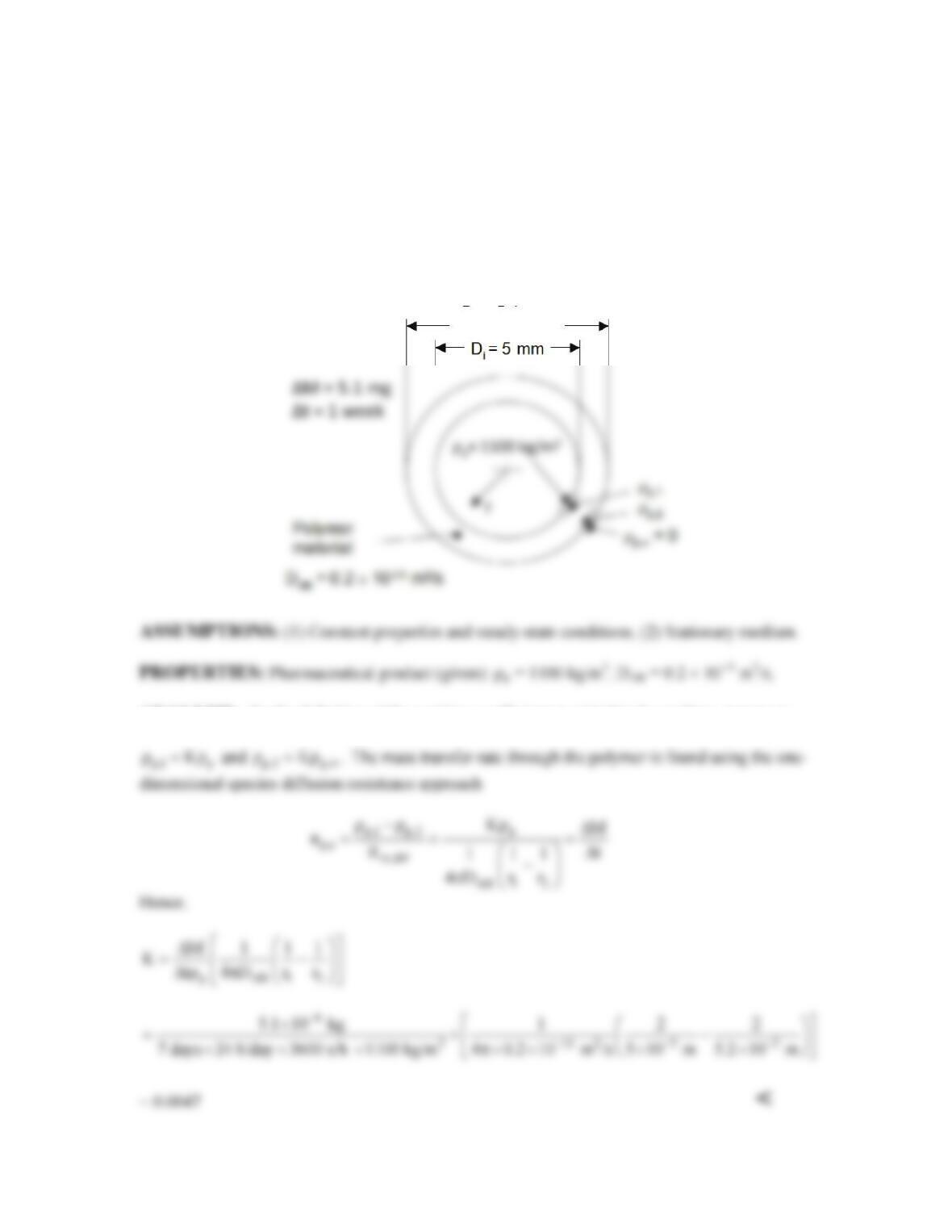
KNOWN: Thickness of polymer packaging material, temperature and humidity conditions in
gas on either side of the material.
FIND: (a) Solubility of the packaging material, (b) Total water vapor transfer rate for a material
that has 10% of the diffusivity of the material in Example 14.3, (c) Total water vapor transfer rate
for a material that has 10% the solubility of the material in Example 14.3, (d) Total water vapor
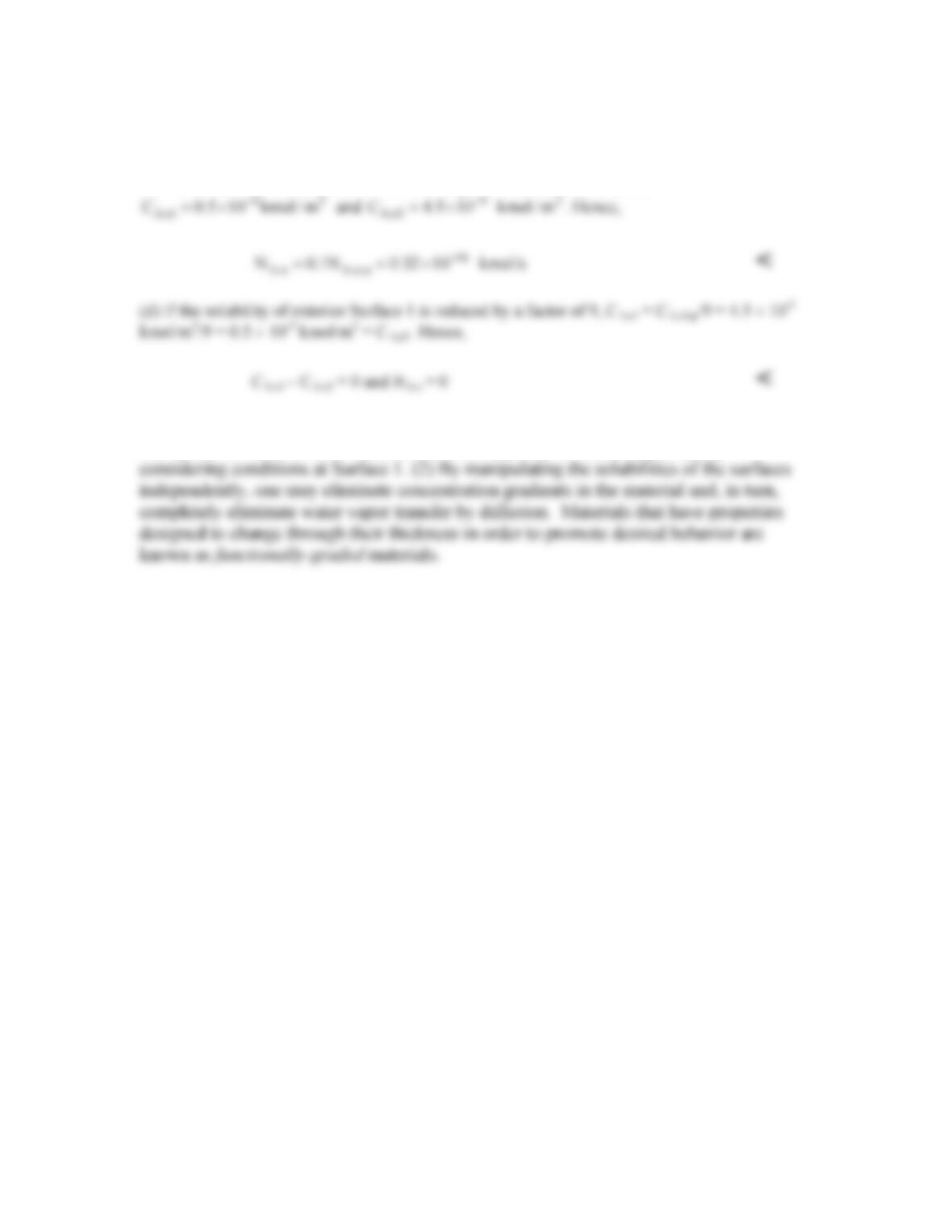
transfer rate after coating the exterior surface with a thin film to reduce its solubility by a factor of
9, leaving the interior surface untreated.
SCHEMATIC:
ASSUMPTIONS: (1) Constant properties and steady-state conditions, (2) Stationary medium.
ANALYSIS:
(a) For the exterior Surface 1,
A
p (x 0)
=
1 A,sat
pφ
= 0.9 0.02617 bars = 0.02355 bars. For the
Po lymer
material
Po lymer
material
PROBLEM 14.28 (Cont.)
(c) If the solubility is reduced to 10% of its original value at both surfaces,
COMMENT: (1) The same value of the solubility may be found in part (a) by
PROBLEM 14.29
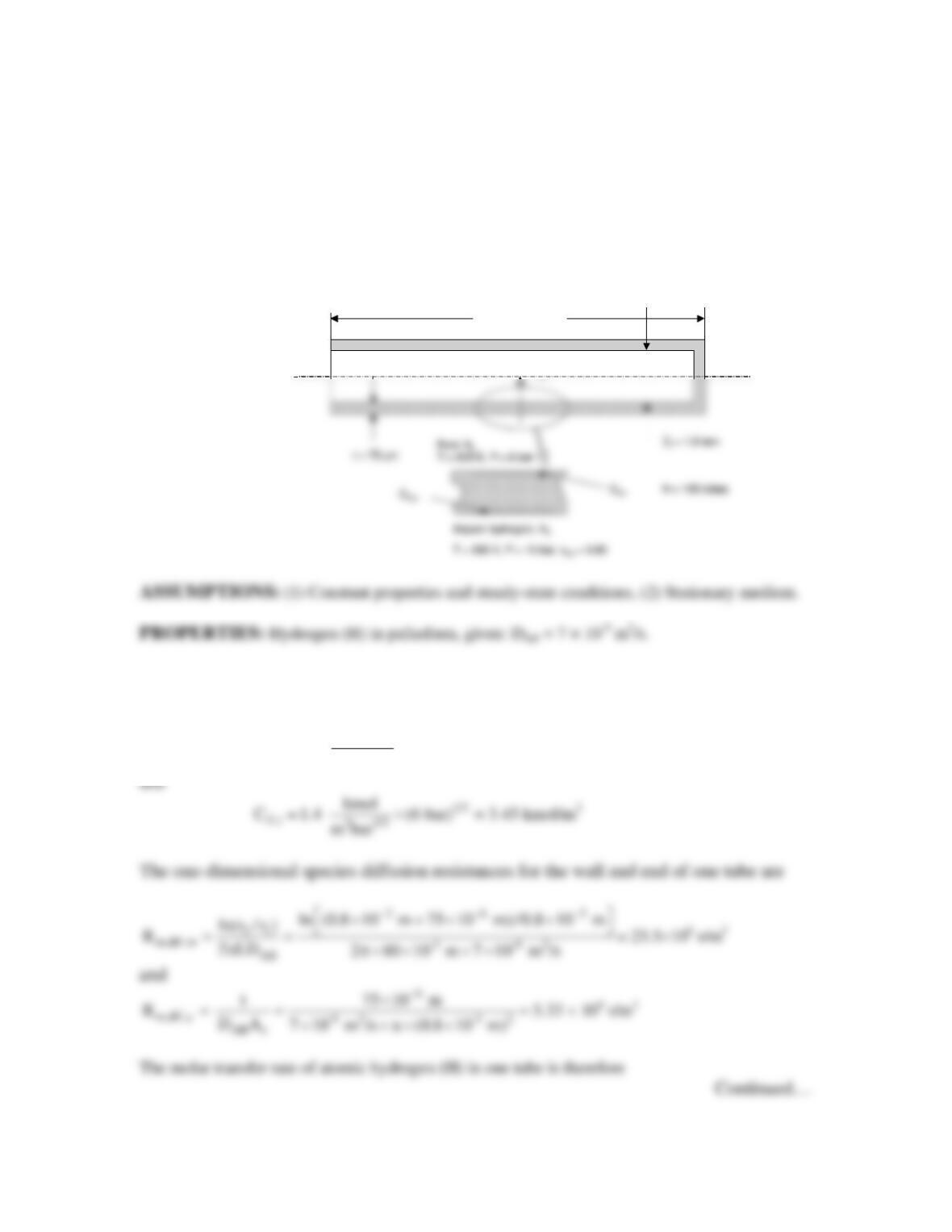
KNOWN: Dimensions of sphere containing a pharmaceutical product. Mass loss of sphere over
specified time period, mass diffusivity, external conditions.
FIND: The value of the partition coefficient, K.
SCHEMATIC:
D
o
= 5.2 mm
ANALYSIS: By the definition of the partition coefficient provided in the problem statement,
PROBLEM 14.30
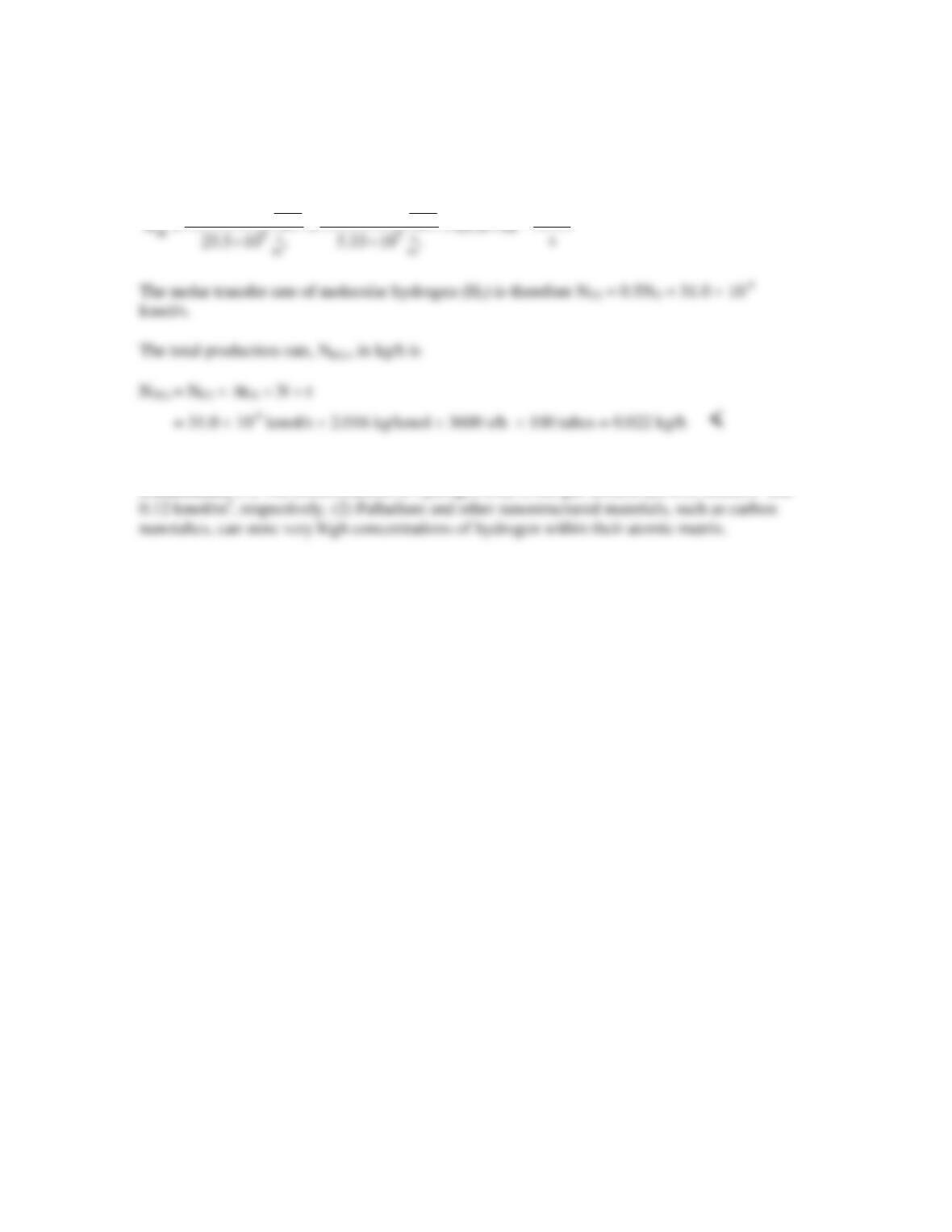
KNOWN: Dimensions of N =100 closed-end palladium tubes. Hydrogen (H2) pressures and
temperature on either side of tube wall. Mass diffusivity of atomic hydrogen (H) through the
palladium, and Sievert’s constant.
FIND: Hourly production rate of pure hydrogen (H2).
SCHEMATIC:
ANALYSIS: The concentration of atomic hydrogen (H) on the outer and inner surfaces of the
tube are
1/2 3
H,o 31/2
kmol
C 1.4 (0.85 15 bar) = 5.00 kmol/m
mbar
L = 80 mm
N
L = 80 mm
L = 80 mm
N
PROBLEM 14.30 (Cont.)
33
kmol kmol
9
mm
(5.00 3.43) (5.00 3.43) kmol
Comments: (1) The concentrations of hydrogen (H2) in the gas streams are 0.25 kmol/m3 and