14-1
CHAPTER 14
LONG-TERM LIABILITIES
CONTENT ANALYSIS OF EXERCISES AND PROBLEMS
Number
Content
Time Range
(minutes)
E14-1
Bond Issue at Par. (Easy) Plus accrued interest. Semiannual
interest payments. Journal entries.
5-10
E14-6
Proceeds from Bond Issues. (Easy) Determination if sold to yield
less than stated rate, more than stated rate.
5-15
E14-7
Bond Issue: Premium and Discount. (Moderate) Effective
interest method. Semiannual interest payments. Journal
entries.
10-20
E14-8
Bond Amortization Tables. (Moderate) Premium. Straight-line,
effective interest methods. Journal entries.
10-20
E14-12
(AICPA adapted). Extinguishment of Bonds Prior to Maturity.
(Moderate) Issued at a premium plus accrued interest.
Reacquired at a discount plus accrued interest. Straight-line
method. Schedule to compute gain or loss.
10-20
14-2
Number
Content
Time Range
(minutes)
E14-14
(AICPA adapted). Convertible Bonds. (Moderate) Premium.
Straight-line method for amortization. Stock split. Book value
method. Journal entries.
15-20
E14-19
Long-Term Note Payable. (Easy) Non-interest-bearing.
Exchanged for cash and rights. Journal entries.
10-20
E14-20
Long-Term Note Payable. (Easy) Non-interest-bearing. Fair
market value not determinable. Journal entries to record
issuance, interest, retirement.
10-20
E14-21
Long-Term Note Payable. (Moderate) Non-interest-bearing.
Fair market value of asset given. Journal entries to record
purchase, interest.
10-15
E14-26
Notes Receivable Discounted. (Moderate) Preparation of
journal entries for two notes, including a note bearing interest
but not at a fair rate. Includes material from Chapter 7.
15-25
E14-27
(AICPA adapted). Income from Notes Receivable.
(Moderate) Prepare schedule to determine pretax income
from note. Show supporting computations.
10-20
14-3
Number
Content
Time Range
(minutes)
E14-30
(Appendix 1). Troubled Debt Restructuring (Debtor)–
Modification of Terms. (Moderate) Note payable repayment
date extended, interest rate reduced. Computation of new
annual interest expense.
10-20
E14-34
(Appendix 2). Serial Bonds. (Challenging) Premium. Three
equal semiannual installments. Semiannual interest payments.
Bonds outstanding method of amortization. Journal entries.
15-20
E14-35
(Appendix 2). Serial Bond Issue. (Challenging) Premium.
Effective interest method. Schedule. Journal entries.
10-20
P14-2
Effective Interest Rate. (Moderate) Computation. Discount.
Semiannual interest payments.
15-30
P14-3
Premium Amortization Schedule. (Moderate) Effective interest
method. Retirement prior to maturity at a loss. Journal entries.
30-40
P14-4
Comprehensive: Premium Amortization Schedules and
Retirement. (Challenging) Straight-line, effective interest
methods. Retired at a gain. Journal entries.
30-50

14-4
Number
Content
Time Range
(minutes)
P14-8
Convertible Bonds. (Challenging) Premium. Straight-line
method. Book value, market value methods. Journal entries.
Value of conversion feature. Debt to equity ratio. IFRS
differences.
25-35
P14-12
Notes Receivable. (Moderate) Non-interest-bearing, fair
market values unknown. Journal entries. Balance sheet
disclosures.
15-25
P14-13
Notes Receivable. (Moderate) Non-interest-bearing note. Fair
value known. Journal entries. Balance sheet disclosures.
20-30
P14-16
Comprehensive Debt Problem. (Challenging) Bonds issued at
a premium, at a discount. Convertible bonds. Bond
retirement. Common stock warrants. Non-interest-bearing
note. Straight-line and effective interest method amortization.
Balance sheet disclosures.
60-75

14-5
Number
Content
Time Range
(minutes)
P14-21
(Appendix 2). Call Provisions on Serial Bonds. (Challenging)
30-45
ANSWERS TO QUESTIONS
Q14-1 The following are five reasons why a corporation may wish to issue long-term liabilities
rather than equity securities:
1. Debt may be the only available source of funds. Many small- and medium-sized
companies may appear too risky to attract equity (i.e., capital stock) investments.
2. Debt financing may have a lower cost. Historically, since debt has a lower
investment risk than stock, it usually has offered a relatively lower rate of return.
3. Debt financing offers an income tax advantage. Interest payments to debt
4. The voting privilege is not shared. Corporate stockholders may not wish to share
5. Debt financing offers the opportunity for leverage. Using leverage, the company
Q14-2 A bond is a type of note in which a company agrees to pay the holder the face
value at the maturity date and to pay interest periodically at a specified rate on the
face value.
Q14-2 (continued)
Q14-3 Bonds that are secured by a lien against specific assets of the company are known
as mortgage bonds. In the event the company becomes bankrupt and is liquidated,
Q14-4 Registered bonds are recorded in the name of the purchaser and interest is paid to
the owners listed on the company records on each interest payment date. When
Q14-5 Callable bonds are bonds that are callable by the company at a predetermined
price for a specified period.
Q14-6 The effective rate (yield) on bonds frequently differs from the contract (stated) rate
due to such factors as a difference of opinion between the stockbroker and the
Q14-7 If bonds are sold below their face value, they are issued at a discount–the amount of
the discount being the excess of the face value over the selling price. A bond
Q14-8 Bond premiums or discounts arise because the rate of interest necessary to sell a
bond issue differs from the rate of interest stated on the bonds. The selling price of
the bonds is therefore adjusted to reflect the market rate of interest (yield), and the

Q14-9 When bonds are sold subsequent to their authorization date and between interest
payment dates the investor is only entitled to receive interest for the period of time
Q14-10 The two methods that a company may use to allocate a premium or discount over
the life of a bond issue are the straight-line and effective interest methods. Under the
straight-line method, the company amortizes the premium or discount to interest
expense in equal yearly amounts over the life of the bonds. The straight-line method,
Q14-11 The company adds the amount of the bond discount amortization in each period to
the amount of cash paid to increase the recorded amount of interest expense.
Q14-12 The company subtracts the amount of the bond premium amortization in each
Q14-13 The amount of proceeds from a bond issue is determined by the addition of two
amounts. The first amount is calculated by multiplying the face value of the bonds
Q14-14 A call provision allows the issuing company to recall a long-term debt issue at a
prestated percentage of the face value. Most companies protect themselves from
the inability to take advantage of future favorable changes in market conditions by
including such call provisions on long-term debt.
Q14-15 Both bond retirements and bond refundings are types of extinguishment of debt,
which may take two forms: (1) The borrowed funds may no longer be needed and
Q14-16 Gains or losses on bond refundings could be recognized (1) over the remaining life of
the old bond issue, (2) over the life of the new bond issue, or (3) currently. Those who
14-8
Q14-16 (continued)
they state that the different interest rate obtained for the life of the new issue should
be adjusted to reflect any refunding gain or loss. Finally, those favoring an
Q14-17 A company issues a bond with detachable stock warrants (rights) to increase the
bond’s marketability. Such warrants allow their holders to purchase common stock at
Q14-18 Convertible bonds are debt securities that may be exchanged for common stock at
the option of the bond holder. Generally, a company issues convertible debt
because it eventually wants to increase equity capital at a later date and decides
that convertibles are the most advantageous way of bringing about that result. Or a
company may decide that a conversion feature is necessary to make a debt
Q14-19 The two alternative methods available to account for the issuance of convertible
debt are (1) to attribute a part of the proceeds from the convertible debt issue to the
Q14-20 IFRS require a company to report each component of a compound financial
instrument that contains both liability and equity components separately. U.S. GAAP
Q14-21 When a company exchanges a long-term non-interest-bearing note for cash, the

Q14-22 When a company exchanges a non-interest-bearing note payable for property,
goods, or services, the company determines the value at which to record the note
Q14-23 The incremental interest rate of a borrower is the rate the borrower would be required
to pay to obtain similar financing in the credit market at the time a note is issued. A
company uses this rate when it exchanges a non-interest-bearing note for property,
Q14-24 A troubled debt restructuring occurs when a creditor, for economic or legal reasons
related to a debtor’s financial difficulties, grants a concession to a debtor that it
ANSWERS TO MULTIPLE CHOICE
14-10
SOLUTIONS TO REVIEW EXERCISES
RE14-1
Jan. 1:
RE14-2
March 1:
Cash 507,500
RE14-3
April 1:
Cash 288,000
RE14-4
April 1:
Cash 318,000
RE14-5
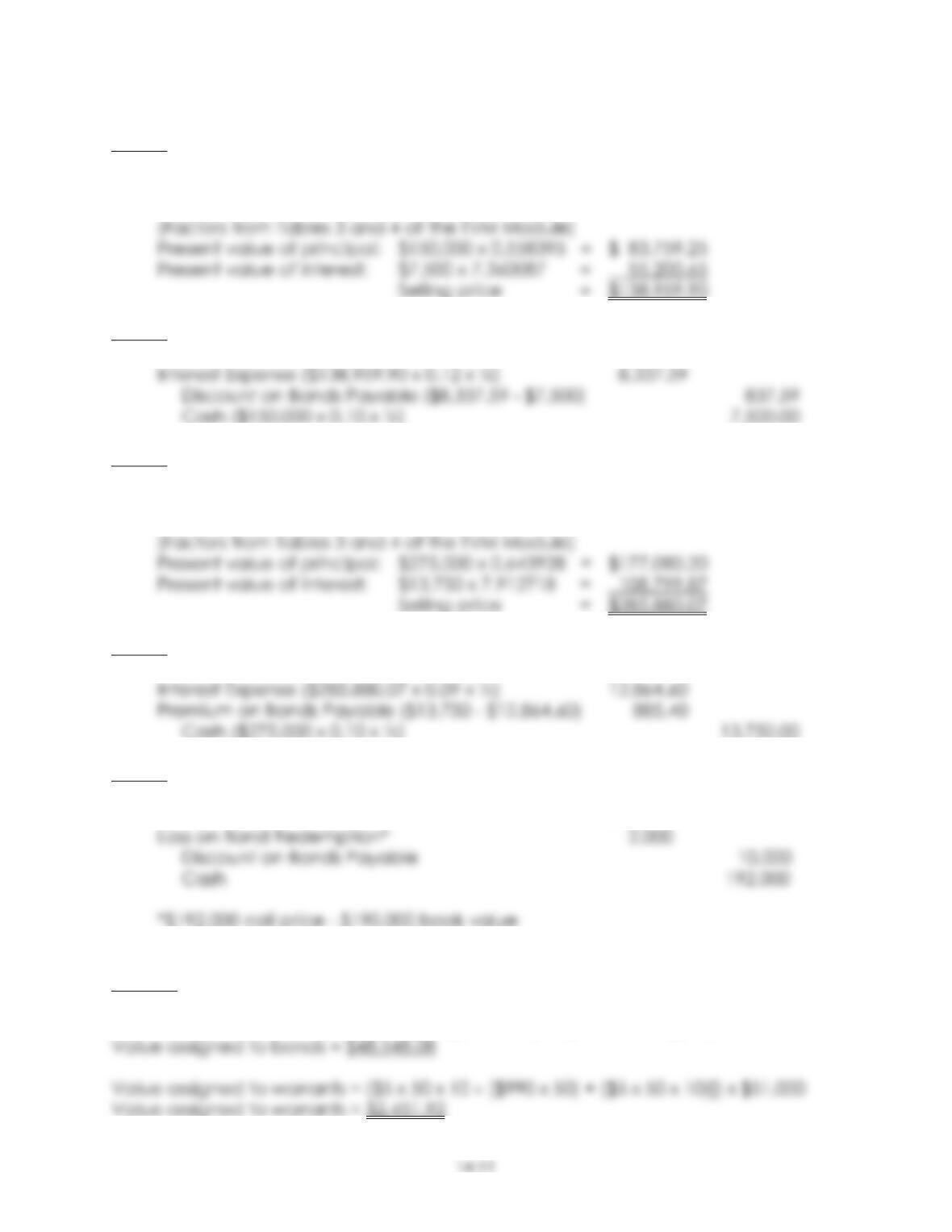
Bonds pay interest semiannually, so i = 6% (12% ÷ 2), n = 10 (5 years x 2)
RE14-6
RE14-7
Bonds pay interest semiannually, so i = 4.5% (9% ÷ 2), n = 10 (5 years x 2)
RE14-8
RE14-9
Bonds Payable 200,000
RE14-10
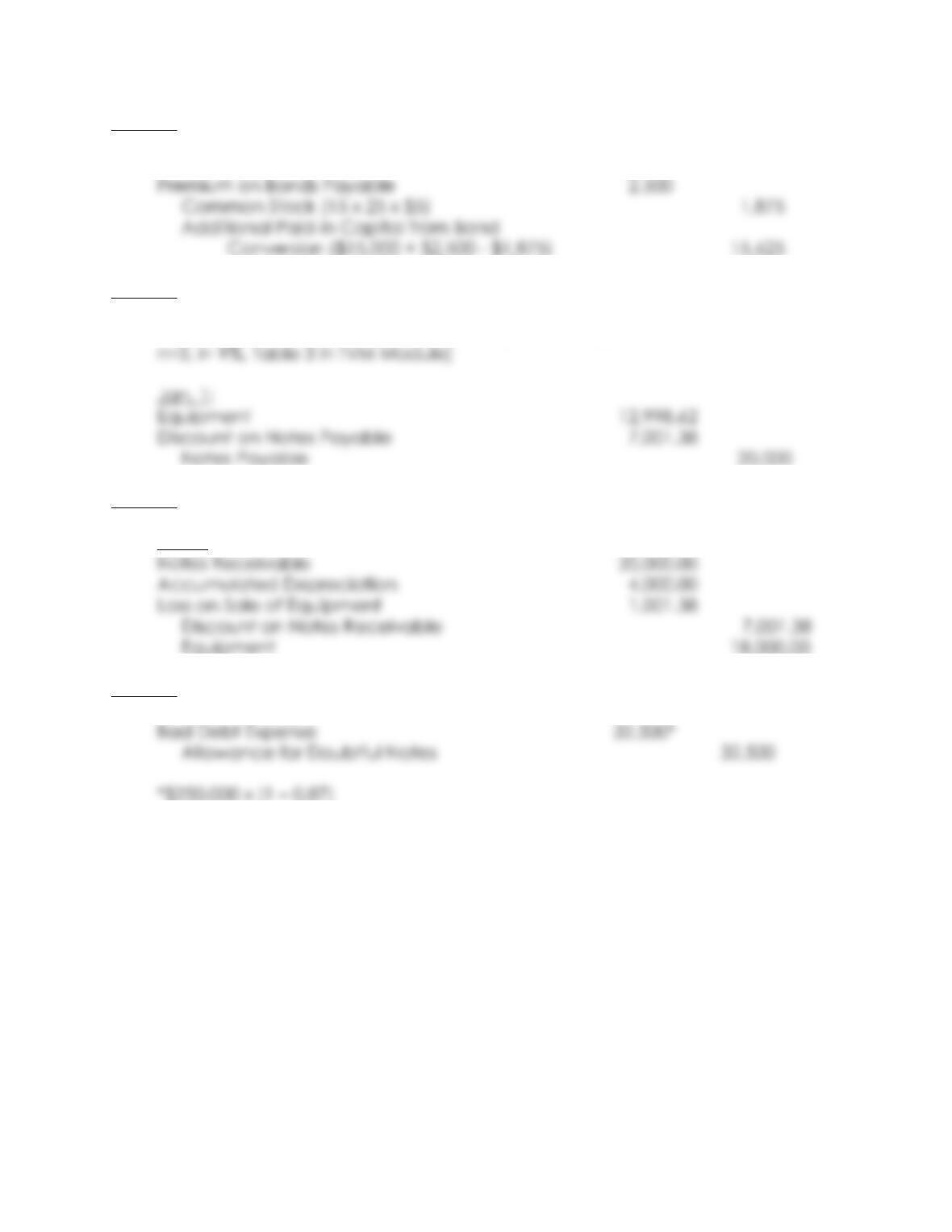
Value assigned to bonds = {$990 x 50 ÷ [$990 x 50) + ($5 x 50 x 10)]} x $51,000
14-12
RE14-11
Bonds Payable 15,000
RE14-12
The present value of the $20,000 note is $12,998.62 ($20,000 x 0.649931 factor,
RE14-13
Jan. 1:
RE14-14
14-13
SOLUTIONS TO EXERCISES
Note to Instructor: Although students may use their calculators or software to
E14-1
2010
Apr. 1 Cash 510,000
June 30 Interest Expense ($500,000 x
0.08 x 6/12)* 20,000
Cash 20,000
E14-2
2010
Apr. 30 Cash 1,063,000
14-14
E14-2 (con tin ued)
June 30 Interest Expense* 59,500
Premium on Bonds Payable [($23,000 ÷
92 months) x 2 months] 500
E14-3
2010
Jan. 1 Cash 486,000
E14-4
1. 2010
14-15
E14-4 (con tin ued)
1. (continued)
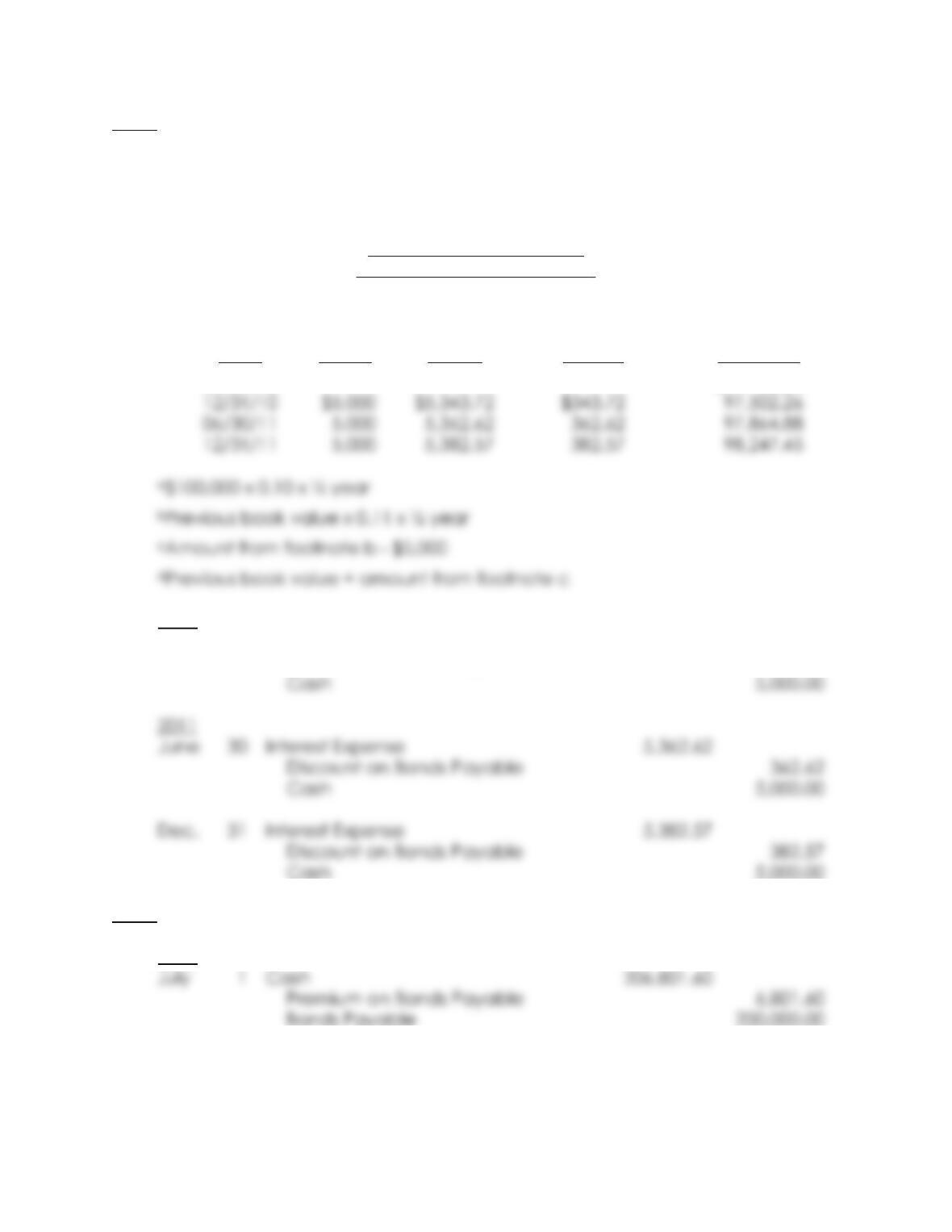
COTTON CORPORATION
Bond Interest Expense and
Discount Amortization Schedule (Partial)
Effective Interest Method
10% Bonds Sold to Yield 11%
Date
Cash
Credita
Interest
Expense
Debitb
Unamortized
Discount
Creditc
Book Value
of Bondsd
07/01/10
$97,158.54
2. 2010
Dec. 31 Interest Expense 5,343.72
Discount on Bonds Payable 343.72
E14-5
2010
14-16
E14-5 (con tin ued)
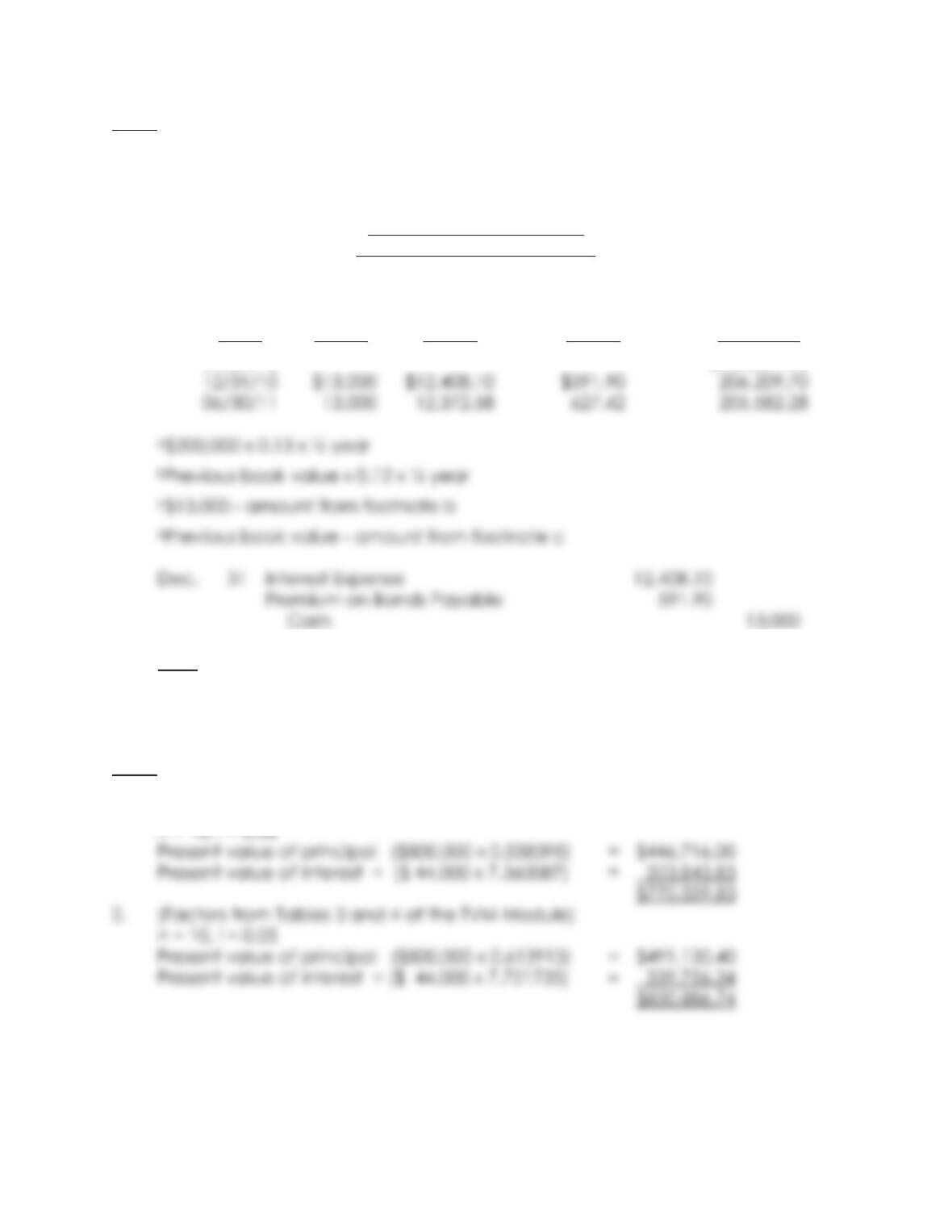
ADDISON INCORPORATED
Bond Interest Expense and
Premium Amortization Schedule (Partial)
Effective Interest Method
13% Bonds Sold to Yield 12%
Date
Cash
Credita
Interest
Expense
Debitb
Unamortized
Premium
Debitc
Book Value
of Bondsd
07/01/10
$206,801.60
2011
June 30 Interest Expense 12,372.58
Premium on Bonds Payable 627.42
Cash 13,000
E14-6
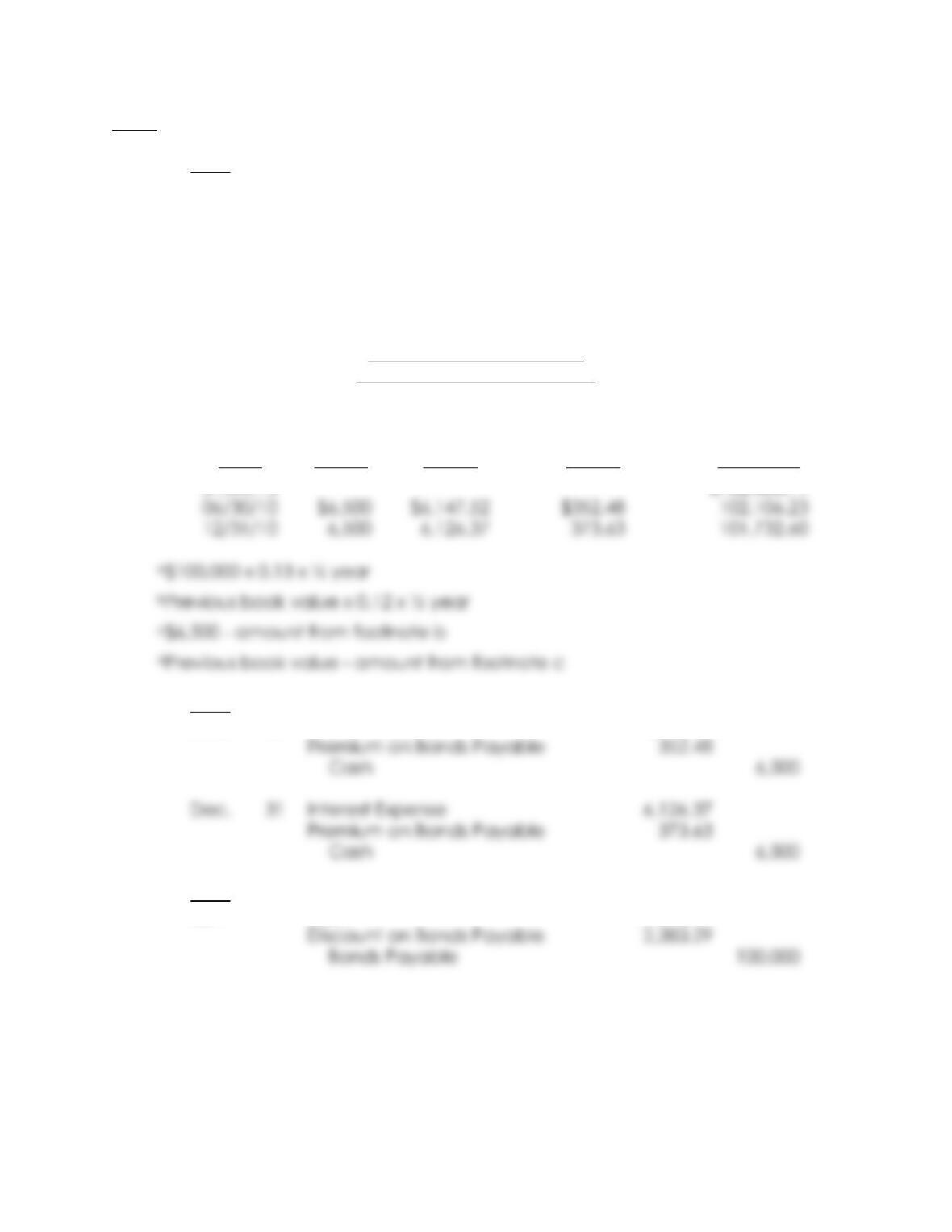
1. (Factors from Tables 3 and 4 of the TVM Module)
14-17
E14-7
1. a. 2010
Jan. 1 Cash 102,458.71
Premium on Bonds Payable 2,458.71
Bonds Payable 100,000.00
TAYLOR COMPANY
Bond Interest Expense and
Premium Amortization Schedule (Partial)
Effective Interest Method
13% Bonds Sold to Yield 12%
Date
Cash
Credita
Interest
Expense
Debitb
Unamortized
Premium
Debitc
Book Value
of Bondsd
01/01/10
$102,458.71
b. 2010
June 30 Interest Expense 6,147.52
2. a. 2010
Jan. 1 Cash 97,616.71
14-18
E14-7 (con tin ued)
2.a. (continued)
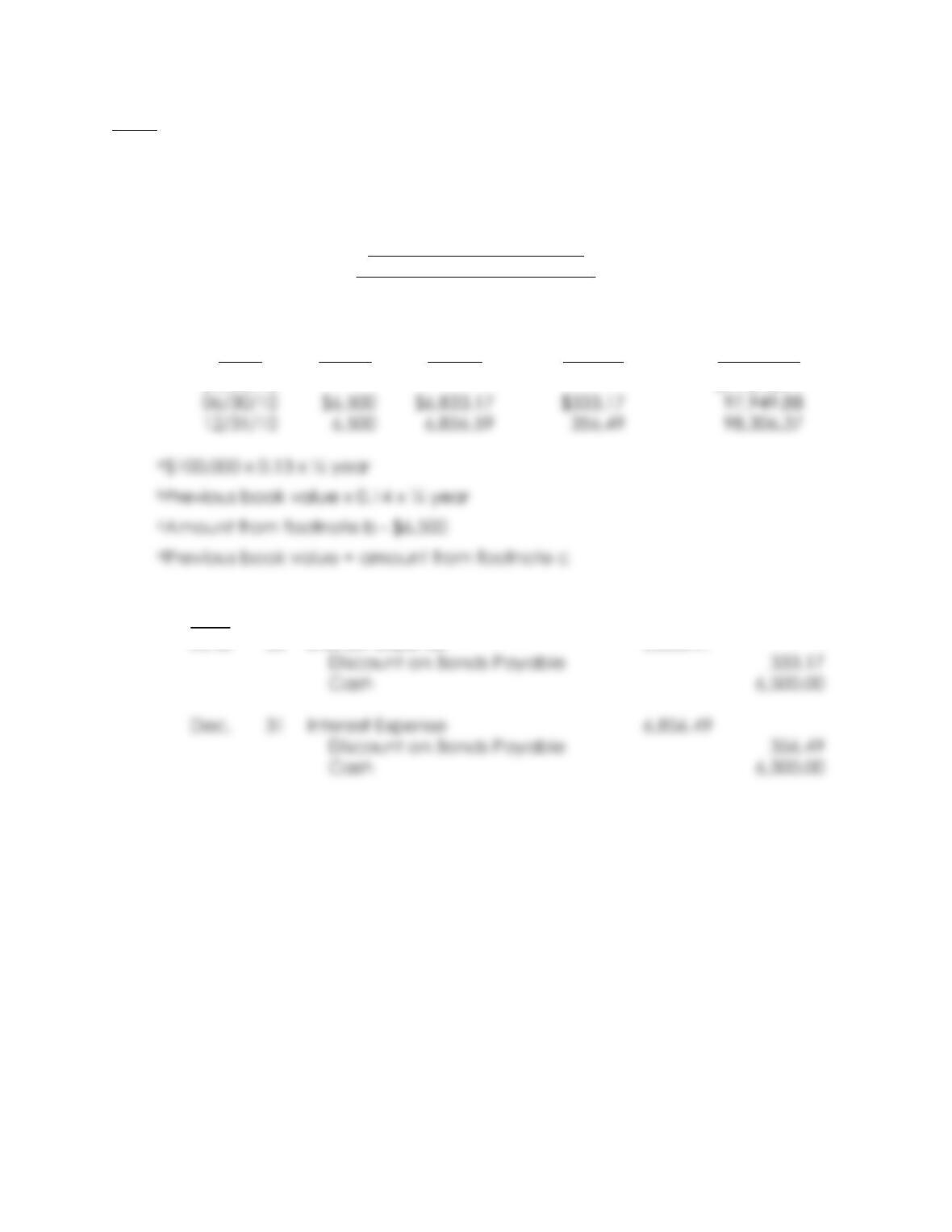
TAYLOR COMPANY
Bond Interest Expense and
Discount Amortization Schedule (Partial)
Effective Interest Method
13% Bonds Sold to Yield 14%
Date
Cash
Credita
Interest
Expense
Debitb
Unamortized
Discount
Creditc
Book Value
of Bondsd
01/01/10
$97,616.71
b. 2010
June 30 Interest Expense 6,833.17

14-19
E14-8
1. CALVERT COMPANY
Bond Premium Amortization Schedule
Straight-Line Method
Date
Cash
Credita
Unamortized
Premium
Debitb
Interest
Expense
Debitc
Book Value
of Bondsd
01/01/10
$103,545.91
2. CALVERT COMPANY
Bond Premium Amortization Schedule
Effective Interest Method
12% Bonds Sold to Yield 10%
Date
Cash
Credita
Interest
Expense
Debitb
Unamortized
Premium
Debitc
Book Value
of Bondsd
01/01/10
$103,545.91
E14-8 (continued)
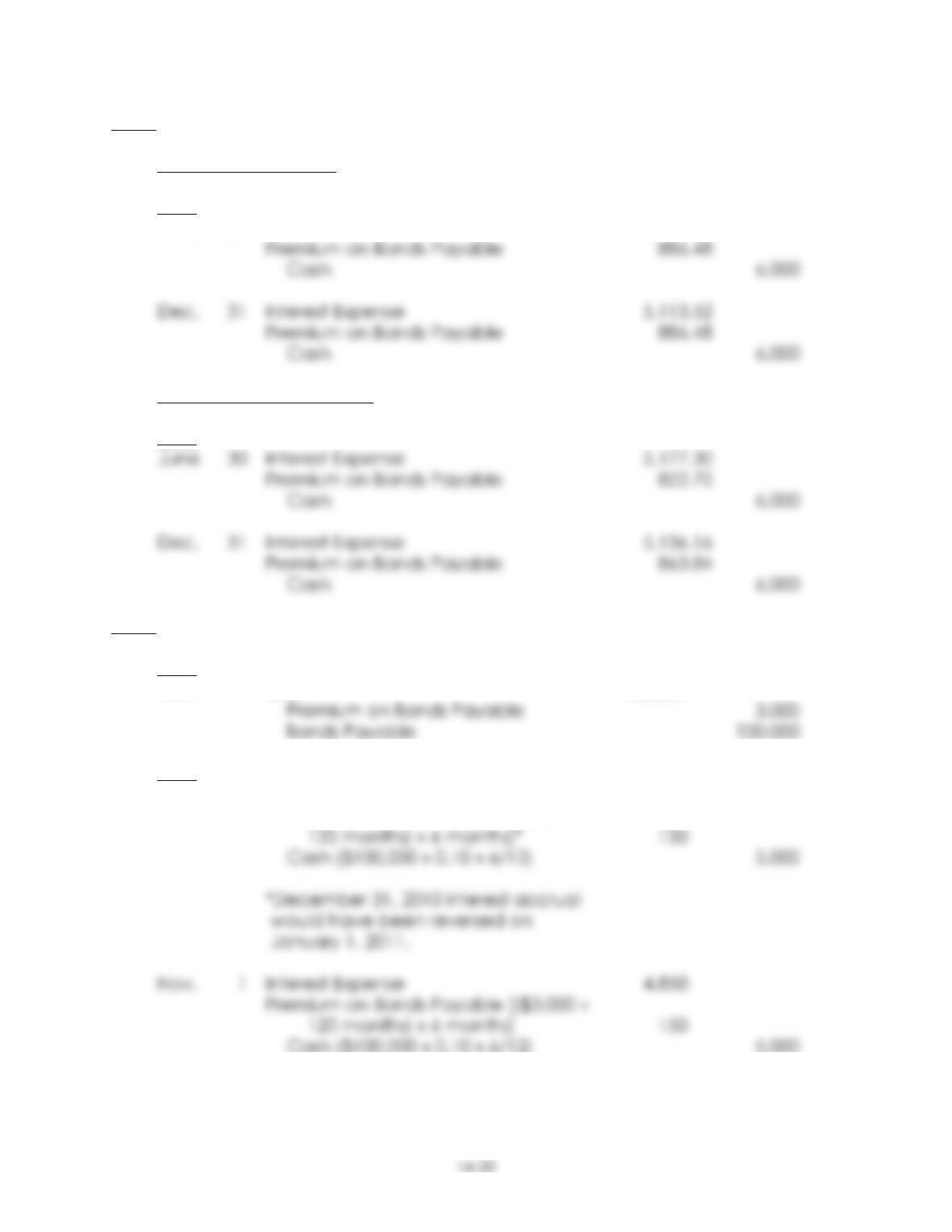
3. Straight-Line Method
2010
June 30 Interest Expense 5,113.52
Effective Interest Method
2010
E14-9
1. 2010
Nov. 1 Cash 103,000
2. 2011
May 1 Interest Expense* 4,850
Premium on Bonds Payable [($3,000 ÷