PROBLEM 14.51 (Cont.)
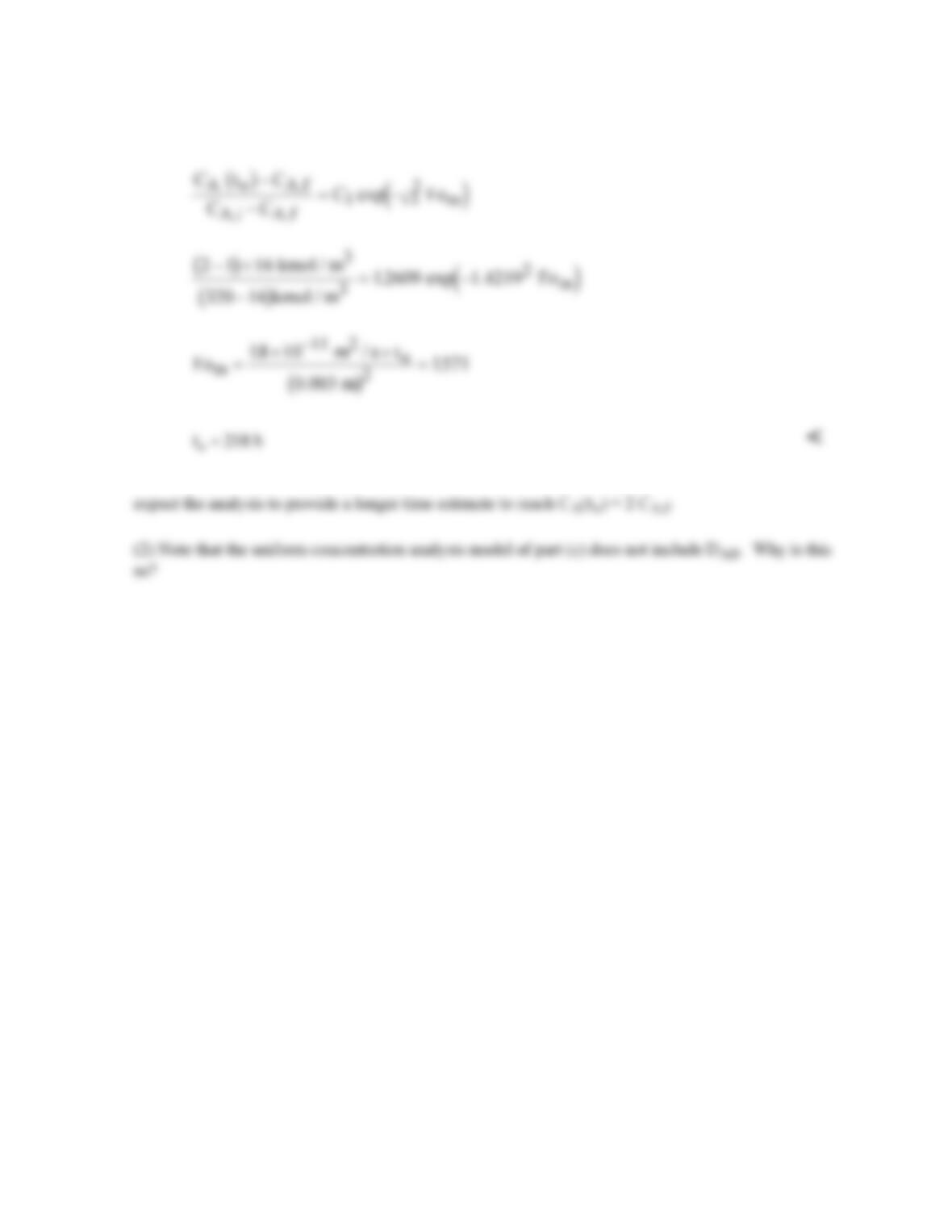
With Bim = 9.5, find ζ1 = 1.4219 rad and C1 = 1.2609 from Table 5.1, so that Eq. 5.44 becomes
COMMENTS: (1) Since Bim = 9.5, the uniform concentration assumption is not valid, and we
PROBLEM 14.52
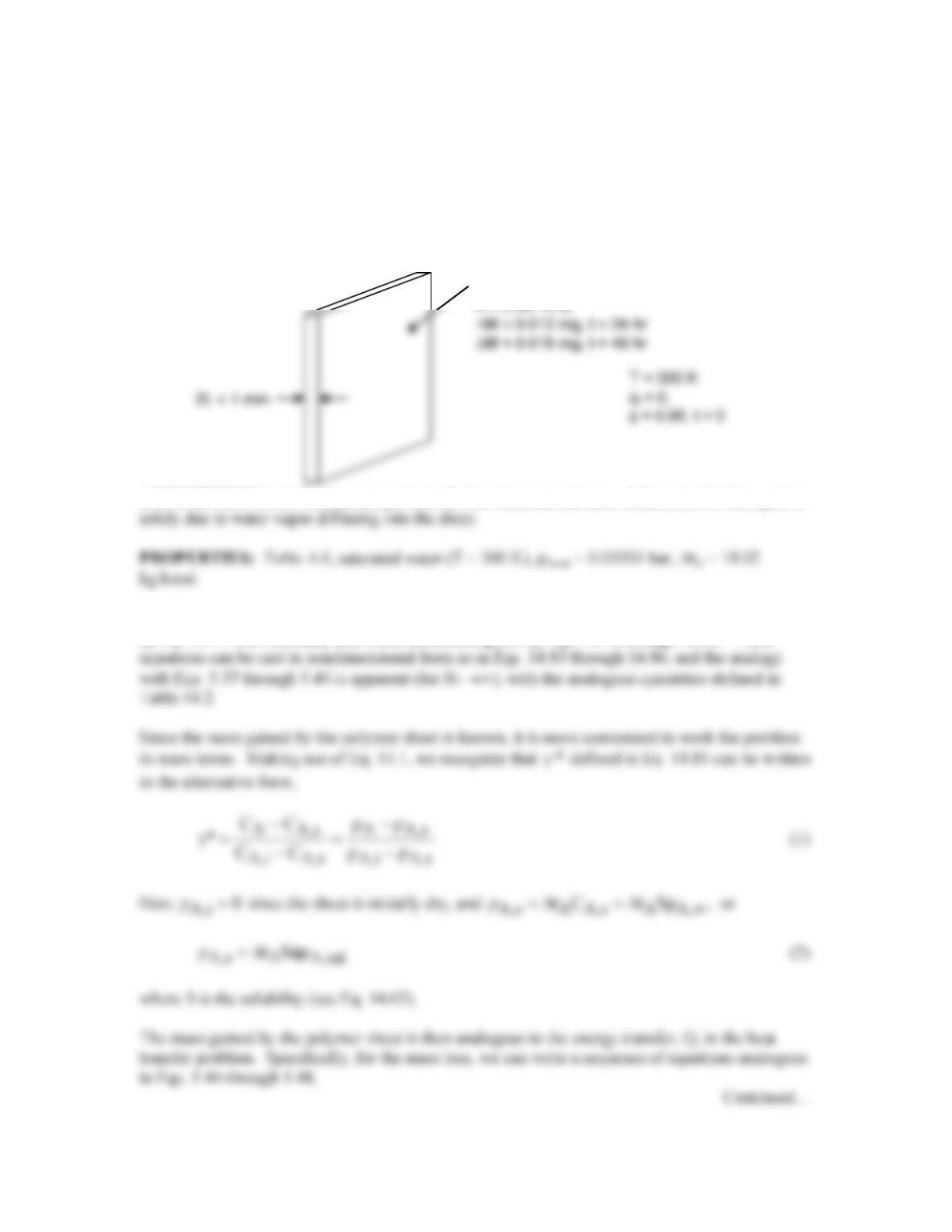
KNOWN: Dimensions of polymer sheet. Temperature and relative humidity of environment.
Increase in mass of sheet over 24 and 48 hour periods.
FIND: Solubility and mass diffusivity of water vapor in polymer, assuming mass diffusivity is
greater than 7 × 10-13 m2/s.
SCHEMATIC:
`
ASSUMPTIONS: (1) Constant properties, (2) One-dimensional mass diffusion, (3) Mass gain is
ANALYSIS: The process of diffusion of water vapor (A) in the polymer (B) sheet is governed
by Eq. 14.77 with boundary and initial conditions given by Eqs. 14.78 through 14.80. These
Polymer sheet
PROBLEM 14.52 (Cont.)
A A A A A,i
Mass loss M [M (t) M (0)] [ (x, t) ]dV=∆ =− − =− ρ −ρ
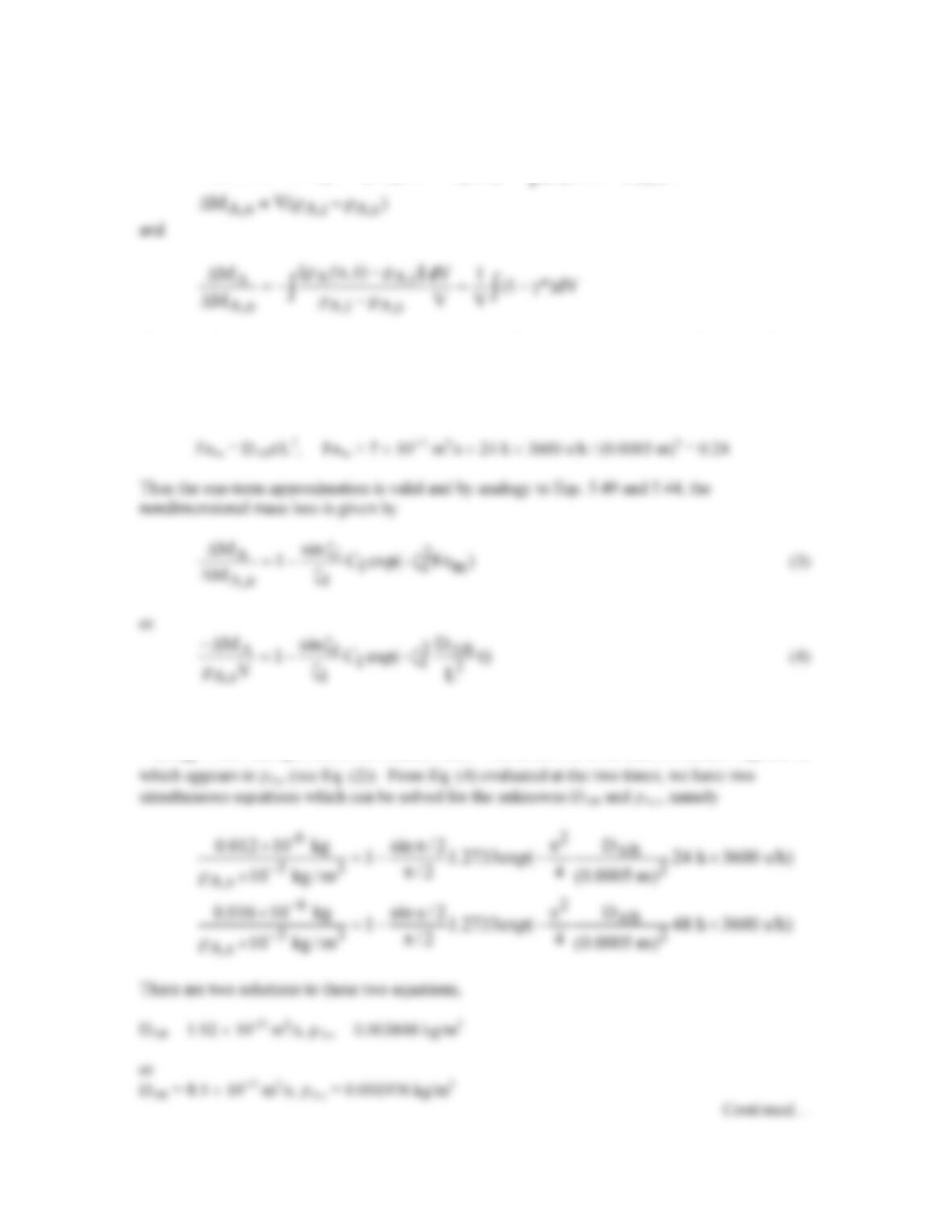
If Fom > 0.2, the solution can be approximated by the first term in the series, and the result for the
mass loss would be analogous to Eq. 5.49. To determine if the first term approximation can be
used, we estimate the mass transfer Fourier number with knowledge that the mass diffusivity is
greater than 7 × 10-13 m2/s,
From Table 5.1 for Bi →∞, we find
1
1.5707 / 2ζ= =π
and
1
C 1.2733=
. The quantity
M−∆
is the mass gain at the two stated times. The unknowns to be determined are DAB and S,
PROBLEM 14.52 (Cont.)
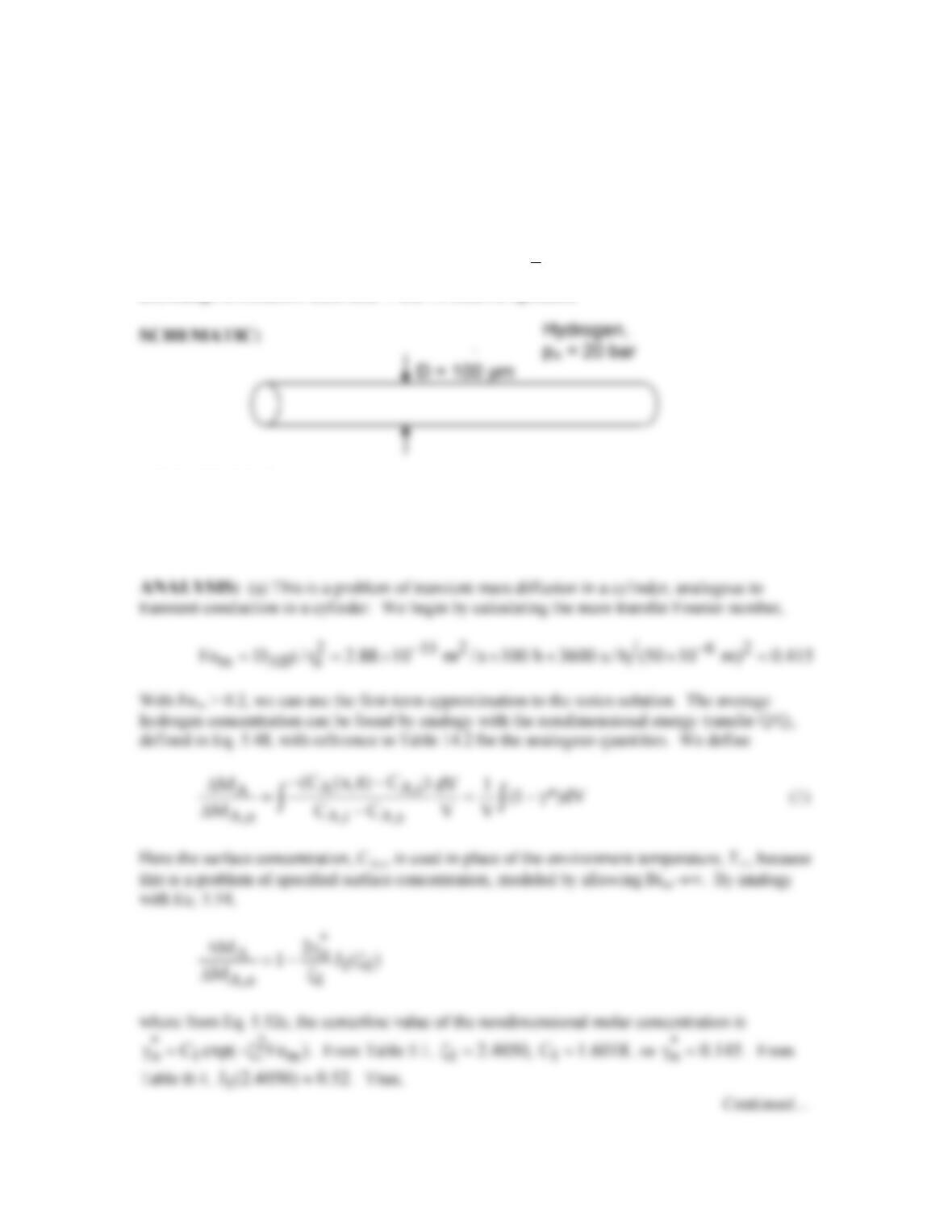
PROBLEM 14.53
KNOWN: Diameter of optical fiber sensor in a hydrogen chamber. Pressure of hydrogen
(species A) in environment. Mass diffusivity and solubility for hydrogen in glass fiber (species
B).
FIND: (a) Average hydrogen concentration in fiber after 100 hours of operation. Change in
refractive index, given that ∆n = (1.6 × 10⁻³ m3/kmol) ×
C
. (b) Average hydrogen concentration
and change in refractive index after 1 and 10 hours of operation.
ASSUMPTIONS: (1) Constant properties, (2) One-dimensional mass diffusion.
PROPERTIES: Hydrogen in vitreous silica fiber (given): DAB = 2.88 × 10⁻¹⁵ m2/s, S = 4.15 ×
10-3 kmol/m3⋅bar.

PROBLEM 14.53 (Cont.)
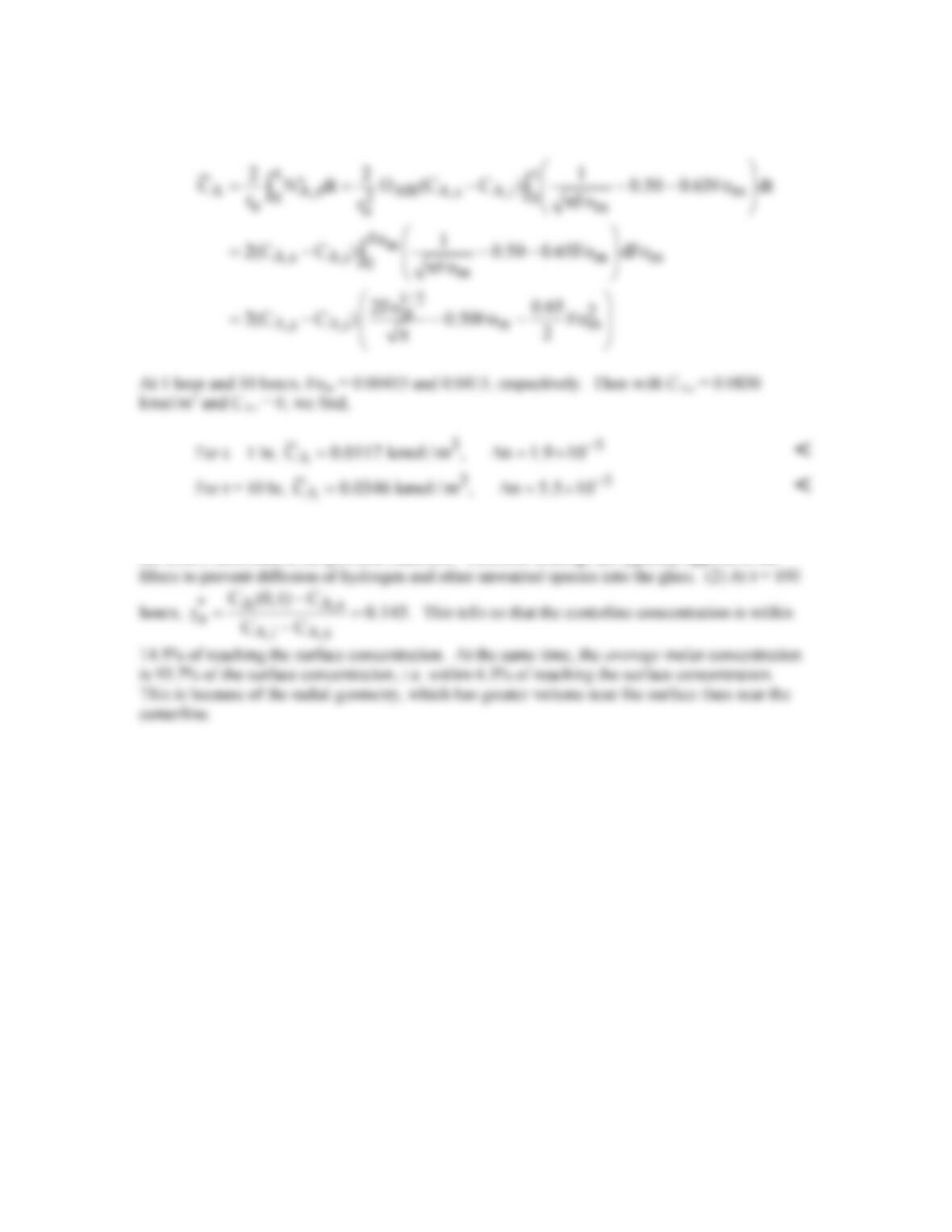
A
A,o
M 2 0.145
1 0.52 0.937
M 2.4050
∆×
=− ×=
∆
(b) For the shorter times, the Fourier number is no longer larger than 0.2, and we must use a
different approach. We could use the exact infinite series solution, but it is easier to use the
solutions provided in Table 5.2a, which are appropriate for uniform surface concentration. For an
infinite cylinder, with Lc = ro,
Continued…
PROBLEM 14.53 (Cont.)
COMMENTS: (1) Hydrogen diffusion into glass optical fibers is highly undesirable because of
the effects described in the problem statement. Hermetic coatings are typically applied to the
PROBLEM 14.54
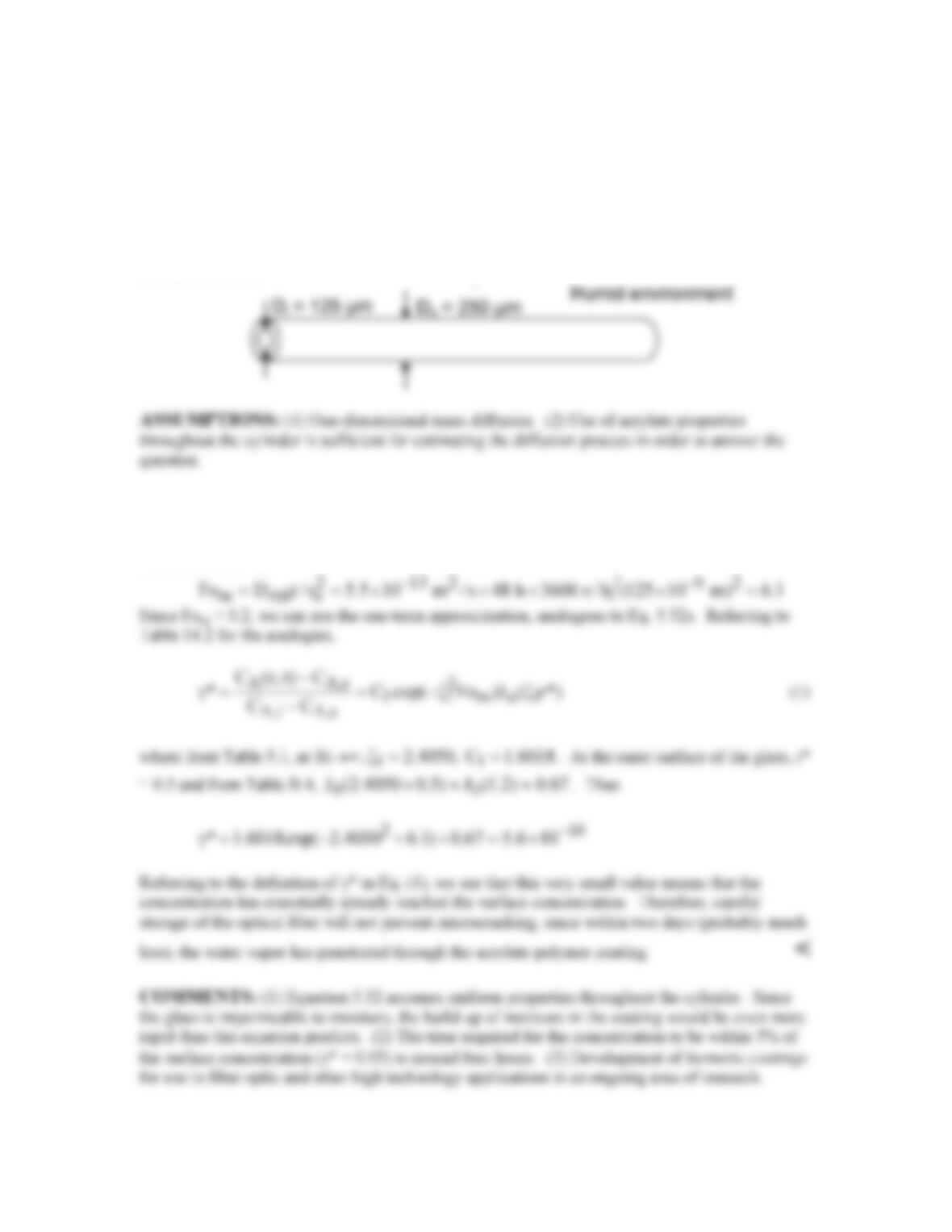
KNOWN: Diameters of glass optical fiber and acrylate polymer coating. Mass diffusivity of
water vapor in the acrylate.
FIND: Whether microcracking would occur within several hot and humid days.
SCHEMATIC:
PROPERTIES: Water vapor in acrylate polymer (given): DAB = 5.5 × 10⁻¹³ m2/s.
ANALYSIS: We arbitrarily begin by considering a two-day period. Then the mass transfer
Fourier number is,
PROBLEM 14.55
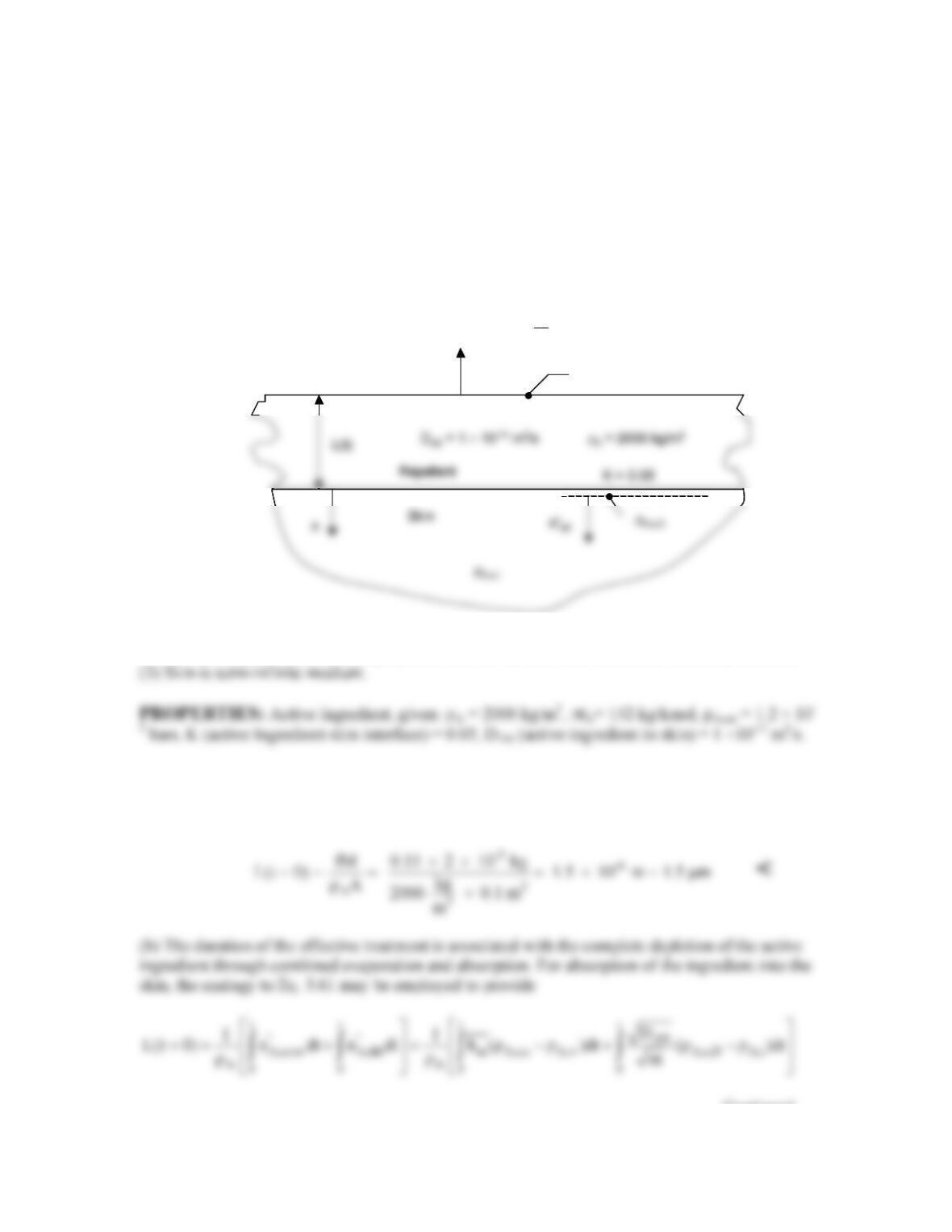
KNOWN: Mass of insect repellent applied to known area of skin. Convective mass transfer
coefficient, partition coefficient at the ingredient – skin interface, mass diffusivity of the
ingredient in the skin.
FIND: (a) Initial thickness of the active ingredient, (b) Duration of effective treatment, (c)
Duration of effective treatment with use of reformulated repellent with a very small partition
coefficient.
SCHEMATIC:
ASSUMPTIONS: (1) Constant properties and steady-state conditions, (2) Stationary medium.
ANALYSIS:
(a) For an active ingredient volume fraction of f = 0.15, the initial thickness of the active
ingredient is
Continued…
n”
conv
ρ
A,s,c
ρ
A,∞
h
m
= 5 ×10
-3
m/s
n”
conv
ρ
A,s,c
ρ
A,∞
n”
conv
ρ
A,s,c
ρ
A,∞
n”
conv
ρ
A,s,c
ρ
A,∞
h
m
= 5 ×10
-3
m/s
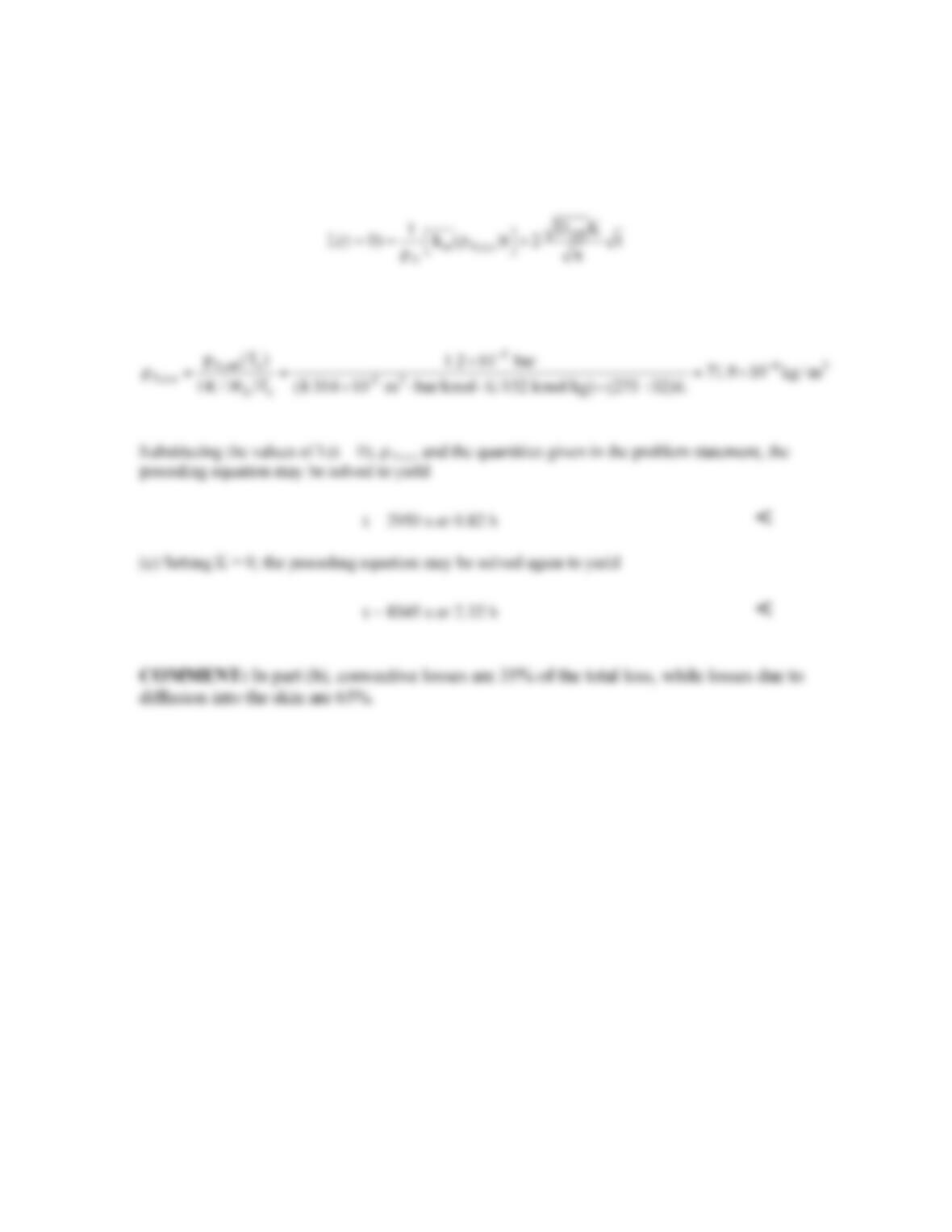
PROBLEM 14.55 (Cont.)
Noting that ρA,∞ = ρA,i = 0 and ρA,s,D = KρA, the integrations may be carried out to yield
The surface concentration of the active ingredient is
PROBLEM 14.56
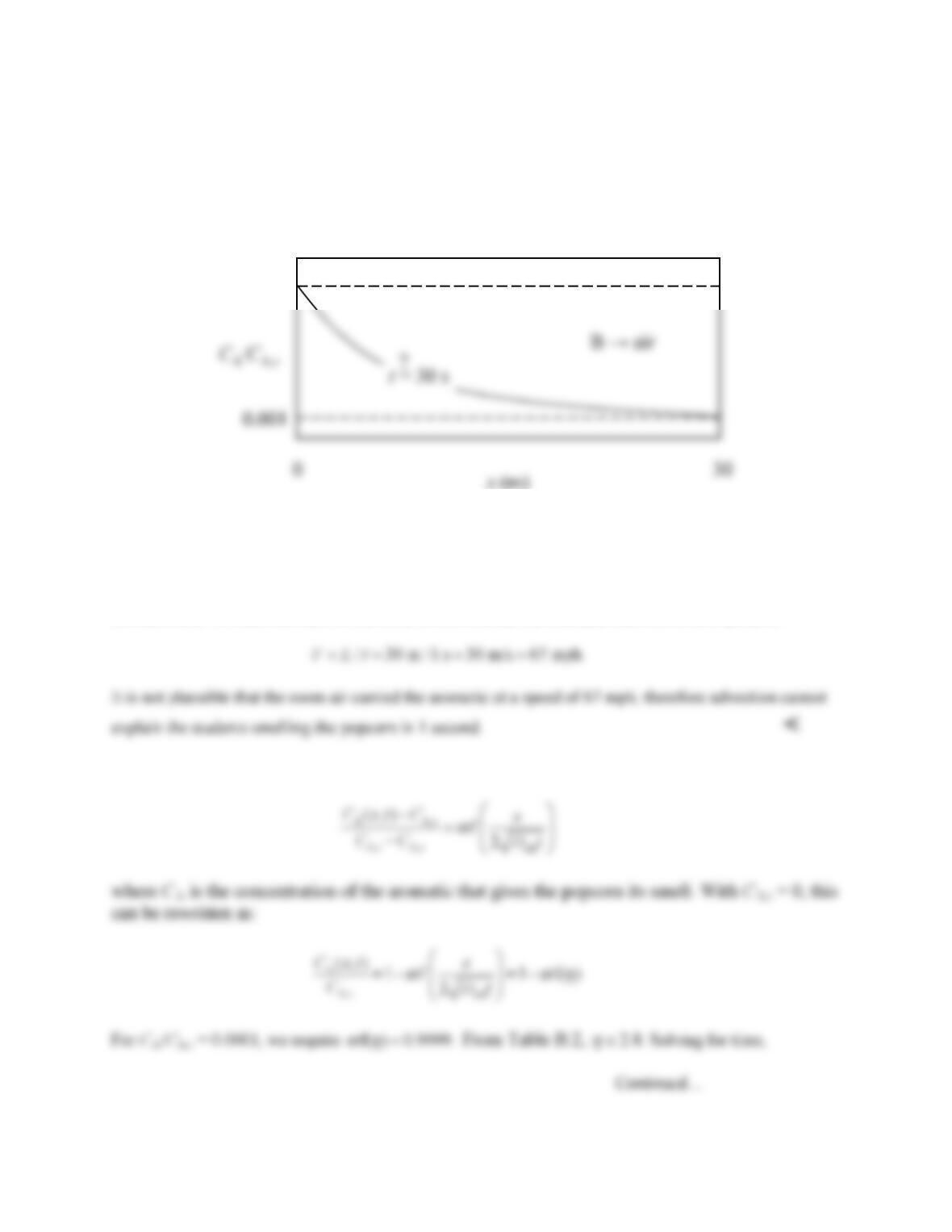
KNOWN: Distance from bag of hot popcorn to students. Time for students to smell popcorn is one
second. Trace amount of aromatic needed for students to smell popcorn.
FIND: Whether the aromatic could have reached the students by advection in one second. Estimate of
time needed for students to smell popcorn using Fick’s law.
SCHEMATIC:
1
ASSUMPTIONS: (1) Diffusion in the room can be treated as one-dimensional diffusion in a semi-
infinite medium.
PROPERTIES: Table A-8, typical value for diffusion of gas in air, DAB = 0.4 × 10⁻⁴ m2/s.
ANALYSIS: To reach the back of the room in one second, the aromatic must travel at a speed of:
For diffusion based on Fick’s law, we can use the mass transfer analogy to Eq. 5.60:
PROBLEM 14.56 (Cont.)
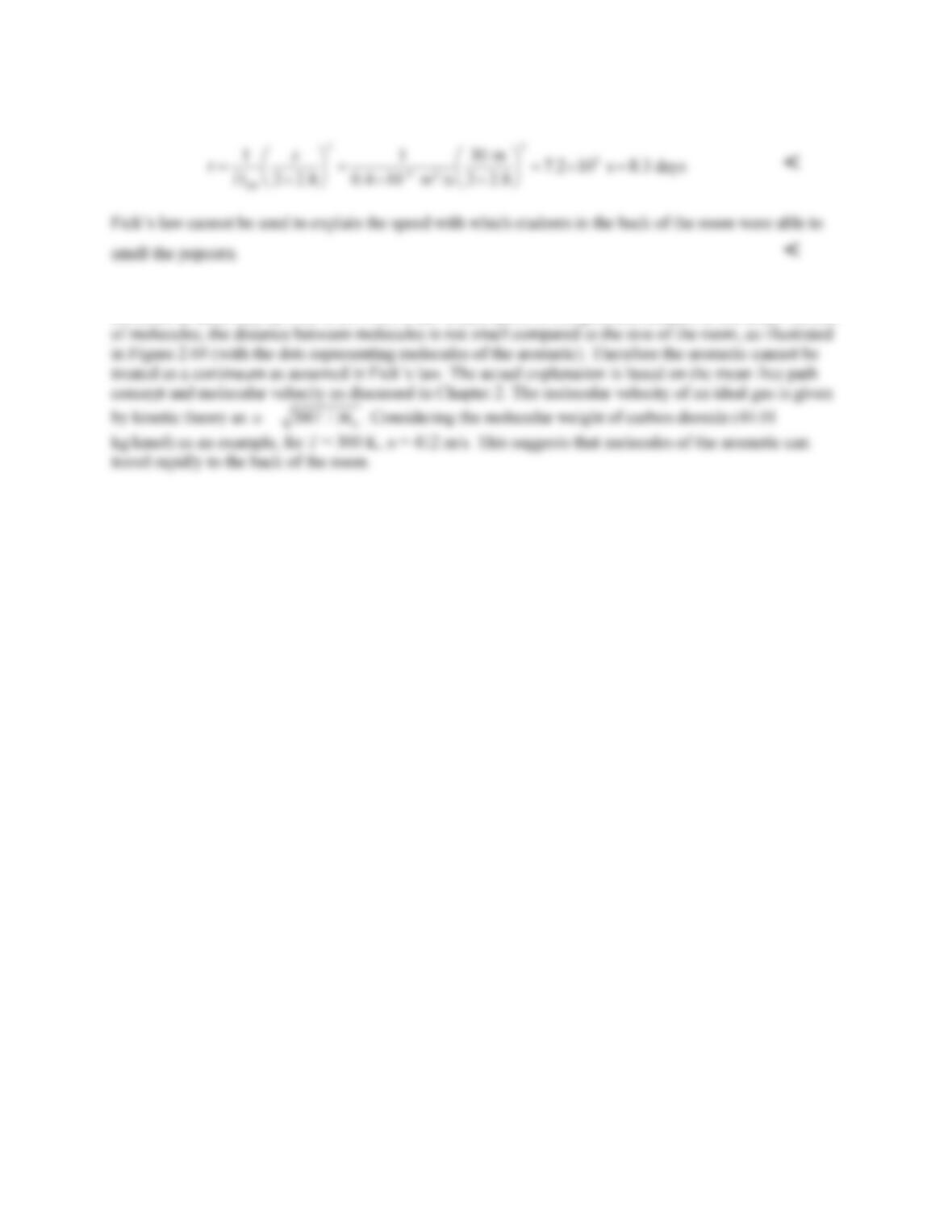
COMMENTS: The transport of the aromatics must be occurring by a process other than advection or
diffusion as described by Fick’s law. Fick’s law breaks down in this problem because of the small number