PROBLEM 14.31
KNOWN: Conditions of the exhaust gas passing over a catalytic surface for the removal of NO.
FIND: (a) Mole fraction of NO at the catalytic surface, (b) NO removal rate.
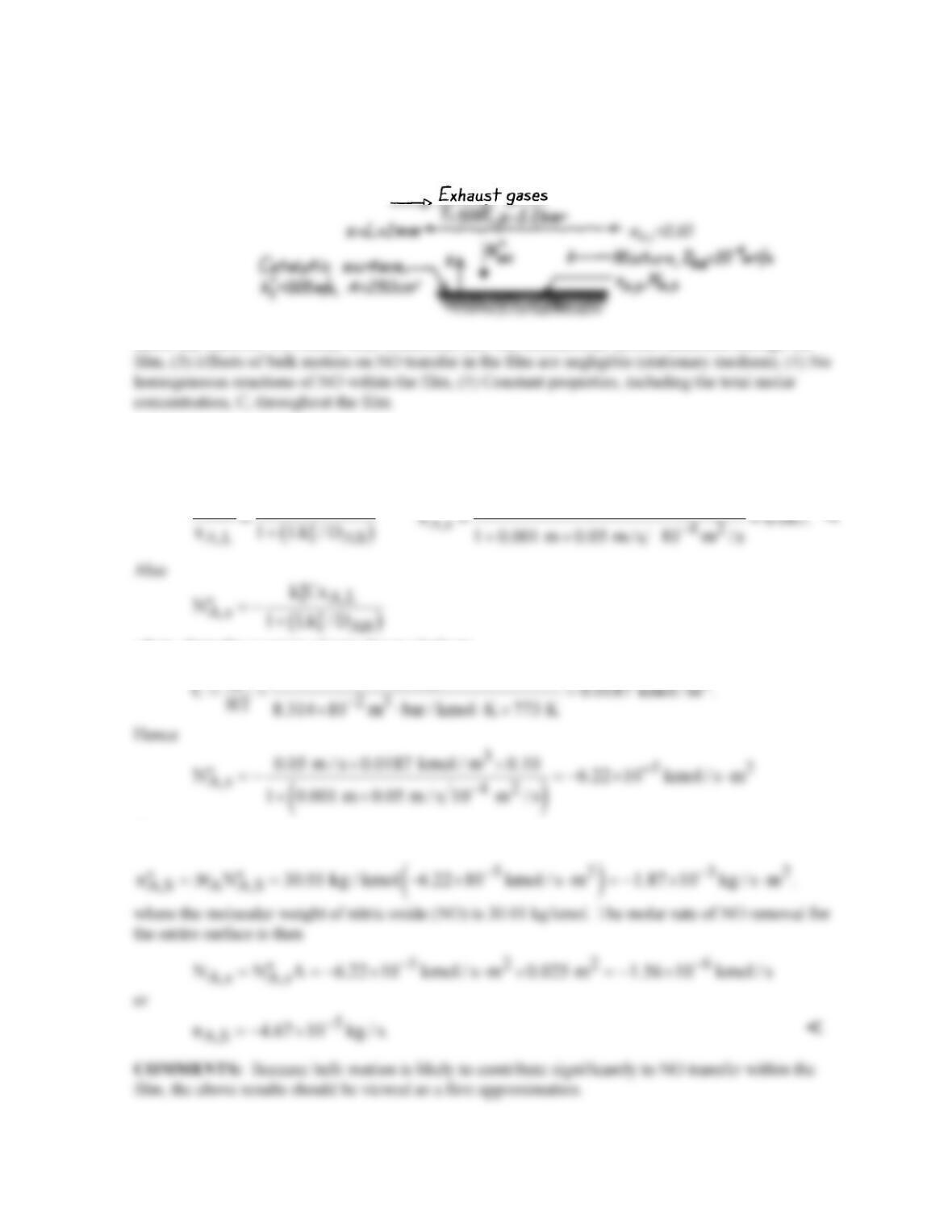
SCHEMATIC:
ASSUMPTIONS: (1) Steady-state conditions, (2) One-dimensional species diffusion through the
ANALYSIS: Subject to the above assumptions, the transfer of species A (NO) is governed by
diffusion in a stationary medium, and the desired results are obtained from Eqs. 14.69 and 14.70.
Hence
A,s A,s 42
x1 0.10
where, from the equation of state for an ideal gas,
3
p 1.2 bar
or
PROBLEM 14.32
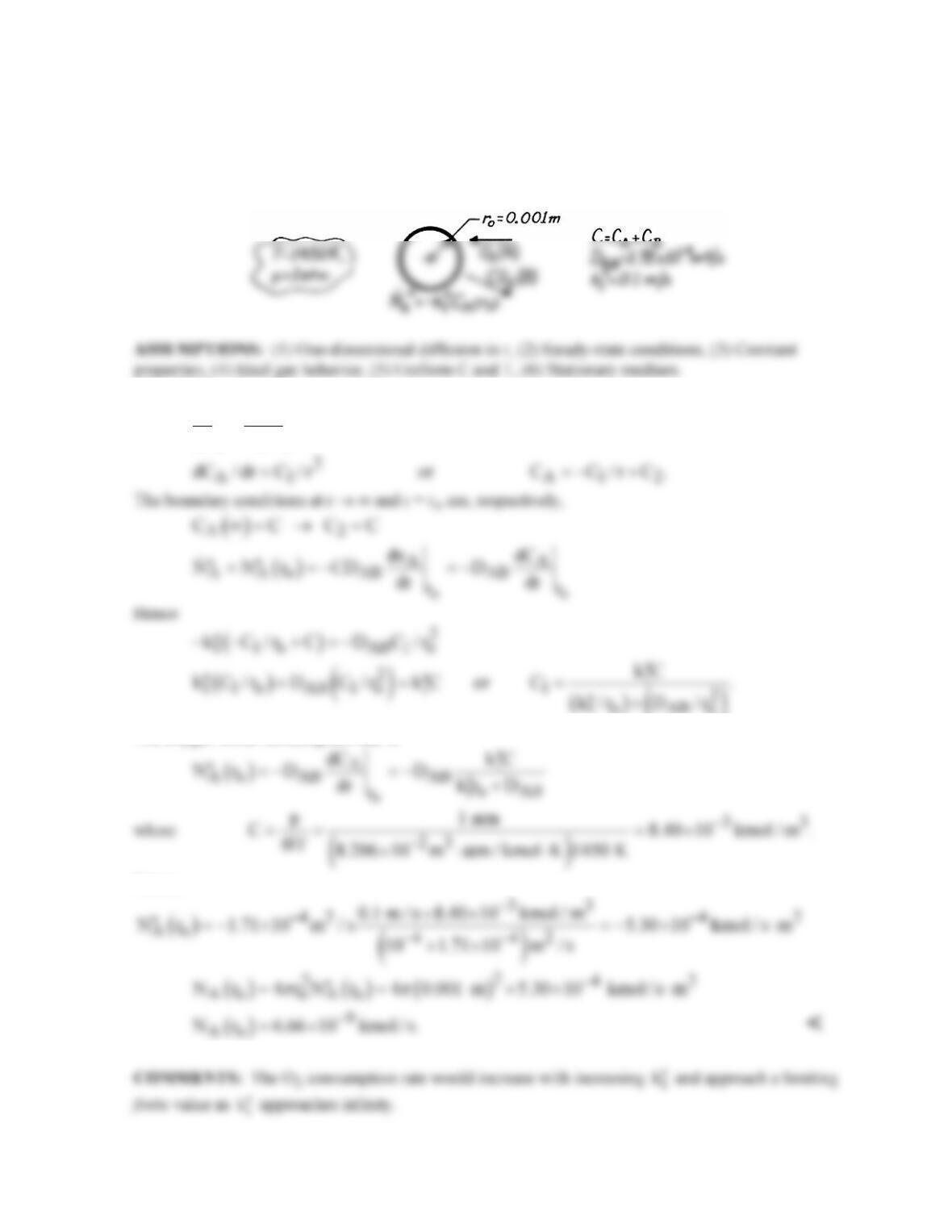
KNOWN: Radius of coal pellets burning in oxygen atmosphere of prescribed pressure and
temperature.
FIND: Oxygen molar consumption rate.
SCHEMATIC:
ANALYSIS: From Equation 14.57,
2A
d dC
r0
dr dr
=
()
The oxygen molar consumption rate is
Hence,
PROBLEM 14.33
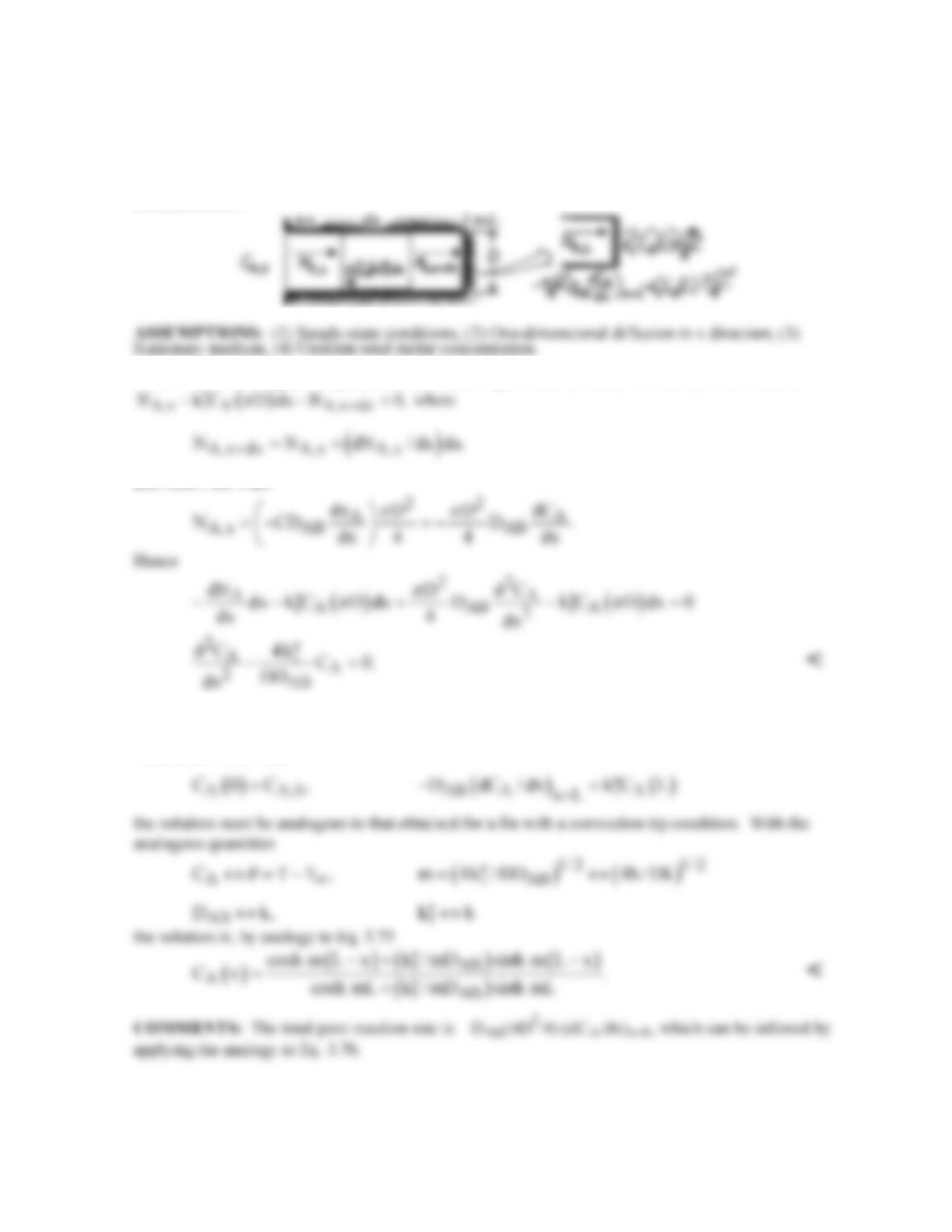
KNOWN: Pore geometry in a catalytic reactor. Concentration of reacting species at pore opening
and order of catalytic reaction.
FIND: (a) Differential equation which determines concentration of reacting species, (b) Distribution
of reacting species concentration along the pore.
SCHEMATIC:
ANALYSIS: (a) Apply the species conservation requirement to the differential control volume,
and from Fick’s law
(b) A solution to the above equation is readily obtained by recognizing that it is of exactly the same
form as the energy equation for an extended surface of uniform cross section. Hence for boundary
conditions of the form
PROBLEM 14.34
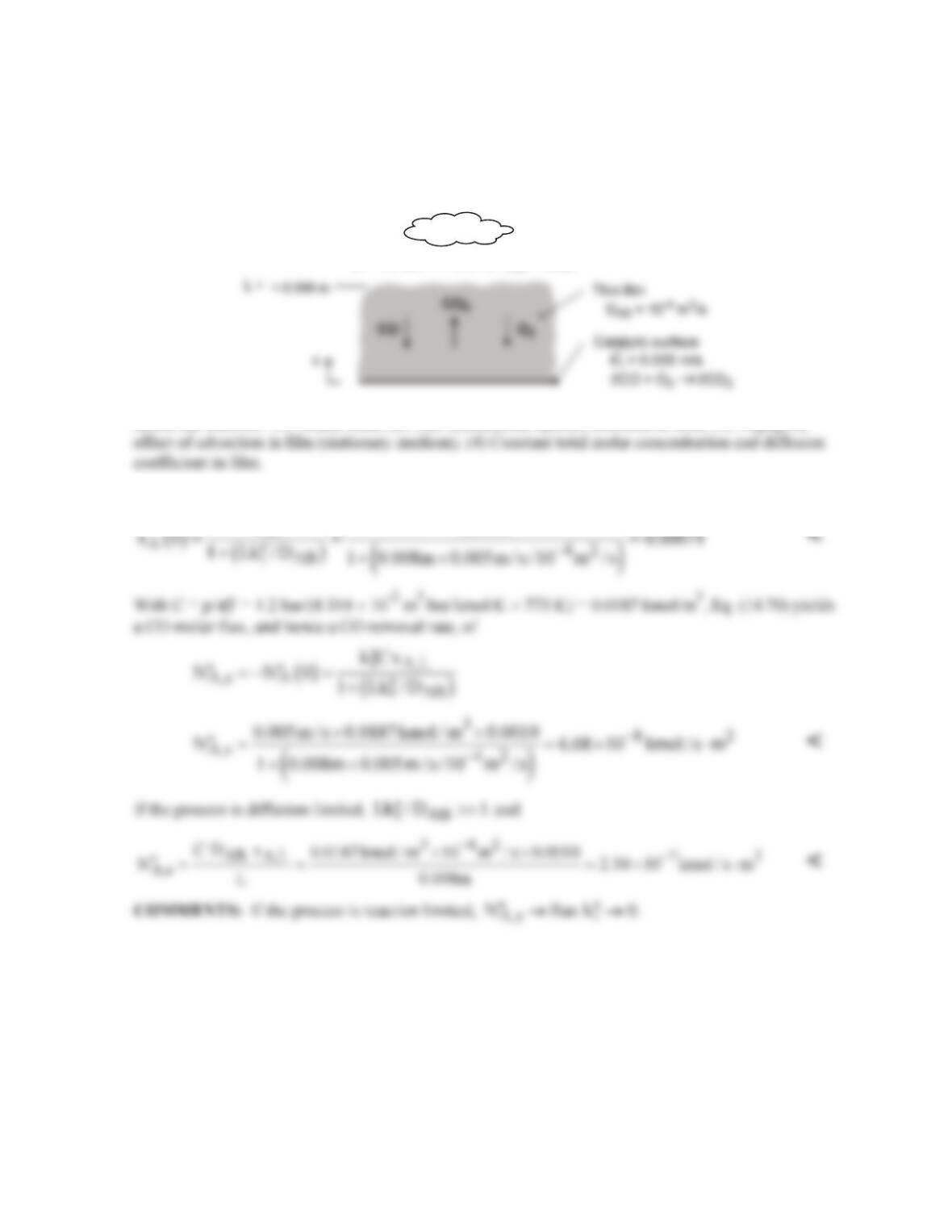
KNOWN: Pressure, temperature and mole fraction of CO in auto exhaust. Diffusion coefficient for
CO in gas mixture. Film thickness and reaction rate coefficient for catalytic surface.
FIND: Molar concentration of CO at catalytic surface, CO removal rate per unit area, and removal
rate (per unit area) if the process is diffusion limited.
SCHEMATIC:
ASSUMPTIONS: (1) Steady-state, (2) One-dimensional species diffusion in film, (3) Negligible
ANALYSIS: From Eq. (14.69) the surface molar concentration is
A,L
x0.0010
p = 1.2 bar, T = 500 C, x = 0.0012
oA,L
Exhaust gas
= 0.001
PROBLEM 14.35
KNOWN: Mass flow rate of gas containing palladium (species A), which flows through a tube
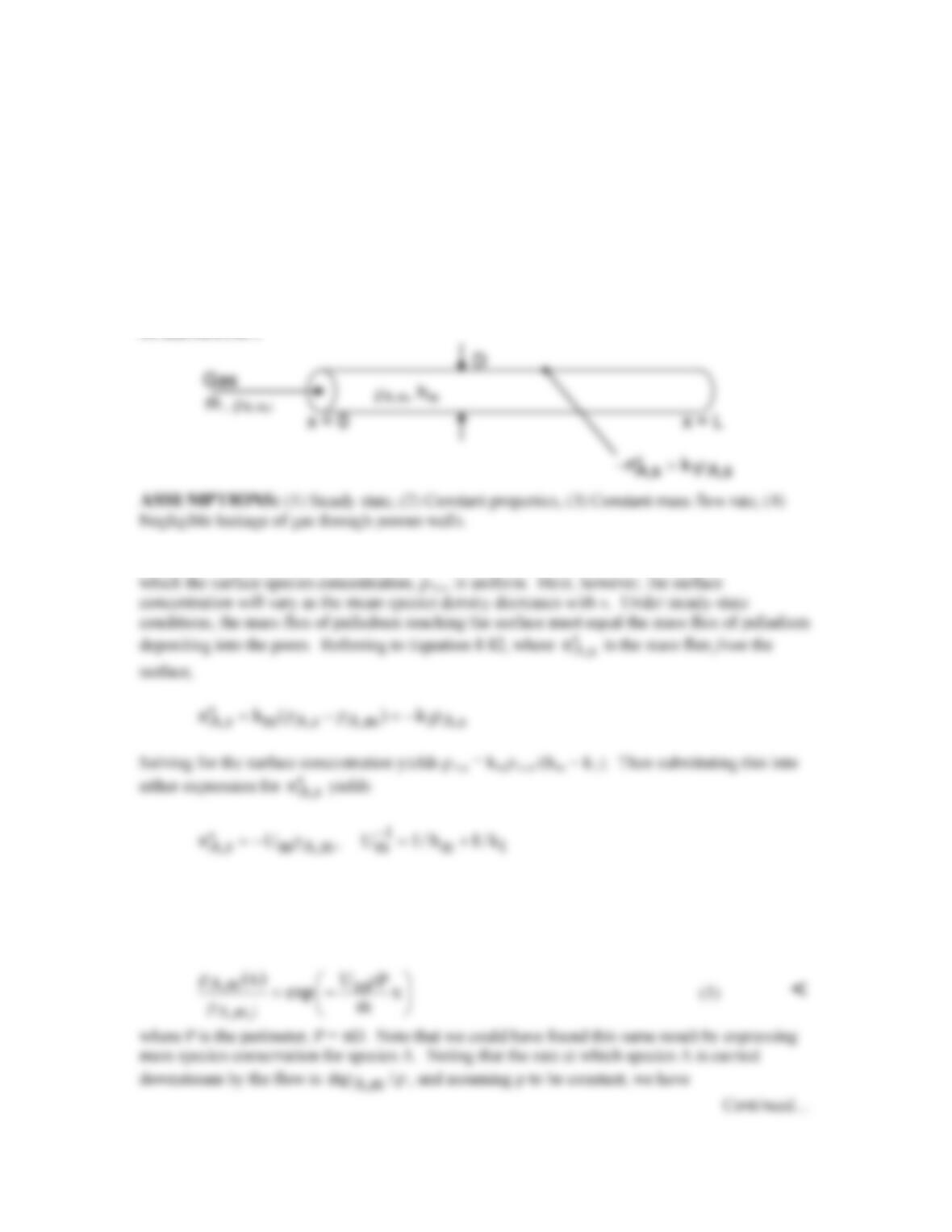
and deposits into pores of tube wall. Inlet mass concentration of palladium. Mass transfer
coefficient between gas and tube surface. Deposition rate is proportional to mass concentration
of palladium at tube surface.
FIND: (a) Expression for variation of mean species density of palladium with x. Expression for
local deposition rate for tube of diameter D. (b) Ratio of deposition rates at x = L and x = 0.
SCHEMATIC:
ANALYSIS: (a) Section 8.9 develops the variation of mean species density, rA,m, for the case in
Comparing this result with Equation 8.82, we see that they are analogous if we replace
m
h
with
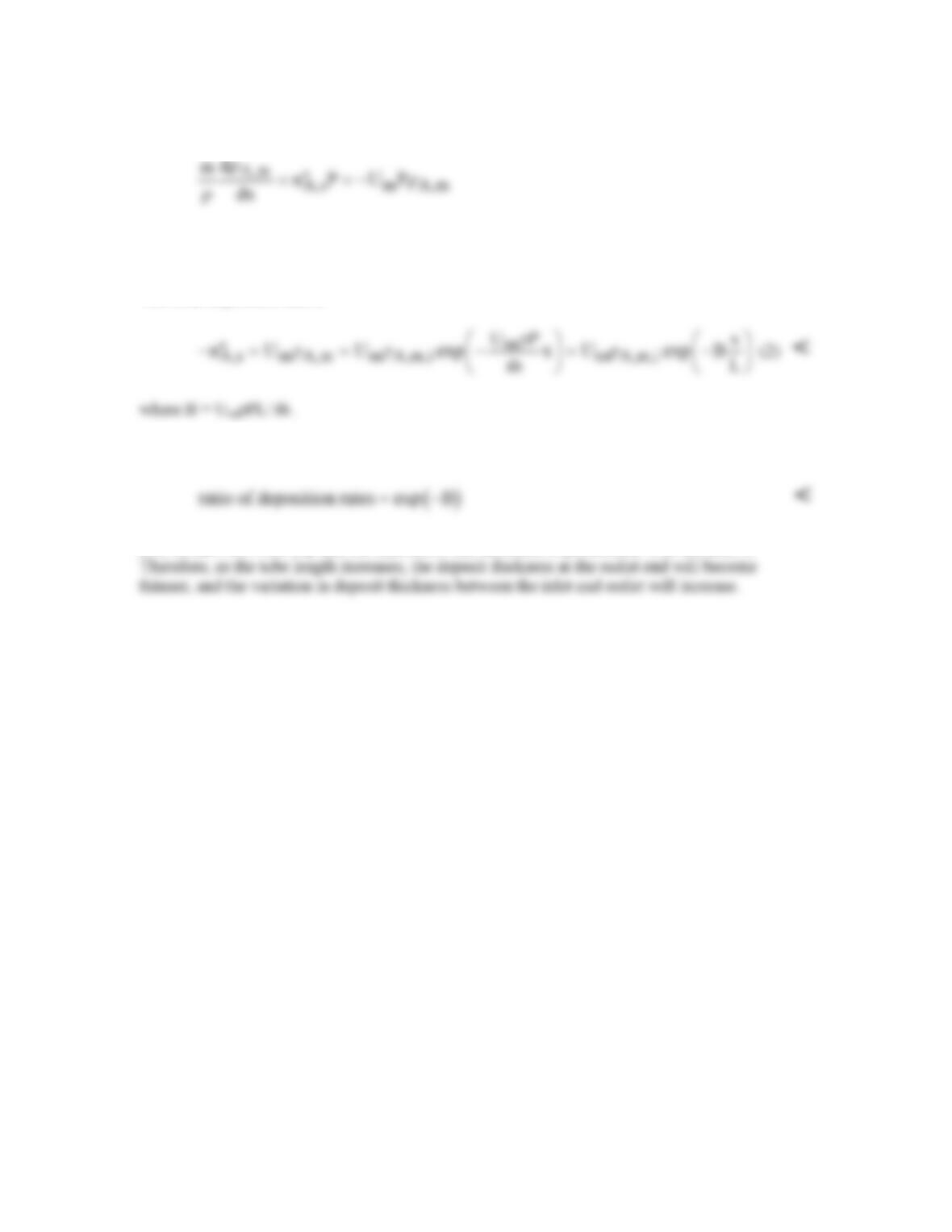
Um and rA,s with 0. Applying the same analogy to Equation 8.86, the distribution of the mean
species density is
PROBLEM 14.35 (Cont.)
Integrating with respect to x and applying the inlet condition yields the same result as Equation
(1).
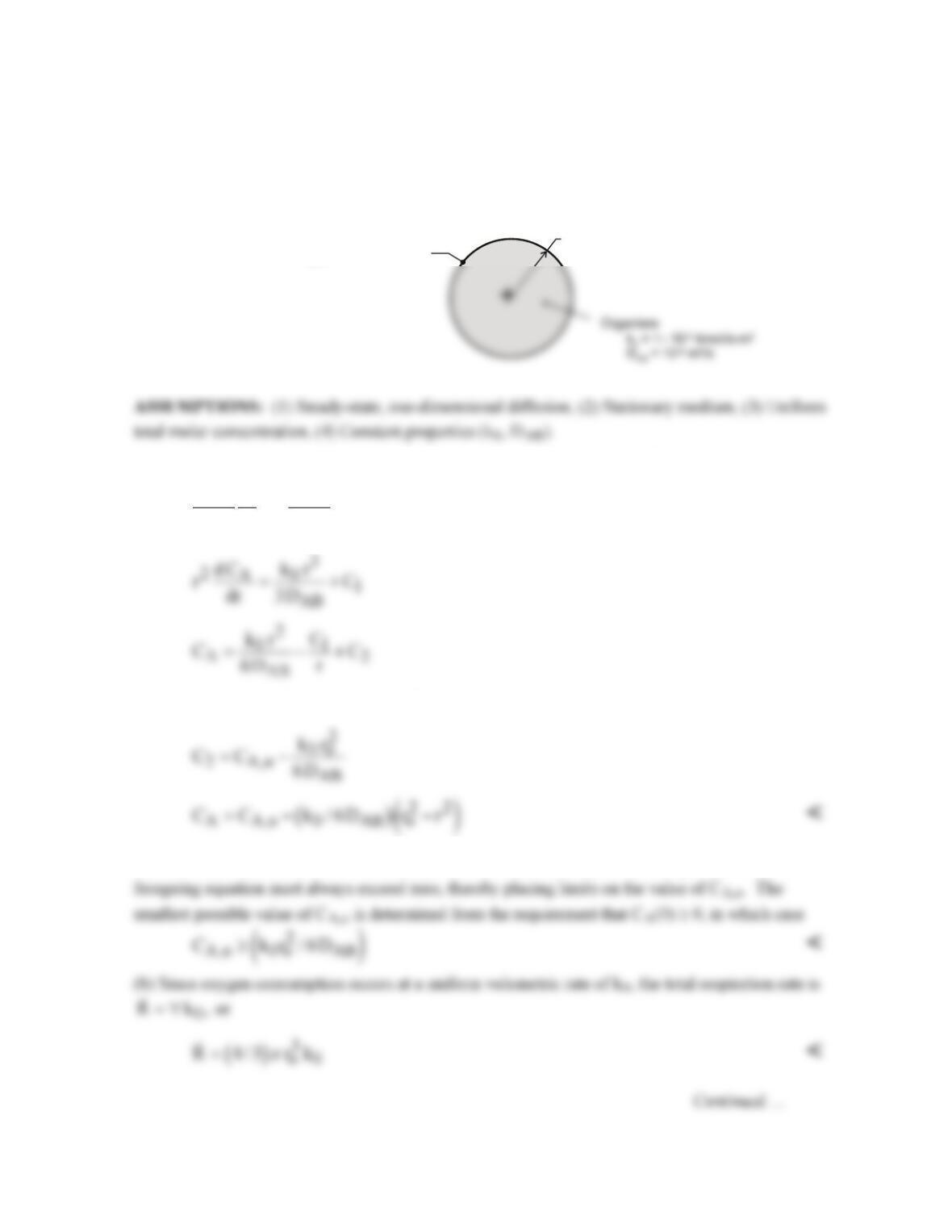
The local deposition rate is
(b) The ratio of deposition rates at x = L and x = 0 is
COMMENT: From Eq. (2), the deposition rate decreases exponentially with distance x.
PROBLEM 14.36
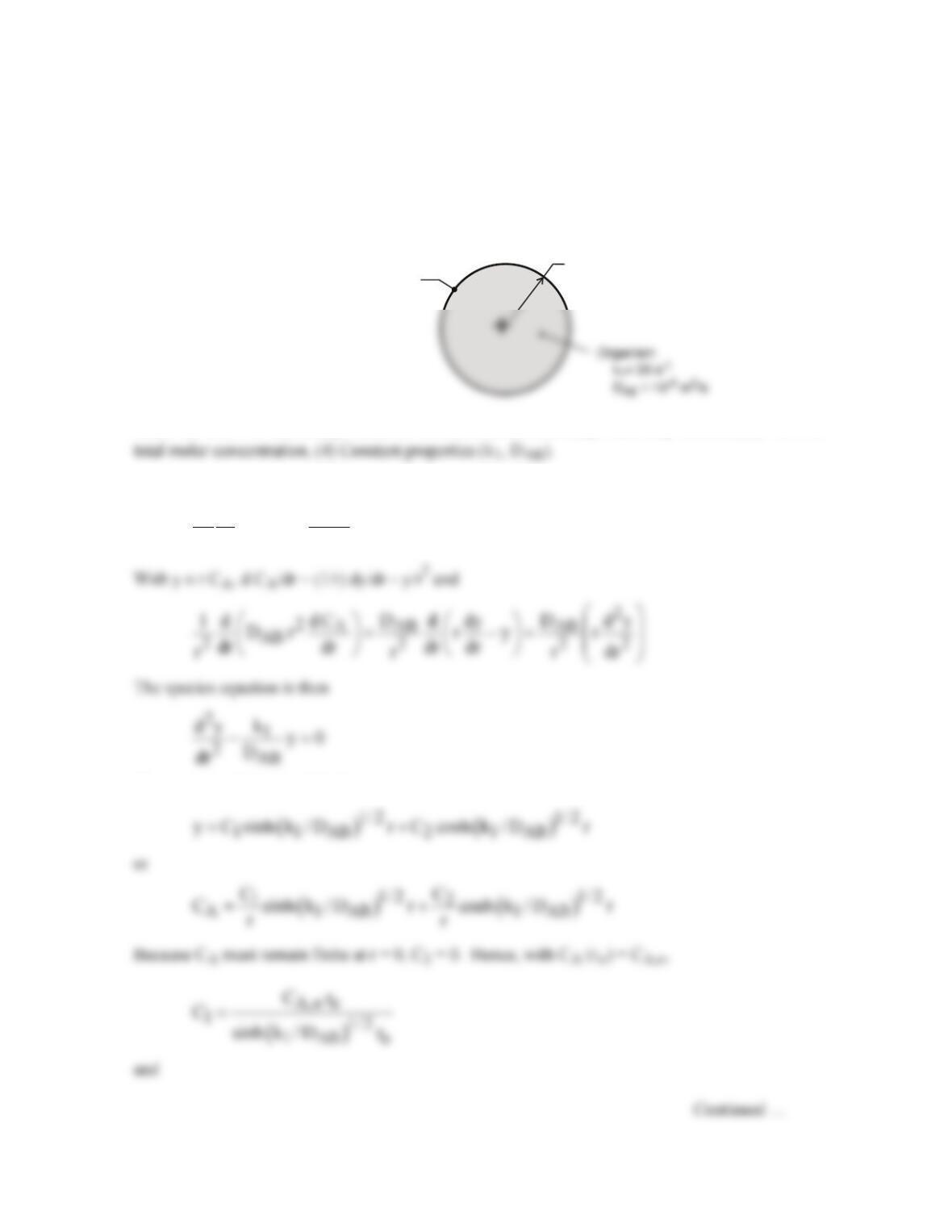
KNOWN: Radius of a spherical organism and molar concentration of oxygen at surface. Diffusion
and reaction rate coefficients.
FIND: (a) Radial distribution of O2 concentration, (b) Rate of O2 consumption, (c) Molar
concentration at r = 0.
SCHEMATIC:
ANALYSIS: (a) For the prescribed conditions and assumptions, Eq. (14.50) reduces to
2
AB A 0
2
D d dC
r k0
dr dr
r
−=
With the requirement that CA(r) remain finite at r = 0, C1 = 0. With CA(ro) = CA,o
Because CA cannot be less than zero at any location within the organism, the right-hand side of the
r = 10 m
o-4
C
10 m
Ao -5 3
(r ) =
C = 5x kmol/
A,o
r
o
= 1.2×10
-4
m
PROBLEM 14.36 (Cont.)
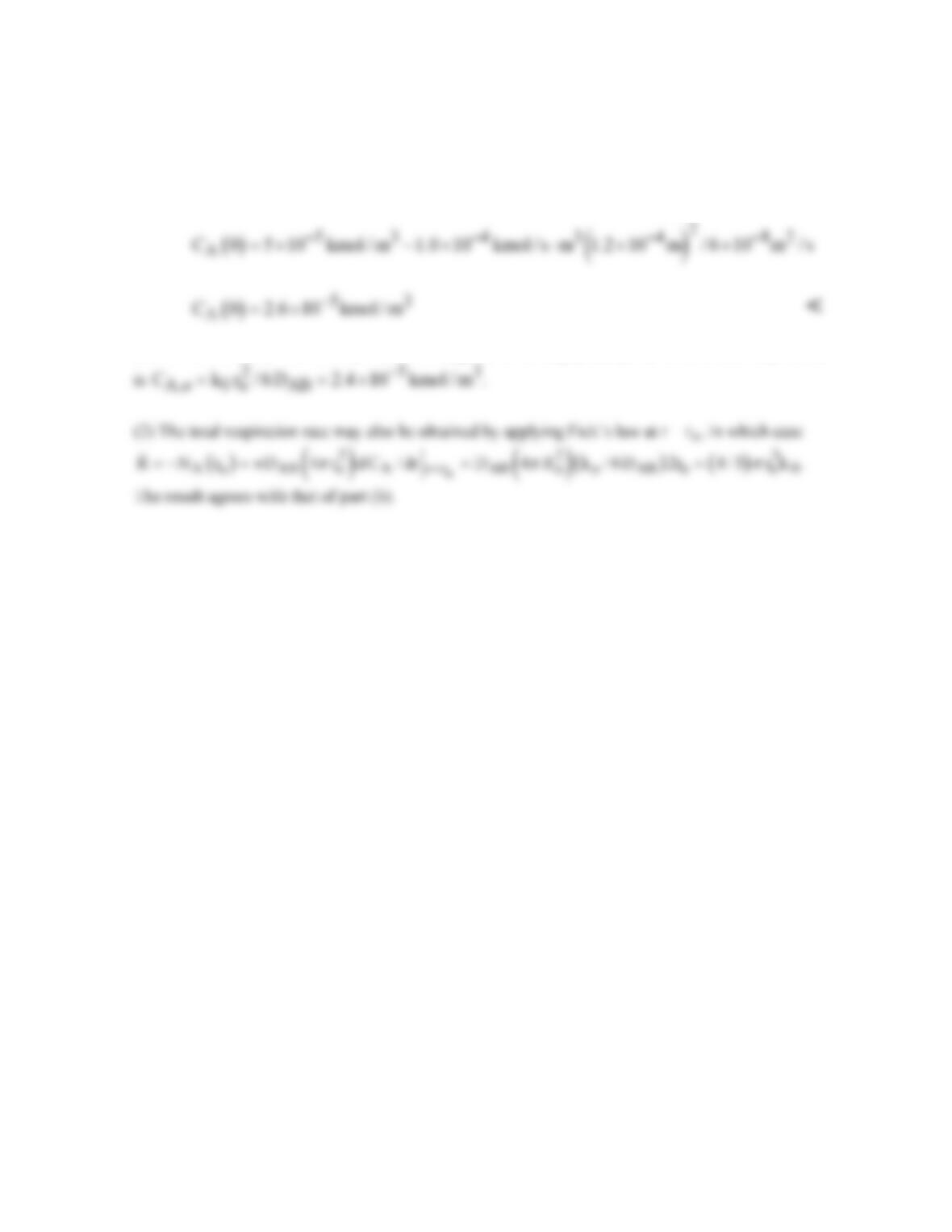
(c) With r = 0,
( )
2
A A,o 0 o AB
C 0 C k r /6D= −
COMMENTS: (1) The minimum value of CA,o for which a physically realistic solution is possible
PROBLEM 14.37
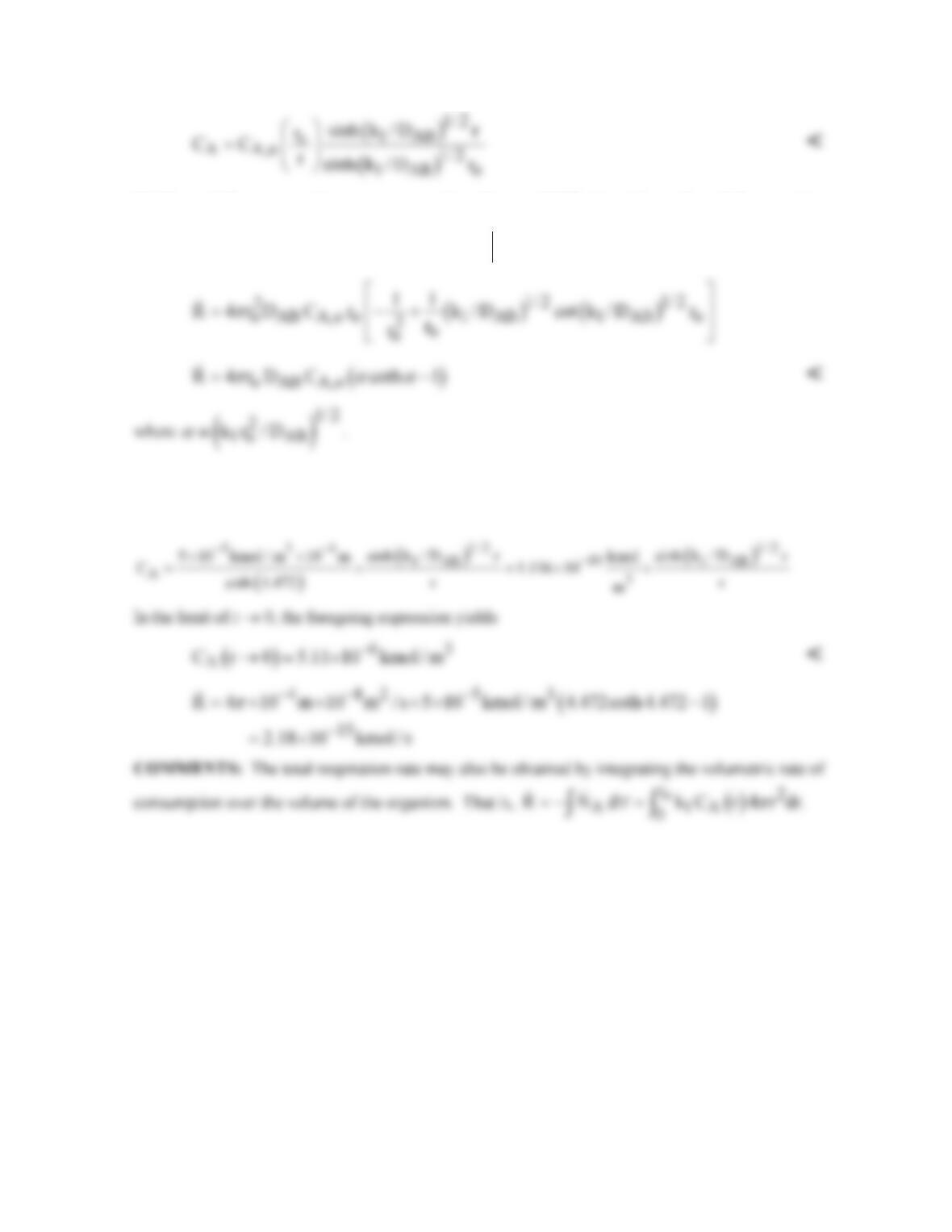
KNOWN: Radius of a spherical organism and molar concentration of oxygen at its surface.
Diffusion and reaction rate coefficients.
FIND: (a) Radial distribution of O2 concentration, (b) Expression for rate of O2 consumption, (c)
Molar concentration at r = 0 and rate of oxygen consumption for prescribed conditions.
SCHEMATIC:
r = 10 m
o-4
C (r ) =
C = 5×10 kmol/m
Ao
A,o -5 3
ASSUMPTIONS: (1) Steady-state, one-dimensional diffusion, (2) Stationary medium, (3) Uniform
ANALYSIS: (a) For the prescribed conditions and assumptions, Eq. (14.50) reduces to
2A
AB 1 A
2
1 d dC
D r kC 0
dr dr
r
−=
The general solution is of the form
PROBLEM 14.37 (Cont.)
(b) The total O2 consumption rate corresponds to the rate of diffusion at the surface of the organism.
( )
()
o
2
A o AB o A r
R N r D 4 r d C / dr
π
=−=+
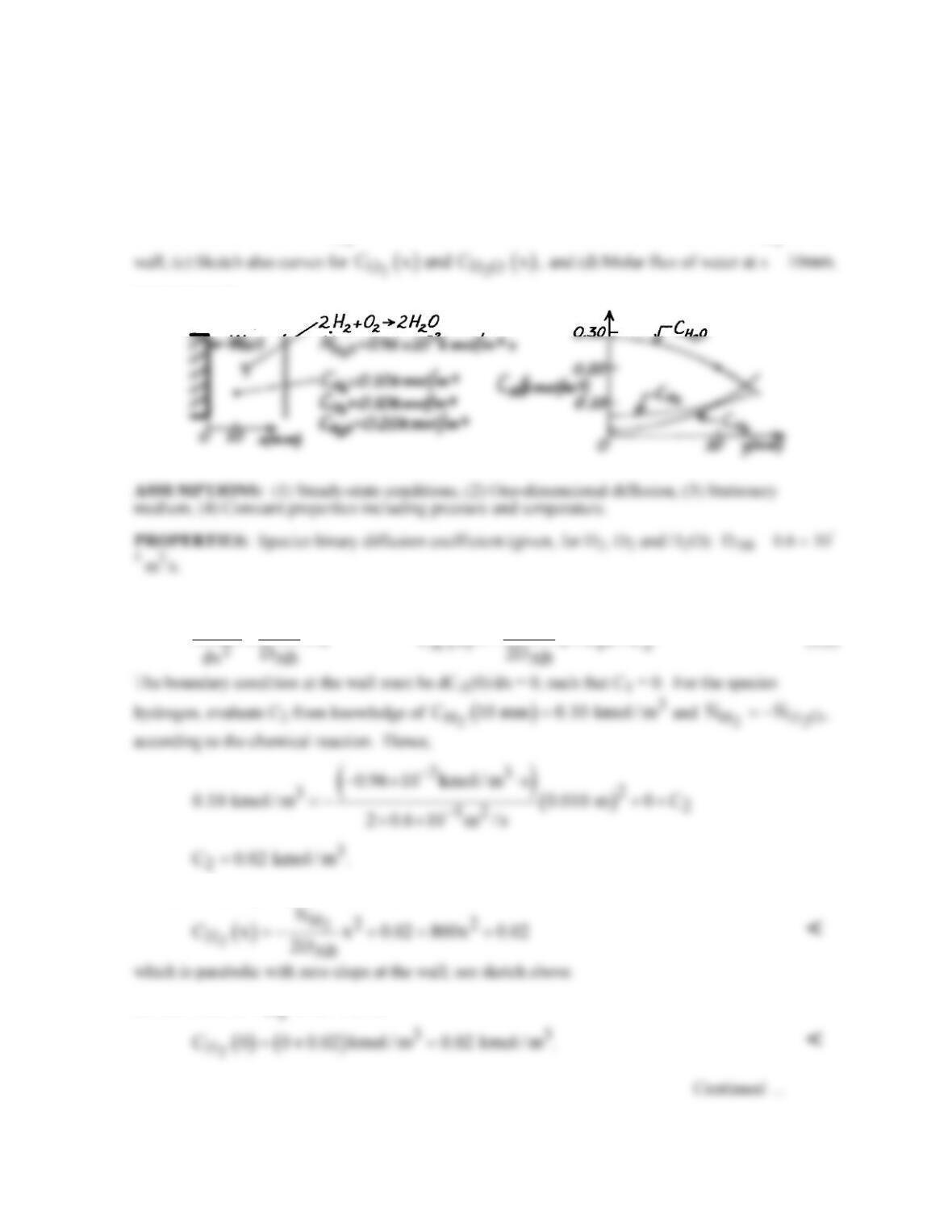
(c) For the prescribed conditions, (k1/DAB)1/2 = (20 s-1 ÷ 10-8 m2/s)1/2 = 44,720 m-1 and α = 4.472.
PROBLEM 14.38
KNOWN: Combustion at constant temperature and pressure of a hydrogen-oxygen mixture adjacent
to a metal wall according to the reaction 2H2 + O2 → 2H2O. Molar concentrations of hydrogen,
oxygen, and water vapor are 0.10, 0.10 and 0.20 kmol/m3, respectively. Generation rate of water
vapor is 0.96 × 10⁻² kmol/m3⋅s.
FIND: (a) Expression for
H
C
as function of distance from wall, plot qualitatively, (b)
H
C
at the
SCHEMATIC:
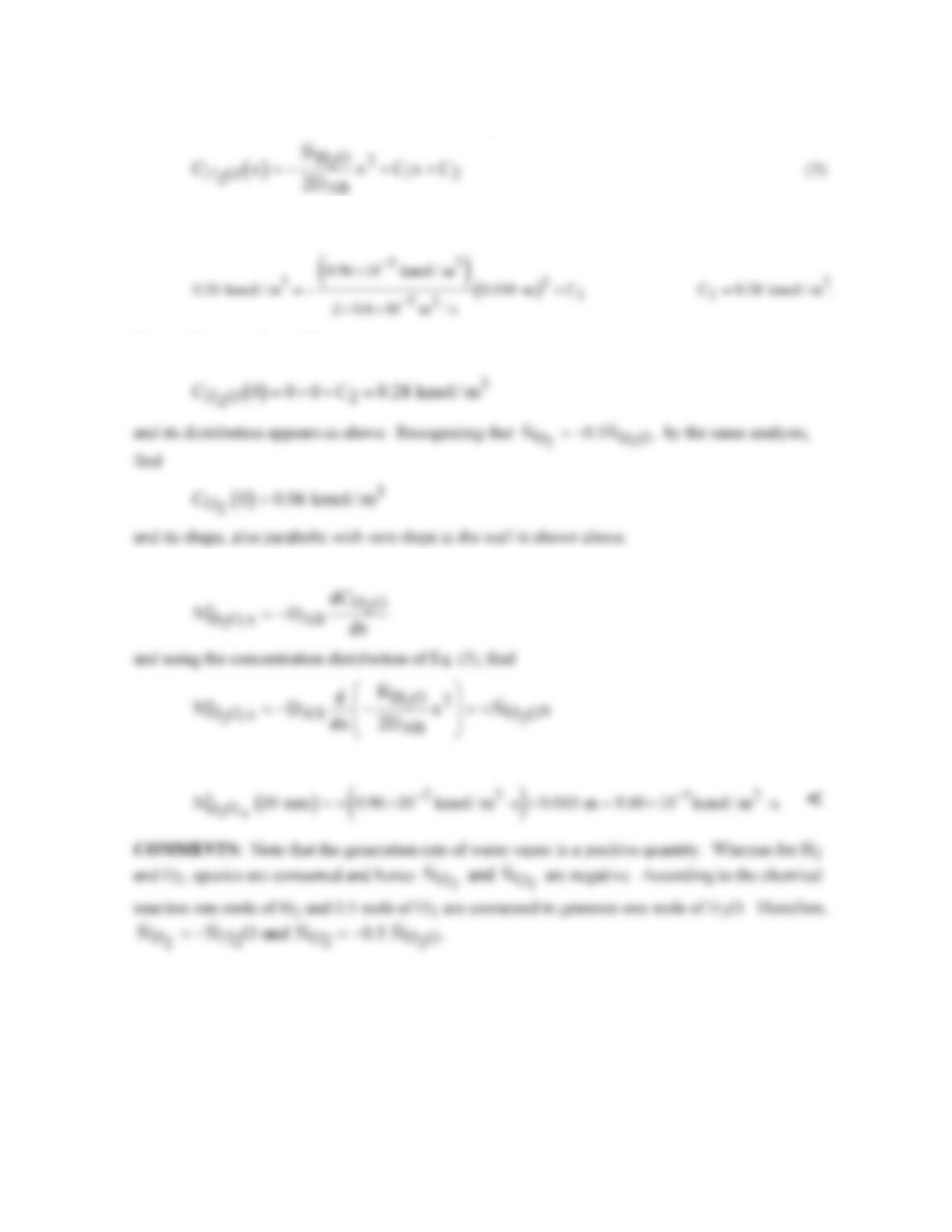
ANALYSIS: (a) The species conservation equation, Eq. 14.48b, and its general solution are
2AA A
dC N N
0 C x xCxC.
+ = =− ++
(1,2)
Hence, the hydrogen species concentration distribution is
(b) The value of
H
C
at the wall is,
PROBLEM 14.38 (Cont.)
(c) The concentration distribution for water vapor species will be of the same form,
With C1 = 0 for the wall condition, find C2 from
( )
2
HO
C 10 mm ,
Hence,
2
HO
C
at the wall is,
(d) The molar flux of water vapor at x = 10 mm is given by Fick’s law
and evaluation at the location x = 10 mm, the species flux is
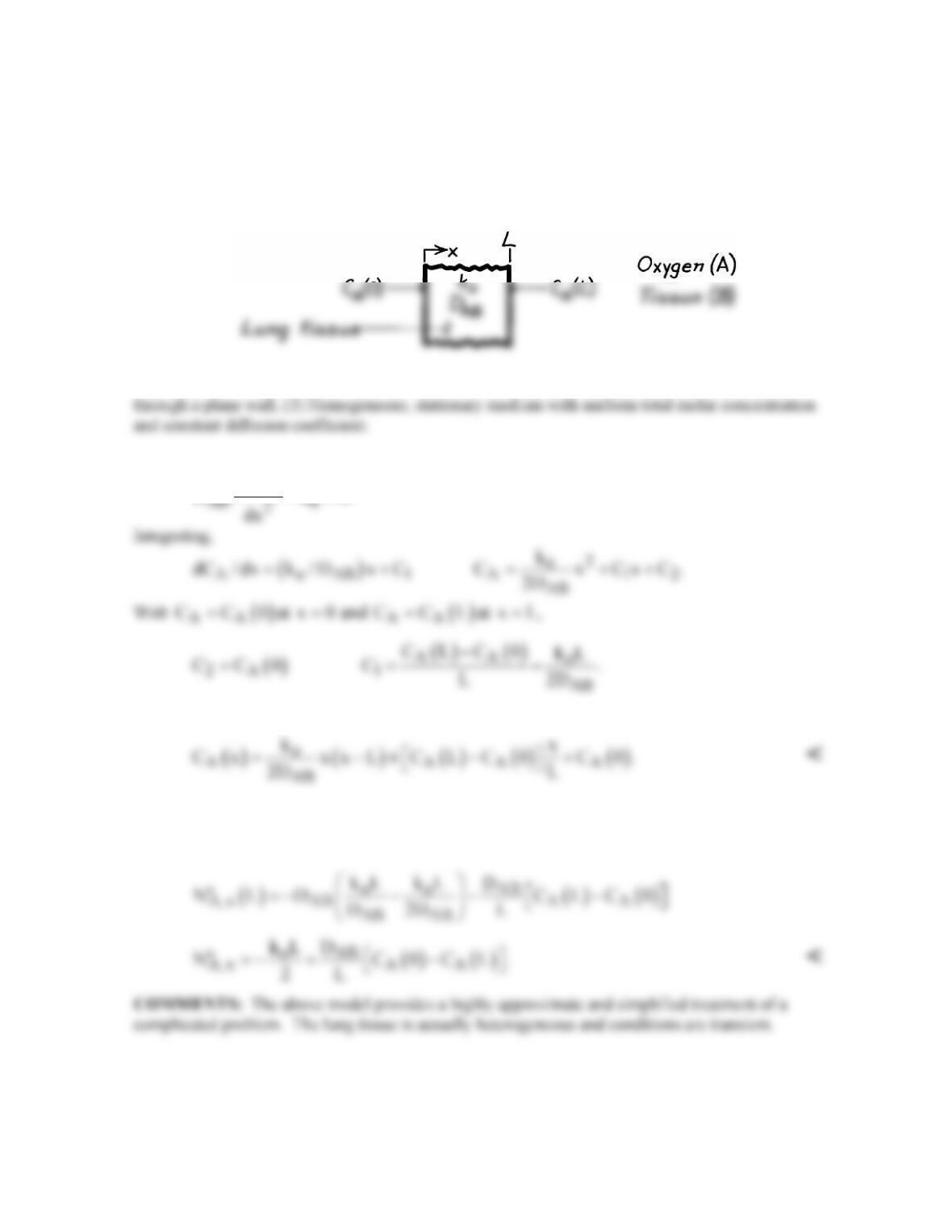
PROBLEM 14.39
KNOWN: Molar concentrations of oxygen at inner and outer surfaces of lung tissue. Volumetric
rate of oxygen consumption within the tissue.
FIND: (a) Variation of oxygen molar concentration with position in the tissue, (b) Rate of oxygen
transfer to the blood per unit tissue surface area.
SCHEMATIC:
ASSUMPTIONS: (1) Steady-state conditions, (2) One-dimensional species transfer by diffusion
ANALYSIS: (a) From Eq. 14.71 the appropriate form of the species diffusion equation is
2A
dC
D k 0.
−=
Hence
(b) The oxygen assimilation rate per unit area is
( ) ( )
A,x AB A xL
N L D dC / dx =
′′ = −
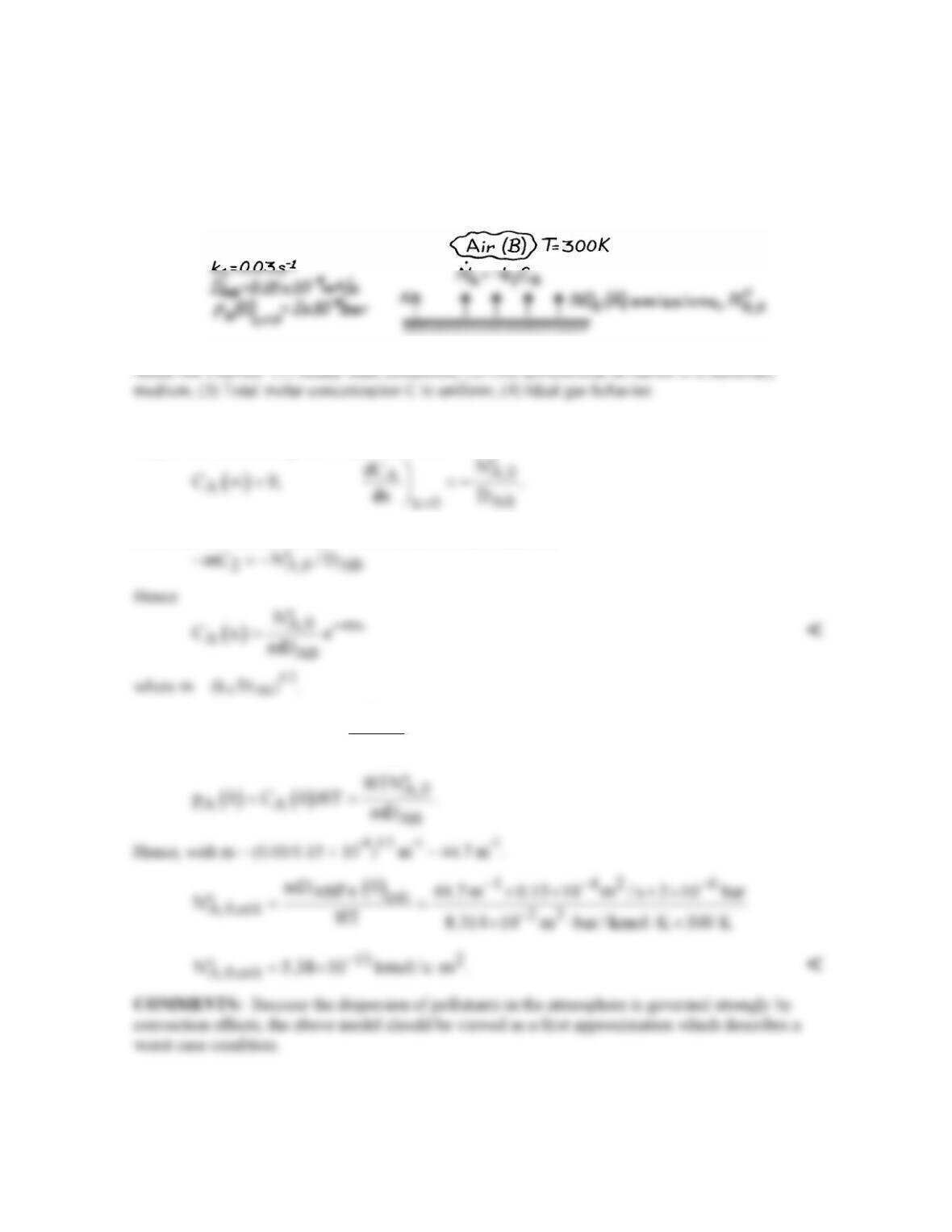
PROBLEM 14.40
KNOWN: Ground level flux of NO2 in a stagnant urban atmosphere.
FIND: (a) Vertical distribution of NO2 molar concentration, (b) Critical ground level flux of NO2,
A,0,crit
N.
′′
SCHEMATIC:
ANALYSIS: (a) For the prescribed conditions the molar concentration of NO2 is given by Eq. 14.73,
subject to the following boundary conditions.
From the first condition, C1 = 0. From the second condition,
(b) At ground level,
( )
A,0
AAB
N
C0 .
mD
′′
=
Hence, from the ideal gas law,
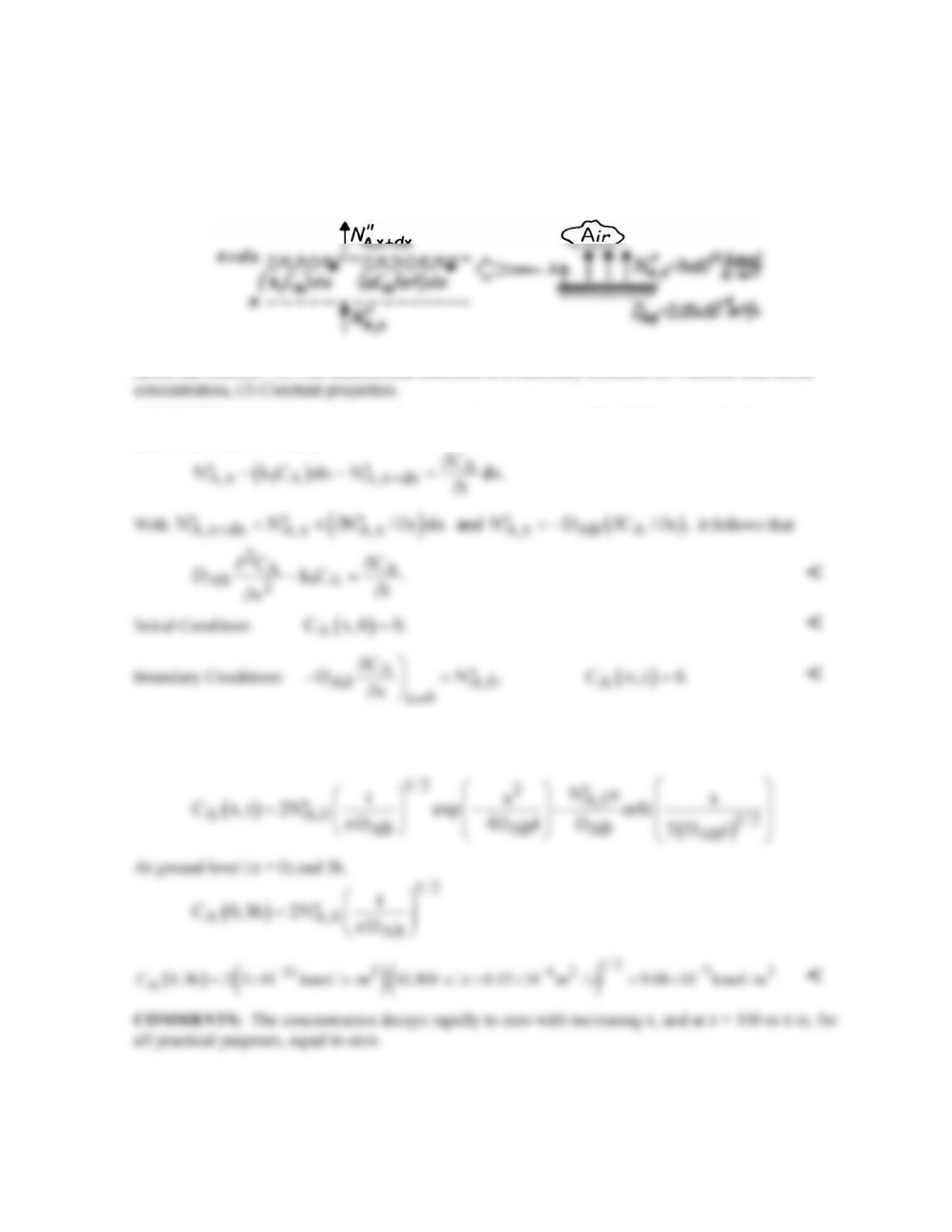
PROBLEM 14.41
KNOWN: Ground level flux of NO2 in a stagnant urban atmosphere.
FIND: (a) Governing differential equation and boundary conditions for the molar concentration of
NO2, (b) Concentration of NO2 at ground level three hours after the beginning of emissions.
SCHEMATIC:
ASSUMPTIONS: (1) One-dimensional diffusion in a stationary medium, (2) Uniform total molar
ANALYSIS: (a) Applying the species conservation requirement, Eq. 14.43, on a molar basis to a unit
area of the control volume,
(b) The present problem is analogous to Case (2) of Fig. 5.7 for heat conduction in a semi-infinite
medium. Hence by analogy to Eq. 5.62, with
AB AB
k D and D ,
α
↔↔
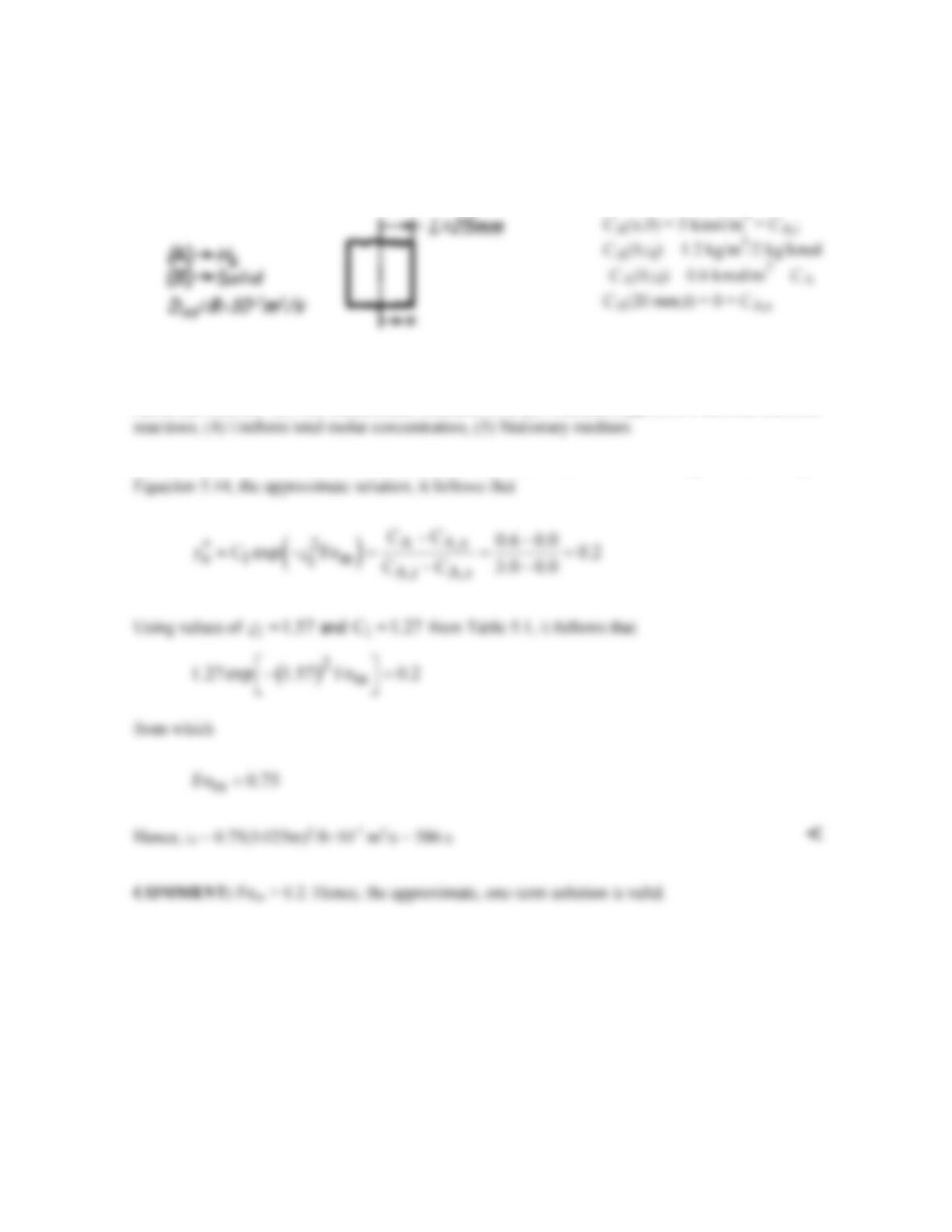
PROBLEM 14.42
KNOWN: Initial concentration of hydrogen in a sheet of prescribed thickness. Surface
concentrations for time t > 0.
FIND: Time required for density of hydrogen to reach prescribed value at midplane of sheet.
SCHEMATIC:
ASSUMPTIONS: (1) One-dimensional diffusion in x, (2) Constant DAB, (3) No internal chemical
ANALYSIS: The mass transfer Biot number is Bim = hmL/DAB →∞. Hence,
1
m
Bi−
= 0. By analogy to
PROBLEM 14.43
KNOWN: Radius and temperature of air bubble in water.
FIND: Time to reach 90% of saturated vapor concentration at center.
SCHEMATIC:
ASSUMPTIONS: (1) One-dimensional radial diffusion of vapor in air, (2) Constant properties, (3)
ANALYSIS: If the one-term approximation to the infinite series solution (Eq. 5.53),
PROBLEM 14.44
KNOWN: Radius and temperature of air bubble.
FIND: (a) Time to reach 95% of the maximum average water vapor concentration, (b) Time to reach
50% of the maximum average water vapor concentration.
SCHEMATIC:
ASSUMPTIONS: (1) One–dimensional radial diffusion of vapor in air, (2) Constant properties, (3)
ANALYSIS: (a) We may employ the one-term approximation to the infinite series solution (Eq.
5.55)
By analogy, the preceding equations may be written as
(b) The time associated with an average water vapor concentration of 50% is expected to be
Continued…
r
o
= 1 mm
r
o
= 1 mm
PROBLEM 14.44 (Cont.)
From Table 5.2a for Fo < 0.2,
2
1
* 1 ;
()
so
si o
qr t
q Fo
kT T Fo r
α
π
′′
= =−=
−
Substituting the expression for Fo into the first equation yields
We desire an expression for Q/Qo. Hence,
2
1/2
0
32
0
4
31
(4 / 3) ( )
t
os t
to
oo si o
t
r q dt
Qr
t dt
Qr cT T r
πα
πα
πr
−
=
=
′′
= = −
−
∫∫
Applying the analogy between heat and mass transfer,
from which Fom = 0.0305. Hence,
COMMENTS: (1) Use of the approximate solution of Section 5.8 is not valid for part (a) since its use
PROBLEM 14.45
KNOWN: Initial carbon content and prescribed surface content for heated steel.
FIND: Time required for carbon mole fraction to reach 0.01 at a distance of 1 mm from the surface.
SCHEMATIC:
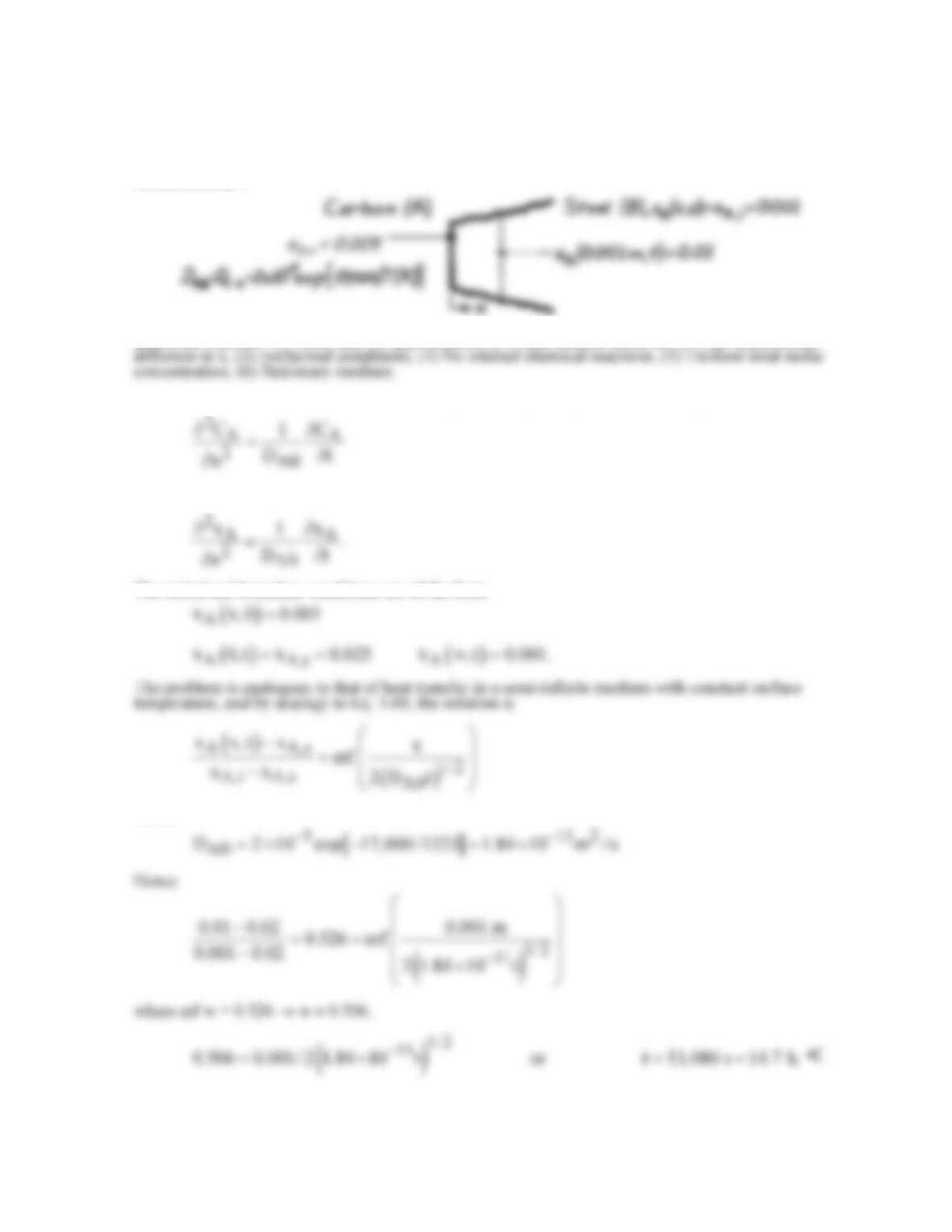
ASSUMPTIONS: (1) Steel may be approximated as a semi-infinite medium, (2) One-dimensional
ANALYSIS: Conditions within the steel are governed by the species diffusion equation of the form
or, in molar form,
The initial and boundary conditions are of the form
where